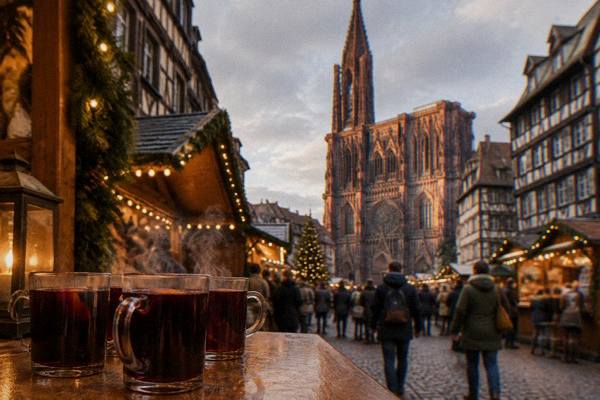
Are Christmas Markets Better In Day Or Night?
Day or night at the Strasbourg Christmas markets in Alsace, France: what daylight gives you, why the evening lights are the signature experience, and how to plan both in one visit.
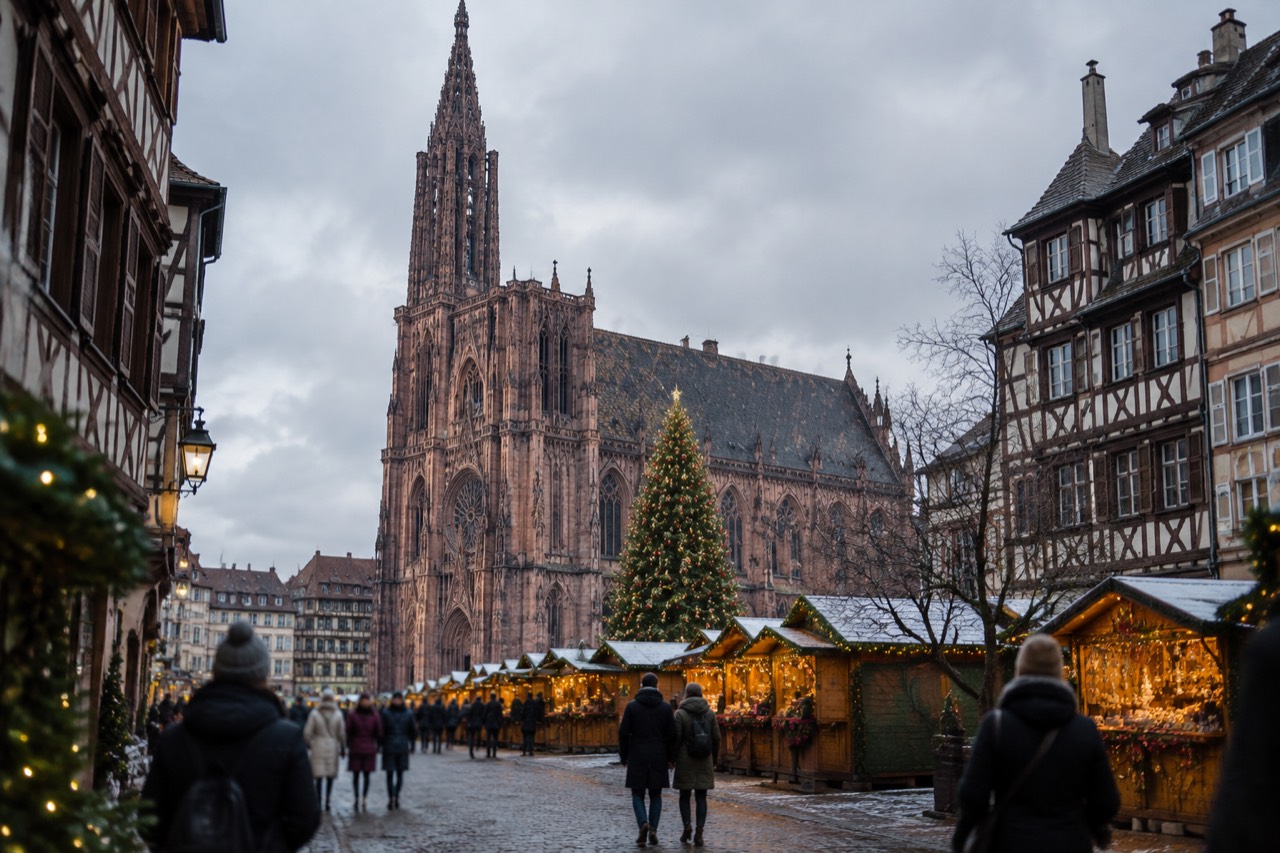
Strasbourg, in north-eastern France on the German border, runs its Christmas market from late November to 24 December, and the city changes character almost completely between mid-afternoon and nightfall. The question of whether the markets are better in day or night is not really a competition. It is a scheduling problem, and the answer depends on what you came for: photographs, shopping and space in the daylight hours, or the lantern-lit timber and spiced-wine atmosphere that made the event famous in the first place.
Are Christmas Markets Better In Day Or Night?
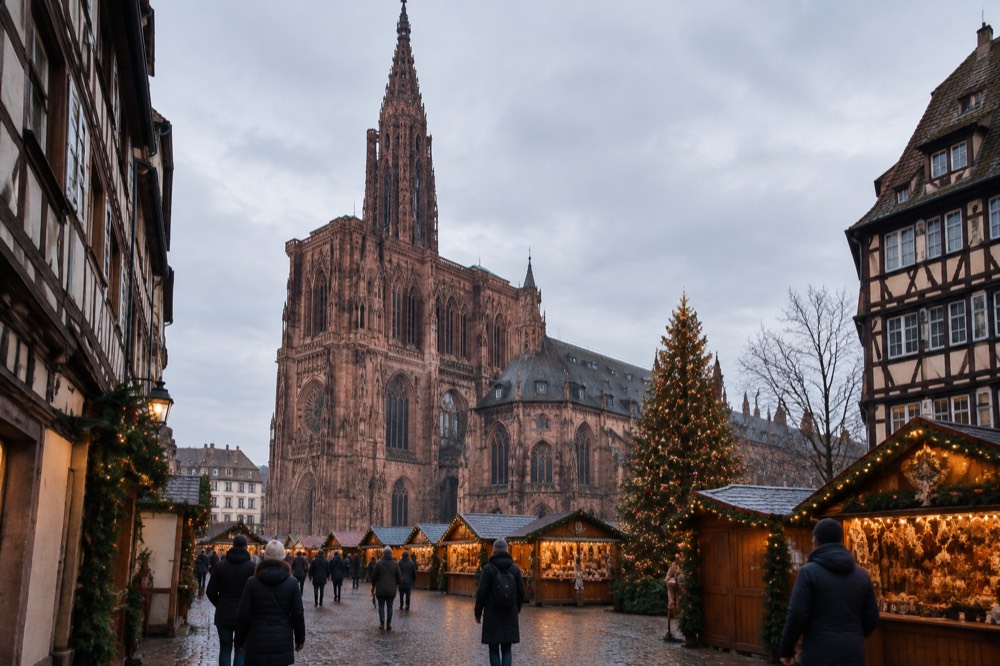
Both, but for different reasons, and the night side is the one Strasbourg is famous for. Daylight gives you half-timbered detail, easier photography, shorter queues at the chalets and a calmer browse for gifts. After dark, the lights on the Grande Île streets and around the cathedral create the atmosphere that draws millions of visitors each December. The practical answer is to arrive in the afternoon, see the market in daylight, stay through dusk and let the evening be the centrepiece.
The 2025 edition, which ran 26 November to 24 December, drew 3.05 million visitors according to the city's own press release, down from 3.4 million the year before. That scale is the single biggest factor in the day-versus-night decision. A market this busy compresses into a small historic centre, and the crowds build steadily from late afternoon into the evening. Anyone who has stood on Place Kléber at night in December knows the trade-off: the scene is at its most beautiful exactly when it is hardest to move through.
There is also a seasonal reality. Strasbourg has a semi-continental climate, and the Meteo-France 1991-2020 normals for Strasbourg-Entzheim put the mean December maximum at 5.9 C and the mean minimum at 0.8 C, with 10.2 days of rain of 1 mm or more in the month. Darkness falls early, cold settles in, and the difference between a 15:00 visit and a 19:00 visit is not just the light. It is also how long you can comfortably stand outside. Plan layers either way.
What Daylight Gives You At The Markets
Daylight is the practical half of the visit: the half where you buy, photograph and actually look at the city. In the morning and early afternoon the chalet queues are shorter, the half-timbered architecture of the Grande Île reads clearly rather than dissolving into a wash of lights, and the cathedral's pink sandstone is at its best in low winter sun. If shopping is the priority, daylight wins outright, because stock is full and sellers have time to talk.
The photographic argument for daylight is stronger than people expect. The market's signature images, the glowing chalets at night, are the ones everyone takes. The rarer pictures are the daytime ones: wreaths against clean façades, the decorations along the river in Petite France, the cathedral's single spire in sharp winter light. The city's World Heritage core, the Grande Île, was inscribed for its architecture, and architecture photographs in daylight.
Daylight is also when the practical errands happen. Handmade ornaments, Alsatian ceramics, food gifts and the smaller craft stalls reward a slow browse, and a slow browse is only possible before the evening rush. Chalets typically open late morning and run into the evening, so a late-morning start gives you the full range of stalls before the after-work crowd arrives. The cathedral helps here too: during the market season it stays open continuously Monday to Saturday on the Place du Château side, 08:30 to 17:45, so a daylight circuit can include the nave without re-planning the day.
| What you want | Better in day | Better at night | Why |
|---|---|---|---|
| Photographing half-timbered buildings | Yes | No | Detail and colour read clearly in daylight |
| Photographing lights and atmosphere | No | Yes | The lights are the subject after dark |
| Shopping for crafts and gifts | Yes | Partly | Shorter queues and fuller stock earlier in the day |
| Eating at a winstub | Either | Yes | Evening is the traditional time for a warm, seated meal |
| Avoiding the biggest crowds | Yes | No | Crowds build from late afternoon onward |
| Standing outside comfortably | Yes | Partly | December daylight hours are the warmest of the day |
The table's last row deserves a note: in December the daylight hours are also the warmer hours, with the mean maximum near 5.9 C and temperatures falling toward freezing after dusk. Families with small children and anyone sensitive to cold will simply last longer before nightfall. That is a legitimate reason to weight a visit toward the afternoon, then finish with a shorter evening walk rather than a full night out.
For travellers who want the market experience without managing the city logistics themselves, there is a guided option that covers the wider region. The Alsace Christmas markets day tour from Strasbourg pairs the city's event with the Christmas towns of the Alsace wine country, which is a different proposition from an evening in the Grande Île, and one that only really works as a daytime trip.
A final daylight advantage is pairing. The museums of Strasbourg, the Batorama river boats and the cathedral's astronomical clock show at 12:30 all sit inside the same walkable core as the markets, and they fill the daylight hours that the market itself does not need. The municipal museums are free on the first Sunday of every month, and the 1-day Pass Musées at 20 EUR covers them, which makes a daylight museum-and-market combination a genuinely efficient day. The wider Christmas markets of Alsace, beyond the city itself, also reward the daylight half of any trip.
Why The Night Experience Is The Famous One
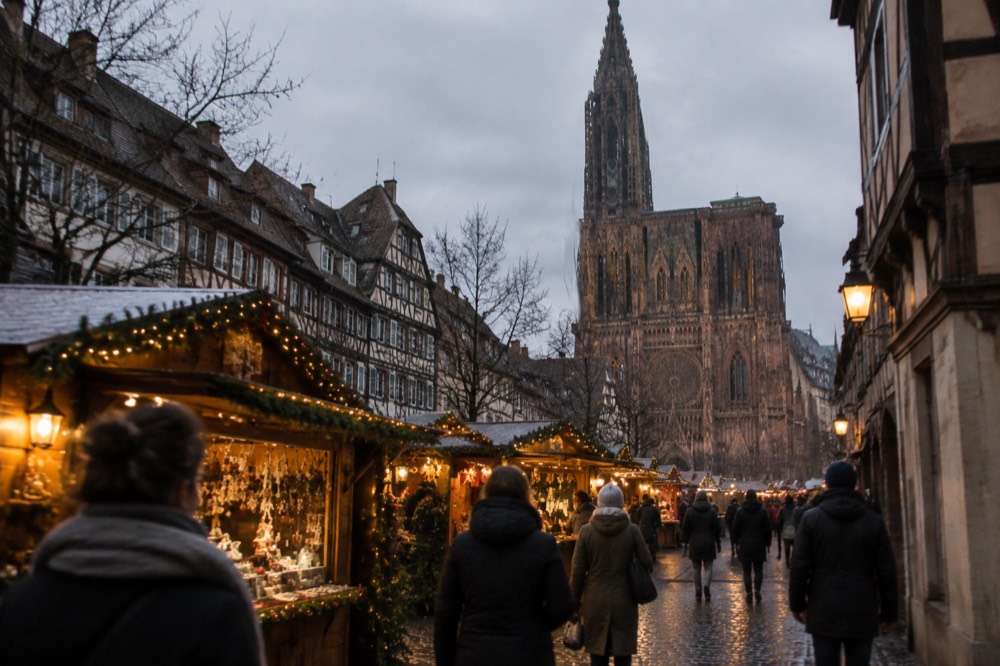
Night is the version of Strasbourg's Christmas market that travels: the Great Tree on Place Kléber, the light garlands strung across the old streets, and the chalet lanterns reflecting off wet cobblestones. The city's own branding as a Christmas capital is built on the evening scene, and the atmosphere between dusk and the late-evening close is unlike anything the daylight hours produce. If you can only pick one half of one day, pick the evening.
The lights are not decoration bolted onto a shopping event. They define how the historic core is read after dark. The narrow streets of the Grande Île, which in daylight are architecture, become corridors of light in which the market itself is only one element. The cathedral's façade, lit from below, dominates the Place de la Cathédrale in a way its daytime self does not. Dusk, roughly the hour when the daylight crowd thins and the lights come fully on, is the moment the market changes character, and it is worth being on a square, not in a queue, when it happens. The full index of guides sits on Strasbourg Travel Guide.
Food belongs to the evening too. The warm, seated, winstub side of Alsatian Christmas eating, the choucroute, the tarte flambée, the spiced wine, is an evening tradition, and the streets around the market fill with the smell of it after dark. A daylight visit can taste its way through the stalls, but the full experience of eating indoors while the cold crowd moves past outside is a night one. The 24 December close comes early in the evening, so the final evening of the season is shorter than the rest.
For visitors who want the evening scene explained rather than just walked through, a guided historic walk of the old town in the late afternoon slots neatly ahead of the lights. The historic walking tour with a local guide covers the core streets and stories, and it ends close to where the night market begins.
Prefer the evening lights with a guide at your side? Book a Christmas markets walking tour here.
The evening does have real costs, and honesty about them matters. Crowds on the main squares at night in December are dense, moving slowly, and hard on small children and anyone with limited mobility. Pickpocket pressure rises with density anywhere, and the standard precautions apply. The cold is a genuine constraint: after dark the temperature sits near the December mean minimum of 0.8 C, and the spiced wine is popular partly because it works. Build the evening in segments, with indoor stops, rather than as one long stand outdoors.
How To Split One Day Between The Two
The best single-day plan is an afternoon arrival, a daylight circuit of the squares and shopping, a seated dinner in a winstub as the lights come on, and a short night walk through the Grande Île to finish. That sequence captures both halves at their strongest without asking you to stand outside for six hours in December cold. Two evenings, one for the lights and one for the tree and cathedral square, beat one marathon night.
Start with the practical frame. Chalets typically open late morning and run into the evening, so the daylight window is generous. The market runs to 24 December, closing early that final evening, and the 2026 dates were still being finalised on the city's official Christmas site, so confirm them before booking travel. The pattern is stable in shape: late November opening, four weeks of trading, 24 December close.
| Time block | What to do | Why it works then |
|---|---|---|
| Late morning | Cathedral nave, astronomical clock at 12:30, craft stalls | Nave is open continuously Mon-Sat in market season, 08:30-17:45 |
| Early afternoon | Shopping circuit, Place Kléber and Petite France in daylight | Shorter queues, fuller stock, warmest hours |
| Late afternoon | Guided walk or museum, then a seated dinner | Dusk happens while you are indoors |
| After dusk | Lights circuit: cathedral square, riverside streets, Great Tree | The signature scene, with a warm meal behind you |
The 12:30 clock show deserves its line in the plan: tickets are 4 EUR, sold on the day only, at the cathedral stalls in the morning or from the Saint-Michel entrance from 11:30, so the daylight half of the day has a fixed anchor. From there the day flows downhill toward the lights. If the evening is the priority, protect it: book the winstub ahead, because December evenings fill the good rooms, and a table reservation converts the coldest hour of the night into an indoor one.
Travellers staying several days can go further and split the experiences across evenings. The question of how many days you need for the Christmas markets has its own answer, and it is more than one if the night side matters to you, because a first evening spent orienting is never the same as a second spent simply enjoying it. The wider itinerary options, including a full Christmas market itinerary built around the city, cover that planning in depth.
Not every December day in Strasbourg is about the markets. Rain falls on 10.2 days of the month on average, and the city has a full indoor playbook for the wet ones. And for visitors whose December trip has room for one sobering contrast, the former Natzweiler-Struthof camp in the Vosges mountains is reachable on a guided half-day excursion, a very different kind of memory to carry home from the same region.
What To Check Before You Commit To An Evening
Three things decide whether your evening works: the official 2026 dates, the weather forecast for the specific night, and a dinner reservation. The dates are published on the city's Christmas site and were still being finalised for 2026, so treat any secondary source's dates as provisional. The forecast matters more than the averages, and the reservation matters because every warm indoor room near the market fills up in December.
On dates: the 2025 edition ran 26 November to 24 December, and the usual pattern is an opening in the last week of November with an early evening close on 24 December. The city's Christmas site is the place to confirm the 2026 programme, including any changes to square layouts or the guest programme, before you lock in hotels or trains. Anyone planning around the market's dates should also read the dedicated answer on the Strasbourg Christmas market dates, which tracks the same question in detail.
On weather: the December normals, a mean maximum of 5.9 C, a mean minimum of 0.8 C and 45.2 mm of rain across the month, describe the climate, not your evening. A dry, still night near 0 C with the lights on is one of the best evenings France offers in winter. A wet, windy one at the same temperature is miserable, and the difference between them is a forecast check, not a season. Build the evening plan so it can shrink to a shorter walk without collapsing.
On logistics: the city's transport is cheap and simple, with a CTS 24h Solo pass at 4.60 EUR covering a day of trams and buses, and the airport shuttle combined ticket at 4.60 EUR including the 8-minute train from Entzheim. An evening that ends with a short tram ride back to a warm hotel beats one that ends with a long cold walk, and the pass removes the last friction from that decision. For the wider question of whether the trip justifies itself, the honest assessment of whether the Strasbourg Christmas market is worth it is a separate answer worth reading.
If the plan is to base yourself in the city and let the evenings carry the trip, the choice between Strasbourg and Colmar for a Christmas stay has its own answer, and the two cities split the daylight and night experiences differently. Wherever you sleep, the same rule holds: daylight to look, night to feel.
Common Questions About Christmas Markets In Strasbourg
Are Christmas markets better in day or night?
Both halves have a job. Daylight is for photography, shopping and the cathedral; night is for the lights and atmosphere that made Strasbourg's market famous. Arrive in the afternoon, stay through dusk and let the evening be the centrepiece.
What time do the Strasbourg Christmas market chalets open?
Chalets typically open late morning and run into the evening throughout the season. The exact hours for the coming edition are published on the city's official Christmas site alongside the dates.
When does the Strasbourg Christmas market end each day?
The market trades into the evening, with the final day, 24 December, closing early. The 2025 edition ran 26 November to 24 December, and the 2026 dates were still being finalised on the official site.
Is the Strasbourg Christmas market crowded at night?
Yes, the main squares are dense from late afternoon onward, and the evening is when the market is both at its most beautiful and hardest to move through. Splitting the evening into segments with indoor stops makes it far more comfortable.
How cold is Strasbourg at night in December?
The Meteo-France 1991-2020 normals give a December mean minimum of 0.8 C and a mean maximum of 5.9 C, so evenings sit near freezing. Proper layers and warm indoor stops are part of the plan, not an afterthought.
Can you see the Strasbourg Christmas market and the cathedral on the same day?
Yes, easily. During the market season the cathedral nave is open continuously Monday to Saturday on the Place du Château side, 08:30 to 17:45, so a daylight cathedral visit flows straight into an evening at the market.
The short version stands: daylight is the practical half of the Strasbourg Christmas market, night is the famous half, and one December day in the Grande Île is enough to have both if you let dusk, dinner and the lights do the dividing for you.