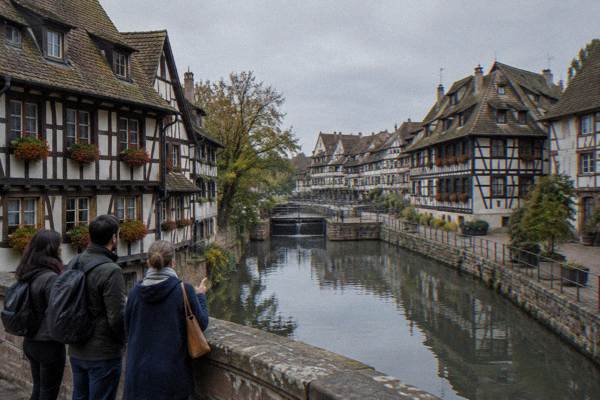
Petite France Strasbourg
Petite France is the half-timbered canal quarter on the western tip of Strasbourg's Grande Île, a UNESCO-listed river island in Alsace, north-eastern France. This guide covers what to see, how to get there, tour options and the practical details that shape a visit.
Short answer
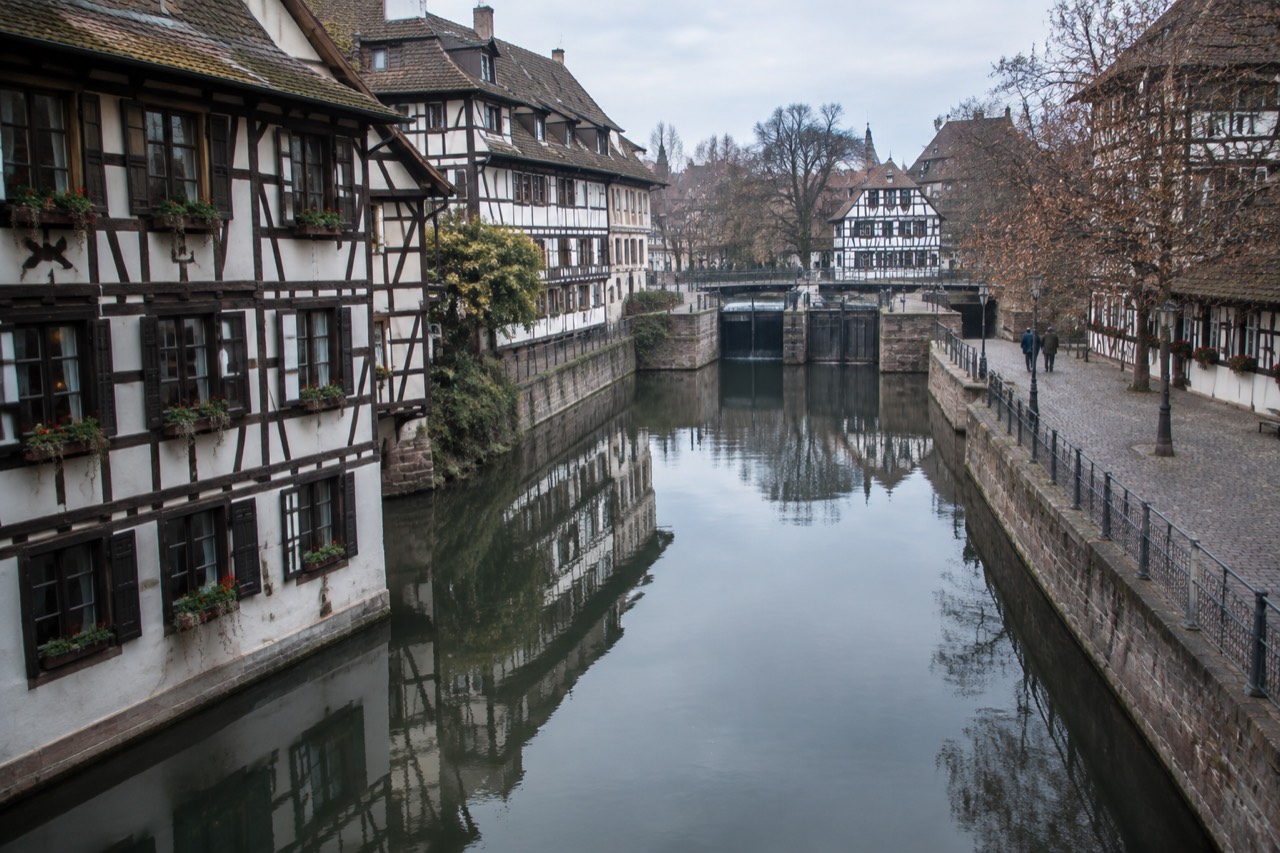
Petite France is the former tanners' and millers' quarter at the western end of the Grande Île, Strasbourg's UNESCO World Heritage river island, where the River Ill splits into canals past half-timbered houses, weirs and the Ponts Couverts. It is a public quarter, open at all hours, reached on foot or by tram from the city centre, and its signature viewpoints are the Barrage Vauban terrace and the Covered Bridges.
Petite France is the pocket of half-timbered houses and quiet canals at the western tip of the Grande Île, the river island that forms the historic heart of Strasbourg, in Alsace, north-eastern France. The River Ill, which flows past the city before joining the Rhine on the German border, splits into several channels here, and the quarter's weirs, footbridges and waterfront façades have made it the image of Strasbourg on postcards, Christmas cards and travel features for generations. The whole island, together with the Neustadt district across the water, is inscribed as "Strasbourg, Grande-Île and Neustadt" on the UNESCO World Heritage List, and Petite France is the part of it that visitors photograph first.
This guide from the Strasbourg Travel Guide editorial desk covers what Petite France actually is, how to reach it, what to see once you are there, which tours pair well with it, and the practical details, from terrace opening hours to tram fares, that shape a visit.
What Is Petite France In Strasbourg?
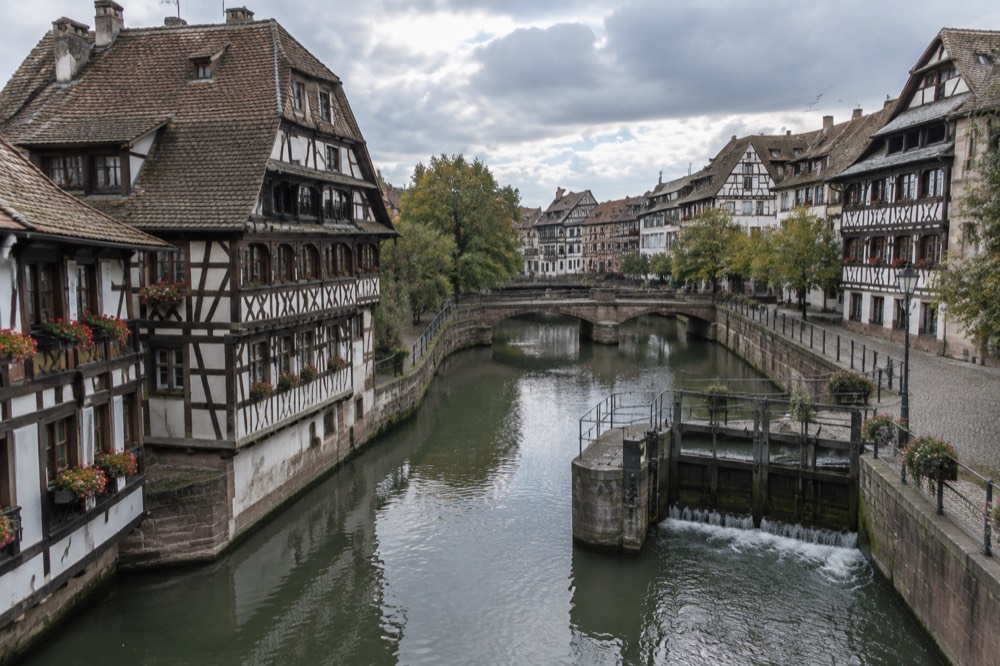
Petite France is the canal-laced quarter of half-timbered houses at the western end of Strasbourg's Grande Île, where the River Ill divides around weirs and former watermills before passing the Ponts Couverts. It is a public neighbourhood of the UNESCO World Heritage property "Strasbourg, Grande-Île and Neustadt", open at all hours with no ticket and no gate, and its streets, footbridges and waterfront terraces are what give Strasbourg its most photographed face.
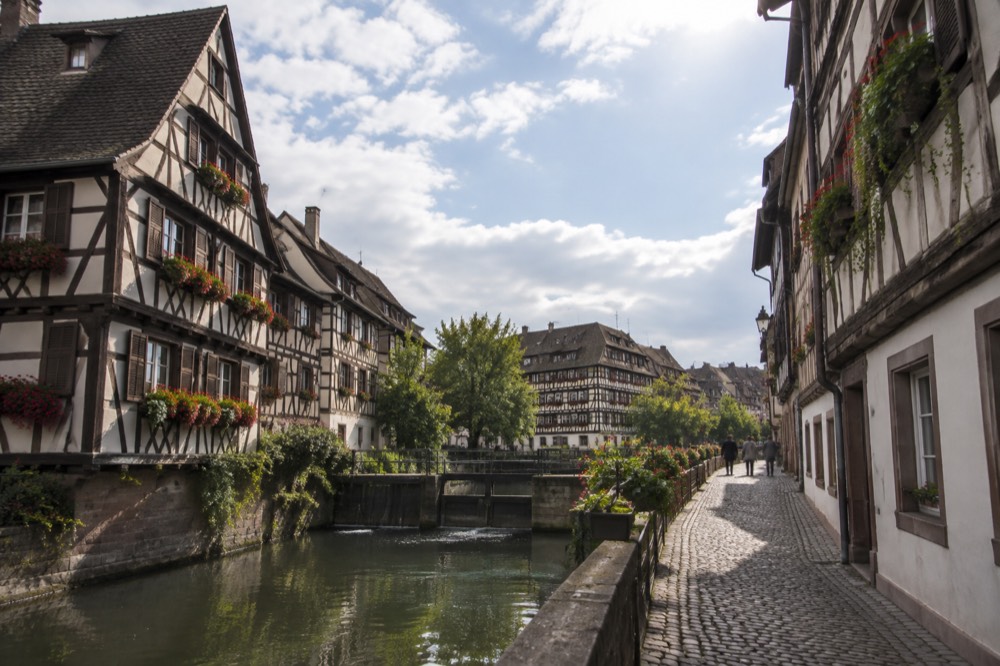
The quarter sits at the point where the Ill, having run down from the Vosges through the Alsatian plain, breaks into several arms on its way around the island. That splitting of the river is the reason the quarter exists at all: flowing water powered the mills and washed the hides of the artisans whose workshops once lined these channels, and the half-timbered houses that survive today are the domestic architecture of that working riverfront rather than a purpose-built scenic set. The weirs are still there, still working, and the sound of water running over them is constant through the lanes.
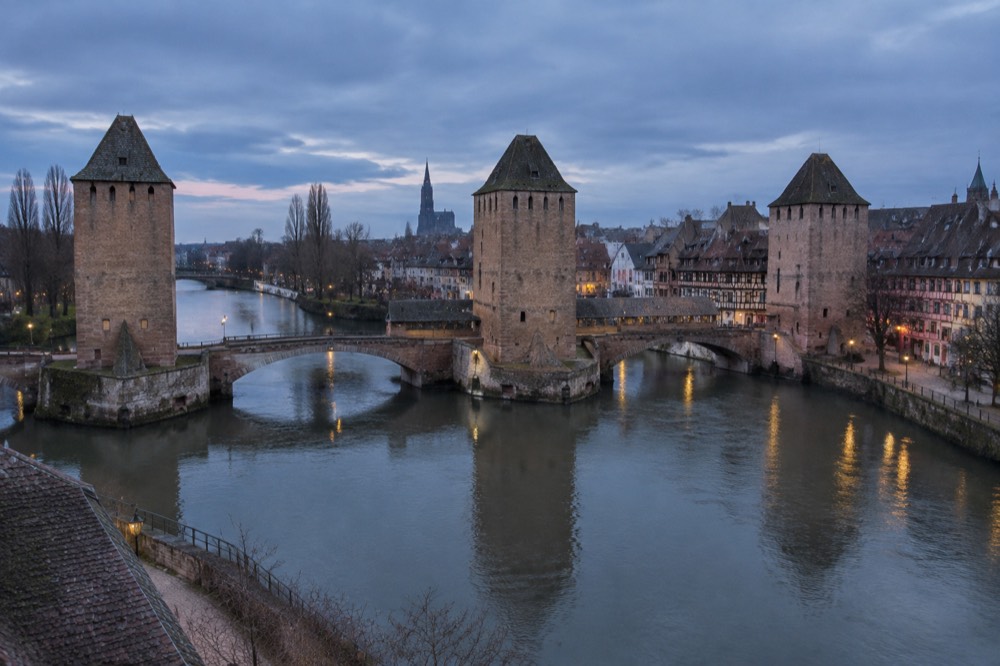
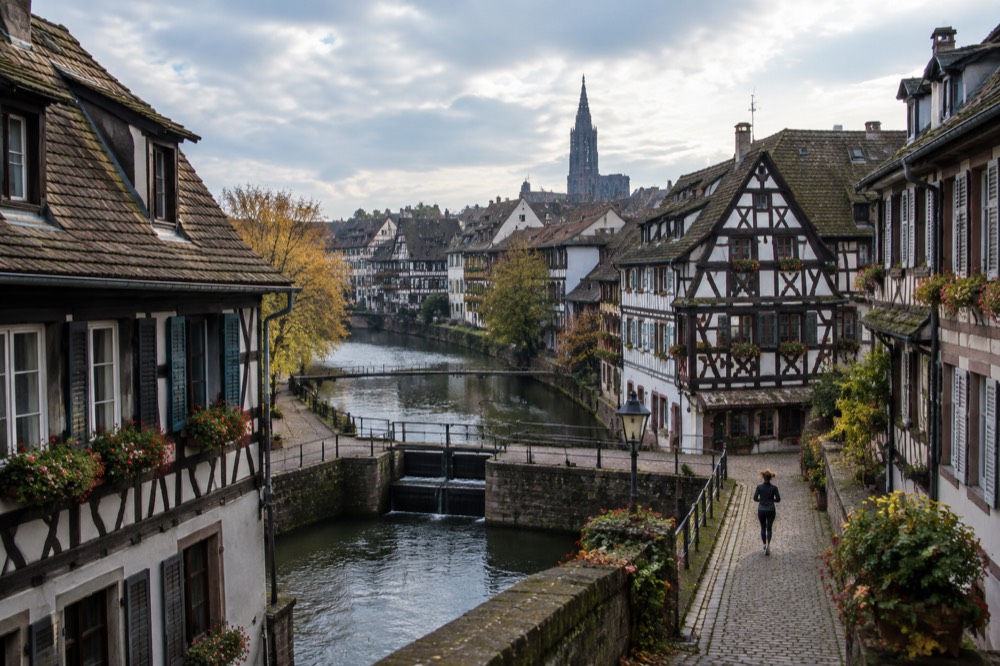
What visitors find now is a small, walkable mesh of streets and quays. The Rue des Moulins and the Quai de la Petite France follow the water; the Place Benjamin-Zix is the little square at the heart of it; and the whole thing is crossed on foot in a relaxed wander rather than a march. The quarter's edges are its landmarks: the Ponts Couverts, the three stone towers and their covered bridge spans at the western outlet, and the Barrage Vauban, the fortified weir whose rooftop terrace gives the single best view over the rooftops toward Strasbourg Cathedral.
A quick orientation table before the detail:
| Question | The short answer |
|---|---|
| What is it? | A former riverside artisan quarter of half-timbered houses on the Grande Île, part of a UNESCO World Heritage property |
| Where exactly? | Western tip of the Grande Île, Strasbourg, Bas-Rhin, Alsace, north-eastern France |
| Is there a ticket? | No, the streets, quays and bridges are public space, open at all hours |
| Signature view | The Barrage Vauban rooftop terrace, looking east over the quarter to the cathedral |
| Nearest landmarks | Ponts Couverts and Barrage Vauban at the western edge; the cathedral across the island |
| River | The Ill, splitting into canals through the quarter before joining the Rhine |
One honest caveat belongs here. Petite France is beautiful, and it is not a secret. On fine weekends, and continuously during the Christmas market season, the lanes are full, and the calm of the photographs takes some finding. Early morning is the quiet window; midday in December is the opposite. Nothing about the quarter itself changes between the two, but the experience of it changes a great deal.
Where Is Petite France And How Do You Get There?
Petite France lies on the Grande Île, the historic island centre of Strasbourg, at its western end beside the Ponts Couverts and the Barrage Vauban. From Strasbourg's main station it is a straightforward tram ride on the city's CTS network, with a single ticket at 1.90 EUR bought via the app or contactless, or 2.50 EUR bought on board the bus; from the cathedral it is a walk across the island with no transport needed.
The city's transport operator, CTS, runs the trams and buses. The fare structure that matters to a visitor is simple and published on CTS's own fare pages: a single ticket costs 1.90 EUR when bought through the Badgéo card, the CTS app or contactless payment, and 2.50 EUR when bought from the driver on board a bus. A 24-hour Solo pass covering one traveller is 4.60 EUR, and a 24-hour Trio pass covering two to three people travelling together is 10.20 EUR. For a day spent hopping between the Grande Île, the Neustadt and the European Quarter, the 24-hour passes usually beat buying singles, but the arithmetic is the traveller's own to do against their plans.
| CTS ticket | Price | What it covers |
|---|---|---|
| Single (app, Badgéo, contactless) | 1.90 EUR | One journey on tram or bus |
| Single (bought on board a bus) | 2.50 EUR | One journey, driver purchase |
| 24H Solo | 4.60 EUR | One person, unlimited rides for 24 hours |
| 24H Trio | 10.20 EUR | Two to three people travelling together, 24 hours |
| Airport combined ticket | 4.60 EUR | Train from Entzheim airport plus CTS travel, details on the airport's shuttle page |
Trams stop within a short walk of the quarter on the island's edges, and the station-to-quarter journey needs no planning beyond checking which lines serve the stops nearest the Ponts Couverts on the day you travel. Visitors arriving from Entzheim airport should note the combined ticket above, which the airport's own access page describes: a shuttle train runs between the airport and Strasbourg's station, and the combined fare covers the CTS leg at the other end.
For visitors with mobility needs, the flat island centre is one of the more manageable historic environments in France, though the quarter's cobbles and footbridges are uneven in places, and the Barrage Vauban terrace is reached by stairs and a slope. Travellers planning around accessibility will find the details in the city's accessibility pages; do not assume the terrace is step-free without checking.
Getting around the quarter itself is a matter of feet. Petite France rewards the slow approach: the views that define it, the reflections in the canals, the weirs under the Ponts Couverts, are all visible from the quays and footbridges, and there is no route through the quarter that misses them. Visitors who prefer a loop with commentary rather than a self-guided wander can pair the quarter with the rest of the island on a guided segway or bike circuit, which covers the riverfront and the Grande Île in one ride; the guided segway tour on the roster is a popular way to do exactly that, and its dates and prices are on the operator's live listing.
What Are The Best Things To See In Petite France?
The essential sights of Petite France are the Ponts Couverts with their three stone towers, the Barrage Vauban and its rooftop panoramic terrace, the weirs and canals of the River Ill, the half-timbered houses along the Quai de la Petite France, and the Place Benjamin-Zix at the quarter's heart. The Barrage Vauban terrace is the one viewpoint that changes how you see the whole island, and it has seasonal hours worth checking before you climb.
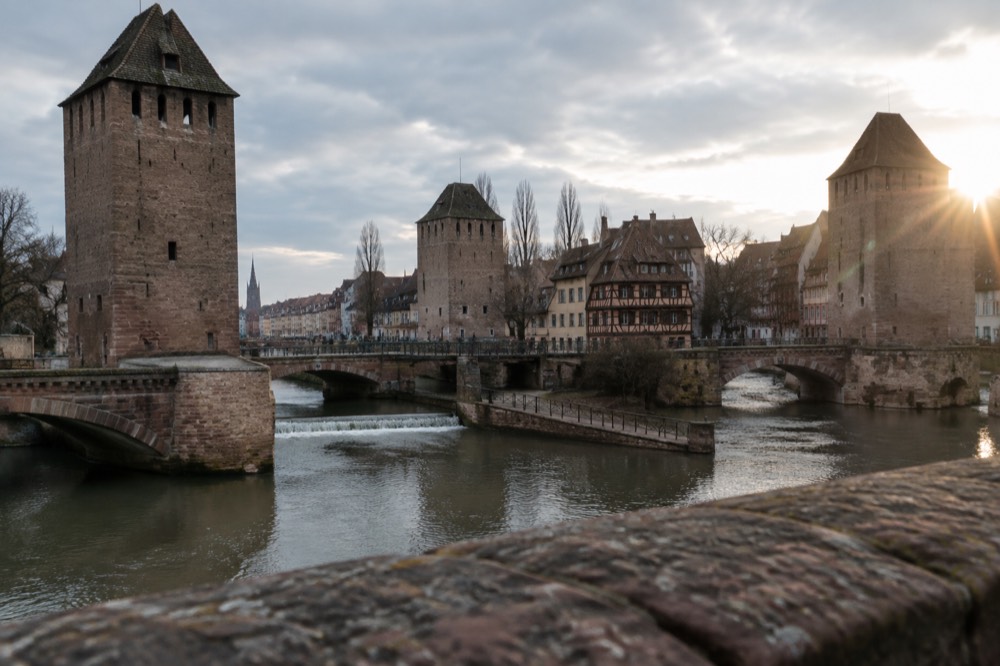
The Ponts Couverts come first for anyone walking in from the west. These are the covered bridge spans and the three stone towers that once guarded the western entrance to the city, standing where the Ill's channels leave the island. The bridges no longer carry the defensive roof that gave them their name in its original form, but the towers and the stone spans are intact, and the view from the footbridge, up the canals into the quarter, is the classic first impression of Petite France. The Ponts Couverts have their own page on this site with more detail on the towers and the crossing.
The Barrage Vauban stands beside them, a long fortified weir built to control the river and, in its original military logic, to flood the land south of the city if attacked. Today its rooftop terrace is a public viewing platform over the entire western island: the tiled roofs of Petite France in the foreground, the spire of the cathedral rising beyond, and the Ponts Couverts below. The terrace has seasonal opening hours published by the city, and they are worth having in mind before you plan the climb.
| Barrage Vauban terrace | Opening hours |
|---|---|
| March and April | 08:00-19:00 |
| September and October | 08:00-19:00 |
| November to February | 08:30-16:00 |
| Admission | Check the official page before visiting |
Inside the quarter, the walks are short and the details are the point. The half-timbered houses along the Quai de la Petite France lean over the water at angles that centuries of river damp have settled them into; the weirs beneath the Ponts Couverts churn steadily; the Rue des Moulins keeps the memory of the mills in its name. None of this needs a ticket or a schedule. The quarter is simply there, and the way to see it is to walk its edges and then cut through its middle.
Beyond the quarter's own sights, the rest of the Grande Île is a walk away across the island. The cathedral, with its single spire and its platform at 66 m, dominates the island from the east; the astronomical clock inside performs its automaton show daily at 12:30 sharp, with tickets at 4 EUR bought on the day only. The Palais Rohan and its museums, the Maison Kammerzell beside the cathedral, and the Place Kléber all sit on the same compact island, which is why the Grande Île rewards a full day rather than a rushed hour.
A river view is the other way to see the quarter. Batorama, the city's official sightseeing boat operator, runs circuits from the quays that pass through the canals around Petite France, and its two standard tours have published prices and durations.
| Batorama tour | Duration | Full price | Reduced price |
|---|---|---|---|
| Long tour (Red Tour circuit) | 1h10 | 16.20 EUR | 8.90 EUR |
| Short tour (Blue Tour circuit) | 0h45 | 12.50 EUR | 7.20 EUR |
The boat and the terrace make a natural pairing: one shows you the quarter from the water, the other shows you the water and the quarter together from above. Between them they account for the two views of Petite France that people remember.
When Is The Best Time To Visit Petite France?
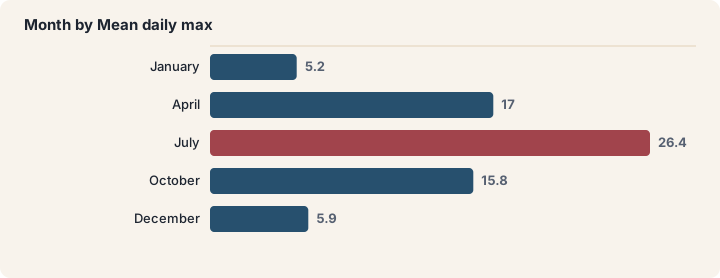
The best time to visit Petite France is early morning in the warmer half of the year, when the quarter is quiet and the light is on the water, or the Christmas market season from late November to 24 December, when the whole island is at its most atmospheric and its most crowded. Strasbourg has a semi-continental climate, with mean daily maxima from 5.2 C in January to 26.4 C in July, so the seasons genuinely differ.
The climate figures are worth taking seriously because they shape the visit more than in milder French cities. Meteo-France's 1991-2020 normals for Strasbourg-Entzheim put the mean daily maximum at 5.2 C in January and 26.4 C in July, with mean minima of -0.2 C and 14.9 C respectively. Rain falls on 9.1 days of at least 1 mm in January and 10.4 in July; the year totals 635.7 mm across 112.3 such days. In practice that means cold, grey winters with occasional snow on the rooftops, warm summers, and a real chance of rain in any month.
| Month | Mean daily max | Mean daily min | Rain days (1 mm or more) |
|---|---|---|---|
| January | 5.2 C | -0.2 C | 9.1 |
| April | 17.0 C | 5.7 C | 8.6 |
| July | 26.4 C | 14.9 C | 10.4 |
| October | 15.8 C | 7.2 C | 9.6 |
| December | 5.9 C | 0.8 C | 10.2 |
The Christmas period deserves its own planning note. Strasbourg's Christmas market, the city's signature winter event, opens in the last week of November and runs until 24 December, closing early in the evening on the final day; the 2025 edition ran from 26 November to 24 December and drew 3.05 million visitors according to the city's own bilan. The city posts each edition's dates on its Christmas site, so confirm them there before booking anything. During those weeks Petite France is at its busiest and, for many visitors, at its best: the half-timbered façades carry their winter dress, and the quarter sits within walking distance of the market squares across the island. Visitors weighing the season can read more in our Strasbourg Christmas market itinerary.
Outside the market season, the shoulder months are the quiet compromise. Spring brings the plane trees on the quays into leaf; autumn colours the island's trees and thins the crowds after the summer peak. The terrace hours above matter here too: the Barrage Vauban's rooftop keeps evening hours in the warmer months and closes at 16:00 through the winter half of the year, which is the difference between a sunset view and a mid-afternoon one.
What Tours Work Well Around Petite France?
The tours that pair best with Petite France are the guided walking tours of the historic centre, which pass through the quarter on their island routes; the segway and bike tours, which cover the riverfront and the Grande Île in a single loop; and the food and wine walks, which use the quarter's winstubs and the wider city's tables as their stops. All of them are bookable products whose prices, ratings and durations are shown on the operator's live listing rather than quoted here.
Walking tours are the natural fit, because Petite France is a walking place. Several English-language walks on the roster route through the historic centre and the quarter with a local guide; the Petite France historic-centre walk with a local guide is built around exactly this part of the island, and the general walk with a local guide covers the quarter alongside the cathedral and the wider Grande Île. There are also free, pay-what-you-want English walks running through GuruWalk, including a historian-led walk of the historic centre: these carry no fixed price and no fixed duration printed anywhere but the listing itself, and the convention is simply to tip the guide at the end.
Preferring a guide for the quarter's lanes. Book a free walking tour here.
For visitors who would rather cover ground than stand still, the wheeled options are strong. The segway tours of the city, including the guided circuit featured on this page, roll along the Ill's quays and through the island's edges, giving the riverfront a longer share of the ride than a walking tour can afford. The bike tours do the same with more distance covered; the two-and-a-half-hour bike tour with a local guide is the roster's longer cycling option, and the bike tour with bikes included suits riders who want the machine provided. Both formats suit travellers with limited time who want the cathedral, Petite France and the European Quarter explained in one loop rather than researched separately.
The food walks are the third family, and they belong on this page because Petite France's winstubs are among their stops. Strasbourg's traditional Alsatian taverns serve tarte flambée, choucroute and riesling by the glass, and the guided gourmet walks route through the city's tables with tastings built in. The gourmet walk with tastings is the roster's standard option, and the traditional food walk runs longer with more stops. Both are covered in more depth on our Strasbourg food tour page.
One honest comparison for the undecided: the walking tours go deepest into the quarter's lanes, the segway and bike tours cover the most ground per hour, and the food tours trade breadth for tables. None of them requires the others. A visitor with one full day can take a morning walk, an afternoon boat or terrace, and an evening winstub without any tour at all, and have seen the quarter properly.
Where To Eat And Stay Near Petite France?
The eating near Petite France is winstub country: traditional Alsatian taverns serving tarte flambée, choucroute and baeckeoffe with local riesling and beer, mixed with modern bistros along the quays. Staying in or beside the quarter puts the visitor on the island itself, within a walk of the cathedral and the market squares, and the choice between Petite France, the wider Grande Île and the station district is a trade between atmosphere and price.
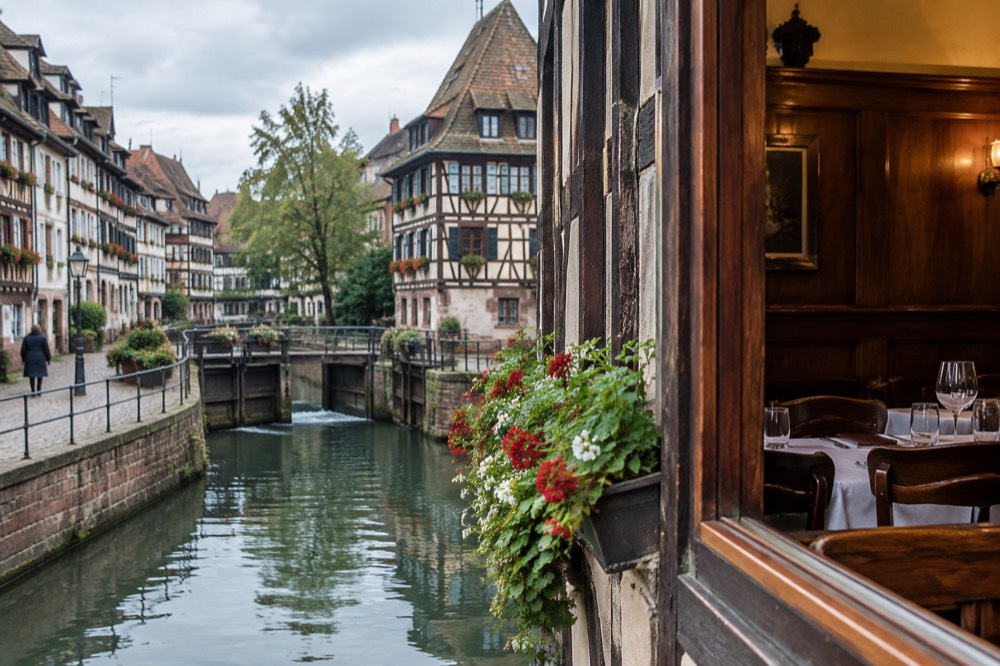
The winstub is the institution to understand. Part tavern, part living room, it serves the Alsatian classics in a setting of dark wood and checked tablecloths, and the quarter and its approaches hold a good share of the city's best-known examples. Our winstubs in Strasbourg page covers the format in detail, and the individual dishes each have their own: tarte flambée, the thin crust baked with cream, onions and lardons; choucroute, the sauerkraut platter that is the region's heavyweight; and kougelhopf, the marbled cake that turns up at breakfast. A glass of Alsace riesling or a local beer alongside is the standard order.
For a quicker, cheaper format, the city's tarte flambée counters sell the dish by the tray at lunch prices well below a sit-down winstub dinner, and the covered market halls and bakeries across the island fill the gaps between them. Reservations matter for dinner in the classic winstubs, and matter a great deal during the Christmas market weeks, when the island's tables fill early.
| Eating format | What you get | What to check |
|---|---|---|
| Classic winstub | Alsatian classics, local wine and beer, traditional rooms | Reserve ahead, especially in December |
| Tarte flambée counter | The dish by the tray, quick service, lower prices | Opening hours, lunch vs dinner menus |
| Modern bistro on the quays | Contemporary cooking, river-facing terraces in season | Terrace season, reservation policy |
| Market halls and bakeries | Kougelhopf, breads, cheeses, picnic supplies | Market days and morning hours |
On staying: the quarter itself holds a small stock of hotels inside its half-timbered streets, and the trade-off is straightforward. Staying in Petite France means waking up in the postcard, at prices that reflect it; staying elsewhere on the Grande Île keeps the walk short while spreading the options; staying by the station trades atmosphere for fare and convenience. The full picture, including the trade-offs through the Christmas season, is laid out in our where to stay in Strasbourg guide and our neighbourhood answer on where to stay in Petite France.
Visitors combining the quarter with the wider region should know that Petite France also anchors several day-trip itineraries: the Alsace wine route starts a short drive south, and the medieval villages circuits use Strasbourg as their base. Our Alsace road trip page covers the full circuit for travellers with a car.
What Else Should You Know Before You Go?
Five practical points shape a visit to Petite France: the Musée Alsacien, the folk-life museum that would otherwise be the quarter's natural indoor stop, is closed for works until 2028; the municipal museums across the island cost 9 EUR full price with a 20 EUR one-day pass, and all of them are free on the first Sunday of every month; the cathedral platform costs 10 EUR with a 66 m viewing height; and the quarter's cobbles and stairs reward sensible shoes.
The museum situation is the one closure that genuinely bites. The Musée Alsacien, the museum of Alsatian domestic and rural life, is closed for works until 2028, and no visit to Petite France should be planned around it. The island's other museums remain open: the Musée de l'Œuvre Notre-Dame, beside the cathedral, holds the medieval sculpture of the cathedral workshops; the Musée des Beaux-Arts and the decorative arts and archaeological collections sit in the Palais Rohan; the modern art museum, MAMCS, faces the river. Tickets are 9 EUR full price and 5 EUR reduced, a one-day pass covering the municipal museums is 20 EUR, and every municipal museum is free on the first Sunday of the month.
| Museum | Collection | Ticket |
|---|---|---|
| Musée de l'Œuvre Notre-Dame | Medieval sculpture and art from the cathedral workshops | 9 EUR full / 5 EUR reduced |
| Musée des Beaux-Arts (Palais Rohan) | Old-master paintings | 9 EUR full / 5 EUR reduced |
| MAMCS | Modern and contemporary art | 9 EUR full / 5 EUR reduced |
| Musée Alsacien | Alsatian folk life | Closed for works until 2028 |
| All municipal museums | Free entry | First Sunday of every month |
The Strasbourg City Card, sold by the tourist office at 5 EUR for adults and 3.50 EUR for children, is a discount card rather than an all-inclusive pass: it takes set amounts off museums, the boat tours, the cathedral platform and the clock show over seven days, and it only pays for itself against a full sightseeing schedule. The cathedral platform itself, at 10 EUR full and 6 EUR reduced with children under 6 free, is the island's one paid climb, open seasonally with a last ascent published on the cathedral's own pages.
Practicalities, briefly: the euro is the currency on both sides of the nearby German border, and a tram or a short river crossing into Kehl makes an easy half-day extension. Pickpocketing risk in the crowded December lanes is ordinary city caution rather than anything specific to the quarter; our is Strasbourg safe page covers the city's situation in full. Photography is best in the early morning from the east-facing quays, when the light comes down the river valley.
Is Petite France Worth Visiting?
Petite France is worth visiting for almost every traveller to Strasbourg, because it is the quarter that gives the city its identity: half-timbered houses, working weirs, canals and bridges, all inside a UNESCO World Heritage island that costs nothing to walk. The honest qualification is crowding, which is heavy in high summer and continuous through the Christmas market weeks, and the fix is simple: go early, and climb the Barrage Vauban terrace to see the quarter whole.
The case against is thin but real. The quarter is small, and a visitor who arrives at midday in December, fights the crowds down one street and leaves, can come away wondering what the fuss was about. The case for is everything else: the same streets at eight in the morning, the river running under the towers, the view from the terrace, and the fact that nowhere else in a major French city concentrates a working river landscape and a medieval street plan quite like this. Our is Strasbourg worth visiting page makes the city-wide case, of which this quarter is the largest single part.
For first-time visitors with limited time, the practical formula is this: arrive early, walk the quays from the Ponts Couverts to the Place Benjamin-Zix, climb the terrace while its hours allow, then continue east across the island to the cathedral and the clock show at 12:30. That is a half-day that captures the island's core. Add a boat circuit, a winstub dinner or a guided walk, and the day fills without strain. Returning visitors can go deeper: the Grande Île and Krutenau pages on this site cover the island's quieter quarters, and the Strasbourg hidden gems guide collects the corners the first visit misses.
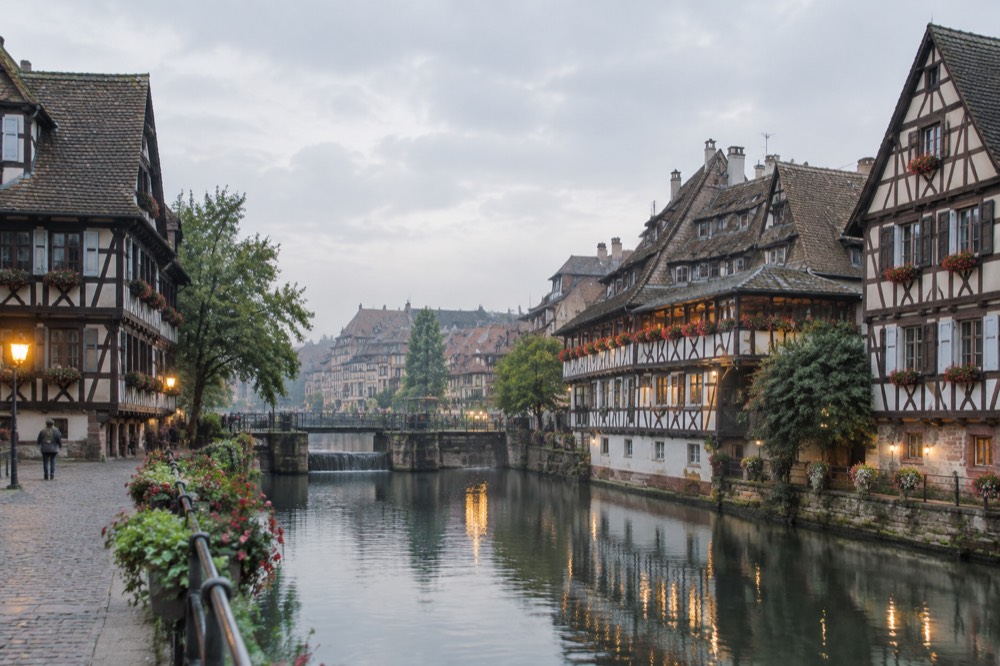
The quarter also earns its place in the wider Alsace itinerary. Travellers using Strasbourg as a base for the wine route and the medieval villages will find that Petite France is the evening reward at the end of each day trip, the place whose lights and reflections close the day. That rhythm, walk out to the vineyards by day, back to the canals by evening, is one of the most reliable pleasures of an Alsatace holiday, and it needs no planning beyond an early enough start.
Common Questions About Petite France
What Is Petite France In Strasbourg?
Petite France is the half-timbered canal quarter at the western end of the Grande Île, Strasbourg's UNESCO World Heritage island, where the River Ill splits into channels past weirs, former mills and the Ponts Couverts. It is public space, open at all hours with no ticket.
Where Is Petite France And How Do You Get There?
It sits on the Grande Île in central Strasbourg, beside the Ponts Couverts and the Barrage Vauban. The CTS tram network serves stops within a short walk of the quarter, with a single ticket at 1.90 EUR via the app or contactless, and the whole island is walkable from the station and the cathedral.
What Are The Best Things To See In Petite France?
The Ponts Couverts and their three towers, the Barrage Vauban rooftop terrace, the weirs and canals of the Ill, the half-timbered houses along the Quai de la Petite France, and the Place Benjamin-Zix. The terrace gives the best single view of the quarter and the cathedral beyond.
When Is The Best Time To Visit Petite France?
Early morning in the warmer months for quiet and light, or the Christmas market season from late November to 24 December for atmosphere, accepting heavy crowds. Strasbourg's semi-continental climate runs from a January mean maximum of 5.2 C to a July mean maximum of 26.4 C.
Is Petite France Free To Visit?
The streets, quays, footbridges and the Ponts Couverts are public space with no charge at any hour. The Barrage Vauban terrace has seasonal hours and its admission terms should be checked on the official page, and the boat tours and guided walks around the quarter are paid products.
Is Petite France Worth Visiting?
Yes, for almost every traveller: it is the quarter that defines Strasbourg's image, and it costs nothing to walk. Arrive early to avoid the heaviest crowds, climb the Barrage Vauban terrace for the overview, and pair the quarter with the cathedral across the island.
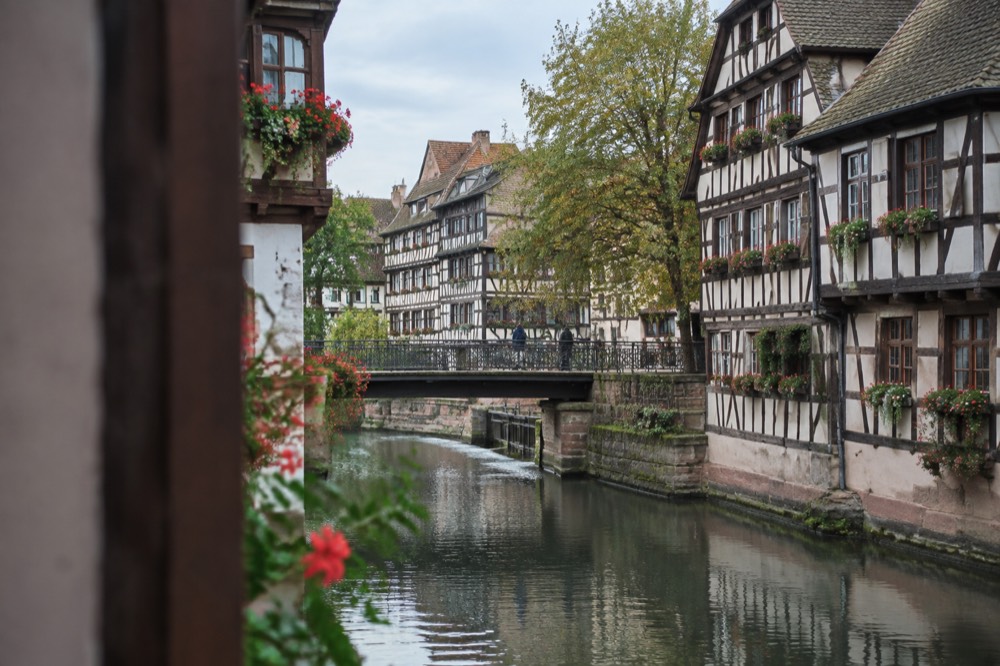
Petite France rewards the visitor who treats it as a working river quarter rather than a backdrop: the water is doing something, the houses have leaned over it for centuries, and the best views are earned either by getting up early or by climbing the terrace that was built to watch this exact stretch of the Ill. Walk it slowly, cross to the cathedral, come back at dusk, and the quarter will have given you the Strasbourg you came for.