Maison Kammerzell
Maison Kammerzell is the tall, richly carved half-timbered house standing on the square beside Strasbourg Cathedral in Strasbourg, Alsace, north-eastern France. This guide covers what it is, how to reach it, what to eat there, and how to plan the hours around it.
Short answer
Maison Kammerzell is a historic half-timbered merchant house on the cathedral square in Strasbourg, France, today housing a restaurant serving Alsatian specialities. Entry to the square is unrestricted; the cathedral nave is open Mon-Sat 08:30-11:15 and 12:45-17:45, and the astronomical clock show runs daily at 12:30 (4 EUR, day-of tickets only).
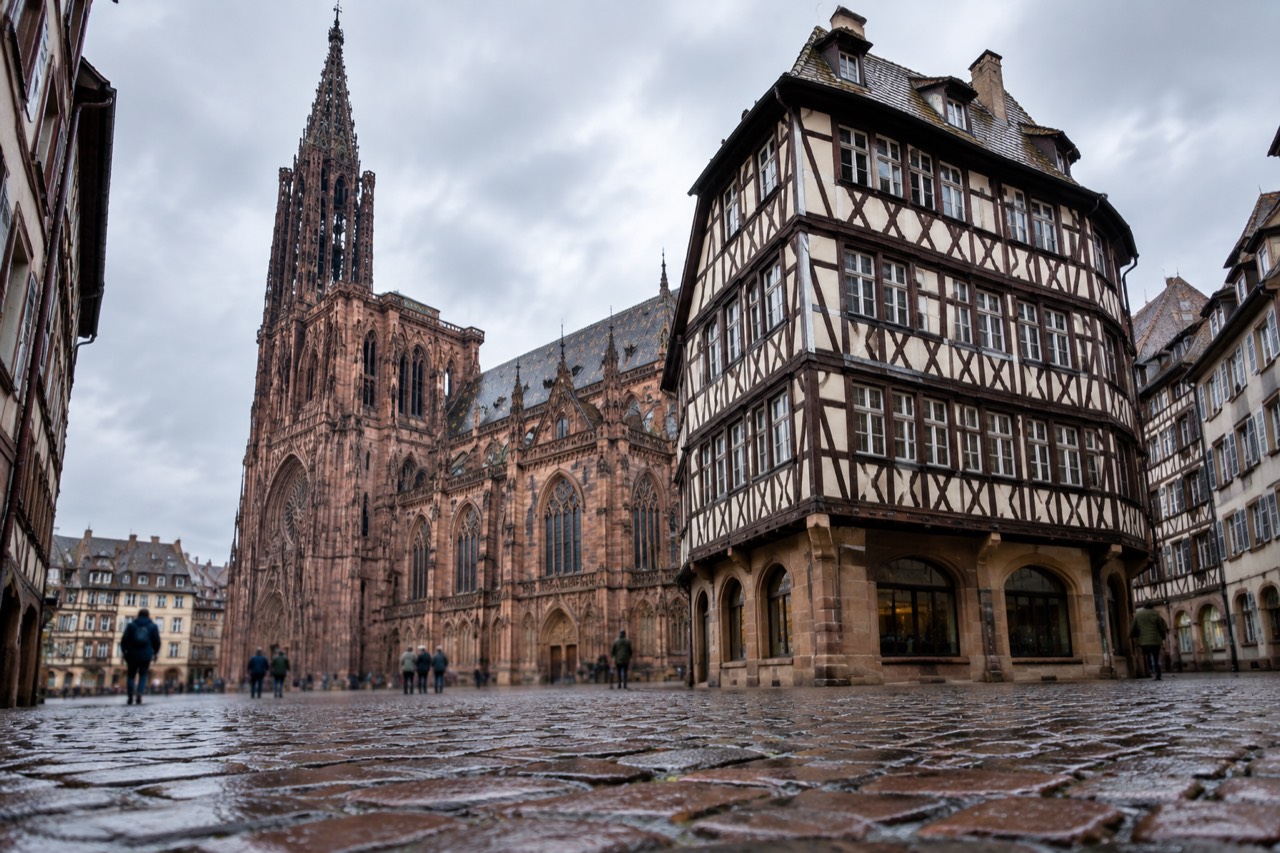
Maison Kammerzell is the tall, dark, richly carved half-timbered house that stands on the square beside Strasbourg Cathedral, in Strasbourg, the prefecture of the Bas-Rhin in Alsace, north-eastern France. Visitors crossing the Place du Château almost always stop in front of it before they ever step inside the cathedral. Today the house works for a living: it holds a restaurant serving Alsatian specialities, and the building itself is the kind of landmark you experience from the square, from a table, and from the flow of a walking route, rather than from a ticket queue.
This guide treats the house the way a visitor actually meets it: as a piece of the cathedral square, as a place to eat, and as a fixed point around which the rest of a Strasbourg day is arranged. The practical figures here, opening hours, ticket prices, transport fares, come from the official pages of the cathedral, the museums and the city transport network, and everything that is not published officially is flagged as something to check with the house or on the operator's live listing.
What Is Maison Kammerzell In Strasbourg?
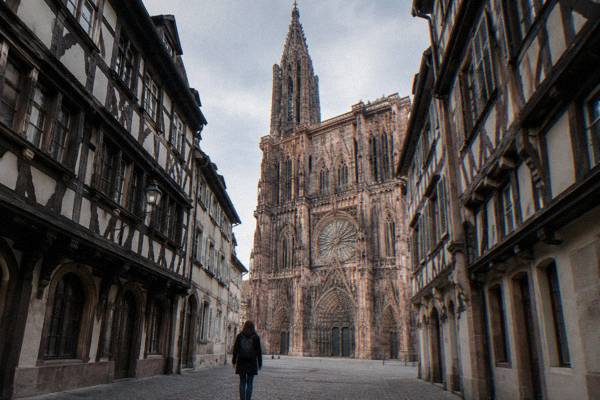
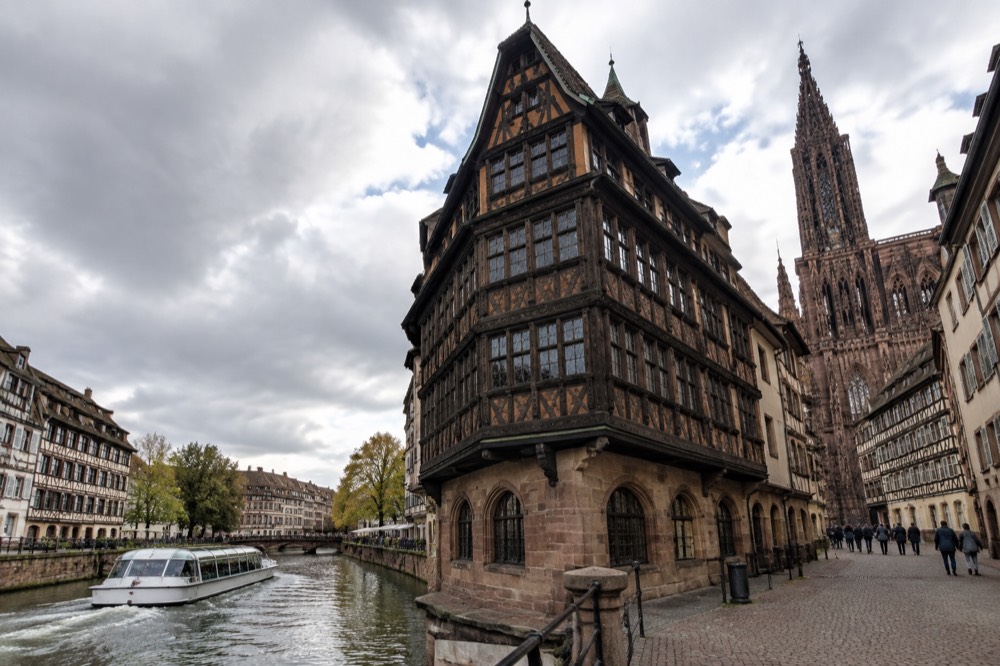
Maison Kammerzell is a historic half-timbered merchant house on the Place du Château, the square beside Strasbourg Cathedral in Strasbourg, Alsace, north-eastern France. It is one of the best-known secular buildings in the city, a corner house whose stacked floors, carved corbels and painted timber front make it a landmark in its own right. Today it houses a restaurant serving Alsatian specialities, and visitors experience it from the square, from a table, or as a stop on a guided walk.
The house belongs to a family of buildings that defines Strasbourg's old centre: the tall, narrow, half-timbered houses of the Grande Île, the river-bound historic core that UNESCO lists together with the Neustadt as a World Heritage property. What sets Kammerzell apart is not its type but its completeness. Where many old houses in the city were altered, reclad or lost across the centuries, this one survived with its dark timber frame, its projecting upper floors and its carved ornament intact, and it stands directly opposite the cathedral's west front, which gives it the best address in the old city.
The building's story is a merchant's story, and it should be told the way the building tells it, without invented dates. The house stands where trade stood: on the cathedral square, where goods, money and travellers converged in the medieval city. Its successive owners were burghers of a city that grew rich on river trade, and the house's scale, several stacked storeys on a valuable corner plot, is itself the record of that wealth. The cathedral's own pages, the tourist office and the house itself publish the detailed history for readers who want it.
What the visitor meets today is a working building rather than a museum. The ground floor and the upper levels hold the restaurant, whose interior woodwork, painted beams and staircases are part of the attraction; the dining rooms themselves are the closest thing the house has to an exhibition. You do not buy a ticket to see Maison Kammerzell. You see it from the square, which is public space, and you see it from inside if you eat there or take a guided walk that steps through the doors. That distinction shapes everything in the sections below: the costs that matter are the costs of the cathedral, the museums and the food, not of the house itself.
Where Is Maison Kammerzell And How Do You Get There?
Maison Kammerzell stands in the heart of the Grande Île, the historic island centre of Strasbourg, France. The whole old centre is pedestrian-first, so the usual approach is on foot, by tram to a stop on the edge of the island, or by river boat to a landing stage. A CTS single ticket costs 1.90 EUR bought in the app or by contactless, and a 24-hour Solo pass costs 4.60 EUR.
The house could not be better placed for a visitor arriving without a car. The Grande Île is compact and largely given over to pedestrians, and the cathedral square sits at its centre, so every walking route through the old city, from Place Kléber to Petite France, from the Barrage Vauban to the riverbank, passes within a few minutes of the front door. The tram network runs around and across the island, and CTS's fare page gives the numbers that matter for a day's hopping: the single ticket at 1.90 EUR through the Badgéo card, the CTS app or contactless payment, or 2.50 EUR if bought on board a bus; the 24-hour Solo pass at 4.60 EUR; and the 24-hour Trio pass at 10.20 EUR for a group of two or three travelling together.
| Ticket | Price | What it covers |
|---|---|---|
| CTS single | 1.90 EUR | One journey, bought via Badgéo, the CTS app or contactless |
| CTS single, on board a bus | 2.50 EUR | One journey, bought from the driver |
| 24-hour Solo pass | 4.60 EUR | Unlimited CTS travel for one person for 24 hours |
| 24-hour Trio pass | 10.20 EUR | Unlimited CTS travel for two or three people together |
| Airport combined ticket | 4.60 EUR | Train from Entzheim plus tram or bus and a 24-hour EMS pass |
Visitors flying into Strasbourg Airport at Entzheim have a simple run in: the airport's own access page describes a train shuttle running up to five times an hour, taking eight minutes to Strasbourg's central station, with a combined ticket covering the train, a tram or bus connection and a 24-hour pass at 4.60 EUR. From the station, the old centre is a short tram ride or a walk along the Ill. The station district has its own character, and summer engineering works on the tram network near the station have finished, so the lines run normally again; anything time-specific should be checked on the CTS pages before travel.
For anyone planning a day that starts at the cathedral and the Kammerzell and then fans out, the geography is generous. Petite France, the old tanners' quarter of waterways and half-timbered houses, lies to the south-west; the Ponts Couverts and the Barrage Vauban terrace frame it further south; and Place Kléber, the city's main square, sits a few streets north. A river cruise is the other natural pairing: the boat companies land within the old centre, and seeing the island from the water, then re-entering the pedestrian streets at the cathedral square, is the classic Strasbourg loop.
For travellers who want the cathedral square explained rather than just found, a guided walk is the efficient choice, and the options below pair the house with the routes that pass it.
What Can You See At Maison Kammerzell And Around It?
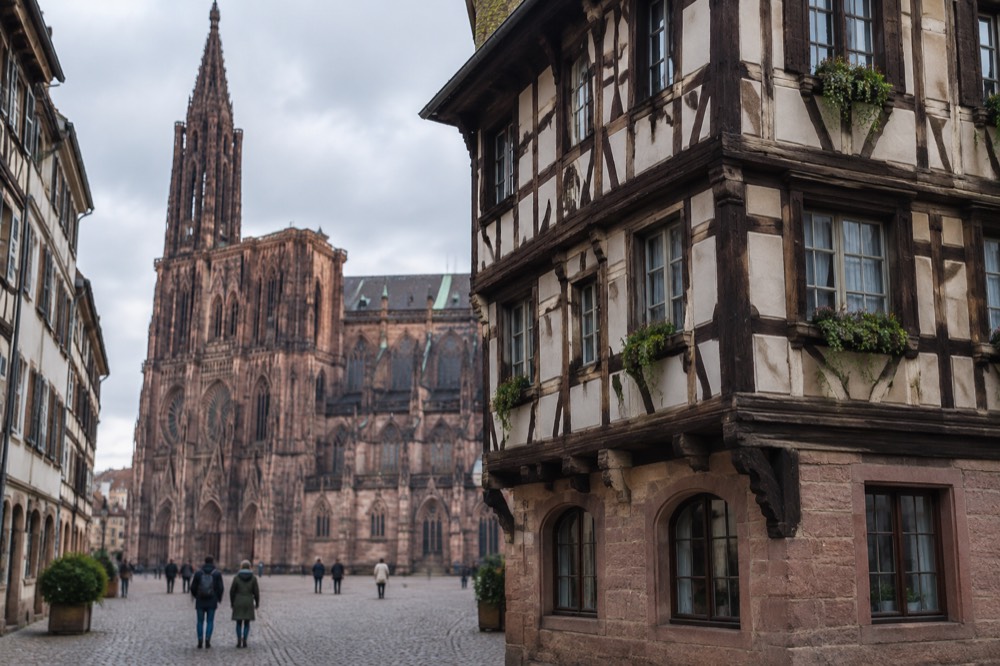
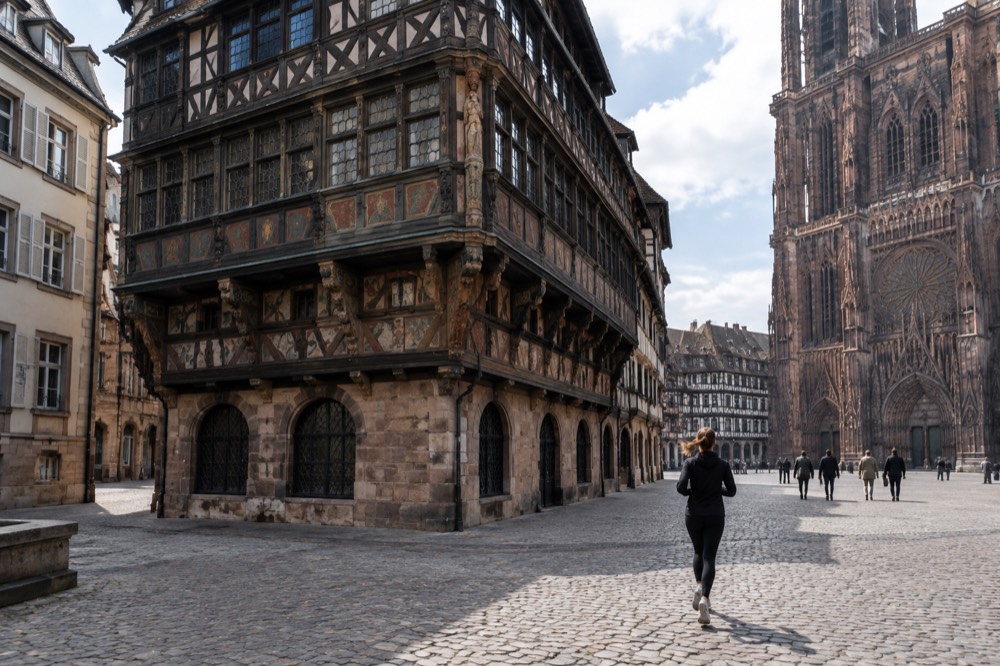
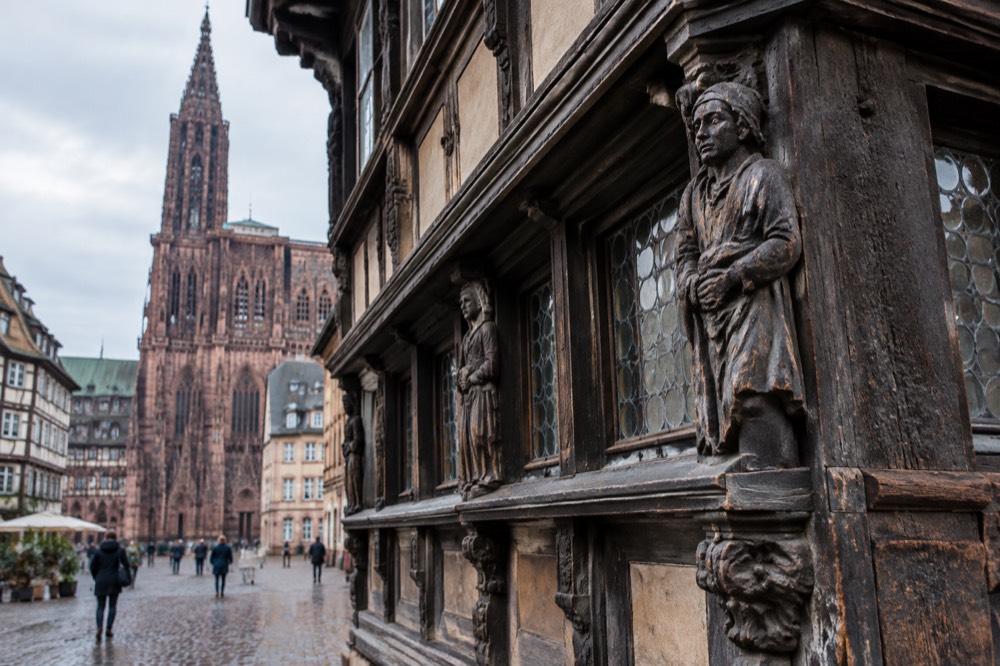
The house itself is seen from the Place du Château: the dark timber frame, the stacked projecting storeys, the carved figures and the painted ornament of the facade, all free to look at from public space. Inside, the restaurant's wood-panelled rooms are the attraction, accessible when you eat there. Around it, the cathedral nave, the astronomical clock and the platform at 66 m fill the rest of the square with ticketed sights, and the Musée de l'Œuvre Notre-Dame stands a few steps away.
Start with the facade, because it rewards time. The carved figures and painted panels of a house like this were not decoration for its own sake; they were a merchant's display, the timber-frame equivalent of a shop window, and reading them is the pleasure of standing on the square. The best light for photographs comes in the morning, when the square is not yet full; late afternoon is the second choice, with the timber glowing warmer as the day closes. There is no ticket, no queue and no barrier: the square is public, and the house asks nothing of a visitor who only wants to look.
Inside, the house is a restaurant. The dining rooms, with their woodwork, painted beams and historic staircases, are what a visitor experiences when seated at a table, and the honest advice is that eating here is the way to see the interior. If the interior matters to you, book a table rather than hoping to wander in, and say so when booking, so the staff can seat you in the rooms you came for.
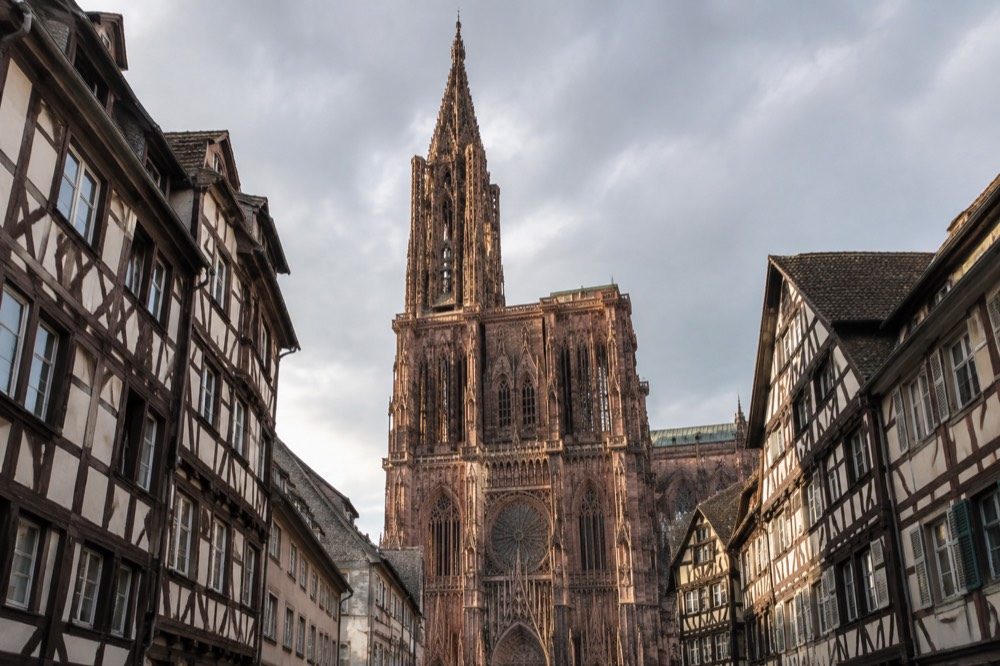
The square around the house is the densest cluster of sights in the city, and the cathedral's own pages give the hours and prices that matter. The nave is open Monday to Saturday from 08:30 to 11:15 and from 12:45 to 17:45, and on Sundays and feast days from 14:00 to 17:15; during the Christmas market the cathedral stays open continuously on the Place du Château side, Monday to Saturday, 08:30 to 17:45. The astronomical clock's automaton show runs daily at 12:30 sharp, with tickets at 4 EUR for adults, sold on the day only, at the cathedral stalls between 10:00 and 11:00 or at the Saint-Michel entrance from 11:30. The tower platform, at 66 m, is reached by a ticket at 10 EUR full fare or 6 EUR reduced, with children under 6 free, and its hours shift with the seasons.
| Sight on or beside the square | Admission | Hours or show time |
|---|---|---|
| Cathedral nave | Check the cathedral's page for any event closures | Mon-Sat 08:30-11:15 and 12:45-17:45; Sun 14:00-17:15 |
| Astronomical clock show | 4 EUR adult, day-of tickets only | Daily at 12:30 sharp |
| Cathedral platform at 66 m | 10 EUR full, 6 EUR reduced, under 6 free | 1 Apr-30 Sep 09:30-13:00 and 13:30-20:00; 1 Oct-31 Mar 10:00-13:00 and 13:30-18:00 |
| Musée de l'Œuvre Notre-Dame | 9 EUR full, 5 EUR reduced | Museum opening hours on the museums' official page |
| Maison Kammerzell interior | Via the restaurant; book a table | Restaurant hours on the house's own page |
The platform ticket carries a small bonus worth knowing: it gives a reduced rate at the Musée de l'Œuvre Notre-Dame, the museum of cathedral art that stands just off the square, so the two pair naturally in one visit. The platform closes on 1 January, 1 May and 25 December. A practical note for anyone carrying bags: the cathedral has no luggage lockers, so plan storage elsewhere before a climb. The Strasbourg Cathedral guide and the astronomical clock guide on this site carry the detail on each of these sights.
One museum in the neighbourhood is off the menu: the Musée Alsacien, the folk museum of old Alsace, is closed for works until 2028, so it cannot be part of any plan around the square. The other municipal museums remain open, and all of them are free on the first Sunday of every month, which is a genuinely useful planning lever for a weekend visit.
What Should You Eat At Maison Kammerzell?
Maison Kammerzell's restaurant serves the classic Alsatian table: choucroute garnie, the sauerkraut platter with sausages and pork; tarte flambée, the thin cream-and-bacon flatbread; baeckeoffe, the slow-cooked meat and potato casserole; and kougelhopf, the ring-shaped brioche that is the region's signature cake. Menus and prices change with the seasons, so confirm current dishes and rates on the house's own page or when booking.
Eating at Kammerzell is the practical way to see inside the house, and the kitchen's territory is the winstub tradition: the Alsatian tavern where these dishes belong, served in wood-panelled rooms with local wine. A first-time visitor ordering with confidence wants three names in mind. Choucroute garnie is the plate Strasbourg is known for, sauerkraut cooked in wine with a full range of pork cuts and sausages. Tarte flambée, called flammekueche in the dialect, is the quicker, lighter choice, a blistered thin bread with fromage blanc, cream and lardons, best eaten immediately. Baeckeoffe is the slow dish, a marinated mix of meats and potatoes baked long in a casserole, and kougelhopf is the sweet note, a yeasted ring often taken with a late glass of wine.
| Dish | What it is | Where to read more |
|---|---|---|
| Choucroute garnie | Sauerkraut cooked in wine with sausages and pork cuts | The choucroute guide on this site's food pages |
| Tarte flambée | Thin flatbread with fromage blanc, cream and lardons | The site's tarte flambée guide |
| Baeckeoffe | Slow-baked casserole of marinated meats and potatoes | The site's baeckeoffe guide |
| Kougelhopf | Ring-shaped yeasted brioche, the region's signature cake | The site's kougelhopf guide |
| Alsatian wines | Riesling and other white varieties of the Alsace route | The site's Alsace wine guide |
The table above points to this site's own food guides for the dishes themselves, and the honest framing for prices is a planning range rather than a promise: a winstub meal in the old centre runs to a sit-down price rather than a snack price, and the current menu at Kammerzell is the only source for the current figures. Booking matters more here than at an ordinary restaurant, because the house is small, famous and on the busiest square in the city. In the Christmas season, and on weekends in summer, reserving ahead is the difference between a table in a carved room and a long walk elsewhere.
For travellers who want the food and the city explained together, a guided food walk is the format that does both, moving through the old streets with stops at producers and tables.
A different way into the same material is a shorter culinary walk, which covers the old centre's food stops in less time; the operator's live listing carries the current itinerary, price and availability. Whichever format you choose, the Kammerzell works well as either the starting point or the finishing table of a food-focused day, since it sits at the centre of every route a food walk follows.
How Much Does A Visit To The Maison Kammerzell Area Cost?
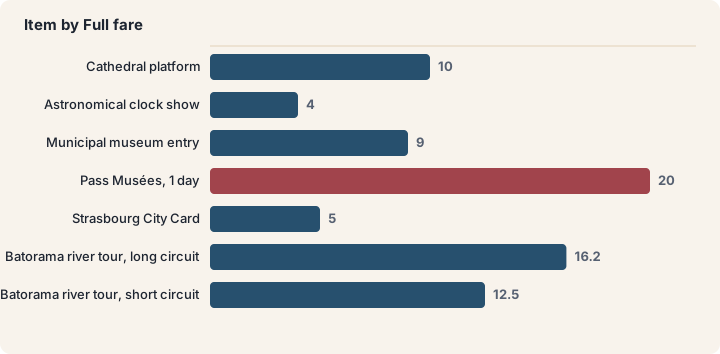
The house itself costs nothing to see: the Place du Château is public space and the facade is free to view. The costs around it are the cathedral's and the museums': the clock show at 4 EUR, the platform at 10 EUR full or 6 EUR reduced, municipal museums at 9 EUR full or 5 EUR reduced, and the 1-day Pass Musées at 20 EUR. All municipal museums are free on the first Sunday of every month, and the 5 EUR City Card trims several prices.
The square is one of the few places in Europe where a half-day of sightseeing can be spent entirely on tickets under 10 EUR, and the figures below are the ones a planner needs. The cathedral nave costs nothing to enter as published by the cathedral's own hours page; the clock show and the platform are the two ticketed items inside the building; and the museums around the island follow the municipal tariff. The Pass Musées at 20 EUR covers the municipal museums for a day, and it pays for itself somewhere past the third museum; the annual passes, solo, duo and family, exist for longer stays and are listed on the museums' official tariff page.
| Item | Full fare | Reduced or alternative |
|---|---|---|
| Cathedral platform | 10 EUR | 6 EUR reduced; under 6 free |
| Astronomical clock show | 4 EUR | 3 EUR groups of 12+ and students to 25; 2 EUR children 6-17 |
| Municipal museum entry | 9 EUR | 5 EUR reduced |
| Pass Musées, 1 day | 20 EUR | Covers the municipal museums for one day |
| Strasbourg City Card | 5 EUR adult | 3.50 EUR child (3-17), valid 7 days, discounts only |
| Batorama river tour, long circuit | 16.20 EUR | 8.90 EUR reduced |
| Batorama river tour, short circuit | 12.50 EUR | 7.20 EUR reduced |
Two clarifications save confusion. The Strasbourg City Card is a discount card, not an all-inclusive pass: for 5 EUR adult or 3.50 EUR child, valid seven days, it takes money off museums, the boat tour, the cathedral platform and the clock, so it suits a visitor planning several paid sights rather than one. And the free first Sunday applies to the municipal museums, not to the cathedral's ticketed items or the boat tours, so a first-Sunday plan should front-load the museums and leave the platform and the clock for another day.
The river figures above are the official Batorama tariffs: the long tour at 16.20 EUR full and 8.90 EUR reduced, the short tour at 12.50 EUR full and 7.20 EUR reduced, with the long Red Tour running 1 h 10 and the short Blue Tour 45 minutes. A day that combines the Kammerzell, the cathedral, one museum and a boat circuit is the classic Strasbourg package, and at the official tariffs it remains a mid-priced city day rather than an expensive one. The Strasbourg on a budget guide on this site collects the other low-cost angles, and the free things to do guide lists what costs nothing at all.
When Is The Best Time To Visit Maison Kammerzell?
The square is enjoyable year round, but the two best windows are late spring through early summer, when the terraces open and the crowds are thinner than in December, and the Christmas season, when the market fills the old centre and the square glows after dark. Strasbourg's climate is semi-continental: Meteo-France 1991-2020 normals give mean maxima from 5.2 C in January to 26.4 C in July, with 635.7 mm of rain a year, so pack for cool winters and warm summers.
The climate table below is the one to plan against, and the honest reading of it is that Strasbourg has four real seasons. Winter is cold, with a mean December maximum of 5.9 C and a mean minimum of 0.8 C, and December averages 10.2 rain days of 1 mm or more, which is why the Christmas market experience is an indoor-and-outdoor one: warm rooms, hot wine, cold squares. Summer is warm rather than scorching, with July mean maxima of 26.4 C, and spring sits between, with April mean maxima at 17.0 C. Rain falls fairly evenly through the year, so a rain layer belongs in the bag in every season.
| Month | Mean maximum | Mean minimum | Rain | Rain days of 1 mm or more |
|---|---|---|---|---|
| January | 5.2 C | -0.2 C | 35.4 mm | 9.1 |
| April | 17.0 C | 5.7 C | 41.8 mm | 8.6 |
| July | 26.4 C | 14.9 C | 71.9 mm | 10.4 |
| October | 15.8 C | 7.2 C | 59.5 mm | 9.6 |
| November | 9.4 C | 3.3 C | 47.6 mm | 9.2 |
| December | 5.9 C | 0.8 C | 45.2 mm | 10.2 |
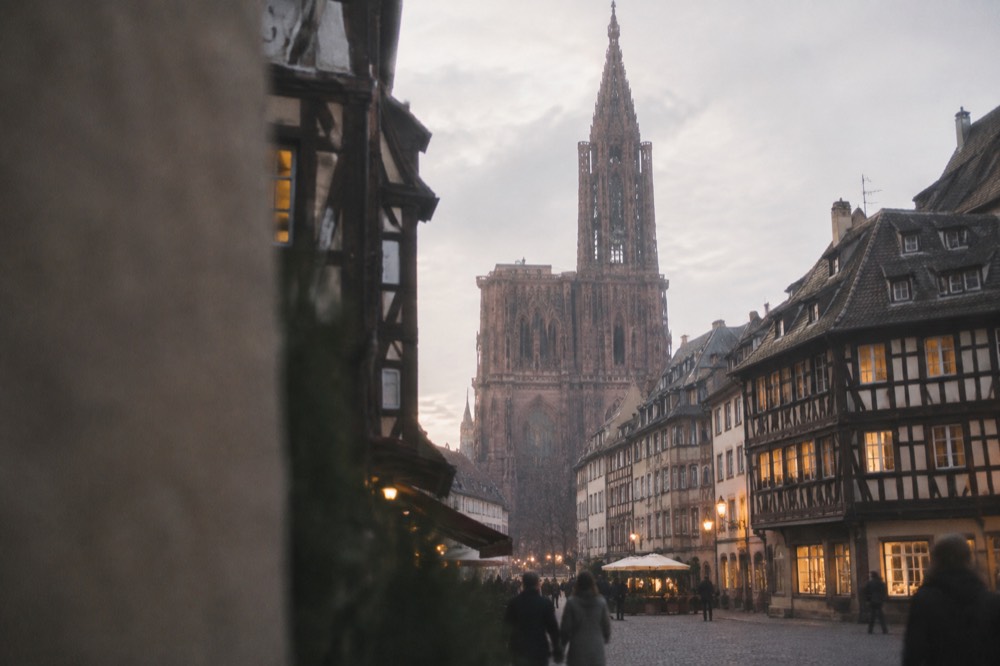
The Christmas season deserves its own paragraph, because it is the period that defines the city's reputation. Strasbourg's Christmas market normally opens in the last week of November and runs until 24 December, with the closing day ending early in the evening; the 2025 edition ran from 26 November to 24 December and drew 3.05 million visitors, on top of 3.4 million the year before. The 2026 dates and programme are still being finalised on the city's official Christmas site, so confirm them there before booking anything. During the market, the cathedral stays open continuously on the Place du Château side, Monday to Saturday, 08:30 to 17:45, which makes a Kammerzell table in December both magical and hard-won: book well ahead.
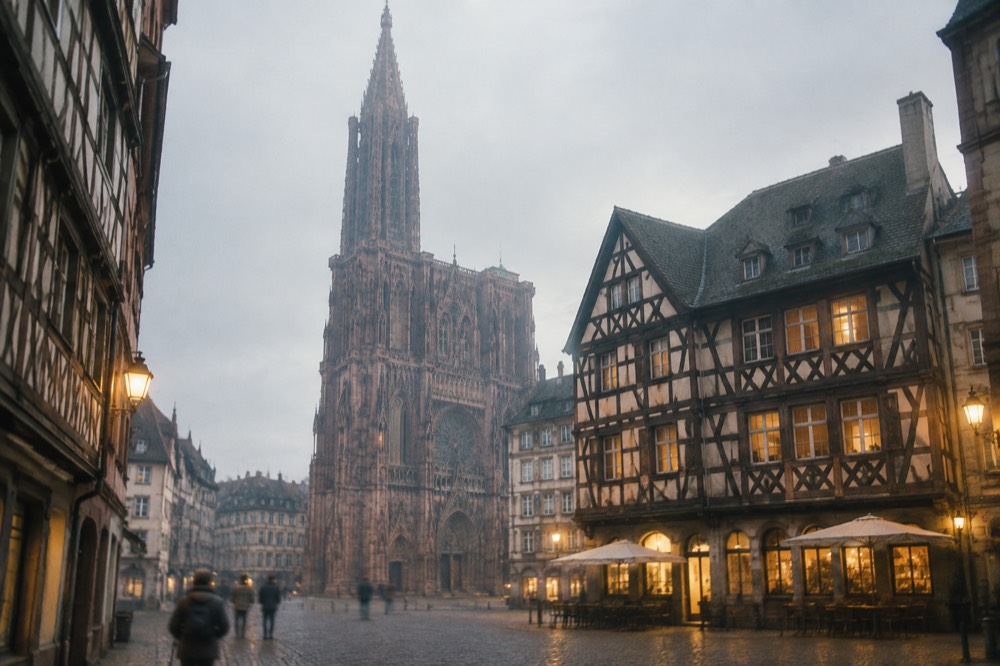
Outside the season, the practical advice is about hours of daylight and crowd rhythm. The square is quietest early in the morning, before the tour groups arrive from mid-morning, and again after the day-trippers leave in the later afternoon, when the timber of the facade catches the low sun. A winter visit rewards the same late-afternoon slot, because the early dusk turns the square into a lit stage. On any day, the clock show at 12:30 creates a crowd spike on the square, so time your photographs before or after it rather than during.
How Does Maison Kammerzell Compare With Other Strasbourg Landmarks?
Maison Kammerzell is the old city's most complete secular facade, a merchant house rather than a monument, and it pairs with landmarks rather than competing with them: the cathedral for scale, Petite France for atmosphere, the Barrage Vauban for the panoramic view, and the Ponts Couverts for the river frame. It is seen in minutes from outside and in a meal from inside, which makes it a hub of a day rather than a destination that fills one.
The comparison that matters is with the cathedral, because the two share a square and a visitor's morning. The cathedral is the vertical statement, a single spire over a Gothic nave, with a platform at 66 m and a clock show at 12:30; Kammerzell is the horizontal, human-scaled counterpoint, the house a merchant built across from all that stone. A good morning does both: the nave first, the clock if the timing works, then a look at the facade in full daylight, then a table. The Petite France guide covers the tanners' quarter to the south-west, where the half-timbered houses stand over water instead of over a square, and the contrast between the two settings is the quickest way to understand what the old city is.
| Landmark | Character | What it asks of a visitor |
|---|---|---|
| Maison Kammerzell | Half-timbered merchant house, restaurant inside | A look from the square, a table for the interior |
| Strasbourg Cathedral | Gothic nave, single spire, platform at 66 m | Free nave entry; 10 EUR platform, 4 EUR clock show |
| Petite France | Historic tanners' quarter on the river | Free to wander; time for the lanes and bridges |
| Barrage Vauban | Panoramic terrace over the city roofs | Seasonal hours; terrace open 08:00-19:00 Sep-Oct |
| Ponts Couverts | Medieval bridge towers on the Ill | Free to view from the banks; part of a riverside walk |
The Barrage Vauban terrace deserves its place in that table with one caution: the terrace has seasonal opening hours, published on the city's page for the site, with the September-October period running 08:00 to 19:00 and the November-February period 08:30 to 16:00, and the admission price is not stated on that page, so check it before assuming anything. The Ponts Couverts stand beside it, and the two together frame the river entrance to the old city. For the full sweep of the island from above, the cathedral platform remains the ticket to buy.
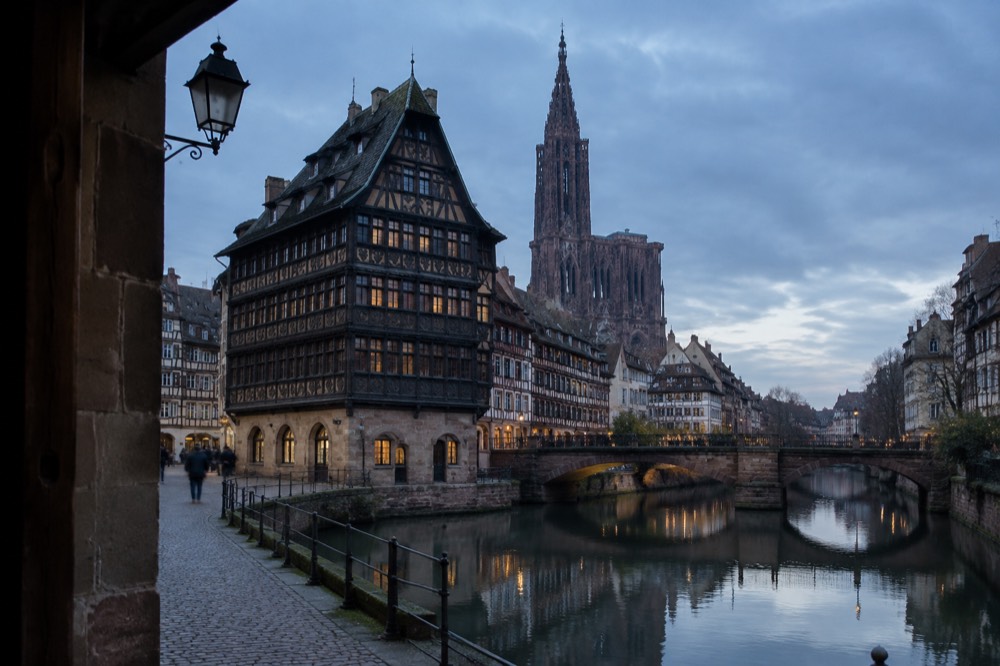
The honest ranking advice is not to rank at all, but to sequence. The house, the cathedral and the museum beside it fill one square and one morning; Petite France and the river frame fill the afternoon; a boat circuit stitches the two halves together from the water. Visitors who try to see the old city as a list of separate sights end up walking the same lanes repeatedly, because the island is small and everything is close. That compactness is the reason a single well-placed table at Kammerzell, in the middle of the day, is worth more than a second museum.
Which Tours Pair Well With Maison Kammerzell?
The tours that pair best with the house are the walks that route through the cathedral square, the food walks that stop in the old centre, and the river cruises that view the island from the water. A small-group curiosities walk covers the square and the lanes around it, a city-centre walk suits a short stay, and a private boat with a captain aboard gives the river perspective. Product prices, ratings and durations render from the listings below.
A walking tour is the natural first pairing, because the house gains from explanation: the carvings, the merchant world and the square's history read very differently with a guide than alone. The small-group walk between history and curiosities is the format that fits, moving through the old centre in the company of a guide who treats the square as a story rather than a photo stop. For a short stay, a city-centre walk is the compressed version, hitting the cathedral square and the essential lanes in a single loop.
Want the carvings and the merchant world explained? Book a guided walking tour here.
The river pairing works in the other direction. The streets around the Kammerzell are pedestrian and close; the water is the only place the island's shape makes sense, and a cruise past the Ponts Couverts and the old quarter gives the geometry that the lanes hide. The featured option on this page is a private boat with a captain aboard, a small-group-of-your-own format that runs on the Ill around the old centre; the operator's live listing carries the current price and availability. Check availability if the private format suits your group, since seats and slots on a small boat are limited by design.
Beyond these, the roster on this site's tours pages covers food walks, segway circuits, bike tours and day trips into the Alsace wine country, and the pairing logic stays the same: the Kammerzell is the anchor in the centre, and the tour is the loop you draw around it. A morning walk, a lunch or dinner table at the house, and a boat circuit in between is the sequence that visitors repeat most, and it survives every season. In December, add the Christmas market to the loop and book everything ahead, because the square's popularity in the market season leaves little to chance.
Common Questions About Maison Kammerzell
Is Maison Kammerzell Worth Visiting?
Yes, for what it is: the finest half-timbered facade on the cathedral square and a working restaurant inside a genuinely historic house. It is not a museum with tickets and exhibits, so the visit is short from outside and as long as a meal from inside. Pair it with the cathedral, the clock show and the platform, and it earns its place at the centre of any Strasbourg day.
Can You Eat At Maison Kammerzell?
Yes. The house operates a restaurant serving Alsatian specialities such as choucroute garnie, tarte flambée and baeckeoffe, in wood-panelled historic rooms. Menus, prices and hours change with the seasons, so check the house's own page or call ahead, and book in advance in the Christmas season and on summer weekends, when tables in the old centre are scarce.
Do You Need A Ticket To See Maison Kammerzell?
No. The house stands on the Place du Château, which is public space, and the facade is free to view at any hour. The ticketed sights are the neighbours: the astronomical clock show at 4 EUR, the cathedral platform at 10 EUR full or 6 EUR reduced, and the municipal museums at 9 EUR full or 5 EUR reduced. The interior of the house is reached through the restaurant.
How Old Is Maison Kammerzell?
The house belongs to the medieval and Renaissance building tradition of Strasbourg's old centre, and its stacked half-timbered form records the wealth of the merchant city that grew around the cathedral. This guide does not print construction dates or owners' names, because those details are not in the record behind this page; the cathedral's pages, the tourist office and the house itself publish the full history for readers who want the dates.
What Is Near Maison Kammerzell?
The cathedral nave, the astronomical clock and the platform at 66 m share the square itself; the Musée de l'Œuvre Notre-Dame stands a few steps away; and Petite France, the Ponts Couverts and the Barrage Vauban terrace lie within the same walkable island. The Musée Alsacien is closed for works until 2028 and cannot be included in plans around the square.
When Is Maison Kammerzell Open?
The square is public and viewable at any time, and the facade is lit at night. The restaurant keeps its own hours, which change with the seasons, so confirm them on the house's own page before planning a table, especially around the Christmas market, when the cathedral stays open continuously on the Place du Château side, Monday to Saturday, 08:30 to 17:45.
Maison Kammerzell rewards the visitor who treats it as what it is: a merchant's house that survived on the city's best square and now feeds people under its carved beams. Look at it in the morning light, eat in it when the queues for the cathedral have gone, and let the rest of the old city arrange itself around the square it stands on.
For everything else on the square and beyond, the Strasbourg Travel Guide carries the full set of cathedral, museum and itinerary pages, and the Musee de l'Oeuvre Notre-Dame guide is the natural next read for the museum a platform ticket discounts. Whatever the season, the house on the cathedral square is the fixed point from which the old city unfolds, and a table booked there is the simplest way to make a Strasbourg evening last.