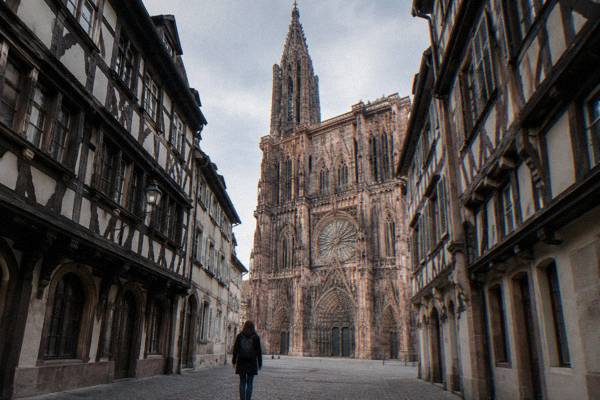
Strasbourg Astronomical Clock
The astronomical clock inside Strasbourg Cathedral, in Alsace in north-eastern France, runs its full automaton show once a day at 12:30 sharp. This guide covers the verified show time, the ticket prices, where to buy tickets on the day, and how to build a visit around the cathedral's own opening hours.
Short answer
The Strasbourg astronomical clock performs its full automaton show daily at 12:30 sharp inside Strasbourg Cathedral, Alsace, France. A ticket costs 4 EUR, 3 EUR for groups of 12 or more and students up to 25, and 2 EUR for children aged 6 to 17. Tickets are sold on the day only, at the cathedral stalls between 10:00 and 11:00 or from the Saint-Michel entrance from 11:30.
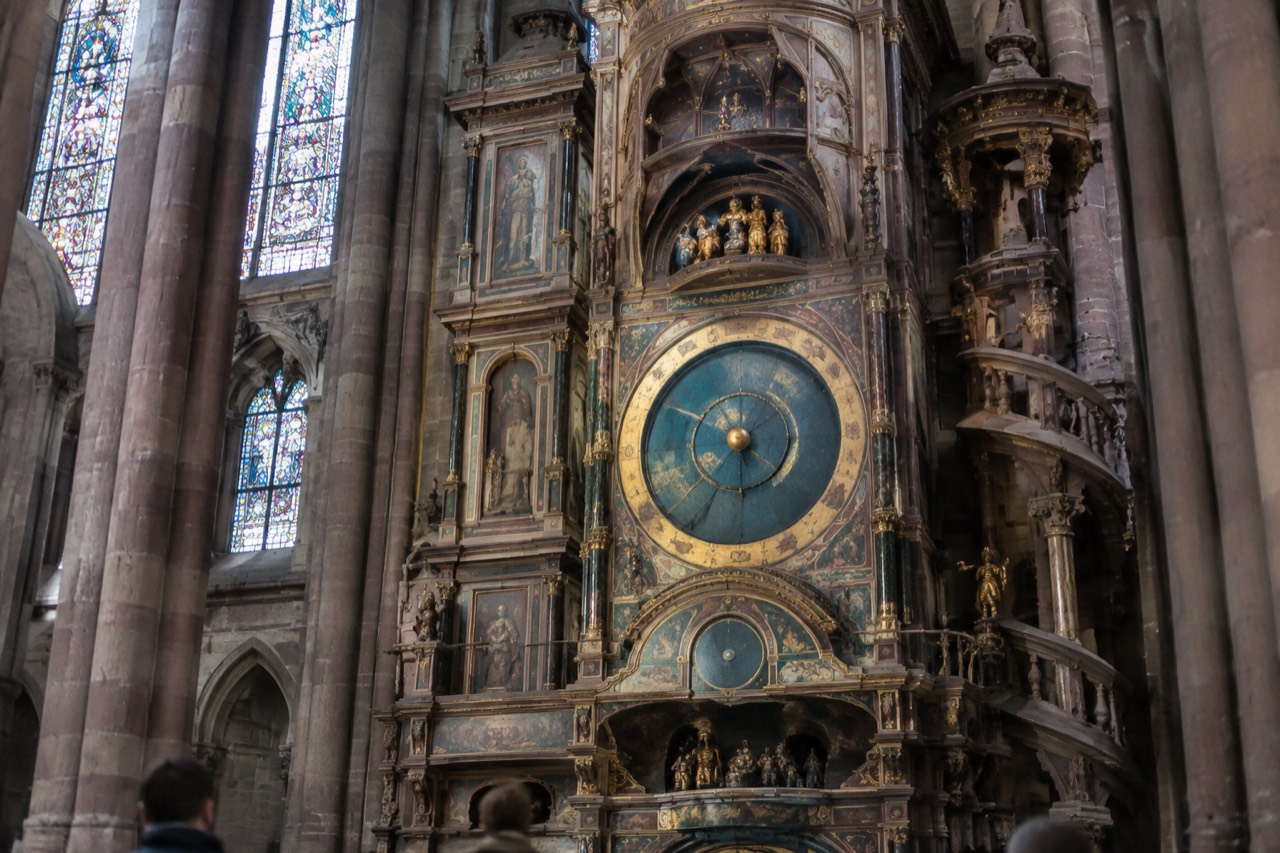
The astronomical clock inside Strasbourg Cathedral, in the city of Strasbourg in Alsace, Bas-Rhin, in north-eastern France, is one of the great working machines of Europe. It stands against the south transept of the cathedral, a cascade of painted dials, brass rings, moving figures and a cockerel that flaps at the stroke of noon. The full automaton show runs once a day, at 12:30 sharp, and it draws a crowd that fills the transept well before the mechanism begins to move. This guide sets out what the clock is, what the show actually does, what a ticket costs, and how to fit the whole visit around the cathedral's own opening hours.
What Is The Strasbourg Astronomical Clock?
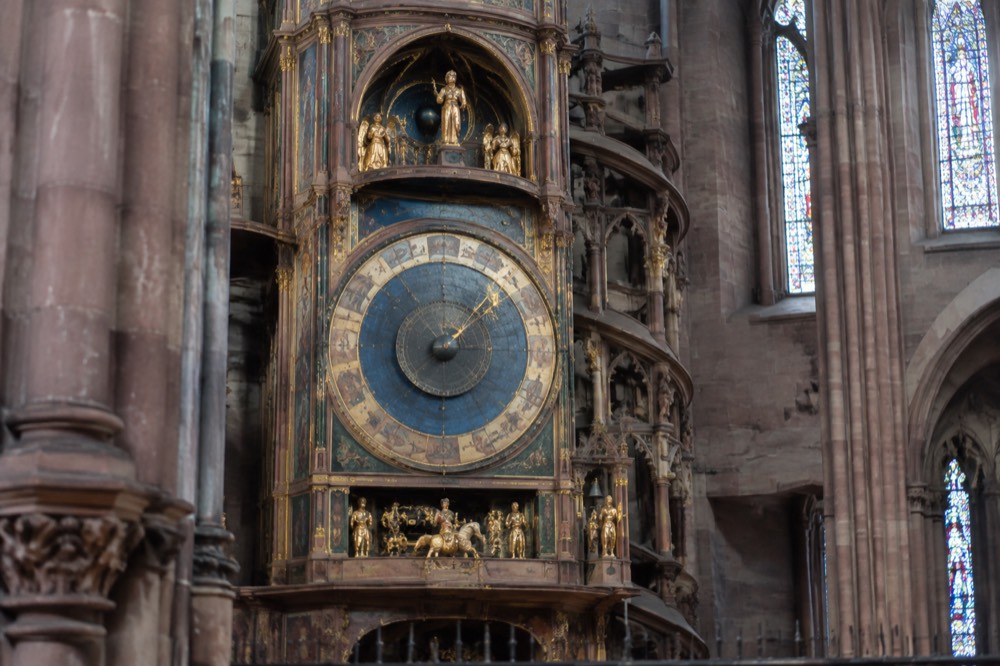
The Strasbourg astronomical clock is a large mechanical and astronomical clock inside Strasbourg Cathedral in Alsace, north-eastern France, built to display not just the hour but a full range of astronomical and calendar data, and famous for a daily automaton show at 12:30 sharp in which carved figures move in sequence and a cockerel crowing mechanism ends the performance. It is the third great clock to have occupied this spot in the cathedral's south transept. The current machine replaced an earlier clock whose works had stopped, and it was assembled by a team of Alsatian craftsmen and engineers whose names are recorded on the casing itself. The casing is a monument in its own right: painted panels, gilded statuary, and a staircase of dials climbing from floor level to the vault above.
The clock does several jobs at once. Its principal dial keeps civil time. Around it, further dials and rings track the calendar, the position of the sun through the zodiac, the phases of the moon, the movable feasts of the church year, and the corrections needed to keep the calendar aligned over long cycles. A computing heart inside the machine handles the arithmetic for the calendar centuries in advance, which is why the clock is studied by horologists rather than simply admired by visitors.
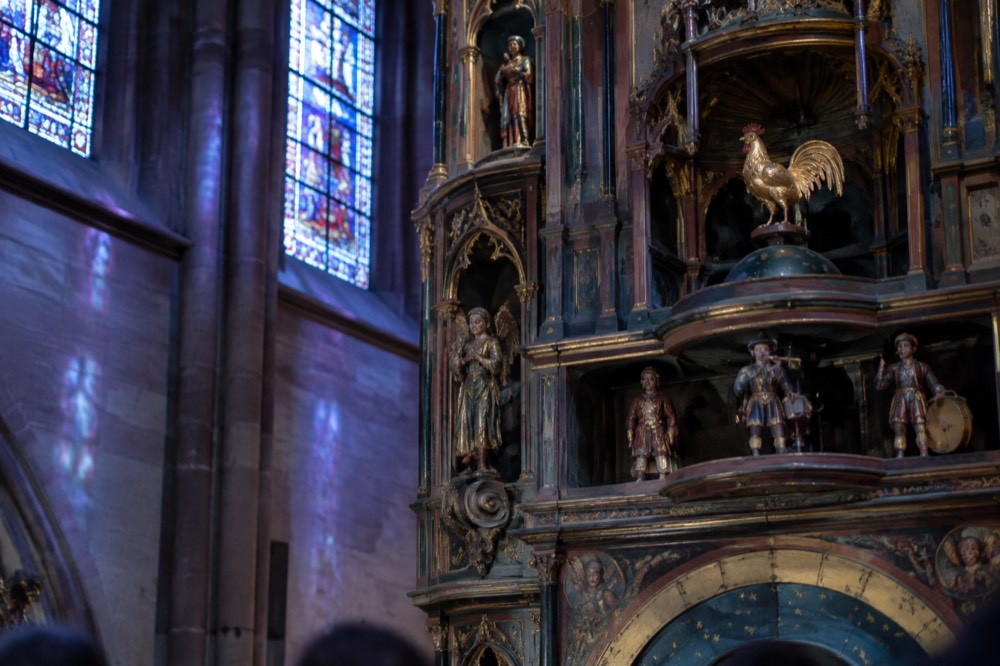
The show is the part visitors remember. At 12:30 sharp, the automaton sequence begins: figures representing the stages of life pass before a seated figure, a winged figure lowers and raises a staff, and at the end a gilded cockerel flaps its wings, lifts its head and crows. The whole performance is short, measured in minutes rather than a quarter hour, and it is timed to the half hour after the cathedral's midday period begins. Visitors who arrive at 12:29 have missed it; the mechanism does not wait.
When Does The Clock Show Run And What Does A Ticket Cost?
The full automaton show runs daily at 12:30 sharp, except on Sundays and feast days when an 11:00 mass is held, and a ticket costs 4 EUR for an adult, 3 EUR for groups of 12 or more and for students up to age 25, and 2 EUR for children aged 6 to 17, with tickets sold on the day only, at the cathedral stalls between 10:00 and 11:00 or from the Saint-Michel entrance from 11:30. There are no reservations for the clock show, so planning means being in the right place at the right time on the day itself. The cathedral's own page on the clock lists the access point at the Saint-Michel entrance on the Place du Château side.
The ticketing rules reward early arrival. Sales at the cathedral stalls run from 10:00 to 11:00, and from 11:30 the sales point moves to the Saint-Michel entrance. In the busy summer months and during the Christmas market, the queue for clock tickets forms well before the sales window opens, because the seating area in front of the clock has a finite capacity and latecomers stand at the back. Buying a ticket at 10:00 and then exploring the rest of the cathedral, or the nearby Musée de l'Œuvre Notre-Dame, before returning for the 12:30 show is the pattern regular visitors follow.
| Ticket type | Price | Notes |
|---|---|---|
| Adult | 4 EUR | Day-of purchase only, no reservations |
| Groups of 12 or more | 3 EUR | Reduced group rate |
| Students up to 25 | 3 EUR | Student rate with valid ID |
| Children 6 to 17 | 2 EUR | Under 6 enter free |
| Sales point 10:00-11:00 | Cathedral stalls | Morning window |
| Sales point from 11:30 | Saint-Michel entrance | Place du Château side |
A morning built around the clock pairs naturally with a food walk afterwards, since the show ends as the lunch service begins across the old quarter. The Do Eat Better traditional food tour with tastings is the related pick on this site for exactly that reason: it starts from the city centre, and its route through the winstubs and market streets of the Grande Île sits comfortably after a cathedral morning. Check availability on the operator's live listing if that combination appeals.
How Do Cathedral Hours Shape A Visit To The Clock?
The cathedral nave opens Monday to Saturday from 08:30 to 11:15 and again from 12:45 to 17:45, and on Sundays and feast days from 14:00 to 17:15, which means the 12:30 clock show sits inside the midday closure of general visiting, and clock ticket holders enter through the designated entrance rather than through the open nave, so the show always runs even when the nave itself is closed to casual visitors. The cathedral's own access page lists these hours, and during the Christmas market season the pattern changes: the cathedral stays open continuously Monday to Saturday from 08:30 to 17:45 on the Place du Château side.
The two daily opening windows matter more than visitors expect. The morning window closes at 11:15, before the clock ticket sales move to the Saint-Michel entrance at 11:30, and the afternoon window opens at 12:45. A visitor who wants both the nave and the show should treat the morning window as sightseeing time and the 11:30 to 12:30 gap as ticket and seating time. On a Sunday, general visiting does not begin until 14:00, so the show is effectively the only cathedral experience available before the afternoon.
| Period | Nave hours | What it means for the clock |
|---|---|---|
| Monday to Saturday | 08:30-11:15 and 12:45-17:45 | Show falls between the two visiting windows |
| Sundays and feast days | 14:00-17:15 | Morning access is for the show only |
| Christmas market season | Continuous Mon-Sat 08:30-17:45, Place du Château side | Longer nave hours around the show |
The platform at 66 m follows its own seasonal schedule, and it is the natural companion to the clock for visitors who want the view as well as the mechanism. The cathedral's platform page gives the detail, summarised below.
| Season | Platform hours | Last ascent | Ticket |
|---|---|---|---|
| 1 April to 30 September | 09:30-13:00 and 13:30-20:00 | 19:15 | 10 EUR normal, 6 EUR reduced, under 6 free |
| 1 October to 31 March | 10:00-13:00 and 13:30-18:00 | 17:15 | 10 EUR normal, 6 EUR reduced, under 6 free |
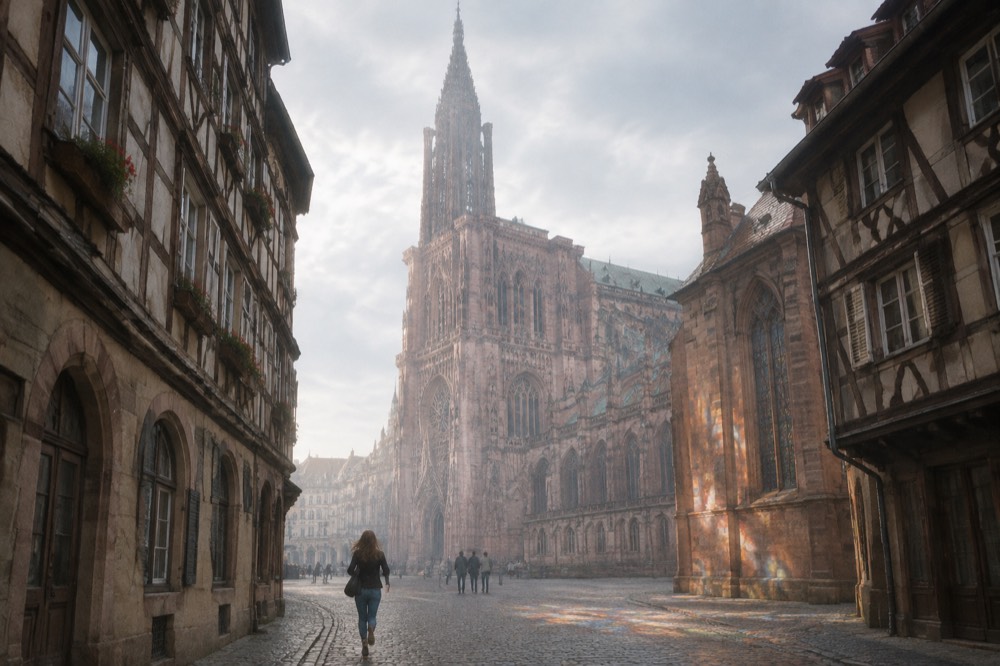
The platform ticket carries a small bonus that clock visitors should know about: it gives a reduced rate at the Musée de l'Œuvre Notre-Dame, the cathedral museum across the Place du Château, which holds the original sculpture removed from the cathedral over the centuries. There are no luggage lockers at the cathedral, so travellers arriving between hotels should plan baggage separately; the Strasbourg luggage storage guide covers the options.
How Does The Astronomical Clock Actually Work?
The clock is driven by a weight-and-pendulum movement whose computing section performs calendar arithmetic mechanically, advancing dials for the day, the month, the solar and lunar cycles and the church's movable feasts, while a separate automaton train stores the energy released at 12:30 sharp to move the carved figures in sequence, ending with the cockerel that flaps, lifts and crows, all of it visible to visitors as painted case, dial and sculpture rather than as a sealed black box. The engineering is the reason horologists still write about this machine. Its predecessors on the same spot were famous in their own day, and the current clock was designed so that its calendar computation would stay correct over very long periods, correcting the drift between the solar year and the calendar without manual adjustment.
The automaton sequence is a staged procession. Figures representing the ages of life pass one by one before a seated figure and bow. An angel turns an hourglass. Death, as a skeleton, strikes a bell. At the end of the cycle the cockerel above the case spreads its wings, raises its head and crows, and the show is over. Each movement is triggered in order by the train of cams and levers inside, which is why the timing is fixed to the half hour and why there is no shortened or repeat performance.
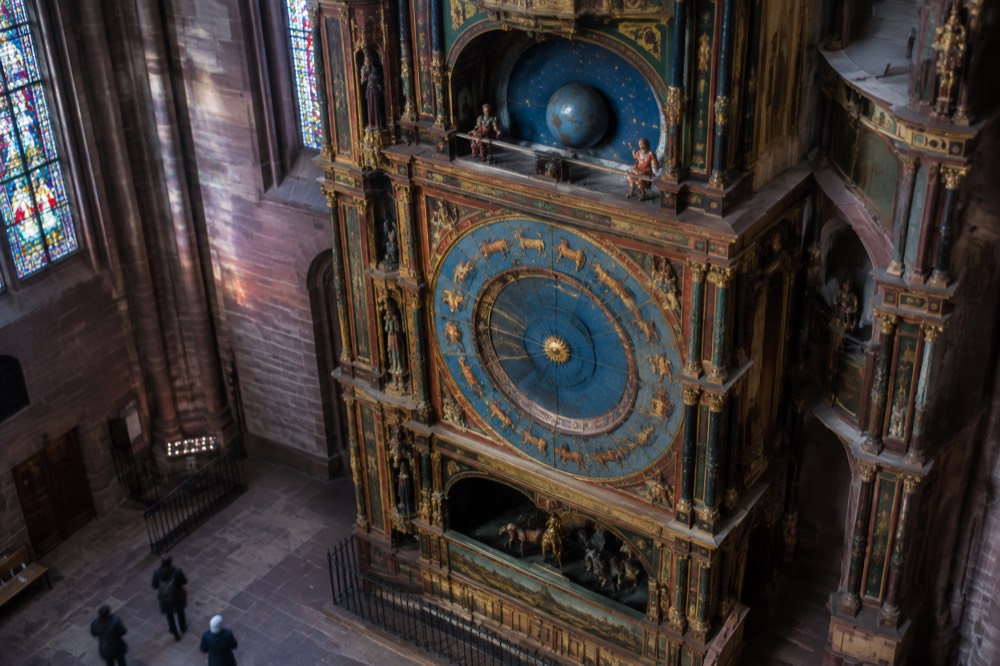
What surprises many visitors is how much of the machine is not about the show at all. The dials that face the nave are working instruments: they display the equation of time, the true solar time against civil time, and the position in the zodiac, alongside the feast calendar. The show gets the applause, but the calendar computation is the part that made the clock famous among clockmakers.
What Else Should You See Inside Strasbourg Cathedral?
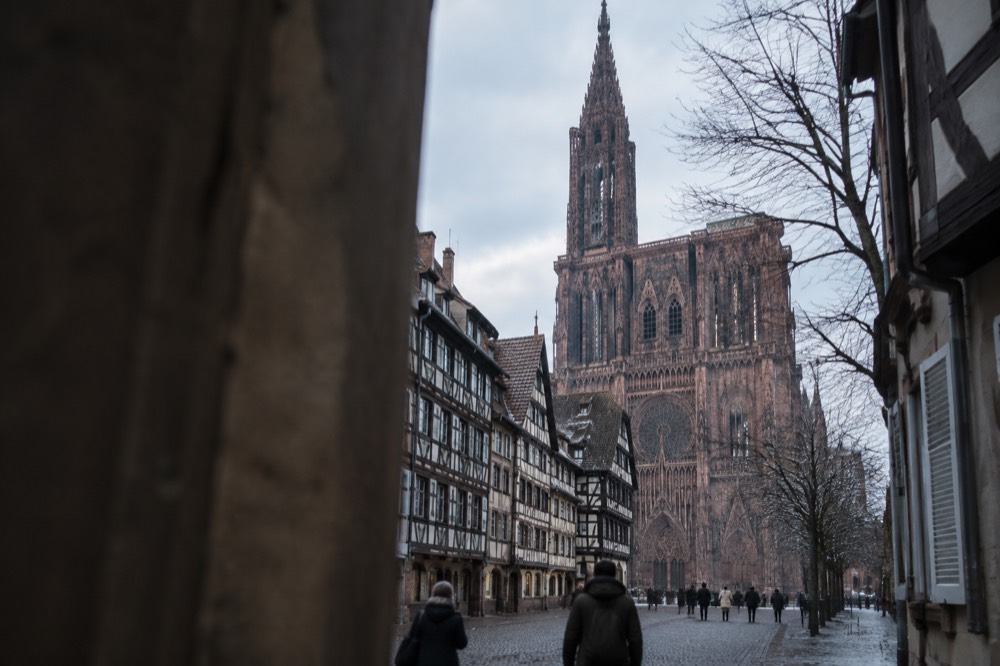
Strasbourg Cathedral's interior rewards far more than the clock alone: the nave is a tall, light-filled Gothic space with a famous single spire rising above it, the stained glass includes a large rose window and panels of figurative glass, and the cathedral's own hours page lists everything a visitor needs for planning, so a clock visit should be planned as part of a fuller cathedral stop of at least an hour, not as a twelve-minute in-and-out around the 12:30 show. The building is the city's landmark, described in detail on this site's Strasbourg Cathedral guide, and the clock sits inside it as one exhibit among many.
The practical loop inside the cathedral is simple. Enter through the main west front, walk up the nave taking in the glass on both sides, then cross to the south transept for the clock. Visitors holding a clock ticket for the 12:30 show can do this loop in the morning window, exit for lunch or for the museum, and re-enter through the Saint-Michel entrance for the show itself. Other pages covering the same trip are gathered on Strasbourg Travel Guide.
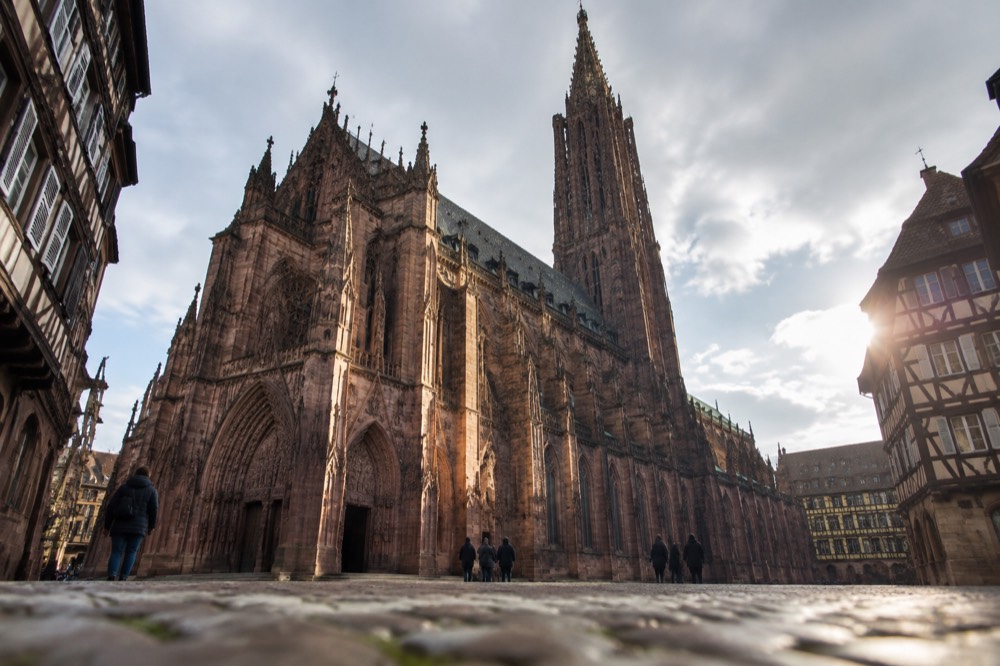
Two cautions from the cathedral's own pages. First, the nave closes to general visiting at 11:15 on weekdays, so the full loop must fit the morning window if the show is the midday anchor. Second, during the Christmas market the continuous Monday-to-Saturday opening on the Place du Château side removes that constraint, which is why December is a comfortable season for a combined visit despite the crowds.
How To Plan A Day Around The 12:30 Show
A day built around the clock show works best in three blocks: a morning block inside the cathedral and its museum, the 12:30 show followed by lunch, and an afternoon block in the riverside quarters or on a guided tour, with the whole plan anchored on the 10:00 ticket window and the 11:30 Saint-Michel entrance so that the show is secured before anything else is attempted. The pattern below assumes a first visit to the city and uses only opening times that the cathedral and museum pages state.
| Time block | What to do | Why it fits |
|---|---|---|
| 09:30-11:00 | Cathedral nave loop, then Musée de l'Œuvre Notre-Dame | Morning window closes at 11:15 |
| 10:00-11:00 | Buy clock ticket at the cathedral stalls | First sales window of the day |
| 11:30-12:25 | Return via Saint-Michel entrance, take a seat | Sales and entry point from 11:30 |
| 12:30 | Watch the automaton show | The one fixed point of the day |
| 12:45 onward | Lunch, then Petite France or a guided tour | Nave reopens at 12:45 if unfinished |
The afternoon is where the guided products on this site slot in. A Euro tour by Segway is a format contrast to a morning on foot: it covers the European institutions and the riverbanks quickly, and the operator's live listing carries the meeting point and the current price. Check availability there before committing to a time, since Segway slots around the old quarter fill fastest in the afternoon.
For visitors who prefer pedal power, a guided bike tour with a local guide covers the Grande Île, the Neustadt and the river loops in about two and a half hours, which pairs well with a shorter cathedral morning. The city is famously flat and bike-friendly, and the guided format handles the crossings and the tram lines that can catch a first-time cyclist out.
What Sights Near The Cathedral Pair Well With The Clock?
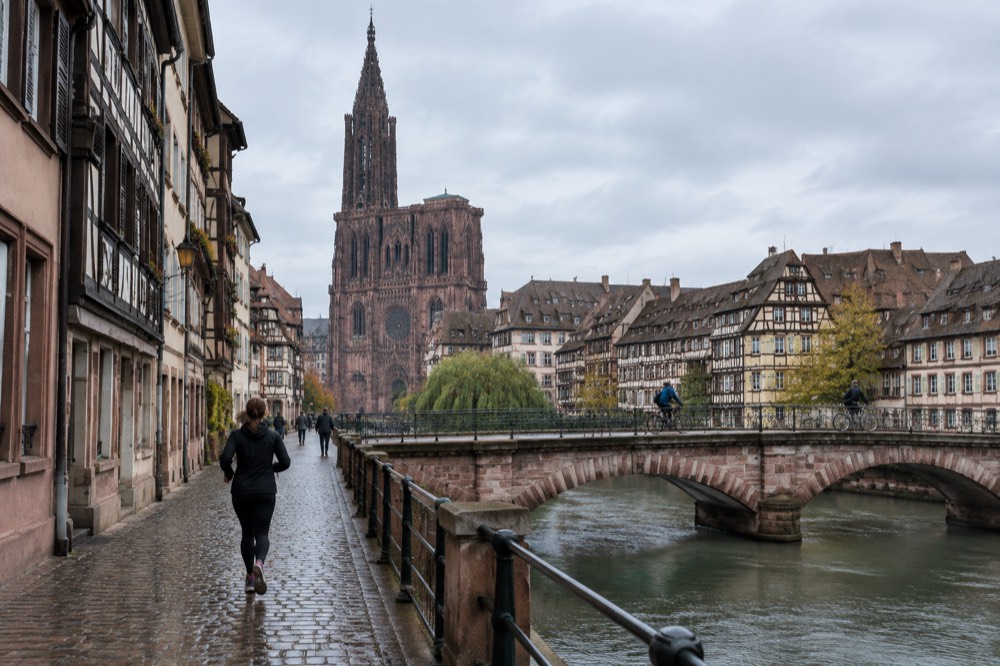
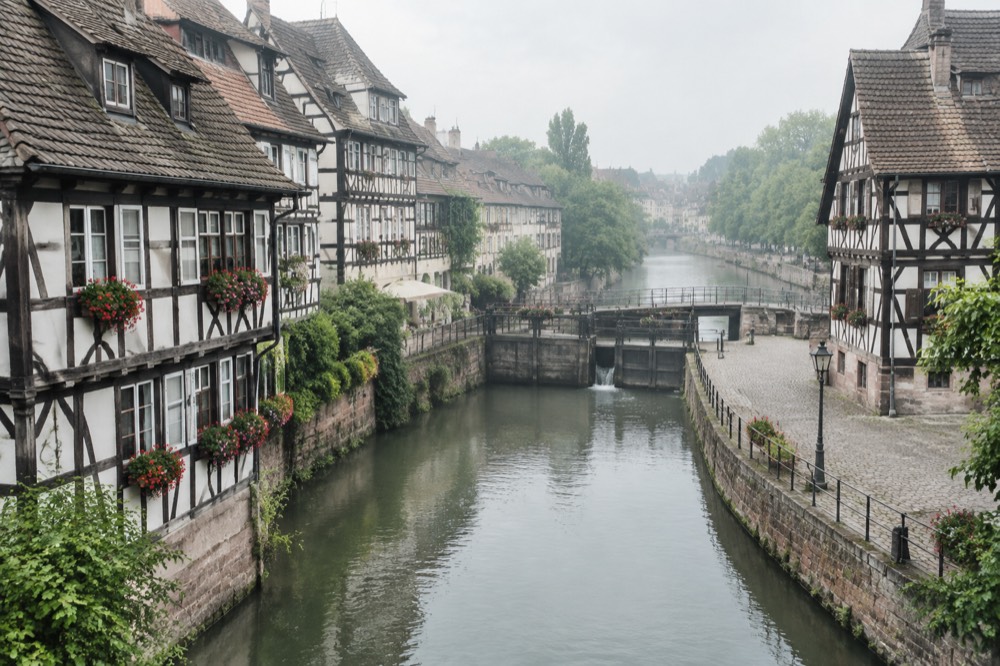
The clock sits at the heart of a walkable cluster: the Place du Château and the Musée de l'Œuvre Notre-Dame are steps from the transept, the Palais Rohan with its museums and the Maison Kammerzell stand within the same few streets, and the riverside quarter of Petite France with the Ponts Couverts and the Barrage Vauban terrace is a short walk south, so a visitor can cover the clock, a museum and the river quarter in one afternoon without transport. The distances here are genuinely short; the whole cluster sits on the Grande Île, the river-island historic centre of Strasbourg.
| Sight | What it offers | When to fit it | What to check |
|---|---|---|---|
| Musée de l'Œuvre Notre-Dame | Original cathedral sculpture and medieval art | Morning, before the show | 9 EUR full, 5 EUR reduced; free first Sunday |
| Palais Rohan | Three museums in one palace | Afternoon | 9 EUR full, 5 EUR reduced per museum |
| Maison Kammerzell | Half-timbered merchant house on the cathedral square | Any time the square is open | Facade visible from outside |
| Petite France | Half-timbered riverside quarter | Afternoon light is best | Public streets and squares |
| Barrage Vauban terrace | Panoramic platform over the rooftops | Late afternoon | Seasonal hours, check the official page |
Two ticketing facts from the city's museums page are worth folding into a plan. Every municipal museum in Strasbourg is free on the first Sunday of the month, which makes a first-Sunday visit a genuine saving for families. And the 1-day Pass Musées at 20 EUR covers the municipal museums in one go, which pays off only for visitors intending several museums in a single day; the Strasbourg City Card at 5 EUR for seven days is a discount card rather than an all-inclusive pass, and it reduces the cathedral platform and clock tickets along with museum and boat tickets.
One closure to plan around: the Musée Alsacien is closed for works until 2028 and should not be routed into any visit. The other municipal museums, including the Archaeological Museum in the Palais Rohan and the Museum of Modern and Contemporary Art, are open on the standard ticket terms above.
When Is The Best Time Of Year To See The Clock?
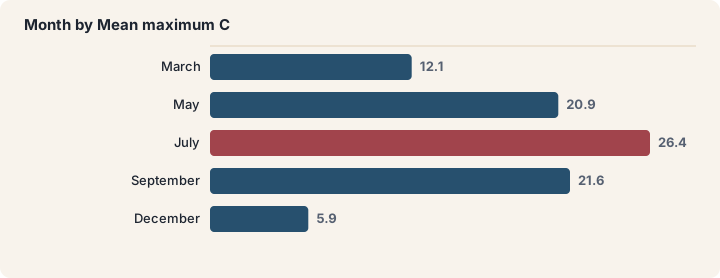
The clock runs at 12:30 sharp every day of the year, so the choice of season is about crowds and comfort rather than the machine: summer brings the longest days and the fullest queues for the 10:00 ticket window, December brings the Christmas market and continuous cathedral opening on weekdays, and the shoulder months offer the calmest access, with Strasbourg's semi-continental climate giving mean daily maxima of 20.9 C in May and 21.6 C in September against 5.9 C in December. The Meteo-France 1991-2020 normals for Strasbourg-Entzheim, the reference series for the city, also record 10.2 December days with a millimetre or more of rain, against 8.0 such days in September, which is worth weighing for a plan built around standing in an unheated square.
| Month | Mean maximum C | Mean minimum C | Rain days of 1 mm or more |
|---|---|---|---|
| March | 12.1 | 2.6 | 8.5 |
| May | 20.9 | 10.1 | 10.8 |
| July | 26.4 | 14.9 | 10.4 |
| September | 21.6 | 10.7 | 8.0 |
| December | 5.9 | 0.8 | 10.2 |
December deserves a special note because of the Christmas market. Last year's edition ran from 26 November to 24 December 2025 and drew 3.05 million visitors, and the city posts each edition's dates on its Christmas site, so anyone planning a December clock visit should confirm the dates and the market programme on the city's own Christmas pages. The market changes the cathedral's weekday opening to a continuous 08:30 to 17:45 on the Place du Château side, which is convenient for the clock, but it also fills the square and the transept.
For a first visit in any season, a general walking tour with a local guide is a sound afternoon companion to a clock morning: the standard format covers the old quarter's lanes and stories, and the operator's live listing shows the current meeting point and price. Check availability there once the cathedral plan is fixed.
After the clock show, an afternoon walk rounds out the day, book a free walking tour here.
Common Questions About The Strasbourg Astronomical Clock
What time does the Strasbourg astronomical clock show run?
The full automaton show runs daily at 12:30 sharp, except on Sundays and feast days when an 11:00 mass is held. There is no second performance, so visitors should be seated in front of the clock before 12:30.
How much does a ticket to the astronomical clock cost?
An adult ticket costs 4 EUR. Groups of 12 or more and students up to 25 pay 3 EUR, children aged 6 to 17 pay 2 EUR, and children under 6 enter free.
Can you book astronomical clock tickets in advance?
No. Tickets are sold on the day only, with no reservations. Sales run at the cathedral stalls from 10:00 to 11:00 and from 11:30 at the Saint-Michel entrance on the Place du Château side.
How long does the clock show last?
The automaton sequence is short, a matter of minutes, ending with the cockerel flapping its wings and crowing. The seated waiting time before 12:30 is longer than the show itself, so plan to arrive from 11:30 with a ticket in hand.
Is the astronomical clock inside Strasbourg Cathedral?
Yes. The clock stands in the south transept of Strasbourg Cathedral in Alsace, north-eastern France, and the show is watched from the transept floor. General nave visiting hours differ from the show access, so check the cathedral's own hours page when planning.
Can you visit the cathedral tower on the same day?
Yes. The platform at 66 m runs on a seasonal schedule, 09:30-13:00 and 13:30-20:00 from April to September and 10:00-13:00 and 13:30-18:00 from October to March, with a 10 EUR normal ticket and 6 EUR reduced. The platform ticket also gives a reduced rate at the Musée de l'Œuvre Notre-Dame.
The astronomical clock rewards a small amount of planning more than almost any other sight in Strasbourg: one ticket bought in a morning window, one seat taken before half past noon, and the rest of the day opens up around it. Pair it with the platform, the cathedral museum across the square, and a slow lunch in the old quarter, and the machine becomes the anchor of a full day in Alsace's capital rather than a passing curiosity.