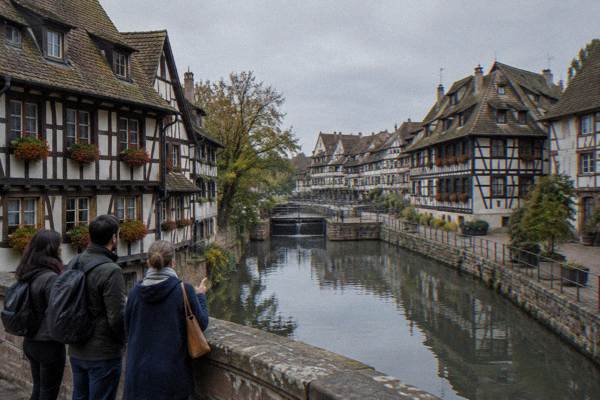
Ponts Couverts Strasbourg
The Ponts Couverts are the medieval river gateway into Strasbourg's Grande Île, four towers and three roofed bridges over the Ill, best seen from the Barrage Vauban terrace beside them.
Short answer
The Ponts Couverts stand at the southern edge of the Grande Île in Strasbourg, France, where the River Ill splits around the old town. They are a set of medieval bridges and four square towers, open to stroll across at any hour. The classic view is from the Barrage Vauban terrace next door, whose seasonal hours are 08:00-19:00 from March to October.
The Ponts Couverts are the roofed river bridges and square stone towers that guard the southern entrance to Strasbourg's Grande Île, in Alsace, north-eastern France, a short walk from the Petite France quarter. They carry no ticket, hold no queue and ask nothing of the visitor except that you cross them slowly, because the whole point of the place is the water: the River Ill divides into channels here, and the bridges were built to be closed, defended and watched, not rushed. Today they are one of the most recognisable sights in a city that already has plenty of them, and they sit beside the Barrage Vauban, whose panoramic terrace gives the single most complete view of the towers, the roofs and the water in one frame.
This guide covers what the Ponts Couverts are, where to stand to see them properly, how to pair them with the sights within a few minutes' walk, what a river tour shows of them, when the light and the weather behave, and how to get there on Strasbourg's trams and buses. Every price and hour printed here comes from the official pages of the cathedral, the museums, the transport network and the boat operator, so the figures are the ones you will find on the day.
What Are The Ponts Couverts In Strasbourg, France?
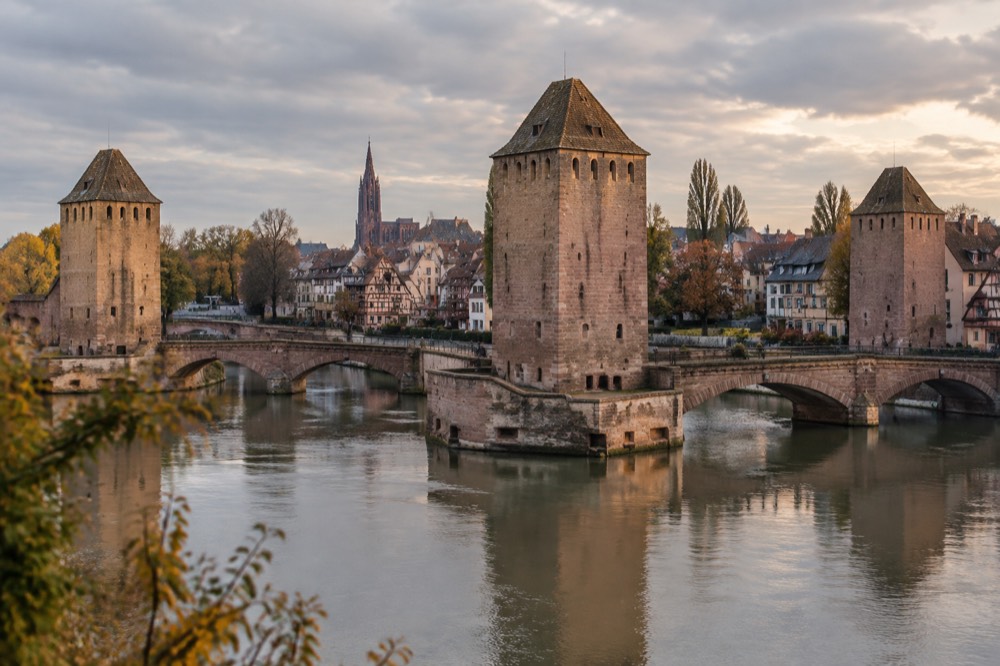
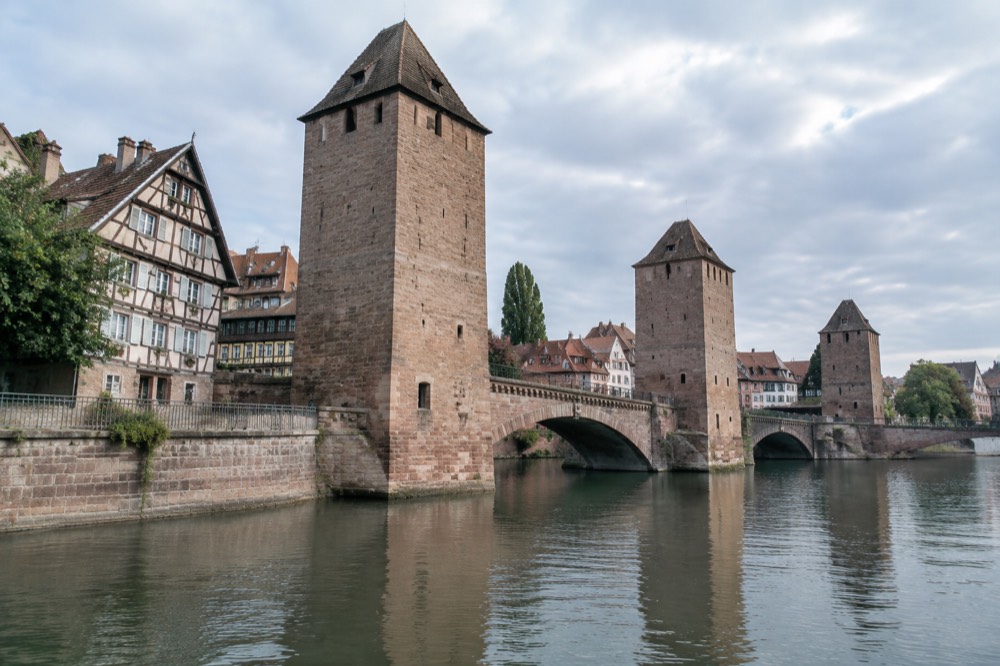
The Ponts Couverts are a group of roofed bridges and defensive towers spanning the channels of the River Ill at the southern tip of the Grande Île, the island core of Strasbourg, France. They belong to the city's medieval fortifications, and their roofs are the reason for the name: the wooden bridge decks were covered so defenders could move and fire from them sheltered. Today the bridges are open to pedestrians at all hours, free to cross.
The name trips people up in both directions. English speakers sometimes read "Ponts Couverts" and expect covered walkways like a bridge with a corridor; French speakers from elsewhere sometimes assume the roofs are a later decorative whim. The roofs were functional, part of a defensive system that also included the Barrage Vauban a little downstream, and the four square towers that punctuate the bridges are the surviving stone witnesses of it. The site is part of the UNESCO World Heritage property "Strasbourg, Grande-Île and Neustadt", which the listing describes as an outstanding example of a medieval city quarter; the Neustadt was added later as an extension of the property.
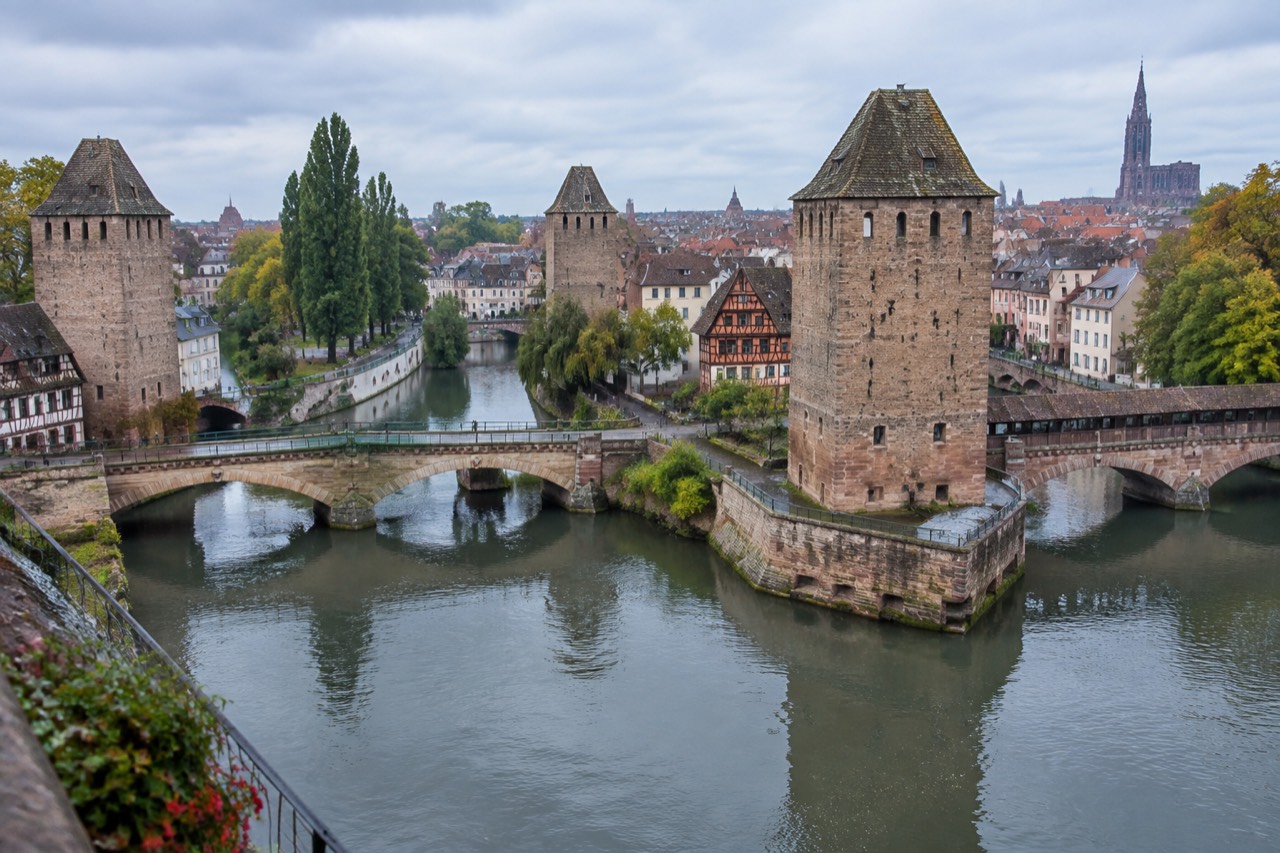
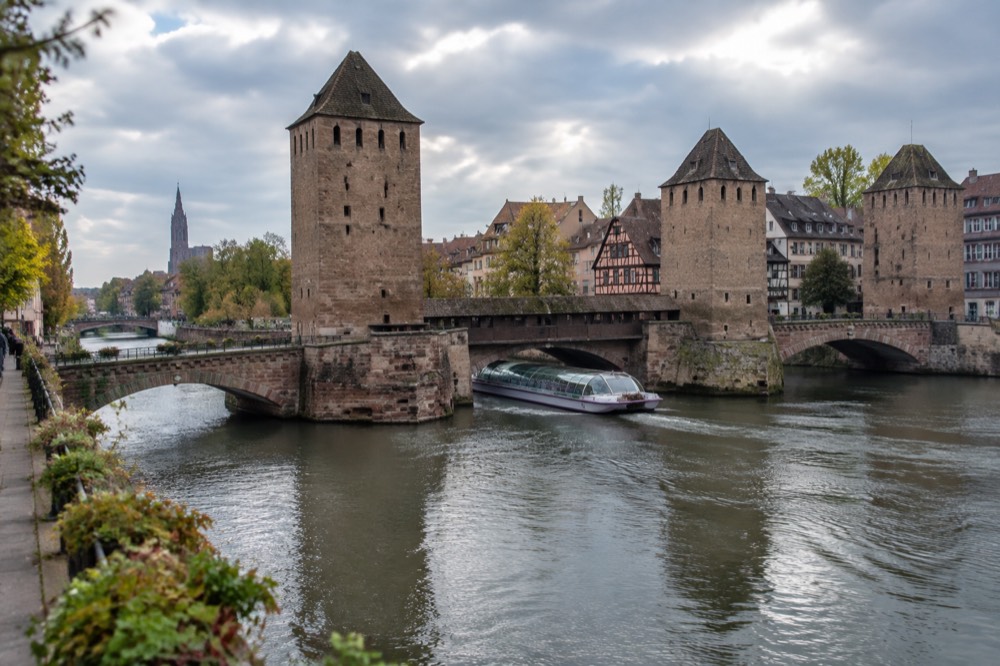
What makes the spot work visually is the water. The Ill does not arrive at the bridges as one river: it splits into several arms around the Grande Île, and at the Ponts Couverts those arms run side by side under a row of separate bridge spans. Stand on the Barrage Vauban terrace and you see the whole arrangement at once, the towers reflected in the channels, the half-timbered roofs of Petite France behind them, and the spire of Strasbourg Cathedral rising over the rooftops further north. It is a compact scene, and it is the reason so many photographs of Strasbourg are taken from exactly that spot.
A practical note on expectations: the Ponts Couverts are a piece of urban landscape, not a ticketed attraction. There is no entrance, no desk, no opening hour for the bridges themselves. You walk onto them from the Petite France side or from the Étoile side, and you can do so at midnight as easily as at midday. The things around them that do have hours and prices, the Barrage Vauban terrace, the boat tours, the museums, are covered in the sections below with their published figures.
Where To See The Ponts Couverts From: The Viewpoints On The River Ill
The classic view of the Ponts Couverts is from the panoramic terrace of the Barrage Vauban, the fortified weir that sits directly downstream of the bridges; the terrace's published seasonal hours are 08:00-19:00 in September and October, 08:30-16:00 from November to February, and 08:00-19:00 in March and April. Secondary views come from the banks of the Ill in Petite France, from the bridges themselves, and from the water on a river tour.
The Barrage Vauban terrace deserves its reputation. From its platform you look north across the full width of the water: the parallel channels, the roofed spans strung between their towers, and behind them the sloping roofs and chimneys of Petite France. The terrace is part of the same defensive logic as the bridges, a later lock-and-weir structure that could raise the water level to flood the approach to the city in time of siege. Its own page on the city's site gives the seasonal hours above; the admission price is not published on that page, so check there before you plan the visit rather than relying on any figure printed elsewhere.
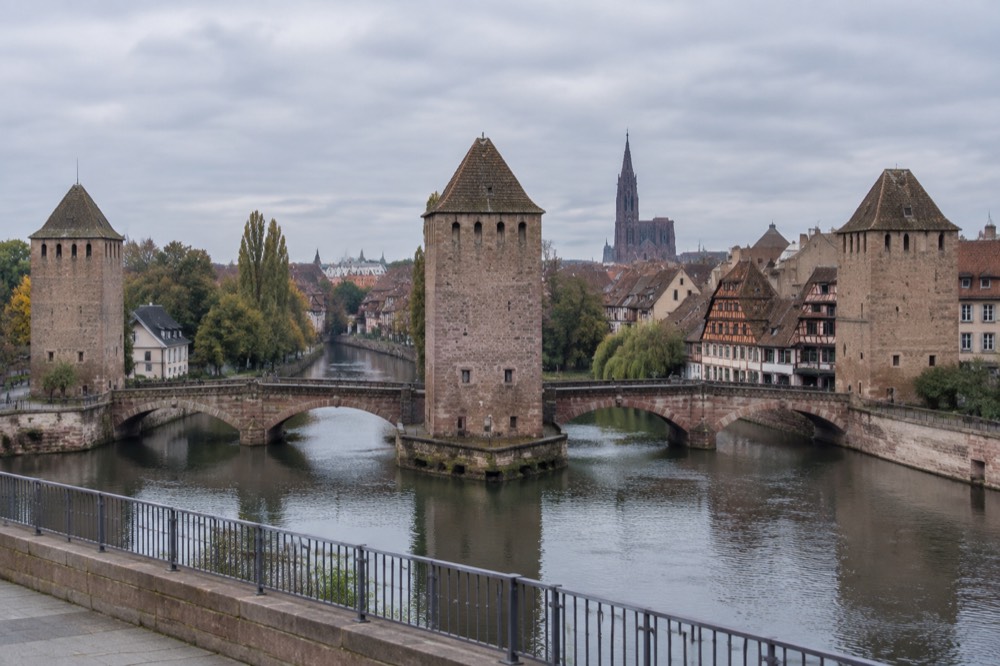
The second viewpoint costs nothing and has no hours at all: the banks themselves. On the Petite France side, the quays along the channels give you a low, close view of the bridge arches and the water sliding under them, and at either end of the day the light comes in along the river and warms the stone. The Petite France quarter guide covers those streets in detail, including the tanners' district that gives the quarter its name.
The third viewpoint is the water itself. Batorama, the city's river cruise operator, runs glass-roofed boats from a landing a short walk upstream, and the shorter of its two standard circuits passes through this stretch of the Ill. The Barrage Vauban guide and the Strasbourg Cathedral guide both pair naturally with a morning here, since all three sights sit within the same corner of the Grande Île and a visitor walking at an ordinary pace can move between them without transport.
A guided walk is the other way to see the bridges, and the one this site features for the Ponts Couverts is the small-group hidden stories walk, a two-and-a-half-hour tour whose route covers the river fortifications and the quarters behind them. The stories attached to the towers and the weir are the kind of thing a guide earns their fee on: why the roofs exist, what the towers were for, what happened on this water. The walk runs with small groups, and its live listing carries the free-cancellation terms.
How To Pair The Ponts Couverts With Nearby Sights
The Ponts Couverts sit within a ten-minute walk of the Barrage Vauban, Petite France, the Musée de l'Œuvre Notre-Dame, the Musée Historique and Strasbourg Cathedral, which makes them the natural anchor of a half-day circuit of the Grande Île's southern half. The municipal museums charge 9 EUR full price and 5 EUR reduced, a one-day Pass Musées is 20 EUR, and every municipal museum is free on the first Sunday of the month.
The pairing that works for nearly everyone is bridges, terrace, then Petite France, in that order, because the terrace view explains the geography before you walk into it. After that the circuit continues north: the Musée Historique tells the city's own story and sits close to the river, the Musée de l'Œuvre Notre-Dame holds the cathedral's medieval sculpture, and the cathedral itself closes the walk with its single spire and its platform at 66 m. The Musée Historique guide and the Musée de l'Œuvre Notre-Dame guide each cover what is inside and what the ticket covers.
| Sight | What it is | Why it pairs with the Ponts Couverts | What to check before going |
|---|---|---|---|
| Barrage Vauban | Fortified weir with a panoramic terrace | The main viewpoint, directly downstream | Seasonal hours; admission not published on the city page |
| Petite France | Former tanners' quarter of half-timbered houses | The streets the terrace view looks across | No ticket; open streets |
| Strasbourg Cathedral | Gothic cathedral with a single spire | The skyline landmark above the bridges | Nave hours 08:30-11:15 and 12:45-17:45 Mon-Sat |
| Musée de l'Œuvre Notre-Dame | Medieval sculpture and cathedral art | The stonework that explains the city's building craft | 9 EUR full, 5 EUR reduced |
| Musée Historique | City history museum | The sieges and defences the bridges belong to | 9 EUR full, 5 EUR reduced |
| Musée Alsacien | Alsatian folk life museum | Would pair well, but it is closed | Closed for works until 2028 |
The cathedral deserves its own note, because its hours shape many people's day. The nave is open Monday to Saturday 08:30-11:15 and 12:45-17:45, and on Sundays and feast days 14:00-17:15; during the Christmas market it stays open continuously on the Place du Château side. The platform at 66 m costs 10 EUR full and 6 EUR reduced, with under-6s free, and its hours shift with the seasons: 09:30-13:00 and 13:30-20:00 from April to September, 10:00-13:00 and 13:30-18:00 from October to March. The astronomical clock show runs at 12:30 sharp, tickets 4 EUR, bought on the day only. The full detail is in the Strasbourg Cathedral guide and the astronomical clock guide.
If the morning is spent on the bridges and the museums, the afternoon can go one of two ways. A river tour from the Batorama landing covers the same water from below; a walk north through the Grande Île carries you to the cathedral and the Place Kléber. Families with children often prefer the river option, because the boats are enclosed and the ride is short; the Le Vaisseau science centre guide covers the children's alternative for a longer stay.
What A River Tour Shows Of The Bridges
Batorama's standard circuits pass through the Ill's channels around the Grande Île, and the short tour, the Blue Tour, runs 45 minutes at 12.50 EUR full and 7.20 EUR reduced, while the long Red Tour runs 1h10 at 16.20 EUR full and 8.90 EUR reduced. The boats are glass-roofed, the circuits are commentaried, and the landing is a short walk upstream from the Ponts Couverts. These are the operator's own published prices and durations.
From the water the Ponts Couverts read differently. The terrace view shows you the arrangement of towers and channels; the boat view puts you underneath the spans, looking up at the timber of the roofs and the stone of the arches as the boat slides through. The commentary on the standard circuits covers the fortifications and the quarters on both banks, and the return leg of the Parliament-Cathedral route takes 17 minutes for those who want only a taste of the river.
| Batorama circuit | Duration | Full price | Reduced price |
|---|---|---|---|
| Blue Tour, short circuit | 0h45 | 12.50 EUR | 7.20 EUR |
| Red Tour, long circuit | 1h10 | 16.20 EUR | 8.90 EUR |
| Parliament-Cathedral return | 17 min | Price on the operator's page | Price on the operator's page |
For visitors who want the water to themselves, the roster also carries a private boat option with a skipper, a two-hour cruise on the Ill for a group of up to four people, which passes the same bridges without a commentary schedule attached. The figures for that product, its price and its rating, sit on its live listing rather than on this page. For everyone else the standard circuits are the practical choice, and their prices are the ones in the table above, taken from the operator's own ticket page.
The bridges also appear on foot itineraries that use the river as a spine. The traditional food walking tour with tastings, a three-and-a-half-hour walk through the city's winstubs and food shops, crosses this stretch of the Ill as it moves between quarters, and its tastings give the walk a different rhythm from a pure sightseeing tour. Its current price and times render on the live listing.
When To Visit: Light, Seasons And Weather
Strasbourg's climate is semi-continental, with Meteo-France 1991-2020 normals giving mean daily maxima from 5.2 C in January to 26.4 C in July and about 635.7 mm of rain across 112.3 rain days a year, so the Ponts Couverts are a year-round sight with genuinely different moods: frost and possible snow on the channels in winter, warm evenings on the quays in summer. There is no bad month for the view from the terrace, only different clothing.
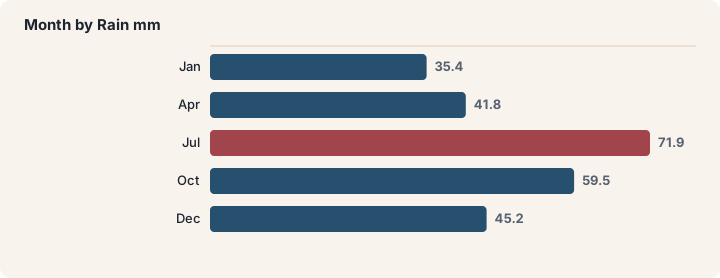
The seasonal numbers are worth knowing before you plan, because they are steadier than a forecast. December, the Christmas market month, has a mean maximum of 5.9 C, a mean minimum of 0.8 C and 45.2 mm of rain over 10.2 days of 1 mm or more, which is to say: cold, occasionally wet, and dark by late afternoon. July and August have mean maxima of 26.4 C and 26.1 C. May is the wettest month on the normals at 77.2 mm, though its rain days, 10.8, are barely ahead of July's 10.4. The rest of the planning pages sit on Strasbourg Travel Guide.
| Month | Mean max C | Mean min C | Rain mm | Days of 1 mm or more |
|---|---|---|---|---|
| Jan | 5.2 | -0.2 | 35.4 | 9.1 |
| Apr | 17.0 | 5.7 | 41.8 | 8.6 |
| Jul | 26.4 | 14.9 | 71.9 | 10.4 |
| Oct | 15.8 | 7.2 | 59.5 | 9.6 |
| Dec | 5.9 | 0.8 | 45.2 | 10.2 |
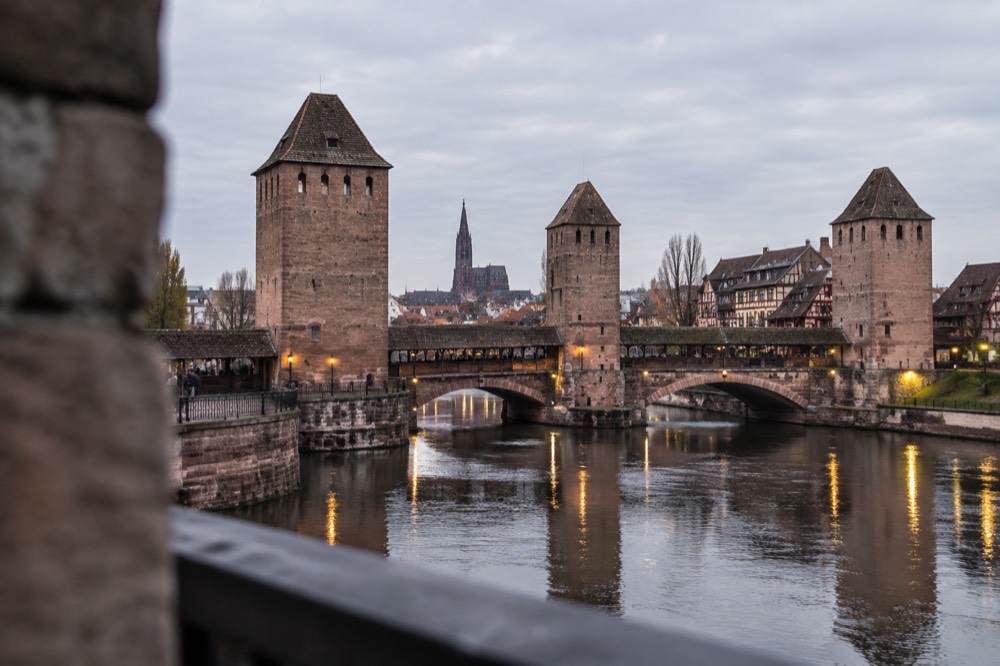
Light matters more than temperature for this particular view. The terrace faces the bridges from the south, so the towers and roofs are lit from mid-morning to mid-afternoon; early and late in the day the sun comes in low along the river and the reflections on the water do the work instead. In the weeks of the Christmas market, late November to 24 December, the whole stretch of the Ill is lit for the season, and the bridges after dark are a different sight from the bridges at noon, with the chalets of the market spread across the squares of the Grande Île behind them. The city posts each edition's dates on its Christmas site, so confirm them there; last year's edition ran 26 November to 24 December 2025 and drew 3.05 million visits.
One seasonal note on the terrace itself: the Barrage Vauban's hours shorten in the winter months to 08:30-16:00 from November to February, which means the after-dark Christmas view of the bridges is taken from the banks and the bridges, not from the terrace. That is less a loss than it sounds, because from the covered spans themselves you stand inside the lit structure, and the channels open out on either side of you.
How To Get To The Ponts Couverts
The Ponts Couverts sit at the southern edge of the Grande Île, reached on foot from anywhere in central Strasbourg, and the CTS network that serves them charges 1.90 EUR for a single ticket bought in the app, on a Badgéo card or by contactless, 2.50 EUR if bought on board a bus, 4.60 EUR for a 24h Solo pass and 10.20 EUR for a 24h Trio pass covering two or three people. The airport shuttle's combined train-and-ticket fare is 4.60 EUR.
The single ticket is the one detail that catches visitors: the same journey costs 1.90 EUR or 2.50 EUR depending only on where you buy it. The CTS fare page lists both prices plainly, and the app or a contactless card at the validator gives the lower one. For a day of hopping between the bridges, the museums and the cathedral, the 24h Solo at 4.60 EUR pays for itself on the fourth ride; for two or three travelling together the 24h Trio at 10.20 EUR is the arithmetic to check first.
| CTS ticket | Price | Notes |
|---|---|---|
| Single, app / Badgéo / contactless | 1.90 EUR | Validated before boarding |
| Single, bought on board a bus | 2.50 EUR | The higher counter price |
| 24h Solo | 4.60 EUR | One traveller, all CTS lines |
| 24h Trio | 10.20 EUR | Two or three travellers together |
| Airport combined ticket | 4.60 EUR | Train shuttle plus 24H EMS ticket |
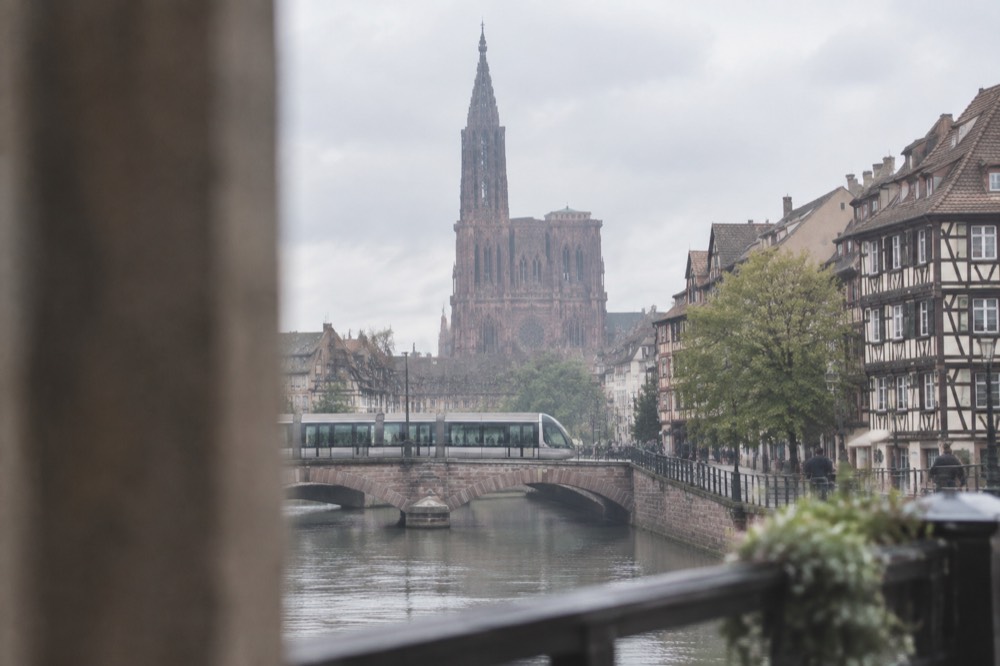
Visitors arriving by air should know that the airport train shuttle runs up to five trains an hour and takes 8 minutes from Entzheim to the central station, with the combined ticket at 4.60 EUR covering the train and a day of urban transport. From the station the walk to the Ponts Couverts crosses the Grande Île from north to south, past the cathedral and through the shopping streets, and it is the introduction to the city that many visitors remember as much as the bridges themselves. The getting around pages on this site cover the tram lines and the walking routes in more detail, and the Strasbourg Cathedral guide marks the halfway point of that walk.
Cyclists have an easy time of it too. The Ill is followed by flat towpaths on both banks, and the bridges sit on the route between the Petite France quays and the Jardin des Deux Rives further south, where the river path continues toward the German border and Kehl on the far side of the Rhine. The city's bike-hire and cycle-route detail belongs to the transport pages; what matters here is that the bridges are a node on a riverside ride, not a detour from one.
What The Bridges Mean In The City's Story
The Ponts Couverts are the surviving piece of Strasbourg's medieval river defences, a chain of towers and roofed spans that closed the southern water approach to the Grande Île, later reinforced downstream by the Barrage Vauban, whose weir could raise the Ill to flood the ground in front of the walls. Together they explain why the old city sits where it sits and why the channels around the island look the way they do. The site is protected within the UNESCO property "Strasbourg, Grande-Île and Neustadt".
The mechanics are worth a moment, because they make the view make sense. A city on an island in a dividing river has a natural moat; the problem is that a moat only works if you can control the water and the crossings. The towers of the Ponts Couverts controlled the crossings, and the roofed decks let defenders hold them under cover. The Barrage Vauban controlled the water, damming the Ill so the level could be manipulated. What looks today like a picturesque row of bridges was, in its working life, a single hydraulic and military machine, and the reason the towers stand in a line across several channels rather than one bridge over one river is that the defence was built for the water's geometry, not for a postcard.
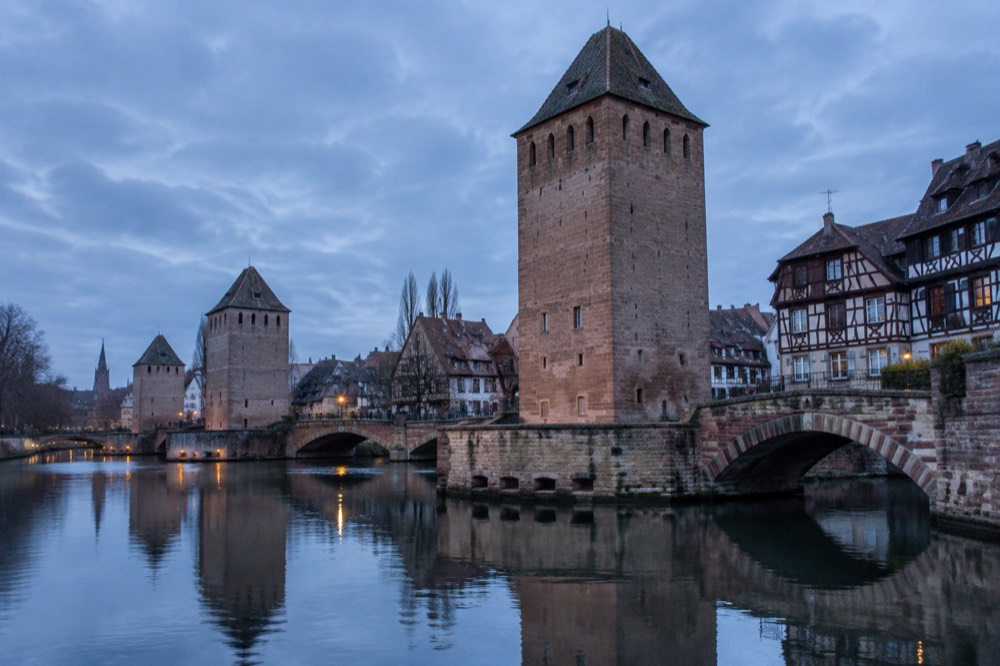
That geometry is also why the quarter behind the bridges, Petite France, looks the way it does. The tanners who worked there needed the river's channels, and the defences that closed the island also shaped where the working trades could cluster. The Petite France guide walks that story street by street. For the sieges, the treaties and the city's later role as a parliamentary capital, the Musée Historique guide is the deeper dive, and the museum's own galleries carry the narrative further than a page can.
The European institutions are the modern chapter of the same story of a border city, and they are reachable from the bridges by tram in the other direction. The European Parliament guide and the Council of Europe guide cover those buildings and their visiting arrangements, including the Parlamentarium, which outside plenary weeks opens Monday to Friday 09:00-18:00 and Saturday 09:30-12:00 and 13:00-18:00, with an airport-style security check at entry and different hours in plenary weeks.
Beyond The Bridges: Day Trips That Start Here
The Ponts Couverts make a natural first stop on a wider Alsace itinerary, because the same river-and-fortification logic repeats across the region: the wine villages south of Strasbourg, the castles on the Vosges ridge, and the Black Forest across the Rhine in Germany all sit within a day trip of the city. Organised day tours from Strasbourg cover Colmar, Riquewihr, Kaysersberg and the Haut-Koenigsbourg castle in a single circuit, and the operators' listings carry the current prices and departure details.
The classic circuit is the one that strings together Colmar's old town, the wine village of Riquewihr, Kaysersberg and the Haut-Koenigsbourg castle, a full day that trades the intimacy of the Grande Île for the scale of the region. This site's guides to Colmar and the surrounding villages cover each stop in detail, including what the castle is and what its own admission pages list. The tour version of that circuit suits travellers without a car; the independent version suits those who want to linger in one village, and the choice between them usually comes down to how many places you want to see against how long you want to stay in each.
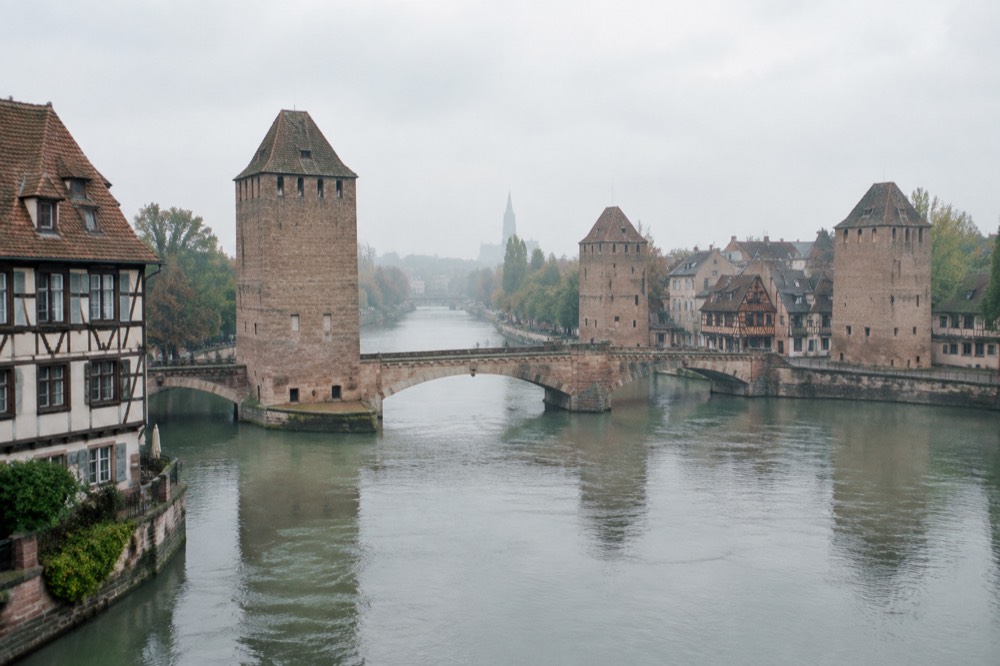
For visitors whose stay in Strasbourg is short, the honest arithmetic is this: the Ponts Couverts and their terrace take an hour, Petite France takes a morning, the cathedral and its platform take another hour or two, and the museums take whatever you give them. A single day in the city can hold the bridges, the terrace, the cathedral and a river tour with time to eat; two days add the museums and the European quarter; a third day is the day trip. The one-day itinerary pages on this site lay out those versions hour by hour.
A free walking tour is the budget-conscious alternative for the bridges and the old town: the pay-what-you-want English walks listed through GuruWalk cover the Grande Île's highlights with a local guide, you tip the guide at the end, and the duration and meeting point are on each walk's own listing. The walks do not replace the terrace view or the river boat, but they give the bridges and the fortifications their narrative, and for a first day in the city that narrative is worth having.
Happy to explore the bridges and old town with a local guide. Book a free walking tour here.
Common Questions About The Ponts Couverts
Are the Ponts Couverts free to visit?
Yes. The bridges are public highway and can be crossed at any hour without a ticket. The Barrage Vauban terrace beside them has seasonal opening hours, 08:00-19:00 in the warmer months and 08:30-16:00 from November to February, and its admission price is not published on the city's page for the site, so check there before your visit.
What is the best view of the Ponts Couverts?
The panoramic terrace of the Barrage Vauban, directly downstream of the bridges, gives the fullest single view of the towers, the roofed spans and the Petite France rooftops behind them. The banks of the Ill in Petite France and the bridges themselves give lower, closer perspectives, and a Batorama river boat passes under the spans for a view from the water.
How do I get to the Ponts Couverts?
On foot from anywhere in central Strasbourg: they sit at the southern edge of the Grande Île, just past Petite France. By tram or bus, a CTS single ticket costs 1.90 EUR bought in the app, on a Badgéo card or by contactless, or 2.50 EUR bought on board a bus; a 24h Solo pass is 4.60 EUR and a 24h Trio pass for two or three people is 10.20 EUR.
Can you take a boat tour past the bridges?
Yes. Batorama's Blue Tour runs 45 minutes at 12.50 EUR full and 7.20 EUR reduced, and the Red Tour runs 1h10 at 16.20 EUR full and 8.90 EUR reduced, both passing through the channels of the Ill around the Grande Île. The landing is a short walk upstream from the bridges.
When is the best time of year to see the bridges?
Any month works, with different moods. Winter brings the Christmas market season, late November to 24 December, when the stretch of the Ill is lit after dark; summer brings mean maxima of 26.4 C in July and warm evenings on the quays. The terrace's hours shorten to 08:30-16:00 from November to February, so the after-dark winter view is taken from the banks.
Is the Ponts Couverts area good for a first visit to Strasbourg?
Yes, it is one of the most efficient corners of the city for a first visit: the bridges, the Barrage Vauban terrace, Petite France and the river boat landing sit within a few minutes of one another, and the walk north from there leads to the Musée Historique, the Musée de l'Œuvre Notre-Dame and Strasbourg Cathedral. A half-day circuit covers all of it comfortably.
The Ponts Couverts reward exactly the kind of visit they seem to forbid: an unhurried one. Cross them once for the view along the channel, climb the terrace for the arrangement of the whole defence, and come back after dark if your trip allows, because the lit roofs over the water are the city's own signature image and it costs nothing but the walk there.