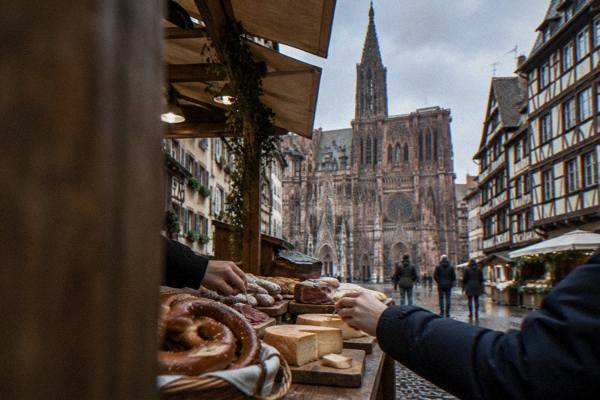
Strasbourg Food Tour
A food tour is one of the rewarding ways to eat your way through Strasbourg, the Alsatian capital in north-eastern France, and this guide covers what a good one includes and how to plan around it.
Short answer
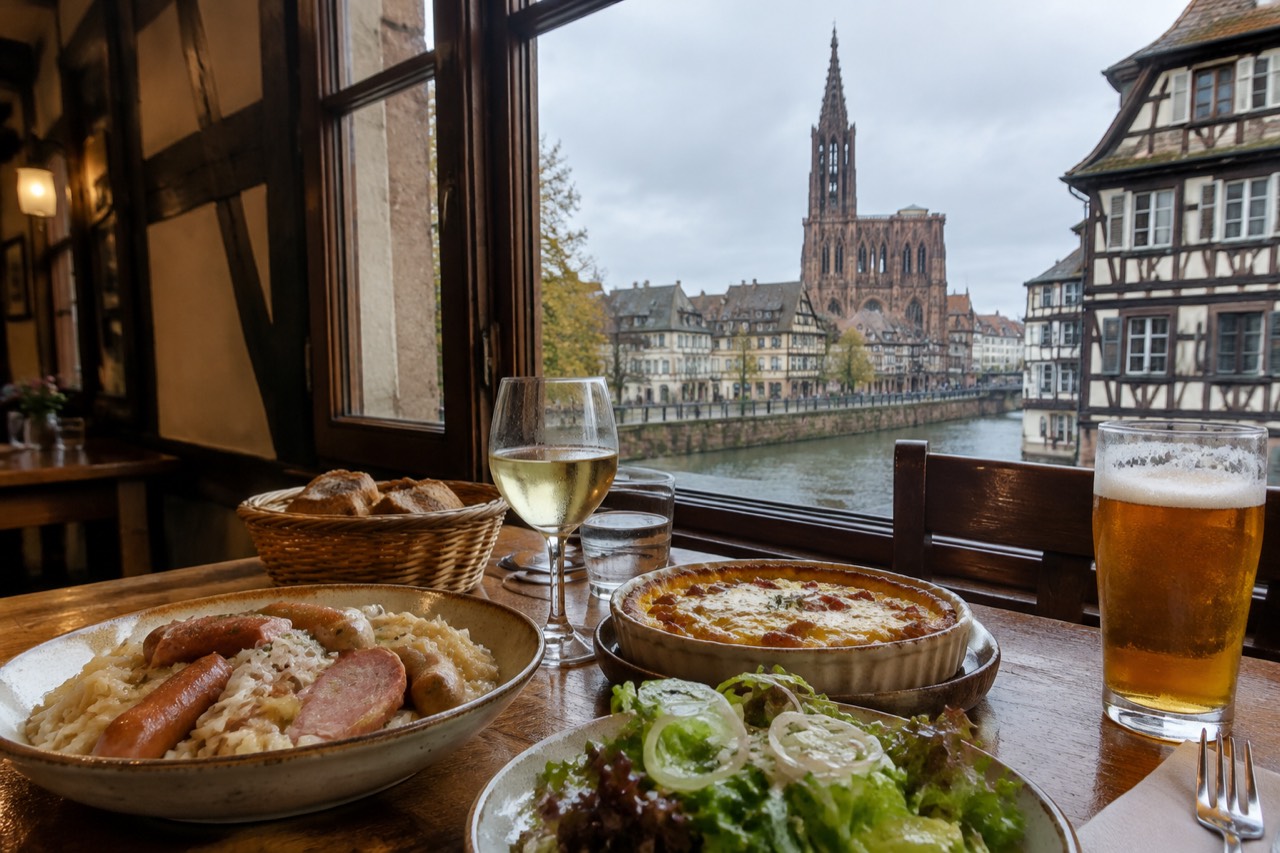
A Strasbourg food tour walks you through the old Grande Île and Petite France quarters with tastings of tarte flambée, choucroute, baeckeoffe, kougelhopf and Alsatian wine. Paid walks run roughly one to three and a half hours; free pay-what-you-want walks cover the sights with food stops left to you. Book morning slots in the old town and check the live listing for what is included.
Strasbourg, the prefecture of the Bas-Rhin in Alsace, sits in north-eastern France on the River Ill, a short hop from the German border across the Rhine. That position is the whole story of its cooking: Alsatian food is French technique married to German appetite, served in timber-framed winstubs in the UNESCO-listed Grande Île. A food tour here is not a gimmick bolted onto a sightseeing walk, it is the fastest route into a regional kitchen that otherwise takes weeks of restaurant visits to decode. This guide sets out what a good Strasbourg food tour includes, which dishes and drinks it should cover, how to fold it into a wider day, and what the practical costs around the tour ticket look like.
What Makes A Strasbourg Food Tour Worth Booking?
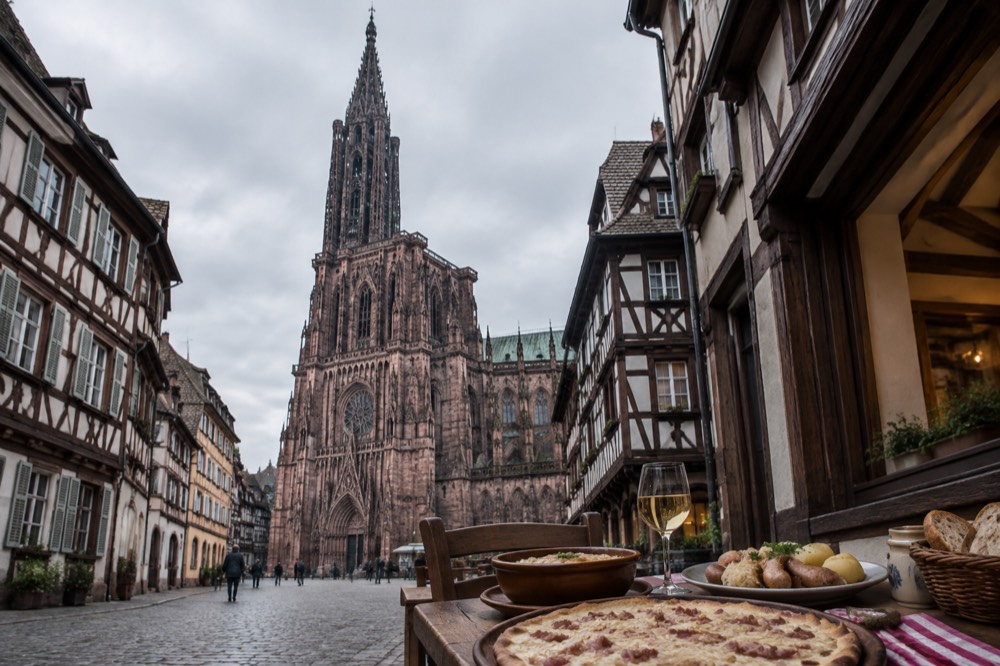
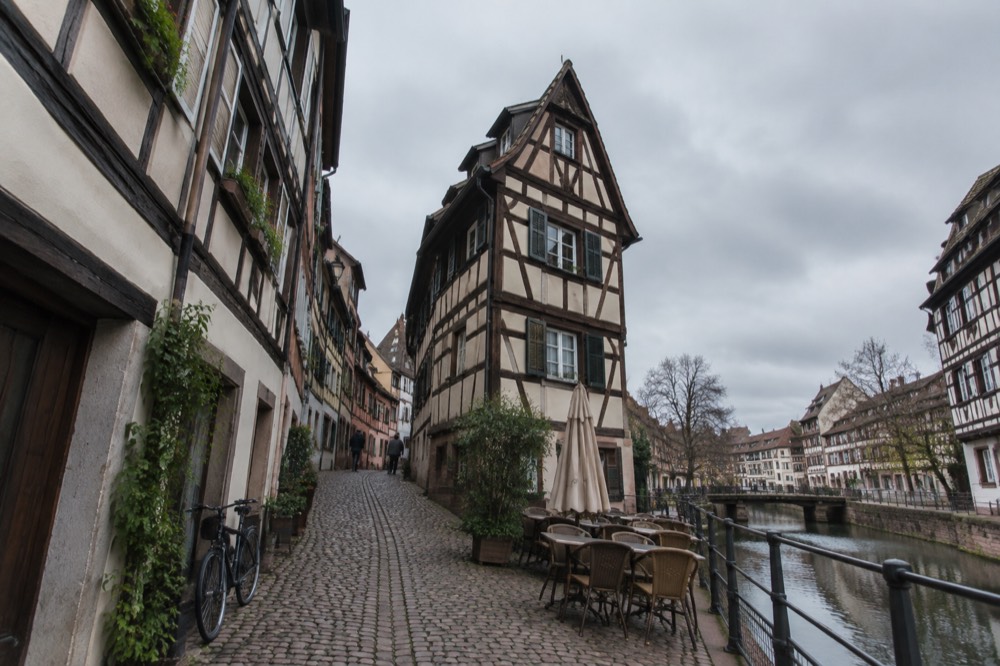
A Strasbourg food tour is worth booking because Alsatian food is regional rather than national: tarte flambée, choucroute garnie, baeckeoffe and kougelhopf rarely appear on menus outside Alsace, and a guided walk with tastings explains each one where you eat it. A guide also unlocks the winstub, the traditional Alsatian eating house, whose unwritten rules and dialect menu wording can otherwise slow a first-time visitor down. The old centre is compact, so a walking format works, and tastings spread across several stops let you try more dishes in one afternoon than a single restaurant sitting could.
The alternative is self-guiding, and plenty of travellers do exactly that with the help of the site's Strasbourg food and winstub guide. The case for a paid or free guided walk is context: why the winstub serves off a slate board, why Riesling from local vineyards stands beside the choucroute, and why the Christmas season changes the entire street-food landscape of the Place Kléber and Place Gutenberg squares.
Guided options on the roster run from a one-hour city-centre orientation to a three-and-a-half-hour traditional food walk with tastings, plus a dedicated gourmet tastings walk and a shorter culinary walk. The four English-language free walks, which run through GuruWalk on a pay-what-you-want basis, cover the sights well but leave the eating to you; a sentence on the listing explains the tipping model. For depth, the tasting walks are the ones that open kitchen doors.
Which Dishes And Drinks Should A Strasbourg Food Tour Cover?
A complete Strasbourg food tour covers tarte flambée, choucroute garnie, baeckeoffe, kougelhopf and Alsatian wine or beer, ideally across four or more tasting stops in the Grande Île and Petite France, with the guide explaining each dish at the table where it is served. Tarte flambée, the thin cream-and-bacon flatbread baked in a wood oven, is the dish guides serve first because it arrives in minutes and divides easily among a group. Choucroute garnie, sauerkraut heaped with sausages and pork, is the heavy centrepiece. Baeckeoffe, a three-meat casserole slow-cooked in wine, is the one dish a short tour often describes rather than serves, because it needs a full day in the oven.
A complete tour covers the dishes and the drinks in one walk. Book a traditional food tour here.
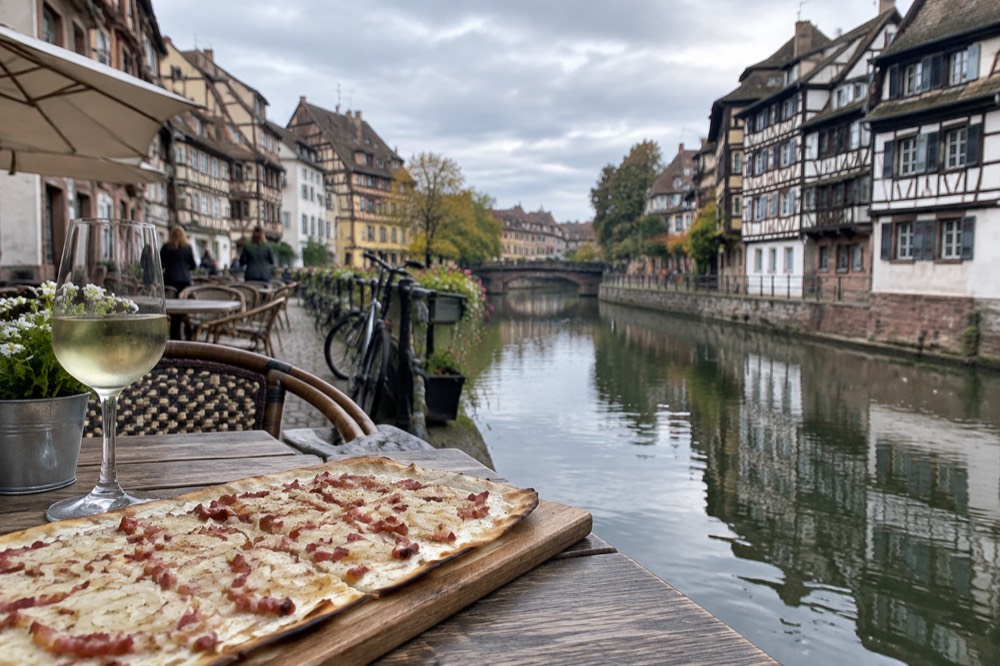
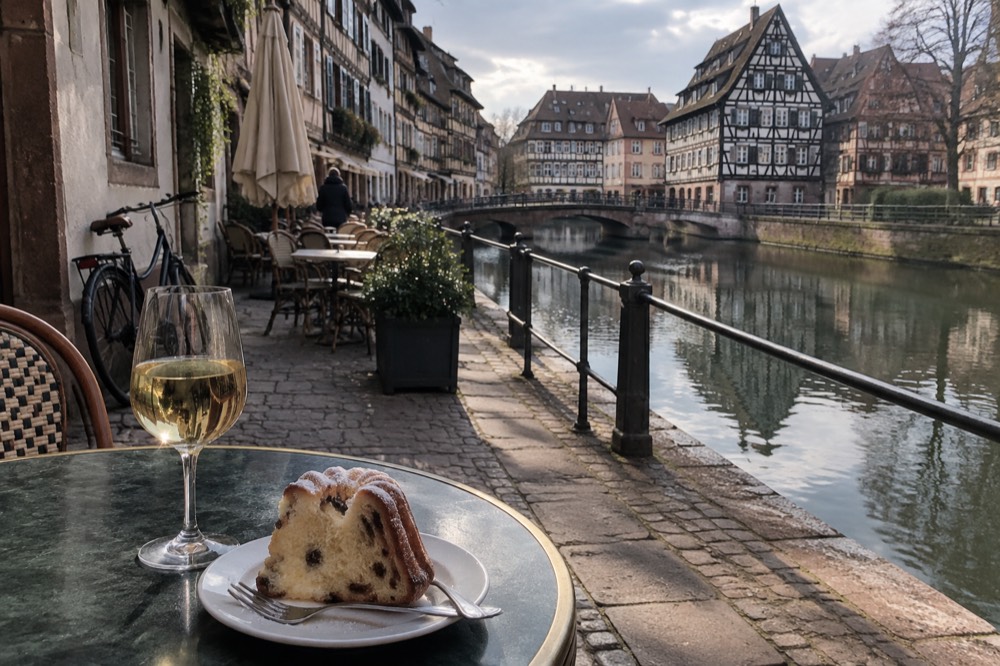
The sweet finish is kougelhopf, the brioche-like ring moulded with almonds and raisins, and the drinks are Alsatian Riesling, Gewurztraminer or Crémant alongside the local craft beer, which has its own scene detailed in the Strasbourg beer guide. The table below is the checklist to hold any tour listing against.
| Dish or drink | What it is | How a tour usually handles it |
|---|---|---|
| Tarte flambée | Thin flatbread with fromage blanc, onions, lardons | Shared plate at an early stop, baked to order |
| Choucroute garnie | Sauerkraut with sausages and pork cuts | Tasting portion or explained at a winstub stop |
| Baeckeoffe | Three meats marinated in wine, baked slowly | Described or sampled as a small portion |
| Kougelhopf | Almond and raisin yeasted ring cake | Sweet final tasting, often with coffee |
| Riesling or Gewurztraminer | Dry and aromatic Alsatian whites | Poured at a cellar or winstub stop |
| Crémant d'Alsace | Traditional-method sparkling wine | Sometimes the toast at the last stop |
Ask one question before booking any listing: how many stops include a seated tasting rather than a standing sample. The answer separates a genuine food walk from a sightseeing walk with a snack. The operator's live listing states the stops and the inclusions, and that page is the place to verify both.
How Do Food Tours, Bike Tours And Segway Tours Fit Together?
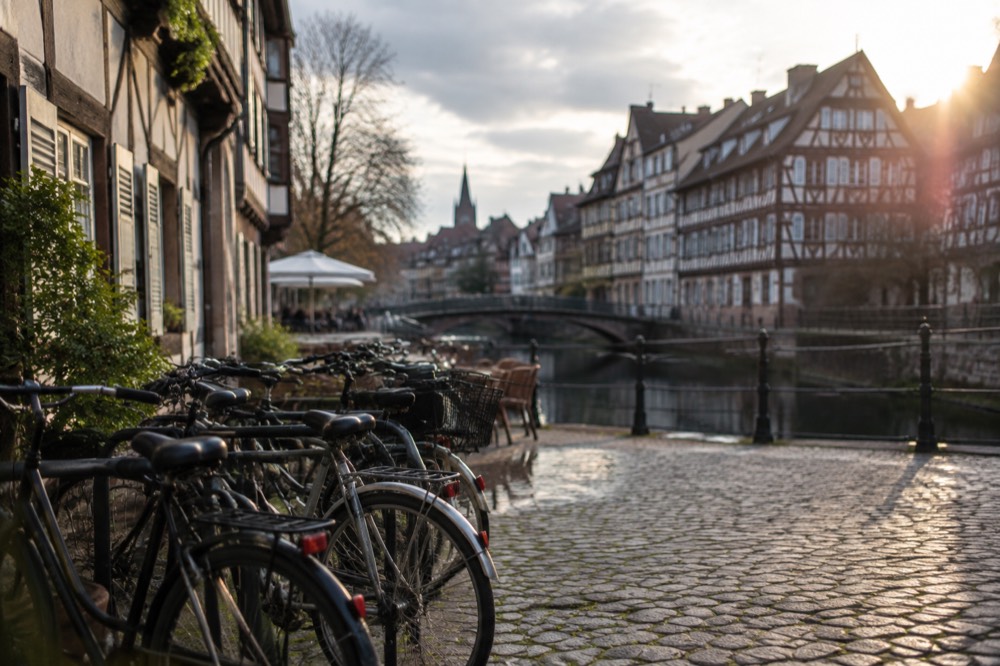
Food tours, bike tours and Segway tours fit together as a morning-and-afternoon pair: a wheeled orientation tour covers the European quarter, the Neustadt and the riverbanks in the morning, then a food walk concentrates on the Grande Île afterwards, when kitchens are fully open. The logic is geographic. The eatable city is small and pedestrian, while the impressive city is spread along the Ill, from the Parc de l'Orangerie to the European institutions, and wheels cover that ground far better than feet on a full stomach.
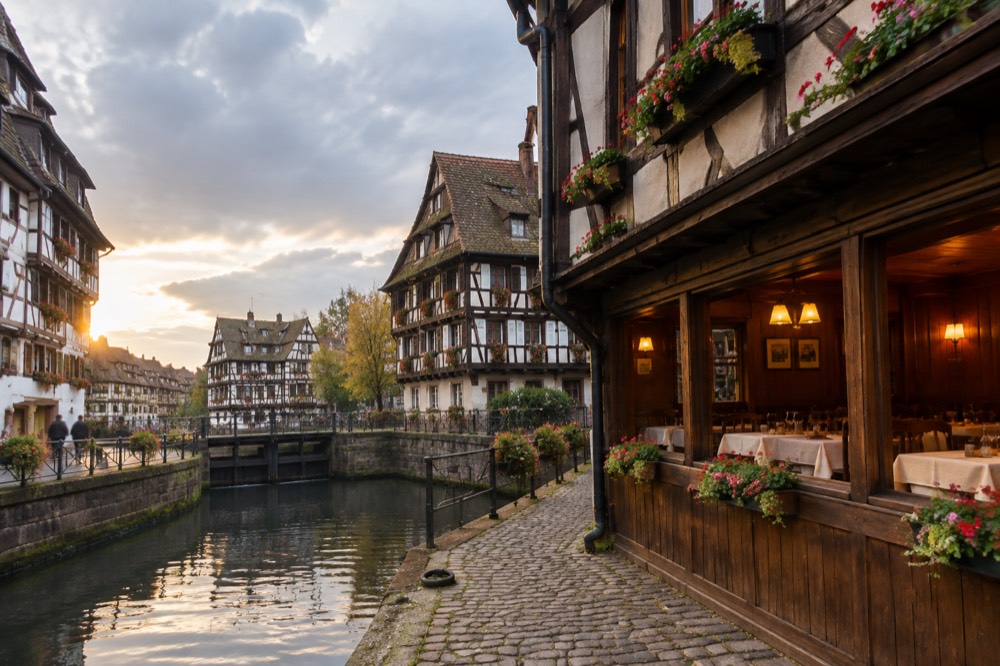
The pairing this site rates for that job is the Euro Segway tour, which sweeps the European quarter and the river loop and leaves you back in the centre with your bearings set and an appetite intact. Check availability on the live listing if that split appeals. Travellers who prefer pedals to platforms get the same coverage from the local-guide bike tour, and a shorter Segway option exists for tight schedules.
Whichever format you choose, book the food walk for the second half of the day. Alsatian portions are generous, and a heavy choucroute tasting sits better as a late-lunch or early-evening event than as a pre-ride meal. The reverse order, eating first and rolling after, is the mistake first-time visitors make once and do not repeat.
Where Should You Eat Between Stops: Winstubs, Markets And Christmas Stalls?
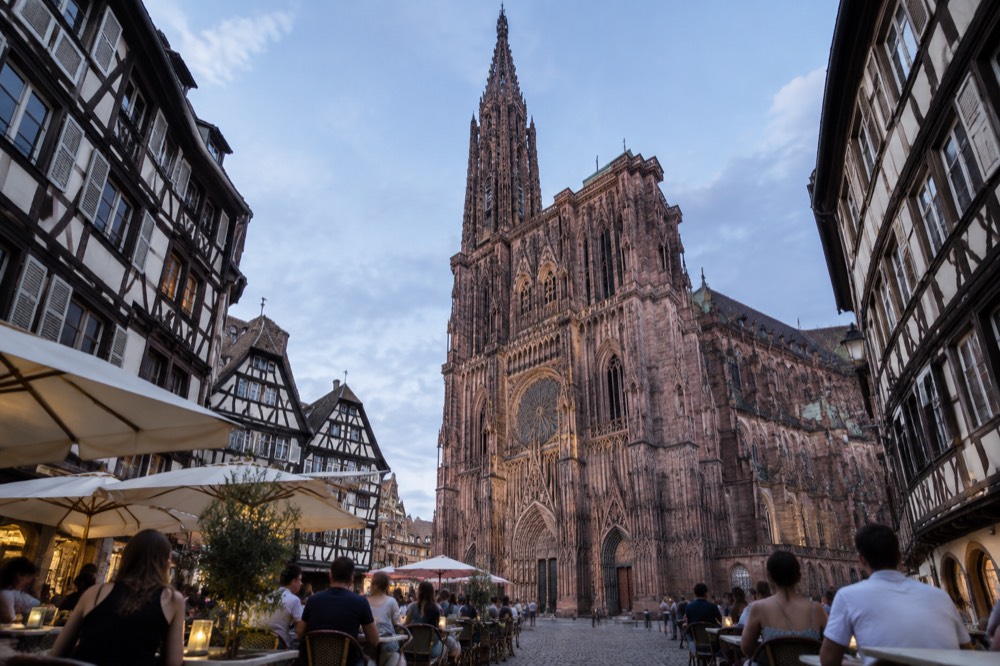
Between tour stops, the places to eat in Strasbourg are the winstubs of the Grande Île and Krutenau, the covered and open markets, and, from late November, the Christmas-market chalets around the cathedral and Place Kléber, each with its own rhythm and its own price list. The winstub is the institution: a small, wood-panelled room with paper tablecloths, daily specials chalked up, and a wine list that leans on local growers. The site's dedicated winstubs in Strasbourg guide lists the houses worth queueing for and explains the etiquette, including the fact that a winstub turns tables slowly and does not hurry anyone.
Outside the winstubs, the market stalls carry the street-food side of the region, and the Christmas season supercharges it. The city's own Christmas site states that the 2026 dates and programme are still being finalised, so confirm them there before planning a food trip around the stalls; the usual pattern opens the markets in the last week of November and runs them to 24 December, closing early on the final evening. Last year's edition ran 26 November to 24 December 2025 and drew 3.05 million visits, which tells you what the squares feel like on a December weekend. For the edible detail, the Strasbourg Christmas market food guide covers the stalls dish by dish.
One pairing worth planning early: a food walk in the afternoon and the Christmas lights in the evening, with the Strasbourg at night guide for the route between them. In the shoulder months, when the chalets are not yet built, the winstubs and the daily markets carry the whole food scene on their own.
Which Season Suits A Strasbourg Food Tour Best?
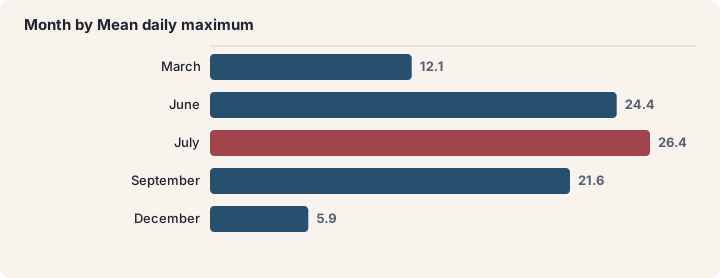
The seasons that suit a Strasbourg food tour are late spring through early autumn for eating outdoors, and December for the Christmas-market food culture, with a trade-off: December brings the chalets and the crowds, summer brings terrace weather and the full 26.4 C July mean maximum. The climate here is semi-continental, which means warm summers, cold winters and rain spread fairly evenly through the year. Meteo-France 1991-2020 normals for Strasbourg-Entzheim put the annual rainfall at 635.7 mm across 112.3 rain days, so a shower risk exists in every month and no season is dry.
| Month | Mean daily maximum | Mean daily minimum | Rain days of 1 mm or more |
|---|---|---|---|
| March | 12.1 C | 2.6 C | 8.5 |
| June | 24.4 C | 13.4 C | 10.2 |
| July | 26.4 C | 14.9 C | 10.4 |
| September | 21.6 C | 10.7 C | 8.0 |
| December | 5.9 C | 0.8 C | 10.2 |
Read that table as a menu-planning tool. June through August is terrace season, when a tasting walk can linger outside and the long evening light stretches the day, but September carries the same warmth with fewer rain days than midsummer and thinner queues. December is cold, with a mean minimum just above freezing, yet it is the month the food scene is at its loudest, because the market chalets turn the whole centre into an open-air pantry. The best time to visit Strasbourg guide and the Strasbourg weather guide unpack the full year if the trip dates are flexible.
For a food-first trip, two windows stand out: late September into October, when the new wine reaches the winstubs and the streets are calm, and the Christmas run from late November, when the markets justify the coats. Book the December food walks well ahead, because the season fills the old town. The wider set of guides lives on Strasbourg Travel Guide.
How Do You Get Around Strasbourg On A Food Tour Day?
You get around Strasbourg on a food tour day on foot inside the Grande Île and by tram everywhere else, with a CTS single ticket at 1.90 EUR from the app or contactless, or 2.50 EUR bought on board the bus, and a 24-hour Solo pass at 4.60 EUR covering a full day of hopping between quarters. The trams and buses are run by CTS, the city network, and the old centre's pedestrian streets mean the food walk itself needs no ticket at all. The fares below are the ones CTS's own fare pages list.
| CTS ticket | Price | Notes |
|---|---|---|
| Single | 1.90 EUR | Badgéo card, CTS app or contactless |
| Single bought on board | 2.50 EUR | Bus purchases only |
| 24h Solo | 4.60 EUR | One traveller, all network, 24 hours |
| 24h Trio | 10.20 EUR | Two or three travellers together |
| Airport combined ticket | 4.60 EUR | Train from Entzheim plus tram and bus travel |
The airport line deserves its own note: the shuttle train runs between Entzheim and the Gare Centrale in 8 minutes, up to five trains an hour at peak, and the 4.60 EUR combined ticket folds the tram and bus network in for the day of arrival, which is exactly the ticket a food-tour day built around an arrival morning wants. The getting around Strasbourg guide covers the network in full, and the Strasbourg airport to city centre guide handles the arrival itself.
If the day pairs a wheeled tour with the food walk, the meeting points cluster near the cathedral and the river, both inside the walkable core, so a single tram ride in the morning and a walk home after dinner covers the transport need for the whole day.
The bike option above suits the same split differently: riders cover the riverbanks and the Neustadt under their own power, then park near the cathedral for the food walk. The tour's live listing carries the current meeting point and what is included.
What Does A Self-Guided Food Walk Of Strasbourg Look Like?
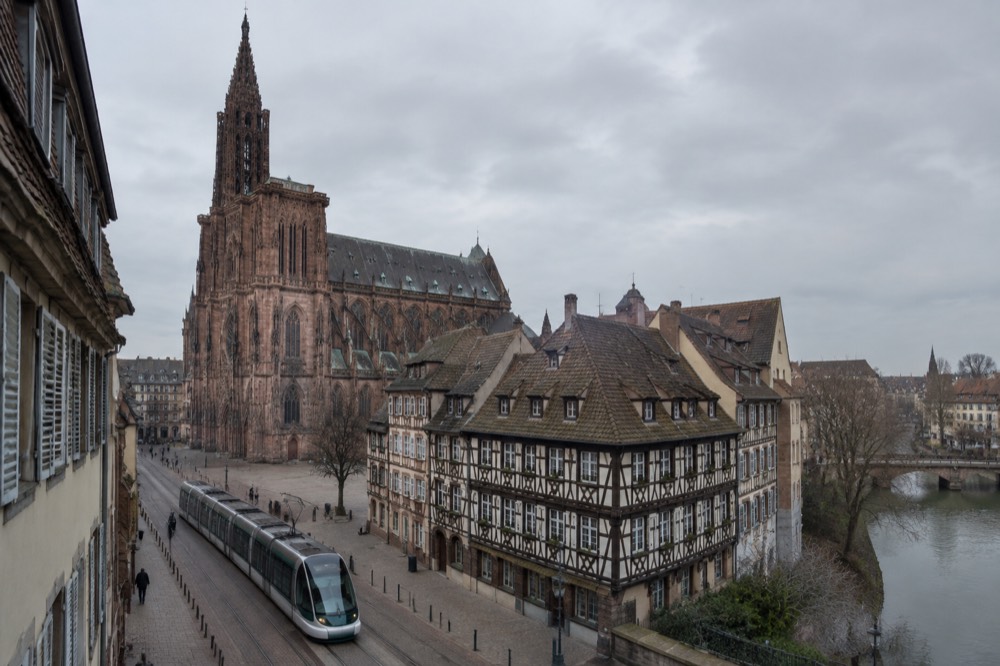
A self-guided food walk of Strasbourg runs from the cathedral and Place du Château south through the Grande Île to Petite France, pausing at a winstub, a market and a bakery, and takes a half-day at eating pace with the astronomical clock's 12:30 show as a natural midday anchor. The route is short in metres and long in courses, and every stop is a food stop rather than a detour. Start on the cathedral square, where the nave is open to visitors in the morning visiting hours, 08:30 to 11:15 Monday to Saturday, and the clock show at 12:30 sharp costs 4 EUR, with tickets sold on the day only.
| Stop on the walk | What to do | Ticket or cost |
|---|---|---|
| Cathedral nave | Visit before the 11:15 morning close | Strolling the nave, check the cathedral's hours page |
| Astronomical clock | The 12:30 automaton show | 4 EUR, day-of purchase only |
| Platform at 66 m | Climb after lunch, winter hours 10:00-13:00 and 13:30-18:00 | 10 EUR full, 6 EUR reduced |
| Grande Île winstub | Late lunch, tarte flambée first | Menu prices on the slate, check the room |
| Petite France | Coffee and kougelhopf by the locks | Prices at the counter |
From the cathedral, drop south through the Rue des Orfèvres towards the river, cross into Petite France, and finish on the Quai des Bateliers where the Batorama boats leave: the long river tour costs 16.20 EUR full fare and 8.90 EUR reduced and runs 1 hour 10 minutes, while the short tour costs 12.50 EUR and 7.20 EUR and runs 45 minutes, a digestif-on-water way to end the day. The Strasbourg boat tour guide compares the circuits. The one day in Strasbourg itinerary sequences the same ground for travellers who want the full plan.
The Segway tour above is the one this site pairs with the self-guided food walk: it clears the wide-angle sights in the morning, leaving the afternoon free to eat through the old lanes without a schedule pressing.
How Much Should You Budget Beyond The Tour Ticket?
Beyond the tour ticket, budget for the extras the walk inspires: museum entries at 9 EUR full or 5 EUR reduced with a 1-day Pass Musées at 20 EUR, a Batorama boat tour at 12.50 to 16.20 EUR, and the drinks and second helpings the tastings will leave you wanting, plus the Strasbourg City Card at 5 EUR if discounts appeal. The City Card is a discount card rather than an all-inclusive pass: it costs 5 EUR for adults and 3.50 EUR for children aged 3 to 17, runs for 7 days, and takes set amounts off museums, the boat, the cathedral platform and the clock. The Strasbourg city pass guide explains what it does and does not cover.
| Item | Price | Where it applies |
|---|---|---|
| Municipal museum ticket | 9 EUR full, 5 EUR reduced | Beaux-Arts, MAMCS, Historical, Oeuvre Notre-Dame and others |
| Pass Musées 1 day | 20 EUR | All municipal museums in one day |
| First Sunday of the month | Free entry | Every municipal museum |
| Strasbourg City Card | 5 EUR adult, 3.50 EUR child | 7 days of discounts at museums, boat, platform, clock |
| Batorama short tour | 12.50 EUR full, 7.20 EUR reduced | 45 minutes on the Ill |
| Batorama long tour | 16.20 EUR full, 8.90 EUR reduced | 1 hour 10 minutes, cathedral to European quarter |
Two notes keep that table honest. First, the Musée Alsacien is closed for works until 2028 and appears on no current itinerary, so its usual slot in a food-and-culture day goes to another museum or to more time at the table. Second, the free first Sunday applies to the municipal museums, not to food, and the winstubs keep their own calendars; the slate board and the counter are the only price lists that matter there. For the wider picture of eating cheaply, the Strasbourg on a budget guide and the free things to do in Strasbourg guide stretch a food-first trip without thinning the plates.
The tour ticket itself is the one figure this page never prints, because prices, ratings and durations of bookable products belong to the operator's live listing, where they are kept current. Compare the walks there, read the stop list, and match the inclusions against the dish table earlier on this page before committing.
A shorter wheeled tour like the one above fits the same day at lower cost and time, for travellers whose food walk already runs long. The listing carries the current details.
Which Strasbourg Food Tour Should You Actually Book?
Book the tasting walk that matches your appetite and your clock: a three-hour-plus traditional food walk with tastings for the full choucroute-to-kougelhopf arc, a shorter gourmet walk for a first afternoon, or a free pay-what-you-want walk paired with your own winstub lunch if the budget is tight. The deciding factors are the number of seated tastings, whether wine or beer is poured, and whether the route stays in the Grande Île or stretches into the Krutenau, the student quarter where the winstubs are locals-first and the prices gentler.
Whatever the choice, anchor the day well. The old town rewards a slow pace, the semi-continental weather can turn a terrace into an awning in the time it takes to finish a glass of Riesling, and the best food days in Strasbourg are the ones that leave room for the unplanned second winstub.
Common Questions About Strasbourg Food Tours
What food is Strasbourg famous for?
Strasbourg is famous for tarte flambée, choucroute garnie, baeckeoffe and kougelhopf, served in the winstubs of the old town, with Alsatian Riesling, Gewurztraminer and Crémant alongside. The Christmas season adds the chalet stalls around the cathedral and Place Kléber, covered in the site's dedicated Christmas market food guide.
How long does a food tour in Strasbourg last?
Guided food walks on the current roster run around three and a half hours for the traditional food walk with tastings. The free pay-what-you-want walks state their duration on the listing. Exact durations for any paid tour are shown on the operator's live listing.
Is a Strasbourg food tour worth it for a short visit?
For a stay of one or two days, a tasting walk is an efficient use of a single afternoon: it covers the Grande Île on foot while introducing the regional dishes that are hard to find outside Alsace. Travellers with more time can self-guide using the site's Strasbourg food guide and winstub listings instead.
Do Strasbourg food tours include wine tastings?
Several tasting walks pour Alsatian wine at a cellar or winstub stop, and one option is a dedicated one-hour Alsace wine tasting. The inclusions are listed stop by stop on the operator's live listing, which is the page to check before booking, since stop lists change with the season.
When should I book a Strasbourg food tour for the Christmas market?
Book early for the Christmas run. The city's Christmas site states the 2026 dates and programme are still being finalised, and the usual pattern runs from the last week of November to 24 December. Last year's edition drew 3.05 million visits, so December food walks and winstub tables fill well in advance.
Can you do a Strasbourg food tour on a budget?
Yes. The free pay-what-you-want English walks cover the old town with no fixed price, tips go to the guide, and a self-guided winstub crawl using the site's budget guide keeps costs low. The CTS 24h Solo pass at 4.60 EUR covers the transport for the whole day.