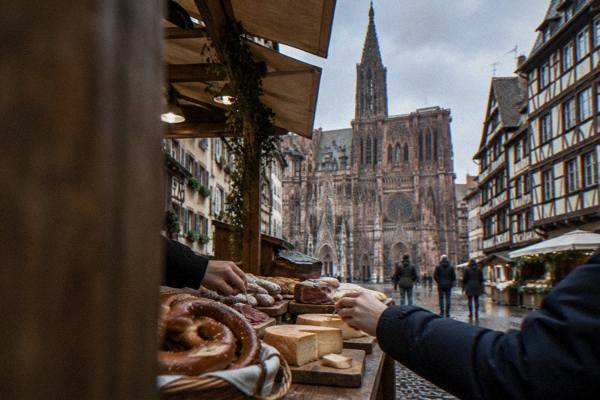
Strasbourg Food
Strasbourg, in Alsace in north-eastern France, eats differently from the rest of the country. This guide sets out the dishes, the drinks, the winstubs, the markets and the guided food walks that define the city's table.
Short answer
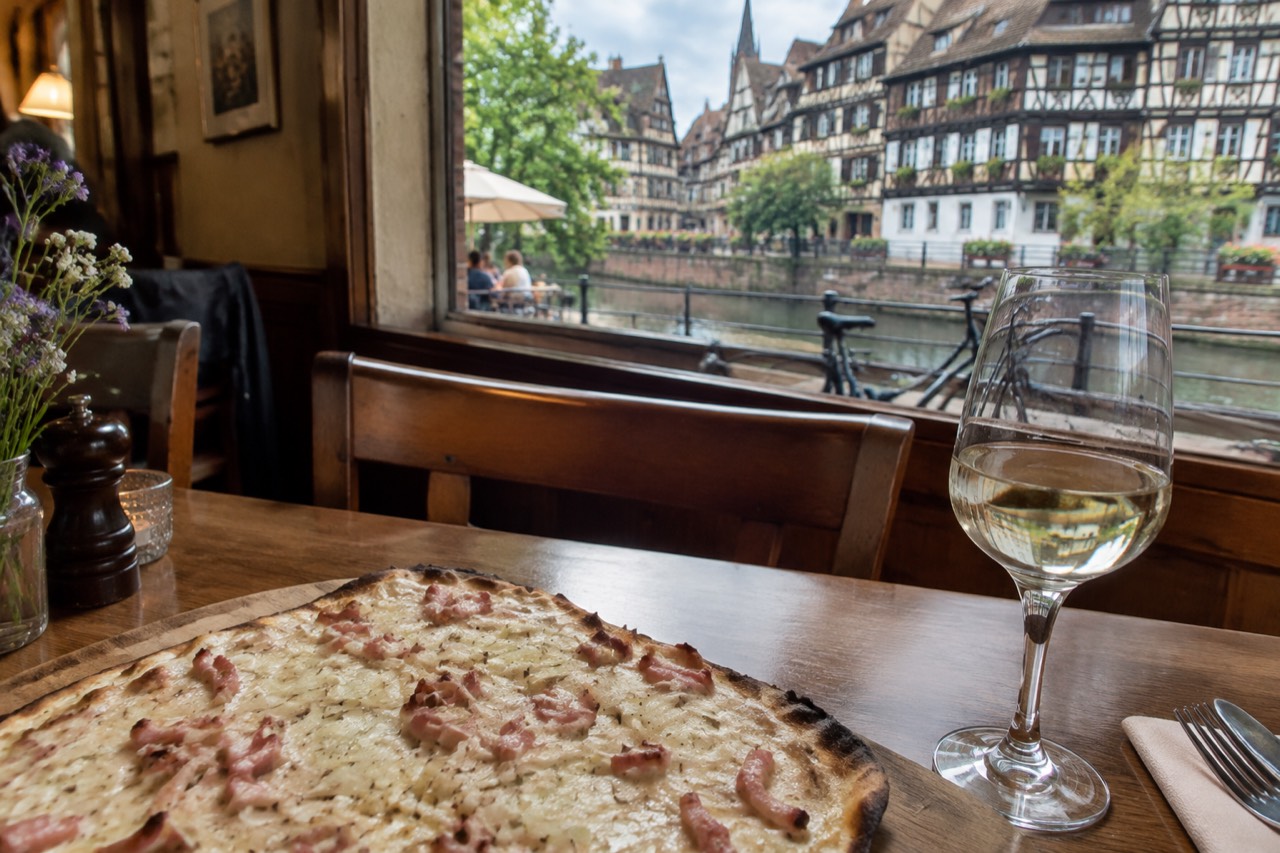
Strasbourg's signature dishes are tarte flambée, choucroute garnie, baeckeoffe and kougelhopf, served in winstubs across the Grande Île and Petite France. Drinks lean on Alsace white wines and local beer. A guided food walk or a winstub dinner in the historic centre covers the essentials in a single day.
Strasbourg, the prefecture of the Bas-Rhin in Alsace, north-eastern France, sits on the River Ill beside the Rhine and the German border, and its food carries that geography on every plate. The city's kitchen is Alsatian before it is French: pork cured in Riesling, cabbage fermented in the local style, cream and onions baked onto thin dough, and a brioche-like kougelhopf that turns up at breakfast, dessert and every celebration in between. The dining rooms that serve it, the winstubs, are as much a part of the city's identity as the single-spired cathedral that towers over the Place du Château. This guide walks through the dishes, the drinks, the neighbourhoods and the guided experiences that make eating in Strasbourg a reason to travel there.
What Food Is Strasbourg Known For?
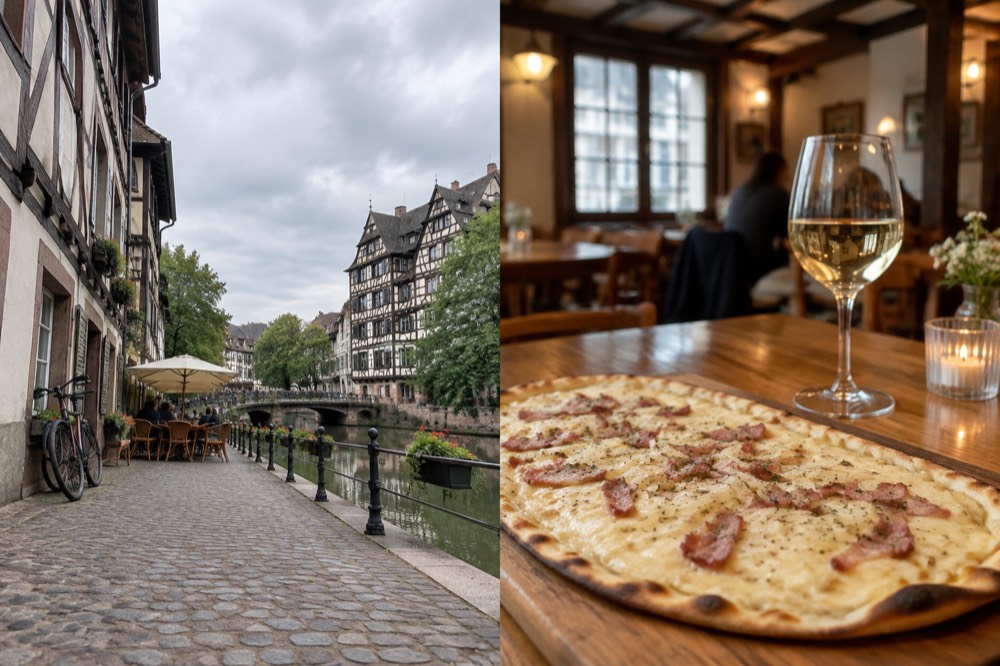
Strasbourg is known for four dishes above all: tarte flambée, a thin flatbread baked with cream, onions and lardons; choucroute garnie, sauerkraut heaped with pork cuts and sausages; baeckeoffe, a slow-baked casserole of three meats marinated in white wine; and kougelhopf, a ring-shaped yeasted cake studded with raisins and almonds. Around them sit spätzle dumplings, presskopf head cheese, and a sweet tradition of pain d'épices that runs through the Christmas market season. The wines poured alongside are almost always Alsace whites: Riesling, Pinot Blanc, Gewurztraminer and Sylvaner, plus Crémant d'Alsace when something sparkling is called for.
None of this is bistro food in the Parisian sense. A winstub, the word literally means wine room, serves generous plates in a wood-panelled room where the menu changes with the market and the chef's mood. Portions are built for the semi-continental climate: Meteo-France's 1991-2020 normals for Strasbourg give a mean January maximum of just 5.2 C, and a January evening in the Grande Île calls for choucroute rather than a salade composée. Summer inverts the equation, with a mean July maximum of 26.4 C, and the terraces along the Ill fill up accordingly.
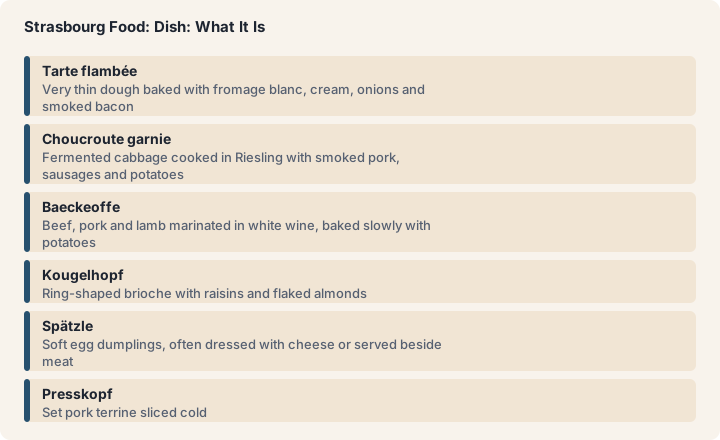
| Dish | What It Is | When Alsatians Eat It |
|---|---|---|
| Tarte flambée | Very thin dough baked with fromage blanc, cream, onions and lardons | Lunch or supper, often ordered in rounds |
| Choucroute garnie | Fermented cabbage cooked in Riesling with smoked pork, sausages and potatoes | The classic large dinner plate |
| Baeckeoffe | Beef, pork and lamb marinated in white wine, baked slowly with potatoes | A Sunday and family dish |
| Kougelhopf | Ring-shaped brioche with raisins and flaked almonds | Breakfast, dessert, gifts and festivals |
| Spätzle | Soft egg dumplings, often dressed with cheese or served beside meat | Everyday accompaniment |
| Presskopf | Set pork terrine sliced cold | Charcuterie starters |
For a deeper run through the wine side of the table, the Alsace wine guide and the guide to tarte flambée cover their subjects in full.
Where To Eat Traditional Alsatian Food In Strasbourg?
For traditional Alsatian food in Strasbourg, head to the winstubs of the Grande Île, the UNESCO-listed river-island old town, where the heaviest concentration sits around the cathedral, the rue des Orfèvres, and the lanes of Petite France. These cozy tavern-style eateries serve the region's classic dishes, making the old town the natural first stop for anyone craving authentic local cooking. A winstub is recognisable before you read a menu: half-timbered frontage, small windows, handwritten plats du jour, and a room that feels borrowed from somebody's grandmother. Reservations matter in the evening, especially in December, and Sunday lunch is a serious sitting rather than an afterthought. Expect the classics, expect large portions, and expect the wine list to open with Alsace whites by the glass and by the carafe.
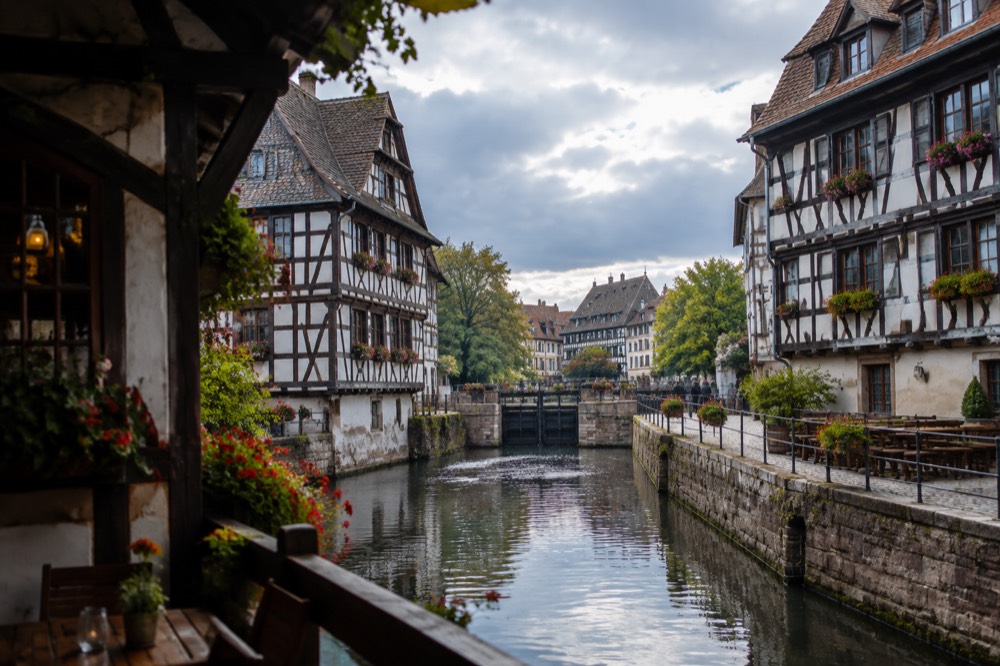
Petite France, the former tanners' and millers' quarter at the western tip of the island, is the postcard setting for dinner, and its winstubs sit among waterwheel channels and geranium-lined balconies. The trade-off is simple: the prettiest rooms sit on the prettiest streets, and the streets fill up first. Two streets back from the river, in the rue des Dentelles and the lanes toward the cathedral, the rooms are quieter and the cooking is often the more careful of the two. The Petite France guide maps the quarter in detail, and the winstubs in Strasbourg guide lists the rooms themselves.
Beyond the winstubs, the Krutenau, the student quarter south of the Grande Île, is where Strasbourg actually eats on a Tuesday: small modern bistros, natural wine bars and inexpensive world food, a short walk from the cathedral but a different price level from the old town. The Neustadt, the German-built quarter east of the centre, runs heavier on pork, pastry and neighbourhood bakeries. Neither quarter needs a plan, just an appetite and comfortable shoes.
A walking tour pairs well with the eating, because the historic centre is compact and a guide's commentary fills the gaps between sittings.
| Neighbourhood | What To Expect | Best For |
|---|---|---|
| Grande Île, cathedral lanes | Traditional winstubs, oldest rooms, busiest evenings | First-time visitors, classic dishes |
| Petite France | Riverside setting, half-timbered dining rooms, terrace season | A special dinner, photographs |
| Krutenau | Modern bistros, wine bars, student prices | A second or third visit |
| Neustadt | Neighbourhood bakeries, pork butchers, quieter tables | Breakfast and lunch away from crowds |
Which Guided Food Walk Gives The Best Introduction?
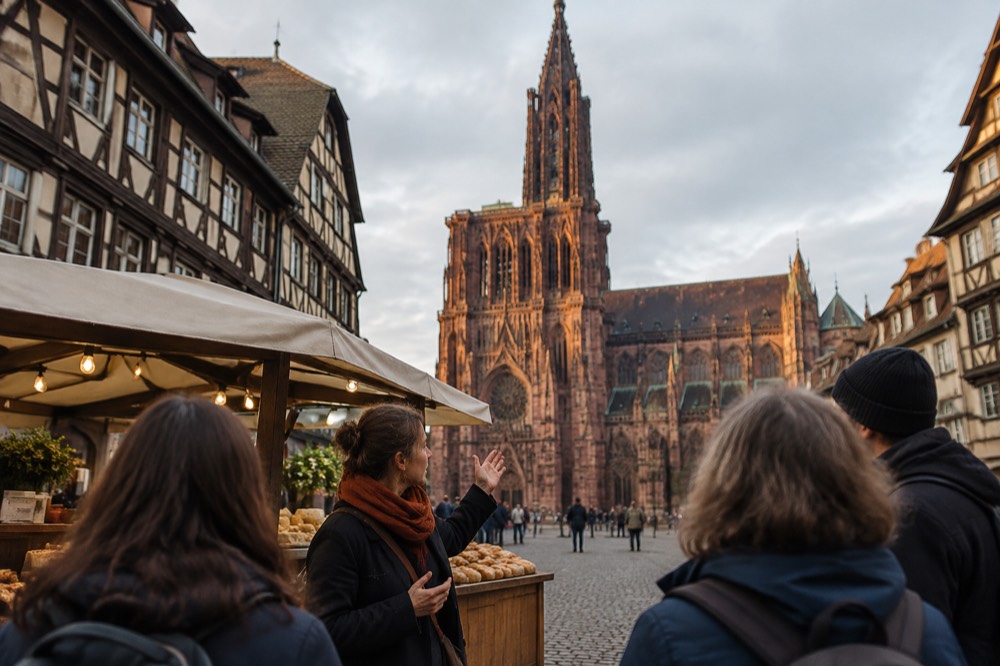
A guided food walk suits a first visit best, because it combines the old-town orientation of a general walking tour with stops at producers and counters you would not otherwise find, and Strasbourg has several formats: a gourmet tastings walk, a traditional food walk, and a short culinary walk for tight schedules. The small-group welcome walk that this site features is not a food tour, but it does the orientation half of the job, covering the historic centre with a local guide and leaving you standing in the right lanes at dinner time. Its live listing carries the current times, and Check availability before you build your evening around it. The food tour guide compares the formats in detail.
What a guided tasting walk adds is access: a baker's oven, a cheese counter, a winstub kitchen, a chocolate workshop, each with a few bites and a story attached. The longer formats run to around three hours and take in a full progression from bread to wine. The shorter ones compress the same idea into a couple of hours, which pairs well with a cathedral morning; the nave is open Monday to Saturday from 08:30 to 11:15 and 12:45 to 17:45, and the astronomical clock show runs at 12:30, so a food walk that starts after lunch slots neatly into a cathedral day.
Booking practicalities are simple. Day-of decisions are risky in December and at weekends, when the rooms and the tours both fill. Cancellation terms vary by operator, so read the listing's policy before you book rather than after. And if your visit is short, take the walking tour on day one and the food walk on day two, in that order, because knowing the geography makes every later meal easier to reach.
The gourmet format below comes with multiple tastings along the route.
What To Drink With Your Meal In Strasbourg?
Drink Alsace wine: Riesling with choucroute and fish, Pinot Blanc or Sylvaner as an all-purpose glass, Gewurztraminer with spicy and rich plates, and Muscat when you want something aromatic, with Crémant d'Alsace as the local sparkling answer and a growing craft beer scene behind it. The Alsace wine route begins practically at the city's edge, and Strasbourg's wine lists reflect that proximity: the whites dominate, the pours are generous, and the sommelier's default is local. Riesling's dry structure is the traditional partner for the fermented cabbage and pork of choucroute, cutting the richness with each mouthful.
To learn which glass goes with which plate, book an Alsace wine tasting here.
Beer matters here more than in the rest of France, a legacy of the German side of the border. The city has a small set of breweries and beer bars, and a craft tasting session that runs before opening hours is one of the more unusual bookable experiences on the roster. The Strasbourg beer guide covers the breweries and the bars. For the wine, the Alsace wine guide explains the grape styles, and a one-hour guided tasting in the city centre is a good way to calibrate your palate before ordering by the bottle.
| Drink | Style | What It Pairs With |
|---|---|---|
| Riesling | Dry, structured white | Choucroute, fish, presskopf |
| Pinot Blanc | Soft, easy white | Everyday winstub suppers |
| Gewurztraminer | Aromatic, full | Rich plates, spiced dishes, cheese |
| Sylvaner | Light, dry white | Tarte flambée, lunch pours |
| Crémant d'Alsace | Traditional-method sparkling | Apéritif, kougelhopf |
| Local craft beer | Lagers to ales from city breweries | Tarte flambée, terraces |
One practical note on ordering: in a winstub the house wine by the carafe is often a Sylvaner or a Pinot Blanc blend, and it is usually the right call for a casual plate. Ask what is open rather than what is famous. The list of Alsace's grand names is short, and the honest local pour is half the point of the room.
Where To Shop For Food In Strasbourg?
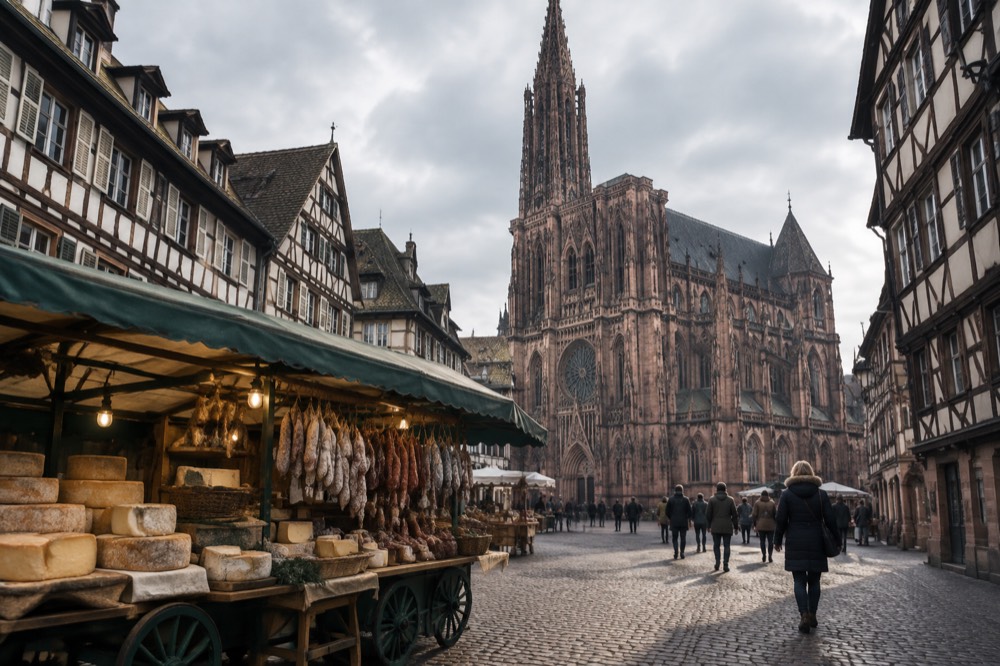
Shop at the city's markets and specialist counters: the covered markets of the centre for cheese, charcuterie and bread, the weekly outdoor markets for produce, and the Christmas market chalets from late November for the sweet and spiced end of the repertoire. The traditional food walk below moves through exactly this world, stopping at producers and counters across about three and a half hours, which is the most efficient way to eat the city's shopping culture rather than read about it.
The covered market tradition is the backbone of Alsatian cooking, because the winstub menu is written from the market rather than from a supplier catalogue. Cheese is the first stop: Munster, with its washed rind and farmhouse punch, is the one to know, and it arrives on boards with caraway. Charcuterie follows, smoked pork and the sliced presskopf that starts half the winstub meals in the city. Bread and kougelhopf come from the bakers, and the pain d'épices, spiced honey bread, is the souvenir that survives the journey home. More of these guides are collected on Strasbourg Travel Guide.
For self-catering visitors, the practical advice is to shop in the morning, when the counters are full and the market is at its loudest, and to build a picnic rather than a larder: cheese, bread, cured pork, a bunch of grapes, and a bench on the Ill. The Strasbourg markets guide lists the locations and days, and the budget guide shows how far a market picnic goes against a restaurant dinner.
| What To Buy | Where | Notes |
|---|---|---|
| Munster cheese | Market cheese counters | Washed rind, farmhouse versions strongest |
| Smoked pork and presskopf | Charcuterie stalls | Ask for sliced, thin cuts |
| Kougelhopf | Bakers, market stalls | Sold whole or sliced |
| Pain d'épices | Market and Christmas stalls | Keeps well for travel |
| Alsace whites | Wine merchants, cellars | Riesling and Pinot Blanc travel best |
How Does Christmas Change The Strasbourg Food Scene?
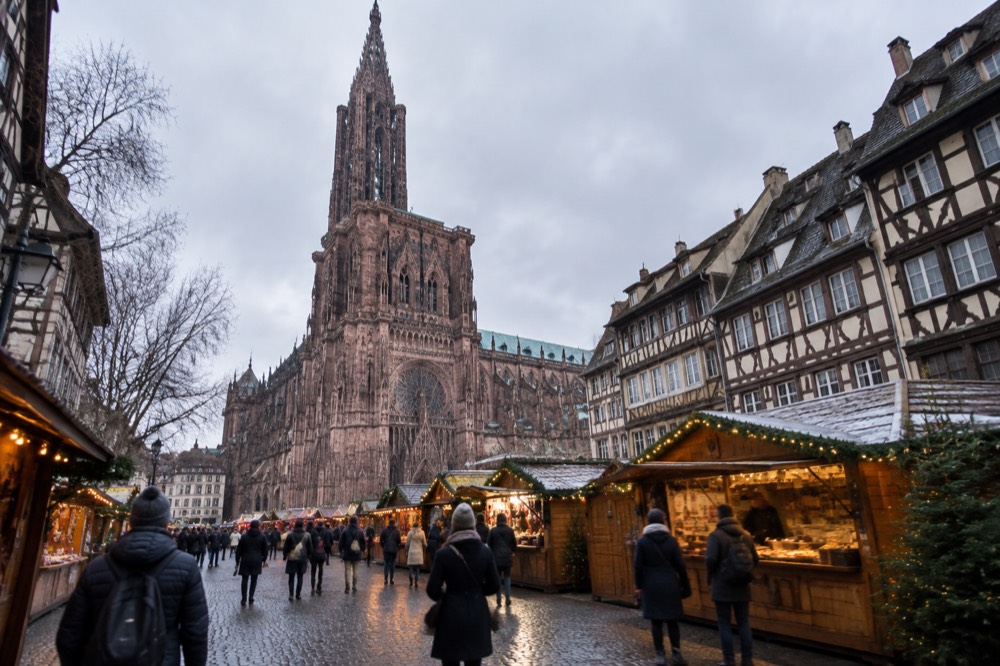
At Christmas the food moves outdoors: from late November until 24 December the market chalets take over the old-town squares, and the eating shifts to hot spiced wine, roasted chestnuts, bredele biscuits and the sweet, savoury and smoked specialities that only appear in the season. Last year's edition ran from 26 November to 24 December 2025 and drew 3.05 million visitors, and the 2026 dates are still being finalised on the city's official Christmas site, so confirm them there before you book anything around the market. The chalets typically open from late morning into the evening, with an early close on 24 December itself.
The Christmas repertoire deserves its own vocabulary. Vin chaud, hot wine spiced and sweetened, is the fuel of the market circuit. Bredele are the small Christmas biscuits, baked in dozens of shapes and family recipes, sold by weight from chalet counters. Roasted chestnuts, gingerbread and the season's kougelhopf fill the gaps, and the winstubs run their fullest menus of the year, which is why December reservations are not optional. The Christmas market food guide covers the stalls dish by dish, and the Christmas markets in Alsace guide places Strasbourg in the wider region.
December weather shapes the eating. The Meteo-France normals give the month a mean maximum of 5.9 C, a mean minimum of 0.8 C and 10.2 days of rain of 1 mm or more, so plan on cold, damp evenings and dress for standing around a chalet with a hot cup. Getting around is easy: the CTS network sells a 24h Solo pass for 4.60 EUR and a 24h Trio pass for two to three people for 10.20 EUR, which covers the tram rides between the old town and the outer markets.
| Christmas Stall Food | What It Is | How To Eat It |
|---|---|---|
| Vin chaud | Hot spiced wine | Standing, cup returned for a deposit |
| Bredele | Small Christmas biscuits | Buy by weight, mix shapes |
| Roasted chestnuts | Hot, peeled in the shell | From paper cones between stalls |
| Gingerbread | Spiced, often iced | Keeps as a gift |
| Seasonal kougelhopf | The brioche, dressed for the season | Whole, from bakery chalets |
Can You Plan A Food Day Trip From Strasbourg?
Yes, and the two directions taste different: west into the Alsace wine route villages for cellar tastings and village kitchens, or east across the Rhine into Germany's Black Forest and Baden-Baden for cake, ham and a different beer culture, both reachable on bookable day trips from the city. The wine route option pairs a food day with scenery: the villages of Riquewihr, Eguisheim and Kaysersberg sit among vineyards, and a tasting stop is built into the better trips. The Alsace wine route guide and the Riquewihr guide cover the villages; the Black Forest guide covers the German side.
The Black Forest and Baden-Baden day trip is the contrast option, and it is the one that changes the currency of nothing, since France and Germany share the euro, but changes everything else on the plate: the ham, the cake and the spa-town café culture of Baden-Baden, plus the forest landscape beyond. A guided option runs a full day from Strasbourg, and the trio at the end of this page includes it. Do not try to combine both directions in one day; the point of a food day trip is to slow down, not to collect two regions before supper.
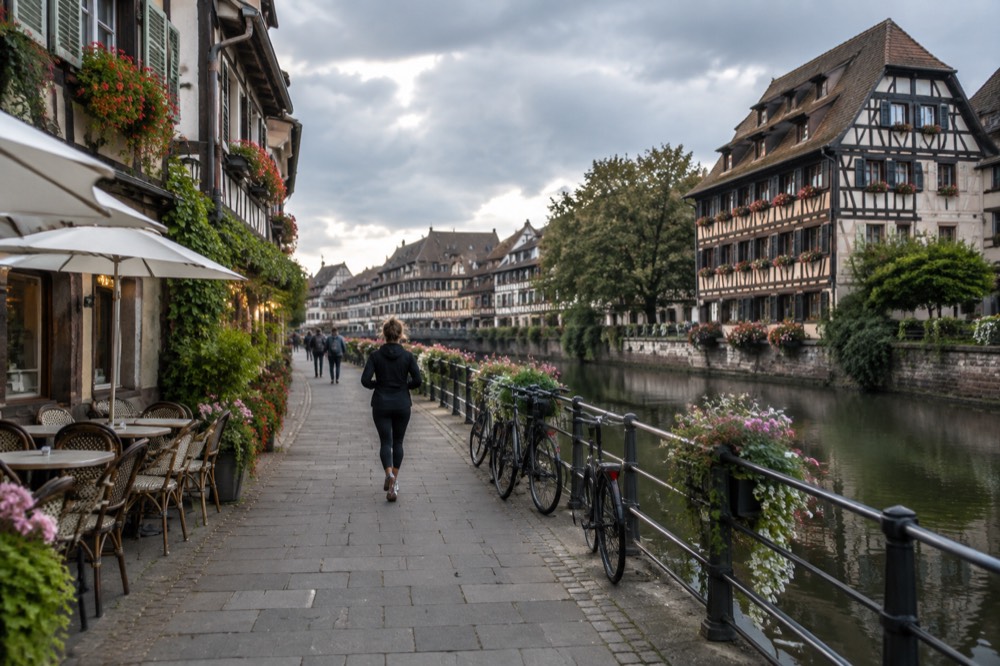
For a half-day version, an Alsace wine tour from Strasbourg runs about four hours and returns you to the city in time for dinner, which is the best of both worlds: cellar morning, winstub evening. The Colmar guide is the reference if you would rather base yourself closer to the vineyards, and the Strasbourg and Colmar itinerary splits a trip between the two.
| Day Trip Direction | What You Eat | Who It Suits |
|---|---|---|
| Alsace wine route villages | Cellar tastings, village kitchens, kougelhopf | Wine-first visitors |
| Black Forest and Baden-Baden | German ham, Black Forest cake, café culture | Visitors wanting the border contrast |
| Half-day Alsace wine tour | Guided tastings, back for dinner | Short stays, first-time tasters |
Where Should You Stay To Be Near The Best Food?
Stay inside or on the edge of the Grande Île if food is the trip's purpose: the winstubs, the markets and the Christmas chalets are all within a short walk, and the trade-off is higher room rates against the value of being able to walk home after a long dinner. The where to stay in Strasbourg guide breaks the neighbourhoods down properly. For a December visit, when the market crowds thin out after the chalets close, staying in the old town turns the whole evening into yours; the where to stay for the Christmas market guide is the seasonal version of the same question.
The Krutenau is the value answer, close enough to walk to the cathedral in minutes and far enough from the old town that the restaurants are where locals eat. The station district suits arrivals and departures: the Gare Centrale puts you a tram ride from the centre, and a CTS single ticket costs 1.90 EUR bought through the app or contactless, or 2.50 EUR bought on board the bus. Wherever you sleep, book the winstub for your first night before you travel, not after you arrive.
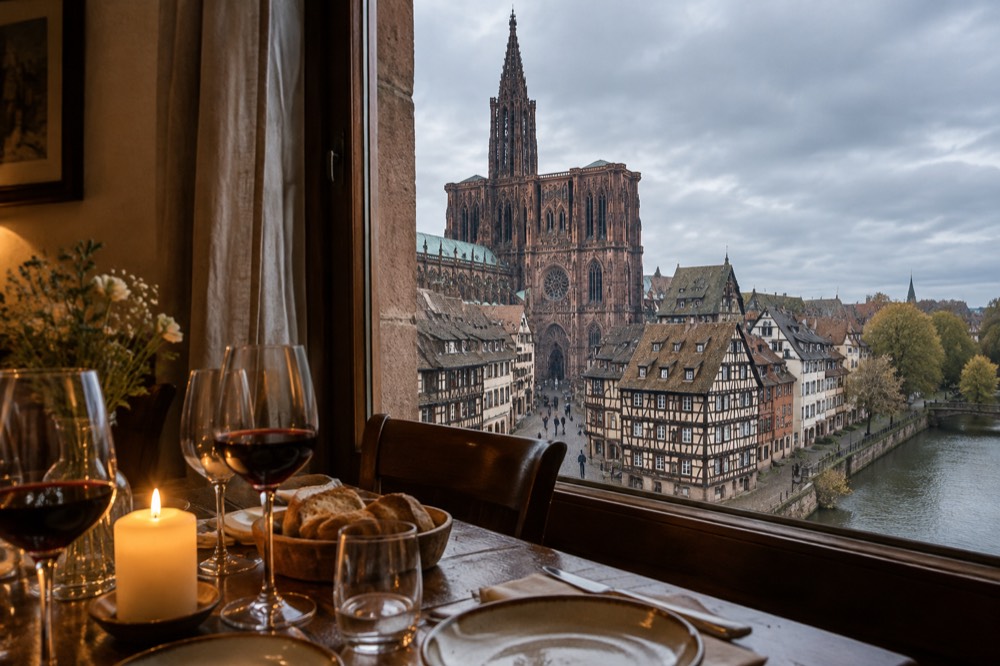
The short culinary walk below suits the evening of an arrival day, when a full dinner feels like too much but a couple of hours of tasting does not.
What Does A Perfect Food Day In Strasbourg Look Like?
Start with market shopping in the morning, take a cathedral visit before the 12:30 astronomical clock show, eat tarte flambée at a winstub lunch, spend the afternoon on a guided tasting walk or a boat circuit, and finish with a choucroute or baeckeoffe dinner in the Grande Île, with a kougelhopf and coffee the following morning. The pattern works because the city is compact and the food sits on top of the sights rather than beside them: the best dining rooms are inside the postcard, not a taxi ride away.
The boat leg is worth building in, because the river is how Strasbourg's geography makes sense, and the food quarters cluster on the water. Batorama's long tour costs 16.20 EUR full fare, 8.90 EUR reduced, and runs 1 hour 10 minutes; the short tour costs 12.50 EUR full, 7.20 EUR reduced, over 45 minutes. Either fits between lunch and a late-afternoon tasting, and both leave from the quai des Bateliers, a short walk from the winstub lanes. The Strasbourg river cruise stop guide adapts the same logic for visitors arriving by boat.
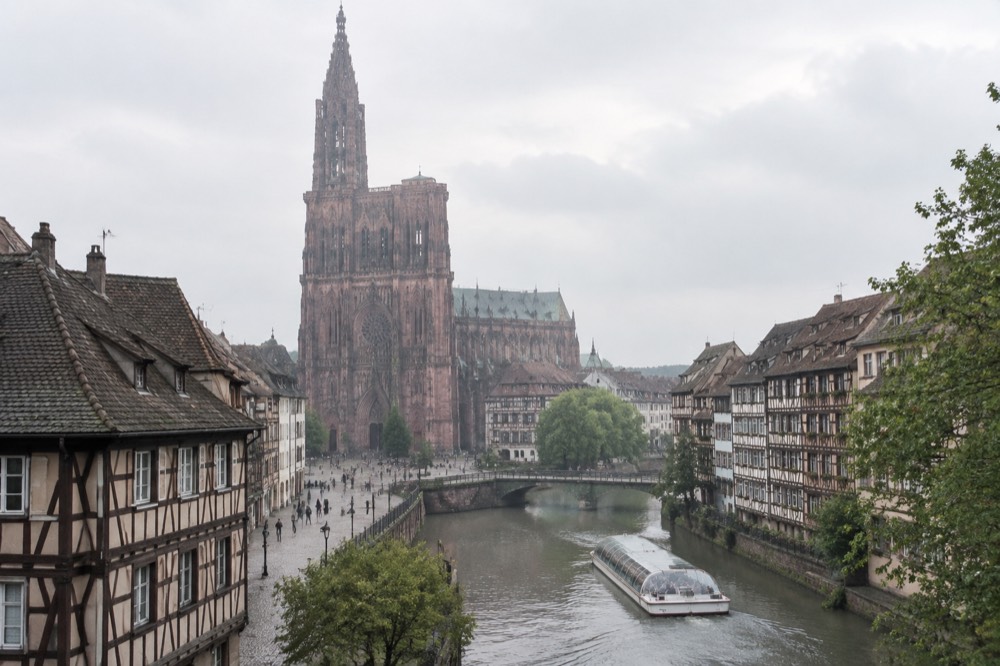
For a second day, the pattern repeats with substitutions: a Krutenau bistro instead of a winstub, a wine bar instead of a tasting walk, and a market picnic if the weather holds. The one day in Strasbourg guide and the three days in Strasbourg guide give the full sightseeing scaffolding around the meals, and the best time to visit guide weighs the seasons, including the December food scene against the summer terraces.
Common Questions About Strasbourg Food
What is the signature dish of Strasbourg?
Tarte flambée is the dish Strasbourg eats most often, a thin flatbread baked with cream, onions and lardons, but choucroute garnie is the city's famous large plate, and the two anchor every winstub menu alongside baeckeoffe and kougelhopf.
Do I need to book winstubs in advance?
Yes, for evenings and for any December visit. The traditional rooms are small, the Christmas market season fills them first, and Sunday lunch is a full sitting. Book your first night before you travel.
What should I drink with choucroute garnie?
Riesling. Its dry structure cuts the richness of the pork and cabbage, and it is the traditional pour in every winstub. A Sylvaner or a Pinot Blanc works if you prefer something softer.
Is the Strasbourg Christmas market good for food?
Yes. The chalets run from late November to 24 December and sell vin chaud, bredele biscuits, roasted chestnuts, gingerbread and seasonal kougelhopf, and last year's edition drew 3.05 million visitors. Confirm the 2026 dates on the city's official Christmas site before booking.
Can I eat well in Strasbourg on a budget?
Yes. Market picnics from the covered markets, lunchtime winstub menus, and the student quarter of the Krutenau all eat well below old-town dinner prices. The tarte flambée itself is one of the least expensive full plates in the city.
Are food tours in Strasbourg worth it?
For a first visit, yes: a guided tasting walk reaches producers and counters you would not otherwise find and orients you in the old town at the same time. Take the general walking tour first if your visit is short, and the food walk on a second day.
Eating in Strasbourg is the simplest reason to visit and the easiest thing to get right: book one winstub, walk the rest, and let the market, the river and the border do the rest of the work.