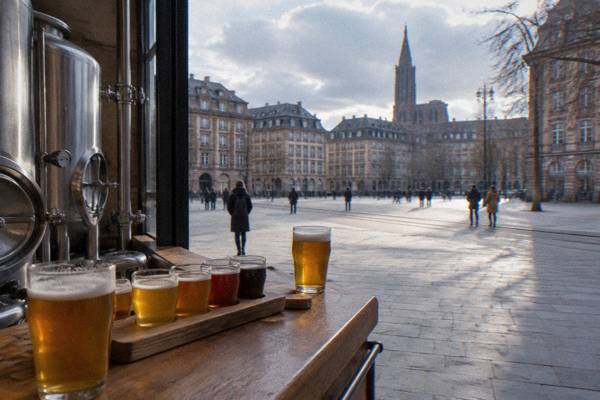
Strasbourg Beer
Strasbourg, in Alsace in the north-east of France, is the rare French city where beer holds its own against wine. This guide covers what to drink, where to drink it, what to eat alongside it and what a beer day costs.
Short answer
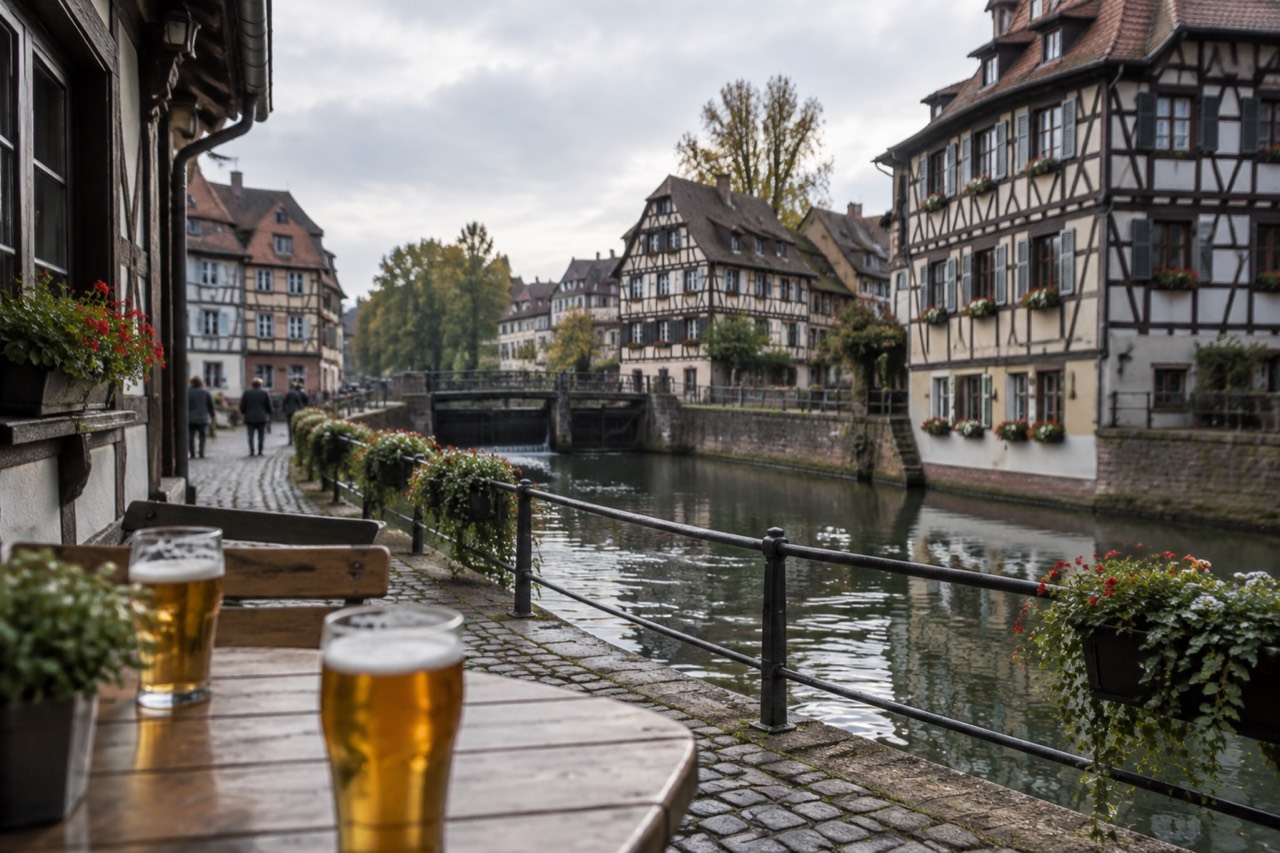
Strasbourg sits in Alsace, France's historic brewing region, and beer flows through its winstubs, craft taprooms and riverside terraces. A CTS single ticket costs 1.90 EUR, the 24h Solo pass 4.60 EUR, and the astronomical clock show costs 4 EUR. This guide covers styles, neighbourhoods, pairings, seasons and guided options.
Strasbourg, in Alsace in the north-east of France, is the rare French city where beer holds its own against wine. The city stands on the River Ill beside the Rhine, the border with Germany, and that position shaped everything on the table: the half-timbered winstubs pour local lager as readily as Riesling, the food leans towards tarte flambée and choucroute rather than Provençal vegetables, and the brewing tradition of the surrounding plain runs deep enough that the region reads as the beer corner of France. This guide walks through what that means in practice: the styles to look for, the neighbourhoods that pour them, the pairings that work, and what a day built around the glass actually costs.
What Makes Strasbourg A Beer City In France?
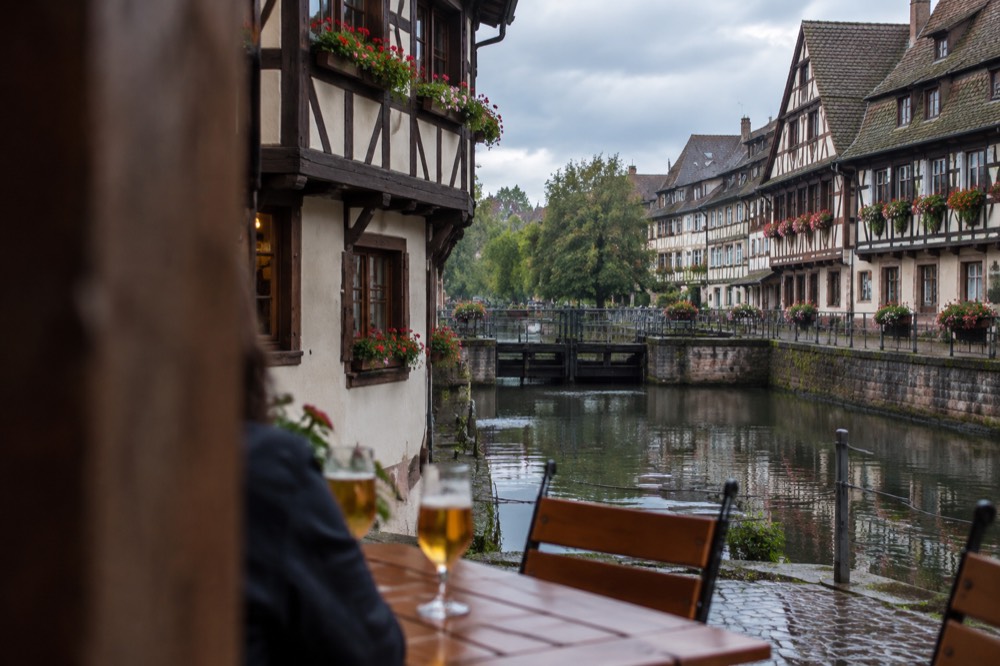
Alsace is the historic brewing heart of France, and Strasbourg is its capital in every practical sense: the winstubs of the Grande Île pour local blondes and ambrées by default, the region's big brewery names grew up on the plain around the city, and a new wave of craft taprooms has settled into the Krutenau and the streets off the station. Beer here is not a novelty next to wine, it is half of the table. The explanation is geographic as much as cultural. Alsace sits on the French side of the Rhine, close enough to German brewing tradition that lager became the everyday pour, while still keeping its own Alsatian identity in the glass and on the plate. The winstub, the cosy wood-panelled dining room that defines eating out in Strasbourg, is the clearest expression of this: a place where a carafe of Riesling and a tall blonde beer sit on neighbouring tables and nobody considers either choice unusual.
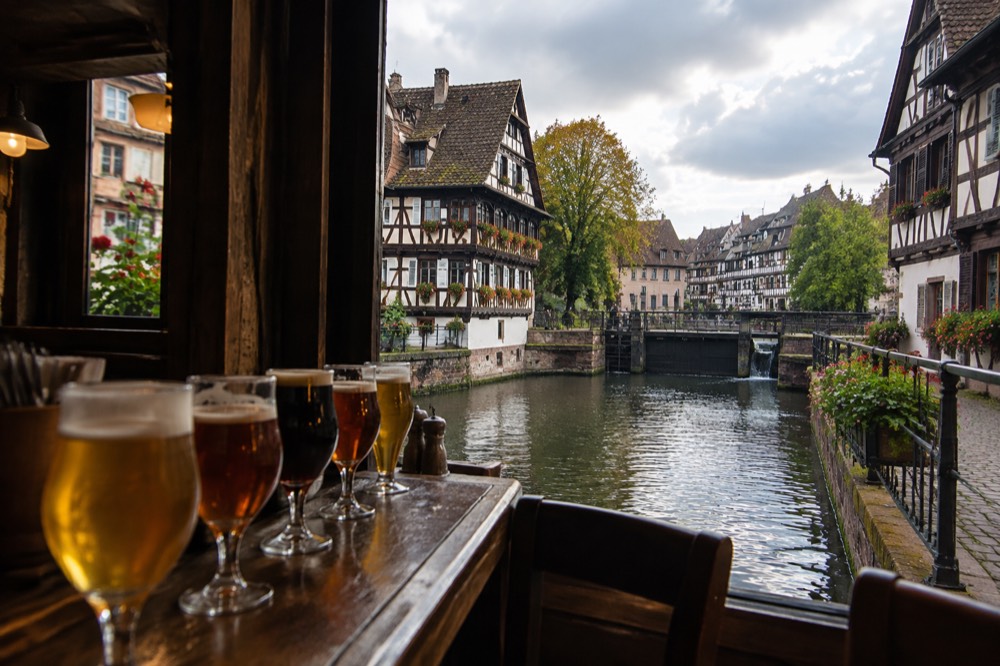
What that means for a visitor is simple: the default beer in Strasbourg is a clean, drinkable blonde lager in the German style, and the interesting part is everything around it. Amber beers, wheat beers brewed to a spicier Alsatian pattern, and a growing roster of craft IPAs, sours and stouts from small city breweries give the scene depth. Christmas season adds its own layer, when the market chalets pour beer alongside the mulled wine, and the cold-weather versions of Alsatian food call for darker glasses.
The styles worth knowing, in the order a visitor is likely to meet them:
| Style | Character | Where You Meet It | What It Suits |
|---|---|---|---|
| Blonde (lager) | Light, crisp, mild hop | The default pour in winstubs and market chalets | First glass of the evening, tarte flambée |
| Ambrée (amber) | Toasted malt, gentle caramel | Winstub lists and regional bottles | Choucroute, cold evenings |
| Blanche (wheat) | Cloudy, spicy, soft | Bottled lists and craft taps | Terrace afternoons in warm months |
| Craft IPA and pale ale | Assertive hops, modern styles | Krutenau and Neustadt taprooms | Drinkers chasing bitterness |
| Dark and seasonal beers | Malt-forward, richer body | Winter lists and Christmas stalls | Baeckeoffe, cheese, December cold |
None of this requires expertise. A traveller who orders the house blonde in a winstub and follows it with whatever the taproom down the street is pouring will cover the whole range in two evenings.
Where To Drink Beer In Strasbourg?
The Grande Île, the UNESCO-listed island at the centre of Strasbourg, carries the classic winstub experience around the cathedral and Petite France; the Krutenau, the student quarter just south, holds the craft beer bars; the Neustadt adds grand brasseries in its imperial-era streets; and the gare district keeps practical, late-opening options near the station. Each zone does a different job, and the walk between them is short enough that a beer itinerary can cross three of them on foot in an evening. The cathedral's own hours page lists nave openings of 08:30-11:15 and 12:45-17:45 Monday to Saturday.
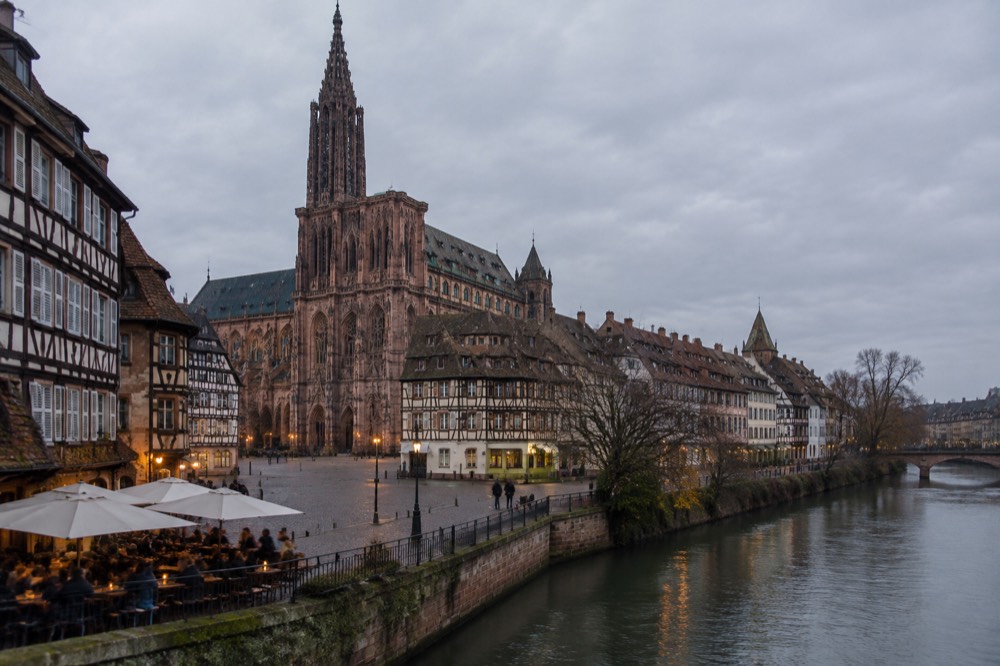
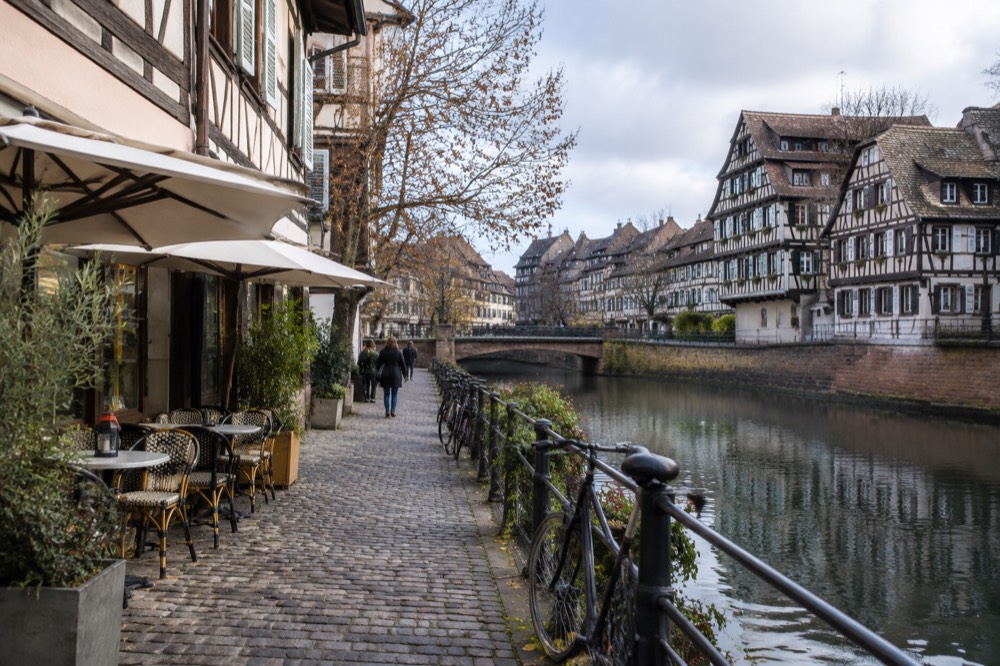
The Grande Île is where the postcard version lives. Around Place Kléber and the lanes off the cathedral, winstubs with painted signs and window boxes pour the regional blondes alongside the tourist flow, and prices rise accordingly. Petite France, the former tanners' quarter where the Ill splits around the Barrage Vauban, is the prettiest backdrop for a terrace glass in the city; the trade-off is that the tables there fill first in good weather. Travellers who want the atmosphere without the premium tend to drift a few streets east, where the same beer costs a little less and the service is calmer. For a fuller picture of the city's quieter corners, the hidden corners of Strasbourg guide maps the lanes that sit just off this circuit.
| Area | Beer Character | Best For | What To Check |
|---|---|---|---|
| Grande Île | Classic winstub blondes and ambrées | First visit, atmosphere | Whether the winstub pours regional or national brands |
| Petite France | Terrace drinking on the water | Warm evenings, photos | Terrace seating fills early in good weather |
| Krutenau | Craft taps, student bars | Modern styles, lower prices | Tap lists change week to week |
| Neustadt | Brasseries in wide imperial streets | A quieter long drink | Opening hours, some close early |
| Gare district | Practical bars near the station | Late arrivals, last glass | Late-night safety and busy periods |
The Krutenau deserves its own paragraph. This quarter, hugging the Ill south of the old centre, is where Strasbourg's younger drinking culture actually lives: small bars with rotating taps, breweries with their own front rooms, and terraces that spill towards the university. A beer-focused evening that starts in a Petite France winstub and ends in a Krutenau taproom covers both halves of what Strasbourg pours. Anyone planning where to sleep in relation to all this will find the where to stay in Strasbourg guide breaks the neighbourhoods down by budget and atmosphere.
For travellers who want the beer and the city explained together, a guided format does the pairing work for you:
Each carries its own price and review figures on the operator's live listing.
What Is The Craft Beer Scene In Strasbourg Like?
The craft scene in Strasbourg is compact, young and concentrated in the Krutenau and the streets around the station: small independent breweries and taprooms pouring modern IPAs, sours and stouts alongside the classic Alsatian blondes, with tap lists that change weekly and prices well below the old-town tourist strip. It reads as a local scene rather than a showcase, which is its charm. The bars are small, the brewers are often behind the counter, and the conversation is as much a part of the product as the beer. Where the Grande Île pours for visitors, the Krutenau pours for the people who live here, and the difference shows in both the glass and the bill.
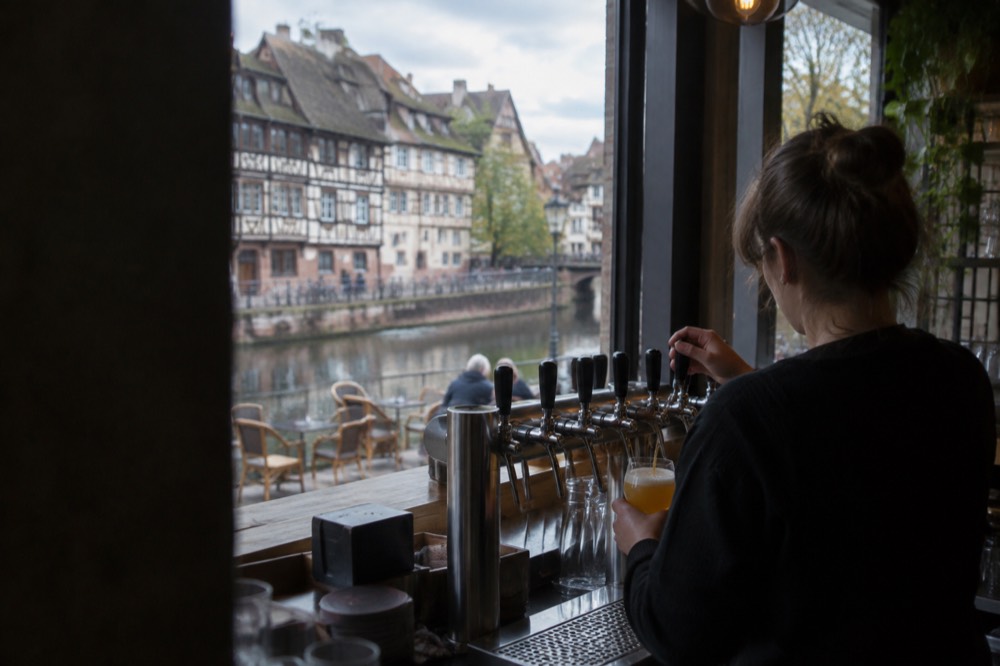
One format on the city's tour roster captures the scene unusually well: a craft beer tasting held in a working brewery before the doors open to the public. The experience runs through the roster's listings with its price, rating and duration shown there, and the before-opening setting is the point, because it puts the visitor inside the production space rather than at the end of the bar. For beer-first travellers it is the closest thing the city offers to a brewery visit without leaving the centre.
Beyond that, the craft scene rewards wandering. A visitor who walks the Krutenau's riverside streets and follows the chalkboard signs will find the taprooms without a map, and the short distances between them make a self-guided crawl entirely practical. The evening guide to Strasbourg covers how the city shifts after dark, from riverside terraces to the bars that stay open latest.
How Do You Pair Beer With Alsatian Food?
The Alsatian table was practically built for beer: tarte flambée wants a crisp blonde to cut the cream and bacon, choucroute needs an ambrée to stand up to the sausage and sauerkraut, munster cheese finds its match in a wheat beer, and the winstub format exists precisely to serve these combinations in one wood-panelled room. Pairing here is not a refined art, it is the default setting of the cuisine. The same dishes that wine country serves with Riesling work just as naturally with the region's beers, and a winstub list always offers both.
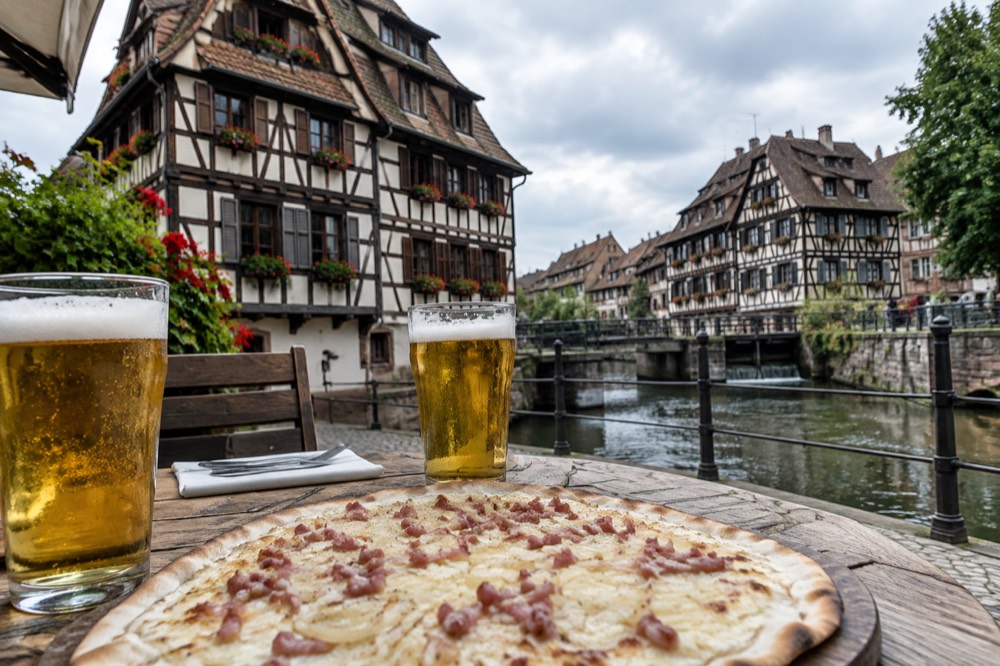
The pairings that matter, in the order a visitor is likely to order them:
| Dish | Why Beer Works | Best Glass | Where To Order It |
|---|---|---|---|
| Tarte flambée | Crisp lager cuts cream and bacon | Blonde | Any winstub; the thin version is the classic |
| Choucroute garnie | Malt stands up to sausage and kraut | Ambrée | Traditional winstubs on the Grande Île |
| Baeckeoffe | Rich stew needs a clean palate reset | Blonde or a dry craft lager | Winstubs that cook it a day ahead |
| Munster cheese | Wheat beer softens the wash | Blanche | Cheese-focused winstubs and market stalls |
| Kougelhopf | Light beer balances the sweet, buttery cake | Blonde | With dessert, or at a market stall |
None of this stays inside the city limits. The villages of the Alsace wine route, the half-timbered towns that sit a short drive out of Strasbourg, pour the same beers in their own auberges and brewery-front restaurants, and the countryside is where the brewing names of the region actually made their name. A historical day trip from Strasbourg through the Alsatian villages pairs the beer table with the scenery behind it, and it is the natural next step for a traveller whose interest in the glass has widened into an interest in where it comes from. The tour's price, rating and duration sit on the operator's live listing, and bookings carry free cancellation.
What Does A Beer Day In Strasbourg Cost?
A day built around beer in Strasbourg costs surprisingly little beyond the drinks themselves: a CTS single ticket is 1.90 EUR, the 24h Solo pass 4.60 EUR, the astronomical clock show 4 EUR, the cathedral platform 10 EUR full or 6 EUR reduced, and municipal museums 9 EUR full or 5 EUR reduced, with every municipal museum free on the first Sunday of the month. The beer itself varies by neighbourhood, with winstub prices on the Grande Île running above the Krutenau's, so the honest answer is that the glass bill depends on where you sit while the sightseeing bill is fixed.
| Item | Price | Notes |
|---|---|---|
| CTS single ticket | 1.90 EUR | Via Badgéo, the CTS app or contactless; 2.50 EUR on board the bus |
| CTS 24h Solo pass | 4.60 EUR | Unlimited travel for one day |
| CTS 24h Trio pass | 10.20 EUR | Covers 2-3 people travelling together |
| Astronomical clock show | 4 EUR | Daily at 12:30, day-of tickets only |
| Cathedral platform | 10 EUR full, 6 EUR reduced | Platform at 66 m, under 6s free |
| Municipal museums | 9 EUR full, 5 EUR reduced | Pass Musées 1 day at 20 EUR |
| Batorama short boat tour | 12.50 EUR full, 7.20 EUR reduced | Blue circuit, 45 minutes |
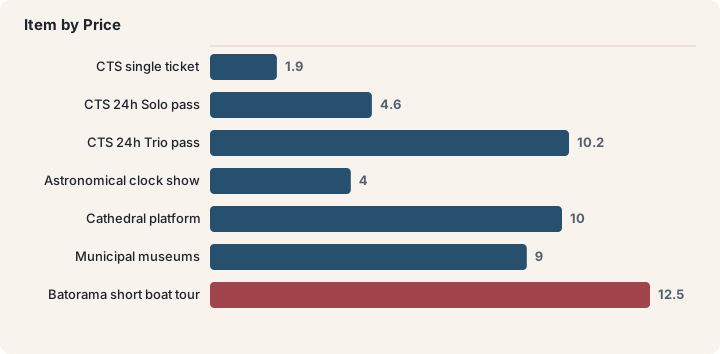
Two of those figures deserve a second look. The clock show sells tickets on the day only, at the cathedral stalls in the morning or the Saint-Michel entrance from 11:30, so a beer itinerary that plans lunch for 12:30 needs to buy the ticket before the first glass. And the first Sunday of the month turns the museum half of the day free, which is worth knowing for anyone stretching a budget; the budget guide to the city and the free things to do guide list the rest of what costs nothing.
Not every tasting in Strasbourg is beer, and that is part of the point. The region's wine culture sits in the same cellars and the same winstubs, and a visitor who wants to understand the Alsatian table properly will taste both. A discovery tasting of Alsace wines runs through the roster's listings, price and rating shown there, and it makes a neat contrast to an evening of craft taps.
Curious about the wine side of the Alsatian table too? Book an Alsace wine tasting here.
When Is Terrace Beer Season In Strasbourg?
Terrace season in Strasbourg runs from roughly April through September, when the Meteo-France 1991-2020 normals show mean daily maxima of 17.0 C in April rising to 26.4 C in July, with rain on 8.0 to 10.8 days per month at 1 mm or more, so the best terrace months are May to August and the shoulder months trade warmth for emptier tables. The climate is semi-continental, which in practice means warm summers, cold winters and rain spread evenly through the year rather than concentrated in one wet season. There is no bad beer month in Strasbourg, only different months that want different rooms.
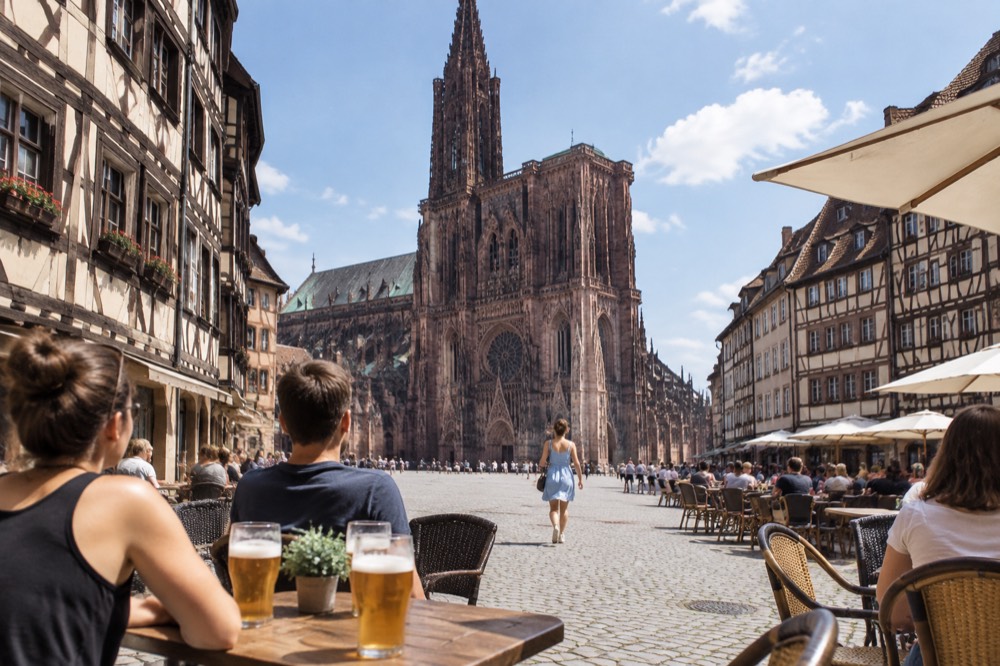
| Month | Mean Max C | Mean Min C | Rain Days >=1 mm | Terrace Verdict |
|---|---|---|---|---|
| April | 17.0 | 5.7 | 8.6 | Warm afternoons, cool evenings |
| May | 20.9 | 10.1 | 10.8 | Prime terrace weather |
| June | 24.4 | 13.4 | 10.2 | Long evenings, carry a light plan |
| July | 26.4 | 14.9 | 10.4 | Peak season, book terraces ahead |
| August | 26.1 | 14.5 | 9.5 | Still prime, slightly quieter |
| September | 21.6 | 10.7 | 8.0 | The locals' favourite month |
The rain-day column matters more than visitors expect. With measurable rain on roughly eight to eleven days in every summer month, a terrace plan needs an indoor fallback, and the winstub is exactly that: the same beer, the same food, a wood-panelled room instead of a pavement. The month by month weather guide and the best time to visit Strasbourg guide carry the full year in detail, and the seasonal guides, from spring in Strasbourg through summer in Strasbourg to autumn in Strasbourg, break down what each stretch of the calendar does to the city.
Winter changes the beer rather than stopping it. December's normals show a mean maximum of 5.9 C and a mean minimum of 0.8 C, and the scene moves from terraces to the warm rooms, where the darker and richer winter glasses come into their own. The winter in Strasbourg guide covers the cold half of the year in full.
Which Guided Tours Pair Well With A Beer Trip?
The tours that pair best with a beer trip are the food and tasting walks, which route through the winstubs and markets where the beer table lives; the historical day trips into the Alsace villages, which reach the countryside behind the breweries; and the city formats like Segway circuits, which compress the sightseeing so the evening stays free for the glass. None of them is a pub crawl, and that is deliberate: Strasbourg's product is the city itself, with beer as one layer of it, and the guided options exist to explain the rest.
| Format | What It Does | Who It Suits | Beer Angle |
|---|---|---|---|
| Food walk with tastings | Routes through eateries with a guide | First-time visitors, eaters | Winstub stops pour beer with the food |
| Historical Alsace day trip | Village and countryside circuit | Travellers with a full day | Brewery country and auberge lunch stops |
| Segway city circuit | Fast sightseeing loop | Short-stay visitors | Frees the evening for the taprooms |
| Craft beer tasting | Brewery visit before opening | Beer-first travellers | The production side of the scene |
| Wine tasting session | Guided Alsace wine flight | Curious contrast seekers | Explains the other half of the table |
The food walks earn their place at the top of that table. A traditional food walking tour with tastings moves through the city's eating houses, and the winstub stops on its route pour the same blondes and ambrées this guide has been describing, with the guide explaining what each room means. Its price, rating and review count render on the operator's listing rather than in this prose.
The day trips serve a different purpose. Strasbourg is the natural base for the Alsace villages, and the historical day trip through the region is the roster's flagship version, reaching the half-timbered towns whose auberges pour the same beers as the city's winstubs. For a traveller whose beer interest has grown into a broader interest in Alsace, it is the single best day of the trip.
Where Does Beer Fit Into Christmas And Nights Out In Strasbourg?
Strasbourg's Christmas season, which by long pattern opens in the last week of November and runs to 24 December, pours beer at the chalets alongside the mulled wine, and the cold-weather food of the stalls, from tartines to roasted fare, is built for exactly the amber glasses the region brews; after the stalls close, the night scene shifts to the Krutenau bars and the riverside rooms that stay open latest. The 2026 market dates are not yet published, and the city's Christmas site states that the programme is still being finalised, so any December visit should confirm dates there before booking travel.
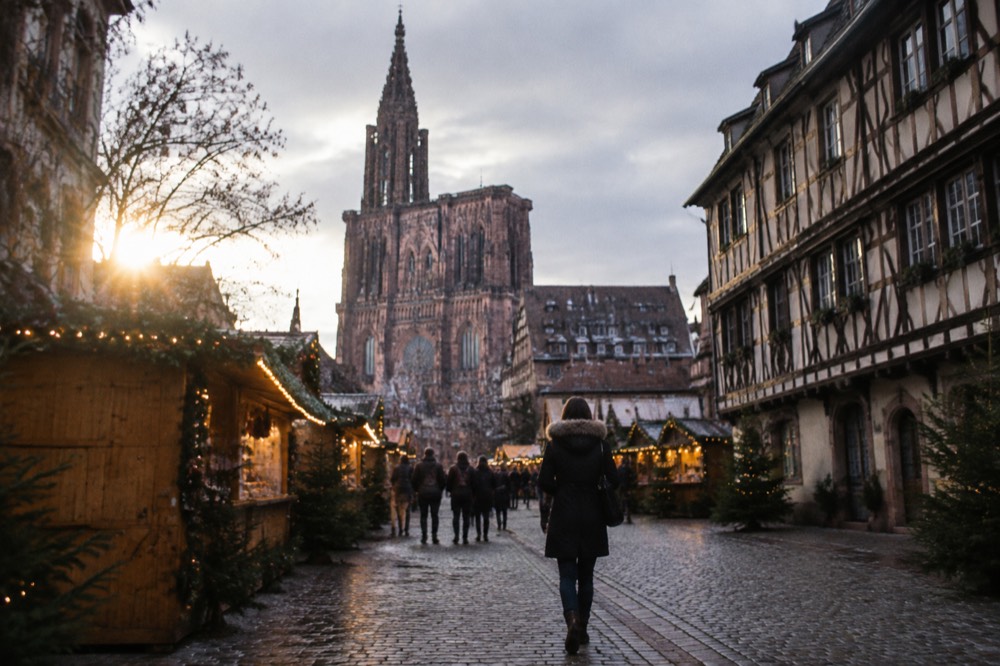
The Christmas connection runs deeper than the stalls. Strasbourg styles itself around the Christmas season, and last year's edition drew 3.05 million visitors, which means December tables need booking and terrace seats need claiming early. The Christmas market food guide covers what to eat at the stalls, and the evening guide to Strasbourg covers what the city does after the chalets shut. Between the two, a December visitor can build a full beer-and-market evening without guessing.
For the rest of the year, the night pattern is simpler. The Grande Île quiets after dinner, the Krutenau fills, and the walk between them along the Ill is one of the pleasantest stretches of the city after dark. A traveller who ends a beer evening on the Ponts Couverts, with the covered bridges lit over the water, gets the view that the whole city is photographed for.
That is the shape of it. Strasbourg pours beer the way other French cities pour wine, in rooms that were built for it, in a region that has brewed it for as long as the architecture has stood, and the visitor who follows the glass from winstub to taproom to market stall will see more of the city than the cathedral alone could ever show. For the wider picture of what the city offers beyond the beer table, Strasbourg Travel Guide covers the sights, itineraries and day trips that surround it.
Common Questions About Strasbourg Beer
Is Strasbourg known for beer?
Yes, in a qualified way. Strasbourg is the capital of Alsace, the historic brewing region of France, and beer sits beside wine in its winstubs and markets. The city is not a beer destination in the brewery-tour sense; it is a city where beer is a normal, everyday part of the table, and the craft taprooms of the Krutenau have added a modern layer on top of that tradition.
What beer should you try in Strasbourg?
Start with the house blonde lager poured in any winstub, then an Alsatian ambrée with something richer on the plate, and finish with whatever the craft taprooms of the Krutenau have on the rotating taps. Wheat beers and winter dark beers round out the range. The order matters less than the variety; two evenings cover the whole spectrum.
Do winstubs serve beer as well as wine?
Yes. The winstub is the Alsatian dining room, and its list carries the regional beers alongside the Riesling and other Alsatian wines. Ordering a blonde with tarte flambée is entirely normal, and no waiter will treat it as a lesser choice. The bigger winstubs around the cathedral and Petite France pour the fullest lists.
Can you visit a brewery in Strasbourg?
The closest option in the city is a craft beer tasting experience held in a working brewery before it opens to the public, which runs through the tour listings with its price and details shown there. Beyond that, the region's larger breweries sit out in the Alsace countryside around the city, and visiting them calls for a car or an organised day trip; check each brewery's own page before travelling.
Is beer expensive in Strasbourg?
It depends on where you sit rather than what you order. Glasses on the Grande Île and in Petite France carry the tourist-strip premium, while the Krutenau's student-quarter bars pour for noticeably less. Sightseeing costs are fixed and modest: the CTS 24h Solo pass is 4.60 EUR, the astronomical clock show is 4 EUR and the cathedral platform is 10 EUR, so the day around the beer costs little.
Does the Christmas market serve beer?
Yes, the chalets pour beer alongside the mulled wine, and the amber styles suit the cold-weather food of the stalls. The market by its usual pattern opens in the last week of November and runs to 24 December, but the 2026 dates are not yet published, so confirm them on the city's Christmas site before booking a December trip.