Strasbourg In Autumn
Autumn in Strasbourg, in north-eastern France, runs from warm September afternoons to the first Christmas market chalets in late November. Here is what the season actually delivers, with figures from Meteo-France normals, the cathedral's own hours pages and the CTS fare table.
Short answer
Autumn in Strasbourg, France, means mean daily maxima of 21.6 C in September, 15.8 C in October and 9.4 C in November, with 8.0 to 9.6 rain days of 1 mm or more each month. The cathedral platform costs 10 EUR, municipal museums 9 EUR, and the Christmas market opens in the last week of November.
Strasbourg, the prefecture of the Bas-Rhin in Alsace, part of the Grand Est region of north-eastern France, sits on the River Ill beside the Rhine, which forms the border with Germany. Autumn here is a season of two halves: September still carries terrace weather, October lays gold over the half-timbered roofs of the Grande Île, and November slides quietly into the biggest event on the city's calendar, the Christmas market that opens in the last week of the month. This guide walks through the weather the Meteo-France 1991-2020 normals actually record, the tickets and hours that matter in autumn, the tours that suit the season, and how to plan around rain days that average eight to ten per month.
What Is Autumn In Strasbourg Like?
Autumn in Strasbourg, in the Alsace region of north-eastern France, is mild in September and genuinely cold by November: Meteo-France 1991-2020 normals give mean daily maxima of 21.6 C in September, 15.8 C in October and 9.4 C in November, with 8.0, 9.6 and 9.2 rain days of 1 mm or more respectively. The climate is semi-continental, in the rain shadow of the Vosges, so layers matter more than they would in Mediterranean France.
The Meteo-France 1991-2020 normals for the Strasbourg-Entzheim station, published via Meteociel, give the honest picture. September mean minimum sits at 10.7 C, October at 7.2 C and November at 3.3 C, so a mid-October evening walk along the Ill can feel two seasons apart from a lunchtime coffee on Place Kléber. Rainfall totals 54.6 mm in September, 59.5 mm in October and 47.6 mm in November, which is steady rather than dramatic: this is a city of frequent light rain, not Atlantic downpours. Over the whole year the station records 635.7 mm across 112.3 days with 1 mm or more, and autumn sits close to that monthly rhythm.
| Month | Mean daily maximum | Mean daily minimum | Rainfall (mm) | Days with 1 mm or more |
|---|---|---|---|---|
| September | 21.6 C | 10.7 C | 54.6 | 8.0 |
| October | 15.8 C | 7.2 C | 59.5 | 9.6 |
| November | 9.4 C | 3.3 C | 47.6 | 9.2 |
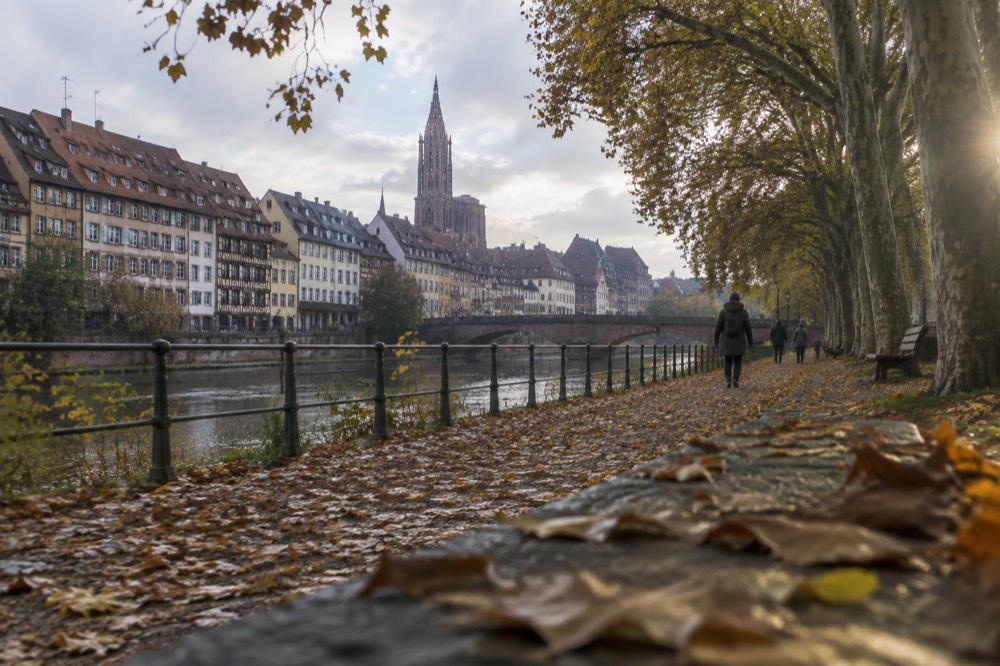
What those numbers mean in practice is simple. September belongs to long evenings on the riverbank and outdoor tables in the Krutenau quarter. October is the month the plane trees and vines take on colour, with afternoons that can still feel warm at a mean maximum of 15.8 C. November shortens everything: the light goes low and golden across the Grande Île, the winstubs light their stoves, and the first chalets of the Christmas market arrive in the last week of the month. For a fuller month-by-month breakdown, the Strasbourg weather month by month guide carries the complete normals table.
What To Do In Strasbourg In Autumn
The core autumn activities are walking the Grande Île and Petite France, climbing the cathedral platform at 66 m for 10 EUR, catching the astronomical clock show at 12:30 for 4 EUR, visiting the municipal museums at 9 EUR full price, and riding a Batorama boat along the Ill. With rain on roughly eight to ten days per month, the workable plan mixes one outdoor headline with one indoor fallback each day.
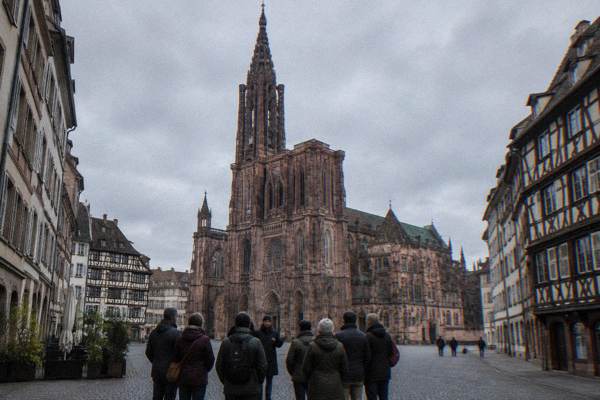
The cathedral anchors any list. The cathedral's own hours page lists nave visiting times of 08:30-11:15 and 12:45-17:45 Monday to Saturday, and 14:00-17:15 on Sundays and feast days. The platform above, at 66 m, runs on its winter timetable from 1 October: 10:00-13:00 and 13:30-18:00, with the last ascent at 17:15, and a ticket of 10 EUR full or 6 EUR reduced, with children under 6 free. The astronomical clock performs its full automaton show daily at 12:30 sharp; tickets are 4 EUR, sold on the day only, with no reservations, so arrive early at the stalls or the Saint-Michel entrance.
| Sight or experience | Hours in autumn | Ticket |
|---|---|---|
| Cathedral nave | Mon-Sat 08:30-11:15 and 12:45-17:45; Sun 14:00-17:15 | Entry per the cathedral's page |
| Cathedral platform (66 m) | 1 Oct-31 Mar: 10:00-13:00 and 13:30-18:00, last ascent 17:15 | 10 EUR full, 6 EUR reduced, under 6 free |
| Astronomical clock show | Daily at 12:30 | 4 EUR, day-of purchase only |
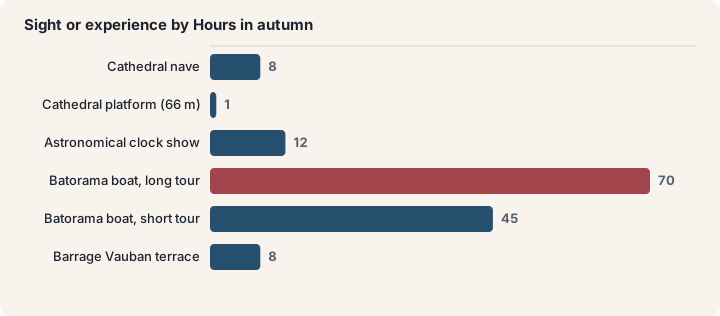
| Batorama boat, long tour | Red Tour, 1h10 | 16.20 EUR full, 8.90 EUR reduced |
| Batorama boat, short tour | Blue Tour, 0h45 | 12.50 EUR full, 7.20 EUR reduced |
| Barrage Vauban terrace | Sep-Oct 08:00-19:00; Nov-Feb 08:30-16:00 | Admission on the official page |
Museums are the autumn insurance policy. Every municipal museum charges 9 EUR full and 5 EUR reduced, the 1-day Pass Musées is 20 EUR, and all municipal museums are free on the first Sunday of every month, a fact the city states plainly on its museums FAQ. One exception matters: the Musée Alsacien is closed for works until 2028 and cannot be visited at all. The Musée de l'Œuvre Notre-Dame, the Beaux-Arts in the Palais Rohan and the MAMCS all remain open, and the Strasbourg museums in depth guide covers each one. The Strasbourg City Card, at 5 EUR adult and 3.50 EUR for children aged 3 to 17 and valid for 7 days, is a discount card rather than an all-inclusive pass, taking money off museums, the boat, the cathedral platform and the clock; the Strasbourg City Card discounts page breaks down what it saves.
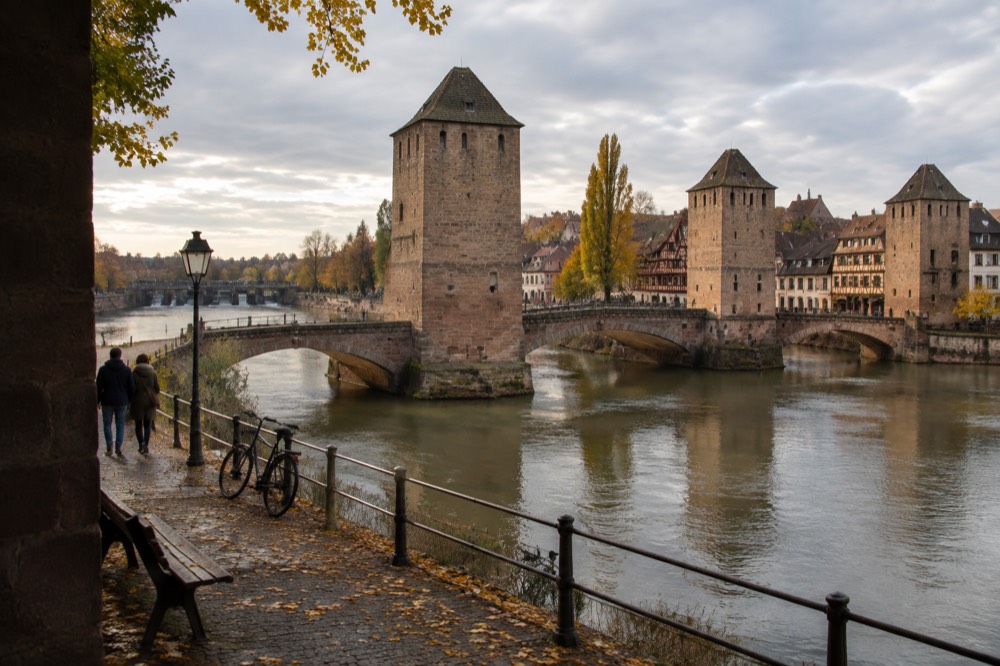
Between showers, the free options are real: strolling the public squares, the Ponts Couverts and the riverbanks of Petite France costs nothing, and the free things to do in Strasbourg guide lists them properly. The Barrage Vauban terrace, with its panoramic view over the Covered Bridges and the rooftops, keeps seasonal hours of 08:00-19:00 through October and 08:30-16:00 from November, so it is an early-in-the-day stop once the clocks change.
Is Autumn A Good Time To Visit Strasbourg?
Yes. September still behaves like late summer at a mean maximum of 21.6 C, October delivers the colour, and November trades warmth for thin crowds and the opening of the Christmas market in the last week of the month. Rain falls on 8.0 to 9.6 days per month with 1 mm or more, which a compact umbrella and a museum fallback list handle comfortably.
The case for autumn is a trade, and the trade is a good one. The summer months carry the year's highest rain totals, 71.9 mm in July against 59.5 mm in October, and the winter months push mean minimums to -0.2 C in January. October and November sit in the quietest stretch of the visitor year before the December rush, which matters in a city whose Christmas edition drew 3.05 million people last year. Hotel demand, restaurant tables on Place Kléber and the queue for the cathedral platform all ease noticeably once September ends.
The case against is honesty about November. The mean maximum of 9.4 C and the 3.3 C mean minimum describe a city that wants a proper coat, and the 9.2 rain days of 1 mm or more mean at least one wet afternoon in any week-long stay. The payoff is that late November is when Strasbourg turns: the market opens in the last week of the month and runs to 24 December, and the weeks either side of that opening belong to travellers who like the city with its guard down. For the full weighing of months, the best time to visit Strasbourg guide compares all four seasons, and this Strasbourg Travel Guide site carries the rest of the picture, from summer terrace season to the December market.
| Autumn month | Mean max | Mean min | Rain days | What defines it |
|---|---|---|---|---|
| September | 21.6 C | 10.7 C | 8.0 | Terrace season lingering on the Ill |
| October | 15.8 C | 7.2 C | 9.6 | Peak colour, jacket weather |
| November | 9.4 C | 3.3 C | 9.2 | Short days, market build-up |
Festivals fill the gaps between the showers. The contemporary music and jazz festivals that anchor the city's autumn programme sit on the tourist office's events calendar, and the Strasbourg events and festivals calendar guide collects the season's headline dates. Check the calendar page for the current edition's dates before you plan around any single festival.
Which Strasbourg Tours Suit An Autumn Visit?
A walking tour is the strongest autumn format because the city is compact and guides keep the group moving between covered stops; the roster's Strasbourg options include a Petite France walk with a local guide, a hidden-stories small-group walk and a cathedral-focused guided tour. A half-day Alsace wine tour adds vineyards and cellar tastings, and a boat on the Ill works in any weather.
To get your bearings before the weather turns, book a free walking tour here.
Walking tours earn their place in autumn for a mechanical reason: the Grande Île is small enough that a guide can reroute a group indoors within minutes of the sky turning, something a bike or Segway format cannot do as gracefully. The Petite France and historic-centre walk covers the half-timbered river quarter and the cathedral forecourt, while the hidden-stories small-group walk digs into the stranger corners of the old town's past. Both run through the shoulder season, when group sizes thin out and guides have time for questions.
The wine option deserves its own paragraph, because autumn is the vineyard season on the Alsace wine route and the half-day tour from Strasbourg is the article's featured trip. A local guide handles the road out to the vineyards and back, the tastings are built into the itinerary, and the half-day shape leaves the evening free for a winstub. It pairs naturally with a morning walk through Petite France on the same day: city in the morning, vines in the afternoon, choucroute by night. Check availability on the operator's live listing, because harvest-season departures are the ones that fill first.
Food tours are the third format worth naming. Strasbourg's culinary walks thread winstubs and tasting stops through the old town, and they sit indoors for half their running time, which makes them a sound bet for the 9.6 October rain days. Whatever the format, book the first slot of the day where the roster offers one: the cathedral platform queue is shortest before noon, and the light on the sandstone is better then anyway.
Where To See Autumn Colour Around Strasbourg
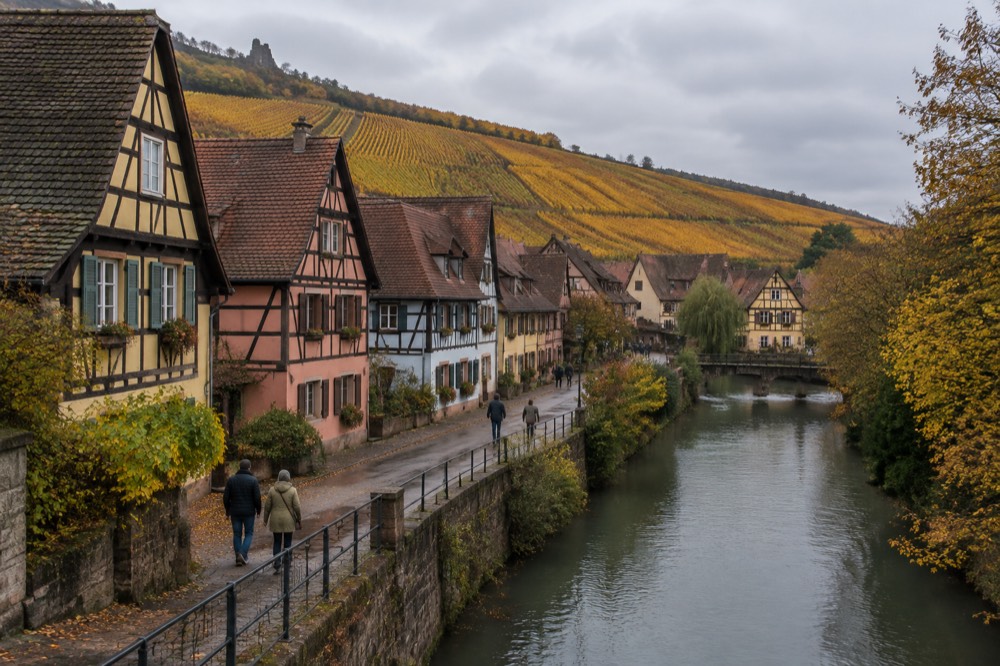
The strongest autumn colour sits on the Alsace wine route, where village vineyards turn gold through October, and inside the city along the Ill riverbanks in Petite France and in the Parc de l'Orangerie. The Barrage Vauban terrace, open 08:00-19:00 through October and 08:30-16:00 from November, gives the classic elevated view over the Covered Bridges and the old quarter's rooftops.
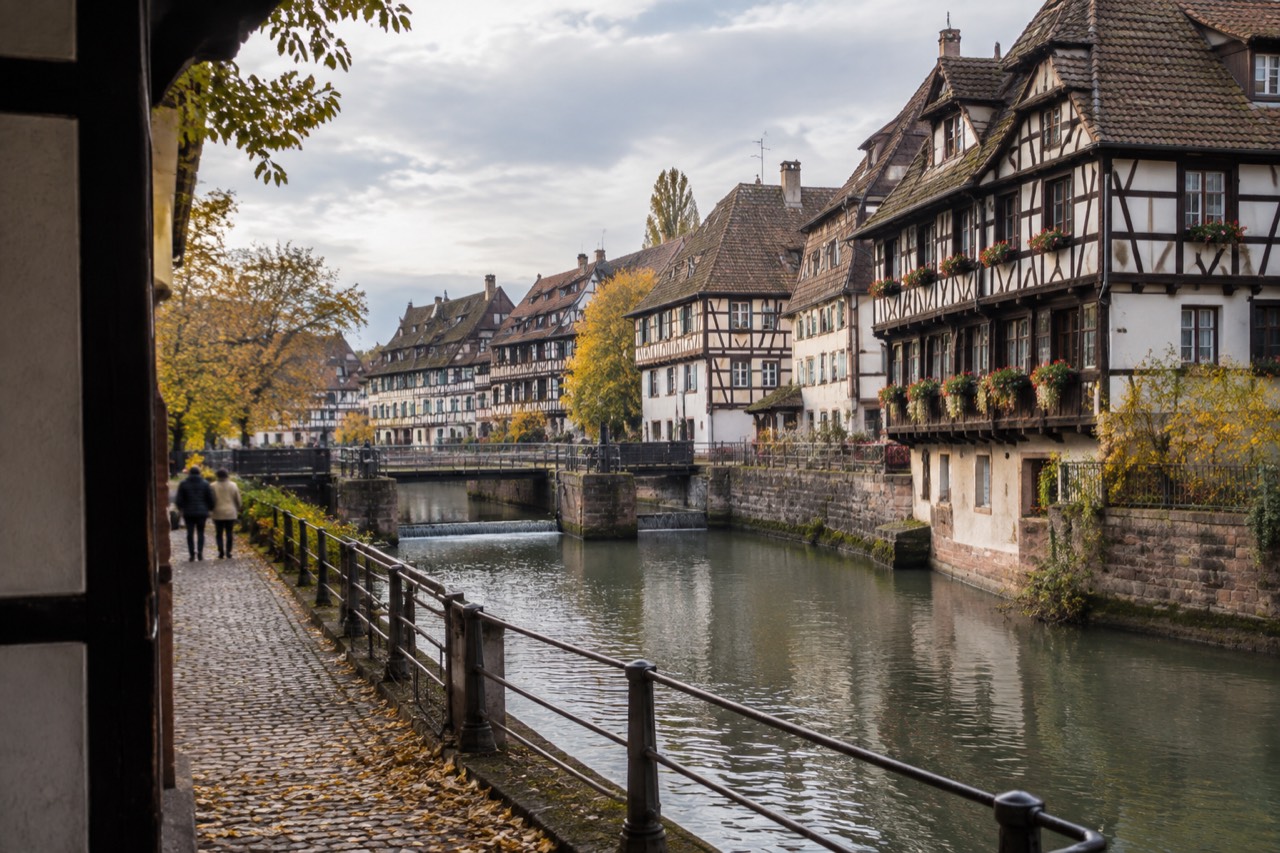
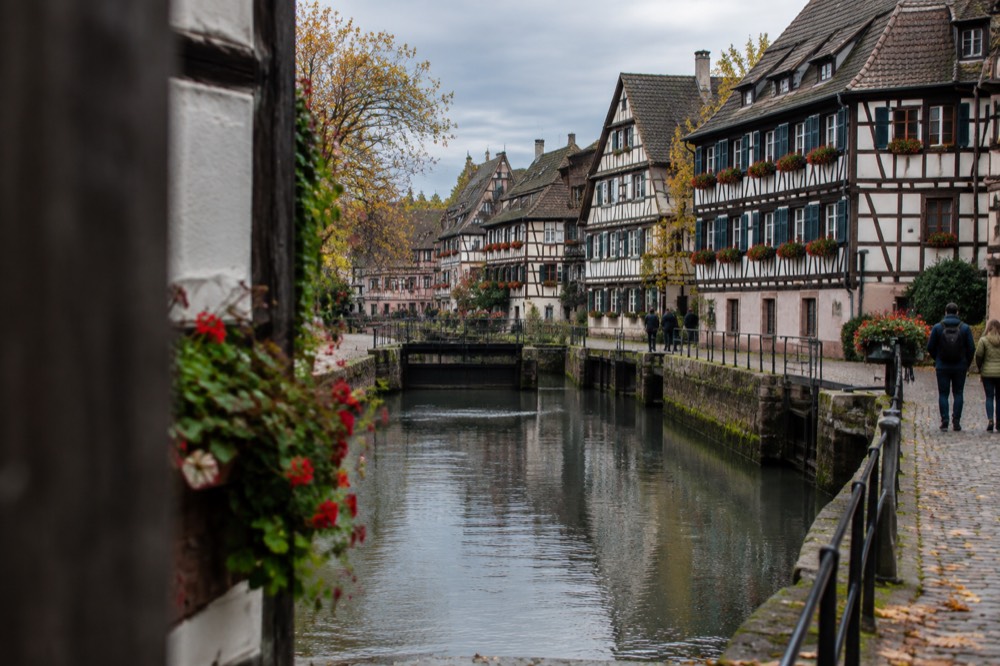
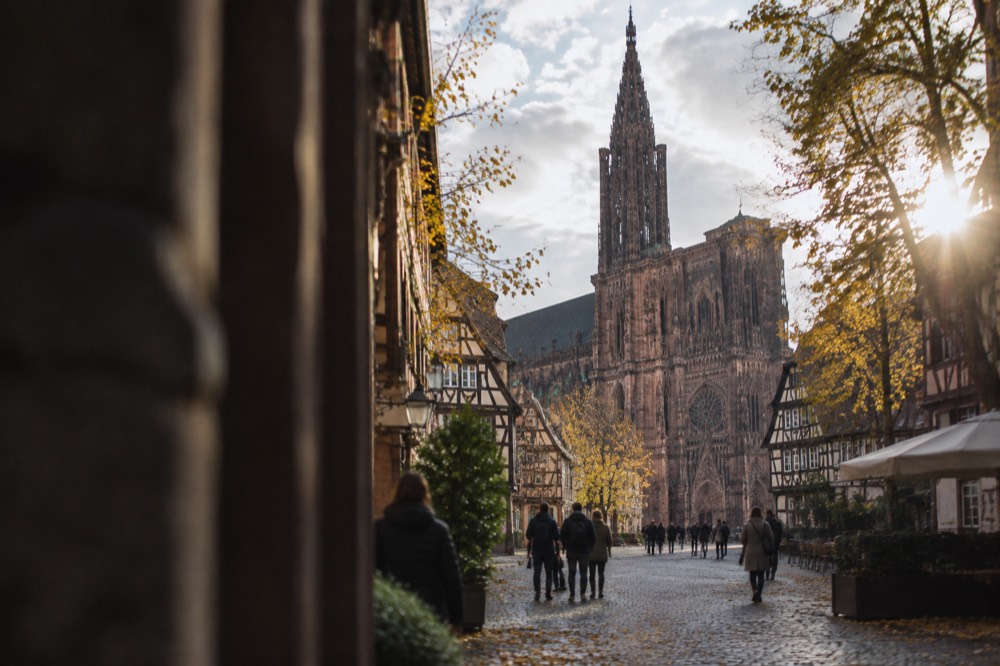
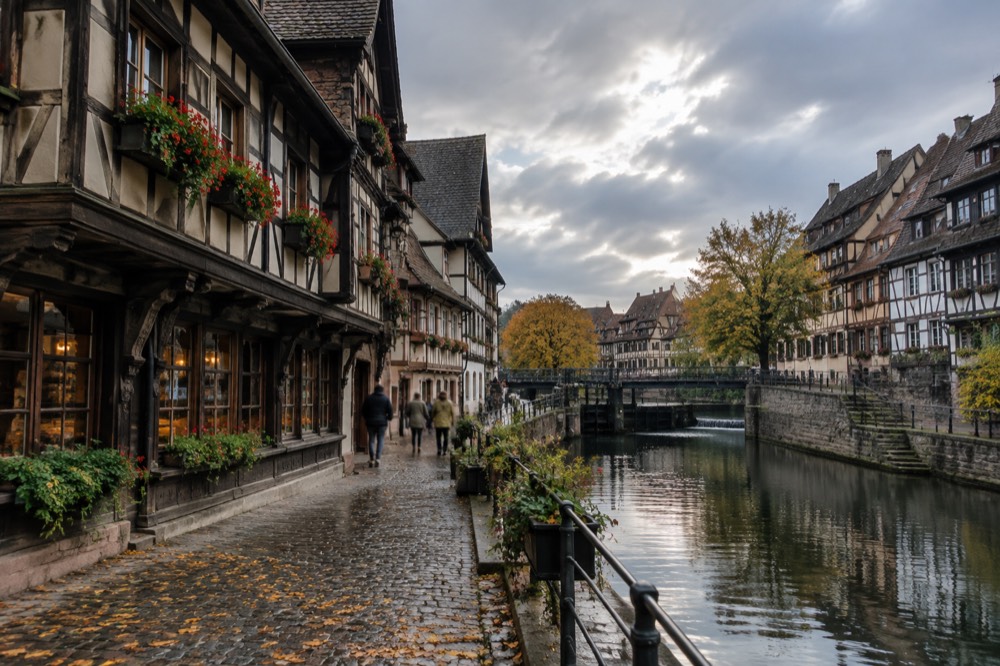
Inside the city, the colour is concentrated along the water. The Ill splits around the Grande Île, and the banks in Petite France, flanked by half-timbered houses, carry the season's best short walk: out along one bank, over the Ponts Couverts, up the Barrage Vauban terrace for the panorama, and back down the far side. The Parc de l'Orangerie, the city's oldest large park, holds its leaves into late October and makes an easy half-day pairing with the European Quarter institutions that sit beside it.
Outside the city, the wine route is the headline. The half-day Alsace wine tour from Strasbourg is the simplest way into it, and the villages along the route, places like Riquewihr, Eguisheim, Kaysersberg and Obernai, wear their vineyard slopes in full colour through October. Independent travellers can reach some of them by regional train, but the connections between villages are sparse, which is exactly the gap a guided day trip fills: one vehicle, several villages, a guide who knows which cellar is pouring what. For planning beyond the tour, the Colmar and Alsace wine route pages on this site carry the detail.
One timing note earns its own sentence: the colour peaks in October and the November rain days, 9.2 of them with 1 mm or more, strip the trees fast once they arrive. If leaf colour is the point of the trip, aim for the first three weeks of October and treat anything later as a bonus rather than a plan.
What To Pack For Strasbourg In Autumn
Pack layers: a warm jacket over a sweater for mornings near the 3.3 C November mean minimum, something lighter for afternoons that still touch a 21.6 C September mean maximum, and real rain gear, since 9.6 October days see 1 mm or more. Comfortable waterproof shoes beat the wet cobbles of the Grande Île.
The packing logic follows the normals table directly. September wants a light jacket and a sweater in the bag, with evenings around 10.7 C mean minimum. October wants a proper coat, a scarf for the riverbank wind and an umbrella that fits a daypack. November wants everything October wanted, plus gloves, because the mean minimum of 3.3 C describes mornings that can sit close to freezing. None of this is alpine equipment; it is ordinary north-eastern French city gear.
| Item | Why it earns its place | Which month needs it |
|---|---|---|
| Compact umbrella | 8.0-9.6 rain days of 1 mm or more per month | All three |
| Waterproof walking shoes | Wet cobbles and riverbank paths in Petite France | Oct, Nov |
| Warm coat | Mean minimums 7.2 C in Oct, 3.3 C in Nov | Oct, Nov |
| Light layers | Mean maximum 21.6 C in September | Sep |
| Scarf and gloves | Early mornings near freezing by late Nov | Nov |
Two practical notes complete the list. First, the cathedral has no luggage lockers, a fact its visiting page states plainly, so arrive from the hotel with bags stored or use a left-luggage service before heading to the platform. Second, dress for the boat: the Batorama circuits are covered, but the boarding pontoons along the Ill are exposed, and the wind off the water in November is sharper than the quai suggests.
How To Get Around Strasbourg In Autumn
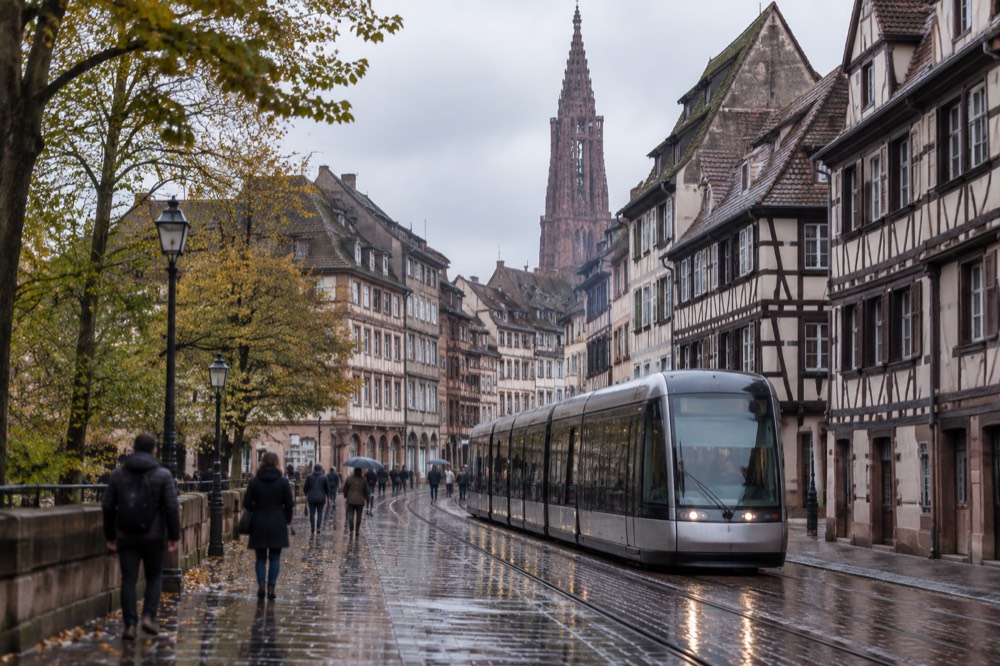
Walk, or use the CTS network: a single ticket is 1.90 EUR from the CTS app, a Badgéo card or contactless payment, or 2.50 EUR bought on board the bus, and a 24h Solo pass is 4.60 EUR. The airport train takes 8 minutes into the station with up to 5 trains per hour, and a combined train-plus-network ticket costs 4.60 EUR. No car is needed for the city itself.
CTS's fare page gives the numbers that matter. The 24h Solo pass at 4.60 EUR covers a full day of trams and buses and pays for itself after three single journeys. The 24h Trio at 10.20 EUR does the same for two or three people travelling together, which suits families more than solo autumn travellers. The single ticket at 1.90 EUR, or 2.50 EUR if bought on board a bus, is the right choice only for one-off hops; the contactless and app options make the cheaper price the default.
| Ticket | Price | What it covers |
|---|---|---|
| Single | 1.90 EUR (2.50 EUR on board bus) | One journey, app, Badgéo or contactless |
| 24h Solo | 4.60 EUR | One person, all CTS trams and buses for 24 hours |
| 24h Trio | 10.20 EUR | Two to three people travelling together |
| Airport combined ticket | 4.60 EUR | Train from Entzheim plus CTS travel |
The airport link is the quiet bargain of the transport table. The shuttle train between Strasbourg-Entzheim and the Gare Centrale takes 8 minutes and runs up to 5 trains per hour in the daytime, and the combined ticket at 4.60 EUR folds the train and a CTS day of travel into one fare. Arriving in autumn, that single purchase solves the whole first day. The airport's press release also notes new twice-weekly Jet2 winter routes to Edinburgh, Manchester and London Stansted from late November 2026, which widens the direct-flight picture for anyone planning the market season.
For trips beyond the city, the calculus changes. The wine route villages and the Vosges viewpoints are awkward without a vehicle, which is the honest argument for the guided day trips rather than a rental car. The train station keeps the region connected, and the regional services to Colmar and the wine towns are the sensible independent option for a single destination, while anything involving several villages in a day is better left to a tour.
How Does Autumn Lead Into The Christmas Market?
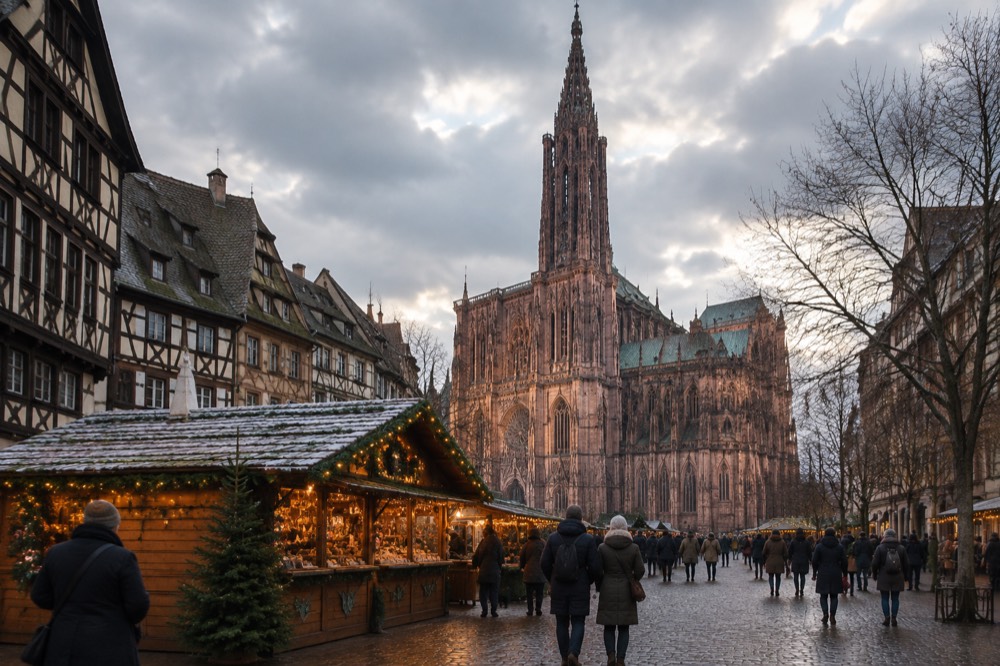
The market opens in the last week of November and runs to 24 December; last year's edition ran 26 November to 24 December 2025 and drew 3.05 million visitors. The 2026 dates are still being finalised, the city's Christmas site states, so confirm them there before booking travel. Late November in Strasbourg therefore belongs half to autumn and half to the festive season.
The overlap is the reason a late-November trip is unlike any other week of the autumn. The chalets typically open late morning and run into the evening, the 24 December close comes early in the evening, and the city's own bilan press release put the 2025 attendance at 3.05 million visitors, with 3.4 million the year before. Those numbers describe a city that changes gear overnight: hotel demand jumps, the where to stay for the Christmas market question starts to matter, and the winstub tables need booking rather than wandering into.
Planning around the opening has one rule: do not print a 2026 date from memory, because the city has not published one. The pattern, an opening in the last week of November and a close on 24 December, is stable enough to plan against, but the specific day belongs to the official Christmas site. Travellers coming from Paris have a dedicated route guide, and the Christmas market from Paris page covers the train-and-stay logistics. The full Strasbourg Christmas market guide carries the market-by-market breakdown, and the food and drink side of the season has its own page in the Christmas market food guide.
For anyone weighing late November against December itself, the trade is straightforward. Late November offers the opening atmosphere at autumn hotel prices, with the mean maximum of 9.4 C and 3.3 C minimums demanding the full winter wardrobe, while December delivers the complete market at peak demand. The winter in Strasbourg guide takes over where this one ends, covering the deep-season cold, the January lull and everything the coldest months do to the city's plans.
Common Questions About Strasbourg In Autumn
Is autumn a good time to visit Strasbourg?
Yes. September delivers a 21.6 C mean maximum, October brings the colour at 15.8 C, and November trades warmth for thin crowds and the Christmas market opening in the last week of the month. Rain falls on 8.0 to 9.6 days per month with 1 mm or more, so the season rewards a museum fallback list alongside the outdoor plans.
What is the weather like in Strasbourg in autumn?
Meteo-France 1991-2020 normals for Strasbourg-Entzheim give mean daily maxima of 21.6 C in September, 15.8 C in October and 9.4 C in November, with mean minimums of 10.7 C, 7.2 C and 3.3 C. Rainfall totals 54.6 mm, 59.5 mm and 47.6 mm across the three months, over 8.0, 9.6 and 9.2 days with 1 mm or more. The climate is semi-continental, not Mediterranean.
Is the Strasbourg Christmas market open in autumn?
Partly. The market opens in the last week of November, which is meteorological autumn even if the city is already in festive mode, and runs to 24 December. The 2025 edition ran 26 November to 24 December and drew 3.05 million visitors. The 2026 dates are still being finalised, the city's Christmas site states, so confirm them there before booking.
What should I pack for Strasbourg in autumn?
Layers and rain gear: a compact umbrella for the 8.0 to 9.6 monthly rain days, waterproof walking shoes for the wet cobbles of the Grande Île, a warm coat for October and November, and light layers for September afternoons. By late November the mean minimum sits at 3.3 C, so gloves and a scarf earn their place in the bag.
Are Strasbourg museums free on Sundays?
All municipal museums are free on the first Sunday of every month, which the city states on its museums FAQ page. On every other day the standard ticket is 9 EUR full and 5 EUR reduced, and the 1-day Pass Musées is 20 EUR. Note that the Musée Alsacien is closed for works until 2028 and cannot be visited on any day.
Do I need a car in Strasbourg in autumn?
No, not for the city. The CTS network covers the centre and beyond, with a single ticket at 1.90 EUR and a 24h Solo pass at 4.60 EUR, and the Grande Île is walked rather than driven. A car or a guided day trip only starts to make sense for the wine route villages and the Vosges, where connections between villages are sparse.