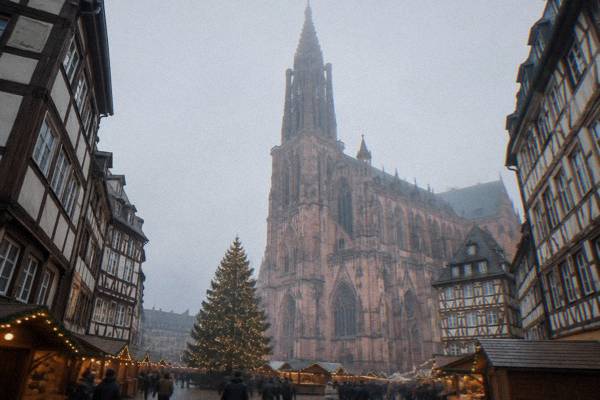
Strasbourg Christmas Market
Strasbourg, the prefecture of the Bas-Rhin in Alsace, north-eastern France, runs the oldest of the big French Christmas markets: late November to 24 December, across the squares of the Grande Île.
Short answer
The Strasbourg Christmas Market runs from late November to 24 December. The 2025 edition ran 26 November to 24 December 2025 and drew 3.05 million visitors. The 2026 dates are not yet published; the city's Christmas site states the official dates and programme are still being finalised. Expect cathedral hours, CTS trams at 1.90 EUR a single and cold, damp December weather.
Strasbourg, in Alsace (Bas-Rhin, Grand Est) in north-eastern France, on the River Ill beside the Rhine and the German border, hosts what is widely called the Capital of Christmas. The city's Christmas market fills the squares of the Grande Île and beyond for roughly four weeks each winter, and the whole centre turns into a pedestrian flow of chalets, fir garlands and mulled wine stalls. The 2025 edition ran 26 November to 24 December 2025 and drew 3.05 million visitors, down from 3.4 million in 2024, according to the city's own press release. The 2026 dates are not yet published: the city's Christmas site states that the official dates and programme are still being finalised, so confirm them there before booking travel.
This guide covers the pattern of the dates, the squares that matter, what a visit costs in euros, the December weather to pack for, the food and drink worth queueing for, and where to sleep. It also looks past the markets: Strasbourg's position on the French-German border makes it a base for Alsace wine villages, the Black Forest and the memorial site at Natzweiler-Struthof in the Vosges. For a full rundown of the city itself, start with the Strasbourg Travel Guide homepage and work inward from there.
What Is The Strasbourg Christmas Market?
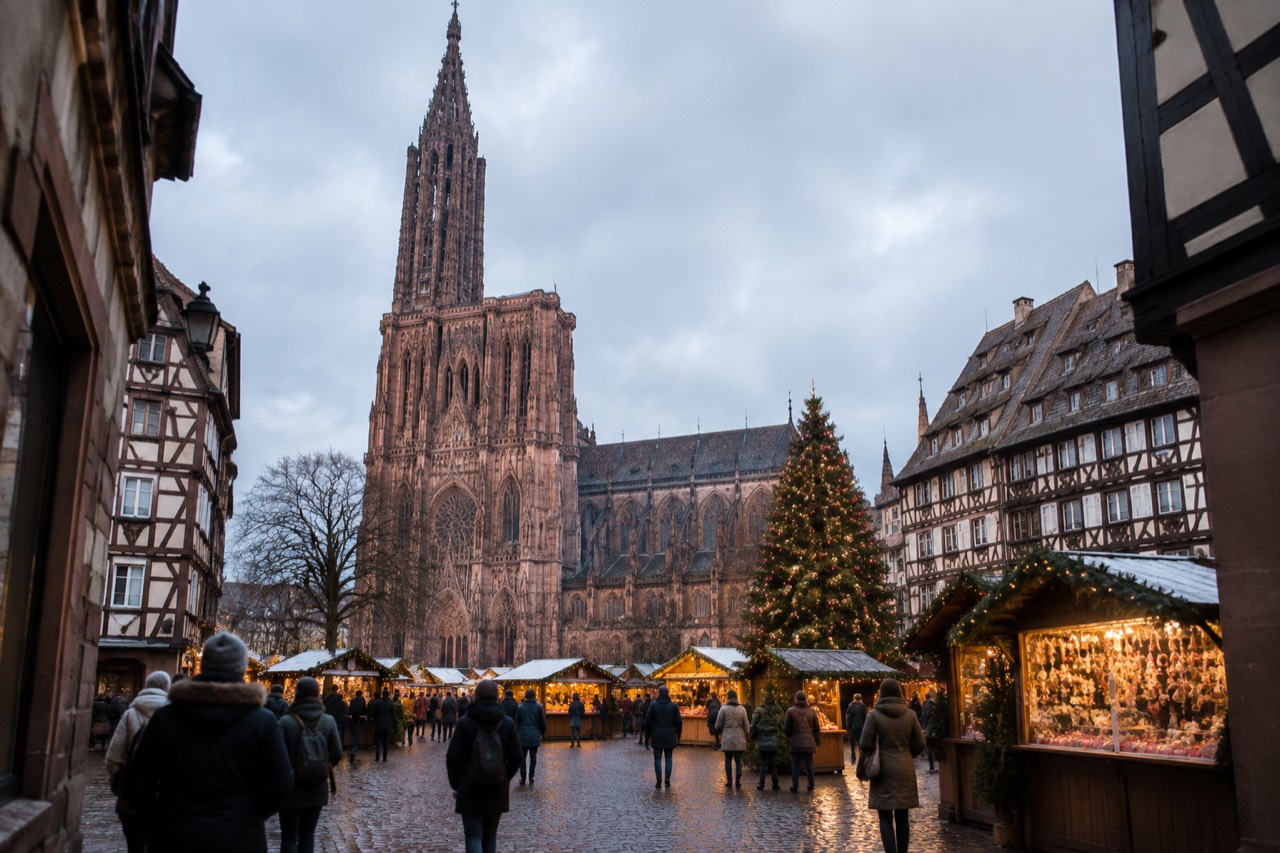
The Strasbourg Christmas Market is a dispersed market: dozens of chalets across several squares of the Grande Île and surrounding streets, anchored on Place Kléber and the cathedral, running late November to 24 December each year. Strasbourg brands the whole season "Strasbourg Capital of Christmas", and the 2025 edition drew 3.05 million visitors. It is not a single enclosure with one gate; you wander between squares on foot and pay nothing to enter the streets themselves.
The market is the reason Strasbourg reads as a Christmas city rather than merely a pretty one. Chalets spill across the historic centre, which is listed by UNESCO as "Strasbourg, Grande-Île and Neustadt", and the city hangs lights and fir across streets that are half-timbered and medieval at their core. The scale is the draw: you can walk for an hour between squares and still not have seen the whole footprint. The city does not publish a confirmed chalet count, so treat any number you read elsewhere with caution.
Want a guide to walk you through the decorated squares? Book a free walking tour here.
What distinguishes Strasbourg from other Alsatian markets is the mix of setting and seriousness. The Gothic cathedral, with its single spire, towers over the market on Place du Château; Place Kléber carries the great tree; Petite France's canals sit a short walk away. Because the city is also a working European capital, with the European Parliament and Council of Europe in the Orangerie quarter, the December streets carry a mix of tourists, officials and locals that keeps the winstubs genuinely busy. For background on the city's standing, see why Strasbourg is so famous and the answer to which Christmas market is best in Strasbourg.
If you are weighing Strasbourg against its Alsatian rival, the honest comparison is one of scale against charm: Strasbourg is the capital, Colmar the postcard. The question Strasbourg or Colmar for Christmas is worth settling before you book, because the two pair well by train and many visitors do both.
When Does The Strasbourg Christmas Market Run?
The market opens in the last week of November and runs to 24 December, closing early on the evening of the 24th. The 2025 edition ran 26 November to 24 December 2025. The 2026 dates are not published yet; the city's Christmas site states the official dates and programme are still being finalised, so check noel.strasbourg.eu before you commit to flights or hotels.
The pattern is stable enough to plan around even without an official announcement: a late-November opening, four full weeks of trading, and a 24 December close in the early evening. What changes year to year, and what the city announces in autumn, is the detail: the guest country theme, the layout of squares, and the programme of concerts and events. Those announcements land on the city's own Christmas site first, and secondary pages that print specific 2026 dates before that are guessing.
Attendance gives a sense of what you are walking into. The city's press release put the 2025 edition at 3.05 million visitors, down from 3.4 million in 2024. Practically, that means the first and last weekends are the crush, midweek early-December evenings are calmer, and the 24 December close is a short, local-feeling day. If you are deciding how long to stay, the answer to how many days you need for the Christmas markets is two to three, with a day trip or two on top.
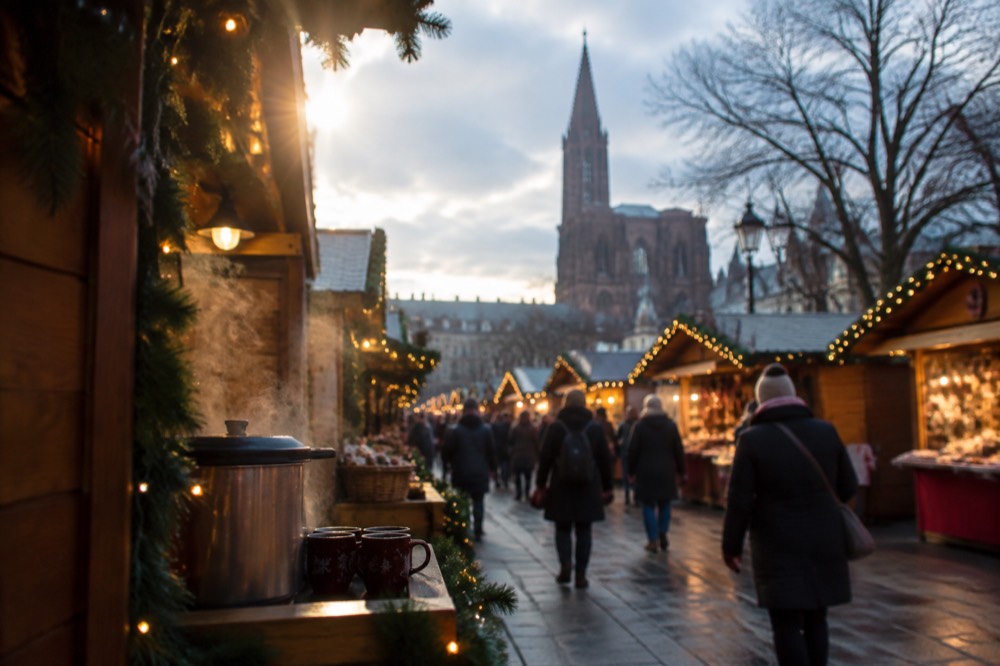
Planning from Paris is common and easy: the market is the single biggest reason people make the trip. The guide to the Strasbourg Christmas Market from Paris covers the rail options, and the question of whether December is a good time to visit Strasbourg is really a question about crowds and cold, both of which this market delivers in full.
For a structured visit, the site's Strasbourg Christmas Market itinerary sequences the squares by day and evening light, and the answer to whether the Christmas market is worth it is a fair one to ask before spending a December weekend in the cold.
Where Are The Christmas Markets And Which Squares Matter Most?
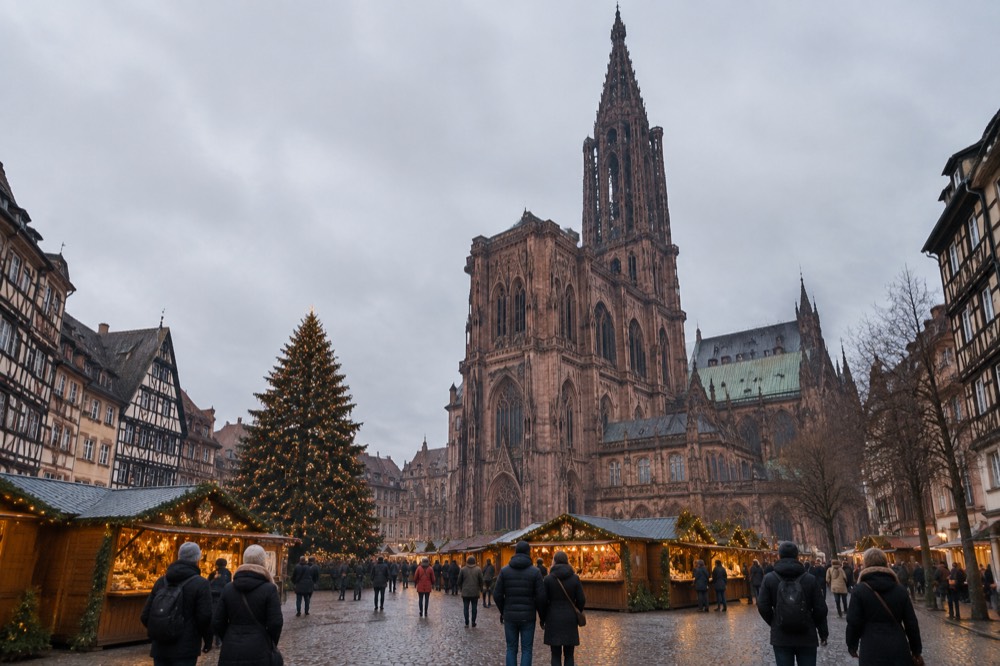
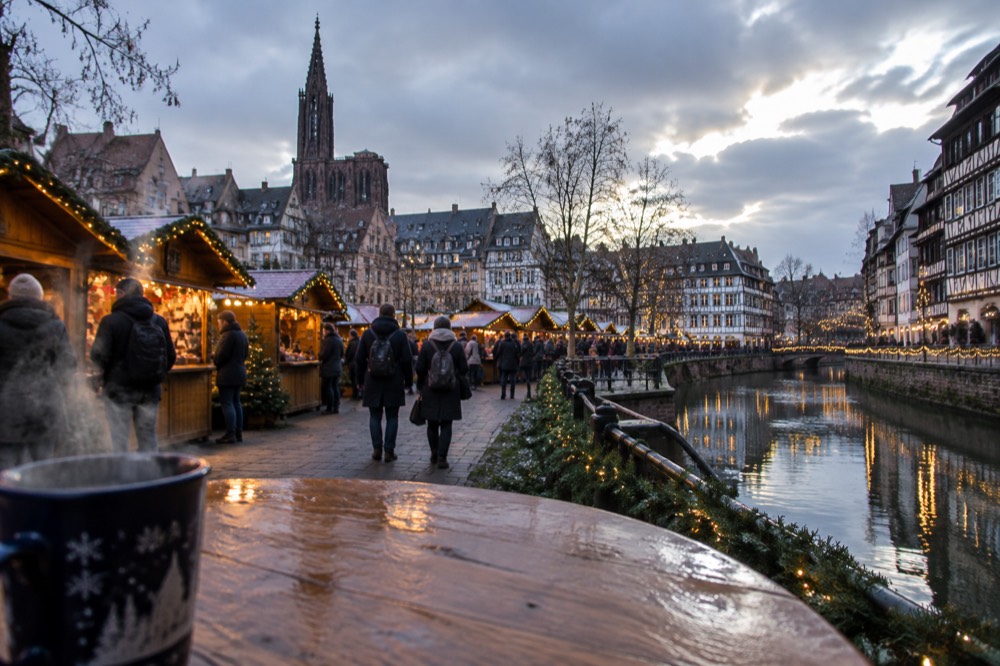
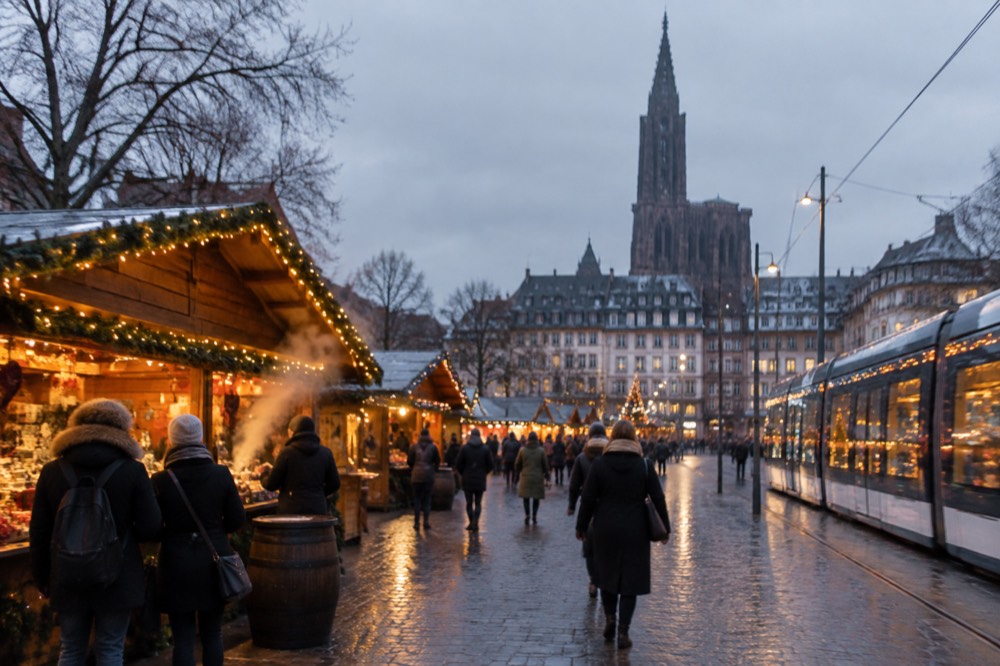
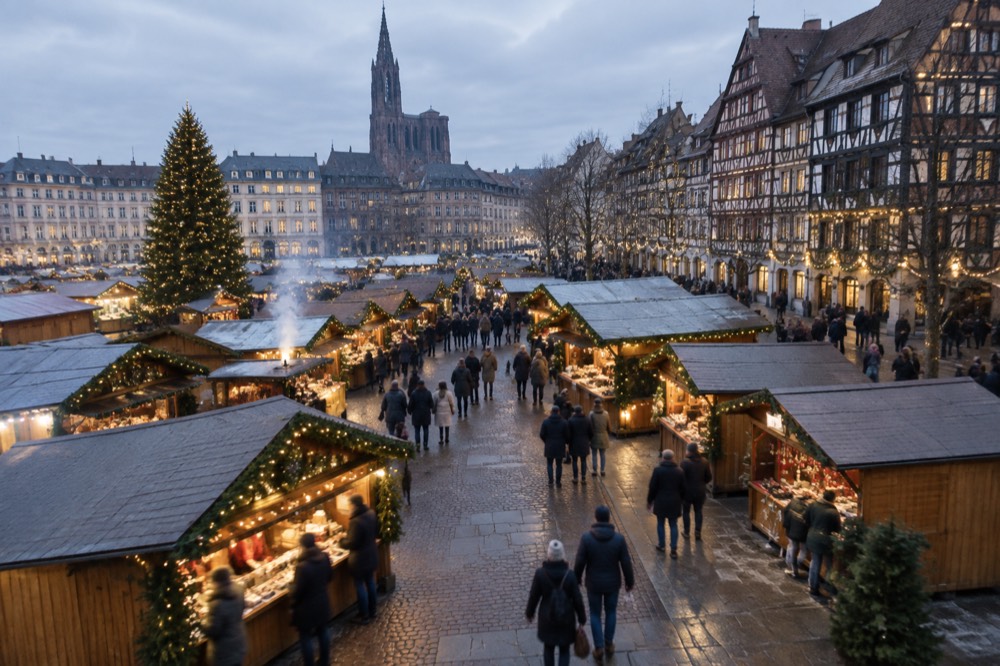
The market centres on Place Kléber and the cathedral's Place du Château, with chalets spreading through the surrounding squares and streets of the Grande Île. Place Kléber carries the great Christmas tree, the cathedral square the craft and food chalets, and Petite France and Place Gutenberg add smaller clusters. Everything is walkable, and the whole footprint sits within the UNESCO-listed old centre.
Place Kléber is the symbolic heart. The city erects its great tree there, and the square becomes the meeting point for the whole season. The cathedral square, Place du Château, sits a few minutes away with the Gothic façade as a backdrop and the Musée de l'Œuvre Notre-Dame alongside. From there the market threads out through streets towards Place Gutenberg, the quays, and down into Petite France, where the canals and half-timbered houses do a lot of the decorative work on their own.
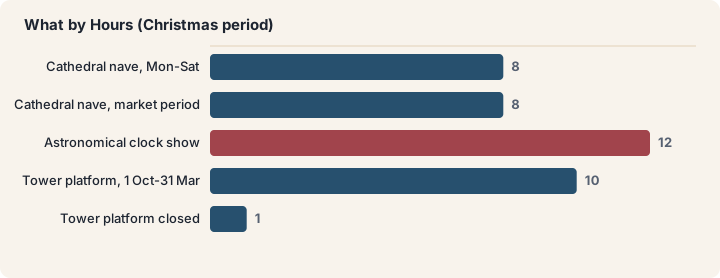
The cathedral itself keeps visitor hours through the season, and they shape any market day. The nave is open Monday to Saturday 08:30-11:15 and 12:45-17:45, and on Sundays and feast days 14:00-17:15; during the Christmas market it opens continuously on the Place du Château side, 08:30-17:45. The tower platform, at 66 m, runs on seasonal hours, and the astronomical clock performs its automaton show daily at 12:30 sharp. The clock ticket is 4 EUR, sold on the day only, with sales at the cathedral stalls 10:00-11:00 or from the Saint-Michel entrance from 11:30.
| What | Hours (Christmas period) | Ticket |
|---|---|---|
| Cathedral nave, Mon-Sat | 08:30-11:15 and 12:45-17:45 | Admission on the cathedral's own terms |
| Cathedral nave, market period | Continuous Mon-Sat, Place du Château side, 08:30-17:45 | Check the cathedral's hours page |
| Astronomical clock show | Daily at 12:30 | 4 EUR, day-of purchase only |
| Tower platform, 1 Oct-31 Mar | 10:00-13:00 and 13:30-18:00, last ascent 17:15 | 10 EUR full, 6 EUR reduced |
| Tower platform closed | 1 Jan, 1 May, 25 Dec | No access |
The platform ticket also gives a reduced rate at the Musée de l'Œuvre Notre-Dame next door, which is worth knowing if you plan a museum hour between market circuits. For the full picture of the building, see the site's Strasbourg Cathedral guide, and for the clock itself, the astronomical clock guide explains what the 12:30 show actually does.
For the question of which market cluster to prioritise, the answer to where the prettiest Christmas market is and the guide to Christmas markets across Alsace both help, because the honest reply depends on whether you want scale, craft or canal-side atmosphere. Strasbourg's own claim to be the most famous Christmas market in France rests on history and size together.
What Does A Visit To The Market Cost?
Entry to the streets and squares is nothing; you pay for what you consume. A CTS single tram ticket is 1.90 EUR, a 24h Solo pass 4.60 EUR, the cathedral platform 10 EUR, the astronomical clock 4 EUR, and municipal museums 9 EUR full price, free on the first Sunday of the month. Chalet food and drink prices are set by each stall, and the city publishes no official price list for them.
Transport is the first cost to plan. The CTS network of trams and buses covers the whole city, and the airport shuttle is a combined ticket at 4.60 EUR. During the market the trams run late and the centre is largely pedestrianised, so a day pass usually pays for itself on the second or third ride. The fare table below is from CTS's own fare pages.
| CTS ticket | Price | Notes |
|---|---|---|
| Single | 1.90 EUR | Badgéo card, CTS app or contactless |
| Single bought on board | 2.50 EUR | Bus only, from the driver |
| 24h Solo | 4.60 EUR | One traveller, all day |
| 24h Trio | 10.20 EUR | Two to three people travelling together |
| Airport shuttle combined ticket | 4.60 EUR | Train plus tram/bus plus 24h EMS ticket |
Museums are the other predictable line. The municipal museums charge 9 EUR full and 5 EUR reduced, with a 1-day Pass Musées at 20 EUR; all municipal museums are free on the first Sunday of every month, which in December often falls inside the market. Note that the Musée Alsacien is closed for works until 2028 and cannot be visited, so do not route a museum day around it. The Strasbourg City Card, at 5 EUR adult and 3.50 EUR child for 7 days, is a discount card rather than an all-inclusive pass: it takes money off museums, the boat, the cathedral platform and the clock, which suits a busy market weekend well.
| Museum option | Price | Notes |
|---|---|---|
| Municipal museum, full | 9 EUR | Per museum |
| Municipal museum, reduced | 5 EUR | Per museum |
| Pass Musées, 1 day | 20 EUR | Multiple museums |
| First Sunday of the month | Free | All municipal museums |
| Strasbourg City Card | 5 EUR adult, 3.50 EUR child | 7 days, discounts only |
| Musée Alsacien | Closed | Closed for works until 2028 |
The river boat is a market-season favourite because it warms you up. Batorama, the main operator, runs two standard circuits from the quays: the fare and duration table below is from the operator's own site. The long tour loops through the whole old centre and the European quarter; the short tour is a tighter circuit of the Grande Île. Book the heated boats in the evening if the cold is the problem, and the open boats in the afternoon for photographs.
| Batorama circuit | Duration | Full price | Reduced price |
|---|---|---|---|
| Long tour | 1h10 | 16.20 EUR | 8.90 EUR |
| Short tour | 0h45 | 12.50 EUR | 7.20 EUR |
For a deeper look at the boat side of the city, including how a cruise stop fits a December day, see the site's guide to Strasbourg as a river cruise stop, and for whether the cruise format suits the market season at all, the answer to whether a Christmas market river cruise is worth it sets out the trade-offs honestly.
How Cold And Wet Is Strasbourg In December?
Strasbourg's December climate is semi-continental and genuinely cold: Meteo-France 1991-2020 normals give a mean daily maximum of 5.9 C and a mean minimum of 0.8 C, with 45.2 mm of rain and 10.2 rain days of 1 mm or more across the month. Pack for near-freezing evenings, damp air and the possibility of snow rather than dreaming of a white guarantee.
The city sits far from any ocean moderation, in the Upper Rhine plain, and that shows in the numbers. November is already cool at a 9.4 C mean maximum, and January bottoms out at 5.2 C by day and -0.2 C by night. Rain falls somewhere between eight and eleven days a month in every winter month, which is why the market's covered chalets and the winstubs matter as much as the open squares. The climate table below is the full winter picture from the normals.
| Month | Mean max C | Mean min C | Rain mm | Rain days >=1 mm |
|---|---|---|---|---|
| November | 9.4 | 3.3 | 47.6 | 9.2 |
| December | 5.9 | 0.8 | 45.2 | 10.2 |
| January | 5.2 | -0.2 | 35.4 | 9.1 |
| February | 7.3 | 0.0 | 34.1 | 8.3 |
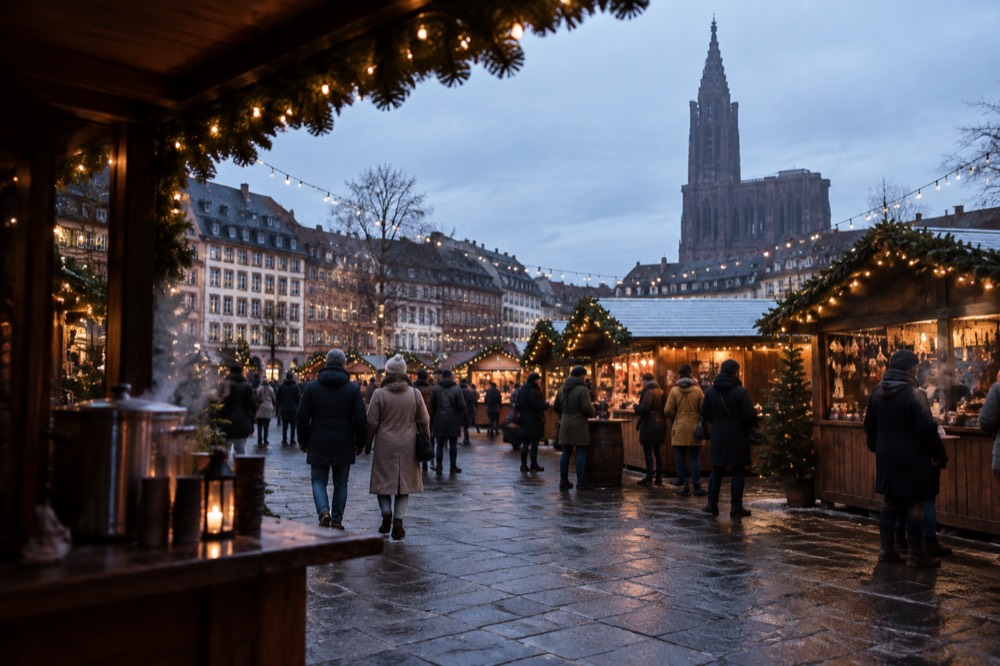
Practically, this means layers and a plan for warmth. The market squares are open to the wind that funnels down the Rhine valley, and the winstubs serve hot food from late morning. Daylight is short in December, which works in the market's favour: the lights come on in the mid-afternoon and the photogenic hours are also the warmest. The site's guides to Strasbourg in winter and Strasbourg weather carry the full seasonal detail, and the best time to visit Strasbourg weighs December against the warmer months.
What And Where To Eat At The Christmas Market?
The market's food is Alsatian winter food: tarte flambée, choucroute, baeckeoffe, bredele biscuits, kougelhopf and mulled wine, sold from chalets across the squares and in the winstubs around them. Chalet prices are set stall by stall, so check the board before you order rather than expecting a published tariff. The sit-down winstubs of the old centre are the warmer, slower alternative to eating standing up.
Eating is half the point of coming. The chalet circuit covers the classics: tarte flambée off a wood oven, choucroute in its ceramic dish, sausages, roasted chestnuts, and the bredele and kougelhopf that Alsatian households bake for the season. Mulled wine, vin chaud, is sold at the wine chalets, and the Alsace wine on offer runs from riesling to the sweeter late-harvest styles. The site's guides to tarte flambée, choucroute, kougelhopf and Alsace wine cover each of these in depth, and the dedicated Christmas market food guide maps the eating options square by square.
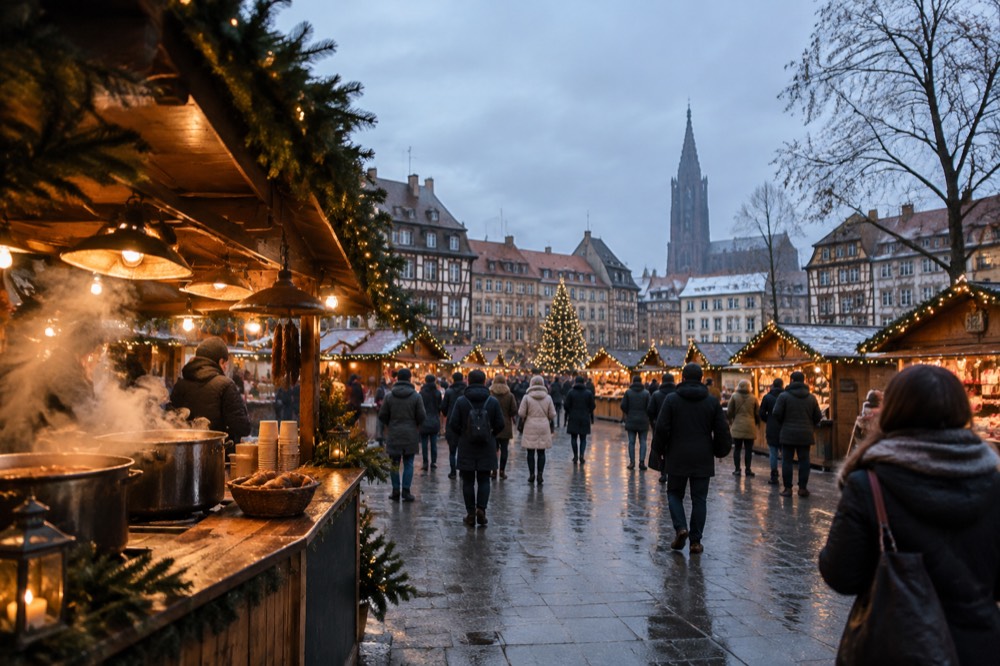
The winstub, the Alsatian tavern, is the other half of the equation. These are small, wood-panelled rooms serving baeckeoffe, the slow-cooked three-meat casserole, and the full regional repertoire at a pace the chalets cannot match. In December the good ones fill from opening, so book ahead or eat early. The site's winstub guide and the round-up of the best restaurants in Strasbourg are the practical companions here, and the question of where locals eat in Strasbourg has a useful answer for anyone tired of market-adjacent pricing.
A guided food walk is one way to short-circuit the choice. The traditional food walk with tastings covers the old centre with a local guide and stops along the way, which suits a first evening when the squares are still unfamiliar.
Where To Stay For The Strasbourg Christmas Market?
Stay inside or on the edge of the Grande Île if you want the market on your doorstep, in the Krutenau or gare district for a cheaper walk-in, or across the Ill in Neustadt for quieter nights at a lower rate. December is the city's most expensive month, and the question of where to base yourself is really a trade between price, noise and the walk home in the cold.
The market's footprint makes location decisive. Inside the Grande Île you step out of your hotel into the chalets, but you also step into the crowds until late each evening. The Krutenau, the student quarter south-east of the old centre, and the streets around the station keep you a short tram ride or a brisk walk away, at lower rates and with more ordinary restaurants. Neustadt, the imperial-era extension across the river and part of the same UNESCO property, is quieter still. The site's guides to where to stay in Strasbourg and, specifically, where to stay for the Christmas market break the districts down street by street.
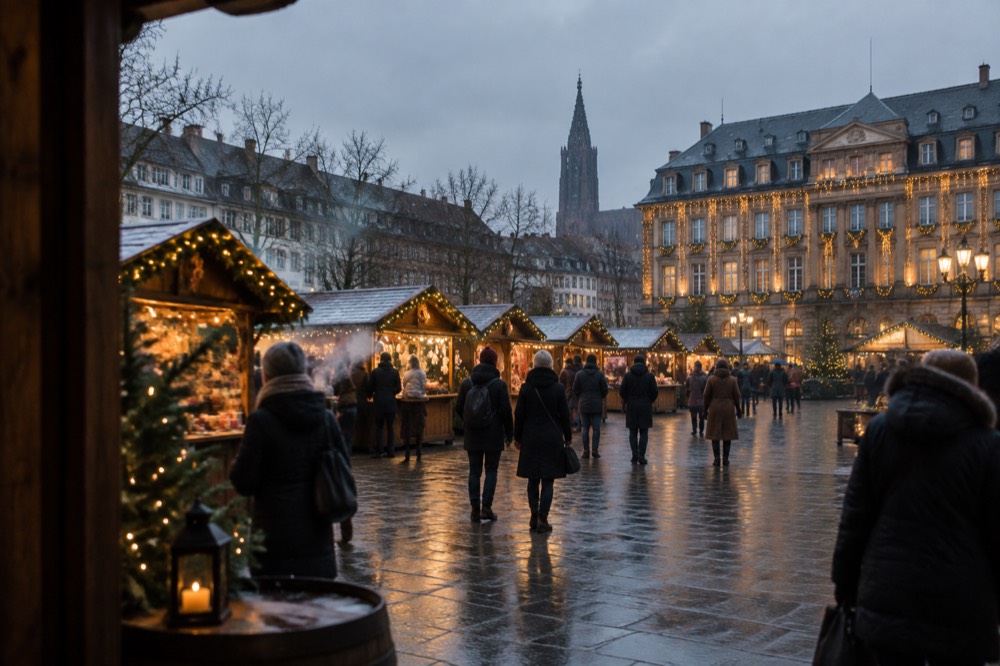
Book early, and treat the 24 December close as your planning horizon: rates are highest on the opening and closing weekends, and the market's 3.05 million visitors in 2025 did not fit into the old centre's hotel stock at once. If everything central is full, Kehl, on the German side of the Rhine, is the obvious overflow, though you should check transport connections for the specific night you arrive rather than assuming a late tram back.
What Can You Do Beyond The Christmas Markets?
Strasbourg in December is also a base for the wider region: the Alsace wine route villages, Colmar's own market, the Black Forest across the border, and the memorial site at Natzweiler-Struthof in the Vosges. Guided day trips from Strasbourg cover all of these, and the market season is when the wine villages put up their own lights.
The classic pairing is Strasbourg with Colmar, whose market is smaller and arguably more photogenic; the site's Colmar Christmas Market guide covers it in full. Beyond Colmar, the wine route villages, Riquewihr, Eguisheim, Kaysersberg and their neighbours, run their own December stalls, and a day trip that strings several together is the standard second day of any market weekend. The Alsace road trip guide and the most beautiful villages in Alsace cover the routes, and the Alsace wine route guide covers the cellars.
Cross-border options are equally close. The Black Forest begins on the far bank of the Rhine, and a guided day trip from Strasbourg to Triberg, Titisee and Freiburg is the easiest way to see it without a car in winter conditions; the site's Black Forest guide covers the region. The table below compares the main guided day-trip directions qualitatively, because tour prices and durations belong on the live listings rather than in prose.
| Day trip direction | What it delivers | Who it suits | What to check |
|---|---|---|---|
| Alsace villages and wine tasting | Medieval villages, cellar tastings, market lights | First-time visitors, wine buyers | Whether cellar stops are included |
| Colmar and Haut-Koenigsbourg | A second market plus a castle above the plain | Photographers, families | Winter opening of the castle |
| Black Forest, Triberg and Titisee | German craft towns, lakes, a border crossing | Anyone wanting the contrast | Passport carry, winter roads |
| Natzweiler-Struthof memorial | A former concentration camp site in the Vosges | Visitors wanting the history | Seasonal access and opening days |
The Struthof direction deserves a separate word. The Natzweiler-Struthof site, in the Vosges above the Alsace plain, is a memorial on the ground of a former concentration camp, and a guided half-day from Strasbourg is the way to visit it with context. The site's Natzweiler-Struthof guide covers what the visit involves and how to prepare for it.
For the market-focused alternative, a guided day tour to the Alsatian Christmas markets takes in several decorated villages in one loop from Strasbourg, which is the efficient option if you have no car and limited days.
How Should You Plan A Market Day Hour By Hour?
A good market day starts with the cathedral in the morning before the queues, takes a boat or a museum in the cold mid-afternoon, and gives the evening to the lights, when the squares look their best. The astronomical clock show at 12:30 and the platform's last ascent at 17:15 in winter are the two fixed times worth building a day around. Eat either a long winstub lunch or a chalet-grazing dinner, not both, or the day becomes a queue.
Morning is the quiet window. The nave opens at 08:30 on weekdays, the squares fill slowly before noon, and the light on the sandstone façade is at its best early. Buy the clock ticket for the 12:30 show when sales open at the stalls between 10:00 and 11:00, then spend the hour before it in the chalets on Place du Château. After the show, either climb the platform, which in winter runs 10:00-13:00 and 13:30-18:00 with the last ascent at 17:15, or save it for the next morning and take a long lunch.
The afternoon is the boat hour or the museum hour, depending on the weather. The Batorama long tour at 1h10 covers the whole circuit including the European quarter, and the heated boats make it the warmest sightseeing in the city. If rain sets in, the municipal museums at 9 EUR, or free on the first Sunday of the month, are the fallback, remembering that the Musée Alsacien is closed until 2028. From mid-afternoon the lights come on, and the evening is the market's real theatre: Place Kléber's tree, the chalets at their brightest, and a winstub or a standing dinner to finish. For a full sequence, the one day in Strasbourg itinerary adapts to December, and two days in Strasbourg is the more realistic market-and-day-trip frame.
Common Questions About The Strasbourg Christmas Market
What are the dates of the Strasbourg Christmas Market?
The market opens in the last week of November and runs to 24 December, closing early on the 24th. The 2025 edition ran 26 November to 24 December 2025. The 2026 dates are not yet published; the city's Christmas site states that the official dates and programme are still being finalised, so confirm them there before booking.
Is the Strasbourg Christmas Market worth it?
For the scale of the setting, yes: the market spreads across the UNESCO-listed Grande Île with the cathedral as its backdrop, and the 2025 edition drew 3.05 million visitors. It is cold, crowded and at its most expensive in December, so it rewards visitors who come midweek, book accommodation early and plan indoor stops between the squares.
How many days do you need for the Strasbourg Christmas Markets?
Two days cover the market squares, the cathedral and a boat circuit comfortably; three allow a guided day trip to the Alsatian villages or the Black Forest. A single day works for the core squares but leaves no room for the winstubs, the museums or the European quarter.
Which Strasbourg Christmas Market is the best?
There is no single best square: Place Kléber carries the great tree, Place du Château the craft and food chalets against the cathedral, and Petite France the canal-side atmosphere. The honest answer is to walk the circuit and let the setting decide; the site's dedicated answer page compares the squares in detail.
Is Strasbourg or Colmar better for a Christmas market visit?
Strasbourg offers scale, the cathedral and the capital-city programme; Colmar offers a smaller, more concentrated old-town setting. They pair well by train, and many visitors take two nights in Strasbourg with a day in Colmar. The site's comparison answer weighs cost, crowds and atmosphere.
How much does a day at the Strasbourg Christmas Market cost?
Entry to the streets and squares is free. A 24h Solo transport pass is 4.60 EUR, the cathedral platform 10 EUR, the astronomical clock 4 EUR and municipal museums 9 EUR, free on the first Sunday of the month. Chalet food and drink prices are set by each stall, so budget generously and check the boards before ordering.
The Strasbourg Christmas Market rewards exactly the kind of visitor who plans: the dates follow a pattern but the 2026 edition is not confirmed yet, the cold is real rather than picturesque, and the best days mix the squares with a boat, a winstub and one trip out to the villages or the Vosges. Confirm the dates on the city's Christmas site, book the bed early, and let the rest of the plan follow the lights.