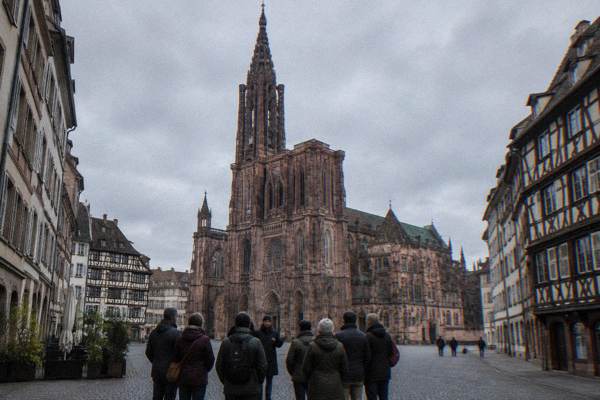
Place Gutenberg Strasbourg
Place Gutenberg sits in the heart of Strasbourg's Grande Île, a few minutes on foot from the cathedral. This guide covers how to reach it, what to see around it, and how the square changes with the seasons.
Short answer
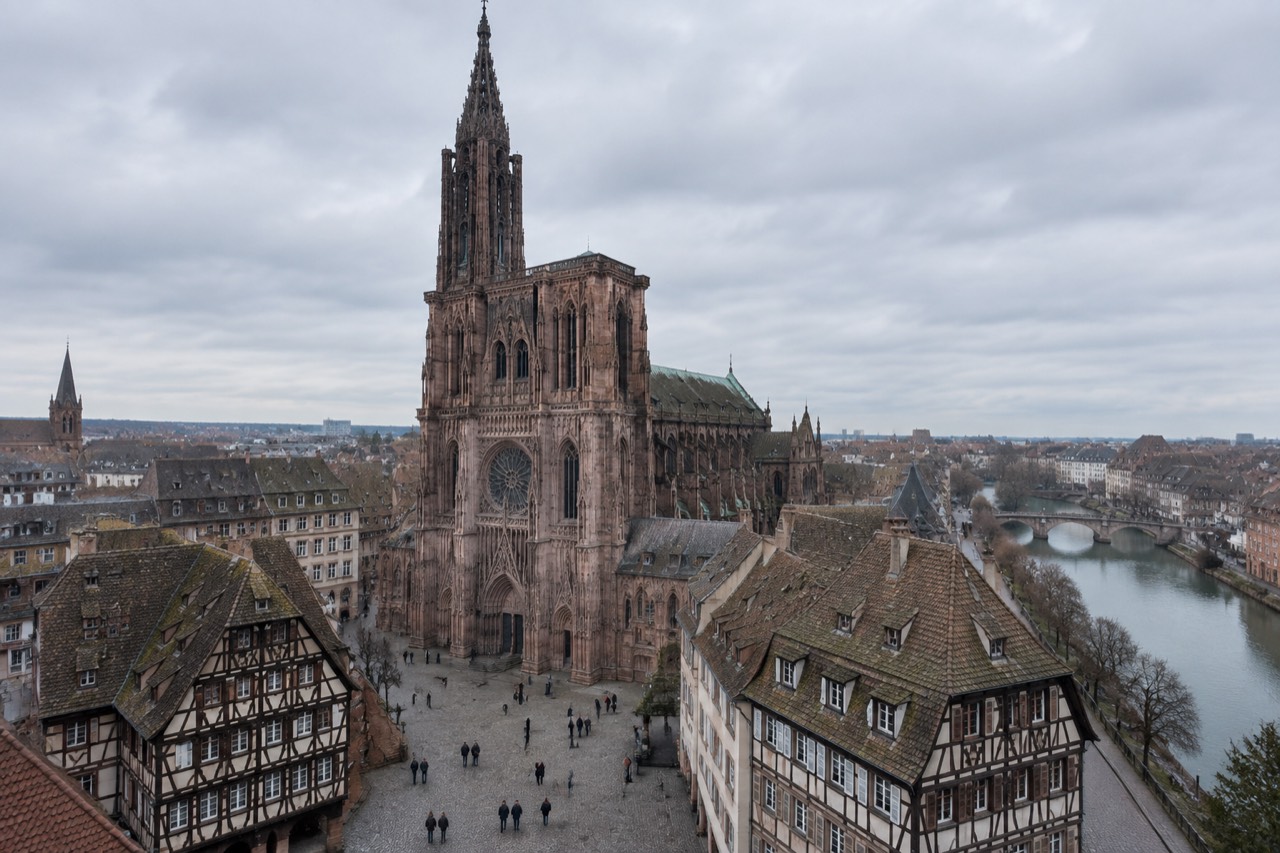
Place Gutenberg is a broad open square in central Strasbourg, France, a short walk from the cathedral and Place Kléber. A single CTS tram ticket costs 1.90 EUR, or 4.60 EUR for a 24-hour Solo pass. The square is a public space with no admission, and it fills with Christmas market chalets in late November and December.
Place Gutenberg is a broad open square in the historic centre of Strasbourg, the prefecture of the Bas-Rhin department in Alsace, north-eastern France, standing on the Grande Île a few minutes on foot from the cathedral. The city sits on the River Ill beside the Rhine, which forms the border with Germany here, and Kehl lies on the far bank. The square is one of the open rooms of the old town: no ticket, no gate, no queue, just a paved expanse framed by historic facades that locals and visitors cross a dozen times a day without thinking about it. That ordinariness is exactly its value. Some of Strasbourg's sights demand a timed entry and a fee; this one asks for nothing but a detour, and it rewards the detour best when you know what surrounds it, when to come, and how the space transforms in December. This Strasbourg Travel Guide article walks through all of it, from tram fares to the Christmas chalets.
What Is Place Gutenberg In Strasbourg, France?
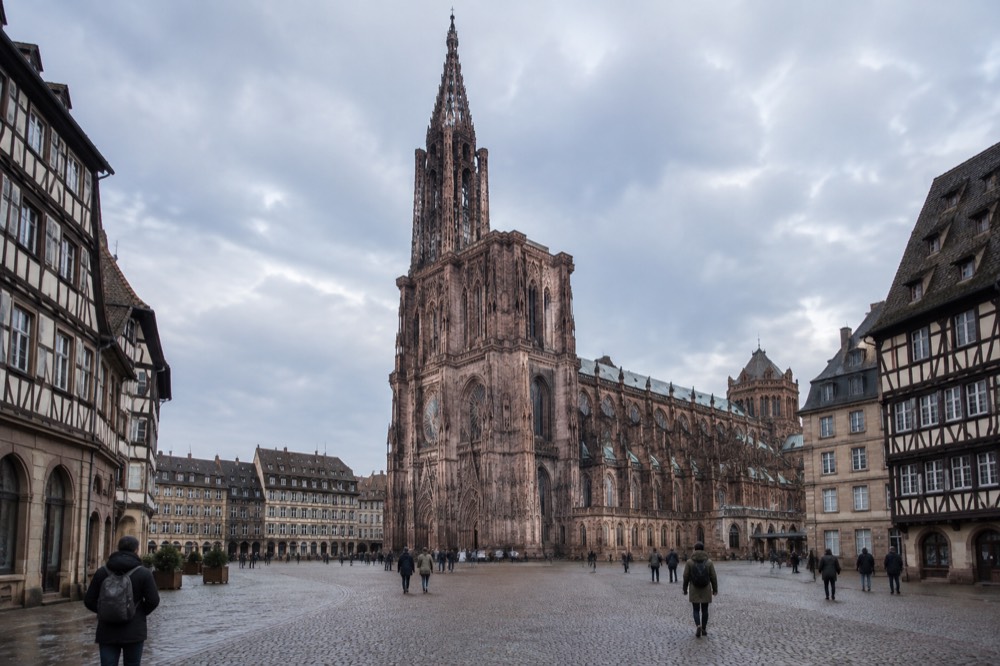
Place Gutenberg is a large public square on the Grande Île, Strasbourg's World Heritage island core, a short walk west of the cathedral and south of Place Kléber. It is an open, paved space with no admission charge, used daily as a crossing point, a meeting spot and an event ground. UNESCO lists the whole of the Grande Île and the later Neustadt extension as one World Heritage property, and this square sits inside it.
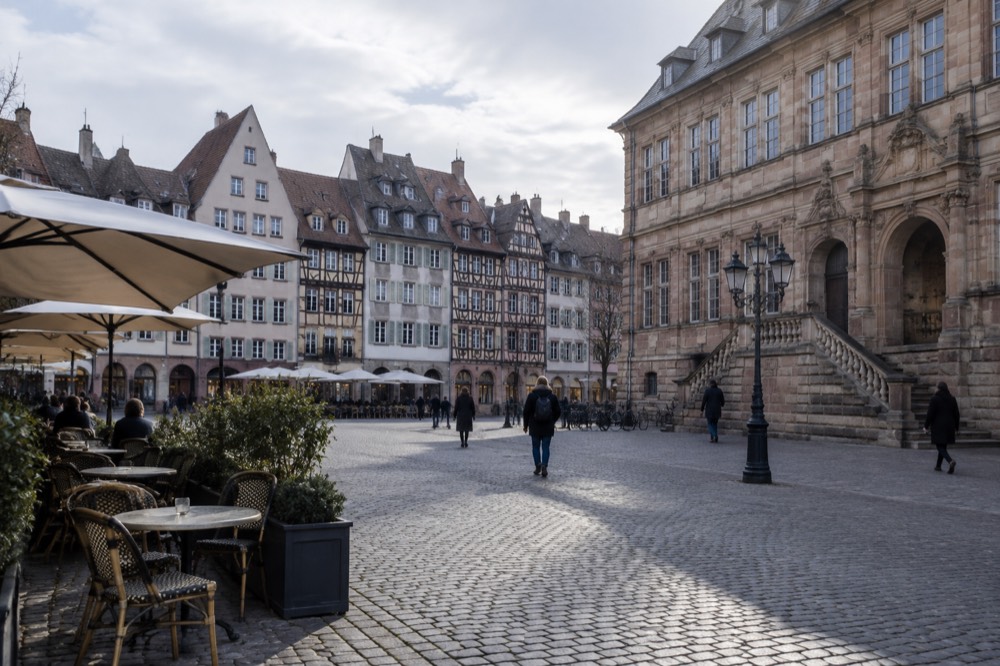
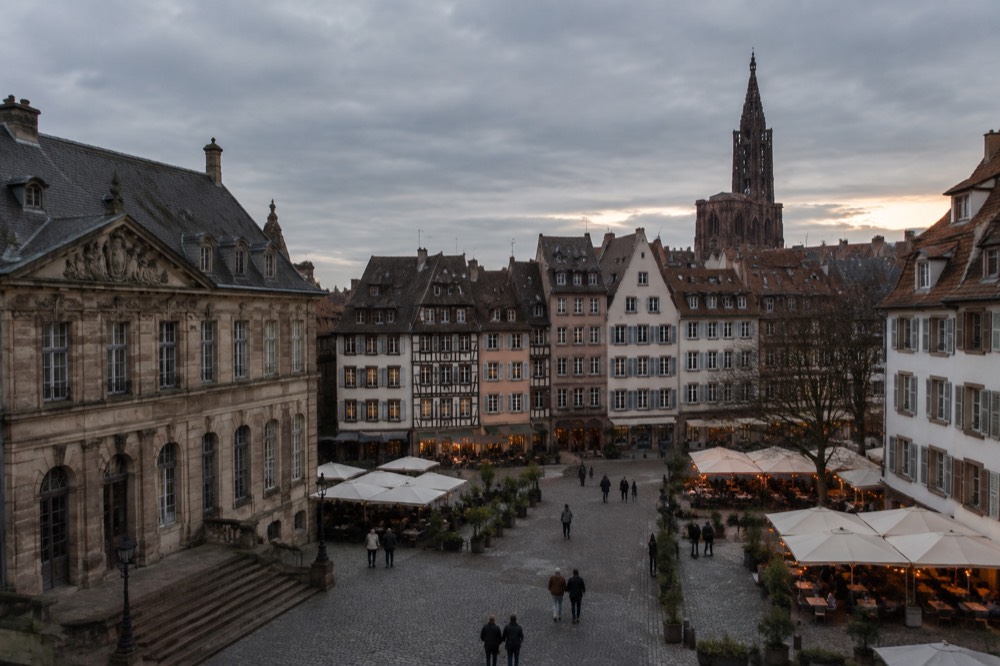
The square works as a hinge in the old town. Walk one way and you are at the cathedral's west front within minutes; walk another and you drop toward the river channels of the Petite France quarter; a third direction leads toward the shopping streets that run up to Place Kléber, the central square. Nothing here is fenced off or ticketed. The space belongs to the rhythm of the city: cafés spill onto the pavement in warm weather, market stalls and event structures appear when the calendar calls for them, and in the weeks before Christmas the square becomes one of the stages of the famous market that gives Strasbourg its title of Christmas capital.
The name itself points at the printing trade that shaped this city's early modern life, and the square has long been tied to the book trade and public gatherings rather than to any single monument. What you see today is a working piece of the historic fabric: Renaissance and later facades, restaurant terraces, and an open centre that the city programmes across the year. Visitors expecting a museum-piece square with a single headline attraction will find something better, a space that shows how Strasbourg's old town is lived in rather than preserved under glass. The half-timbered Maison Kammerzell beside the cathedral makes a good first landmark for anyone using the square as a base.
Where Is Place Gutenberg And How Do You Get There?
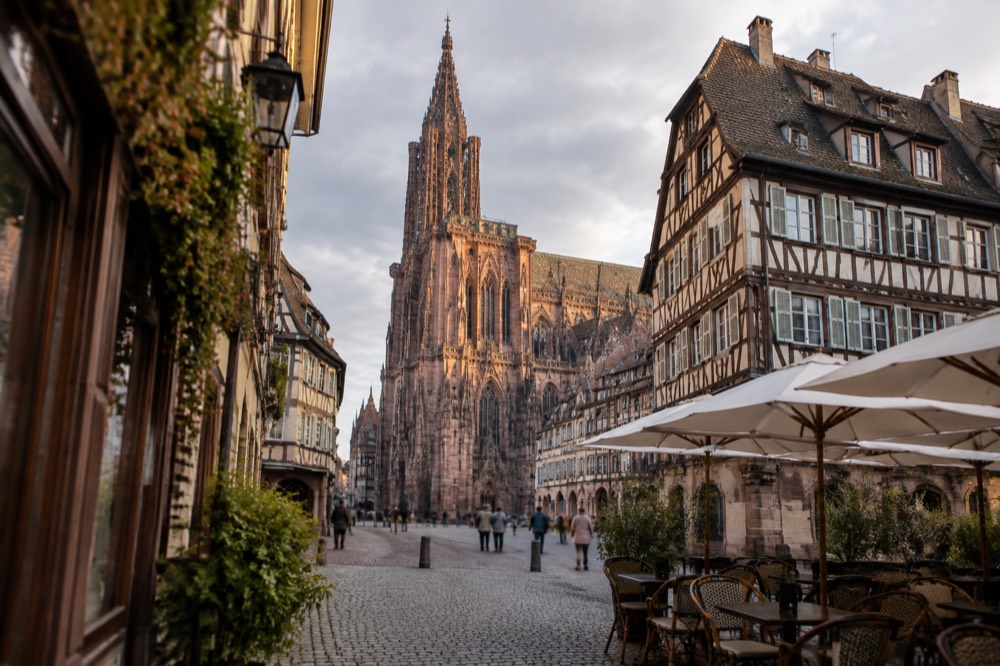
The square sits in the pedestrian core of Strasbourg's Grande Île, reached on foot from the cathedral in a few minutes or by tram to the stops around Place Kléber and the station side of the centre. A single CTS ticket costs 1.90 EUR bought through the app, a Badgéo card or contactless, or 2.50 EUR bought on board a bus. A 24-hour Solo pass is 4.60 EUR and a 24-hour Trio pass for two to three people is 10.20 EUR.
Because the old town is largely pedestrianised, the practical plan is simple: ride the tram to the edge of the Grande Île, then walk in. The cathedral is the anchor, and from its forecourt the square is a short level stroll away, with the whole route inside the World Heritage island. Anyone arriving from Strasbourg Airport should note the combined ticket the airport's own page describes: a train-and-tram-and-bus day bundle at 4.60 EUR that covers the shuttle train from the airport station into the city and a day of urban travel. The airport shuttle runs up to five trains an hour and takes 8 minutes to reach Strasbourg's main station, from where the tram network feeds the centre.
| Ticket | Price | What it covers |
|---|---|---|
| CTS single (app, Badgéo, contactless) | 1.90 EUR | One journey on tram or bus |
| CTS single bought on board a bus | 2.50 EUR | One journey, no advance purchase |
| 24h Solo pass | 4.60 EUR | One traveller, 24 hours of CTS travel |
| 24h Trio pass | 10.20 EUR | Two to three travellers together, 24 hours |
| Airport combined day ticket | 4.60 EUR | Airport shuttle train plus CTS day travel |
Drivers should park outside the island and walk in; the centre's lanes are not built for through traffic, and the tram lines carry the load. Cyclists have the better deal of all. Strasbourg is famously flat, the Ill's banks give pleasant approaches, and a bicycle lets you string the Grande Île, the Neustadt and the riverside parks together in one loop. That is why this site's featured way to see the city around the square is a guided ride: the bike tour with bikes included covers the old town and the river with a local guide, and you can Check availability on the operator's live listing.
What Can You See Around Place Gutenberg?
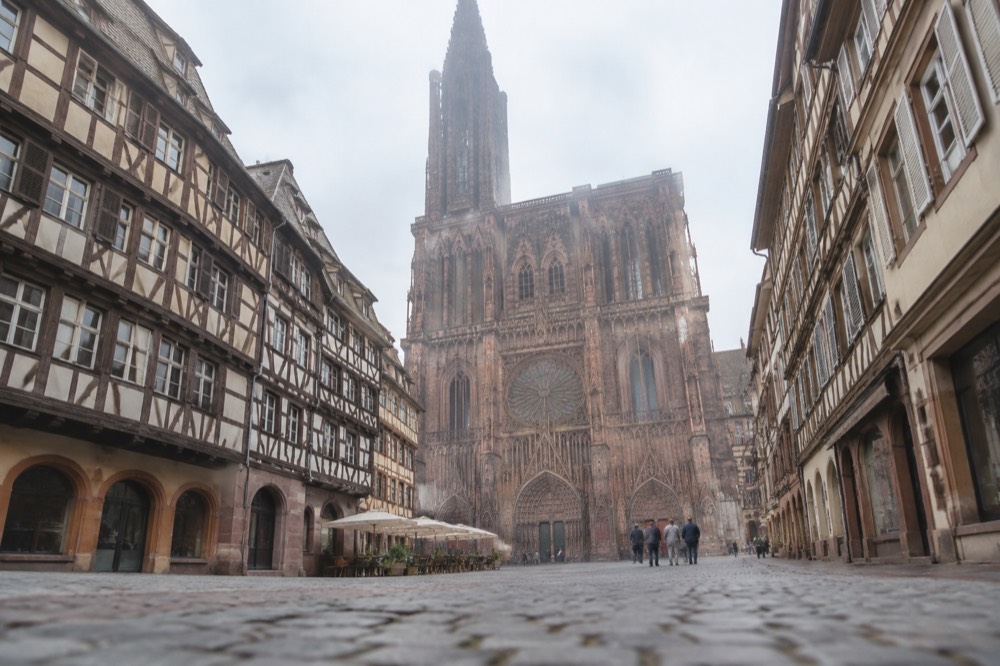
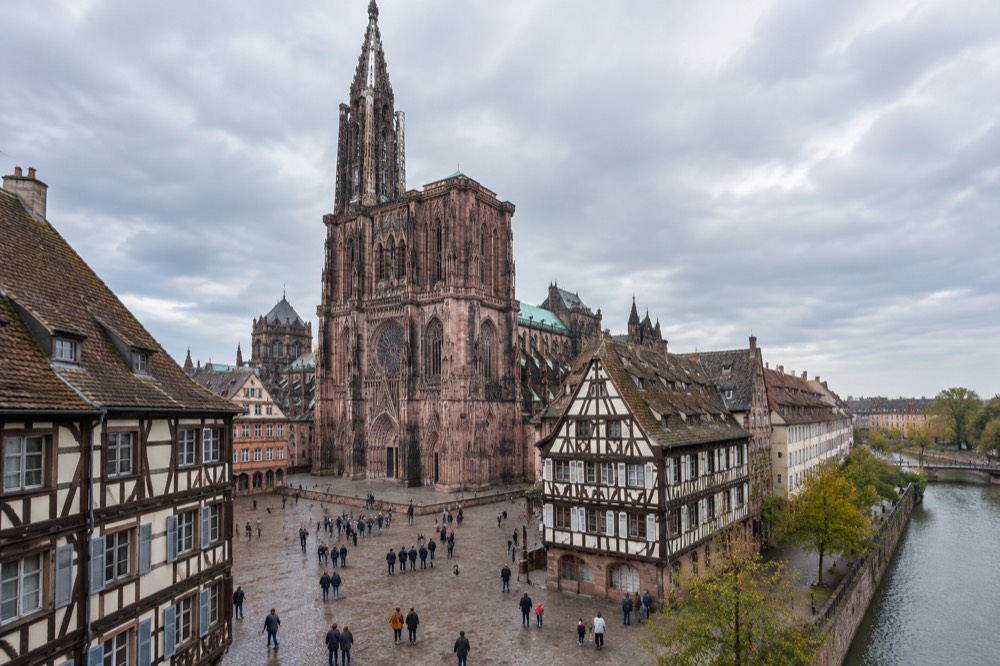
Within a short walk of the square you reach Strasbourg Cathedral with its single spire and 66 m viewing platform, the astronomical clock, Place Kléber, the Palais Rohan museums, and the river quarter of Petite France with the Ponts Couverts and the Barrage Vauban terrace. The cathedral nave opens Monday to Saturday from 08:30 to 11:15 and 12:45 to 17:45, and on Sundays from 14:00 to 17:15.
The cathedral is the obvious first stop and it earns the walk. Its hours page lists the nave visiting times above, and during the Christmas market season the building stays open continuously on the Place du Château side, Monday to Saturday from 08:30 to 17:45, which makes a December visit easier to plan. The platform ticket is 10 EUR full price and 6 EUR reduced, with children under 6 free, and the platform keeps seasonal hours: from April to September it runs 09:30 to 13:00 and 13:30 to 20:00 with the last ascent at 19:15, while from October to March it runs 10:00 to 13:00 and 13:30 to 18:00 with the last ascent at 17:15. The platform closes on 1 January, 1 May and 25 December. Full detail on the building itself is in the Strasbourg Cathedral guide.
The astronomical clock inside the cathedral gives its full automaton show daily at 12:30 sharp. The ticket is 4 EUR, with 3 EUR for groups of twelve or more and for students up to 25, and 2 EUR for children aged 6 to 17. Tickets are sold on the day only, with no reservations, at the cathedral stalls between 10:00 and 11:00 or at the Saint-Michel entrance from 11:30. Anyone who wants the clock explained rather than just watched can join a cathedral guided tour, whose details and price render on its live listing, or read the astronomical clock guide before going.
From the square, the walk to Place Kléber leads into the city's commercial heart, while the Palais Rohan a street further on houses three of the municipal museums. The museums charge 9 EUR full price and 5 EUR reduced, a one-day Pass Musées costs 20 EUR, and every municipal museum is free on the first Sunday of the month. One caution: the Musée Alsacien is closed for works until 2028 and should not be on anyone's plan, but the Musée de l'Œuvre Notre-Dame near the cathedral carries the medieval sculpture collection, and a platform ticket even gives a reduced rate there. The table below lays out the paid sights within easy reach.
| Sight near the square | Ticket | Hours to check |
|---|---|---|
| Cathedral nave | No ticket stated for the nave; check the hours page | Mon-Sat 08:30-11:15 and 12:45-17:45; Sun 14:00-17:15 |
| Cathedral platform at 66 m | 10 EUR full, 6 EUR reduced, under 6 free | Apr-Sep 09:30-13:00, 13:30-20:00; Oct-Mar 10:00-13:00, 13:30-18:00 |
| Astronomical clock show | 4 EUR full, 3 EUR groups and students to 25, 2 EUR ages 6-17 | Show at 12:30 daily; day-of tickets only |
| Municipal museums | 9 EUR full, 5 EUR reduced; 1-day Pass Musées 20 EUR | Free the first Sunday of every month |
| Strasbourg City Card | 5 EUR adult, 3.50 EUR child, valid 7 days | A discount card, not an all-inclusive pass |
The City Card deserves a line of explanation because visitors misread it. It is not a pass that covers entries; it is a 5 EUR discount card, valid seven days, that knocks money off the museums, the cathedral platform, the clock, the boat tours and other attractions. For a short stay built around one or two paid sights it may not pay for itself, but for a full sightseeing week it usually does the arithmetic favours. The card is sold through the tourist office's shop page, and the current discount list is on that page.
South of the square the ground slopes gently toward the river, and the walk ends in Petite France, the former tanners' and millers' quarter where the Ill splits into channels around half-timbered houses. The Ponts Couverts stand at the end of it, and the Barrage Vauban's panoramic terrace sits beside them, open seasonally: the terrace runs 08:00 to 19:00 through September and October, and 08:30 to 16:00 from November to February. The admission price is not published on the city's page for the site, so check there before planning the climb. For the walk itself, a small-group historic centre tour that includes Petite France with a local guide is a good fit for visitors who want the quarter's story told rather than just its picture taken.
Is Place Gutenberg Good For Families And Children?
Yes, the square suits families well because it is traffic-light, free to enter and surrounded by easy diversions: the cathedral, the boat tours on the Ill, the riverside parks and, in season, the Christmas market itself. The CTS 24-hour Trio pass at 10.20 EUR covers two adults and a child travelling together for a day, and children under 6 go up the cathedral platform free.
The square's openness is what makes it work with children. There is room to stand, to wait, to regroup, and no road to cross at the centre of it, which turns it into a natural rendezvous point for families splitting up to see different things. From here the day can branch in several directions. The cathedral platform is a genuine climb, a spiral stairway inside the single tower, and children who manage it are rewarded with the rooftops of the Grande Île; the reduced 6 EUR ticket covers ages 6 to 18, and under-6s ride free. The platform is closed on 1 January, 1 May and 25 December, and the last ascent is earlier than the closing time, so arrive with margin.
The river offers the easier option. Batorama's boat tours leave from the quay side of the old town, and the official prices are printed on the operator's own ticket page: the long tour costs 16.20 EUR full and 8.90 EUR reduced, the short tour 12.50 EUR full and 7.20 EUR reduced. The Red Tour runs 1 hour 10 minutes and the Blue Tour 45 minutes, which gives families a choice between a full circuit of the Ill and a shorter loop that suits shorter attention spans. The boats glide past the European institutions on one side and the half-timbered river quarter on the other, and nothing needs to be booked around a child's nap except the departure time.
For families staying several days, the museums deserve a look beyond the obvious. Le Vaisseau, the science centre for children, appears on the City Card's discount list, and the municipal museums' free first Sunday turns a rainy morning into a cheap one. The Musée Alsacien, which once showed rural Alsatian life, is closed for works until 2028 and is not an option, but the Palais Rohan's collections and the Musée de l'Œuvre Notre-Dame fill the gap for older children. A family itinerary built around the square, the platform, a boat and one museum makes a full two days without ever needing a car.
When Is The Best Time Of Year To Visit Place Gutenberg?
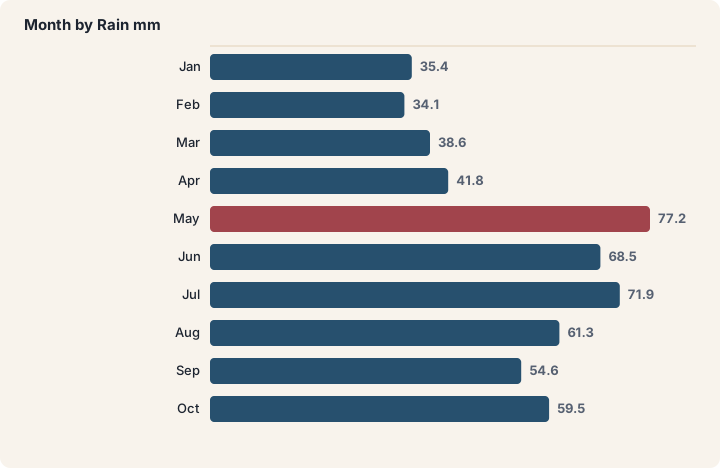
The square is pleasant from late spring to early October, when Strasbourg's semi-continental climate gives mean daily maxima of 20.9 C in May, 24.4 C in June and 26.4 C in July, but it changes character completely in late November and December, when the Christmas market fills it with chalets. December averages a maximum of 5.9 C and a minimum of 0.8 C, with 10.2 rain days of 1 mm or more, so warm layers matter.
Strasbourg's climate is semi-continental, with cold winters and warm summers, and the Meteo-France 1991-2020 normals for the Strasbourg-Entzheim station set the expectations. Spring arrives gradually: March averages a maximum of 12.1 C and a minimum of 2.6 C, April 17.0 C and 5.7 C, and the rain is spread evenly, with 8.6 days of at least 1 mm in April. Summer is warm rather than hot, with July's mean maximum at 26.4 C and August's at 26.1 C, and the long evenings of June and July, when the minimum sits near 15 C, are the friendliest for sitting on a terrace beside the square. Autumn shortens quickly: October still averages 15.8 C by day, but November drops to 9.4 C and the rain days climb back toward double figures.
| Month | Mean max C | Mean min C | Rain mm | Days rain 1 mm or more |
|---|---|---|---|---|
| Jan | 5.2 | -0.2 | 35.4 | 9.1 |
| Feb | 7.3 | 0.0 | 34.1 | 8.3 |
| Mar | 12.1 | 2.6 | 38.6 | 8.5 |
| Apr | 17.0 | 5.7 | 41.8 | 8.6 |
| May | 20.9 | 10.1 | 77.2 | 10.8 |
| Jun | 24.4 | 13.4 | 68.5 | 10.2 |
| Jul | 26.4 | 14.9 | 71.9 | 10.4 |
| Aug | 26.1 | 14.5 | 61.3 | 9.5 |
| Sep | 21.6 | 10.7 | 54.6 | 8.0 |
| Oct | 15.8 | 7.2 | 59.5 | 9.6 |
| Nov | 9.4 | 3.3 | 47.6 | 9.2 |
| Dec | 5.9 | 0.8 | 45.2 | 10.2 |
The yearly picture behind those months: a mean maximum of 16.0 C, a mean minimum of 6.9 C, and 635.7 mm of rain across 112.3 rain days. No month is dry, and none is a washout either, so the honest planning advice is layered clothing and a compact umbrella in any season. September is a quietly excellent compromise, with a mean maximum of 21.6 C and the fewest rain days of the year at 8.0, plus the back-to-school calm that returns the old town to its residents. May is the wettest single month at 77.2 mm, though that figure comes with the greenest of the riverside parks.
For the purposes of this square, the year divides into two: the long stretch when it is simply a handsome open space in a walkable city, and the short, intense season when it becomes part of the Christmas market. A visitor who only knows Strasbourg in December has seen the square at its most crowded and its most magical, but never at its most typical. The shoulder months, late September into October, show the city as it is for the people who live in it.
How Does Place Gutenberg Change During The Christmas Market?
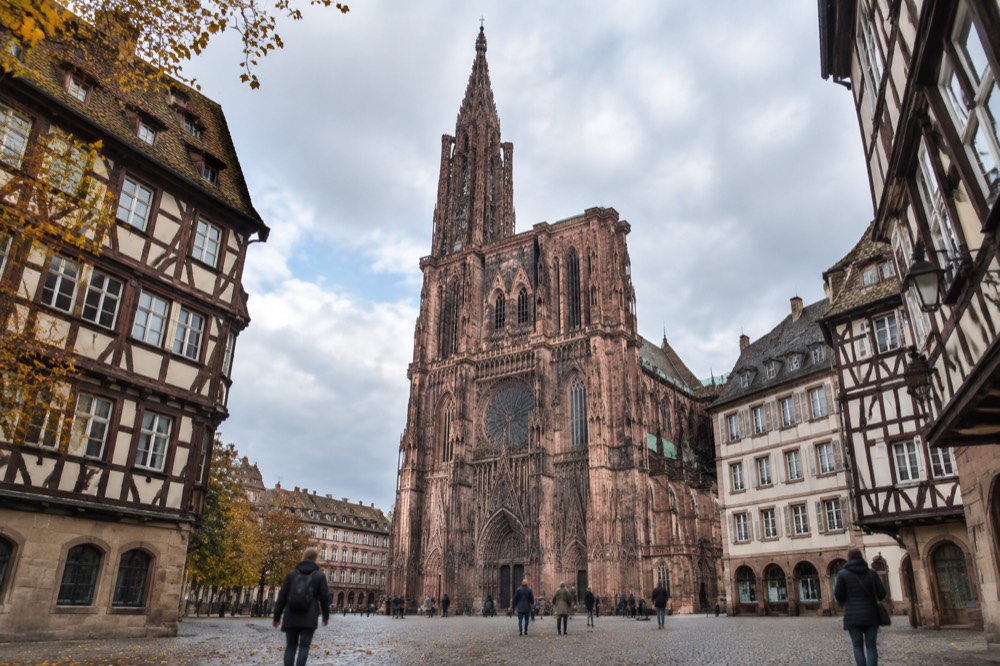
During the Christmas market the square fills with market chalets, because the market spreads across several squares of the historic centre rather than sitting in one place. Last year's edition ran from 26 November to 24 December 2025 and drew 3.05 million visits. The 2026 dates are not yet published; the city's Christmas site states that the official dates and programme are still being finalised, so confirm them there.
Strasbourg styles itself the Capital of Christmas, and the market is the reason. The pattern, in years past, is an opening in the last week of November and a run to 24 December, with the final day closing early in the evening. Chalets typically open from late morning into the evening. The 2025 edition is the one with full published figures: it ran 26 November to 24 December 2025, and the city's own press release put attendance at 3.05 million, against 3.4 million the year before. Those are last year's numbers, and they describe the scale of the thing rather than a promise about 2026.
| Christmas market fact | What is known |
|---|---|
| 2025 edition dates | 26 November to 24 December 2025 |
| 2025 attendance | 3.05 million visits, per the city's press release |
| 2026 dates | Not yet published; the city's Christmas site says they are still being finalised |
| Usual pattern | Opens in the last week of November, runs to 24 December, which closes early |
| Chalet hours | Typically late morning to evening; confirm on the city's Christmas site |
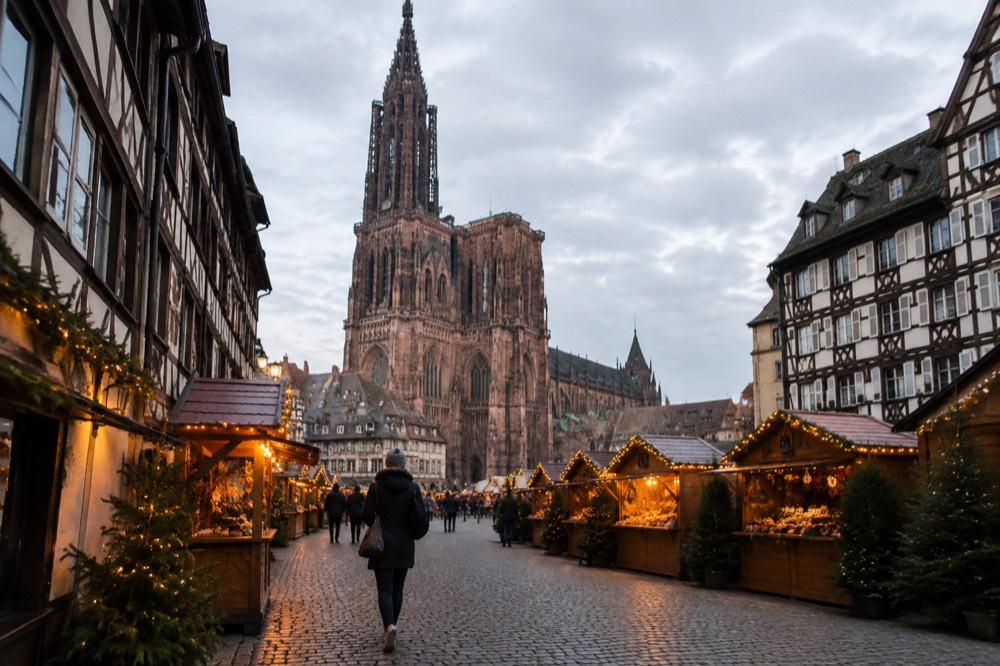
In market season the square stops being a crossing point and becomes a destination. The chalets that occupy the historic centre's squares sell the Alsatian Christmas repertoire, ornaments, mulled wine, bredele biscuits and regional crafts, and the air over the old town carries the smell of spiced wine and hot dough for a month. The cathedral cooperates with the season: during the market the nave stays open continuously Monday to Saturday on the Place du Château side, 08:30 to 17:45, which removes the midday closing that catches visitors out in other months. The astronomical clock's 12:30 show runs as usual, and its day-of ticket rule means December visitors should buy at the stall or the Saint-Michel entrance before midday.
Practical December notes are worth setting down plainly. The first Sunday of the month makes every municipal museum free, which is a fine rain plan, and the museums near the square are close enough to duck into between chalet runs. The cathedral platform in December runs the winter hours, 10:00 to 13:00 and 13:30 to 18:00 with the last ascent at 17:15, and it closes on 25 December, though the market itself ends the day before. Visitors who want the full Alsatian Christmas circuit beyond the city, the villages and the vineyards dressed for the season, can take a dedicated Christmas markets day tour from Strasbourg, whose details render on its live listing.
What To Eat And Drink Near Place Gutenberg?
The streets around the square sit inside winstub country: the Alsatian tavern tradition of tarte flambée, choucroute, baeckeoffe and riesling by the carafe, with kougelhopf for the sweet finish. Tasting fees and menu prices vary from house to house, so check the room or the menu board rather than expecting fixed figures, and book ahead in December when the market fills every dining room in the old town.
The winstub is the institution to understand. It is the Alsatian equivalent of the neighbourhood tavern, wood-panelled, tightly seated, serving the region's hearty dishes at prices that are generally kinder than the dressed-up restaurants a few streets over. Around this part of the Grande Île you are never far from one, and the classic order is straightforward: tarte flambée, the thin cream-and-bacon flatbread, or choucroute, the sauerkraut platter with sausages and pork, with a glass of local riesling or a mug of the region's beer. Baeckeoffe, the slow-cooked meat and potato casserole, is the dish that rewards a lunch booking because it is made in advance and served until it runs out.
For visitors who would rather have the food scene explained than navigate it alone, two formats work. A traditional food walking tour with tastings strings the winstubs and the market stalls together with a guide who knows which counter to lean on, while a shorter culinary walk suits anyone with a half-day budget. An Alsace wine tasting in the city is the compressed option for travellers who want the region's grapes decoded, riesling, pinot blanc, gewurztraminer and the local crémant sparkling wine, without surrendering an evening to it. The details, prices and current schedules for all of these render on their live listings.
The sweet half of the repertoire is its own reason to linger. Kougelhopf, the domed brioche with almonds and raisins, is the Alsatian cake, baked in the distinctive fluted mould that appears in every kitchen shop window in the old town, and it pairs with the afternoon coffee stop that Alsatians take as seriously as any Parisian. Bredele, the small Christmas biscuits, appear in tins from late November, and the market chalets sell them by weight. Between the square and the river there is also the matter of the covered markets and the cheese shops of the old town, where munster, the pungent local cheese, and the spice breads of the region round out a shopping bag.
How To Fit Place Gutenberg Into A Strasbourg Itinerary?
Give the square twenty minutes of dedicated time and let the rest of its value come from what surrounds it: the cathedral and its clock, the museums of the Palais Rohan, the river quarter of Petite France and a boat on the Ill. In one day, cluster the square with the cathedral in the morning, the museums or the boat after lunch and Petite France toward evening. In two or three days, add the European Quarter and a day trip into the Alsace countryside.
The square is a hub, and hubs are planned by what you hang on them. A one-day plan writes itself from here. Morning goes to the cathedral: the nave from 08:30, the platform when the ascent window opens, and the 12:30 clock show with a ticket bought before 11:00 at the stalls or from 11:30 at the Saint-Michel entrance. Lunch lands in a winstub within a few streets, and the afternoon splits between the Palais Rohan museums and a Batorama boat, the short Blue Tour at 45 minutes if the day is running late, the Red Tour at 1 hour 10 minutes if it is not. Evening belongs to Petite France and the Ponts Couverts, with the Barrage Vauban terrace for the panorama if the seasonal hours allow it.
Happy to let a local guide lead the way around the island. Book a free walking tour here.
| Time block | What to do | Why it fits |
|---|---|---|
| Morning | Cathedral nave, platform, 12:30 clock show | All within a short walk of the square; clock tickets are day-of only |
| Lunch | A winstub in the streets around the square | The tavern tradition is the region's cooking at its plainest |
| Afternoon | Palais Rohan museums or a Batorama boat | 9 EUR museum entry or 12.50 EUR short tour, 16.20 EUR long tour |
| Evening | Petite France, Ponts Couverts, Barrage Vauban terrace | Terrace hours are seasonal, 08:00-19:00 in Sep-Oct, 08:30-16:00 Nov-Feb |
| In December | Christmas market chalets across the old town's squares | Last year's edition ran 26 Nov to 24 Dec 2025; 2026 dates are not yet published |
A second and third day open the city outward. The European Quarter, with the European Parliament, the Council of Europe and the European Court of Human Rights, sits along the Ill to the north-east, and the Parlamentarium visitor centre there opens Monday to Friday 09:00 to 18:00 and Saturday 09:30 to 12:00 and 13:00 to 18:00 outside plenary weeks, with an airport-style security check at the door; plenary weeks run different hours, so check the visitor page first. Beyond the city, the Alsace countryside does the rest: the wine route villages, the medieval towns and the castle at Haut-Koenigsbourg fill full days, and the guided day tours from Strasbourg handle the driving. The medieval villages and wine tasting day trip and the full-day highlights of the Alsace tour are the two formats this site features, and both render their current details and prices on their live listings.
Whichever of those two formats you pick, the square remains the sensible place to start and finish: it sits mid-island, it is easy to find again, and every tram that serves the old town passes within a short walk of it. A day tour that leaves from the centre returns you to the centre, and an evening in a winstub afterward needs no second journey. That loop, square in the morning, countryside through the day, square again at night, is the shape of a good Strasbourg day out.
Common Questions About Place Gutenberg Strasbourg
Is Place Gutenberg free to visit?
Yes. The square is an open public space in Strasbourg's historic centre with no admission charge and no gate. The paid sights are the ones around it: the cathedral platform at 10 EUR full and 6 EUR reduced, the astronomical clock show at 4 EUR, and the municipal museums at 9 EUR full and 5 EUR reduced, free on the first Sunday of every month.
How far is Place Gutenberg from Strasbourg Cathedral?
The square sits a short level walk from the cathedral within the Grande Île, Strasbourg's World Heritage island core. The whole route between them is inside the pedestrian old town, so no transport is needed and the walk takes only a few minutes at a normal pace.
What is the best way to reach Place Gutenberg by public transport?
Ride the CTS tram to the stops around Place Kléber and the edge of the old town, then walk in. A single ticket costs 1.90 EUR through the app, a Badgéo card or contactless, or 2.50 EUR bought on board a bus. A 24-hour Solo pass is 4.60 EUR and a 24-hour Trio pass for two to three people is 10.20 EUR.
Does the Christmas market come to Place Gutenberg?
The Strasbourg Christmas market spreads across several squares of the historic centre rather than sitting in one place, and the squares around the cathedral fill with chalets in season. The 2026 dates are not yet published; the city's Christmas site states that the official dates and programme are still being finalised. Last year's edition ran 26 November to 24 December 2025 and drew 3.05 million visits.
Is Place Gutenberg good for children?
Yes. The square is traffic-light, open and free, which makes it a natural regrouping point for families. Children under 6 climb the cathedral platform free, the 6 to 18 ticket is 6 EUR, and the Batorama boats offer a 45-minute short tour at 12.50 EUR full and 7.20 EUR reduced for younger attention spans.
What is there to eat around Place Gutenberg?
The streets around the square are winstub country: tarte flambée, choucroute, baeckeoffe and riesling by the glass, with kougelhopf and bredele biscuits for the sweet course. Prices vary from house to house, so check the menu board, and book ahead in December, when the Christmas market fills every dining room in the old town.
A last word on how to use this square well. Treat it as the compass point of a visit rather than a destination in itself: arrive by tram to the edge of the island, walk in past the facades, take the cathedral and the clock in the morning, eat in a winstub at midday, and let the afternoon choose between the museums, a boat on the Ill or the river quarter to the south. Come in the warm months for the terraces and the long evenings, or come in late November and December for the market, the spiced wine and the lights, knowing that the 2026 dates sit unpublished on the city's Christmas site until it says otherwise. Either way, the square costs nothing and gives the visit its centre of gravity, which is the best bargain in Strasbourg.