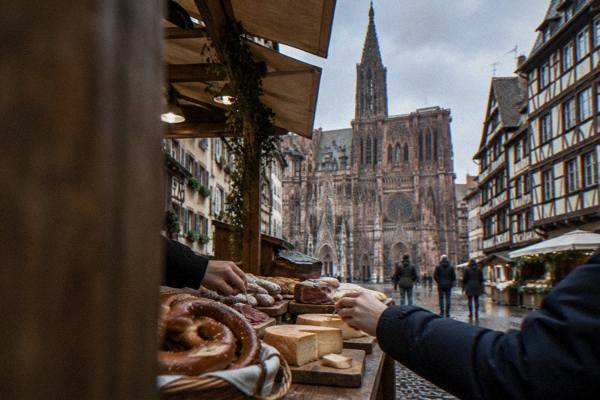
Kougelhopf
Kougelhopf is the fluted, ring-shaped yeast cake that Strasbourg, in Alsace, north-eastern France, bakes for Sunday tables, Christmas markets and wine tastings. This guide covers what it is, how it tastes, where to find it and how to build a day around it.
Short answer
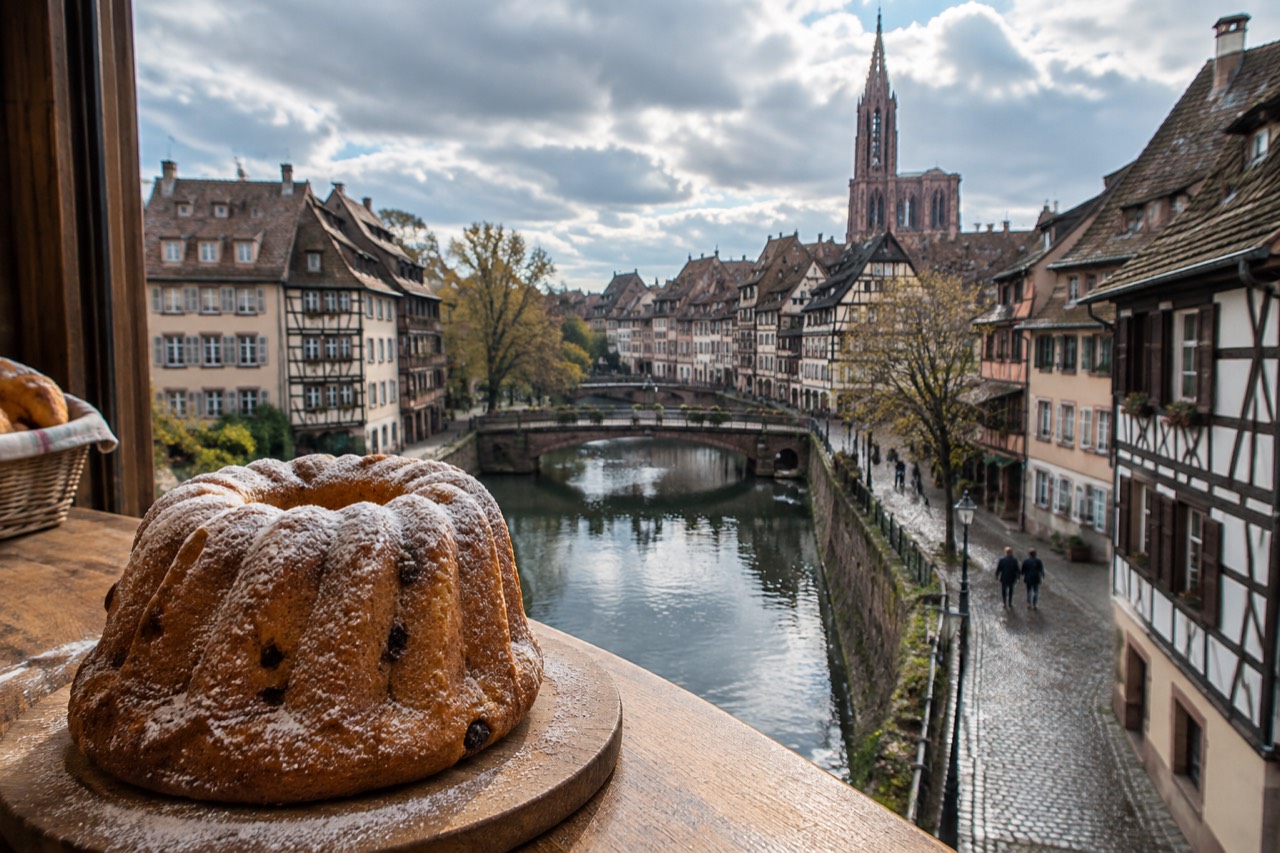
Kougelhopf is a yeasted ring cake baked in a fluted mould, studded with raisins and crowned with almonds, eaten across Strasbourg and Alsace at breakfast, with coffee after lunch, and at the Christmas market, which last year ran 26 November to 24 December 2025 and drew 3.05 million visitors.
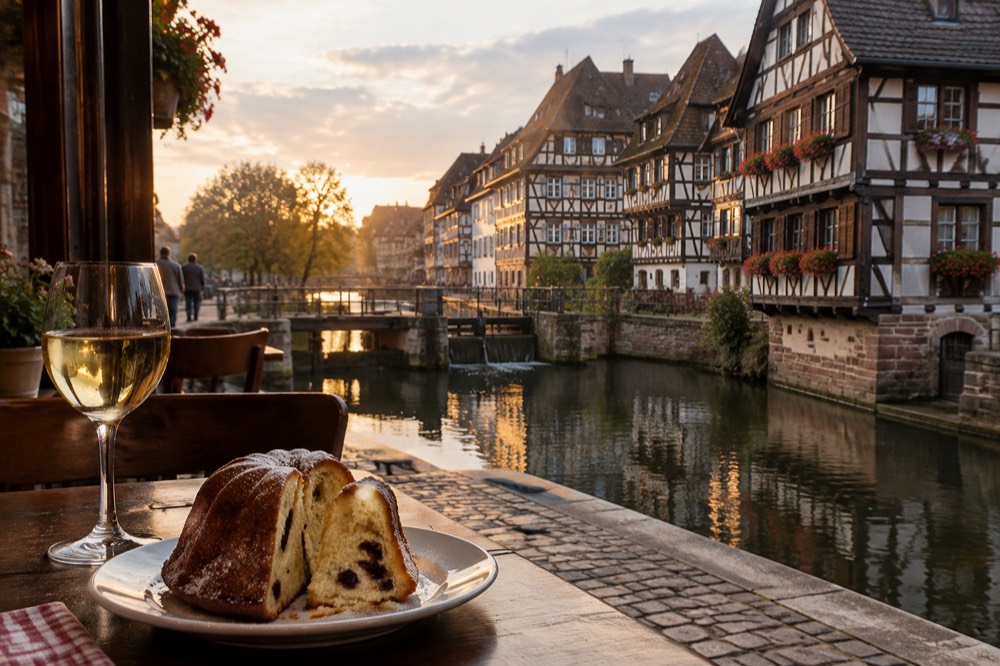
Kougelhopf is the fluted, ring-shaped yeast cake that bakers across Strasbourg, the prefecture of the Bas-Rhin in Alsace, north-eastern France, pull from their ovens for Sunday breakfasts, wedding tables and the Christmas market. It is a brioche-style dough, enriched with butter and eggs, studded with raisins that have been plumped in liquid, set with whole almonds in the creases of its ribbed tin, and finished with a snowfall of icing sugar once it has cooled. In a city whose food identity runs from choucroute to tarte flambée, this is the cake that crosses every occasion: a slice with morning coffee, a wedge with a glass of Alsatian white wine in the afternoon, a whole ring carried home under an arm. This guide explains what kougelhopf is, how it tastes, where to find the good ones in Strasbourg, how it fits into the city's Christmas season, and how to plan a full tasting day around it.
What Is Kougelhopf?
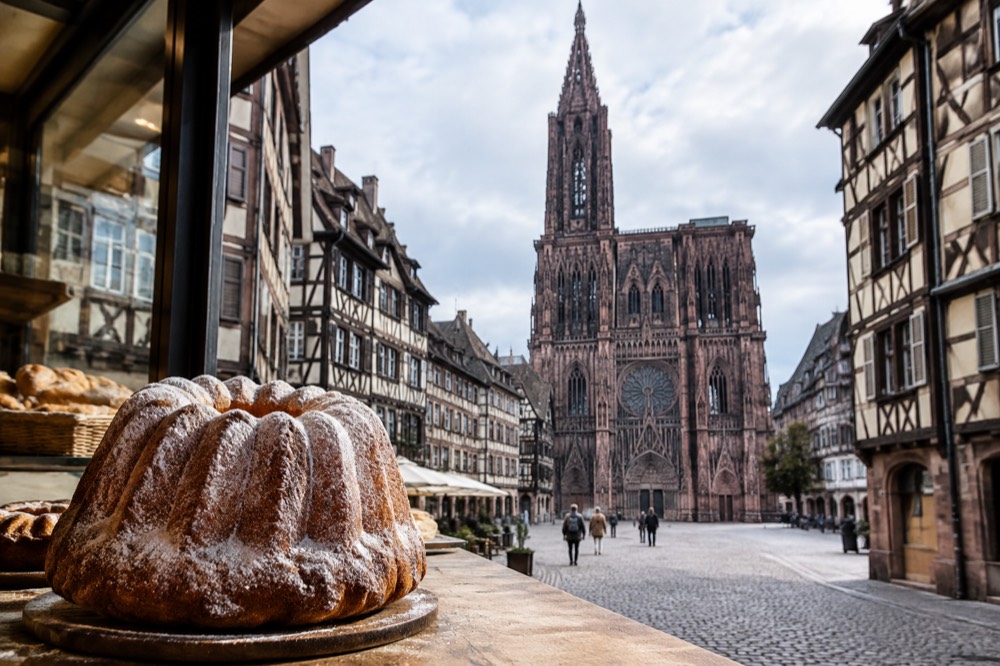
Kougelhopf is a sweet, enriched yeast cake baked in a deep, ribbed ring mould, and it is the signature bake of Strasbourg and the wider Alsace region of north-eastern France. The dough is close to a brioche: flour, butter, eggs and a little sugar, raised slowly, then filled with raisins and arranged in a fluted tin with an almond pressed into each groove. The finished cake turns out pale gold and slightly domed, and it is served cut in thick slices, plain or dusted with icing sugar.
The name travels under several spellings. Kouglof and kougelhopf are the two you will see on bakery windows in Strasbourg; the German form, Gugelhupf, appears across the border in Baden, and the cake has cousins throughout the Rhine valley. Whatever the spelling, the Alsatian version is the one this page is about: a light, yeasted, not-too-sweet ring that belongs as much to the wine table as to the breakfast table. It is not a dense fruitcake and not a dry sponge. The crumb should pull apart in soft strands, the raisins should be juicy rather than chewy, and the sugar should be a finish, not the point.
| Aspect | What To Expect |
|---|---|
| Shape | Tall ring with fluted, ribbed sides and a hole through the centre |
| Dough | Enriched yeast dough, brioche-like, slow-raised |
| Fillings | Raisins soaked before baking; whole almonds in the mould's grooves |
| Finish | Plain, or dusted with icing sugar once cooled |
| Eating occasions | Breakfast, afternoon coffee, dessert, wine tastings, Christmas market |
| Where in Strasbourg | Bakeries, winstubs, Christmas market chalets, food shops |
A note on what kougelhopf is not. It is not the same as a Parisian brioche, which is richer and sweeter and baked without the mould's ridges. It is not a kugel, despite the similar-sounding name, which is a savoury dish from elsewhere entirely. And it is not a dessert you eat with a fork and a spoon at a formal dinner: in Alsace it is a cake you slice at the table, pass around, and eat with your fingers or a small fork, depending on the company. The mould itself, called a kougelhopf tin, has become a souvenir in its own right, and visitors carry them home from kitchen shops across the Grande Île.
What Does Kougelhopf Taste Like And How Is It Different From Other Alsatian Bakes?
Kougelhopf tastes gently sweet and buttery, with a warm, faintly bready flavour from its slow yeast rise, soft raisins in every slice, and a toasty edge from almonds baked against the tin. Unlike Alsace's savoury classics, it is the region's sweet counterweight: tarte flambée is a thin cream-and-onion flatbread served hot, choucroute is sauerkraut with pork, and baeckeoffe is a slow-cooked meat and potato casserole, while kougelhopf follows them or replaces them at breakfast.
Texture does a great deal of the work. A well-made kougelhopf is springy under the knife, and the crumb is tender enough to tear but firm enough to hold a slice's shape. The outside, where the dough met the hot metal of the fluted ridges, carries a slightly firmer, more caramelised crust. Because the dough is enriched with butter, a slice feels richer than ordinary bread but lighter than a pound cake, and it keeps its appeal over a couple of days, which is why Alsatian households have always treated it as a make-ahead cake for gatherings.
| Alsatian Classic | Type | Sweet Or Savoury | When It Is Eaten |
|---|---|---|---|
| Kougelhopf | Yeasted ring cake | Sweet | Breakfast, coffee, dessert, wine time |
| Tarte flambée | Thin flatbread with cream, onions, bacon | Savoury | Evening, shared straight from the oven |
| Choucroute | Sauerkraut with pork and sausages | Savoury | Lunch or dinner, a full plate |
| Baeckeoffe | Slow-baked meat and potato casserole | Savoury | Sunday lunch, a one-dish meal |
| Bredala | Small Christmas biscuits | Sweet | Advent and the Christmas season |
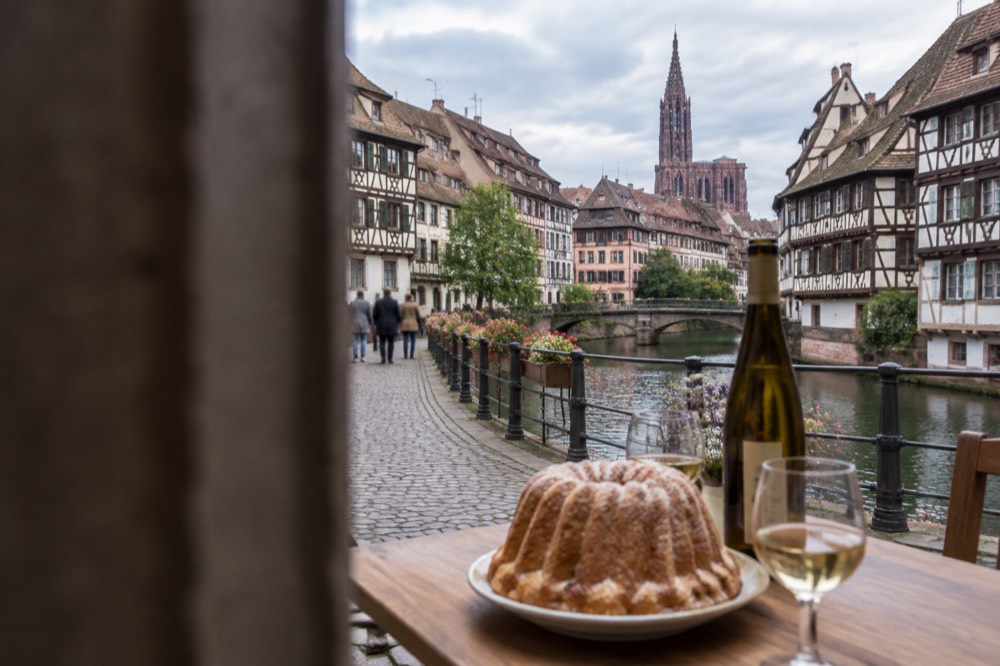
Pairing is where kougelhopf earns its place in Strasbourg's food culture. With coffee in the morning it plays the role of a pastry. With a glass of Alsatian riesling or a sparkling crémant in the afternoon it becomes a wine cake, its mild sweetness setting off the region's dry whites. At a winstub, the traditional Alsatian tavern, a slice sometimes arrives at the end of a meal in place of a composed dessert, and nobody objects. If you are planning a wider food trip through the city, our guide to Strasbourg Christmas market food covers the sweet and savoury stalls of the winter season, and the classic winstub dishes of Strasbourg sit alongside kougelhopf on the same menus.
A tasting session is one way to try several of these pairings in a single afternoon, with a guide walking you through what goes with what. The options below include a guided walk through the city's food streets and two seated tasting experiences, an Alsatian wine discovery and a craft beer session held before the taproom opens.
Curious to taste your way through the city with a local guide? Book a free walking tour here.
Where To Find The Best Kougelhopf In Strasbourg?
The best kougelhopf in Strasbourg comes from traditional bakeries on and around the Grande Île, the UNESCO-listed river island at the city's centre, from winstubs that bake or buy their rings daily, and from the Christmas market chalets selling warm slices and whole cakes from late November. Look for a cake baked that morning, pale gold rather than dark brown, with visible raisins at the cut face, and a queue of locals at the counter on a Sunday morning.
Bakeries are the backbone. Strasbourg's boulangeries bake kougelhopf in small batches, and the ones a street or two back from the main tourist lanes often turn out the better cakes simply because they are baking for regulars rather than passers-by. A whole small ring is the classic purchase; many counters also sell slices, which lets you try two or three bakers' versions in a single walk. In the days around the Christmas market, production steps up, and some bakeries take orders for whole decorated rings for the holiday table.
| Where | What You Get | What To Check |
|---|---|---|
| Traditional bakery | Whole rings or slices, baked that morning | Ask what came out of the oven today |
| Winstub | A slice at the end of a meal, sometimes warmed | Whether it is house-baked or bought in |
| Christmas market chalet | Warm slices and whole cakes in season | The market's official dates before you go |
| Food and gift shops | Wrapped rings and kougelhopf tins to take home | The eat-by date on wrapped cakes |
| Café with a pastry counter | A slice with coffee, an easy first taste | Whether the crumb still feels fresh |
The Christmas market deserves its own word of caution about timing. The 2026 dates are not yet published; the city's Christmas site states that the official dates and programme are still being finalised. Last year's edition ran 26 November to 24 December 2025 and drew 3.05 million visitors, so the market weeks are busy, and the pattern in recent years has been an opening in the last week of November and a close on 24 December, with chalets typically open from late morning into the evening. Confirm the 2026 dates on the city's Christmas site before you plan a trip around them, and see our Strasbourg Christmas market guide for the full picture.
One pleasant way to combine a kougelhopf morning with sightseeing is to walk the city with a guide who knows the streets between the bakery counters. A street-art walk is an unexpected but genuinely good pairing: Strasbourg's painted walls and tucked-away courtyards sit on routes that cross the bakery districts, and the walk ends within a short stroll of several good counters on the Grande Île. The operator's live listing carries the current times and meeting point, and there is more on the format in our overview of guided walks in Strasbourg.
How Is Kougelhopf Served In Alsace?
In Strasbourg and across Alsace, kougelhopf is served in thick slices at room temperature, sometimes lightly warmed, plain or with a light dusting of icing sugar, and it appears at three moments of the day: with morning coffee, with afternoon wine or crémant, and as a simple dessert after a winstub meal. It is not usually sauced, filled or plated with cream. The Alsatian instinct is to let the cake and its raisins speak, with a drink beside them.
Breakfast is the first and simplest service. A slice, a coffee, perhaps a little butter if the cake is a day old, and the morning is sorted. In winstubs, the cake turns up at the other end of the day, after choucroute or a plate of tarte flambée, as the house dessert, and it is often the moment when a waiter will tell you whether the kitchen baked it or which bakery it came from. Between those two moments sits the Alsatian wine hour, where kougelhopf and a dry white or a glass of crémant is a classic combination, the cake's mild sweetness playing against the wine's acidity.
There are variations worth knowing. Some bakers make a chocolate kougelhopf, with cocoa in the dough or chocolate pieces folded through it, and a savoury version exists too, made without sugar and filled with cubes of bacon and walnut, served as an aperitif cake with a glass of wine before lunch. The savoury kind is less common in the city centre, but it turns up in rural bakeries and at food festivals, and it surprises visitors who thought they had the cake figured out. Our calendar of Strasbourg events and festivals notes the periods when food stalls and festival menus are most likely to carry the unusual versions.
What Role Does Kougelhopf Play At The Strasbourg Christmas Market?
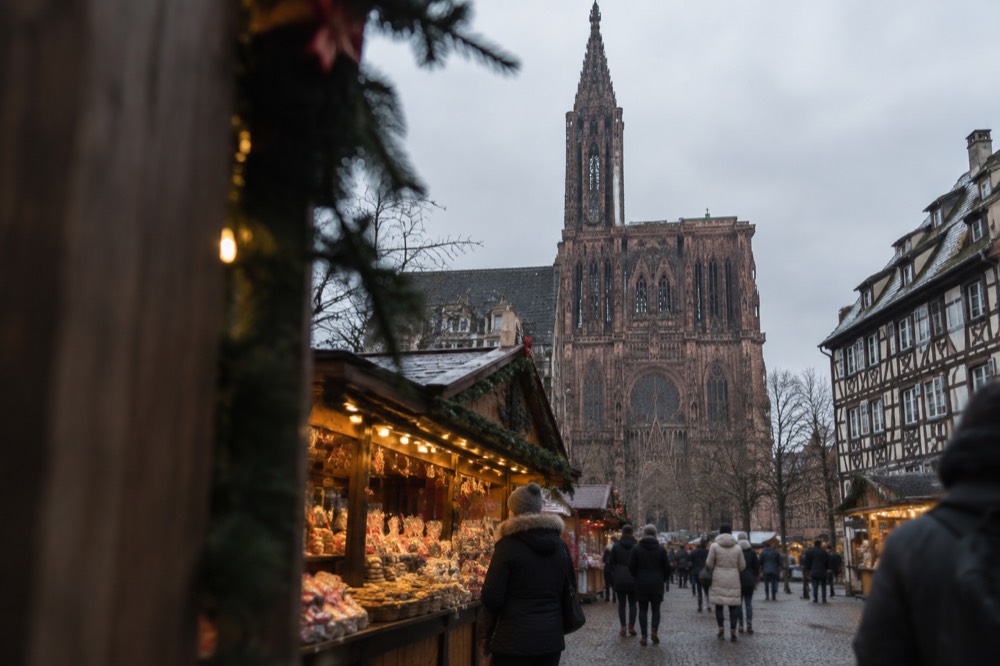
At the Christmas market, kougelhopf shifts from bakery counter to chalet stall: vendors sell warm slices dusted with icing sugar, whole rings to carry home, and small gift-wrapped cakes alongside the season's other sweets. The market's pattern is an opening in the last week of November and a close on 24 December, and last year's edition, 26 November to 24 December 2025, drew 3.05 million visitors, so the chalets selling warm cake do brisk business in the cold.
The cake suits the season for practical reasons. It keeps better than most pastries, it travels well as a gift, and a warm slice in the hand is exactly what a December evening in Strasbourg calls for. Chalets sell it alongside the other Christmas sweets of Alsace: the small spiced biscuits called bredala, the gingerbread of the market stalls, and the roasted almonds that scent the lanes around Place Kléber. If you are building a food itinerary for the season, pair this page with our guide to Christmas markets in Alsace and the rundown of Colmar's Christmas market, where the same cake appears under the same name.
| Christmas Market Fact | Detail |
|---|---|
| 2025 edition dates | 26 November to 24 December 2025 |
| 2025 attendance | 3.05 million visitors |
| 2026 dates | Not yet published; the city's Christmas site says they are being finalised |
| Usual pattern | Opens in the last week of November, closes on 24 December |
| Chalet hours pattern | Late morning into the evening; check the official site for times |
December weather shapes the experience. Meteo-France's 1991-2020 normals for Strasbourg-Entzheim give a mean December maximum of 5.9 C and a mean minimum of 0.8 C, with 45.2 mm of rain and 10.2 days of rain of 1 mm or more across the month, so a warm slice and a hot drink are not luxuries, they are equipment. Our guide to Strasbourg in winter covers the practical side of a cold-weather visit, and the month-by-month detail sits in the Strasbourg weather guide.
Can You Bake Kougelhopf At Home?
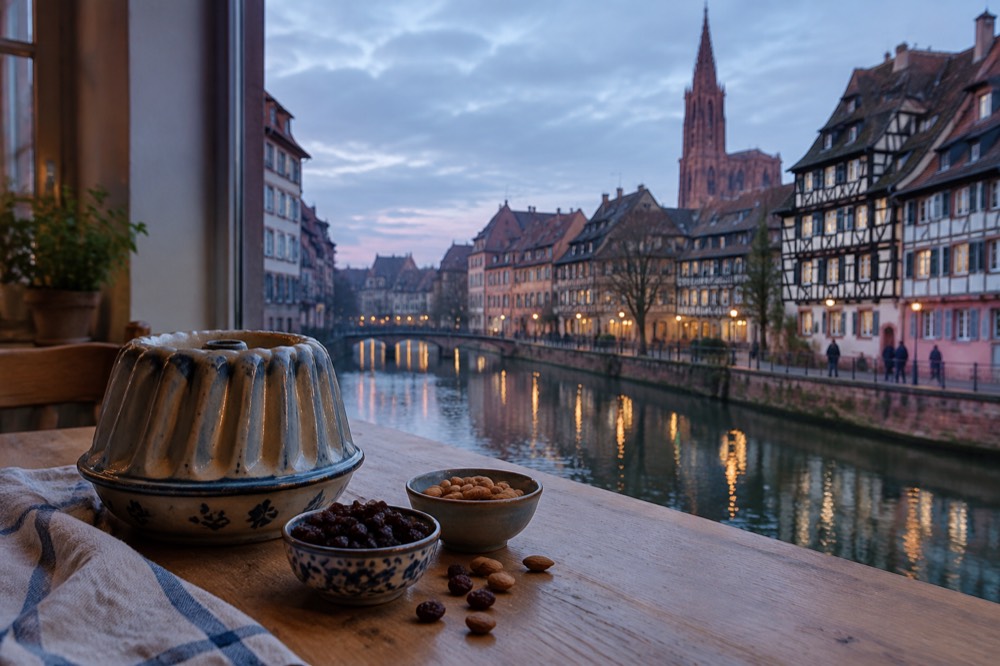
Yes, and Strasbourg's kitchen shops sell the essential piece of equipment: the fluted kougelhopf tin, in glazed ceramic or non-stick metal, which gives the cake its ribbed shape. The bake itself is a slow one, a yeasted dough that rises, is filled with soaked raisins, pressed into the tin with almonds in each groove, and baked until deep gold. Home bakers should plan a long afternoon, and accept that the first ring is a rehearsal.
The tin is the first purchase. Ceramic tins are the traditional choice and hold heat evenly; metal versions release more easily and suit a first attempt. The classic Alsatian tin is a modest size, producing a ring that serves a family table, and the moulds sold in Strasbourg's kitchen shops come in sizes from individual mini-kougelhopfs up to large celebration rings. Soak the raisins well ahead, in water, tea or a splash of Alsatian wine, because dry raisins are the single most common fault in a home bake. Place an almond in every flute before the dough goes in, and the finished cake will carry them in a neat crown around its base. The rest of the planning pages sit on Strasbourg Travel Guide.
The recipe logic is brioche logic. Make an enriched dough with flour, yeast, eggs, butter and a modest amount of sugar, let it rise until doubled, fold in the drained raisins, then let it rise again in the prepared tin before baking. Cool the cake in the tin for a few minutes, then turn it out carefully, because the ring is at its most fragile while hot. Icing sugar goes on last, through a sieve, once the cake has cooled completely. If you would rather eat than bake, the bakeries and food shops of Strasbourg covered elsewhere on this site will do the work for you.
When Is The Best Time Of Year To Eat Kougelhopf In Strasbourg?
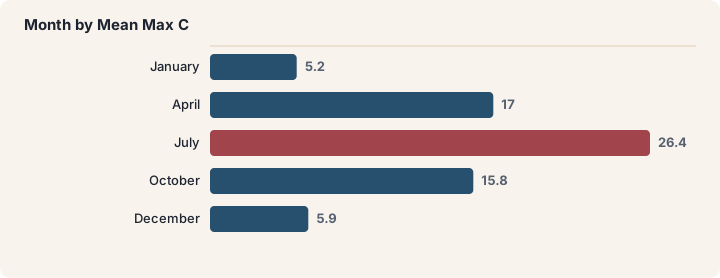
The honest answer is that Strasbourg bakes kougelhopf all year, but two seasons raise the stakes: the Christmas market weeks from late November to 24 December, when chalets sell warm slices, and the late spring and summer months, when the cake pairs with the region's wine served outdoors. The climate is semi-continental, with a mean maximum of 26.4 C in July against 5.2 C in January, so the same cake plays different roles through the year.
In winter it is comfort food, eaten standing at a market stall with steam rising off it. In summer it is a picnic and terrace cake, cut at a table in the shade with a chilled glass beside it. Spring and autumn sit between the two, and they are the seasons when the city is at its calmest for visitors who want bakery counters without queues. The seasonal detail matters if your trip has a fixed window; the month-by-month breakdown in our best time to visit Strasbourg guide weighs crowds, weather and events together.
| Month | Mean Max C | Mean Min C | Rain Days 1 mm Or More |
|---|---|---|---|
| January | 5.2 | -0.2 | 9.1 |
| April | 17.0 | 5.7 | 8.6 |
| July | 26.4 | 14.9 | 10.4 |
| October | 15.8 | 7.2 | 9.6 |
| December | 5.9 | 0.8 | 10.2 |
Those figures are Meteo-France's 1991-2020 normals for Strasbourg-Entzheim, the standard reference for what the city's weather does over a long run of years, and they describe a semi-continental climate: warm summers, cold winters, and rain spread fairly evenly across the year, with 635.7 mm annually. None of it is a reason to skip the cake. It is a reason to decide whether you want it warm at a December chalet or cool on a July terrace.
How To Plan A Kougelhopf Tasting Day In Strasbourg?
A good tasting day strings together three or four stops on foot across the Grande Île and its edges: a morning bakery for a fresh slice with coffee, a walk through Petite France or the painted lanes to earn it, a winstub lunch where the cake can follow tarte flambée, and an afternoon tasting of Alsatian wine or craft beer with a slice alongside. The centre is compact and walkable, and the CTS network covers tired legs, with a 24h Solo pass at 4.60 EUR.
Start early, because the best bakery batches come out in the morning. Buy a slice, not a whole ring, at the first stop, and keep the option of a second slice later; this is a tasting day, not a commitment. Walk it off through Petite France, the former tanners' quarter where the River Ill splits around half-timbered houses, then cross back towards the cathedral streets where the bakery density rises again. Lunch at a winstub, and if the kitchen offers kougelhopf as its dessert, take it, because a house version tells you how the cake is eaten rather than how it is sold.
| CTS Ticket | Price | What It Covers |
|---|---|---|
| Single, app or contactless | 1.90 EUR | One journey on the network |
| Single, bought on board a bus | 2.50 EUR | One journey |
| 24h Solo | 4.60 EUR | One person, unlimited travel for a day |
| 24h Trio | 10.20 EUR | Two or three people travelling together |
| Airport combined ticket | 4.60 EUR | Airport train shuttle plus a day pass |
The afternoon belongs to a guided tasting. An Alsatian wine discovery session walks you through the region's whites with a professional pouring, and kougelhopf is a natural companion to that kind of table; the cake's gentle sweetness is exactly what the dry Alsatian styles are poured against. For a different angle, a craft beer session held before the taproom opens to the public pairs the city's brewing side with a quieter room, and it sits well after a morning of walking. Both are short, seated experiences that fit the gap between lunch and dinner.
The street-art walk mentioned earlier is the other half of the day for many visitors: a guided route past the city's murals and hidden corners that starts near the centre and ends within easy reach of the bakery streets, so the cake stop can come first, last or both. It is a walking-tour format, it runs with a local guide, and the live listing carries the current schedule.
For beer rather than wine, the craft beer tasting before opening hours is the pick: a seated session in a working taproom, with the brewing explained while the room is still calm. It makes an unusual close to a food day in a city better known for its wine, and it is short enough to leave the evening free for dinner.
What Should You Know Before Buying A Kougelhopf In Strasbourg?
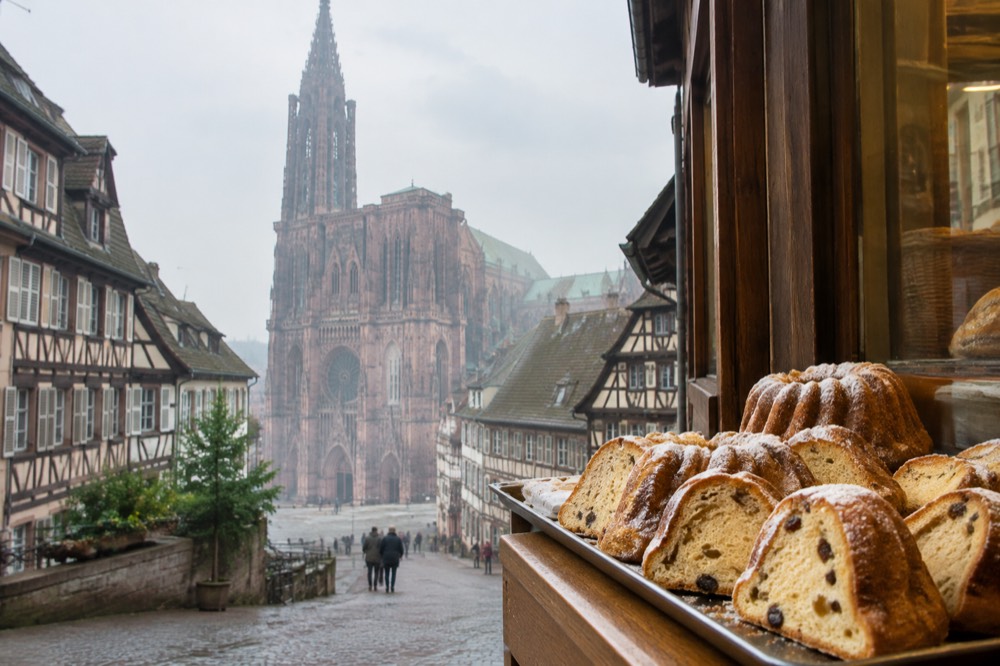
Buy from a bakery that baked that morning, ask for the day's batch rather than a wrapped cake from a shelf, and check the cut face for visible, plump raisins and a pale gold crumb. A whole ring keeps for a couple of days wrapped at room temperature, slices can be briefly warmed to bring the butter back to life, and a wrapped gift cake from a food shop is a different product with a longer shelf life, fine for carrying home but not the same eat.
Timing matters at the counter. Sunday mornings are the cake's natural habitat in Alsatian households, so bakeries bake for them, and a Sunday-morning slice is often the freshest you will find. Weekday afternoons can be thin, because a small bakery's batch may have sold out by lunch. If you are set on a whole decorated ring for a special occasion, order a day ahead; the shops that do this are the ones with a steady local trade, and they will tell you plainly what is possible. For the practical side of eating well without overspending, our Strasbourg on a budget guide covers the wider food scene.
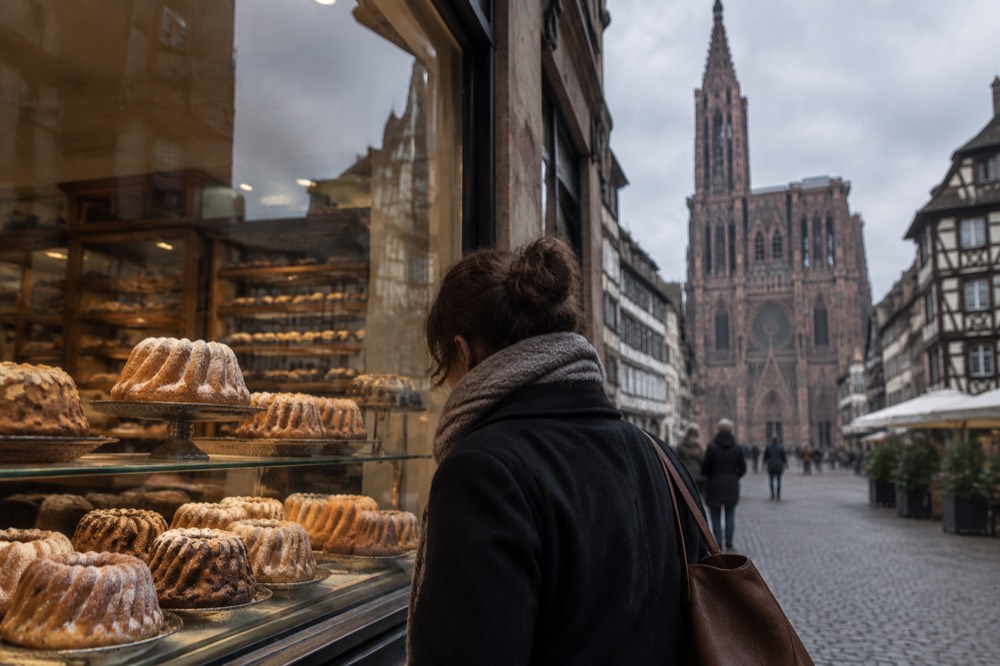
Which Souvenirs Should You Bring Home From A Kougelhopf Trip?
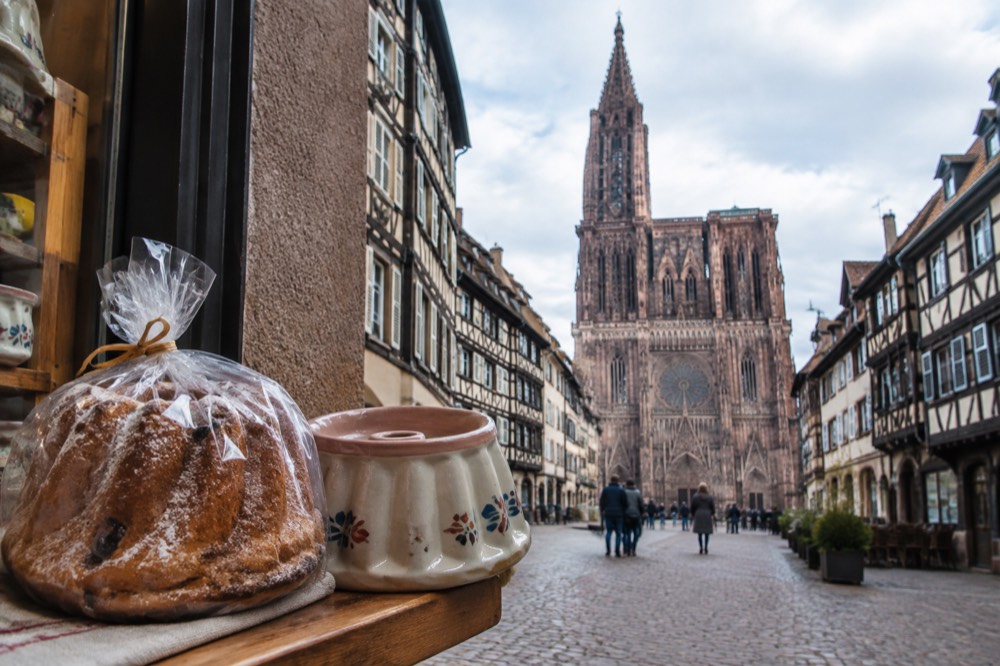
The two that travel well are the fluted kougelhopf tin, sold in kitchen shops across central Strasbourg in ceramic and non-stick metal, and a wrapped whole cake from a bakery or food shop, which keeps longer than a fresh ring and survives a journey in a suitcase. The tin is the better souvenir, because it turns one trip into years of home baking. A bag of Alsatian raisins or a bottle of crémant to pour beside the first home-baked slice completes the set.
Shop for the tin where the locals do, in the kitchenware streets rather than the gift stalls, and compare a ceramic mould against a metal one before choosing: ceramic bakes more evenly and looks the part on a shelf, metal releases cleanly and forgives a first attempt. The cake itself should be bought on the last day of the trip, not the first, and a well-wrapped ring in a sturdy box will get home intact if it rides in the middle of a bag rather than the bottom. Declare nothing to yourself about the diet until you are back in your own kitchen with the tin out on the counter.
How Does Kougelhopf Fit Into A Wider Alsatian Food Trip?
Kougelhopf is the sweet anchor of an Alsatian food trip that runs from Strasbourg's winstubs out through the wine route villages, where bakery counters sell the same cake under the same name, and the Christmas season stacks it against the region's other sweets. Give the cake a morning in Strasbourg, a tasting in the afternoon, and a stop in any wine village you visit, and it will follow you across the region.
The wine route is the natural extension. The villages of the Alsace wine route each carry their own bakery traditions, and a kougelhopf slice with a cellar tasting is a standard stop on guided day trips out of the city, several of which combine medieval villages with wine tasting and are listed on our overview of Strasbourg tours. In winter, the whole region shifts to Christmas mode, and the cake travels with it; the guide to Christmas markets in Alsace maps the towns worth adding to a Strasbourg base.
For a shorter visit, the cake is generous with its time. A single morning on the Grande Île, one good bakery, one slice and one coffee, tells you what the fuss is about, and an afternoon tasting turns the fuss into understanding. If you are weighing whether the city justifies the journey at all, the honest answer, argued in detail in is Strasbourg worth visiting, is that its food alone carries a weekend, and the kougelhopf is where that argument starts.
Common Questions About Kougelhopf
What is kougelhopf?
Kougelhopf is a sweet, enriched yeast cake baked in a fluted ring mould, filled with soaked raisins and set with almonds in the grooves, and finished with icing sugar. It is the signature bake of Strasbourg and Alsace, eaten at breakfast, with afternoon coffee or wine, and as a simple dessert after a winstub meal.
What does kougelhopf taste like?
It tastes gently sweet and buttery, with a soft, brioche-like crumb, juicy raisins through every slice and a toasty edge from the almonds baked against the tin. It is less sweet than a pound cake and richer than ordinary bread, which is why it works as well with a glass of dry Alsatian white as with morning coffee.
Where can I buy kougelhopf in Strasbourg?
Traditional bakeries on and around the Grande Île, winstubs that serve it as a house dessert, and the Christmas market chalets in season all sell kougelhopf. Ask for a cake baked that morning, look for a pale gold colour and plump, visible raisins at the cut face, and expect the freshest batches on Sunday mornings.
Is kougelhopf the same as brioche?
The dough is close to a brioche, enriched with butter and eggs, but the two are not the same bake. Kougelhopf is raised slowly in a fluted ring tin, carries raisins and almonds, and is less sweet than a typical brioche, which has no mould, no fillings and a richer, softer texture.
When is the best time to eat kougelhopf in Strasbourg?
The cake is baked all year, but two seasons stand out: the Christmas market weeks, which follow the pattern of opening in the last week of November and closing on 24 December, with last year's edition running 26 November to 24 December 2025, and the warmer months, when it pairs with chilled Alsatian wine on a terrace.
Can I bring a kougelhopf home as a souvenir?
Yes. A wrapped whole cake from a bakery or food shop keeps longer than a fresh ring and travels well in a sturdy box in the middle of a bag. The fluted kougelhopf tin, sold in ceramic and non-stick metal versions in Strasbourg's kitchen shops, is the other classic souvenir and lets you bake the cake at home.
A kougelhopf bought on a Sunday morning in Strasbourg, eaten in slices across the following two days, is the full experience in miniature: a slow-raised cake for a slow visit, best shared, and best followed by a walk through the streets that baked it.