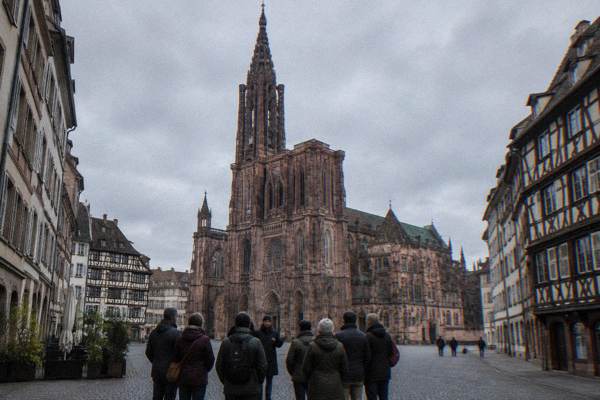
Strasbourg In Winter
Strasbourg, in Alsace in north-eastern France, turns quietly spectacular in winter: cold, bright, half-timbered, and home to France's signature Christmas market. This guide covers the weather you should actually expect, the sights that stay open, and how to plan around the season.
Short answer
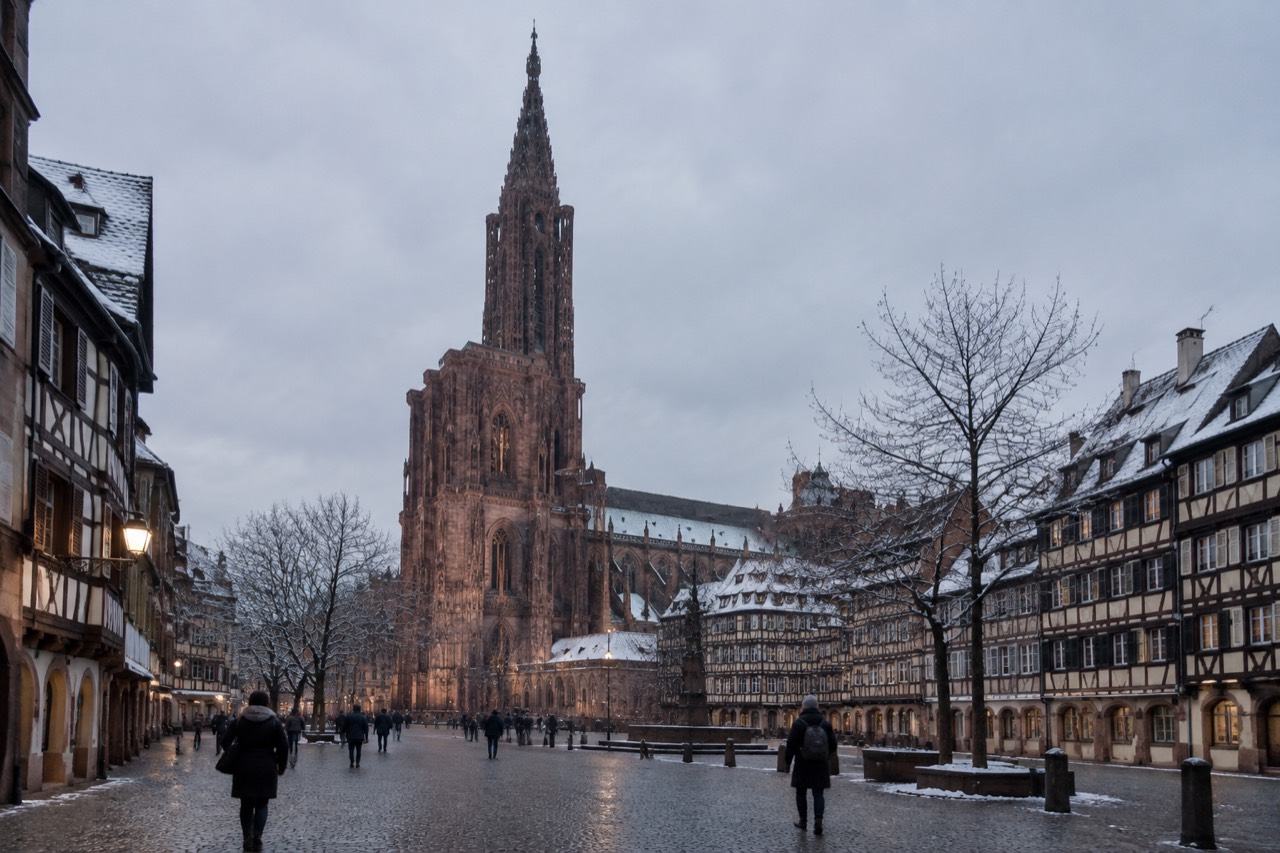
Strasbourg in winter is cold and often crisp: Meteo-France 1991-2020 normals give a January mean maximum of 5.2 C and a minimum of -0.2 C, with December averaging 10.2 rain days. The Christmas market, last year 26 November to 24 December 2025, is the headline draw, and the cathedral, museums and boat tours keep winter hours throughout.
Strasbourg, the prefecture of the Bas-Rhin in Alsace, part of the Grand Est region of north-eastern France, sits on the River Ill beside the Rhine, with the German town of Kehl on the far bank. In winter it is a different city from the summer one: the café tables retreat indoors, the winstubs light their stoves, and the half-timbered roofs of the Grande Île carry frost instead of geraniums. The season runs deeper here than the Christmas market alone, from the first chill of November through to the grey end of February, and it rewards travellers who plan for the cold rather than against it.
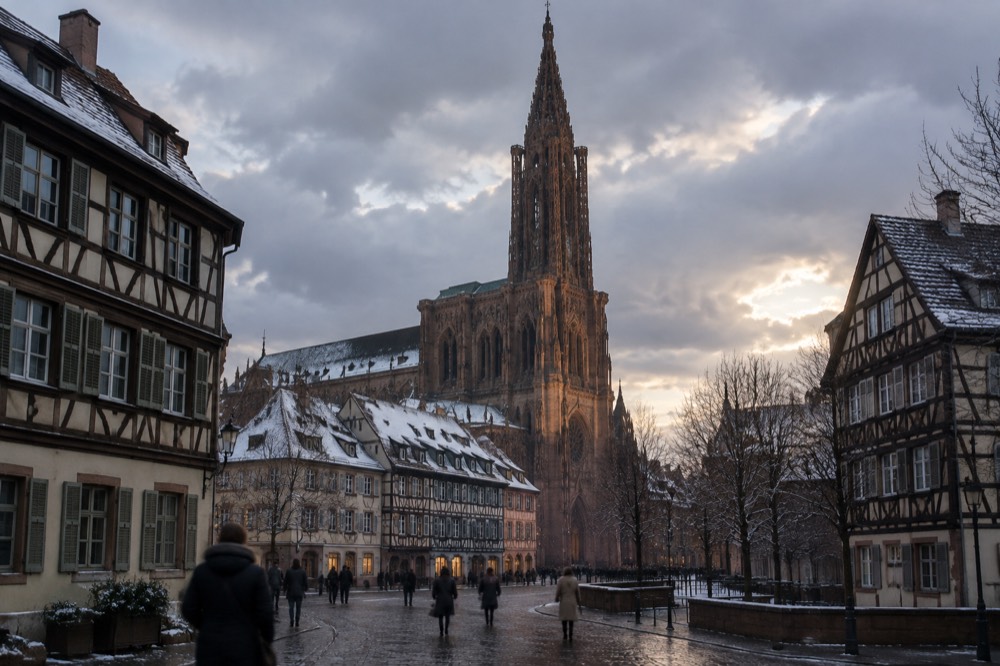
This guide walks through the climate in plain numbers, the Christmas market and its usual pattern, the sights that keep winter hours, the food that makes the season worth the flight, and the practical bits: fares, tickets, packing and where to sleep. The full market picture, including the food chalets, is covered in the Strasbourg Christmas market guide, and the best time to visit Strasbourg puts winter against the rest of the year.
What Is Winter Weather Actually Like In Strasbourg?
Strasbourg has a semi-continental climate with genuinely cold winters: Meteo-France 1991-2020 normals for Strasbourg-Entzheim give a January mean daily maximum of 5.2 C and a mean minimum of -0.2 C, with December averaging 5.9 C and 0.8 C. Rain falls on 10.2 days of 1 mm or more in December and 9.1 in January. Expect frost, short days, occasional snow, and a wind off the Rhine plain.
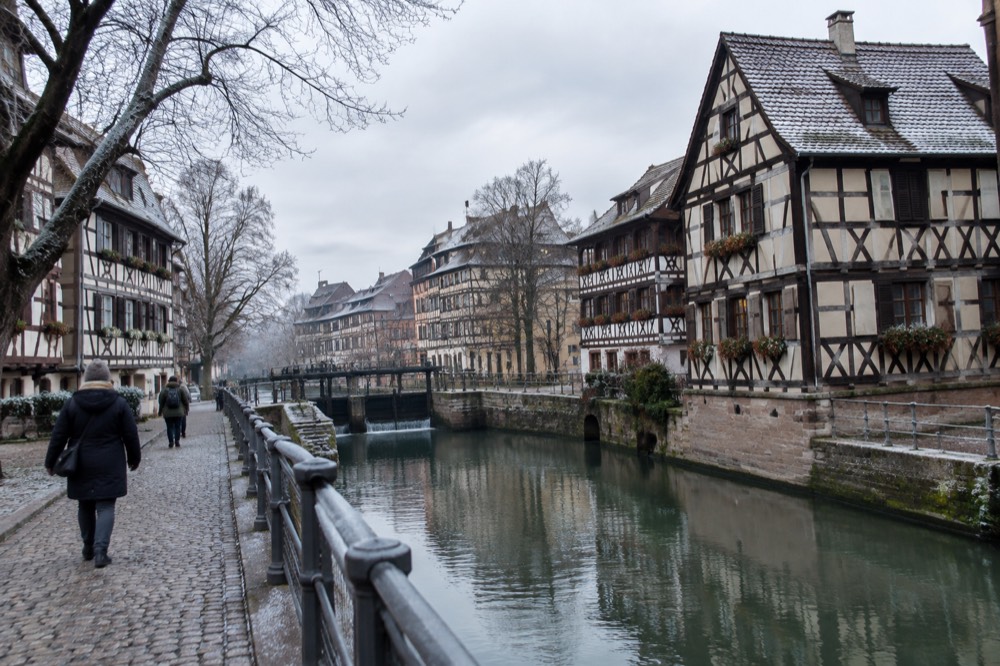
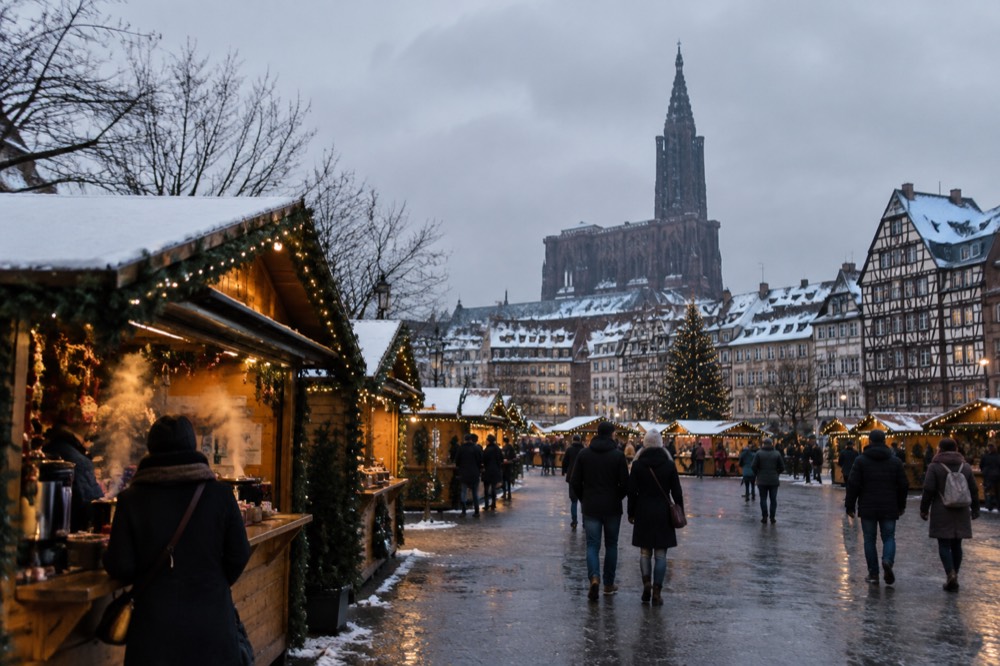
The honest version of a Strasbourg winter is that it is cold in the way northern and eastern France is cold, not in the mild way the Atlantic coast is cold. The Vosges mountains to the west strip a good deal of the oceanic moisture out of the prevailing weather, which is why the annual rainfall total of 635.7 mm is modest for France, but what arrives in winter often arrives as grey drizzle or, when the temperature drops, as snow that settles on the cobblestones of Petite France for a day or two before melting. Daylight is short: by late December the sun is down before the cathedral clock strikes six, and the city compensates with early lantern light along the quays.
The numbers below are the 1991-2020 climate normals for the Strasbourg-Entzheim station, published from Meteo-France data. They are averages, not forecasts, but they are the right basis for packing.
| Month | Mean daily max | Mean daily min | Rainfall | Days with 1 mm or more |
|---|---|---|---|---|
| November | 9.4 C | 3.3 C | 47.6 mm | 9.2 |
| December | 5.9 C | 0.8 C | 45.2 mm | 10.2 |
| January | 5.2 C | -0.2 C | 35.4 mm | 9.1 |
| February | 7.3 C | 0.0 C | 34.1 mm | 8.3 |
What that means in practice: a waterproof layer matters more than an arctic parka, because nine or ten wet days a month is the norm rather than the exception, and a proper scarf matters because the minimum sits around freezing from December through February. The Strasbourg weather guide carries the full twelve-month table if the trip might slide into spring.
What To Do In Strasbourg In Winter When The Cold Sets In?
The core winter city is compact and walkable: the Grande Île, a UNESCO World Heritage property named "Strasbourg, Grande-Île and Neustadt", holds the cathedral, Petite France, the Ponts Couverts and the Barrage Vauban terrace, all within a stroll of each other. Add the Christmas market in late November and December, the municipal museums on cold afternoons, and a covered boat tour on the Ill, and a short winter visit fills easily.
The trick to enjoying Strasbourg cold is to alternate. The cathedral nave is unheated in the way great stone churches are, but the astronomical clock show at 12:30 is an indoor half hour, and the museums of the Palais Rohan cluster three collections under one roof. The Musée des Beaux-Arts, the Archaeological Museum and the Museum of Decorative Arts share the palace, each at 9 EUR full price or 5 EUR reduced, with a 1-day Pass Musées at 20 EUR covering them all. The Musée Alsacien is closed for works until 2028 and should not be on any winter plan; the Strasbourg museums guide has the full list of what is open.
For structure, a guided walk is the efficient winter choice, because a guide keeps the group moving and the commentary distracts from the temperature. The roster's English-language free walks, pay-what-you-want and booked through GuruWalk, are a good first morning: the original free tour is a solid orientation, and a historian-led free walk of the historic centre and Petite France suits travellers who want depth over pace. A paid option is the hidden stories small-group tour, which works well in the early evening dark, when the lanterns are lit and the stories land better.
Happy to let a local show you around instead. Book a free walking tour here.
Segway and bike tours run through the winter months when the surfaces are dry, and they cover ground fast enough that the cold barely registers. The Euro Segway tour sweeps the European Quarter and the Rhine-side parks, while the guided bike tour with a local guide reaches the Neustadt and the farther banks of the Ill in a way walking cannot. Both are better in a dry January week than in a wet December one, so check the forecast before booking either.
Evening is the season's best hour. The Strasbourg at night guide maps the lit facades and the quiet quays, and a private evening walk, ninety minutes with a guide to yourself, turns the empty lanes of the Krutenau into something close to theatre. Snow, when it holds, does the rest.
Is The Christmas Market Worth Building A Winter Trip Around?
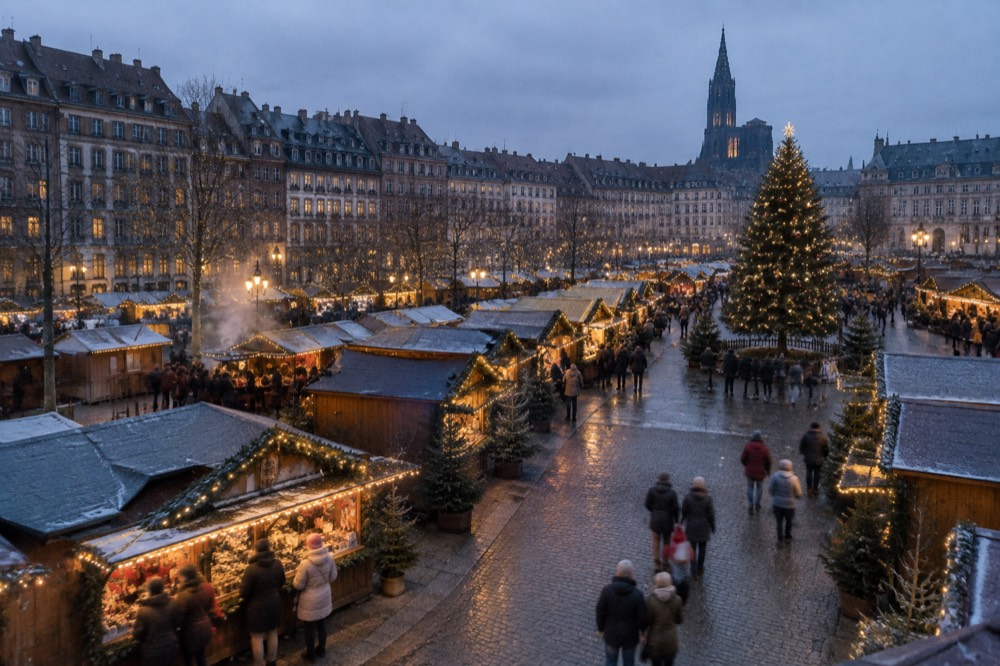
Last year's edition ran 26 November to 24 December 2025 and drew 3.05 million visitors, per the city's own attendance release. The usual pattern is an opening in the last week of November with a close early in the evening on 24 December. The 2026 dates and programme are still being finalised on the city's Christmas site, so confirm them there before booking anything. Chalets typically open late morning and run into the evening.
The market is the reason hotel prices spike in December, and it deserves the reputation: the chalets around the cathedral and down toward Place Kléber sell mulled wine, bredele biscuits and hot food under strings of lights, and the great tree on Place Kléber anchors the whole thing. Scale it honestly: it is busy, especially in the evenings and at weekends, and the crowds are part of the design rather than a failure of planning. Arriving midweek and touring the chalets in the late afternoon, before the after-work crowd arrives, is the standard local tactic.
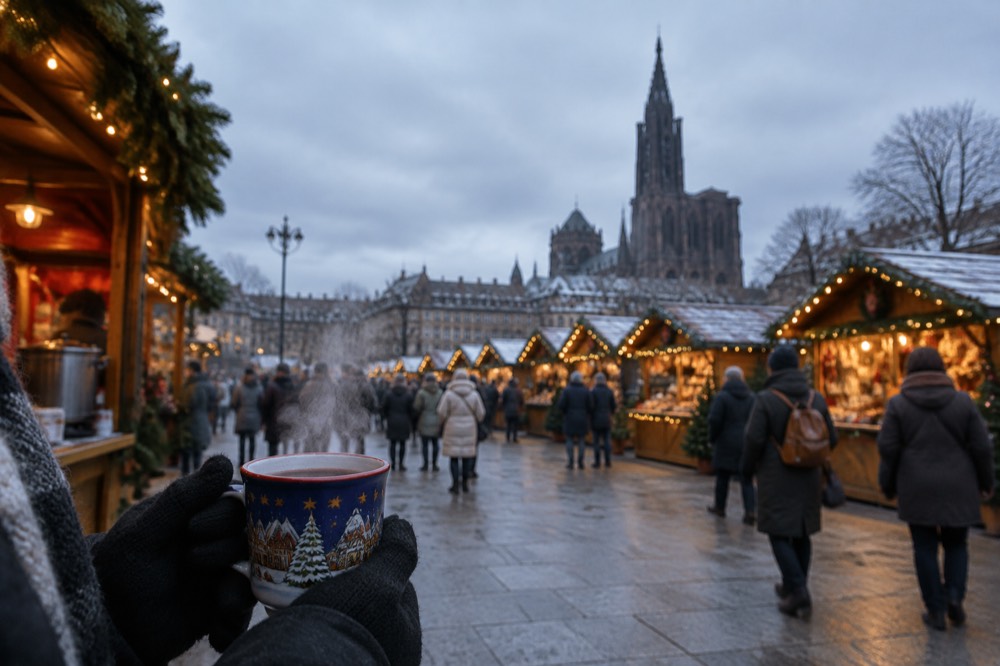
Two practical notes shape the visit. First, the cathedral keeps extended access during the market: the city's Christmas arrangements open the Place du Château side continuously Monday to Saturday, 08:30-17:45, which makes a market circuit and a nave visit easy to combine. Second, the chalets take cash and card in the usual mix, but the mulled wine stalls work fastest with small change and a returned cup deposit, so carry coins. The Christmas market food guide lists what to eat stall by stall, and travellers pairing the city with the region can extend to the Christmas markets in Alsace or compare against Colmar's Christmas market.
A guided food walk solves the market's main problem, which is that the best stalls are not signed in English. The Do Eat Better traditional food tour, roughly three and a half hours with a series of tastings, moves between a winstub, a baker and the market itself, and the operator's live listing carries the current price and the meeting point. Free cancellation applies, which matters when December plans shift with the weather.
What Hours And Prices Apply To The Main Sights In Winter?
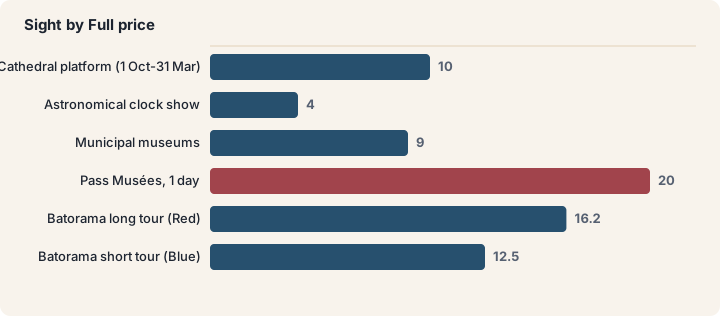
The cathedral platform runs its winter schedule from 1 October to 31 March, 10:00-13:00 and 13:30-18:00 with the last ascent at 17:15, at 10 EUR full and 6 EUR reduced, with under-6s free. The astronomical clock show is daily at 12:30, ticket 4 EUR, day-of purchase only. Municipal museums are 9 EUR full and 5 EUR reduced, free on the first Sunday of each month, and the Batorama long boat tour runs all winter at 16.20 EUR full.
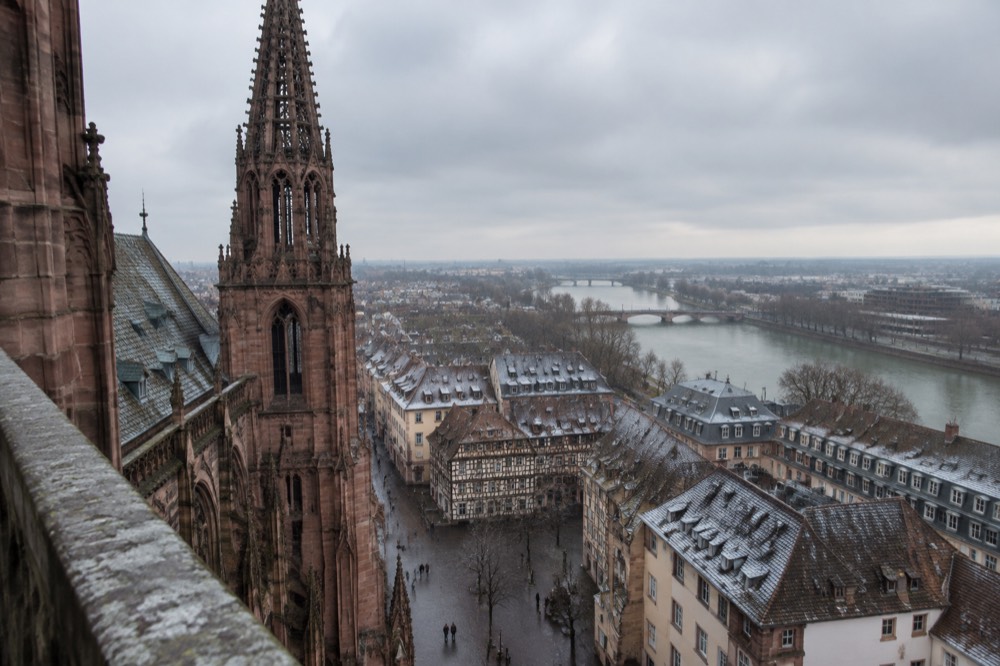
Winter hours shift, and the differences matter more here than in high summer. The platform is climbed in the cold, but the view over a frosted Grande Île is the city's single best vantage point, and the reduced winter timetable still leaves a full afternoon window. The clock show is the other fixed appointment: tickets sell at the cathedral stalls from 10:00 to 11:00 or at the Saint-Michel entrance from 11:30, and there are no reservations, so a December visit means choosing between the queue and the nave. The full index of guides sits on Strasbourg Travel Guide.
| Sight | Winter hours or detail | Full price | Reduced |
|---|---|---|---|
| Cathedral nave (Mon-Sat) | 08:30-11:15 and 12:45-17:45 | Free to enter the nave | Not applicable |
| Cathedral platform (1 Oct-31 Mar) | 10:00-13:00 and 13:30-18:00, last ascent 17:15 | 10 EUR | 6 EUR |
| Astronomical clock show | Daily at 12:30, day-of tickets only | 4 EUR | 3 EUR groups and students |
| Municipal museums | Closed Mondays, open other days | 9 EUR | 5 EUR |
| Pass Musées, 1 day | All municipal museums | 20 EUR | Not applicable |
| Batorama long tour (Red) | 1h10 on the water | 16.20 EUR | 8.90 EUR |
| Batorama short tour (Blue) | 0h45 on the water | 12.50 EUR | 7.20 EUR |
The Strasbourg City Card is a discount card rather than a pass: 5 EUR adult, 3.50 EUR for a child aged 3 to 17, valid seven days, and it knocks money off museums, the boat, the platform and the clock rather than including them. For a two-day winter visit with a museum afternoon and a boat trip, it pays for itself, and the Strasbourg City Card guide works through the arithmetic. The Barrage Vauban terrace, the classic panoramic deck over the Ponts Couverts, keeps seasonal hours, 08:00-19:00 in September and October and shorter winter times thereafter, and the admission price is not published on the city's page, so check it there.
What Should You Eat In Strasbourg When It Is Cold?
Winter is the winstub's natural season: choucroute garnie, baeckeoffe, tarte flambée and a carafe of Riesling are the cold-weather core of Alsatian cooking, and the city's traditional restaurants serve them from lunch through to late evening. A Kougelhopf with a late-afternoon coffee, bredele biscuits from the market stalls, and mulled wine in a deposited cup fill the gaps. A guided food walk stitches the best of it into one sitting.
The winstub, the Alsatian tavern, is the reason winter in Strasbourg works. The dishes are slow ones: baeckeoffe, a marinated meat and potato bake that traditionally spent a night in the baker's oven, and choucroute garnie, fermented cabbage piled with sausages and pork, both built for the season and served in rooms with timber ceilings and stoves. Tarte flambée, the thin crêpe baked with cream, lardons and onions, is the quicker option, and the tarte flambée guide and the choucroute guide each go deeper than a menu can.
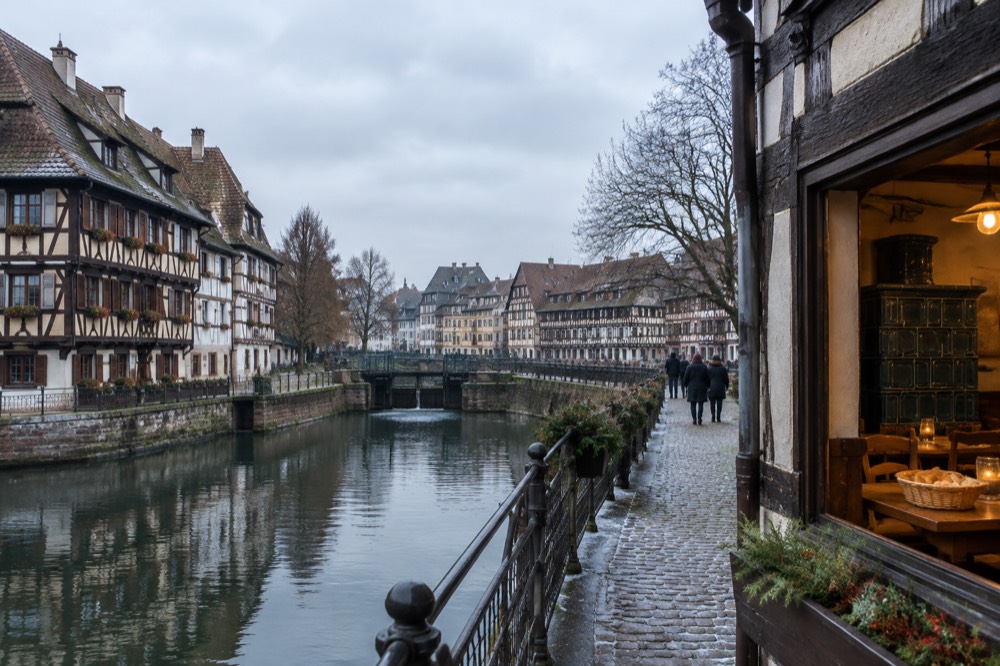
For travellers who would rather not gamble an evening on a random restaurant, the traditional food walk with tastings is the structured route: it moves through several stops, each with a tasting, and the guide handles the ordering. The shorter culinary walk covers similar ground for less commitment. The best restaurants in Strasbourg guide and the winstubs guide list specific addresses, and the Strasbourg food guide covers the full plate, from the signature dishes to the Kougelhopf that ends a winter lunch.
Wine deserves its own note. Alsace Riesling is dry, structural and made for choucroute, and a glass of Crémant d'Alsace, the region's traditional-method sparkling wine, does the festive work that champagne does elsewhere at a kinder price. The Alsace wine guide explains the grape map, and an Alsace wine tasting in the city centre is a warm, seated experience that fits neatly into a cold afternoon.
How Do You Get Around A Cold City, And What Does It Cost?
A CTS single ticket is 1.90 EUR from the Badgéo card, the CTS app or contactless payment, or 2.50 EUR bought from the driver on board, and a 24h Solo pass is 4.60 EUR. The tram and bus network covers the station, the Grande Île and the European Quarter, and the airport shuttle train runs to Entzheim in 8 minutes, with a combined airport ticket at 4.60 EUR. In the cold, the trams are the difference between a pleasant visit and a long walk.
The network is the quiet strength of a Strasbourg winter. The trams run frequently through the day, the stops are close together across the centre, and a 24h Trio pass at 10.20 EUR covers two or three people travelling together, which suits families. The 24h Solo at 4.60 EUR pays for itself after three rides, and the contactless option on board means no ticket machine queue in the drizzle. The getting around Strasbourg guide has the full network detail, and the airport to city centre guide covers the shuttle step by step.
| CTS ticket | Price | Where to buy |
|---|---|---|
| Single | 1.90 EUR | Badgéo card, CTS app, contactless |
| Single bought on board | 2.50 EUR | From the bus driver |
| 24h Solo pass | 4.60 EUR | App, machines, counters |
| 24h Trio pass (2-3 people) | 10.20 EUR | App, machines, counters |
| Airport combined ticket (Alsa+ 24h EMS) | 4.60 EUR | Station and airport machines |
Walking still does the heavy lifting in the centre, and the Grande Île is small enough that the trams matter mainly for the station, the European Quarter and the farther districts. The Strasbourg by bike guide covers the flat riverside network for dry winter days, though cycling in the cold is an acquired taste and the guided bike tours above supply the bikes and the route. For the free things to do in Strasbourg, the squares, the Ponts Couverts and the riverside walks cost nothing but layers.
A free orientation walk costs nothing but the tip you choose to give the guide at the end, and in winter it doubles as a fast way to learn which lanes are sheltered and which squares funnel the wind. Book it for the first morning, then spend the rest of the trip revisiting the corners that earned a second look.
Where Should You Stay In Strasbourg In Winter?
For the Christmas market weeks, stay inside or on the edge of the Grande Île, within a ten-minute walk of Place Kléber, so the evening market circuit does not become a cold tram ride home. Outside the market weeks, the gare district is cheaper and one stop from the centre, and Petite France is the prettiest base at a premium. December rates in the centre rise sharply around the market, so book early or shift the stay to the station side.
The winter logic of a hotel is proximity, because the evening is when the city is at its best and also when it is coldest. A hotel near the cathedral or on the edge of Petite France puts the lit lanes, the chalets and a dozen winstubs inside a short walk, and the walk home after mulled wine is the whole game. The where to stay for the Christmas market guide ranks the neighbourhoods for exactly this season, and the general where to stay in Strasbourg guide covers the rest of the year.
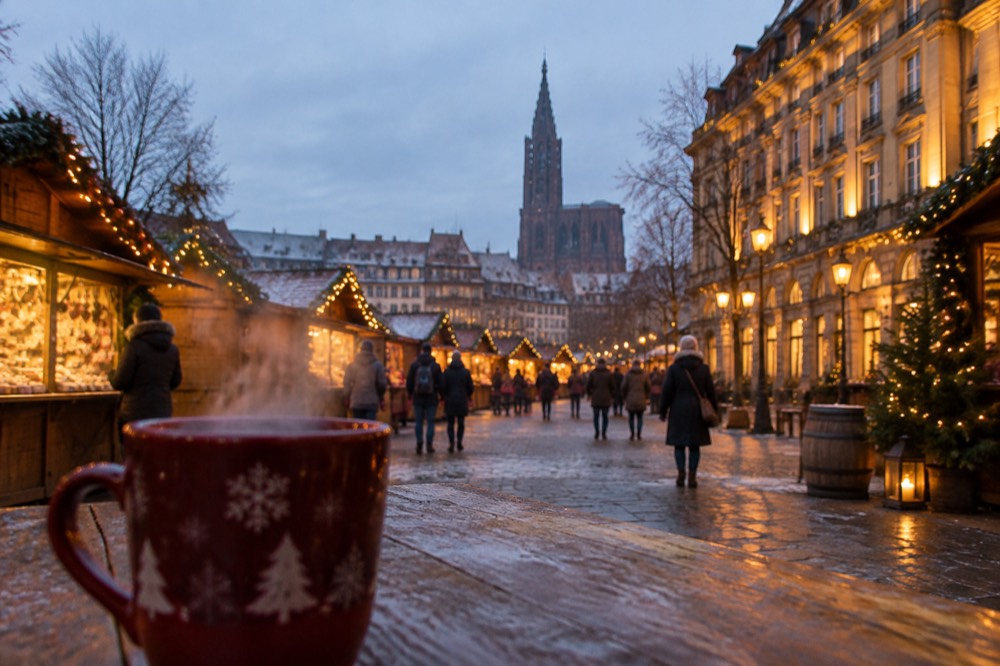
Budget travellers have a genuine winter option in the timing itself: January and February, outside the market, are the quiet months, and the Strasbourg on a budget guide explains how the low season translates into cheaper beds and emptier museums. The trade is the weather, which is at its greyest exactly when the prices fall, so the choice is between paying December rates for the lights or paying January rates for the fog. Both are real Strasbourg.
What Should You Pack, And What Day Trips Work In Winter?
Pack for a semi-continental winter: a waterproof outer layer, real insulation, a hat and gloves, and shoes with grip for frost and the occasional snow on cobblestones. Day trips that work in winter are the indoor-and-village type: Colmar's lanes and museums, the Haut-Koenigsbourg castle above the snow line, and the Alsace wine route's tasting rooms, all reachable on organised tours from the city when the roads are cold.
The packing list follows the normals table above rather than any instinct about France. With a January maximum of 5.2 C and a minimum below freezing, layers plus a waterproof shell are the answer, because the rain days outnumber the snow days and damp cold is the local speciality. Shoes matter more than visitors expect: the Grande Île's cobbles hold frost in the shade all day in a cold snap.
Day trips in winter need honest expectations. The medieval villages of the wine route, Riquewihr and Eguisheim among them, are quieter and arguably better in a January mist than in an August crowd, and the vineyard tasting rooms are warm. The organised options from Strasbourg include a medieval villages and wine tasting day trip, and a full-day Alsace highlights tour, both of which handle the driving on cold roads. The Alsace road trip guide and the Colmar guide cover the independent versions, and the Strasbourg and Colmar itinerary pairs the two cities across a winter weekend.
| Winter day trip | What it offers in the cold season | Who it suits |
|---|---|---|
| Colmar | Half-timbered lanes, indoor museums, warm tasting rooms | First-time visitors, short trips |
| Wine route villages | Quiet lanes, cellar-door tastings out of the weather | Wine travellers, couples |
| Haut-Koenigsbourg castle | A fortified castle with interior rooms and a wide cold view | Families, history readers |
| Black Forest | German towns, forest walks, cake by a stove | Travellers wanting a border crossing |
| Basel | Swiss city culture, museums, a different currency | City travellers, museum days |
One border note that saves an awkward moment: Switzerland is in Schengen but not in the euro, so a Basel day trip needs francs or a card, and euros are not the working currency there. Germany, across the Rhine at Kehl, is in Schengen and in the euro, so a tram-and-walk excursion across the border is frictionless. The Basel guide and the Black Forest guide carry the detail for each direction.
Whichever direction the day trips run, the winter city itself remains the reason to come: cold, knowable, and lit earlier than anywhere else in France. The guided options below cover the three formats that suit the season best, a food walk for the warmth, a Segway sweep for the wide cold spaces, and a bike tour for the dry bright days.
Common Questions About Strasbourg In Winter
Is Strasbourg Worth Visiting In Winter Outside The Christmas Market?
Yes. January and February are the quietest months, the museums run their normal hours, the winstubs are at their best, and hotel prices fall away from the December peak. The trade-off is grey weather: the normals show around nine wet days a month and a mean maximum near 5 C, so pack for cold and damp rather than snow scenes.
When Does The Strasbourg Christmas Market Run?
Last year's edition ran 26 November to 24 December 2025. The usual pattern is an opening in the last week of November and a close early in the evening on 24 December. The 2026 dates and programme are still being finalised on the city's Christmas site, so confirm them there before booking travel.
How Cold Does Strasbourg Get In Winter?
Meteo-France 1991-2020 normals give Strasbourg a January mean daily maximum of 5.2 C and a mean minimum of -0.2 C, with December at 5.9 C and 0.8 C. Snow happens but rain is more common, with 10.2 days of 1 mm or more of rain in December. It is a semi-continental climate, cold in the eastern French manner rather than mild in the Atlantic one.
What Should I Wear For A Winter Visit To Strasbourg?
A waterproof outer layer over real insulation, a hat and gloves, and shoes with grip for frost on cobblestones. The centre is walked end to end in the cold, and the cathedral nave and the market squares are unheated, so plan for standing around outdoors at temperatures near freezing.
Are The Museums And Sights Open In Winter?
The municipal museums are open through winter, at 9 EUR full and 5 EUR reduced, and free for everyone on the first Sunday of every month. The cathedral platform runs its winter timetable from 1 October to 31 March, 10:00-13:00 and 13:30-18:00. The Musée Alsacien is closed for works until 2028 and should be left off the plan.
Is December A Good Time To Visit Strasbourg?
December is the city's headline month, with the Christmas market drawing 3.05 million visitors last year, and it is worth it for the lights, the chalets and the winstub cooking. It is also the busiest and most expensive month of the year in the centre, so book beds early and expect evening crowds around the main squares.
The winter version of Strasbourg rewards the prepared: the cold is real but knowable, the market is the season's centrepiece but not its whole story, and the city's indoor riches, from the clock show to the winstubs, are built for exactly this weather. Plan around the normals, keep the evenings for the lit lanes, and the cold becomes part of the scenery rather than the obstacle.