Tarte Flambee
Tarte flambée is the dish Strasbourg eats standing up at the winstub counter and sitting down at long family tables alike. This guide covers what it is, how to order it, where the city does it best, and how to build a food-focused visit around it.
Short answer
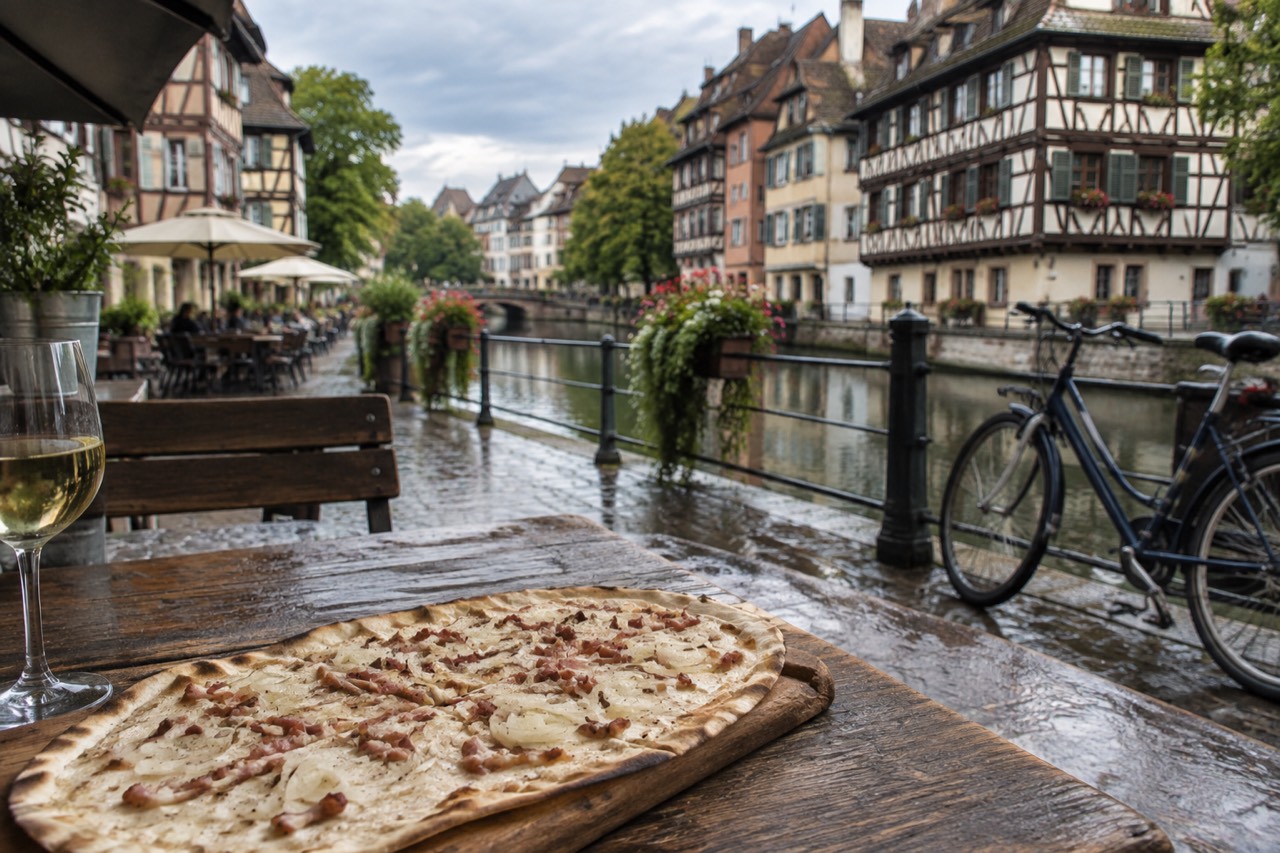
Tarte flambée is a paper-thin bread tart from Alsace, baked seconds in a wood-fired oven and topped with crème fraîche, fromage blanc, sliced onions and lardons. In Strasbourg you eat it in winstubs and modern bistros across the Grande Île and Krutenau, order it by the whole tart, and share it straight off the board.
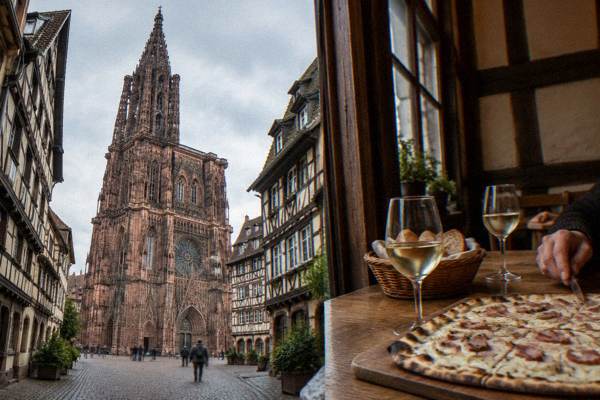
Tarte flambée is the one dish that follows you through Strasbourg, in Alsace, in north-eastern France, from your first evening to your last. It arrives on a wooden board, still blistered from the oven, cream bubbling at the edges, onions softened into the heat and lardons scattered like confetti. Which crust is right, whether the cream should be sweetened, and whether a modern topping counts as creativity or as a crime. This guide walks through the dish itself, the neighbourhoods that serve it best, the words to use when you order it, and the wine to pour beside it, with a few day-trip ideas for eating your way deeper into the Alsace countryside.
What Is Tarte Flambee?
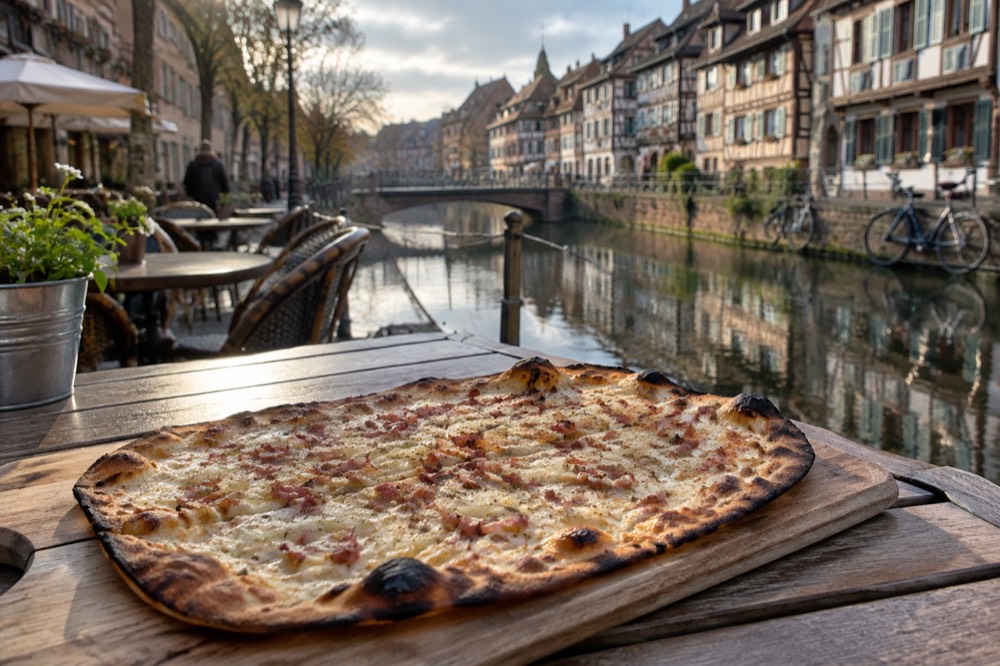
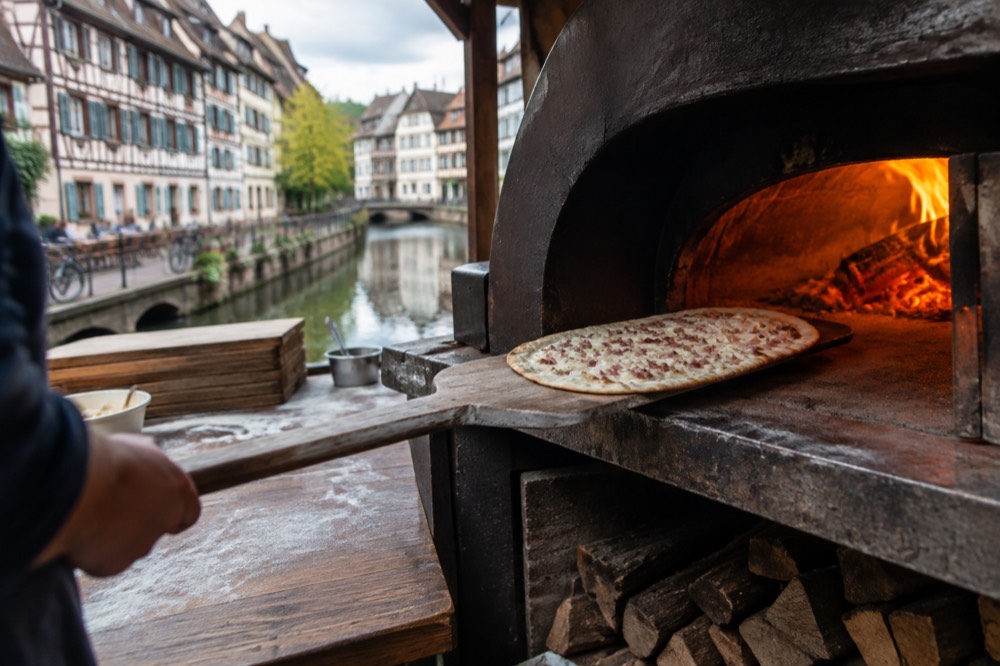
Tarte flambée is a wafer-thin tart of bread dough, rolled until you can almost see through it, spread with a mixture of crème fraîche and fromage blanc, scattered with sliced onions and lardons, and baked for a very short time at very high heat in a wood-fired oven. It is farmhouse cooking from rural Alsace, and in Strasbourg it has moved from the baker's oven to the restaurant table without changing its character. The name is often translated as "flame tart", and the translation is honest: the traditional oven runs hot enough that the tart bakes very quickly. The crust comes out crisp, lightly charred at the rim, and foldable, which matters because the classic way to eat a slice is to roll it up and eat it with your hands.
The story told across Alsace is that the tart began as the baker's test. Before committing a week's bread to the oven, the baker would slap a scrap of dough in to judge the temperature, and the household would dress that scrap with whatever cream and pork fat sat in the larder. Whether every detail of that story holds, the dish is unquestionably rural and unquestionably Alsatian: it belongs to the farm kitchens of the plain between Strasbourg and the Vosges foothills, where dairy, onions and smoked pork were everyday stores. It reached Strasbourg's tables as the region's restaurant culture grew, and it now sits beside choucroute and baeckeoffe as one of the three dishes people travel here to eat.
What separates a good tarte flambée from a forgettable one is the oven and the restraint. A proper one is baked in wood, which gives the crust a smoke note no electric oven reproduces, and it is dressed sparingly: too much cream and the centre goes soggy before the rim chars. The base is a matter of permanent debate. Purists hold that the cream should be a mix of crème fraîche and fromage blanc, lightly salted and peppered, with nothing sweet in it. Others in the region prefer a faintly sweetened base, and this is the fault line along which Alsatian families have argued for generations.
| Form | Name You Will See | Base | Typical Toppings | Where It Belongs |
|---|---|---|---|---|
| Classic Alsatian | Tarte flambée / Flammekueche | Crème fraîche and fromage blanc, unsweetened | Onions, lardons | Winstubs, farm auberges |
| Sweetened-base style | Tarte flambée à l'ancienne (in some houses) | Same mix, lightly sweetened | Onions, lardons | Family tables, traditional houses |
| Modern restaurant style | Tarte flambée "du chef" | Classic base | Gruyère, mushrooms, salmon, munster | Modern bistros in the city centre |
| Dessert version | Tarte flambée sucrée | Sweetened cream | Apples, cinnamon, mirabelle | Winstubs and brasseries |
None of those four rows is wrong. The classic is the reference point, the sweetened base is a genuine regional preference rather than a tourist concession, and the modern versions are what keeps the dish alive in a competitive restaurant city. The dessert tart, with apples or mirabelles, is the version visitors overlook and then reorder.
Where To Eat Tarte Flambee In Strasbourg?
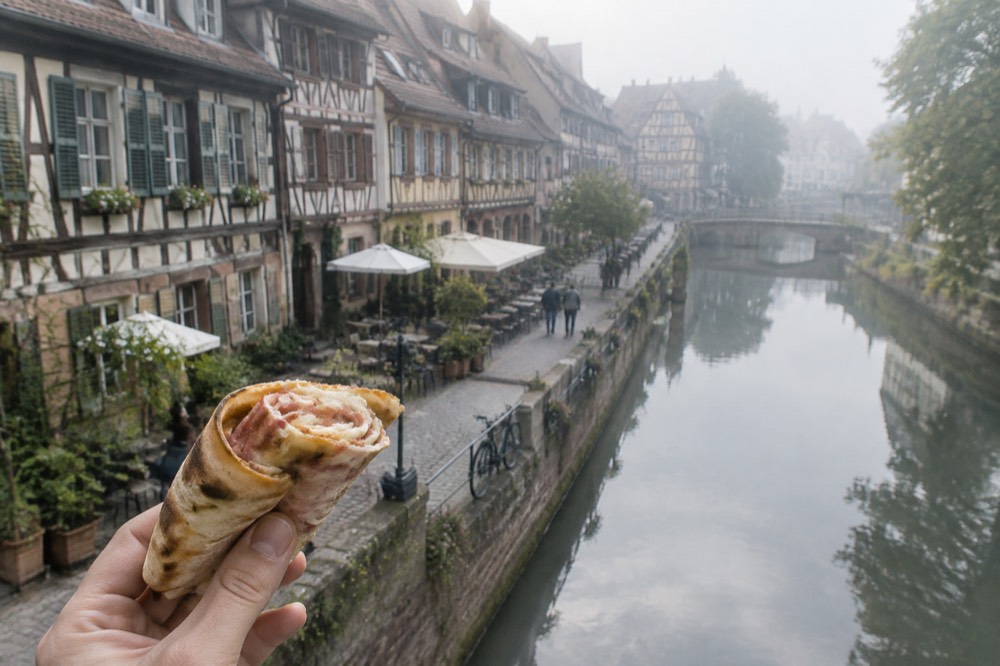
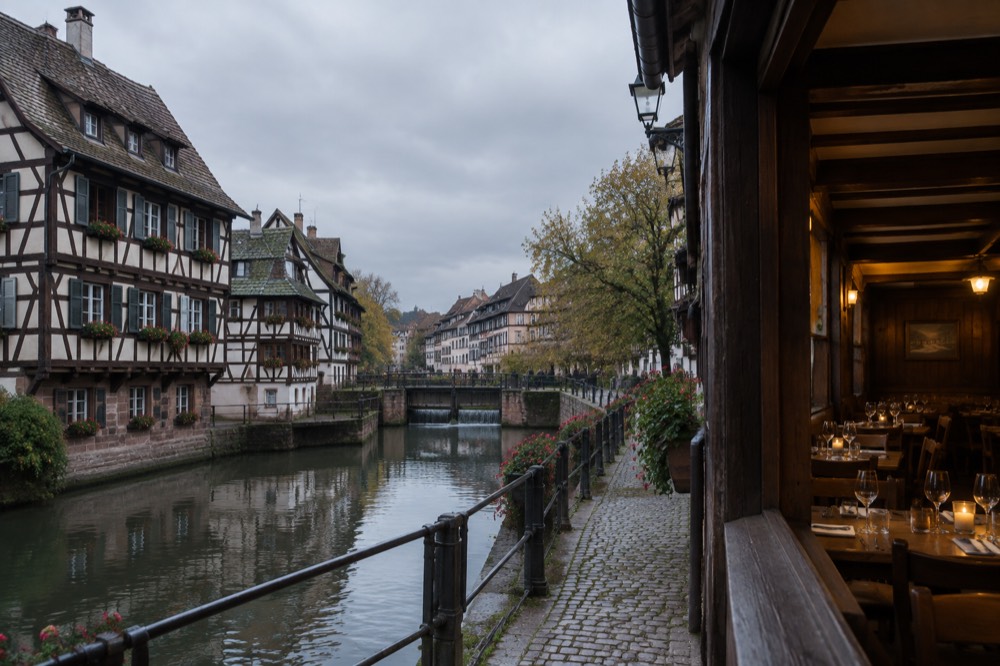
The short answer is the winstubs of the Grande Île, the World Heritage island at the city's centre, and the younger tables of the Krutenau quarter just south of it. Winstubs, the Alsatian wine rooms that double as restaurants, serve the traditional tart in a wood-panelled setting; Krutenau's bistros and craft-beer tables serve looser interpretations at gentler prices. Both quarters are walkable from Strasbourg Cathedral, and both are at their best in the evening. The choice between them is a choice of mood rather than quality. A winstub is small, warm, often booked by regulars, and the tart arrives the way it has for decades. A Krutenau bistro is louder, cheaper, more likely to experiment, and more likely to have a table without a reservation on a weekday.
The winstub is the institution to understand first. The word means, roughly, wine room, and the format predates tourism: a small room, a handful of tables, Alsatian wine by the carafe, and a menu that changes with what the market and the cook's family agree on. In a good winstub the tarte flambée is baked in a wood oven you can sometimes see from your table, and the menu describes the tart in two lines rather than a paragraph. Reservations matter here, especially from late November through December, when the Christmas market fills the island with visitors. This Strasbourg Travel Guide recommends booking any winstub dinner in that season a week or more ahead.
Krutenau, the old boatmen's and fishermen's quarter wrapped around the southern loop of the River Ill, is where the city's students and cooks eat. The streets between the university and the river hold bistros that treat the tart as a canvas: one week the special carries munster and potatoes, the next it carries whatever the cheese merchant brought. Prices sit below the island's average, portions run large, and the walk from the cathedral takes you past some of the half-timbered scenery the city is famous for. If your visit is short and you want one classic and one modern tart in the same evening, this pairing of Grande Île and Krutenau is the way to do it.
Between those two quarters, a food-focused walking tour is the efficient way to eat with context: a local guide routes you through the winstubs and the market streets while explaining what you are tasting, which suits a first visit better than a blind restaurant pick. If you are planning where to sleep, the where to stay in Strasbourg guide maps the neighbourhoods against these same tables, and the budget angle, including where the cheap tart actually lives, is covered in Strasbourg on a budget.
| Type Of Table | Atmosphere | The Tart You Get | When To Go | What To Check |
|---|---|---|---|---|
| Traditional winstub, Grande Île | Wood-panelled, small, quiet | Classic recipe, wood oven | Evening, any season | Reservation; whether the oven is wood-fired |
| Krutenau bistro | Young, busy, creative | Classic plus daily variations | Lunch or evening | The day's special, chalked or spoken |
| Brasserie near Place Kléber | Larger, faster turnover | Reliable classic, bigger menu | Lunch on a tight schedule | Whether tarte flambée is listed all day |
| Christmas market chalet | Outdoor, festive | Small tart, eaten standing | Late November to 24 December | The market dates on the city's Christmas site |
| Farm auberge outside the city | Rural, family-run | The reference version | A day trip into Alsace | Opening days; whether booking is required |
How Do You Order Tarte Flambee Like A Local?
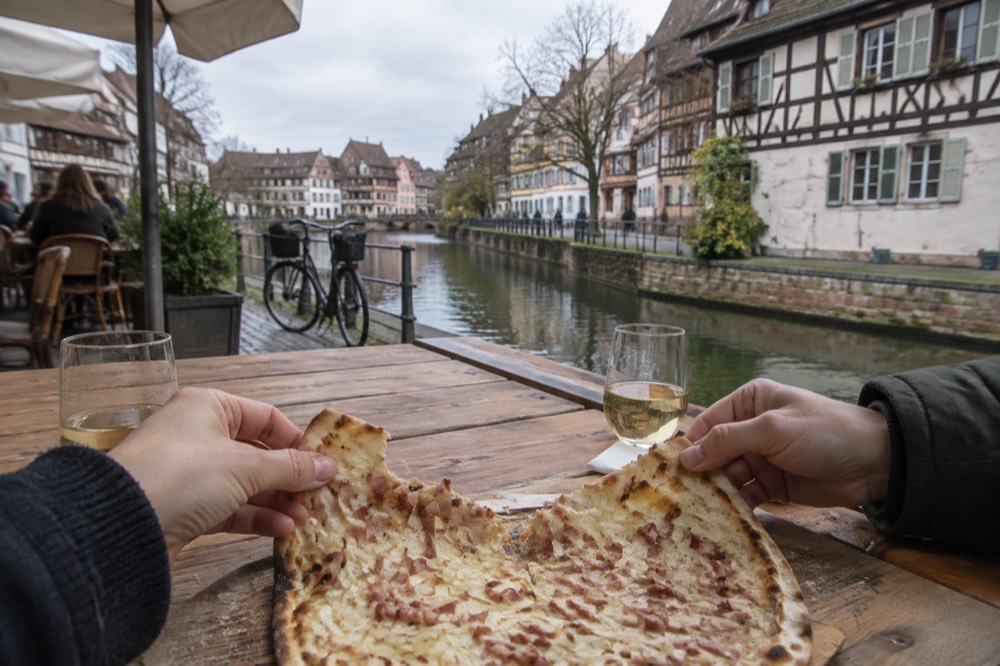
You order one whole tart per table and let it arrive in waves, you ask for it bien cuite if you want a properly charred rim, and you eat it with your hands, rolling each slice before it goes cold. Locals order a second tart only after the first is finished, because a tarte flambée waits for nobody: it is at its best for the few minutes between the oven and the board. The rhythm of the meal matters as much as the food. A table of four orders one or two tarts to start, cuts or tears them apart as they land, and orders the next round when the board is bare. Ordering everything at once marks you as a visitor, and it also ruins the dish, because tart number two arrives cold while you finish tart number one.
The vocabulary is small and worth learning. The tart itself you can call tarte flambée or flammekueche; both are understood everywhere in the city, and the second is the Alsatian word, which earns a nod in a winstub. Bien cuite asks for a darker bake, and there is no shame in it: the charred edge is the part Alsatians fight over. À point means cooked to the point, the standard. If you want the tart without lardons, say sans lardons, and expect the question "végétarienne?" back at you, because that is the standard vegetarian request. For a sweet finish, ask whether there is a tarte flambée sucrée, the dessert version with apples or mirabelle plums, which many houses keep off the printed menu.
Wine is ordered by the carafe in a winstub, and the house white is usually an Alsatian blend built for exactly this food. Tap water is safe and normal in Strasbourg; ask for une carafe d'eau and it comes free, which is worth knowing on a long evening of salted cream and smoked pork. If you are eating with children, the tart is one of the friendliest dishes in the city: the base version, with the onions picked off by fussy eaters, is effectively bread, cream and cheese.
| Phrase | What It Means | When To Use It |
|---|---|---|
| Une flammekueche, s'il vous plaît | One flame tart, please | Ordering anywhere in the city |
| Bien cuite | Well baked, charred rim | If you like a dark, crisp edge |
| À point | Cooked to the point, standard bake | The default; say nothing and this arrives |
| Sans lardons | Without lardons | The vegetarian request |
| Une tarte flambée sucrée | The sweet dessert version | After the savoury tarts |
| Une carafe d'eau | A jug of tap water | Any table, free of charge |
| Encore une, s'il vous plaît | One more, please | When the board is bare and the table is not |
What Goes On A Traditional Tarte Flambee?
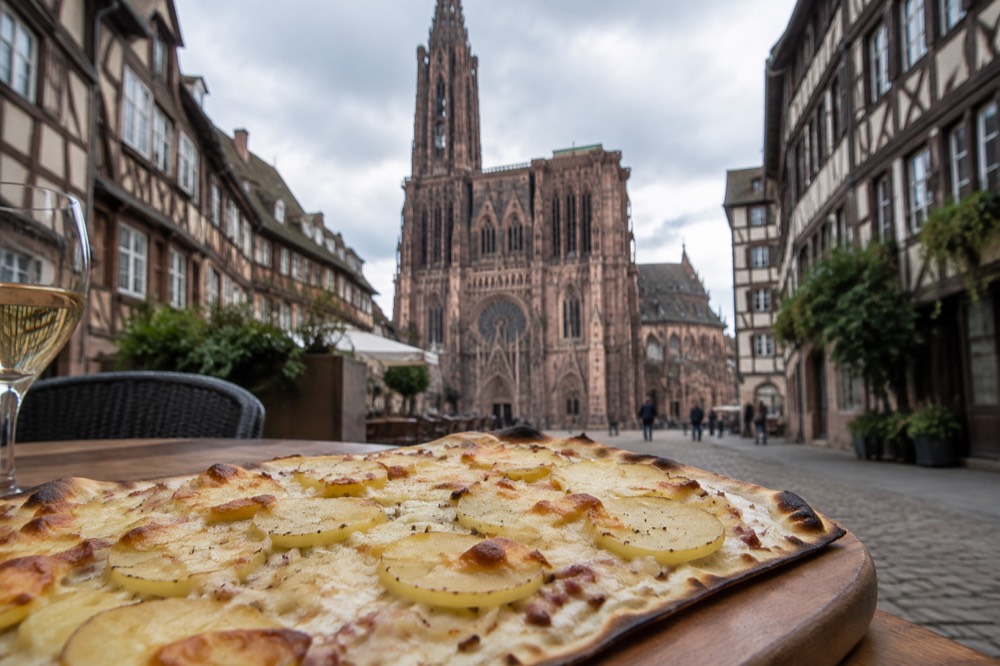
The traditional topping list is short: a base of crème fraîche mixed with fromage blanc, seasoned with salt and pepper; thinly sliced raw onions; and small strips of smoked pork belly, the lardons. That is the whole classic recipe, and its quality rests on the cream mixture and the oven rather than on the number of ingredients. Modern Strasbourg kitchens add gruyère, munster, mushrooms, salmon or potatoes, and those versions are now part of the city's regular menu rather than a novelty. The restraint of the classic is the point. With only cream, onion and pork on a thin crust, every element is exposed: sweet cream against sharp onion against smoke, all of it riding on a crust that has to be crisp at the rim and tender at the centre within about a minute of baking. When a winstub gets the base right, the modern toppings are an optional game; when it gets the base wrong, no amount of cheese rescues it.
The onions are cut fine and raw when they go on, which surprises first-time visitors: they cook in the oven's heat in the seconds the tart is inside, turning sweet and soft without losing their bite. The lardons used in Alsace are smoked, which is the second surprise for visitors who expect plain bacon; the smoke is what the cream is built to carry. The dough itself is a simple bread dough, but rolled to a thinness closer to a crêpe than a pizza, because the whole architecture depends on it baking through before the cream boils away.
The modern variations are worth ordering on a second or third evening. Gruyère melted over the classic trio turns the tart into something closer to a gratinéed flatbread, and it is the most common upgrade on Strasbourg menus. Munster, the pungent Alsatian washed-rind cheese, appears in the versions that lean hardest into the region's larder and pairs naturally with a carafe of the local white. Salmon and crème fraîche is the bistro standard, and the potato version, with thin slices cooked directly on the tart, is the one that turns the dish from a starter into a full meal.
| Topping Style | What Is On It | Character | Who It Suits |
|---|---|---|---|
| Classic (à l'ancienne) | Cream base, onions, lardons | The reference: smoke, sweet onion, sharp cream | First-time visitors, purists |
| Gratinée | Classic plus gruyère | Richer, browned, crowd-pleasing | Families, cheese lovers |
| Munster | Munster, onions, sometimes potatoes | Strong, farmy, deeply Alsatian | Adventurous eaters, wine drinkers |
| Forestière | Mushrooms, cream, onions | Earthy, meat-free | Vegetarians who eat dairy |
| Saumon | Smoked salmon, cream, onions | Light, modern, bistro standard | Seafood eaters |
| Sucrée | Apples or mirabelles, sweetened cream | Dessert, warm and caramel-edged | Everyone, after the savoury tarts |
The toppings on every one of those rows trace back to the farm kitchens of the Alsace wine route, the string of villages where dairy, orchards and smokehouses sit within walking distance of the vines. A guided food walk in Strasbourg introduces the city version of the dish; a day trip into those villages shows you the landscape it came from. The traditional food walking tour with tastings does the first job well, moving through the Grande Île with a local guide and stopping at the tables that matter.
If the idea of eating the dish at its source appeals, the medieval villages and wine tasting day trip from Strasbourg is the natural pairing: it routes you through the wine-route villages with tasting stops, so the tart you eat in the evening arrives with the context of the morning. Check availability on the operator's live listing if that shape of day suits your itinerary.
Tarte Flambee Or Flammekueche: Which Name Should You Use?
Both names describe the same dish and both are correct in Strasbourg. Tarte flambée is the French name, the one printed on menus across the city; flammekueche is the Alsatian name, from the region's own Germanic dialect, and it is the word you will hear in winstubs and in the villages. Using flammekueche in Strasbourg signals nothing except that you know where the dish comes from, and no menu will blink at either. The two names are not two dishes, and this is worth stating plainly because visitors sometimes assume the Alsatian word means a different, more authentic preparation. What varies is the house, not the name: one winstub's flammekueche is sweeter than another's tarte flambée two streets away, and the only way to know is to ask how the base is made.
The naming question carries a little of Alsace's own story, because the region has changed hands between France and Germany across the centuries and its kitchen vocabulary shows it. The dish itself is Alsatian in the way that matters: it was built from Alsatian farms, Alsatian cream, Alsatian smokehouses, and it is eaten with the same rolling-of-the-slice ritual on both banks of the historical border. Cross the Rhine into Germany and you will meet flammkuchen, the same word in standard German, on menus in Kehl and deeper into Baden. The tart does not respect the border, even if the spelling does. Other pages covering the same trip are gathered on Strasbourg Travel Guide.
In practice, order in whichever word comes more easily and let the menu teach you the house style. The useful question in a winstub is not which name to use but how the cream is made: ask whether the base is sweetened, and the answer tells you which school of tarte flambée you have sat down in. Alsatian households are divided on this, and the division is affectionate rather than serious, which makes it a good conversation rather than a test.
For visitors who want the story served alongside the food, a guided gourmet walk through the city centre pairs the dish with its context: the food tour with tastings routes through the Grande Île's tables with a guide who explains exactly these regional distinctions as you eat.
Which Alsace Wine Pairs Best With Tarte Flambee?
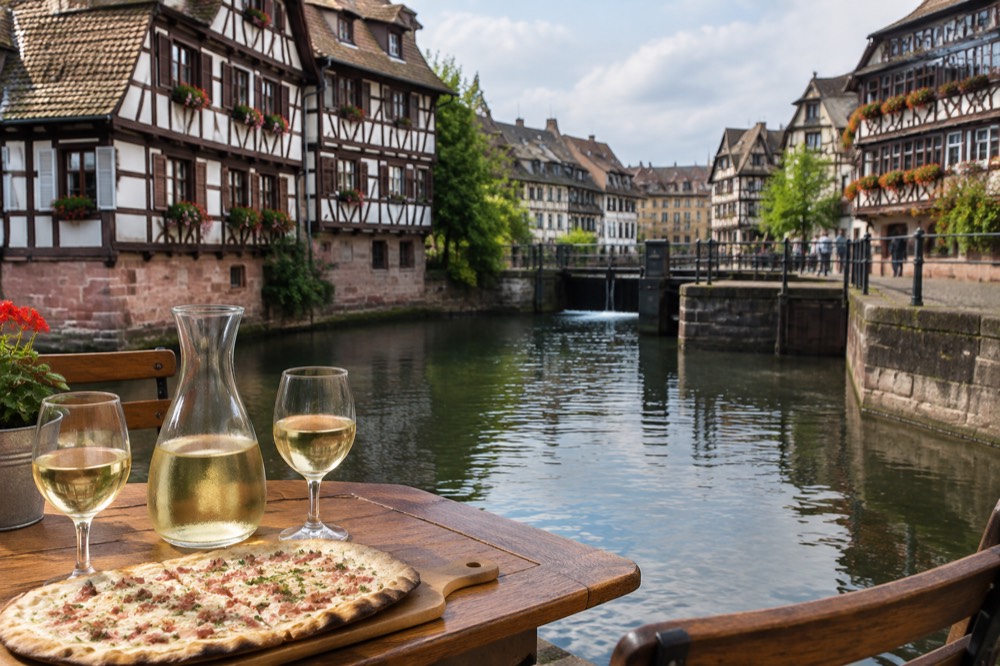
The classic pour is a dry, light Alsatian white: riesling, sylvaner or pinot blanc, ordered by the carafe in a winstub. These are wines with enough acidity to cut the cream and enough weight to stand up to the smoked lardons, which is precisely the balance the dish demands. Crémant d'Alsace, the region's sparkling wine, is the celebratory alternative, and a light Alsatian beer is the everyday counterpoint in the brasseries. The logic of the pairing is fat against acid. A tart built on crème fraîche and smoked pork coats the palate, and a flabby wine disappears under it. Riesling's stony acidity resets the mouth between slices; sylvaner, quieter and slightly herbal, is the traditional village pour for exactly this food; pinot blanc sits roundly between the two and is the safest order for a table of mixed tastes.
Curious how the Alsatian whites pair with the tart? Book an Alsace wine tasting here.
Edelzwicker, the blended white that older winstubs pour by the carafe, deserves a word in its own defence. It is a blend of the region's varieties, it is inexpensive by local standards, and it was built for winstub tables rather than tasting rooms. Ordered beside a tarte flambée at a long table, it does the job as well as anything with a fancier label, which is the point of the format. For a dessert tart with apples or mirabelles, a glass of the region's late-harvest style or simply more of the dry white works; the sweetened cream wants either sweetness of its own or a clean, dry contrast.
| Pour | Character | Why It Works With The Tart | Order It When |
|---|---|---|---|
| Riesling (dry) | Stony, precise, high acid | Cuts the cream, resets the palate | The classic tart with lardons |
| Sylvaner | Light, herbal, quiet | The traditional village match | A long winstub evening |
| Pinot blanc | Round, soft, easy | Pleases every palate at the table | Mixed groups, first visits |
| Edelzwicker | Blend, simple, fresh | Built for carafes and winstub food | Budget evenings, large tables |
| Crémant d'Alsace | Sparkling, dry, biscuity | Scrubs salt and smoke clean | Celebrations, dessert tarts |
| Alsatian lager | Crisp, malty | The brasserie counterpoint | Lunch, market chalets |
Wine education arrives fastest through the glass rather than the guidebook, and the city's tasting walks are built on that principle. The Do Eat Better food tour is the strongest of these for the tart specifically, moving through Strasbourg's traditional tables with tastings at each stop, and it is worth booking ahead in the busy weeks around the Christmas market.
Is Winter The Best Season For Tarte Flambee In Strasbourg?
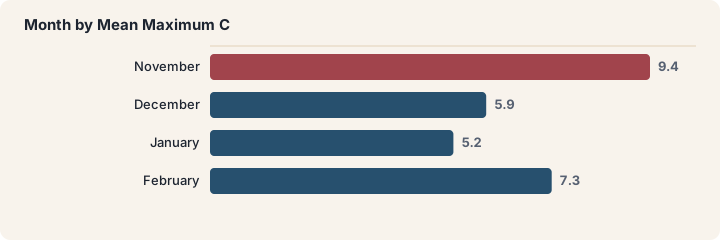
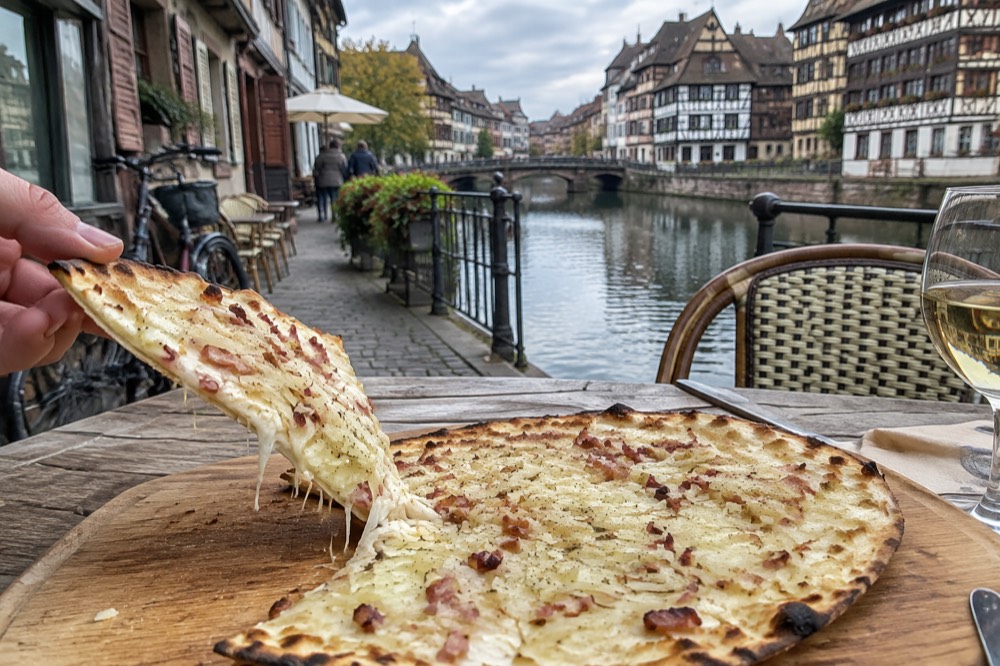
Yes, and for two reasons: the dish is cold-weather farmhouse food by origin, and Strasbourg's winter season, from the Christmas market in late November through the deep quiet of January and February, is when the city's tables feel most like the inside of the oven itself. The trade-off is crowds and weather: December fills the winstubs with visitors, while January and February give you the same food in a calmer, colder city. The climate is semi-continental, which means winters are genuinely cold rather than merely grey. The Meteo-France 1991-2020 normals for Strasbourg-Entzheim put the mean December maximum at 5.9 C and the mean minimum at 0.8 C, with 10.2 days of rain of 1 mm or more across the month. January is colder still, with a mean maximum of 5.2 C and a mean minimum of -0.2 C. None of that is an argument against going; it is an argument for booking the winstub table in advance and walking to it through the cold on purpose.
| Month | Mean Maximum C | Mean Minimum C | Rain Days (1 mm Or More) | What It Means For Eating |
|---|---|---|---|---|
| November | 9.4 | 3.3 | 9.2 | Cool evenings, market season begins |
| December | 5.9 | 0.8 | 10.2 | Cold, festive, winstubs at their cosiest |
| January | 5.2 | -0.2 | 9.1 | Cold and calm, easy tables |
| February | 7.3 | 0.0 | 8.3 | Cold easing, local pace |
The Christmas season is the headline act. The 2025 edition of Strasbourg's Christmas market ran from 26 November to 24 December and drew 3.05 million visitors, and the chalets that fill the historic squares in that period sell their own small tarte flambées, eaten standing in the cold, which is arguably the dish in its purest winter form. The 2026 dates and programme are still being finalised on the city's official Christmas site, so confirm them there before you plan travel around the market. The food side of that season, from the chalet griddles to the winstub specials, is covered in depth in the Strasbourg Christmas market food guide, and the wider seasonal picture, including what December does to hotel prices, sits in Strasbourg in winter.
If a winter trip is on the cards, the timing question has its own guide in best time to visit Strasbourg, and the full market itinerary, including where the chalets cluster, is laid out in the Strasbourg Christmas market guide. The one planning note that belongs on this page is the winstub reservation: in the market weeks, the small rooms fill early, and a table booked from home is the difference between a tart at eight and a tart at ten.
Can You Build A Whole Day Around Tarte Flambee?
Yes, and the best version leaves the city for the morning. The tart's home territory is the Alsace wine route, the villages south and west of Strasbourg where farm auberges bake it in the same wood ovens their grandparents used, and a day that pairs a village lunch with a winstub dinner back in Strasbourg is the fullest way to eat the dish. Guided day trips make this work without a car, which matters because the winstub pour is not compatible with driving. The shape of the day is simple. Take a morning tour or a regional train into the wine country, eat the farm version at midday, where the tart often arrives as the first course of a set meal, and return to Strasbourg for the evening service in a Grande Île winstub. The contrast is the lesson: the village tart is thicker, sweeter in the base, and baked with the confidence of a kitchen that has made nothing else for generations, while the city tart is thinner, sharper and faster.
The medieval villages and wine tasting day trip is the tour built for exactly this itinerary, moving from Strasbourg through the wine-route villages with tasting stops along the way, and it is the featured trip on this page because it turns a food interest into a full day without any logistics on your part. Check availability on the operator's live listing once your dates are fixed, because the small-group days fill first in the market season.
For a shorter visit, or for a second day in the city, the walking tours listed above cover the food geography of the Grande Île on foot, and the free things to do guide rounds out the hours between meals with the cathedral, the river and the squares that cost nothing to enjoy. Whether your tart comes from a market chalet, a Krutenau bistro or a farm auberge an hour into the vines, order it whole, eat it fast, and roll the last slice the way the region does.
Common Questions About Tarte Flambee In Strasbourg
What is tarte flambée?
Tarte flambée is a thin Alsatian tart of bread dough topped with crème fraîche mixed with fromage blanc, sliced onions and smoked lardons, baked very briefly at high heat, traditionally in a wood-fired oven. In Strasbourg it is served whole on a wooden board and eaten in shared slices, often rolled up by hand.
Is tarte flambée the same as flammekueche?
Yes. Tarte flambée is the French name and flammekueche is the Alsatian name for the same dish; flammkuchen is the same word in standard German, seen on menus across the border in Baden. The recipe varies by house, not by name, so ask how the cream base is made if the style matters to you.
What is the difference between tarte flambée and pizza?
The dough is rolled much thinner, there is no tomato or cooked sauce, and the baking time is a fraction of a pizza's because the oven runs far hotter. The base is cold cream rather than cooked sauce, and the classic topping is just onions and smoked lardons, which gives the dish a lighter, sharper character than a pizza.
Where should I eat tarte flambée in Strasbourg?
Start with a winstub on the Grande Île for the traditional version in a wood-panelled room, then try a bistro in the Krutenau quarter for modern toppings at lower prices. Book winstub tables ahead in the Christmas market season, when the small rooms fill early, and ask whether the oven is wood-fired if the classic character matters to you.
What wine goes with tarte flambée?
A dry Alsatian white: riesling for precision, sylvaner for the traditional village match, or pinot blanc for an easy crowd-pleaser. Edelzwicker by the carafe is the classic winstub pour for a long table, and crémant d'Alsace is the festive option. A crisp Alsatian lager works equally well at lunch.
Is there a sweet tarte flambée?
Yes. The dessert version, sometimes called tarte flambée sucrée, uses a lightly sweetened cream base with apples, cinnamon or mirabelle plums, baked in the same hot oven. Many winstubs keep it off the printed menu, so ask for it after the savoury tarts rather than expecting to see it listed.
A tart eaten standing at a market chalet and a tart eaten slowly in a candlelit winstub are the same dish at two speeds, and Strasbourg is one of the few cities where you can have both on the same evening, then take the morning train into the villages where it began.