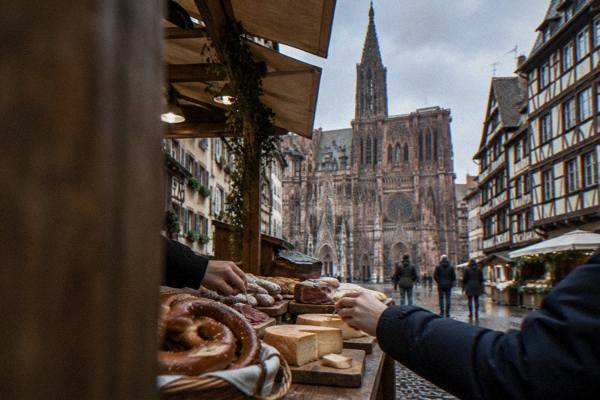
Strasbourg Market
Strasbourg, the prefecture of the Bas-Rhin in Alsace, north-eastern France, turns its historic centre into a market city each winter. This guide covers what the markets are, when they run, what a visit costs and how to pair them with the wine country beyond the city.
Short answer
The Strasbourg Christmas market, the city's headline market event, ran from 26 November to 24 December in 2025 and drew 3.05 million visitors. The 2026 dates are not yet published, but the pattern is late November to 24 December. Cathedral platform entry is 10 EUR, a single tram ticket 1.90 EUR, and municipal museums are 9 EUR.
Strasbourg, the prefecture of the Bas-Rhin in Alsace, in the Grand Est region of north-eastern France, is a market city by long habit. Its historic core, the Grande Île, sits on the River Ill a short way from the Rhine, which forms the border with Germany here, and for a few weeks each winter the whole island becomes a single sprawling market. The rest of the year the city keeps a quieter market life of its squares, food shops and covered halls, and the vineyards of the Alsace wine route begin just beyond the edge of town. This guide explains what the Strasbourg market scene involves, when the Christmas edition runs, what it costs to visit, what to eat, and how to combine it with the wine country that surrounds the city.
What Is The Strasbourg Market Scene?
The Strasbourg market that draws the world is the Christmas market, a seasonal collection of chalets spread across the historic squares of the Grande Île, anchored around the cathedral and Place Kléber, running from late November to 24 December each year. Beyond it, the city's market culture lives in its winstubs, its bakeries and the wine route that starts in the hills west of the city. The Christmas edition is the one with published figures: the 2025 run attracted 3.05 million visitors according to the city's own press release, down from 3.4 million in 2024. Those numbers make it one of the largest Christmas markets anywhere, and they explain why hotel rooms in December need booking well ahead.
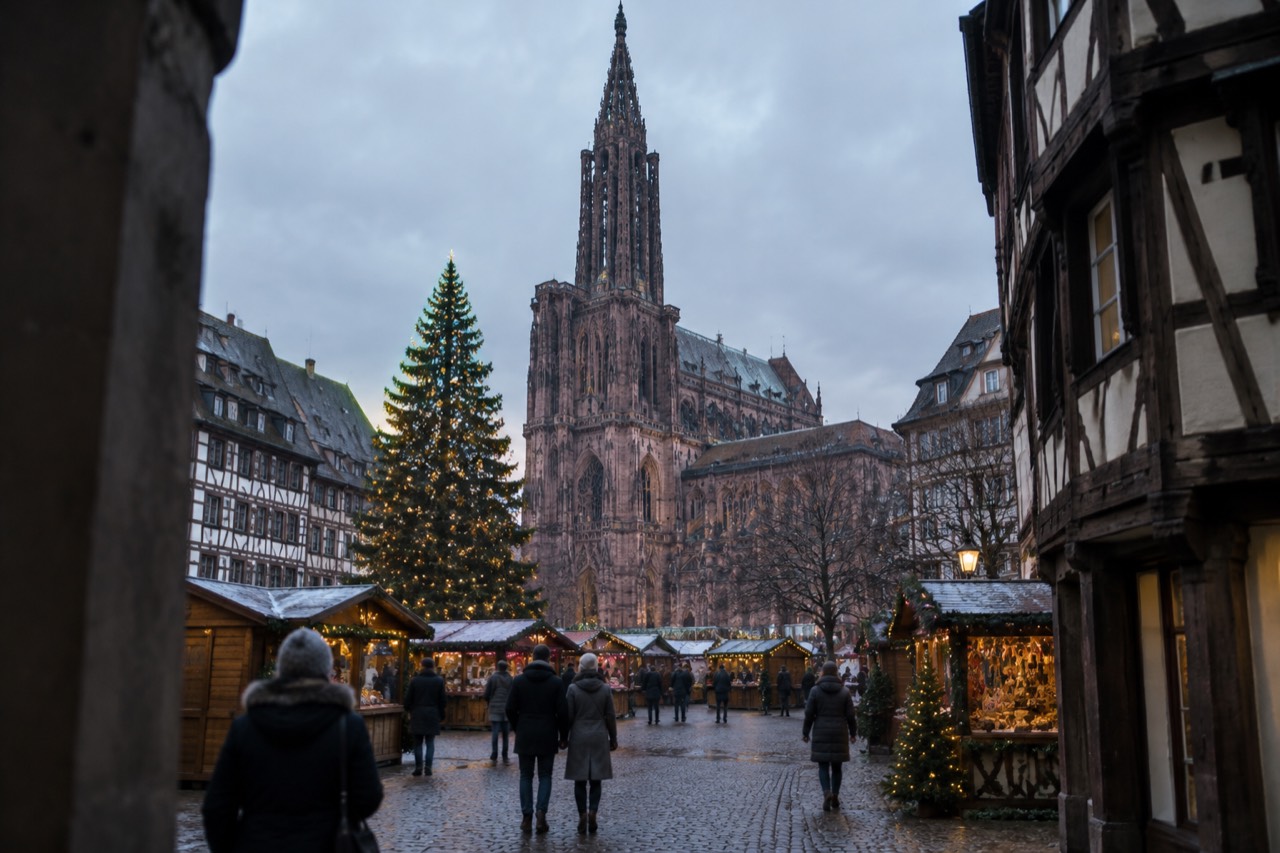
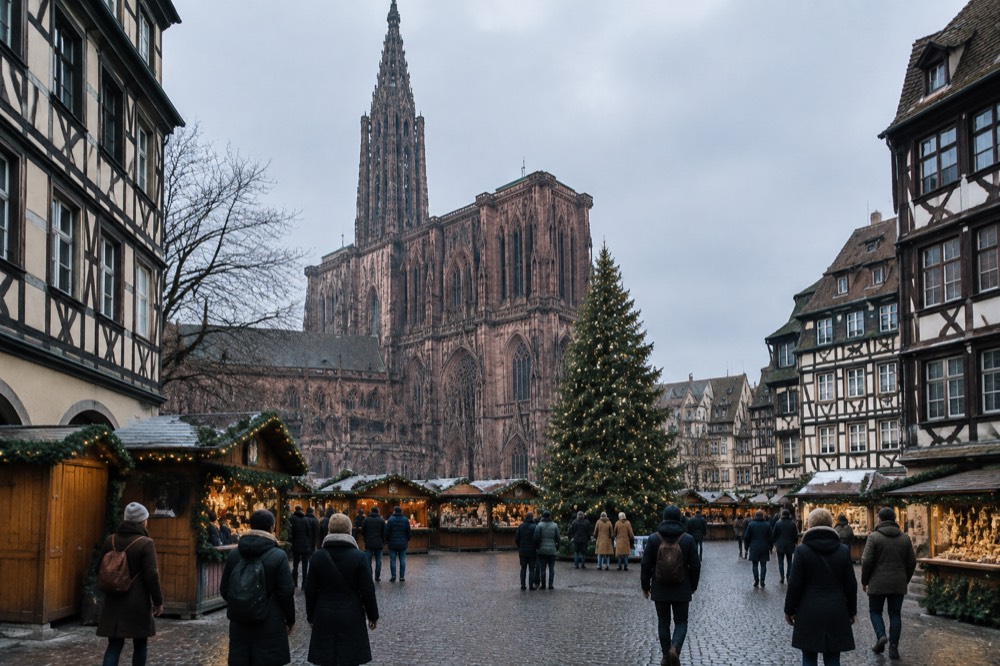
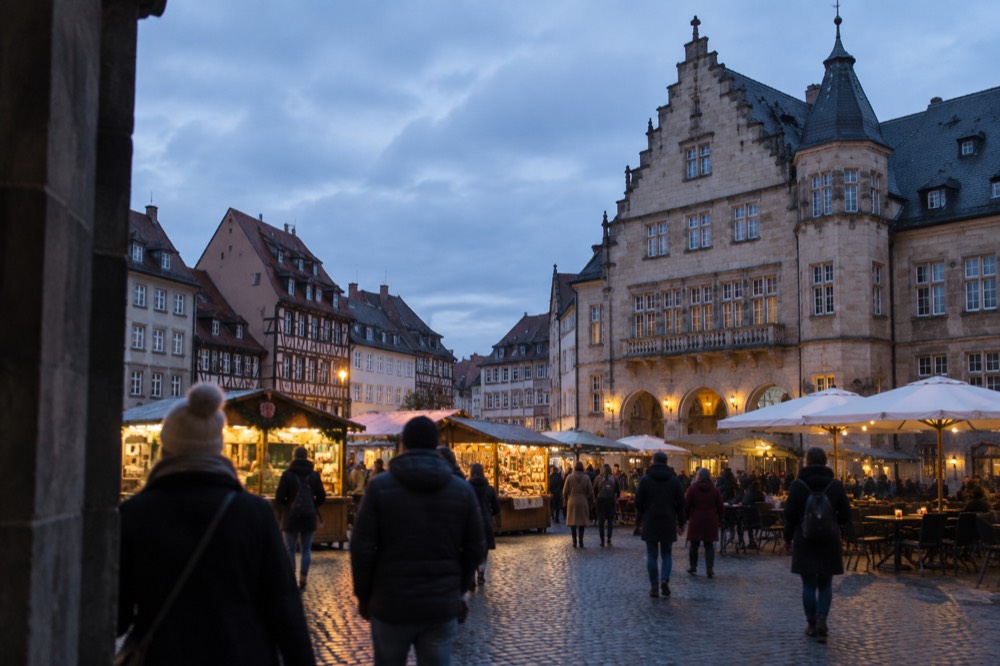
The city's Christmas site groups the chalets across several squares in the historic centre rather than on one single field. The cathedral square, Place Kléber and the streets between them carry the weight of it, with half-timbered facades, a decorated tree and the cathedral's single spire rising over the stalls. What is certain is that the market fills the old centre and that you experience it on foot, square by square.
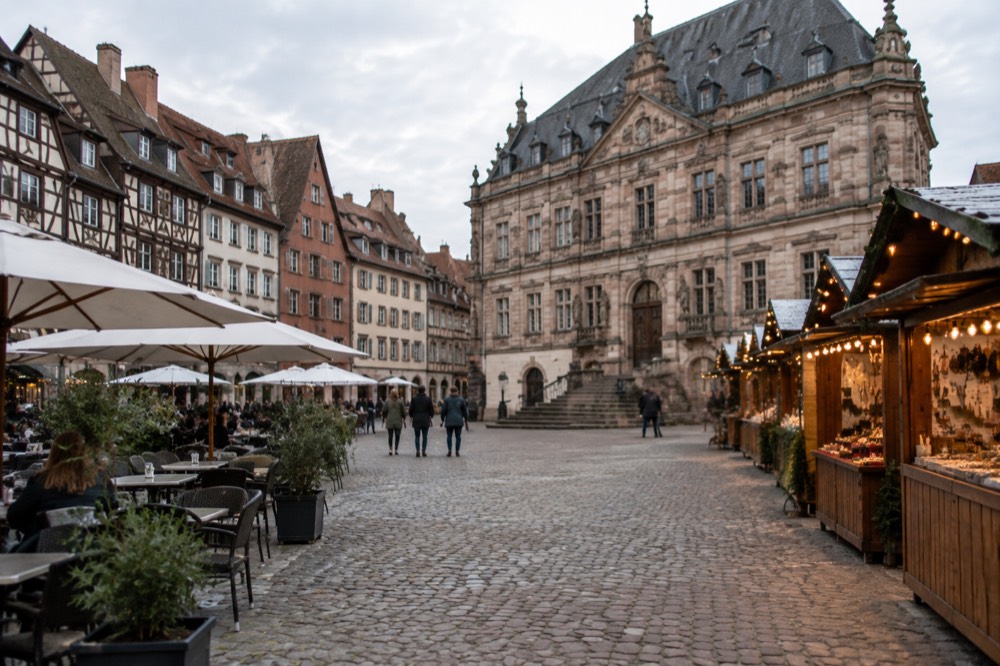
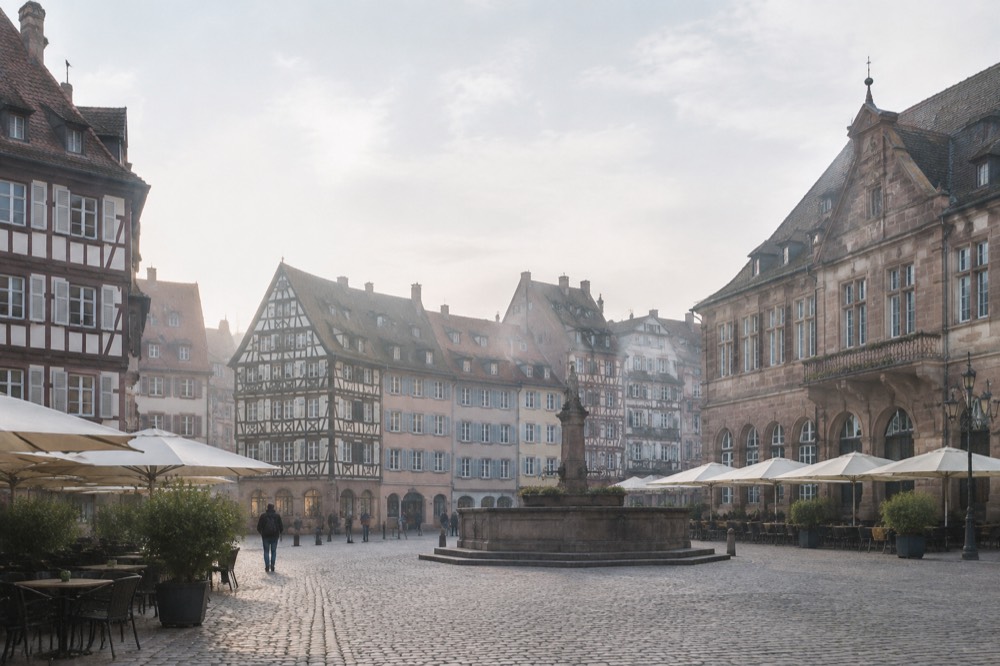
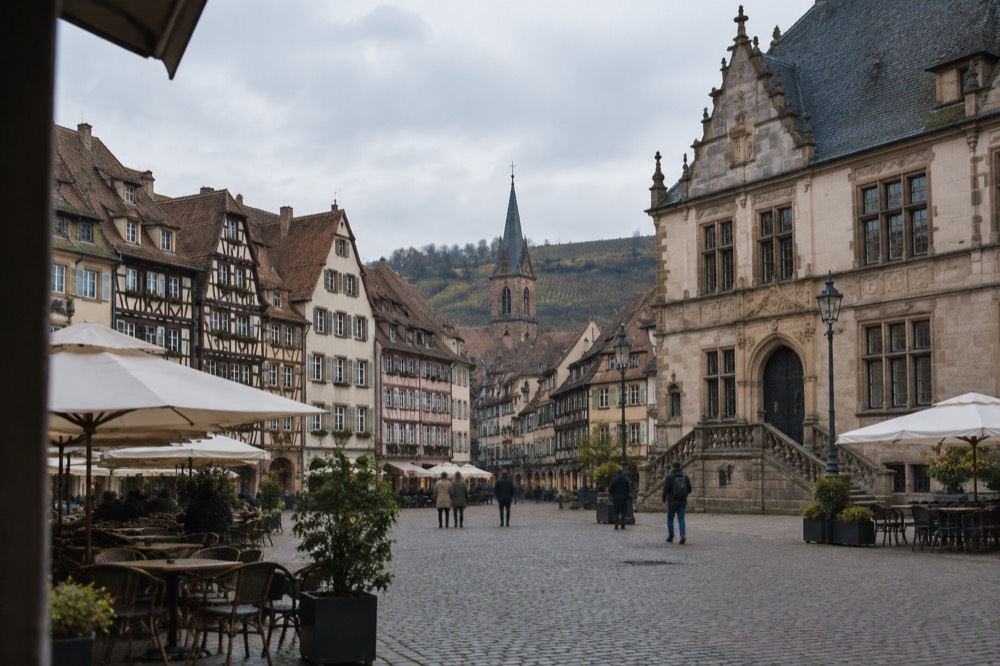
This is not a market on a village green: the chalets sit among medieval and Renaissance buildings on a UNESCO-listed island, with trams running to its edges and a working cathedral at the middle of it. The Grande Île and the later Neustadt extension together form the World Heritage property "Strasbourg, Grande-Île and Neustadt", which is part of why the market photographs so well and why the evenings feel theatrical.
If you are planning a full trip around the market, the companion guide to Strasbourg's Christmas market covers the event itself in more depth, and the page on where to stay in Strasbourg sorts the neighbourhoods by walking distance to the stalls.
When Does The Strasbourg Market Run?
The Strasbourg Christmas market runs from the last week of November through 24 December, following a stable annual pattern. On the final day, the market closes early in the evening, so plan your visit before the afternoon ends if you want to experience it on Christmas Eve itself. The 2025 edition ran from 26 November to 24 December 2025, and the city's press release put its attendance at 3.05 million visitors, down from 3.4 million the year before. The city's Christmas site states that the official dates and programme are still being finalised, so confirm them there before booking travel. Chalets typically open from late morning into the evening each day of the run.
The timing matters more than you might expect. Early December weekdays are calmer; the second and third weekends of December bring the crowds that push the attendance into the millions, and the evenings around the tree are the busiest hours of all. The market's final day, 24 December, closes early, so treat that as a morning visit or skip it. Anyone weighing Strasbourg against its rival down the road can read which Christmas market is better, Strasbourg or Colmar, and anyone fixed on the dates question should start with the dates of the Strasbourg Christmas market.
| What | Detail |
|---|---|
| Usual pattern | Late November to 24 December, closing early on the final day |
| 2025 edition | 26 November to 24 December 2025 |
| 2025 attendance | 3.05 million visitors (city press release) |
| 2024 attendance | 3.4 million visitors |
| 2026 dates | Not yet published, confirm on the city's Christmas site |
| Chalet hours | Typically late morning to evening, daily |
A winter visit rewards planning beyond the market itself. The guide to Strasbourg in winter covers the city's colder months in full, and the question is December a good time to visit Strasbourg is answered honestly for anyone unsure whether the crowds are worth it.
For visitors who want the market plus the countryside in one trip, a guided day trip into the Alsace villages is the cleanest pairing, and three options below cover the range.
What Does A Market Visit Cost?
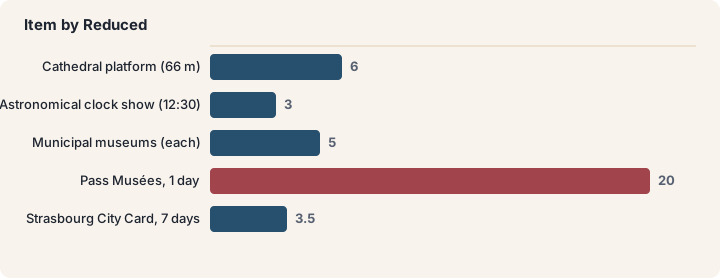
The market squares themselves cost nothing to stroll, so a visit can be entirely free if you simply wander and browse. If you add the surrounding sights, the cathedral platform is 10 EUR, the astronomical clock show 4 EUR, each municipal museum 9 EUR full price, and a tram ticket to reach them 1.90 EUR. The municipal museums drop to 5 EUR reduced, a one-day Pass Musées costs 20 EUR, and every municipal museum is free on the first Sunday of the month, which is the single best saving available on a multi-day stay. The Strasbourg City Card, at 5 EUR adult and 3.50 EUR child for seven days, is a discount card rather than an all-inclusive pass, taking set amounts off museums, the boat tour, the platform and the clock.
The cathedral numbers deserve attention because the building anchors the whole market. The nave keeps its own visiting hours: 08:30 to 11:15 and 12:45 to 17:45 Monday to Saturday, and 14:00 to 17:15 on Sundays and feast days, with continuous opening on the Place du Château side during the market period. The platform at 66 m runs on seasonal hours, 09:30 to 13:00 and 13:30 to 20:00 in summer and 10:00 to 13:00 and 13:30 to 18:00 in winter, with the last ascent earlier than the closing time. The clock's automaton show is at 12:30 sharp, and tickets are sold on the day only, so arrive in the late morning if you want a seat.
| Item | Full price | Reduced |
|---|---|---|
| Cathedral platform (66 m) | 10 EUR | 6 EUR, children under 6 free |
| Astronomical clock show (12:30) | 4 EUR | 3 EUR groups of 12+, students to 25, 2 EUR children 6-17 |
| Municipal museums (each) | 9 EUR | 5 EUR |
| Pass Musées, 1 day | 20 EUR | Palais Rohan version also 20 EUR |
| Strasbourg City Card, 7 days | 5 EUR | 3.50 EUR child (3-17) |
| Strolling the squares and streets | Free | Free |
One closure to plan around: the Musée Alsacien is shut for works until 2028 and should not appear on any itinerary. The other municipal museums, including the Musée de l'Œuvre Notre-Dame beside the cathedral, are open, and the first Sunday of any month is the budget traveller's friend. The guide to Strasbourg on a budget and the list of free things to do in Strasbourg both build on these numbers.
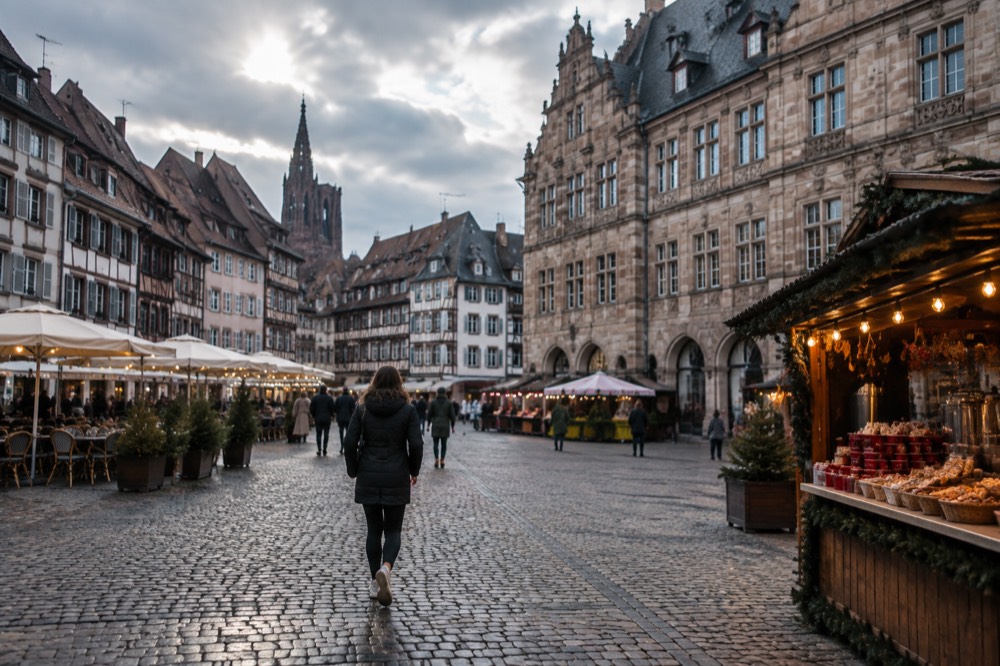
For a day of market wandering paired with the wine villages, the medieval villages and wine tasting day trip handles transport, guiding and tastings in one booking.
What Should You Eat At The Markets?
Eat like a local at the Strasbourg market with Alsatian comfort food eaten standing up: grab tarte flambée, choucroute, baeckeoffe and slices of kougelhopf, all sold from wooden chalets and in the winstubs around the edge of the squares. Wash it down with a cup of warm spiced wine as you browse the stalls. These are the classic market bites, so come hungry and work your way from stall to stall. The winstub, the city's traditional tavern, is where the same food arrives at a table with a local beer or a glass of Alsace wine, and the two experiences pair naturally: a chalet lunch, a winstub dinner. Prices at the chalets are posted at each stall, so check before you order rather than assuming, and expect the queues at the popular stalls to move quickly. The dedicated guide to Strasbourg Christmas market food goes dish by dish, and the individual pages on tarte flambée, choucroute and kougelhopf explain what each one actually is.
The honest way to eat here is to treat the market as a grazing walk rather than a restaurant. A slice of tarte flambée from one chalet, a bredele biscuit from another, a cup of spiced wine at the tree, and then a proper seated dinner in a winstub in Petite France or around the cathedral.
A guided food walk turns the grazing into an education. The operators on the roster run tasting walks of different lengths and depths, and a longer traditional food walk is the one that reaches the winstub classics as well as the stalls.
Rather graze with a guide who knows the stalls? Book a traditional food walking tour here.
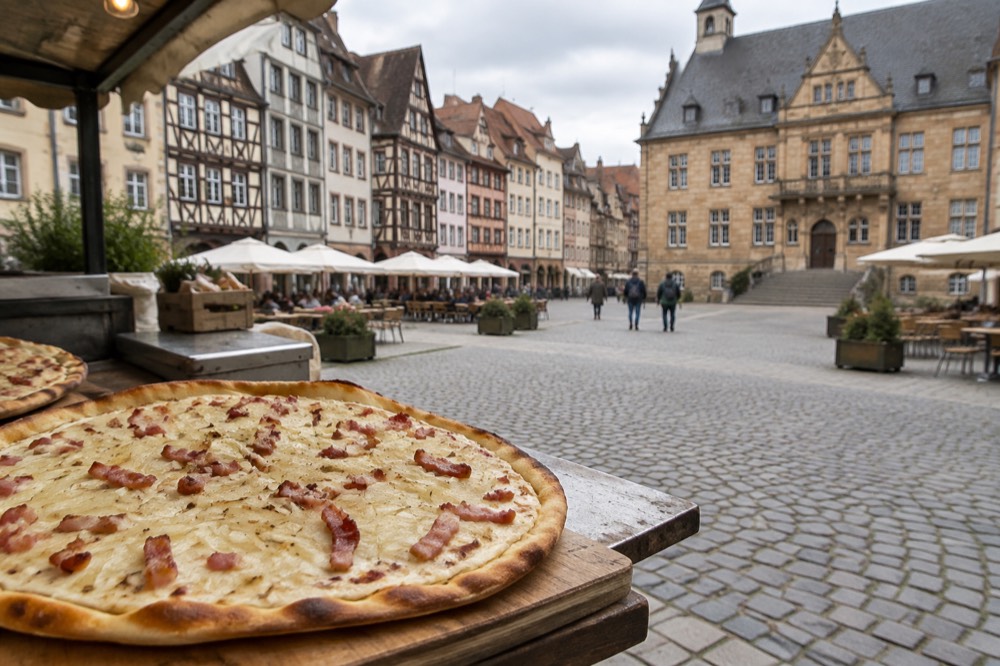
For a shorter, cheaper introduction to the same food culture, a culinary walk covers the central streets with stops along the way.
How Do You Get Around Between The Squares?
The whole market area is walkable, and walking is the point, but the CTS tram network stitches the edges together for 1.90 EUR a ticket when bought through the app, a Badgéo card or contactless, or 2.50 EUR bought on board a bus. A 24-hour Solo pass costs 4.60 EUR and a 24-hour Trio for two to three people costs 10.20 EUR. The airport shuttle deserves special mention: a combined ticket at 4.60 EUR covers the train from Entzheim airport plus a day of city transport, and the shuttle runs up to five trains an hour, taking eight minutes to the main station.
The Ill river offers the other way to see the market city. Batorama's official prices are 16.20 EUR full and 8.90 EUR reduced for the long tour and 12.50 EUR full and 7.20 EUR reduced for the short tour, with the Red Tour running 1h10 and the Blue Tour 0h45. From the water you get the Ponts Couverts, the Barrage Vauban and the half-timbered riverfront of Petite France without any walking at all, which is a fair trade on a cold afternoon. The terrace of the Barrage Vauban keeps seasonal hours, 08:00 to 19:00 in September and October and shorter winter hours from November to February, and admission terms are on the city's page for the site. The full index of guides sits on Strasbourg Travel Guide.
| CTS ticket | Price | Notes |
|---|---|---|
| Single, app/Badgéo/contactless | 1.90 EUR | Cheapest way to ride |
| Single, bought on board bus | 2.50 EUR | Avoid if you can |
| 24h Solo | 4.60 EUR | One person, unlimited rides |
| 24h Trio | 10.20 EUR | Two to three people |
| Airport combined ticket | 4.60 EUR | Train plus 24h city transport |
| Batorama tour | Duration | Full price | Reduced |
|---|---|---|---|
| Red Tour (long) | 1h10 | 16.20 EUR | 8.90 EUR |
| Blue Tour (short) | 0h45 | 12.50 EUR | 7.20 EUR |
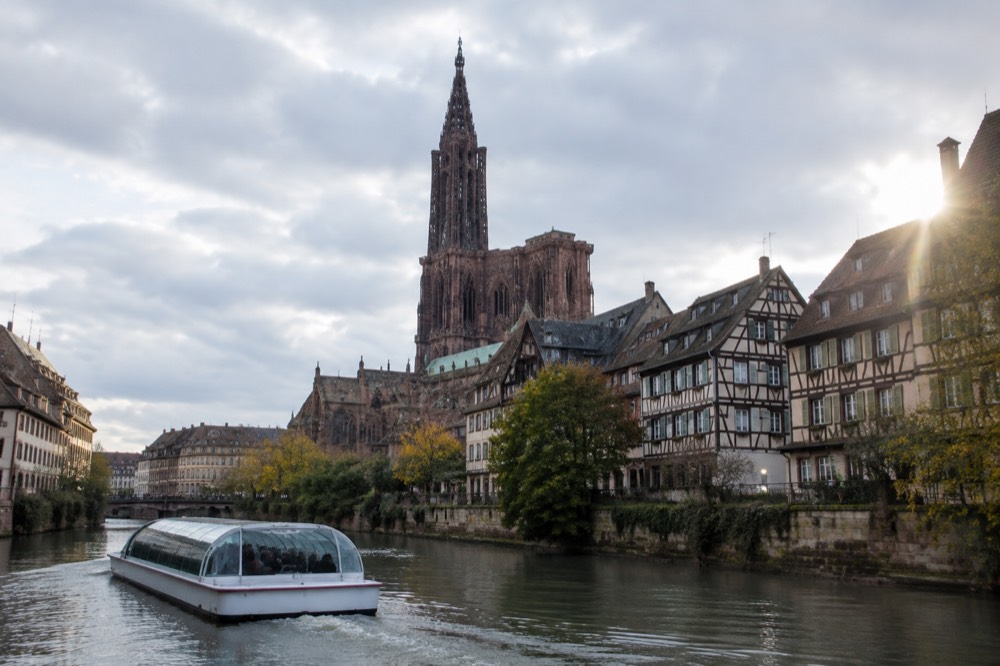
The wider question of moving around the city, including bikes and parking, is handled in the guide to getting around Strasbourg, and the river option is covered fully in the page on the Strasbourg boat tour.
What Is The Weather Like During Market Season?
Strasbourg has a semi-continental climate, and market season is cold: Meteo-France 1991-2020 normals for Strasbourg-Entzheim give a mean December maximum of 5.9 C, a mean minimum of 0.8 C, 45.2 mm of rain and 10.2 days with a millimetre or more of rain. January is colder still, with a mean maximum of 5.2 C and a mean minimum of -0.2 C. November sits between the two, at 9.4 C and 3.3 C. Pack for near-freezing evenings, real rain, and the odd snowfall that makes the half-timbering look better than any photograph can capture.
The rain-day figures are the ones to take seriously. December averages 10.2 days with measurable rain and November 9.2, so a waterproof layer belongs in the bag on any market trip. That does not mean a washout, but it does mean a waterproof layer over the warm one, and shoes that survive cobbles when they are wet. The full month-by-month picture, including the warm months if you are weighing a different season, is in the Strasbourg weather guide, and the broader question of timing is settled in the best time to visit Strasbourg.
| Month | Mean max C | Mean min C | Rain mm | Rain days >=1 mm |
|---|---|---|---|---|
| November | 9.4 | 3.3 | 47.6 | 9.2 |
| December | 5.9 | 0.8 | 45.2 | 10.2 |
| January | 5.2 | -0.2 | 35.4 | 9.1 |
The practical consequence is simple: build indoor stops into the day. The municipal museums at 9 EUR, the cathedral nave, and a long winstub lunch are what keep a wet December afternoon from feeling long. The guide to a rainy day in Strasbourg exists for exactly this.
How Many Days Do You Need For The Markets?
Two days is the working answer for the market itself, one for the Grande Île squares and the cathedral, one for Petite France, the museums and the river, with a third day added if you want the Alsace wine country or a German border town. The market is concentrated but the city is not: the cathedral and its square, Place Kléber, Petite France, the Ponts Couverts and the European quarter are separate walks, and December light is short, with the market at its best after dark.
The itineraries already exist for each length. Start with one day in Strasbourg if that is the constraint, move to two days in Strasbourg for the market-and-museums version, and use the dedicated Strasbourg Christmas market itinerary for the December-specific plan. Travellers arriving by rail from the capital should read the guide to Strasbourg from Paris and the Christmas-specific Strasbourg Christmas market from Paris page, because a day trip from Paris compresses everything into one long day.
Families get a slightly different answer, since the market stalls hold children's attention in short bursts and the city's parks and river walks fill the gaps; the Strasbourg with kids guide handles that balance.
What Lies Beyond The City For Market Visitors?
The Alsace wine route and its medieval villages are the natural extension of a Strasbourg market trip, and a guided day trip is the practical way to reach several of them in one day because the villages sit on scattered country roads rather than on a single rail line. The route's story, its grapes and its towns are covered in the Alsace wine route guide, and individual village pages exist for Riquewihr, Eguisheim, Kaysersberg and Obernai. In December, several of these villages run their own small Christmas markets, which the Christmas markets in Alsace page compares.
The featured pairing on this site is the medieval villages and wine tasting day trip, which leaves from Strasbourg and spends its day in the vineyards with tastings built in. It suits market visitors perfectly: the city in the morning and evening, the wine country in between. Check availability on the operator's live listing for departure details.
For a taste of the region without leaving the city at all, an Alsace wine tasting in Strasbourg covers the local grapes in a single sitting.
The cross-border option is Germany: Kehl sits just across the Rhine, and the Black Forest and Baden-Baden pages cover the farther reaches. Both countries are in Schengen and both use the euro, so no border formalities and no currency change. Switzerland, reached via Basel, is Schengen but outside the euro, so plan cards or francs for that direction.
If the market is the reason for the whole trip and you want every option in one place, the three strongest day-trip pairings are gathered here.
Common Questions About The Strasbourg Market
When does the Strasbourg market run?
The Christmas market opens in the last week of November and runs to 24 December, closing early on the final day. The 2025 edition ran from 26 November to 24 December 2025. The 2026 dates are not yet published, so confirm them on the city's Christmas site before booking travel.
How many visitors does the Strasbourg Christmas market get?
The 2025 edition drew 3.05 million visitors according to the city's press release, down from 3.4 million in 2024. Those figures make early December weekdays noticeably calmer than the weekends closer to Christmas.
What does it cost to visit the market?
Strolling the squares is free. The cathedral platform is 10 EUR full price and 6 EUR reduced, the astronomical clock show is 4 EUR, and municipal museums are 9 EUR full price or 5 EUR reduced, free on the first Sunday of every month.
What should you eat at the Strasbourg market?
Tarte flambée, choucroute, baeckeoffe, kougelhopf and warm spiced wine are the classics, sold from chalets and served seated in the winstubs around the old centre. Chalet prices are posted at each stall, so check before ordering.
How do you get around during the market?
Walk. The squares are close together on the Grande Île. For longer hops a CTS tram ticket is 1.90 EUR via the app, a Badgéo card or contactless, a 24-hour Solo pass is 4.60 EUR, and Batorama river tours run from 12.50 EUR for the short circuit.
Is the Strasbourg market worth a day trip from Paris?
It can be done, and the guide to the Strasbourg Christmas market from Paris explains the mechanics, but the market rewards an overnight stay because it is at its best after dark and the second day lets you add the wine country or Petite France at leisure.
The Strasbourg market experience, in the end, is a city-scale event in a walkable medieval setting, priced in small euros at the door and best planned around the hours after dark. Confirm the dates on the city's own Christmas site, book the bed early, and give the wine country at least one of your days.