Which Christmas Market Is Better, Strasbourg Or Colmar?
A side by side comparison of the Strasbourg and Colmar Christmas markets in Alsace, France: scale, atmosphere, food, cost of entry sights and which one suits which traveller.
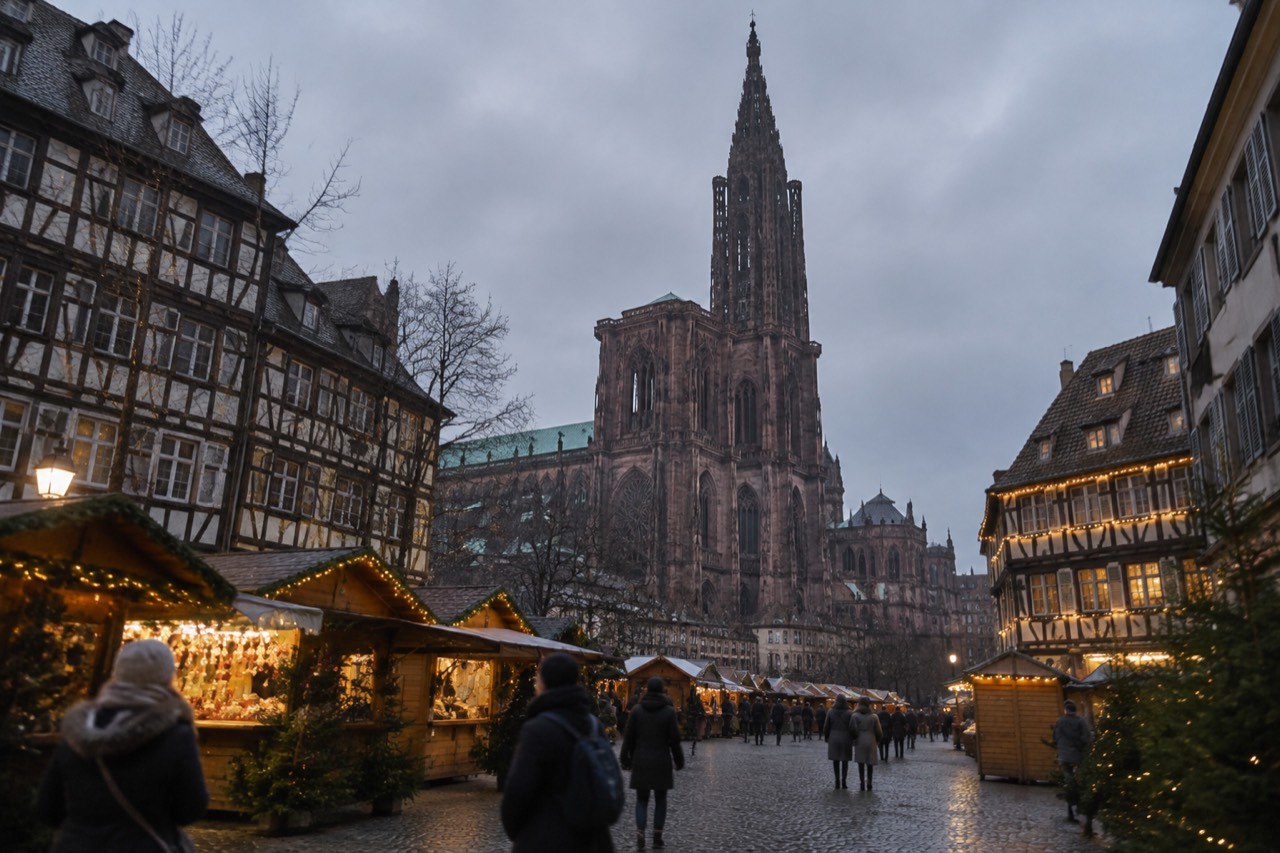
Strasbourg, in Alsace in north-eastern France, holds one of the oldest and largest Christmas markets in Europe, spread across the squares of its UNESCO-listed Grande Île, while Colmar, the wine-capital town to the south, holds a smaller market famous for its half-timbered old streets and canal-side chalets. The honest answer is that they do different jobs: Strasbourg delivers scale, a Gothic cathedral and a full city programme, while Colmar delivers density, charm and an easier pace. This comparison sets out what the verified sources say about the Strasbourg edition, what is generally true of Colmar, and which kind of traveller each one rewards.
Which Christmas Market Is Better, Strasbourg Or Colmar?
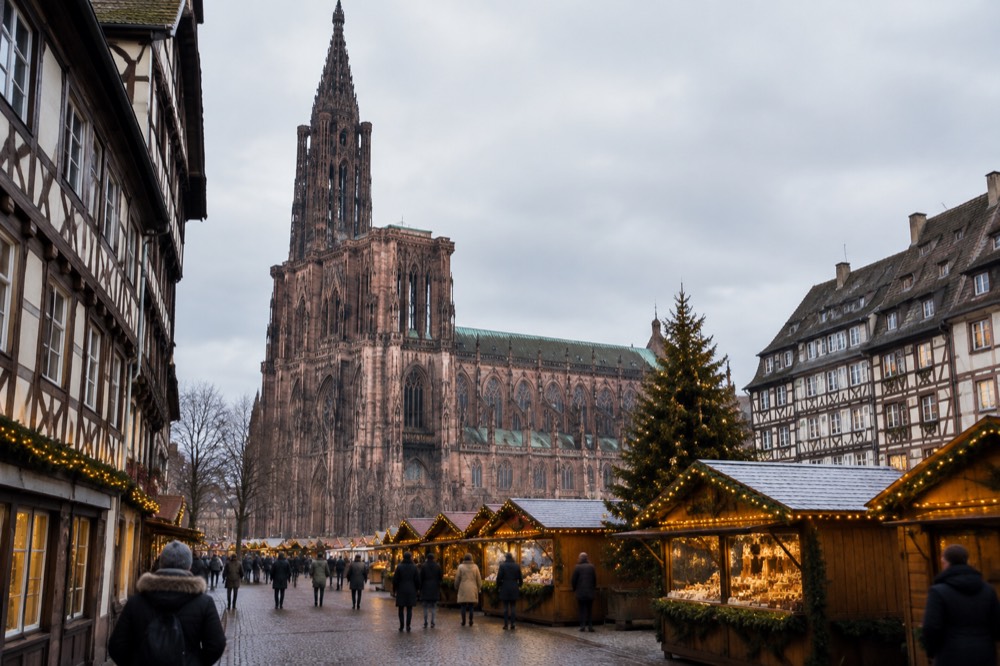
Strasbourg is the better choice for a first Christmas-market trip to Alsace, because it combines the largest market footprint in the region with a cathedral, a river and a full programme of events, all in one walkable centre; Colmar is the better choice for travellers who have seen a big market before and want a compact, intensely decorated old town that can be enjoyed in a single afternoon. The two are close enough that many visitors do both, basing themselves in Strasbourg and giving Colmar a day.
The comparison deserves unpacking, because "better" depends on what a December trip is for. Strasbourg's market, branded Strasbourg Capitale de Noël by the city, is a city-wide affair: chalets and stalls sit across several squares in the historic centre, each with its own character, and the whole thing is threaded through a living city of 293,771 residents that keeps its trams, winstubs and museums running alongside the festivities. The 2025 edition ran from 26 November to 24 December 2025 and drew 3.05 million visitors, down from 3.4 million in 2024, according to the city's own press release. That scale is the market's strength and its cost: the popular squares are busy, and evenings in December feel crowded.
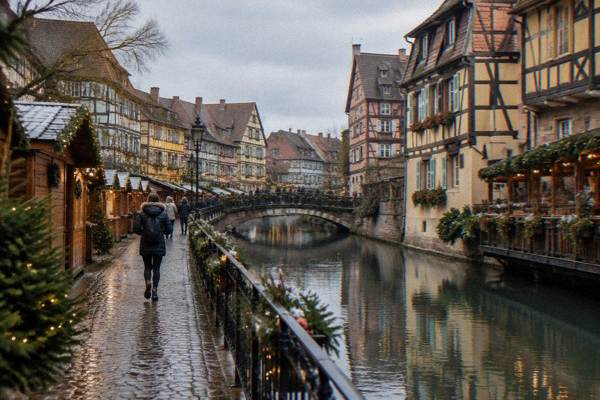
Colmar's market plays a different game entirely. The Alsatian wine capital wraps its chalets through old-town lanes of half-timbered houses, along a canal quarter often photographed in winter, and around its own Dominican church square, and the whole ensemble can be walked in a few unhurried hours. Colmar's December atmosphere is quieter and more concentrated: fewer squares, tighter streets, and a setting that looks engineered for photographs. The trade-off is that Colmar is a small town, so the market sits on top of a thinner layer of other things to do, while Strasbourg layers its market onto museums, boat tours, the European institutions and a cathedral with a 66 m viewing platform.
A useful way to frame the decision is what each city is like once the market lights are off. Strasbourg in late December is a regional capital with a semi-continental climate, meaning cold days and frosty nights: Meteo-France 1991-2020 normals for Strasbourg-Entzheim give a mean December maximum of 5.9 C, a mean minimum of 0.8 C, 45.2 mm of rain and 10.2 rain days of 1 mm or more. Colmar shares that climate, so weather is not a differentiator; what differs is what there is to do on a rainy market evening, and Strasbourg simply has more of it, from the covered collections of the Musée des Beaux-Arts to the Musée d'Art Moderne.
| Question to ask yourself | Points to Strasbourg | Points to Colmar |
|---|---|---|
| First Christmas market in Alsace? | City-wide scale, cathedral, river and markets in one centre | Charming but small; better as a second stop |
| Travelling with children? | Boat tours, the old town train, wide squares | Compact lanes, easy to cover on foot quickly |
| Short on time (half a day)? | Market is spread out; needs a full day | Whole market walkable in a few hours |
| Food-led trip? | Winstubs, Alsatian classics, gourmet walking tours | Wine-capital kitchens and vineyard proximity |
| Photographing half-timbered streets? | Petite France delivers, but amid crowds | The old town is the whole point |
What Makes The Strasbourg Christmas Market Distinctive?
The Strasbourg market's signature is a cathedral-and-squares layout across the Grande Île, a giant Christmas tree tradition on Place Kléber, and a scale that turns the whole historic centre into the event, with chalets across several squares and a late-November opening that runs to 24 December. The city's own Christmas site confirms that the official 2026 dates and programme are still being finalised, so the pattern, not a printed date, is what to plan around.
To get your bearings across those squares with a local, book a guided walking tour here.
The Strasbourg edition is not one market but a collection of them. Chalets sit across several squares in the historic centre, each cluster with its own emphasis, from craft stalls to food stands, and the whole is anchored by the cathedral and the tree on Place Kléber. The city's Christmas site states plainly that the 2026 dates and programme are still being finalised, so any specific 2026 opening date printed elsewhere should be treated with caution; the reliable pattern is an opening in the last week of November and a run to 24 December, with the final day closing early in the evening. Last year's edition, 26 November to 24 December 2025, is the verified reference point, and its 3.05 million visitors show what the crowds look like at peak.
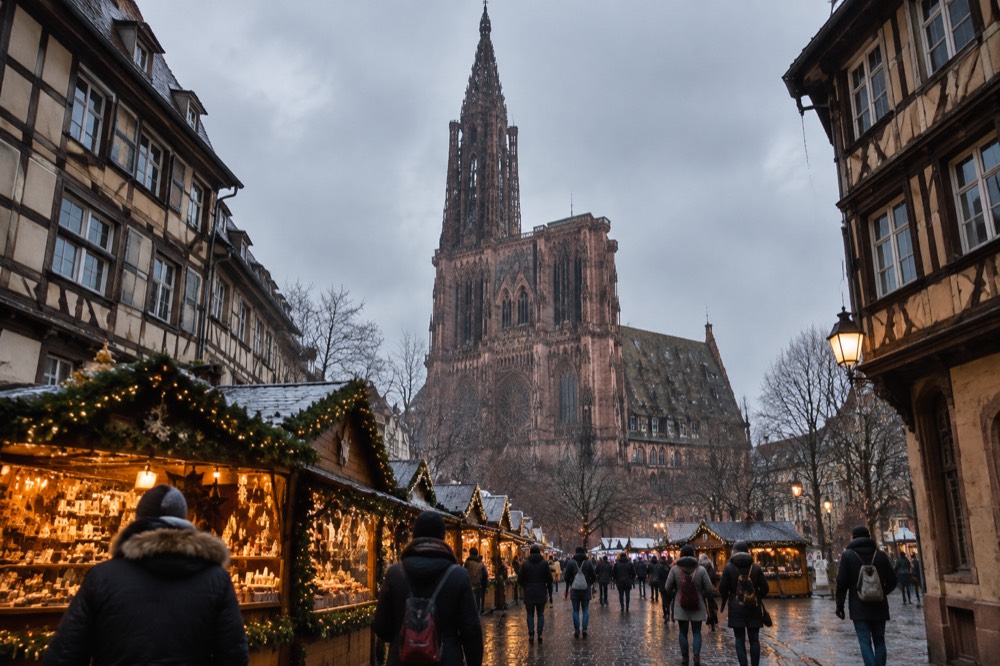
What genuinely separates Strasbourg from a standard market town is the setting. The Grande Île and the Neustadt together form a UNESCO World Heritage property, and the market sits inside it, which means a visitor walks from chalets to a Gothic cathedral with a single spire and a viewing platform at 66 m, past half-timbered houses, along the River Ill. The cathedral's own hours page gives nave visiting hours of 08:30-11:15 and 12:45-17:45 Monday to Saturday and 14:00-17:15 on Sundays and feast days, and during the market season the cathedral is open continuously on the Place du Château side, 08:30-17:45, Monday to Saturday. The astronomical clock inside performs its full automaton show daily at 12:30, with a 4 EUR adult ticket sold on the day only, and the platform ticket is 10 EUR full price, 6 EUR reduced, with under-6s free. Those are the kinds of anchor sights Colmar cannot match in number, whatever its charm.
The food side of the Strasbourg market is another real differentiator. The city is the home of winstub culture, tarte flambée, choucroute and kougelhopf, and the market chalets sell all of them alongside mulled wine and roasted chestnuts, while the surrounding old town carries a full restaurant layer beyond the stalls. A traveller who wants the market experience plus a serious dinner has more options in Strasbourg than in any other Alsatian town, and the guide to Christmas market food in Strasbourg covers the dishes worth seeking out. The trade-off, again, is popularity: December evenings around the cathedral squares are the busiest the city gets all year.
What Makes Colmar's Christmas Market Different?
Colmar's market trades scale for density: its chalets thread through a small half-timbered old town, along a canal quarter and around its main church square, producing the most concentrated festive atmosphere in Alsace in a setting that can be walked end to end in a few hours. It is the better market for photographs, for a relaxed pace and for combining with the surrounding wine route.
What can be said safely is qualitative. Colmar is the capital of the Alsatian wine route, its old town is a dense weave of half-timbered houses painted in a range of colours, and its December market uses that backdrop rather than a cathedral-and-squares layout. The market's five or so locations cluster within the old town, so a visitor never needs a tram or a long walk between them, and the canal-side stretch is the image that sells Colmar in photographs. Other pages covering the same trip are gathered on Strasbourg Travel Guide.
That concentration is the whole argument for Colmar. A traveller with one afternoon between trains can see the market, eat well and leave satisfied, something Strasbourg's spread-out layout does not allow in the same way. Colmar also pairs naturally with the wine villages around it, Eguisheim, Riquewihr and Kaysersberg among them, several of which hold their own small markets, so a Colmar base turns into a wine-route December trip easily. The question of whether Colmar itself is over-loved by tourists is a fair one, and the is Colmar a tourist trap answer takes it head on; the short version is that December is peak season everywhere in Alsace, and Colmar's small size makes the crowds more visible than Strasbourg's.
The honest weakness of Colmar in December is capacity. A small old town hosting a famous market fills up, accommodation books early, and the lanes that photograph so beautifully at 09:00 can feel packed by mid-afternoon. Strasbourg absorbs its millions of visitors across a far larger footprint, so even at peak there are quieter squares, museums and river banks to retreat to. Neither city is "uncrowded" in December, and any page promising a secret corner of either in late December is selling something the calendar does not support.
How Do The Two Cities Compare Beyond The Market?
Strasbourg offers far more around its market: a 66 m cathedral platform, a daily astronomical clock show at 12:30, Batorama river tours at 16.20 EUR full price for the long circuit, municipal museums at 9 EUR full price with free entry on the first Sunday of every month, and a working tram network with a 4.60 EUR 24-hour Solo pass. Colmar offers a wine-route setting and a walkable old town, with fewer anchor sights of the cathedral-and-museum kind.
The non-market layer is where the two cities genuinely diverge, and it matters for a December trip because market hours are evening-heavy and days are short. In Strasbourg, the cathedral alone fills a morning: the nave, the clock show at 12:30, and the platform, which the official PDF prices at 10 EUR full and 6 EUR reduced, closed on 1 January, 1 May and 25 December. The platform's seasonal hours are 09:30-13:00 and 13:30-20:00 with last ascent at 19:15 from April to September, and 10:00-13:00 and 13:30-18:00 with last ascent at 17:15 from October to March, so a December visit means an afternoon ascent with daylight fading over the Black Forest horizon.
| Strasbourg sight or service | Verified figure | Note for a December visit |
|---|---|---|
| Cathedral platform ticket | 10 EUR full, 6 EUR reduced | Under-6s free; closed 1 Jan, 1 May, 25 Dec |
| Astronomical clock show | 12:30 daily, 4 EUR adult | Day-of purchase only, no reservations |
| Batorama long river tour | 16.20 EUR full, 8.90 EUR reduced | Red circuit lasts 1h10 |
| Batorama short river tour | 12.50 EUR full, 7.20 EUR reduced | Blue circuit lasts 0h45 |
| Municipal museums | 9 EUR full, 5 EUR reduced | Free on the first Sunday of every month |
| Pass Musées, 1 day | 20 EUR | Covers the municipal museums |
| Strasbourg City Card | 5 EUR adult, 3.50 EUR child | A 7-day discount card, not an all-inclusive pass |
| CTS 24h Solo transport pass | 4.60 EUR | Single tickets are 1.90 EUR or 2.50 EUR on board |
Note one closure that affects winter planning: the Musée Alsacien, the folk-life museum that would otherwise be a natural December visit, is closed for works until 2028, so it should not appear on any Strasbourg itinerary. The other municipal museums are open, and the first-Sunday free-entry rule applies to all of them, which is worth checking against a December stay's dates. The Strasbourg City Card at 5 EUR is a discount card valid for seven days, giving reductions on museums, the boat tour, the cathedral platform and the clock, and it suits a traveller planning several paid sights rather than one.
Colmar's own museum layer is thinner in the cathedral-and-collections sense, though its old town, its Unterlinden area and its proximity to the wine route give it a different kind of depth. The fair comparison is not museum against museum but itinerary against itinerary: a Strasbourg base yields a city break with a market attached, a Colmar base yields a market town with a wine region attached. Travellers torn between the two as bases should read the is it better to stay in Colmar or Strasbourg answer, which works through the base-city question directly, and the how many days in Colmar is enough answer for the timing side.
Which Market Suits Which Traveller?
Families, first-time visitors and travellers who want a full city programme should choose Strasbourg; photographers, couples on a short break and travellers combining the market with the wine route should choose Colmar; anyone with three or more days should base in Strasbourg and give Colmar a day trip, because the two markets are complementary rather than competing experiences.
The decision rarely needs to be either-or, and that is the practical conclusion most December travellers reach. Strasbourg rewards a base of two or three nights: one evening for the cathedral squares and the tree, one for Petite France and the riverside, one daytime block for the platform, the clock and a museum, plus a food tour or a river circuit. The how many days do you need in Strasbourg for Christmas markets answer breaks that timing down in detail, and the Strasbourg Christmas market itinerary page turns it into a day-by-day plan.
Colmar rewards a day, or a day and a night. Its market is at its best in the late afternoon as the lights come on, and its lanes are pleasant before the crowds build, so an arrival at midday with a departure after dark covers the essentials. The practical way to do both from one base is a guided loop: the Best of Alsace historical day trip from Strasbourg, bookable through Check availability, moves through the region's highlights in a single day and pairs naturally with a Colmar market stop for travellers who would rather not drive winter roads themselves. The Strasbourg and Colmar itinerary page covers the self-drive version for those who prefer their own wheels.
One honest caution on both markets: December in Alsace is cold, wet and busy, in that order. The December normals for Strasbourg-Entzheim give a mean maximum of 5.9 C, a mean minimum of 0.8 C and 10.2 rain days of 1 mm or more, and Colmar sits in the same semi-continental climate zone. Waterproof shoes, a proper coat and a plan for the 17:00 darkness are worth more in either city than a debate about which market is better. The are Christmas markets better in day or night answer helps with the light question, and the best time to visit Strasbourg guide covers the seasonal trade-offs more broadly.
Common Questions About Strasbourg Or Colmar At Christmas
Which Christmas market is better, Strasbourg or Colmar?
Strasbourg is better for a first visit, for families and for travellers who want scale, a cathedral and a full city programme alongside the chalets. Colmar is better for photographers, for a short break and for travellers pairing the market with the wine route. With three or more days, base in Strasbourg and visit Colmar as a day trip.
When does the Strasbourg Christmas market run?
The official 2026 dates are not yet published; the city's Christmas site states they are still being finalised. The usual pattern is an opening in the last week of November and a run to 24 December, with the final day closing early. The 2025 edition ran 26 November to 24 December 2025.
Is the Strasbourg Christmas market worth the crowds?
For scale, setting and atmosphere, yes: the market spreads across several squares of a UNESCO-listed centre, and the crowds thin a few streets away. The is the Christmas market in Strasbourg worth it answer works through the costs and trade-offs in detail.
Can you visit both Strasbourg and Colmar markets in one trip?
Yes, and it is the recommended approach. Base in Strasbourg for the city programme and give Colmar a day trip, by car, train or a guided Alsace loop. The two markets are complementary: one is a city-wide event, the other a compact old-town experience.
Which market is better for food?
Strasbourg, on quantity and variety: winstubs, tarte flambée, choucroute and kougelhopf sit alongside the chalet stalls, and the restaurant layer beyond the market is the deepest in the region. Colmar eats well too, in a smaller, wine-country register.
Is December weather a reason to pick one over the other?
No. Both cities share the same semi-continental climate: cold days around a mean maximum of 5.9 C in Strasbourg in December, frosty nights, and roughly ten rain days in the month. Pack for cold and rain in either town and choose on atmosphere, not forecast.
The short version of the whole comparison: Strasbourg is the event, Colmar is the postcard, and December in Alsace is generous enough to give a well-planned trip both. Choose Strasbourg for a first Christmas-market city break with everything a regional capital adds, choose Colmar for a compact and beautiful market town with the wine route at its back door, and if the calendar allows, choose neither as an either-or and see the pair as one trip.