Strasbourg Train Station
Strasbourg's main railway station is the front door to a French, German and Alsatian crossroads city. This guide covers the tram fares that start at the forecourt, the airport shuttle, arrival times from Paris, and the tours and day trips that begin a short ride from the platforms.
Short answer
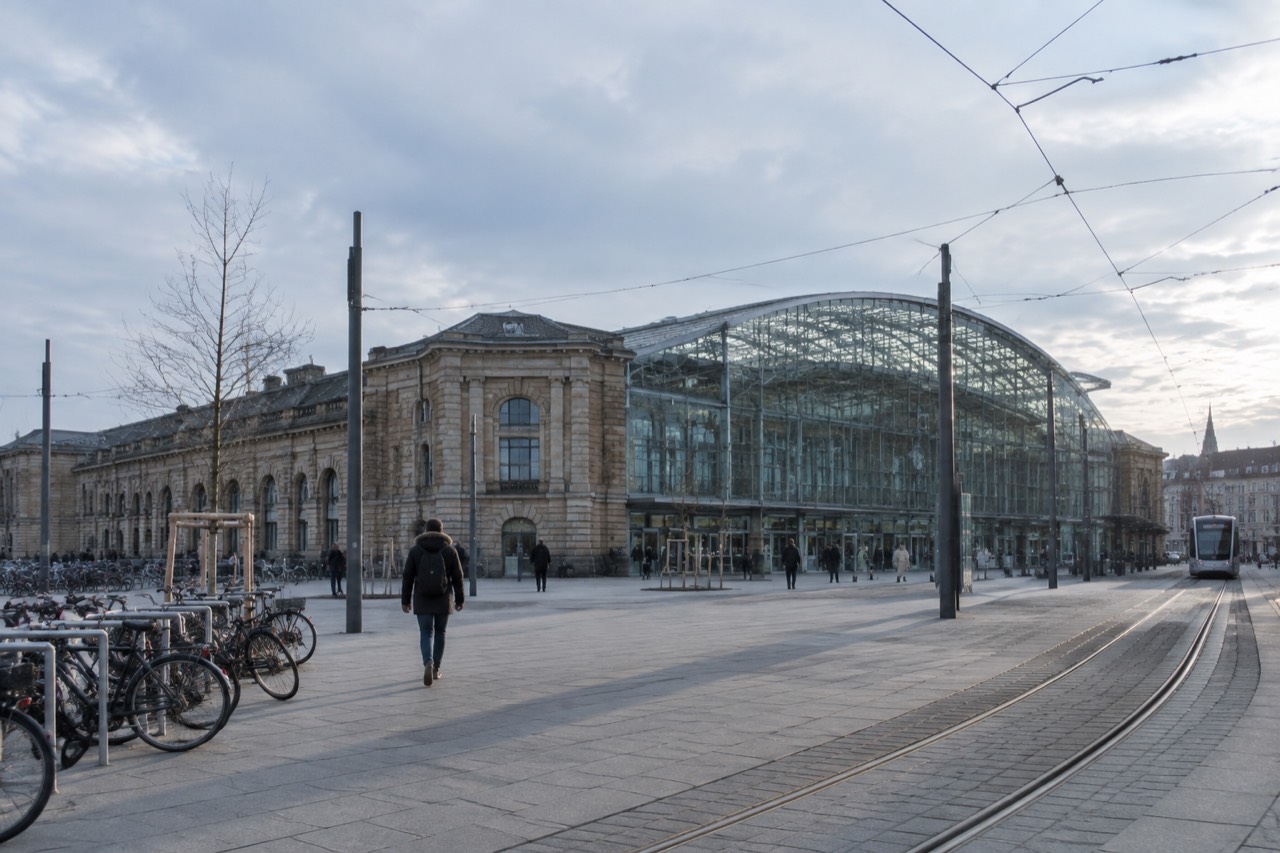
Strasbourg's main station sits at the western edge of the city centre in Alsace, north-eastern France. A single tram or bus ticket costs 1.90 EUR from the app or contactless, the airport shuttle covers the last leg in 8 minutes, and the fastest trains from Paris take about 1 hour 45. The Grande Île heritage centre is a short ride away.
Strasbourg's main railway station is the practical front door to one of Europe's genuinely border-shaped cities. Strasbourg is the prefecture of the Bas-Rhin, in Alsace, part of the Grand Est region of north-eastern France, standing on the River Ill beside the Rhine, which is the border with Germany; Kehl sits on the far bank. The station handles the long-distance trains from Paris, the regional web across Alsace, and the short hop across the river, and it puts the entire heritage centre within a short tram or bus ride. This guide walks through the station itself, the tickets that start at its forecourt, the airport connection, the Christmas market season, and the guided tours that pair well with arriving by rail.
Where Is Strasbourg Train Station In The City?
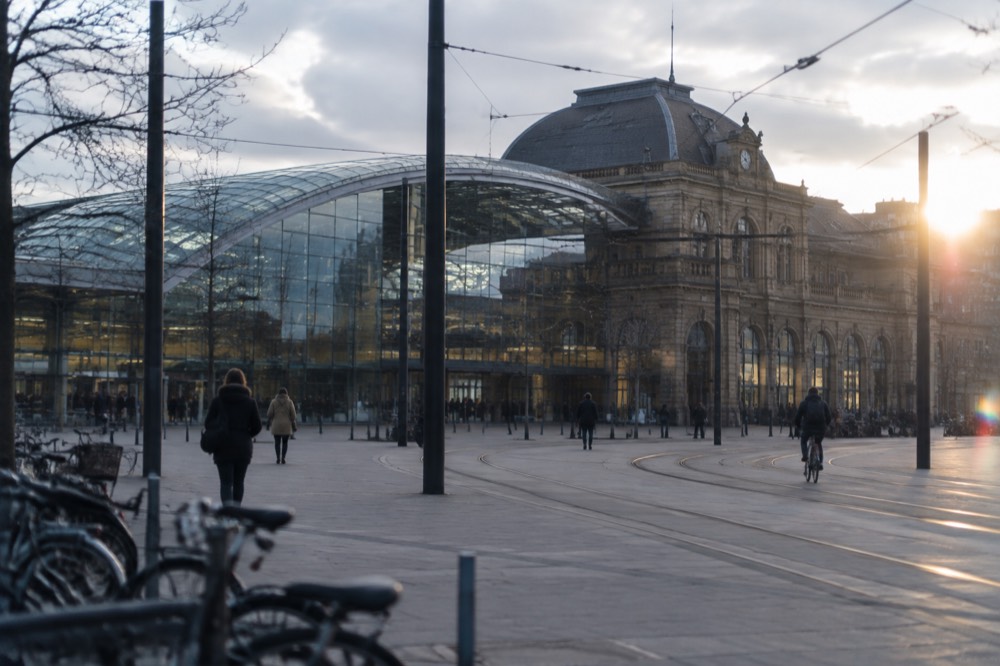
The station stands at the western edge of central Strasbourg, in Alsace, north-eastern France, a short tram or bus ride from the Grande Île, the island heart of the city that UNESCO lists as part of the World Heritage property "Strasbourg, Grande-Île and Neustadt". The commune counted 293,771 residents at the last INSEE census year, and the station district, the gare district, wraps the platforms on the centre side of the tracks.
The geography matters more here than at a typical French station. Strasbourg sits on the Ill, a river that loops through the old town, a short distance upstream of where it meets the Rhine. The Rhine is the border, and the German town of Kehl faces Strasbourg across it. That position is why the station is not just a French hub: it is a crossing point between two countries that share the Schengen area and the euro, so a local train towards Germany involves no border formalities and no currency change.
The station district itself has its own character, and it is worth a short look rather than a dash through. The gare district guide covers the neighbourhood in detail, from the streets immediately around the platforms to the quarters that stretch towards the centre. For travellers deciding whether the area works as a base, the where to stay in Strasbourg guide compares it with Petite France and the other central neighbourhoods.
One planning note belongs here because it shapes everything else on this page. The station is close enough to the centre that a hotel near the platforms and a hotel on the Grande Île are, in practice, the same trip length for most visitors, separated by a few stops of tram or bus. The decision between them is about atmosphere and price, not distance.
How Do You Get From Strasbourg Train Station To The City Centre?
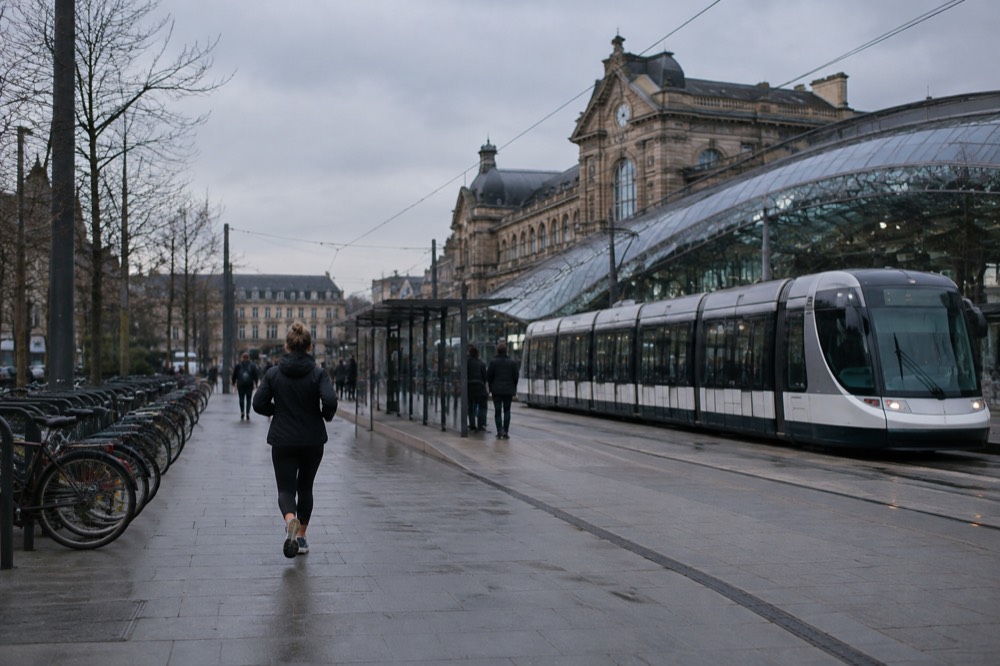
Trams and buses link the station forecourt to the centre, and the CTS network that runs them is cheap: a single ticket is 1.90 EUR bought through the Badgéo card, the CTS app or contactless payment, 2.50 EUR if bought on board a bus, a 24h Solo pass is 4.60 EUR, and a 24h Trio pass covering two or three people travelling together is 10.20 EUR.
Those figures come from CTS's own fare pages, and they are the numbers that matter for a station arrival. The single ticket covers one journey, so for a day of hopping between the station, the cathedral quarter and Petite France the 24h Solo pays for itself quickly. The Trio pass is the one to note for families or small groups arriving together: it covers two or three people on the same ticket.
| CTS ticket | Price | What it covers |
|---|---|---|
| Single (Badgéo, CTS app, contactless) | 1.90 EUR | One journey on the network |
| Single bought on board a bus | 2.50 EUR | One journey, no change given |
| 24h Solo pass | 4.60 EUR | One person, unlimited rides for 24 hours |
| 24h Trio pass | 10.20 EUR | Two or three people travelling together |
Buying on board the bus is the expensive option, at 2.50 EUR against 1.90 EUR, so it pays to have the app or a contactless card ready before stepping up. The network reaches the whole city, including the quarters beyond the centre, and the same tickets cover the trams and buses that serve the station forecourt.
The centre itself rewards arriving early. The Grande Île holds the cathedral, Petite France's half-timbered river quarter, Place Kléber and the covered bridges, and it is compact enough that once a tram has delivered you into it, the rest is walking. Travellers who prefer to skip the ticket machines altogether can start with a walk: the free things to do in Strasbourg guide lists the squares, bridges and riverside stretches that cost nothing.
For anyone who would rather have a local set the orientation on day one, a guided walk is the shortcut.
Want a local to set the orientation on day one? Book a guided walking tour here.
What Is There To Do Near Strasbourg Train Station?
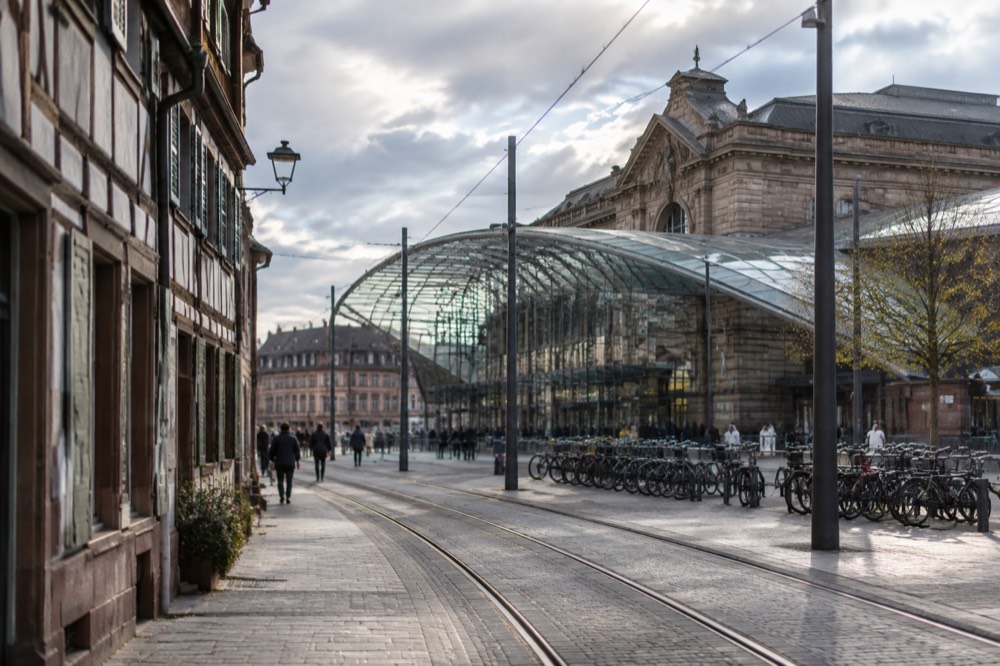
The station's own district is mostly practical, but the centre it feeds holds the cathedral with its single spire and 66 m viewing platform, the Musée de l'Œuvre Notre-Dame, the Beaux-Arts and other municipal museums at 9 EUR full price and 5 EUR reduced, all free on the first Sunday of every month, and the Petite France river quarter, all a short tram or bus ride from the forecourt.
The museums are the quiet bargain of a Strasbourg stopover. The municipal network charges 9 EUR full and 5 EUR reduced per museum, a one-day Pass Musées costs 20 EUR, and every municipal museum opens its doors free on the first Sunday of each month, a policy stated plainly on the city's own culture pages. One exception matters: the Musée Alsacien is closed for works until 2028, so it should not be on any itinerary near the station or anywhere else.
| Ticket or pass | Price | Notes |
|---|---|---|
| Municipal museum, full price | 9 EUR | Per museum |
| Municipal museum, reduced | 5 EUR | Per museum |
| Pass Musées, 1 day | 20 EUR | Municipal museums |
| First Sunday of the month | Free | All municipal museums |
| Strasbourg City Card | 5 EUR adult, 3.50 EUR child | Discount card, 7 days, not an all-inclusive pass |
The Strasbourg City Card deserves a careful read because it is often mistaken for a pass. It costs 5 EUR for an adult and 3.50 EUR for a child aged 3 to 17, lasts seven days, and works by knocking money off attractions: the city's own shop page lists reductions on the municipal museums, the cathedral platform, the astronomical clock, boat trips and guided visits. It is a discount card, not a bundled entry ticket, and the Strasbourg City Card guide works through the arithmetic of when it saves money.
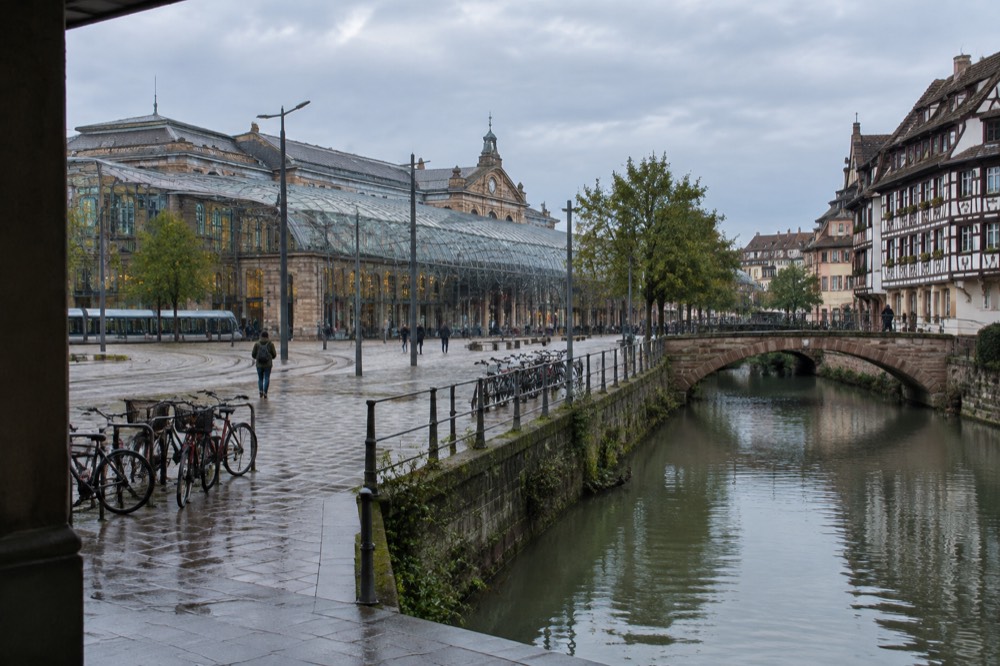
Beyond the museums, the centre near the station's tram lines hides plenty that first-time visitors miss. The Strasbourg hidden gems guide collects the courtyards, churches and riverside corners that sit between the famous sights, and the evening side of the city, from the floodlit cathedral square to the quieter lanes, is covered in Strasbourg at night.
For travellers who land at the station with a few hours to spare and want structure rather than a wander, a guided visit is the efficient answer.
How Do You Arrive At Strasbourg Train Station From Paris Or The Airport?
The fastest trains from Paris cover the route in about 1 hour 45, a figure to confirm on SNCF Connect when booking, and the airport link is even quicker: a dedicated rail shuttle runs between Strasbourg station and Entzheim airport in 8 minutes, with up to 5 trains per hour, and a combined ticket covering the shuttle plus a day of trams and buses costs 4.60 EUR.
The Paris service is the spine of long-distance arrival into Strasbourg. Fares move with demand and there is no fixed price worth printing here, so the honest advice is to check SNCF Connect for timetables and fares. The route itself is quick by any standard, which is why Paris day trips and weekend breaks work so smoothly; the Paris to Strasbourg guide covers the whole journey, and the why the Paris train is expensive answer explains the pricing logic behind those fares.
The airport shuttle is the detail that surprises people. Strasbourg's airport sits at Entzheim, and rather than a bus, the link is a short regional train that reaches the station in 8 minutes, running up to five times an hour. The combined ticket, sold as the Alsa+ 24h EMS option at 4.60 EUR, folds the shuttle, the CTS network and the airport leg into one price, which makes it the obvious first purchase for a flying arrival.
| Connection | Figure | Where to check |
|---|---|---|
| Fastest Paris to Strasbourg trains | About 1 hour 45 | SNCF Connect |
| Station to Entzheim airport shuttle | 8 minutes | TER Grand Est and airport pages |
| Shuttle frequency | Up to 5 trains per hour | TER Grand Est timetables |
| Combined shuttle plus 24h transit ticket | 4.60 EUR | CTS fare pages |
Arrivals from further afield have their own routes. The Frankfurt airport to Strasbourg guide handles the German-side approach, and the easiest way to get to Strasbourg style questions are answered in the site's arrivals section. Whichever direction you come from, the station is where the trip hands over to the tram network, and that handover takes minutes.
Where Can You Travel To By Train From Strasbourg?
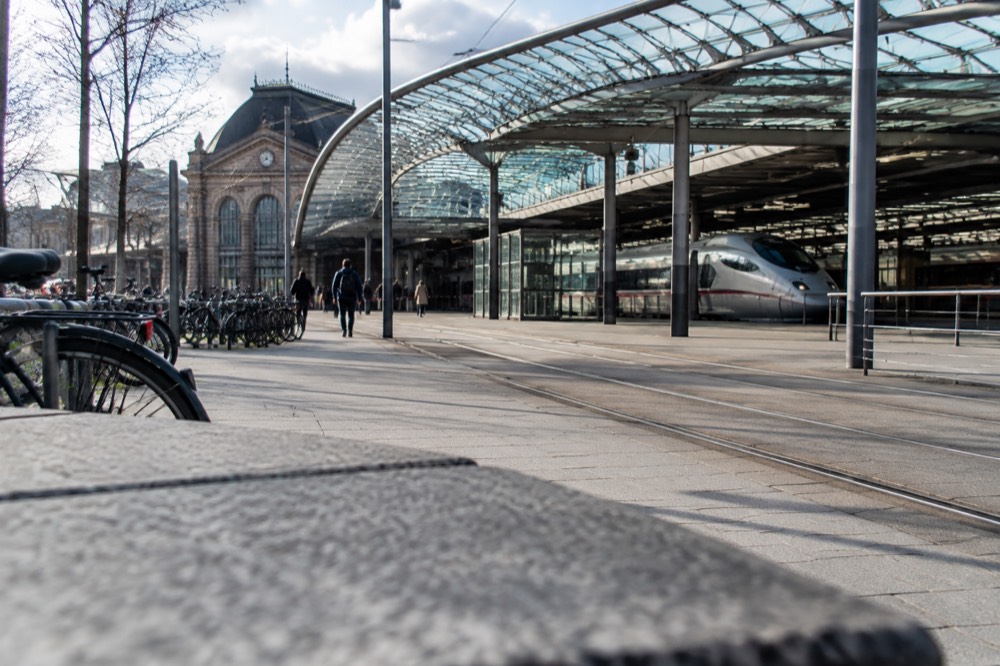
Strasbourg's station is a genuine crossroads: local trains cross the Rhine to Kehl in Germany with no border checks since both countries are in Schengen and use the euro, regional trains fan out across the Alsace wine country and its villages, and high-speed services link the city to Paris in about 1 hour 45, with timetables and fares to be checked on SNCF Connect for each route.
The cross-border side is the part that feels unusual for visitors used to hard borders. France and Germany are both in the Schengen area, so a short train towards Kehl is a commute, not a frontier crossing, and both countries use the euro, so no money needs changing. The German bank of the Rhine is close enough that the Kehl guide treats it as a half-day trip.
| Direction | What it is | What to check |
|---|---|---|
| Kehl, Germany | Local hop across the Rhine, same currency | Local timetables |
| Alsace villages and wine route | Regional trains into the wine country | TER Grand Est timetables |
| Paris | High-speed service, about 1 hour 45 at fastest | SNCF Connect |
| Basel area, Switzerland | Cross-border day trip, Schengen but not the euro | Timetables and Swiss franc note |
The Basel row carries a warning worth repeating: Switzerland is in Schengen but not in the euro, so euros are not the currency there, and any day trip in that direction needs a card or francs. The full map of rail destinations from the city, including the regional towns and the cross-border lines, is laid out in the where you can go by train from Strasbourg answer. The rest of the planning pages sit on Strasbourg Travel Guide.
For travellers who prefer a guide and a vehicle to self-managed timetables, the region's signature day trips run from the city. The Alsace wine route villages, the castles and the memorials of the region are all reachable as organised excursions, and a guided bike tour is another way to cover ground: the city itself is famously flat and cycle-friendly, and a local guide on two wheels reaches corners that walkers and tram riders both miss.
History of a heavier kind also sits within reach of the city. The Natzweiler-Struthof site, the former camp high in the Vosges above the Alsace wine route, is visited on a guided half-day excursion from Strasbourg, and the Natzweiler-Struthof guide explains what the site is and what a visit involves. It is a sobering trip, and one that many travellers combine with the Alsace region overview to understand what the landscape holds.
Is Strasbourg Train Station A Good Base For The Christmas Market?
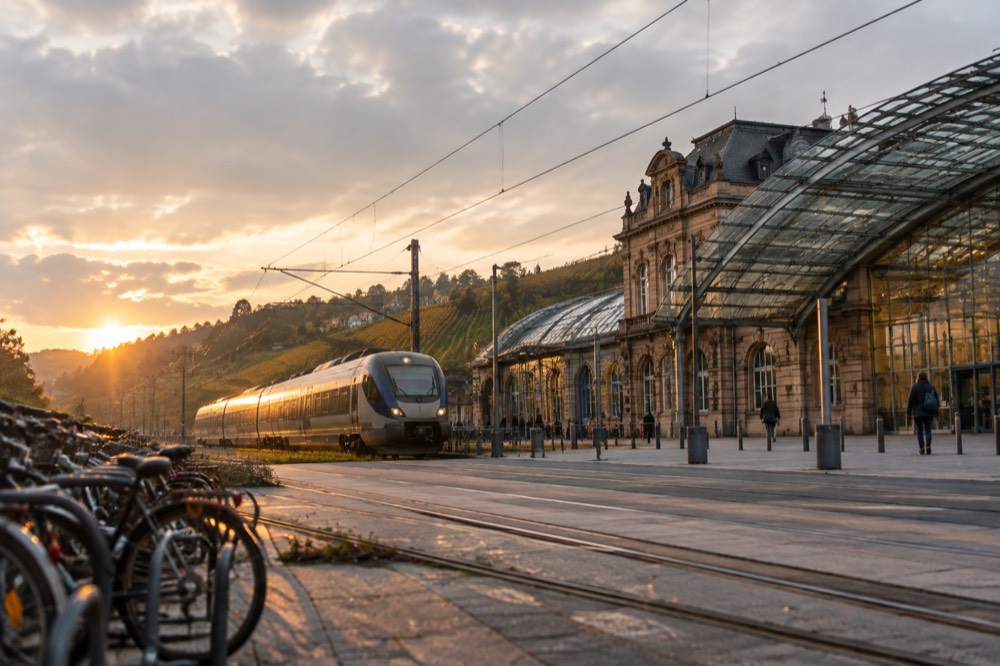
Yes, and it is hard to imagine a better one: the market's usual pattern opens in the last week of November and runs to 24 December, last year's edition ran 26 November to 24 December 2025 and drew 3.05 million visitors, and the chalets sit in the centre a short tram or bus ride from the station forecourt, with the 2026 dates still to be confirmed on the city's official Christmas site.
Strasbourg bills itself as a Christmas capital, and the numbers behind last year's edition back the claim: 3.05 million visitors across the 2025 season, against 3.4 million the year before, figures published by the city itself. The market spreads chalets across the historic squares rather than sitting in one field, which is why a station base works so well: the tram network stitches the squares together, and the walk between clusters is part of the experience.
| Christmas market fact | Figure or pattern |
|---|---|
| Usual opening | Last week of November |
| Usual close | 24 December, closing early in the evening |
| 2025 edition | 26 November to 24 December 2025 |
| 2025 attendance | 3.05 million visitors |
| 2024 attendance | 3.4 million visitors |
| 2026 dates | Not yet published, confirm on the city's Christmas site |
The practical reading of that table is simple. Plan around late November to 24 December, book accommodation early because December fills the city, and check the official Christmas site before locking flights or trains for 2026. The Strasbourg Christmas market guide is the full companion to the season, and the Christmas markets in Alsace and Colmar Christmas market guides extend the idea across the region.
December weather deserves a place in the same planning breath. The Meteo-France 1991-2020 normals for Strasbourg-Entzheim give December a mean daily maximum of 5.9 C, a mean minimum of 0.8 C and 45.2 mm of rain over 10.2 days with 1 mm or more, so the market season is cold and regularly damp: pack layers and something waterproof, and read the Strasbourg in winter guide for the full picture.
Travellers who want the market experience without the self-drive can take an organised day tour that strings the region's markets together, which pairs neatly with a station arrival and a hotel in the centre.
What Should You Know About Tickets, Weather And Timing?
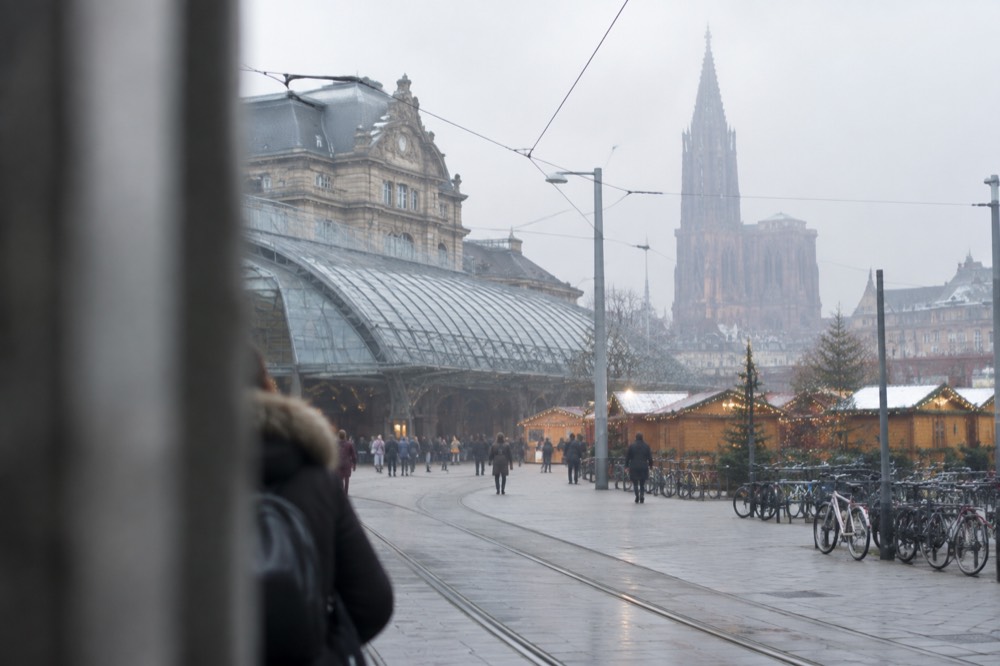
Plan around three numbers: transit from the station costs 1.90 EUR a ride or 4.60 EUR for a 24h Solo pass, the cathedral platform costs 10 EUR full and 6 EUR reduced with the astronomical clock show at 12:30 daily for a 4 EUR ticket, and the climate is semi-continental, with mean daily maxima running from 5.2 C in January to 26.4 C in July and 635.7 mm of rain a year.
The sight tickets are worth lining up before arrival because two of them are time-sensitive. The astronomical clock performs its full automaton show at 12:30 sharp, and the cathedral's own page is explicit that tickets are sold on the day only, at the cathedral stalls in the morning or at the Saint-Michel entrance from 11:30, with no reservations. The platform above it, reached at 66 m, costs 10 EUR full and 6 EUR reduced, with children under 6 free, and its hours shift with the seasons: the cathedral's pages list the summer and winter windows.
| Sight or service | Price | Timing note |
|---|---|---|
| Cathedral platform, full | 10 EUR | Seasonal hours on the cathedral page |
| Cathedral platform, reduced | 6 EUR | Children under 6 free |
| Astronomical clock show | 4 EUR | 12:30 daily, day-of tickets only |
| Batorama long river tour | 16.20 EUR full, 8.90 EUR reduced | Red Tour, 1h10 |
| Batorama short river tour | 12.50 EUR full, 7.20 EUR reduced | Blue Tour, 0h45 |
The river tours in that table are the other station-adjacent classic: Batorama's boats leave from the centre and frame the city from the Ill, and the Strasbourg boat tour guide compares the circuits. The best time to visit Strasbourg guide does the same job for the calendar, and the Strasbourg weather guide holds the full monthly breakdown.
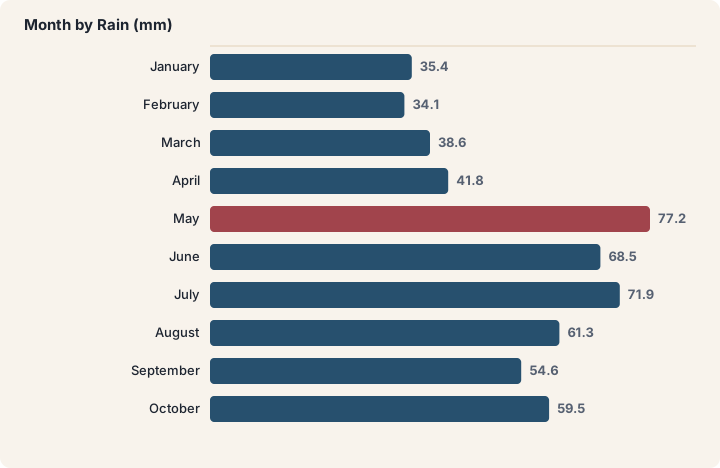
| Month | Mean daily max (C) | Mean daily min (C) | Rain (mm) | Days with 1 mm or more |
|---|---|---|---|---|
| January | 5.2 | -0.2 | 35.4 | 9.1 |
| February | 7.3 | 0.0 | 34.1 | 8.3 |
| March | 12.1 | 2.6 | 38.6 | 8.5 |
| April | 17.0 | 5.7 | 41.8 | 8.6 |
| May | 20.9 | 10.1 | 77.2 | 10.8 |
| June | 24.4 | 13.4 | 68.5 | 10.2 |
| July | 26.4 | 14.9 | 71.9 | 10.4 |
| August | 26.1 | 14.5 | 61.3 | 9.5 |
| September | 21.6 | 10.7 | 54.6 | 8.0 |
| October | 15.8 | 7.2 | 59.5 | 9.6 |
| November | 9.4 | 3.3 | 47.6 | 9.2 |
| December | 5.9 | 0.8 | 45.2 | 10.2 |
Those normals, from Meteo-France's 1991-2020 series for Strasbourg-Entzheim, describe a semi-continental climate: cold winters, warm summers, and rain spread fairly evenly through the year rather than concentrated in a wet season. May is the wettest month at 77.2 mm and February the driest at 34.1 mm, and the city sits in the rain shadow of the Vosges. The practical takeaway for a station arrival is that no month is a bad month, but an umbrella earns its place in the bag year-round.
Which Guided Tours Work Well With A Train Arrival?
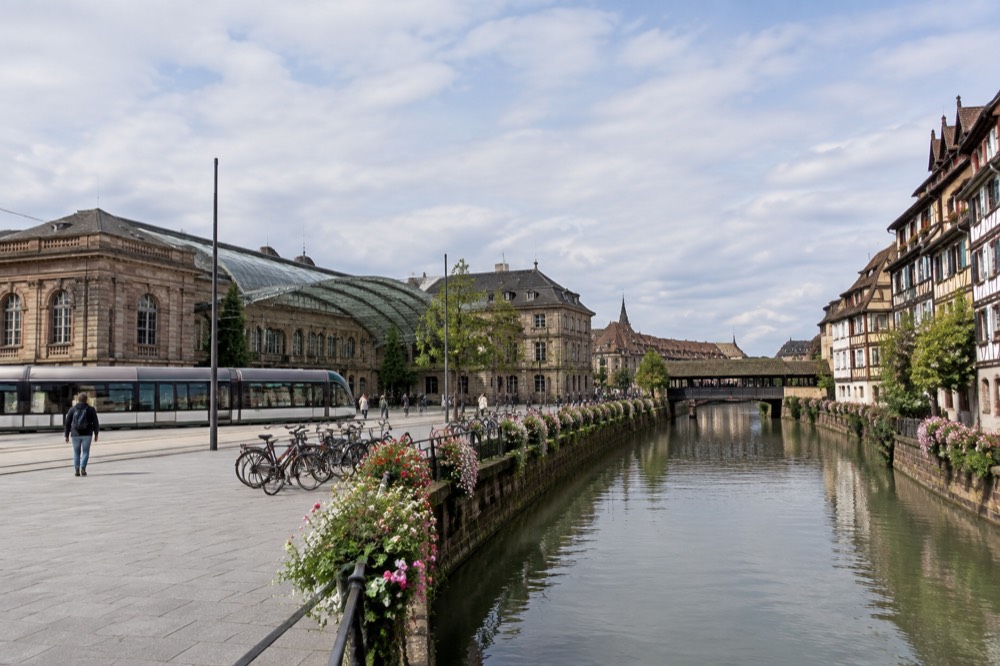
The tours that fit a rail arrival best are the centre-based walks, reachable within minutes of the platforms, the food and gourmet walks that turn the winstub quarter into the itinerary, and the regional day excursions to the Alsace villages, the Vosges memorials or the Christmas markets, all departing from the city the station delivers you into.
The starting point for many travellers is a historic walking tour led by a local guide, which covers the old centre, the cathedral quarter and the river lanes in one guided sweep; it is the most efficient first move after a morning train from Paris, and it can be Check availability on the operator's live listing before you commit to a time.
Food is the other thread worth booking. Strasbourg's table runs through tarte flambée, choucroute, baeckeoffe and kougelhopf, and a gourmet tastings walk stitches those dishes together street by street, which suits a traveller who arrives hungry and wants the centre explained through its kitchens. The Strasbourg food tour guide compares the options.
Beyond the city, the day excursions do the driving. The wine route villages, the Colmar and Riquewihr circuit, the Black Forest across the river in Germany and the Christmas market towns in season all run as guided day trips from Strasbourg, and each pairs with a station arrival better than a hire car for travellers who would rather not drive on the right-hand roads of two countries in one week. The Strasbourg tours overview collects them.
For a final word on the station itself: it is a working terminus in a border city, cheap to leave, quick to reach from Paris or the airport, and surrounded by a tram network that turns the whole of the Grande Île into a short ride.
Common Questions About Strasbourg Train Station
How Far Is Strasbourg Train Station From The City Centre?
The station sits at the western edge of central Strasbourg, and trams and buses link the forecourt to the Grande Île in a short ride. A single ticket costs 1.90 EUR through the Badgéo card, the CTS app or contactless payment, or 2.50 EUR bought on board a bus, and a 24h Solo pass is 4.60 EUR.
Do Trams Run From Strasbourg Train Station?
Yes, the CTS tram and bus network serves the station, and the same tickets cover the whole city. The 24h Solo pass at 4.60 EUR suits a day of sightseeing, and the 24h Trio at 10.20 EUR covers two or three people travelling together.
How Long Is The Train From Paris To Strasbourg?
The fastest trains cover the route in about 1 hour 45. Fares vary with demand and no fixed price applies, so check SNCF Connect for timetables and tickets before booking.
Is The Christmas Market Near Strasbourg Train Station?
The market's chalets spread across the historic squares of the centre, a short tram or bus ride from the station. The usual pattern opens in the last week of November and runs to 24 December; last year's edition ran 26 November to 24 December 2025 and drew 3.05 million visitors. The 2026 dates should be confirmed on the city's official Christmas site.
Can You Reach Germany From Strasbourg Train Station?
Yes, local trains cross the Rhine to Kehl, and France and Germany are both in the Schengen area, so there are no border checks. Both countries use the euro, so no currency change is needed for a trip to the German bank.
Are Strasbourg Museums Free?
Municipal museums cost 9 EUR full price and 5 EUR reduced, with a one-day Pass Musées at 20 EUR, and every municipal museum is free on the first Sunday of each month. The Musée Alsacien is closed for works until 2028 and should not be on an itinerary.