Frankfurt To Strasbourg Train
Frankfurt Airport is one of the main gateways into Germany, and Strasbourg, the capital of Alsace in north-eastern France, sits within easy rail reach of it. This guide covers how the train connection works, where you arrive, what tickets and sights cost once you are there, and how to turn the transfer into a proper visit.
Short answer
Trains link Frankfurt with Strasbourg, in north-eastern France, with direct long-distance services on some departures and a change elsewhere; exact times and fares vary, so check the operators' booking sites before travelling. Strasbourg's Gare Centrale sits a short tram ride from the historic centre, where a 24-hour CTS pass costs 4.60 EUR and the cathedral platform is 10 EUR.
Frankfurt Airport is one of Europe's busiest interchange points, and Strasbourg, the prefecture of the Bas-Rhin in Alsace, north-eastern France, lies across the Rhine plain from it. Travellers landing in Frankfurt often assume Strasbourg is awkward to reach, yet the two cities sit on the same rail corridor, and the French city's station feeds trams straight into a UNESCO-listed historic centre. The catch is that journey times, frequencies and fares on this corridor change with the timetable and the booking window, so this guide sticks to what holds still: how the connection is structured, what Strasbourg's arrival logistics actually look like, and what the verified local prices are once you step off the train.
How Do You Travel From Frankfurt Airport To Strasbourg?
The route runs by rail from Frankfurt Airport's own long-distance station into Strasbourg's Gare Centrale, in north-eastern France, either on a through service or with a change at a German interchange such as Karlsruhe or Offenburg. Departure patterns, journey times and fares on this corridor shift with the timetable, so no fixed duration or price belongs on a page like this: the operators' booking sites are the only place to confirm a specific train.
Frankfurt Airport has its own dedicated rail stations for both long-distance and regional services, which is what makes this transfer workable. You do not need to go into Frankfurt city first. From the airport's platforms, the corridor heads south along the Rhine, and Strasbourg appears on the French side of the border after the river crossing near Kehl. Some departures run through; others ask for one change on the German stretch. Neither version is complicated, but the difference in journey time between them can be significant, which is exactly why the live timetable matters more than any printed average.
Booking behaves the way it does on cross-border routes everywhere. German and French operators each sell tickets across the border, and prices move with demand. A seat reserved a few weeks ahead is a different animal from one bought at the airport on the morning of travel. If your dates are fixed, book ahead; if they are loose, check both operators' sites and compare, because the cheapest option is not always from the carrier whose train you end up riding.
One practical point deserves emphasis. Strasbourg is a small city with an outsized draw, and its hotel base fills around the Christmas market period. Travellers who treat Strasbourg as a brief stopover between Frankfurt and somewhere else routinely end up wishing they had booked a night. The pages on planning the journey from Paris and on why the Paris train costs what it does cover the same logic from the French capital's side, and the pricing behaviour rhymes.
Where Does The Train Arrive In Strasbourg?
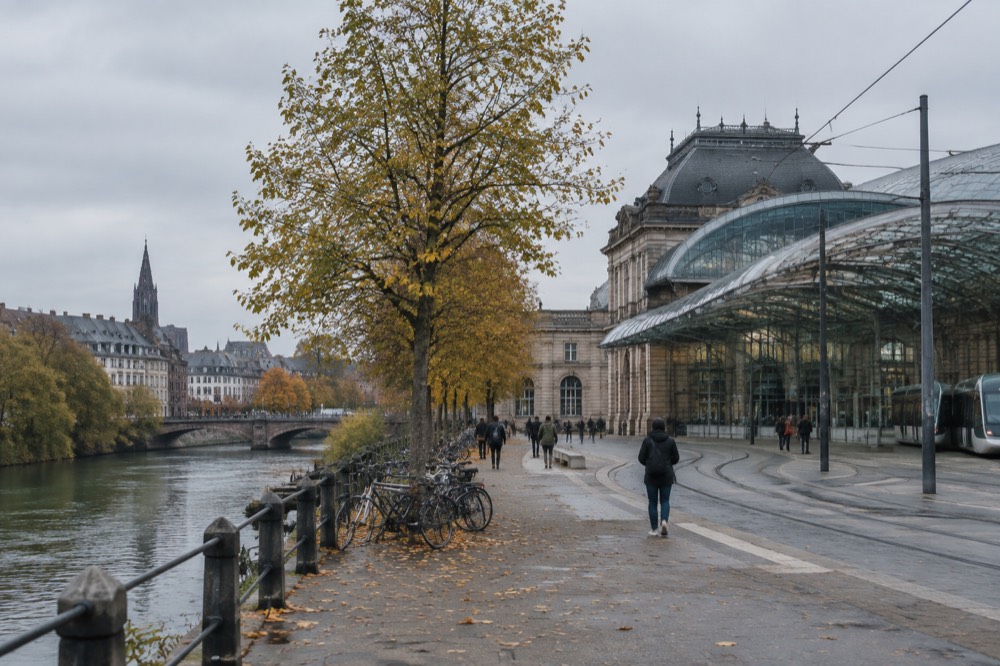
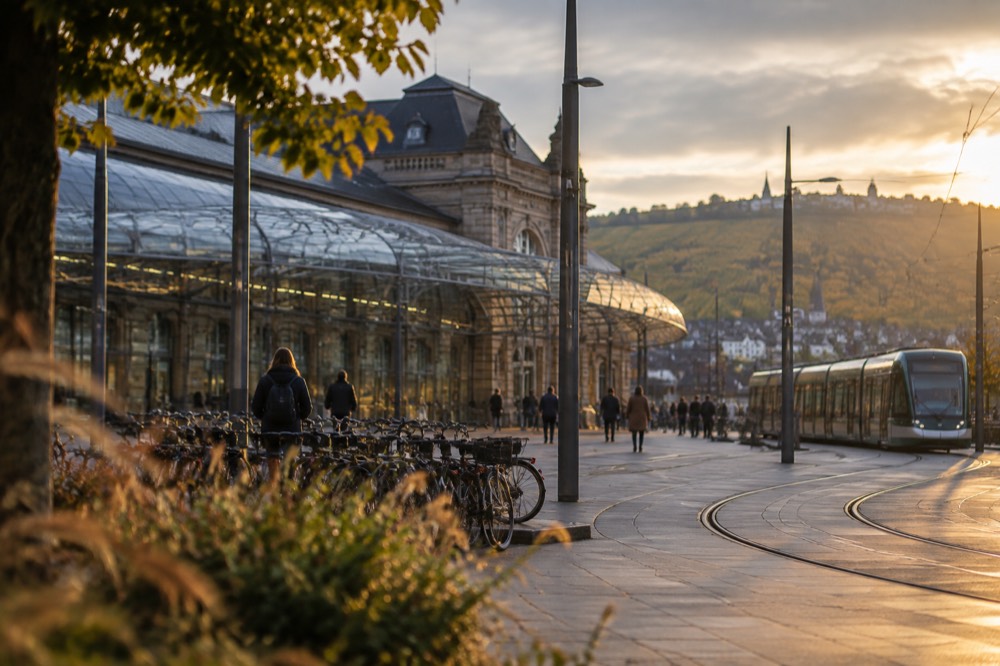
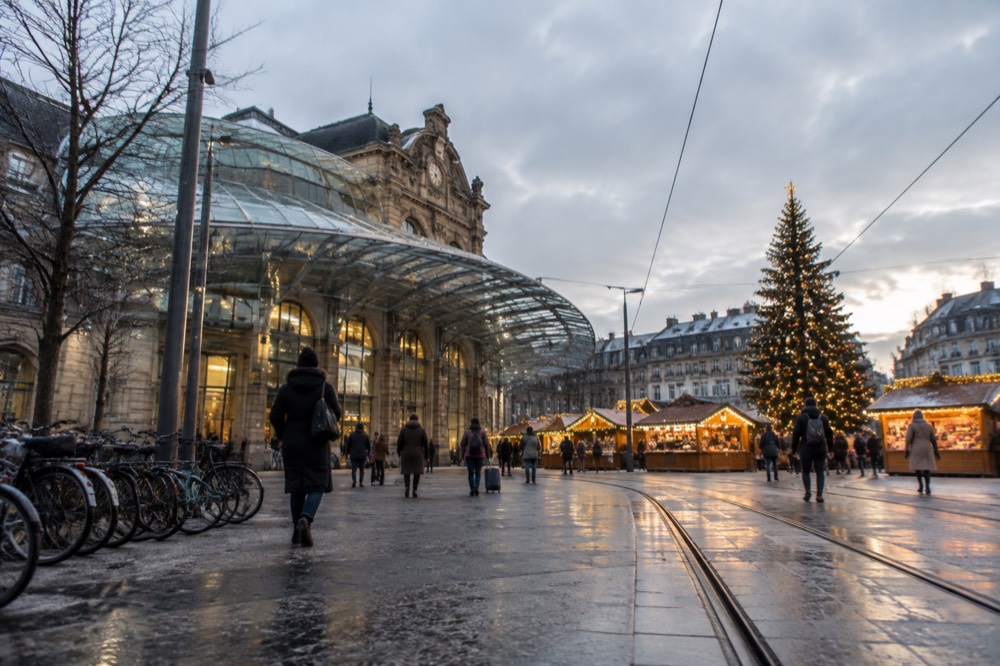
Trains from Frankfurt pull into Strasbourg's Gare Centrale, the city's main station, which stands about one neighbourhood north of the historic Grande Île. The station is a terminus-style hub with tram stops directly outside: lines serving the city centre, the gare district and the European institutions all leave from the forecourt, and a single CTS ticket bought from a machine or by contactless payment covers the ride. Nothing about the arrival requires a taxi unless you are carrying heavy luggage.
The station building itself is worth a pause. Its glass dome divides opinion, but the practical reality is simple: everything you need is in one hall. Ticket machines, the CTS customer space, luggage lockers and the tram platform exits sit within a couple of minutes' walk of each other. The gare district guide maps the neighbourhood if you are staying near the station rather than in the old town, and there is a decent case for it, since every tram line you want passes through it.
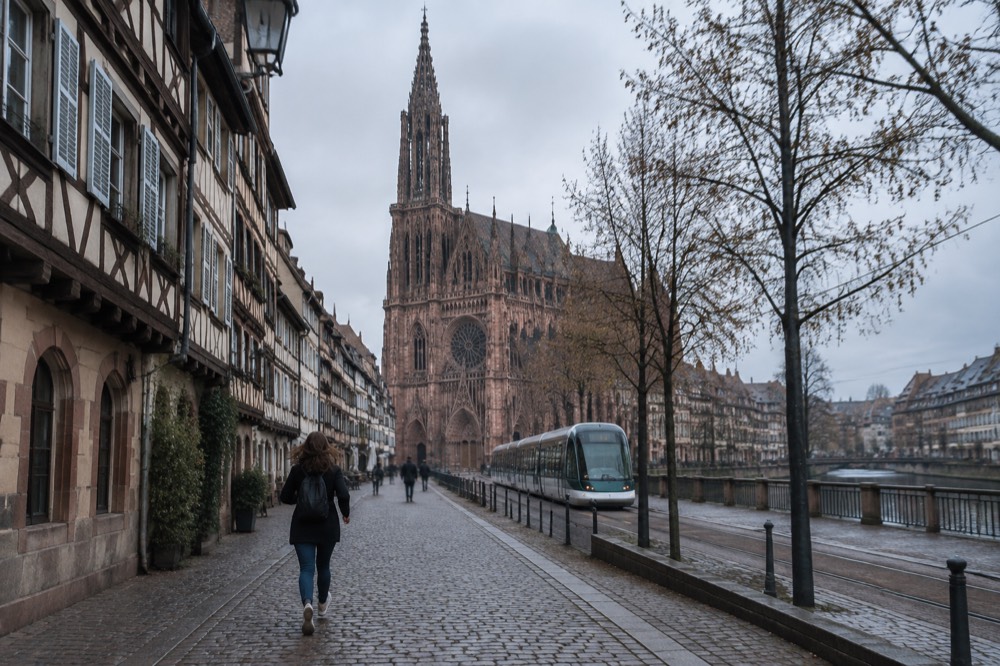
From the forecourt, the historic centre is a straight tram ride, and the walk is also manageable if you travel light. The Grande Île, the river island holding the cathedral, Petite France and the covered bridges, begins a short distance south of the station. First-time visitors often overestimate the distance; the city is compact, flat, and better served on foot than any other way.
For travellers who want the geography explained rather than discovered by trial and error, a guided walk on the first morning pays for itself in saved wandering. The guided walking tour of Strasbourg with a local guide format is the standard choice, and the free pay-what-you-want English walks booked through GuruWalk cover the same ground for travellers protecting a budget. Both leave from central meeting points within walking distance of the tram stops outside the station.
What Should You Do On Your First Day In Strasbourg?
Most first-day itineraries should run cathedral, then Petite France, then the river, in that order. Strasbourg Cathedral opens its nave on Monday to Saturday from 08:30 to 11:15 and 12:45 to 17:45, and on Sunday afternoons from 14:00 to 17:15; the astronomical clock performs at 12:30 sharp for a 4 EUR ticket sold on the day only; and the platform at 66 m costs 10 EUR full price, 6 EUR reduced. Petite France and the riverside cost nothing to wander.
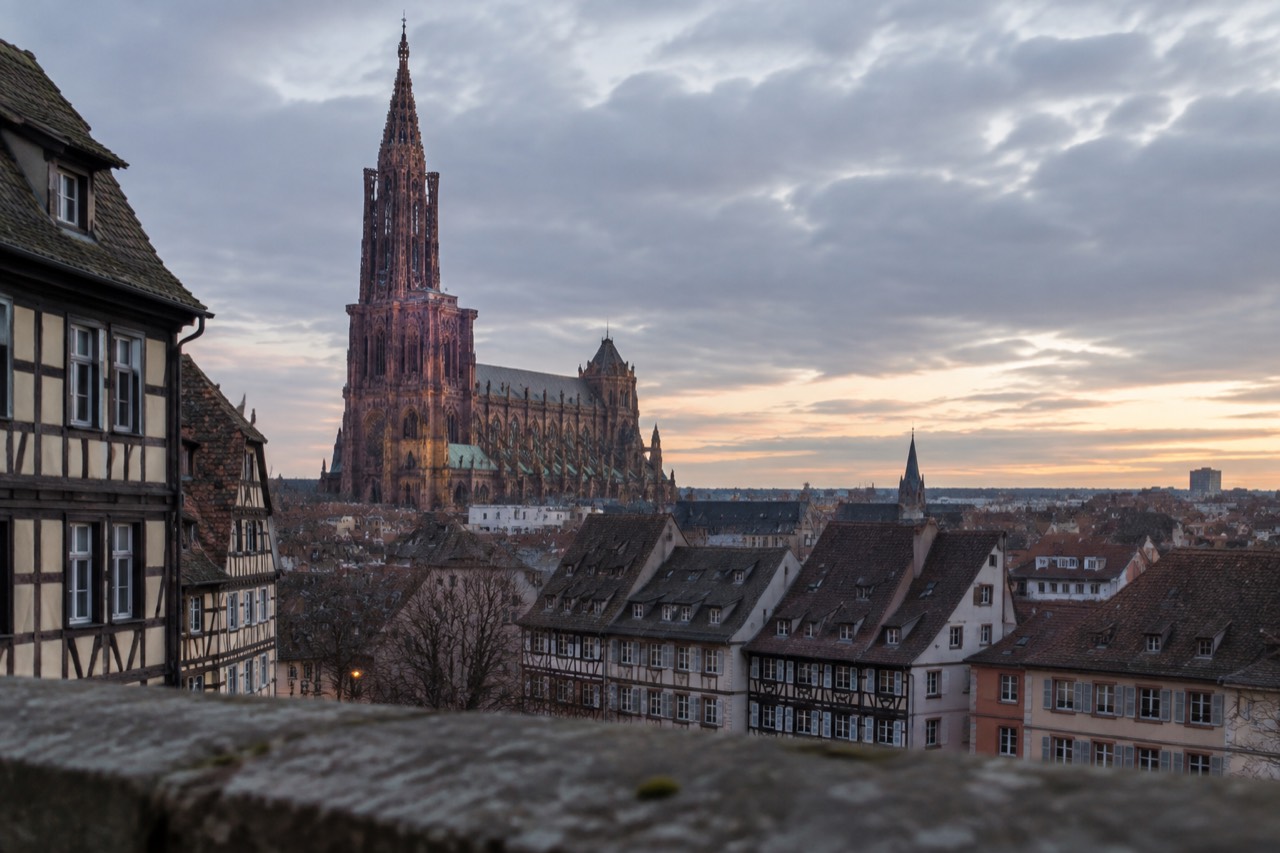
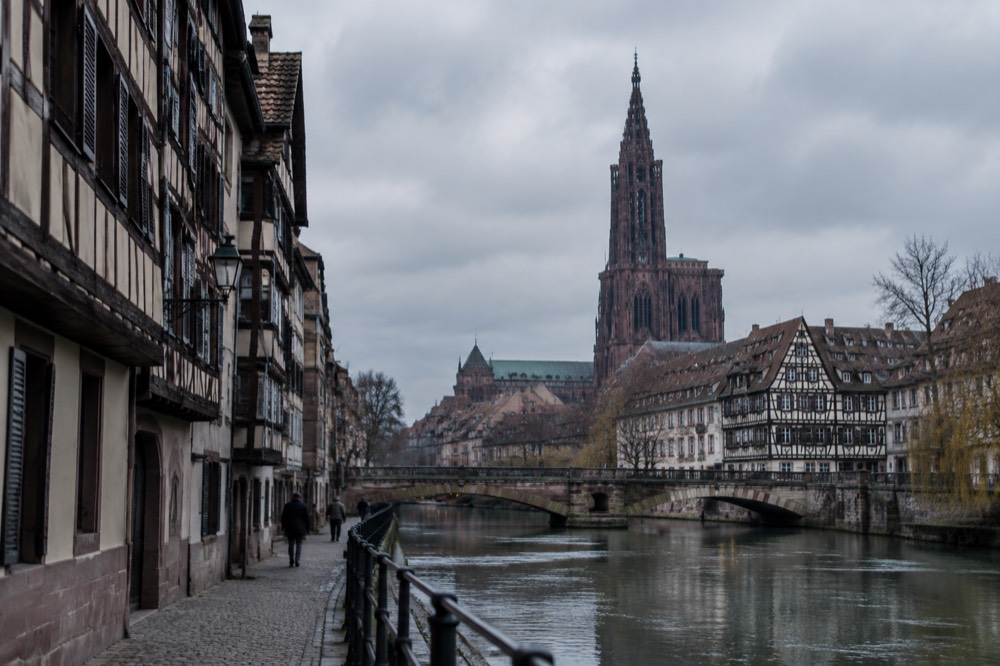
The cathedral is the anchor, and not only for its single spire, which dominates the skyline from every approach. The nave is free of charge to enter during opening hours, and the interior rewards slow looking rather than a quick circuit. The astronomical clock is the interior event: a full automaton show at 12:30 daily, with tickets sold on the day only, at the cathedral stalls in the late morning or at the Saint-Michel entrance on the Place du Château from 11:30. There are no reservations, so if the clock is on your list, plan to be in the square by late morning.
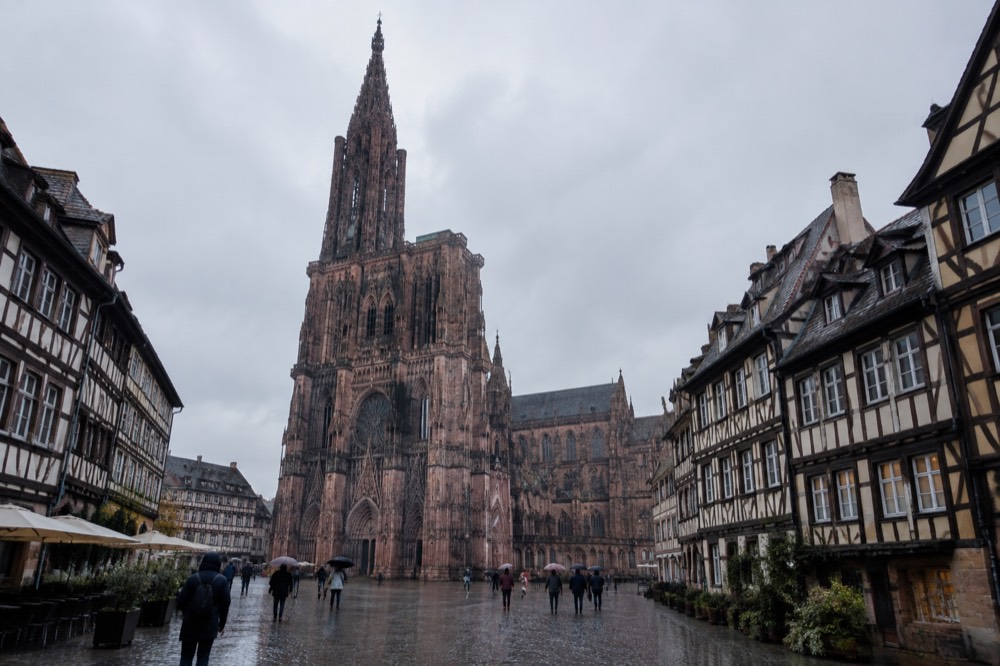
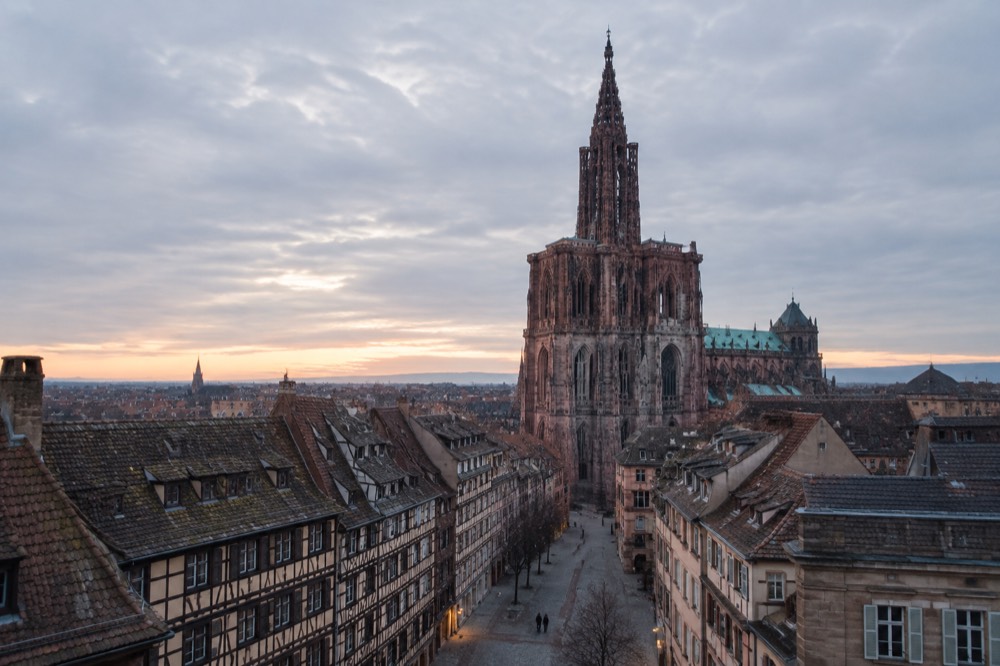
The platform deserves its 10 EUR. The stair climb ends at 66 m, on the tower's viewing stage, with the city laid out below: the orange roofs of the Grande Île, the Ill's loops, and on clear days the line of the Vosges to the west and the Black Forest hills to the east. Hours are seasonal: from 1 April to 30 September the platform runs 09:30 to 13:00 and 13:30 to 20:00 with the last ascent at 19:15; from 1 October to 31 March it runs 10:00 to 13:00 and 13:30 to 18:00, last ascent 17:15. It closes on 1 January, 1 May and 25 December.
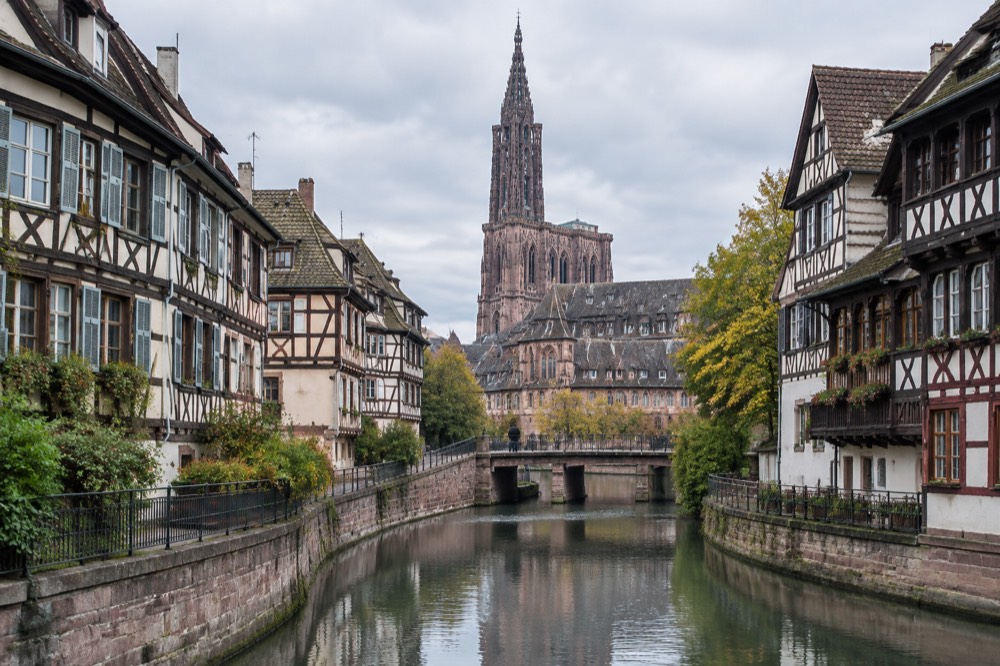
Afternoon belongs to Petite France, the former tanners' and millers' quarter at the western tip of the island, where the Ill splits into channels around half-timbered houses. From there the Covered Bridges and the Barrage Vauban terrace follow one another in sequence; the terrace has seasonal opening hours, 08:00 to 19:00 in September and October, and 08:30 to 16:00 from November to February, with admission to be checked on the official page. The Petite France guide and the one day in Strasbourg itinerary both break the walk down street by street.
How Much Do Tickets And Transport Cost Once You Arrive?
Local transport is cheap and flat-priced: a single CTS ticket costs 1.90 EUR bought via the Badgéo card, the CTS app or contactless payment, or 2.50 EUR bought on board a bus, and a 24-hour Solo pass costs 4.60 EUR with a 24-hour Trio pass for two to three people at 10.20 EUR.
Sight admissions are separate, with the cathedral platform at 10 EUR, the clock show at 4 EUR, municipal museums at 9 EUR full price and the 1-day Pass Musées at 20 EUR.
The CTS network covers trams and buses across the city and its suburbs, and for a visitor staying anywhere central, the 24-hour Solo pass at 4.60 EUR is usually the whole answer. Buy it from machines at tram stops or through the app, validate it, and ride as often as you like until the same time the next day. The Trio pass at 10.20 EUR splits across two or three people travelling together, which makes it the family option. There is also a combined airport ticket, described below, for travellers continuing through Strasbourg's own airport.
| Ticket | Price | What it covers |
|---|---|---|
| CTS single (Badgéo, app, contactless) | 1.90 EUR | One journey on tram or bus |
| CTS single bought on board a bus | 2.50 EUR | One journey, no advance purchase |
| 24H Solo pass | 4.60 EUR | Unlimited tram and bus for 24 hours |
| 24H Trio pass | 10.20 EUR | 24 hours for two to three people travelling together |
| Airport combined ticket | 4.60 EUR | Train shuttle from Entzheim plus tram/bus plus a 24H EMS pass |
The airport row matters for one specific group: travellers whose onward plans involve Strasbourg Airport (SXB) at Entzheim, whether flying out or meeting a connection. A train shuttle runs from the airport to Strasbourg station up to five times an hour and takes 8 minutes, and the combined ticket covering the shuttle plus city transport plus a 24H EMS pass costs 4.60 EUR. Jet2 has also announced winter routes from SXB to Edinburgh, Manchester and London Stansted, twice weekly, which makes the airport a live option for British travellers building an open-jaw trip through Frankfurt and out of Strasbourg. The Strasbourg airport guide covers the terminal side in detail.
For sightseeing costs, the Strasbourg City Card is a discount card rather than an all-inclusive pass: 5 EUR adult, 3.50 EUR for children aged 3 to 17, valid for seven days, and it knocks money off museums, the boat tour, the cathedral platform, the clock and guided visits. Whether it saves you money depends on how much of that list you will actually do; the city pass guide does the arithmetic.
Is Strasbourg Worth Adding Days To A Frankfurt Trip?
Yes, and the case rests on density rather than on any single sight. The Grande Île and the Neustadt together form a UNESCO World Heritage property, the cathedral holds one of the great astronomical clocks, the municipal museums cost 9 EUR full price and are free on the first Sunday of every month, and the city sits at the meeting of two wine regions and two countries. A Frankfurt transfer becomes a genuine short break with two added nights.
The museum layer is stronger than the city's size suggests. The Musée des Beaux-Arts in the Palais Rohan, the Musée de l'Œuvre Notre-Dame beside the cathedral, the MAMCS contemporary art museum and the Archaeological Museum all charge 9 EUR full price, 5 EUR reduced, with a 1-day Pass Musées at 20 EUR covering them together. Every municipal museum is free on the first Sunday of the month, which is the single best-value timing trick in the city. One closure to plan around: the Musée Alsacien is shut for works until 2028 and should not appear on any itinerary. The rest of the planning pages sit on Strasbourg Travel Guide.
| Sight or ticket | Full price | Reduced | Notes |
|---|---|---|---|
| Cathedral nave | No admission charge listed on the hours page | Same | Open Mon-Sat 08:30-11:15 and 12:45-17:45, Sun 14:00-17:15 |
| Cathedral platform (66 m) | 10 EUR | 6 EUR, under 6 free | Seasonal hours; closed 1 Jan, 1 May, 25 Dec |
| Astronomical clock show (12:30) | 4 EUR | 3 EUR groups and students to 25, 2 EUR ages 6-17 | Day-of tickets only, no reservations |
| Municipal museums | 9 EUR | 5 EUR | Free first Sunday of every month |
| Pass Musées, 1 day | 20 EUR | Same | Covers the municipal museums together |
| Strasbourg City Card | 5 EUR | 3.50 EUR ages 3-17 | 7 days, discounts only, not a pass |
| Batorama long tour | 16.20 EUR | 8.90 EUR | Red Tour, 1h10 |
| Batorama short tour | 12.50 EUR | 7.20 EUR | Blue Tour, 0h45 |
The river layer deserves its own half-day. Batorama's glass-roofed boats run from the Quai des Bateliers through the city's waterways, the long tour lasting 1h10 and the short tour 0h45, and the ride doubles as the fastest way to understand how the Ill, the canals and the Rhine fit together. The river cruise stop guide is written for travellers arriving by boat, but the sightseeing logic is the same.
Beyond the city, the day-trip range is what turns a stopover into a base. The Alsace wine route, the walled villages, the Haut-Koenigsbourg castle and the German Black Forest all sit around Strasbourg, and the border is close enough that a single day can include lunch in France and afternoon cake in Germany. The is Strasbourg worth visiting page makes the general case; the practical one is that few cities of 293,771 residents (INSEE, 2023) carry this weight of heritage and this spread of excursions.
Coaches also connect Strasbourg with cities across the region. Book an intercity bus ticket here.
What Is The Weather Like Across The Year?
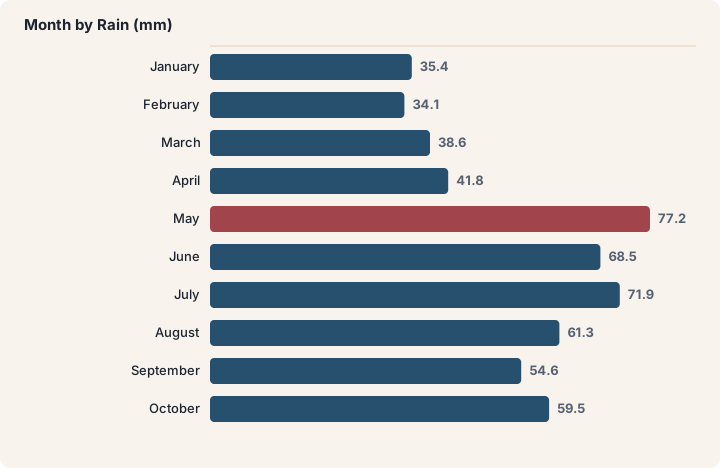
Strasbourg has a semi-continental climate, with cold winters and warm summers, in the rain shadow of the Vosges. Meteo-France 1991-2020 normals for Strasbourg-Entzheim put the mean daily maximum at 5.2 C in January rising to 26.4 C in July, the mean minimum at -0.2 C in January and 14.9 C in July, and annual rainfall at 635.7 mm over 112.3 days with 1 mm or more.
May is the wettest month at 77.2 mm and February the driest at 34.1 mm.
What that means for a Frankfurt-Strasbourg trip is straightforward. Winter visits are cold but usually dry-ish: December averages a 5.9 C maximum and a 0.8 C minimum, with 45.2 mm of rain over 10.2 rain days, so pack for temperatures around freezing in the evenings and a real chance of damp. Summer visits are genuinely warm, with July and August maxima above 26 C, and the rain comes in short heavy spells rather than long drizzle. The Strasbourg weather guide unpacks the seasons month by month.
| Month | Mean daily maximum (C) | Mean daily minimum (C) | Rain (mm) | Days with 1 mm or more |
|---|---|---|---|---|
| January | 5.2 | -0.2 | 35.4 | 9.1 |
| February | 7.3 | 0.0 | 34.1 | 8.3 |
| March | 12.1 | 2.6 | 38.6 | 8.5 |
| April | 17.0 | 5.7 | 41.8 | 8.6 |
| May | 20.9 | 10.1 | 77.2 | 10.8 |
| June | 24.4 | 13.4 | 68.5 | 10.2 |
| July | 26.4 | 14.9 | 71.9 | 10.4 |
| August | 26.1 | 14.5 | 61.3 | 9.5 |
| September | 21.6 | 10.7 | 54.6 | 8.0 |
| October | 15.8 | 7.2 | 59.5 | 9.6 |
| November | 9.4 | 3.3 | 47.6 | 9.2 |
| December | 5.9 | 0.8 | 45.2 | 10.2 |
The semi-continental label matters more than it sounds. This is not Mediterranean France and it is not the mild Atlantic west: winters bite, summers build heat, and the shoulder months of April, May, September and October offer the comfortable middle ground, with May the one shoulder month that carries a heavy rain load. Travellers connecting through Frankfurt in winter for the Christmas market should treat the cold as a feature of the trip, not a surprise.
When Is The Best Time To Make The Trip?
For the Christmas market, plan around the pattern rather than a published date: the market opens in the last week of November and runs until 24 December, and the city posts each edition's dates on its Christmas site, so confirm them there before booking anything. Last year's edition ran 26 November to 24 December 2025 and drew 3.05 million visitors. Outside the market window, late spring and early autumn give the best balance of weather and crowds.
The Christmas market is the reason this corridor gets busy in December. Strasbourg styles itself around the Christmas season, and the 2025 edition's attendance of 3.05 million, down from 3.4 million the year before, tells you what the streets feel like in the run-up to the holidays. Chalets typically open from late morning into the evening, and the market closes early on 24 December. The city's own Christmas site is where the 2026 dates and programme will appear, and until they do, any specific date you read elsewhere is a guess dressed as a fact.
| Christmas market planning point | What is settled | What to check |
|---|---|---|
| 2025 edition dates | 26 November to 24 December 2025 | Past edition, for pattern only |
| 2025 attendance | 3.05 million visitors | Scale of the December crowds |
| 2026 dates | Not yet published by the city | noel.strasbourg.eu, the official Christmas site |
| Usual pattern | Opens in the last week of November, runs to 24 December | Confirm the opening day on the official site |
| 24 December | Market closes early in the evening | Exact closing time on the official site |
| Hotel demand | December fills the city's accommodation | Book early; see the where-to-stay guides |
If December is too cold or too crowded for your taste, the alternatives have their own logic. June through August brings the warm weather and the open-air café life, with July maxima at 26.4 C, but it also brings the tour groups. April, May, September and October are the connoisseur's months: the best time to visit guide ranks the seasons properly, and the Strasbourg in winter page covers the non-market case for cold-weather travel, from winstub fires to empty museum halls.
Which Day Trips Pair Well With Strasbourg?
The strongest pairings from Strasbourg are the Alsace wine villages to the south-west, the castle country around Haut-Koenigsbourg, and the German Black Forest directly across the Rhine, with Freiburg, Titisee and Triberg forming the classic circuit. Guided day trips cover the logistics that a train arrival makes awkward: the wine villages are scattered, the castle sits on a ridge, and the Black Forest's best stops are not on one convenient rail line.
The Black Forest pairing is the natural one for travellers who have arrived from Frankfurt, because it closes the loop: you come in through German rail territory, and a day trip back across the border from Strasbourg shows you the forest country at a slower pace. The roster's Black Forest day trip to Freiburg, Titisee and Triberg is the established version, and its live listing carries the current price, duration and departure point. Check availability if the loop-back appeals; the operator's listing shows the free-cancellation terms alongside the schedule.
| Day trip from Strasbourg | What it is for | Who it suits | What to check |
|---|---|---|---|
| Black Forest: Freiburg, Titisee, Triberg | Forest scenery, a university city, waterfalls and clock country | Travellers who arrived via Germany and want the loop closed | Tour listing for departure point and inclusions |
| Alsace wine route villages | Half-timbered wine villages and cellar tastings | First-time visitors to Alsace | Which villages each tour visits |
| Haut-Koenigsbourg and Riquewihr | A castle ridge above the plain plus a walled wine town | Families and photographers | Castle opening dates in low season |
| Colmar | A canal town an easy hop south | Anyone short on time | Whether the day trip includes free time |
| European institutions, Strasbourg itself | Parliament quarter and the Parlamentarium | Politics and architecture enthusiasts | Parlamentarium hours, which differ in plenary weeks |
On the French side, the wine route trips run from Strasbourg into villages whose names read like wine labels, and the half-day and full-day versions trade depth for pace. The Alsace wine route guide and the most beautiful villages guide cover the ground independently for travellers who would rather use regional trains than a coach. The where can you go by train from Strasbourg answer lists the rail-reachable options, which is the right page for anyone building the trip around a rail pass rather than tours.
How Do You Turn A Transfer Into A Short Break?
Book at least two nights, sleep inside or beside the Grande Île, give the first full day to the cathedral, Petite France and a Batorama boat trip, and give the second to one excursion, either the wine route or the Black Forest. The train corridor works in both directions, so an open-jaw flight into Frankfurt and out of Strasbourg, or the reverse, removes the return leg entirely and turns dead travel time into the best part of the trip.
Accommodation is the first decision. Staying in the old town puts the evening walks and the winstubs on your doorstep but costs more; staying near the station puts every tram at the door. The where to stay in Strasbourg guide breaks the neighbourhoods down, and the Christmas-specific version, where to stay for the Christmas market, is the one to read for December trips, when location determines whether you see the illuminated streets at midnight or only at noon.
Food is the second. Strasbourg's winstubs serve the Alsatian canon, choucroute, baeckeoffe, tarte flambée, and the winstub guide explains what the institution is and how to behave in one. A food tour on the first evening doubles as dinner and as a map of the dishes worth reordering; the Strasbourg food tour page compares the formats. For the budget picture, the Strasbourg on a budget and free things to do guides show how little a day here can cost once the train ticket is paid.
The evening is the third. Strasbourg at night is a different city: the cathedral's west front floodlit, the Petite France canals dark between the lamps, and the student quarters loud in the Krutenau. The Strasbourg at night page sequences it. A private evening walking tour exists on the roster for travellers who want the spooky version with a guide, and its listing carries the details.
Common Questions About Train Travel From Frankfurt To Strasbourg
How do I get from Frankfurt Airport to Strasbourg by train?
Take a train from Frankfurt Airport's own long-distance station towards Strasbourg, either on a through service or with one change on the German stretch of the corridor. Journey times and fares vary by departure and booking window, so confirm the specific train on the operators' booking sites rather than relying on a printed average, and buy in advance if your dates are fixed.
Where does the train from Frankfurt arrive in Strasbourg?
Trains arrive at Strasbourg's Gare Centrale, the city's main station, with tram stops directly on the forecourt. The historic Grande Île is a short tram ride or a manageable walk away, and a single CTS ticket at 1.90 EUR covers the connection.
Do I need to book the Frankfurt to Strasbourg train in advance?
Booking ahead is the safer play on this corridor. Cross-border fares move with demand, and a ticket bought weeks in advance generally costs less than one bought on the day of travel at the airport station. Compare both the German and the French operator's booking sites before paying, since each sells across the border.
How many days should I spend in Strasbourg after arriving from Frankfurt?
Two nights is the sensible minimum, which gives one full day for the cathedral, Petite France and a river trip, and a second day for one excursion. The short version is that a stopover of a few hours sells the city badly; the is Strasbourg worth visiting page makes the fuller case for lingering.
Is Strasbourg expensive once I arrive?
Local costs are modest by big-city standards. A 24-hour CTS pass is 4.60 EUR, the cathedral platform is 10 EUR, the clock show is 4 EUR, municipal museums are 9 EUR and free on the first Sunday of the month, and the Strasbourg City Card discount card is 5 EUR for seven days. Winstub mains sit in the middle range; the on-a-budget guide shows how low a day can go.
Can I fly out of Strasbourg instead of taking the train back to Frankfurt?
Yes, and that is the open-jaw play. Strasbourg Airport at Entzheim is 8 minutes from the main station by a shuttle train running up to five times an hour, with a combined train, tram and 24H EMS ticket at 4.60 EUR. Jet2 has announced winter routes from the airport to Edinburgh, Manchester and London Stansted, twice weekly, which suits British travellers building a loop through Frankfurt.
The Frankfurt to Strasbourg corridor rewards travellers who treat it as more than a line on a rail map. The transfer itself is a routine cross-border ride whose details live on the operators' booking sites, but what waits at the French end, a UNESCO-listed island, a cathedral with a performing clock, a river quarter of tanners' houses, and two countries' worth of day trips within reach, is anything but routine. Book the train early, land at Gare Centrale, buy a 4.60 EUR day pass, and give the city the two nights it deserves.