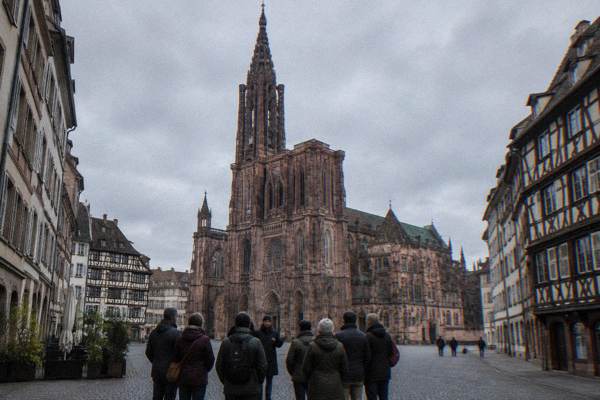
Strasbourg In Spring
Spring in Strasbourg, in north-eastern France, runs from cold March mornings to warm May afternoons, with the half-timbered streets of the Grande Île waking up between them.
Short answer
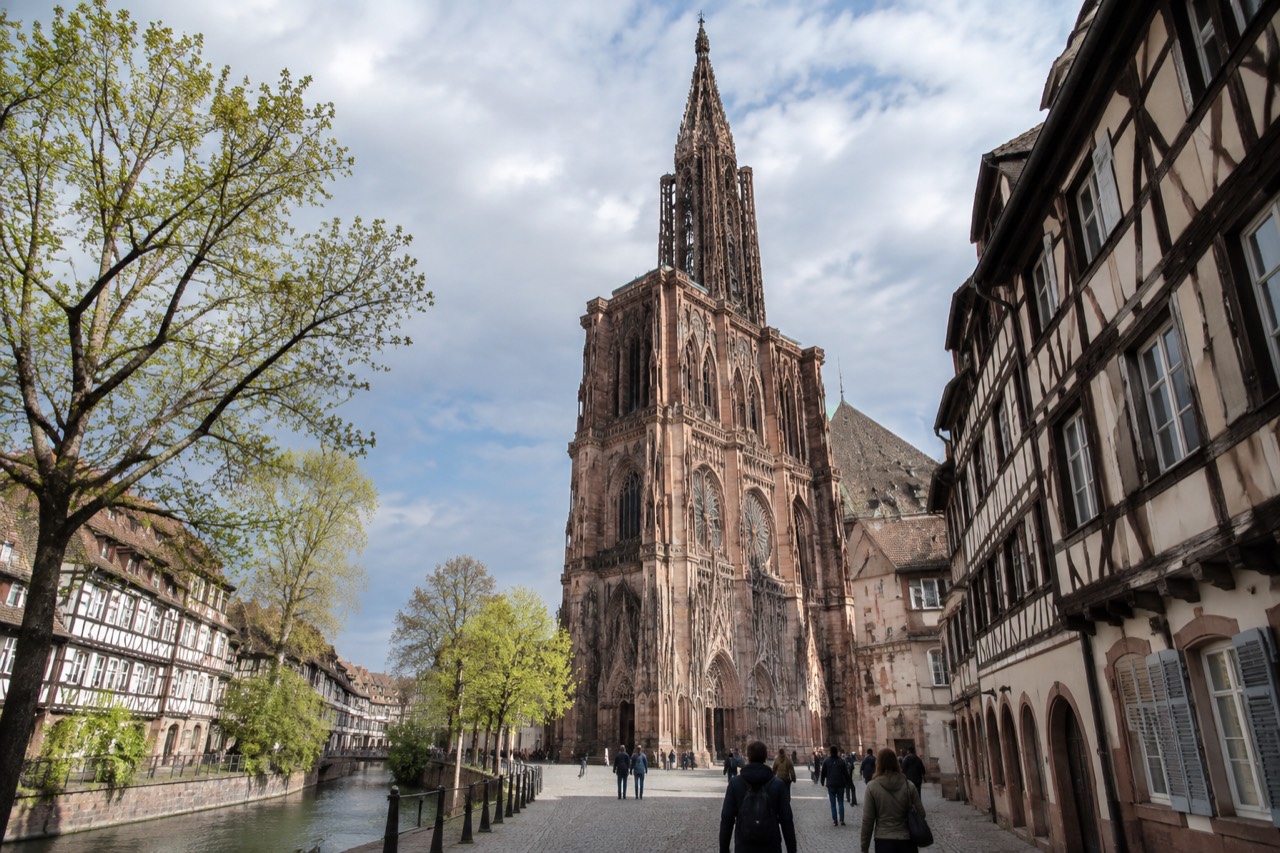
Spring in Strasbourg brings mean daily maxima from 12.1 C in March to 20.9 C in May, with 38.6 to 77.2 mm of rain per month. The cathedral platform opens to 20:00 from April, municipal museums cost 9 EUR and are free on the first Sunday of each month, and the Musée Alsacien stays closed until 2028.
Spring reaches Strasbourg, the prefecture of the Bas-Rhin in Alsace, north-eastern France, in slow stages rather than in one warm week. The city sits on the River Ill beside the Rhine, which forms the border with Germany here, and its semi-continental climate means March can still feel like the tail of winter while May behaves like early summer. The half-timbered streets of the Grande Île, the UNESCO-listed island quarter at the centre of town, shift from bare branches to green canal banks over roughly ten weeks, and the tourist crowds stay thinner than they will at the Christmas market. This guide sets out what the season actually delivers: the weather normals, the sights whose hours change with the clocks, the boats and bikes that suit the season, and the day trips that come into their own once the vineyards turn green.
What Is Spring In Strasbourg Like?
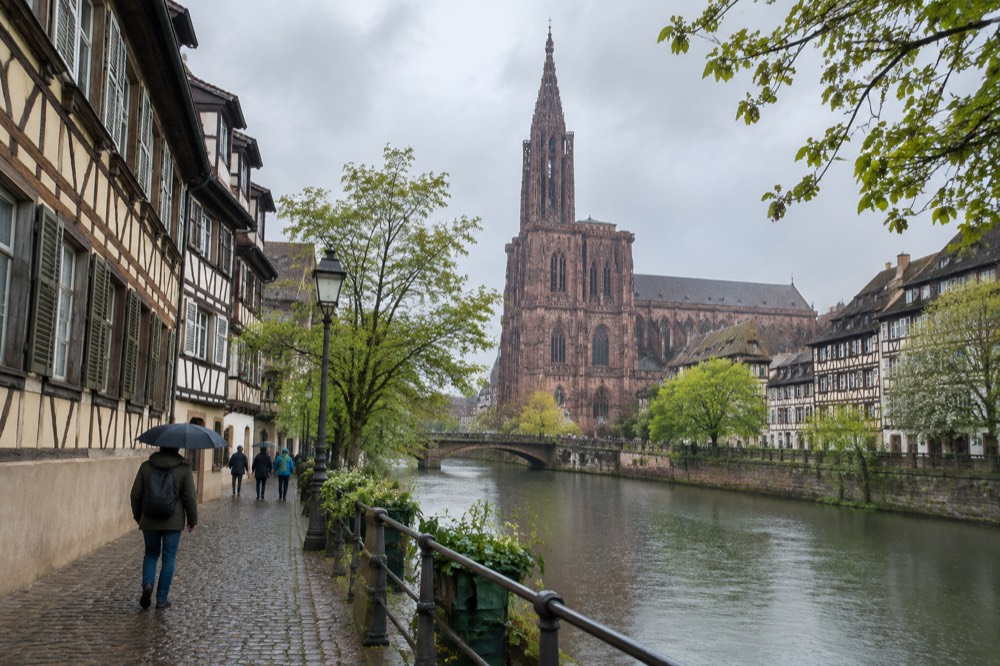
Spring in Strasbourg is a semi-continental spring, not a Mediterranean one: Meteo-France 1991-2020 normals for Strasbourg-Entzheim give a mean daily maximum of 12.1 C in March, 17.0 C in April and 20.9 C in May, with mean minima of 2.6 C, 5.7 C and 10.1 C. Rain falls somewhere between 38.6 mm and 77.2 mm a month across the season, and May is the wettest month of the entire year at 77.2 mm.
The numbers matter more here than in cities with a gentler climate, because the gap between a March afternoon and a May afternoon is close to nine degrees of mean maximum. A visitor who packs for one end of the season and meets the other will be uncomfortable. Meteo-France's normals, published for the Entzheim station that serves the city, put March at 8.5 days with 1 mm of rain or more, April at 8.6 and May at 10.8, so a shower-free week is never a safe assumption in any spring month. The annual picture is 635.7 mm of rain over 112.3 rain days, and the driest month of the year is actually February, at 34.1 mm, which means spring is marginally wetter than the winter it replaces.
| Month | Mean daily maximum | Mean daily minimum | Rainfall | Days with 1 mm or more |
|---|---|---|---|---|
| March | 12.1 C | 2.6 C | 38.6 mm | 8.5 |
| April | 17.0 C | 5.7 C | 41.8 mm | 8.6 |
| May | 20.9 C | 10.1 C | 77.2 mm | 10.8 |
The practical reading of that table is simple. March is a city month: cool enough that the cathedral, the museums and a winstub carry the day, with the first blossom on the Place Kléber and the river banks as a bonus rather than the point. April is the pivot, when the platform hours extend into the evening and the parks fill. May is the warmest and also the wettest spring month, so the greenest photographs come with the highest chance of a soaking. The seasonal overview on Strasbourg weather month by month breaks the full year down, and the comparison with other seasons sits in the best time to visit Strasbourg.
What To Do In Strasbourg In Spring?
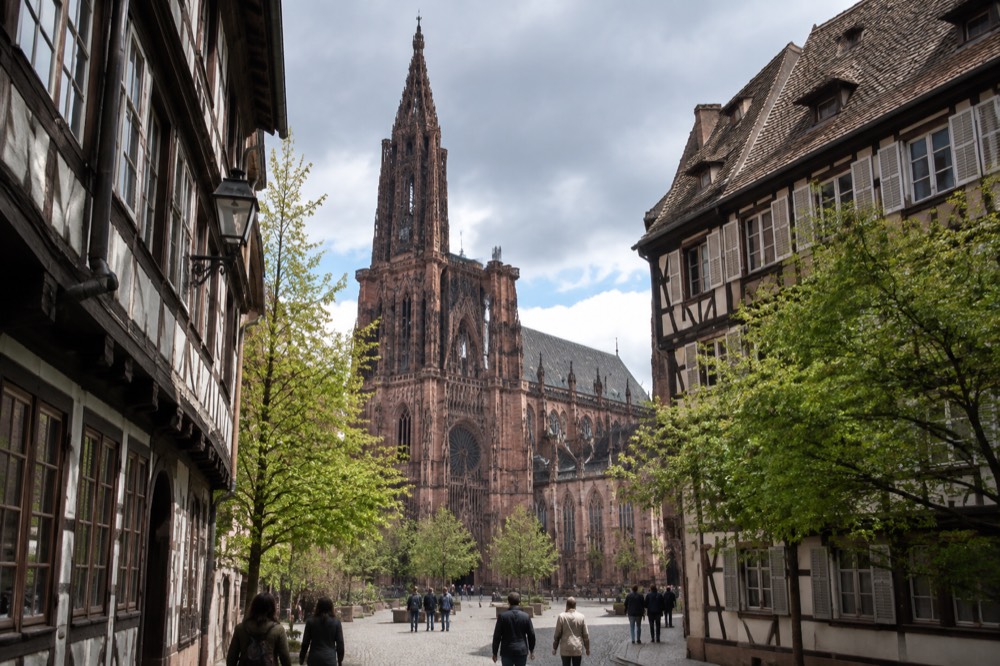
The core of a spring visit to Strasbourg is the walkable Grande Île: the cathedral and its single spire, the Astronomical Clock show at 12:30, Petite France's canals, the Ponts Couverts and the Barrage Vauban terrace, all linked on foot in a day. The clock show costs 4 EUR, the tower platform 10 EUR reduced to 6 EUR, and the municipal museums are free on the first Sunday of every month.
Want someone to walk you through the island's stories? Book a free walking tour here.
The cathedral anchors any first visit, in spring as in every season. The nave keeps its visiting hours of 08:30-11:15 and 12:45-17:45 from Monday to Saturday, and 14:00-17:15 on Sundays and feast days, so a morning walk and an afternoon clock show both fit into one day. The Astronomical Clock performs its full automaton show daily at 12:30 sharp, with tickets at 4 EUR for adults, 3 EUR for groups of 12 or more and students up to 25, and 2 EUR for children from 6 to 17; tickets are sold on the day only, at the cathedral stalls between 10:00 and 11:00 or at the Saint-Michel entrance from 11:30, so a spring visitor who wants a seat should build the late morning around it rather than arriving at noon.
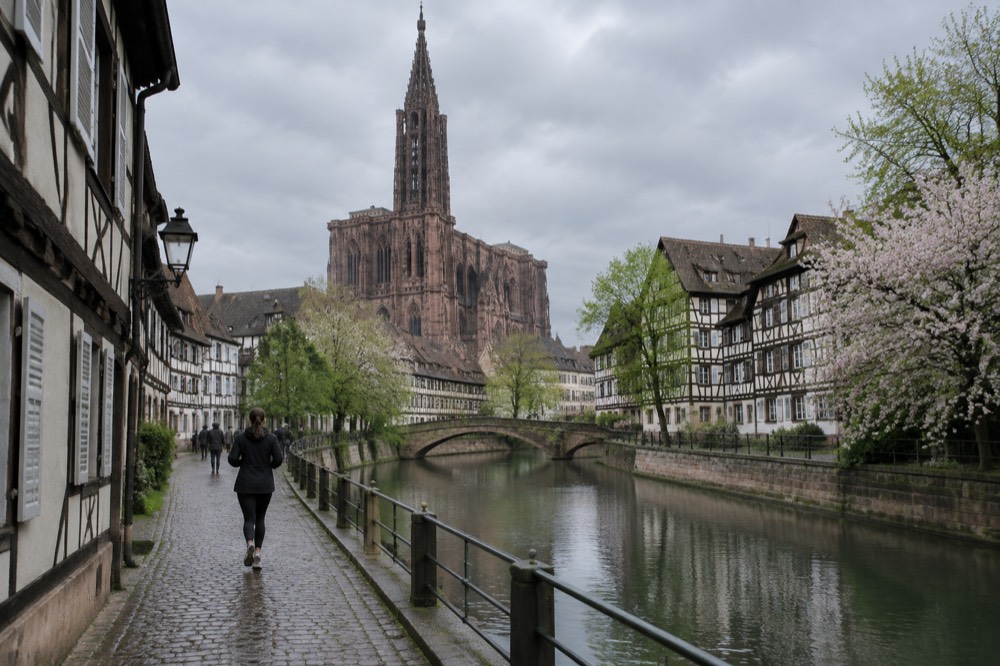
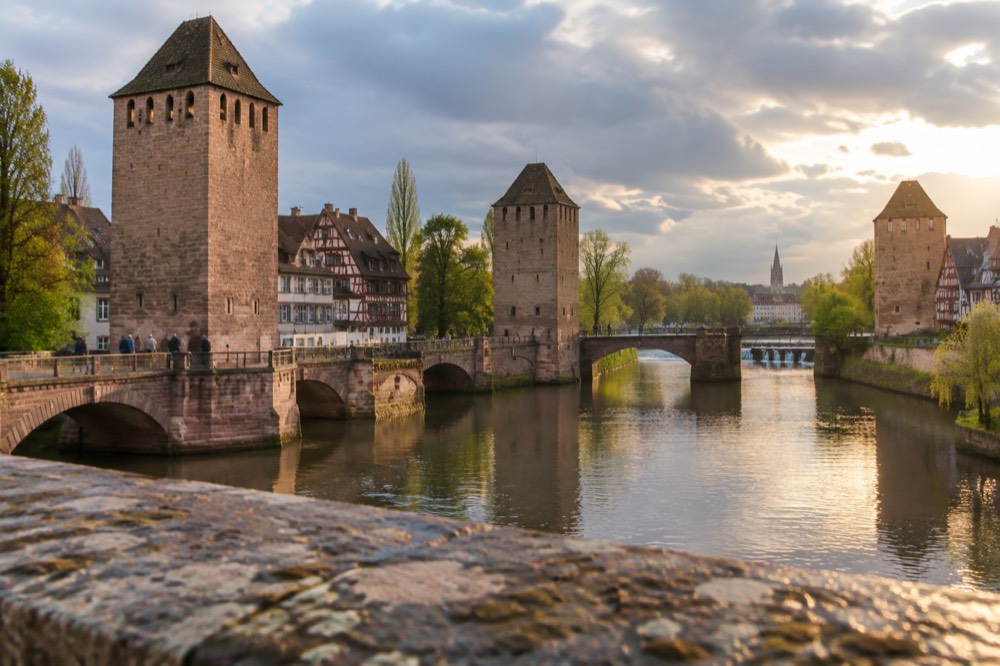
From the Place du Château side, the walk south drops into the river quarter. Petite France, the former tanners' district at the western tip of the island, is the postcard version of Strasbourg: half-timbered houses standing over branches of the Ill, weirs that once served the trades, and terraces that open as the weather does. The Ponts Couverts and the Barrage Vauban sit at the quarter's edge, and the Vauban's panoramic terrace keeps seasonal hours, 08:00-19:00 through September and October, 08:30-16:00 from November to February, and 08:00-19:00 in March and April, with the admission price to be confirmed on the official page. The terrace view over the Ponts Couverts and the cathedral spire is the single best panorama reachable on a stroll in the city, and spring light on the sandstone makes it better than the flat grey of midwinter.
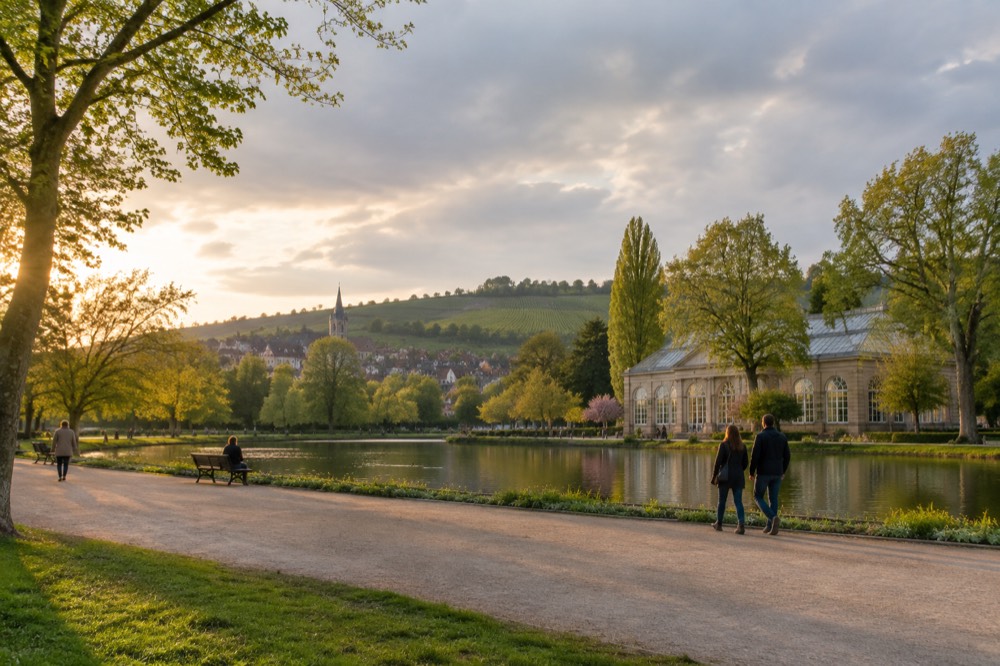
Beyond the island, the season opens the outdoor half of the city. The Parc de l'Orangerie, the largest park within walking range of the old centre, fills with storks, its aviary residents and picnics once April arrives, and the riverside lawns along the Ill between the Barrage Vauban and the Krutenau quarter turn from brown to green in a matter of weeks. The Krutenau itself, the former garden quarter just south of the island, is where students and locals take the first warm evenings, and it rewards a wander even though no single landmark anchors it. For the quieter corners of the whole city, the hidden corners of Strasbourg beyond the postcard streets collects the spots that a first walk misses.
Which Sights Change Their Hours In Spring?
The main spring change is the cathedral platform, which runs 09:30-13:00 and 13:30-20:00 with last ascent at 19:15 from 1 April to 30 September, against the shorter 10:00-13:00 and 13:30-18:00 winter timetable. The municipal museums hold their standard 9 EUR full and 5 EUR reduced prices all season, with free entry on the first Sunday of every month, and the Musée Alsacien stays closed until 2028.
The platform matters because it is the one ticket in the old centre whose timetable moves with the season. At 66 m, reached by stairs inside the tower, it looks over the whole roofscape of the Grande Île, the Ill and, on a clear day, the Black Forest line on the German horizon. The ticket is 10 EUR normal and 6 EUR reduced, with children under 6 free, and it carries a side benefit: the official visitor page confirms it gives a reduced rate at the Musée de l'Œuvre Notre-Dame, the cathedral museum on the square below. The platform closes on 1 January, 1 May and 25 December, so a 1 May visit, a public holiday that often falls inside a spring trip, has to plan around it. There are no luggage lockers at the cathedral, which rules out climbing with a suitcase in hand.
| Sight or ticket | Spring detail | What to check before you go |
|---|---|---|
| Cathedral nave | Mon-Sat 08:30-11:15 and 12:45-17:45; Sun 14:00-17:15 | Hours page on the cathedral site |
| Tower platform | 09:30-13:00, 13:30-20:00 from 1 Apr; 10 EUR / 6 EUR; closed 1 May | Last-ascent time on the official page |
| Astronomical Clock | Show at 12:30 daily; 4 EUR adult, day-of tickets only | Sales windows at 10:00-11:00 and from 11:30 |
| Municipal museums | 9 EUR full, 5 EUR reduced; free first Sunday of each month | Which museums you plan to combine |
| Musée Alsacien | Closed for works until 2028 | Do not route a visit here |
| Pass Musées, 1 day | 20 EUR covering the municipal museums | Whether you will visit three or more |
The museum arithmetic is worth doing before the first Sunday of the month arrives. A single municipal museum costs 9 EUR full or 5 EUR reduced, and the one-day Pass Musées at 20 EUR pays for itself at three museums. On the first Sunday of every month every municipal museum is free, confirmed by the city's own culture pages, which makes that day the obvious one for the Musée des Beaux-Arts in the Palais Rohan, the MAMCS modern art collection and the Musée de l'Œuvre Notre-Dame in one sweep. The Palais Rohan itself, with the archaeological and decorative arts collections around its courtyard, sits directly beside the cathedral, so a museum morning and a platform afternoon share the same square. The full museum picture, including what is open and what is not, is laid out in every Strasbourg museum worth your time.
Where Does Spring Show First In Strasbourg?
Spring shows first in Strasbourg's parks and river banks rather than in its squares: the Parc de l'Orangerie's lawns, the Île aux Épis and the banks along the Ill green up weeks before the tourist centre feels warm, and the Jardin des Deux Rives, the cross-border park shared with Kehl across the Rhine, is the clearest place to see the season arrive on both the French and German banks at once.
The parks are the seasonal city. The Parc de l'Orangerie, a short walk north-east of the European quarter, is the oldest and largest, with its stork enclosure, small lake and tree-lined avenues, and it is where Strasbourg families spend the first genuinely warm weekends. The Parc de la Citadelle, on the Ill's island loop south of the old town, is quieter and sits right on the running and cycling route that follows the river, which makes it the natural half-way pause on a loop of the water. The Jardin des Deux Rives, reached across the Passerelle des Deux Rives footbridge, is the unusual one: a single park laid out on both banks of the Rhine, so a spring walk there crosses an international border twice on foot, inside the Schengen area, without any formalities.
The squares green up later but more theatrically. Place Kléber, the main square, and Place Gutenberg carry the plane trees and the café terraces that fill from mid-April, and the quays along the Ill, from the Barrage Vauban upstream past the Krutenau, become the evening promenade once the terraces open. The Krutenau is the quarter to point at for a spring evening: a former market-garden district turned student neighbourhood, full of small restaurants and bars a few minutes' walk from the cathedral, and livelier in April and May than any guide to the island centre suggests. If the evening is the part of the day you care about, the Strasbourg after dark guide covers the terraces, the riverside and the late side of the same streets.
Is Spring A Good Season For Boats And Bikes In Strasbourg?
Yes: spring is the season when Strasbourg's two best outdoor formats both work. Batorama's river boats run their standard circuits, the long tour at 16.20 EUR full and 8.90 EUR reduced for 1h10, the short tour at 12.50 EUR and 7.20 EUR for 0h45, and the cycling routes along the Ill and the Rhine banks are dry and open before the summer heat arrives.
The boat is the easy one, because it needs no weather luck. Batorama, the main operator from the quays by the Palais Rohan, runs open tickets with the long circuit covering the Grande Île and the European quarter in 1h10 and the short circuit in 0h45, and the commentary explains the river city better than any walking route manages, since half of Strasbourg's architecture is best understood from the water. The Parliament-Cathedral return crossing takes 17 minutes for those who just want to be on the Ill. A spring bonus is the light: the sandstone of the old town and the German-era facades of the Neustadt photograph better in April's low sun than in July's flat glare, and the banks you drift past are green. The full index of guides sits on Strasbourg Travel Guide.
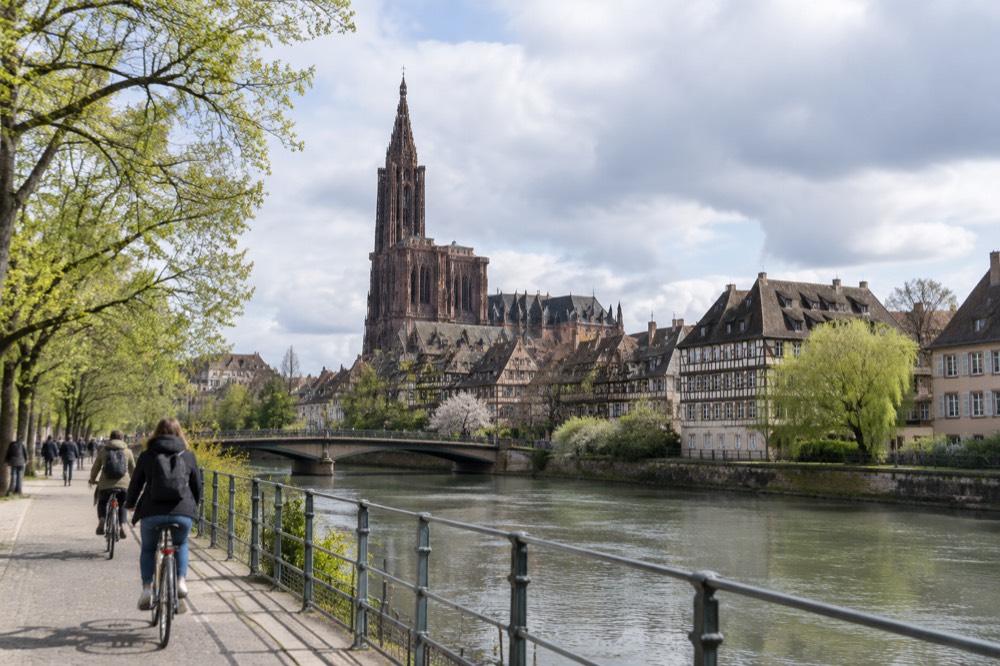
The bicycle is the format the season is really made for. Strasbourg is flat, threaded with cycle lanes, and its river routes connect the old centre to the European quarter, the Orangerie and the Rhine banks without a hill worth naming. A guided ride solves the only real problem, which is knowing which lane goes somewhere, and the guided bike tour with bicycles included is the roster's own pick for this: it loops the Grande Île, the Neustadt and the river banks with a local guide and a bike in the price. It suits spring particularly well because the same ride in July is a hot one and in December a cold one, while in April and May it is simply pleasant. The operator's live listing carries the current times and meeting point: Check availability.
| Format | Price | Duration | Who it suits |
|---|---|---|---|
| Batorama long tour | 16.20 EUR full, 8.90 EUR reduced | 1h10 | First-time visitors, photographers |
| Batorama short tour | 12.50 EUR full, 7.20 EUR reduced | 0h45 | Short stays, families with children |
| Batorama Parliament-Cathedral return | Price on the operator's page | 17 min | A quick taste of the river |
| Guided bike tour, bikes included | From the live listing | About 2 hours | Anyone confident on a bicycle |
Which Day Trips From Strasbourg Suit Spring?
Spring suits the Alsace wine country best: the vineyard hills between Strasbourg and Colmar green up through April, and the medieval villages on the wine route, Riquewihr, Eguisheim, Kaysersberg and their neighbours, are at their freshest before summer fills them. Guided day tours from Strasbourg cover the villages and the castles in a single loop, with a half-day wine option for visitors short on time.
The logic of the season is straightforward. The wine route's villages are half-timbered and photogenic all year, but their appeal peaks when the vines are in leaf and the terraces are open, and that window opens in April. A full-day loop from Strasbourg can pair the villages with a tasting, and the medieval villages and wine-tasting day trip is built exactly around that combination, running roughly ten and a half hours with tastings included. Visitors who want the wider historical sweep, taking in castles and the broader region rather than the vineyards alone, have the full-day highlights tour as the alternative, at about eight hours.
| Day trip | What it is for | Spring fit |
|---|---|---|
| Alsace wine route villages | Half-timbered villages and vineyard tastings | At its best once the vines leaf, from April |
| Colmar | A canal town an hour or so down the train line | Terraces and canal walks open through spring |
| Haut-Koenigsbourg castle | A mountain castle above the plain | Fine in clear spring weather, check the official page |
| Black Forest, German side | Forest, lakes and the town of Freiburg | Green from April; cross-border by tram and rail |
| Basel, Switzerland | A Swiss city on the Rhine | Schengen but not in the euro: cards or francs |
Two practical notes keep the table honest. The first is that no rail or road time to any of these places is printed here; the official pages of each destination give the current times, and the booking pages of the guided tours state their own durations. The second is the border: Germany is a tram ride away at Kehl and in the Schengen area with France, and Switzerland is reachable via Basel, but Basel is not in the euro, so euros do not work there as a matter of course. The full Alsace wine route guide covers the villages in depth, and the Strasbourg and Colmar pairing handles the two-city question.
For visitors with only a half day to spare, the half-day Alsace wine tour from Strasbourg keeps the tasting without surrendering the whole day, which pairs well with a morning on the cathedral square. The longer historical loop, the best-of-Alsace day trip at around ten and a half hours, is the one for travellers making their only excursion from the city and wanting the region in a single stroke.
What Should You Pack For A Spring Visit?
Pack for a spread of conditions: layers that work from a 2.6 C March dawn to a 20.9 C May afternoon, a rain layer for every month of the season, and walking shoes that survive cobbles and canal banks. March needs a real coat, April needs a jacket with something warm underneath, and May needs short sleeves for the afternoons and a sweater for the evenings, with rain protection in all three.
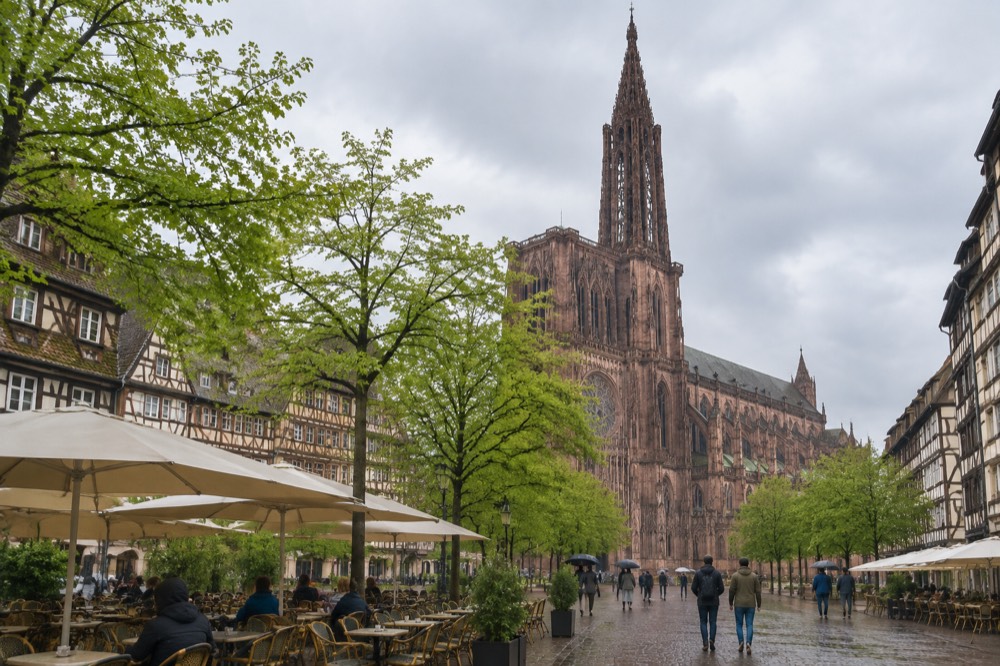
The packing question in Strasbourg is really the rain question. With 8.5 days of 1 mm or more in March, 8.6 in April and 10.8 in May, and May the wettest month of the year at 77.2 mm, a waterproof layer earns its place in the bag even on a forecast that looks clear. The reward for carrying it is that spring showers in the semi-continental climate tend to be short and heavy rather than all-day drizzle, and the museums, the winstubs and the cathedral are all within a few minutes' walk of somewhere dry. An umbrella is fine; a hood is better on the exposed river banks and the platform stairs.
| Month | Typical daytime feel | Evening feel | The one item not to forget |
|---|---|---|---|
| March | Cool, 12.1 C mean maximum | Cold, 2.6 C mean minimum | A proper coat |
| April | Mild, 17.0 C mean maximum | Cool, 5.7 C mean minimum | A warm layer under a jacket |
| May | Warm, 20.9 C mean maximum | Mild, 10.1 C mean minimum | A rain layer, for the 10.8 rain days |
Footwear deserves a sentence of its own. The Grande Île is cobbled and the riverside paths are gravel in places, and the tower platform is a stair climb, so the shoes that work are the ones that can walk all day and grip on stone. Beyond that, the season asks for little specialist kit: no swimwear, no serious cold-weather gear, and nothing that cannot be carried on a bicycle if a guided ride joins the itinerary. The Strasbourg on a budget guide has more on what a frugal spring week looks like, and the free things to do in Strasbourg list costs nothing at all in any weather.
How Much Should You Budget For A Spring Visit?
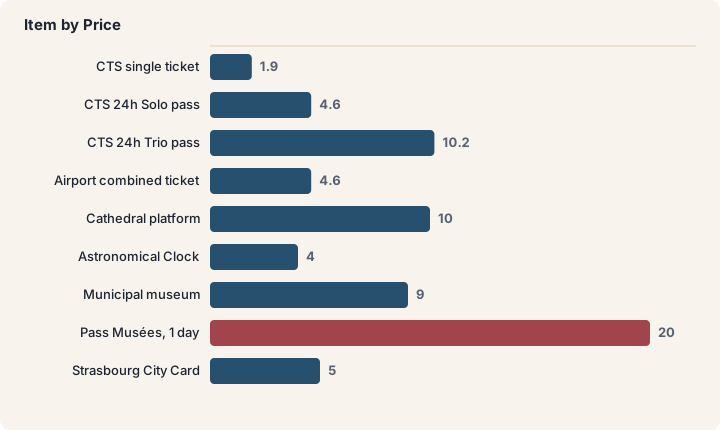
The fixed sightseeing costs are modest: the cathedral platform at 10 EUR, the clock show at 4 EUR, municipal museums at 9 EUR each or 20 EUR for the one-day pass, the Strasbourg City Card at 5 EUR for seven days of discounts, and CTS transport at 1.90 EUR a single ticket or 4.60 EUR for a 24-hour pass. A spring day of cathedral, clock and two museums stays modest before food.
The transport side is the cheapest part of a Strasbourg trip. The CTS network of trams and buses sells a single ticket at 1.90 EUR through the Badgéo card, the CTS app or contactless payment, or 2.50 EUR if bought on board a bus, and the 24-hour Solo pass is 4.60 EUR with the 24-hour Trio at 10.20 EUR for two or three people travelling together. Visitors flying into Strasbourg-Entzheim can buy a combined train-and-network ticket at 4.60 EUR that covers the eight-minute airport shuttle and a day of city transport, which is the single best value in the whole pack. The shuttle runs up to five trains an hour.
| Item | Price | Notes |
|---|---|---|
| CTS single ticket | 1.90 EUR | 2.50 EUR bought on board a bus |
| CTS 24h Solo pass | 4.60 EUR | Unlimited tram and bus for a day |
| CTS 24h Trio pass | 10.20 EUR | Two or three people together |
| Airport combined ticket | 4.60 EUR | Shuttle train plus 24h city network |
| Cathedral platform | 10 EUR / 6 EUR | Children under 6 free |
| Astronomical Clock | 4 EUR | Day-of purchase only |
| Municipal museum | 9 EUR / 5 EUR | Free on the first Sunday of the month |
| Pass Musées, 1 day | 20 EUR | Pays off from the third museum |
| Strasbourg City Card | 5 EUR / 3.50 EUR child | A discount card for seven days, not an all-inclusive pass |
The City Card deserves its clarifying sentence, because its name misleads. At 5 EUR for an adult and 3.50 EUR for a child from 3 to 17, valid for seven days, it is a discount card rather than a pass: it takes money off the museums, the boat tours, the cathedral platform, the clock and other sights, and it pays for itself only against a full itinerary. The detail is worked through in what the Strasbourg City Card actually includes. For accommodation, the where to stay in Strasbourg guide maps the quarters, and spring rates sit well below the December peak that the Christmas market brings.
How Does Spring Compare With The Rest Of The Year?
Spring sits between the two extremes of the Strasbourg calendar: warmer and greener than winter, cooler and quieter than summer, and far less crowded than the Christmas season, whose 2025 edition alone drew 3.05 million visitors. In spring the hotels price below the December peak, the terraces reopen, and the day-trip vineyards come into leaf, at the cost of the year's wettest month arriving in May.
The comparison is worth making honestly. Summer in Strasbourg is warm, with a mean July maximum of 26.4 C, and it is the season of the fullest terraces and the longest evenings; the trade-off is heat in the old town's stone streets and the thinnest hotel availability outside the Christmas weeks. Autumn, covered in Strasbourg in autumn, brings the vineyard harvests and the golden version of the same river banks, with September's 21.6 C mean maximum making it a comfortable walking month of the year. Winter, in Strasbourg in winter, is the famous one: the Christmas market from late November to 24 December, with the 2025 edition running 26 November to 24 December and drawing 3.05 million people, a scale of crowd that spring never approaches.
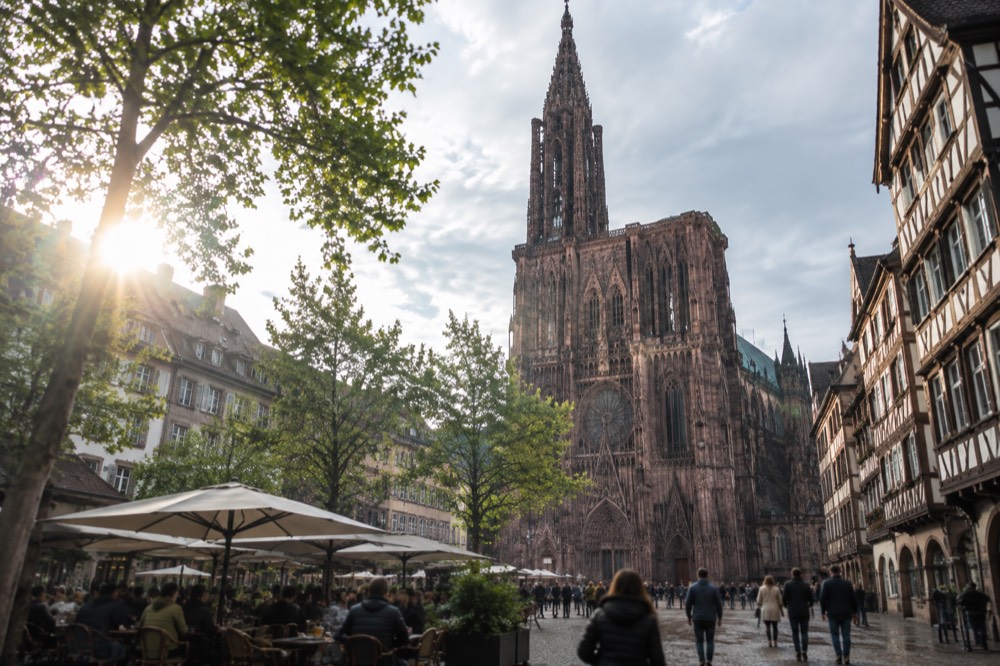
Spring's own case is the balance. The is Strasbourg worth visiting question gets its shortest yes in this season, because the city is fully open, the prices are seasonal rather than festive, and the outdoor city, the parks, the river, the bike routes and the vineyard day trips, all function. The season's one weakness is the rain curve, which climbs to its annual peak in May, and the honest answer to that is the same as the honest answer to the packing question: bring the layer, and let the museums carry the wet afternoon. For travellers weighing the whole year, the seasonal breakdown in the best time to visit Strasbourg puts all four seasons side by side.
Common Questions About Strasbourg In Spring
Is spring a good time to visit Strasbourg?
Yes. Spring brings mean daily maxima from 12.1 C in March to 20.9 C in May, the cathedral platform extends its hours from 1 April, the parks and river banks green up, and the crowds stay well below the Christmas market's scale, with the 2025 edition alone drawing 3.05 million visitors. The trade-off is rain: May is the wettest month of the year at 77.2 mm.
What is the weather like in Strasbourg in spring?
The climate is semi-continental. Meteo-France 1991-2020 normals for Strasbourg-Entzheim give mean daily maxima of 12.1 C in March, 17.0 C in April and 20.9 C in May, with mean minima of 2.6 C, 5.7 C and 10.1 C, and between 8.5 and 10.8 days of 1 mm of rain or more each month.
Is the Strasbourg cathedral platform open in spring?
Yes. From 1 April to 30 September the platform runs 09:30-13:00 and 13:30-20:00, with the last ascent at 19:15, and the ticket is 10 EUR normal or 6 EUR reduced, with children under 6 free. It closes on 1 January, 1 May and 25 December, so a 1 May visit misses it.
Are Strasbourg museums free in spring?
The municipal museums cost 9 EUR full and 5 EUR reduced, or 20 EUR for the one-day Pass Musées, and every municipal museum is free on the first Sunday of each month. The Musée Alsacien is closed for works until 2028 and should not be on a spring itinerary.
What should I do in Strasbourg on a rainy spring day?
The cathedral nave, the 12:30 Astronomical Clock show at 4 EUR, and the municipal museums around the Palais Rohan and the Place du Château cover a full wet day on foot. A Batorama river boat, 16.20 EUR full for the 1h10 long tour, keeps most of its sightline under cover, and the winstubs of the old town handle the rest.
Which day trips from Strasbourg work best in spring?
The Alsace wine route villages, Riquewihr, Eguisheim, Kaysersberg and their neighbours, are at their freshest once the vines leaf in April, and guided day tours from Strasbourg cover the villages, the tastings and the castles in one loop. Colmar, the Black Forest and Basel are also reachable, with Basel outside the euro zone.
A spring visit to Strasbourg, in short, is a visit to the city at its most balanced: the cathedral and the clock running their full schedule, the platform open into the evening from April, the museums free on the first Sunday of the month, and the vineyards an easy day trip away once they turn green. Bring the rain layer, book the bike, and let the season do the rest.