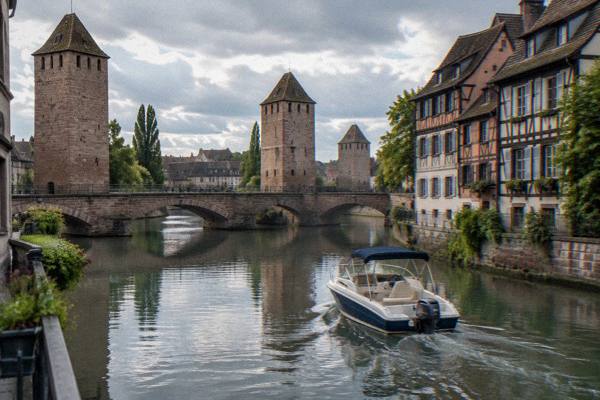
Strasbourg Boat Tour
Strasbourg, in Alsace in north-eastern France, is one of the few European cities where a boat tour genuinely replaces a walking tour: the River Ill carries you through Petite France, around the Grande Île and out to the European Quarter without a single step.
Short answer
Batorama, the main sightseeing operator on the River Ill, runs a 1 hour 10 minute Red Tour at 16.20 EUR full fare and a 45 minute Blue Tour at 12.50 EUR full fare, both with reduced rates. Private charters are also available for small groups.
Strasbourg, in Alsace in the north-east of France, is a city built around water. The River Ill, a tributary of the Rhine, splits into channels that thread through the half-timbered lanes of Petite France, loop around the UNESCO-listed Grande Île and flow past the modern glass facades of the European Quarter before joining the Rhine at the German border. A Strasbourg boat tour is the one activity that reaches every one of those districts in a single seated sweep, and this guide covers the circuits, the fares, the seasonal differences and the private options.
What Is A Strasbourg Boat Tour?
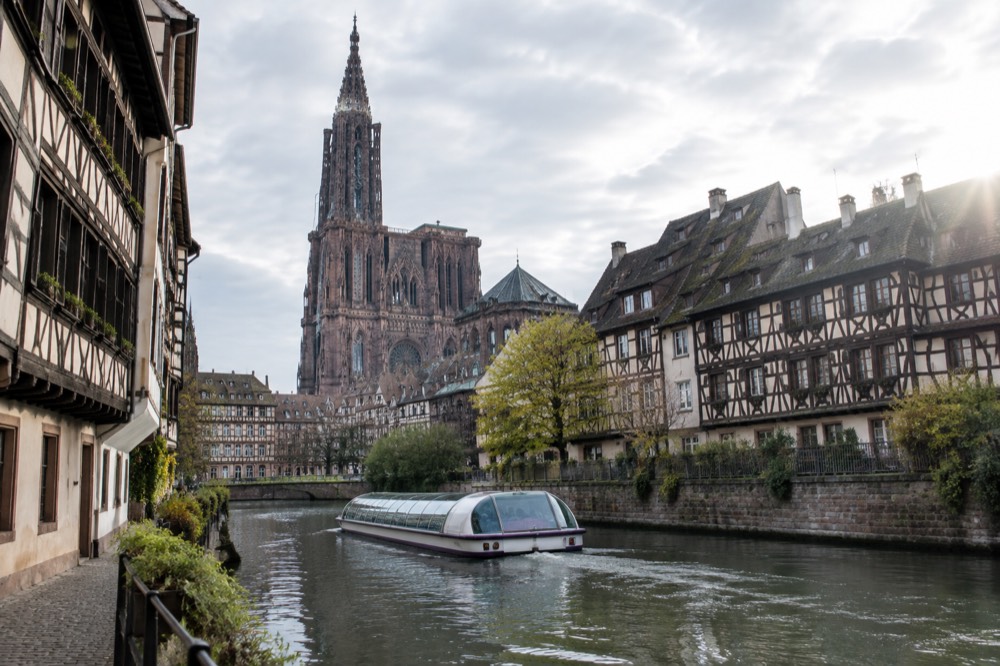
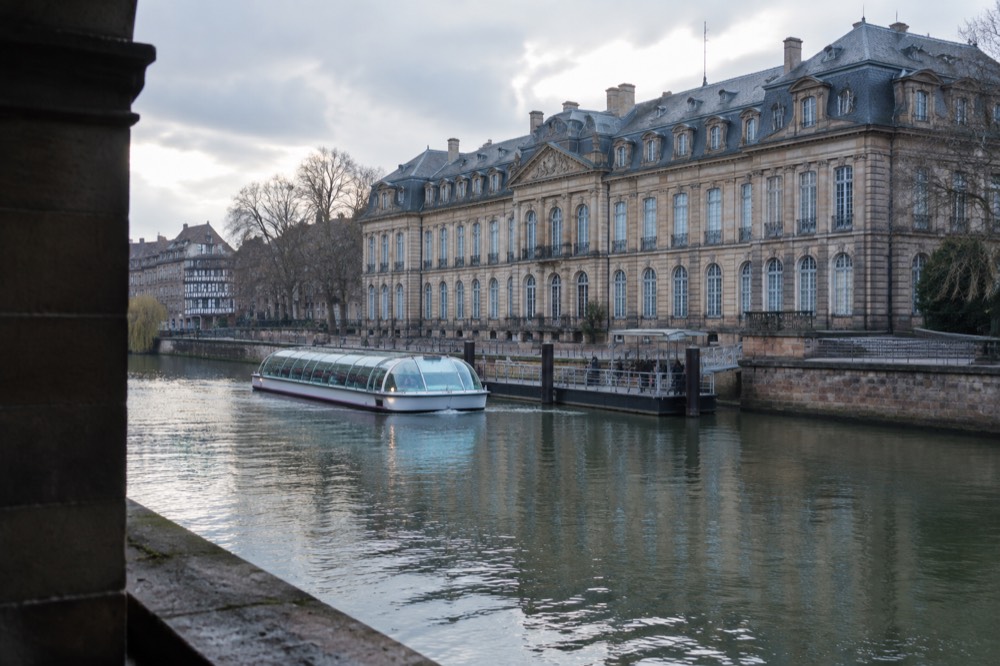
A Strasbourg boat tour is a sightseeing cruise on the River Ill, the tributary that loops around the city's historic core before joining the Rhine at the German border. The main operator, Batorama, runs enclosed glass-roofed boats from a landing stage beside the Palais Rohan, with recorded commentary in several languages. Two principal circuits cover the old town and the modern European institutions, and a third shuttle crosses between the cathedral and the Parliament.
The Ill is a slow, narrow river, shallow enough that the boats are flat-bottomed and low enough to pass under the stone arches of the covered bridges. This is not a high-speed excursion: the water moves at walking pace, and the point of the circuit is to see the city from below street level, where the half-timbered facades lean over the water and the weirs of Petite France churn beneath the ramparts. The boats themselves are enclosed and glass-roofed, which matters in a city with 112.3 rain days a year on the 1991-2020 Meteo-France normals, though open-deck seating is available on some departures in summer.
The circuits fall into two families. The Red Tour, the long circuit, runs 1 hour 10 minutes and covers both the historic core and the European Quarter downstream. The Blue Tour, the short circuit, runs 45 minutes and stays within the old town. A third crossing, the Parliament-Cathedral return, shuttles between the two landmarks in 17 minutes and works as a transport link as much as a tour. All three depart from the same landing stage on the Quai des Bateliers side of the Ill, beside the Palais Rohan.
The operator is Batorama, a Strasbourg company that has run the sightseeing circuits for decades and publishes its fares and durations on its own site. The boats are purpose-built for the Ill's narrow channels and low bridges, and the commentary is prerecorded rather than live, which means it runs in several languages on the same departure without a guide having to switch. For visitors arriving on a Strasbourg river cruise stop, the Batorama circuits are the natural first activity: the boat maps the whole city in one sweep and everything afterwards falls into place.
Which Batorama Tour Should You Choose?
The Red Tour, at 1 hour 10 minutes, is the full circuit: it covers the Grande Île, Petite France, the covered bridges, the Barrage Vauban and the European Quarter downstream. The Blue Tour, at 45 minutes, stays within the historic centre and skips the modern district. The 17 minute Parliament-Cathedral return is a shuttle, not a tour. First-time visitors with two or more hours to spare should take the Red Tour; those on a tight schedule or travelling with young children can settle for the Blue.
The choice comes down to whether the European Quarter interests you. The Red Tour spends roughly half its running time in the modern district, gliding past the European Parliament, the Council of Europe and the European Court of Human Rights, three buildings that look nothing like the medieval core but are the reason Strasbourg hosts a permanent parliamentary seat. If that architecture leaves you cold, the Blue Tour gives you the old town and nothing else, which for a city whose UNESCO-listed Grande Île is the main draw is a reasonable trade.
The table below compares the three circuits at a glance.
| Circuit | Duration | Coverage | Full fare | Reduced fare |
|---|---|---|---|---|
| Red Tour (long) | 1 h 10 | Grande Île, Petite France, covered bridges, European Quarter | 16.20 EUR | 8.90 EUR |
| Blue Tour (short) | 0 h 45 | Grande Île and historic centre only | 12.50 EUR | 7.20 EUR |
| Parliament-Cathedral return | 17 min | Shuttle between the cathedral and the European Parliament | see the operator's page | see the operator's page |
The Parliament-Cathedral shuttle is worth a second look even though it is the least touristic of the three. If you are staying near the European Quarter or visiting the Parliament itself and want to reach the cathedral without a tram ride, the 17 minute crossing does the job and gives you a stretch of the river for the price of a commute. Check the operator's page for the shuttle fare, which is not listed among the standard open-ticket prices.
For visitors who want more than the water alone, a sightseeing cruise can be paired with a land tour in the same day. A guided segway circuit covers the same geography at street level, from the cathedral to the riverside quays, and the two together give a complete picture of how the city fits together.
How Much Does A Strasbourg Boat Tour Cost?
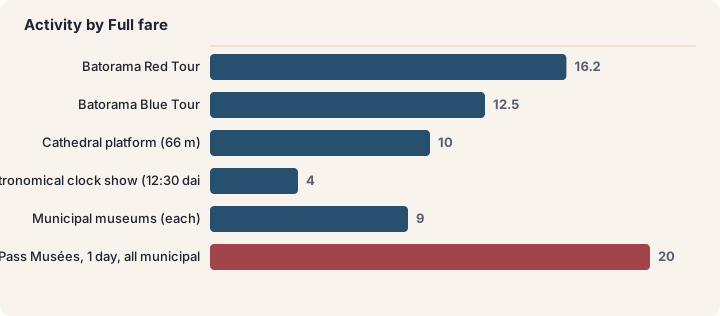
Batorama's official open-ticket fares are 16.20 EUR full and 8.90 EUR reduced for the Red Tour, and 12.50 EUR full and 7.20 EUR reduced for the Blue Tour. The Strasbourg City Card, a 5 EUR discount card valid for seven days, includes reductions on the boat trip as well as on municipal museums and the cathedral platform. Private charters on the Ill are priced per group rather than per person, and their fares appear on the operator's live listing rather than in any fixed schedule.
The Batorama fares are the operator's own open-ticket prices, published on its official site and stable across the year. The reduced rate applies to children and other qualifying categories, and the operator's page lists the exact eligibility rules. For a family of four, the gap between the long and short circuit adds up to a meaningful difference on a multi-day budget, so it is worth deciding in advance whether the European Quarter is part of what you came to see.
The Strasbourg City Card deserves a paragraph of its own. At 5 EUR for an adult and 3.50 EUR for a child aged 3 to 17, valid for seven days, it is not an all-inclusive pass but a discount card: it knocks money off the Batorama boat trip, the cathedral platform, the astronomical clock, municipal museums and several other attractions. If you plan to take the boat tour plus the cathedral platform plus one museum, the card pays for itself in reductions.
| Activity | Full fare | Reduced fare |
|---|---|---|
| Batorama Red Tour | 16.20 EUR | 8.90 EUR |
| Batorama Blue Tour | 12.50 EUR | 7.20 EUR |
| Cathedral platform (66 m) | 10 EUR | 6 EUR |
| Astronomical clock show (12:30 daily) | 4 EUR | 2 EUR (children 6-17) |
| Municipal museums (each) | 9 EUR | 5 EUR |
| Pass Musées, 1 day, all municipal museums | 20 EUR | - |
The clock show deserves a note: tickets are sold on the day only, at the cathedral stalls between 10:00 and 11:00 or at the Saint-Michel entrance from 11:30, and the automaton display runs at 12:30 sharp. If you are planning a morning boat tour followed by the clock, the timing works: the Blue Tour ends close enough to the landing stage that a 45 minute circuit plus a short walk puts you at the cathedral before noon.
The private charters are a different pricing world. A skippered cruise for up to four people and a larger private boat with a captain aboard are both priced per group, not per head, and the fares sit well above the Batorama circuits. The trade is exclusivity and flexibility: a private boat can hold for a photo, circle back, or run a route the fixed circuits do not cover.
What Will You See From The Water?
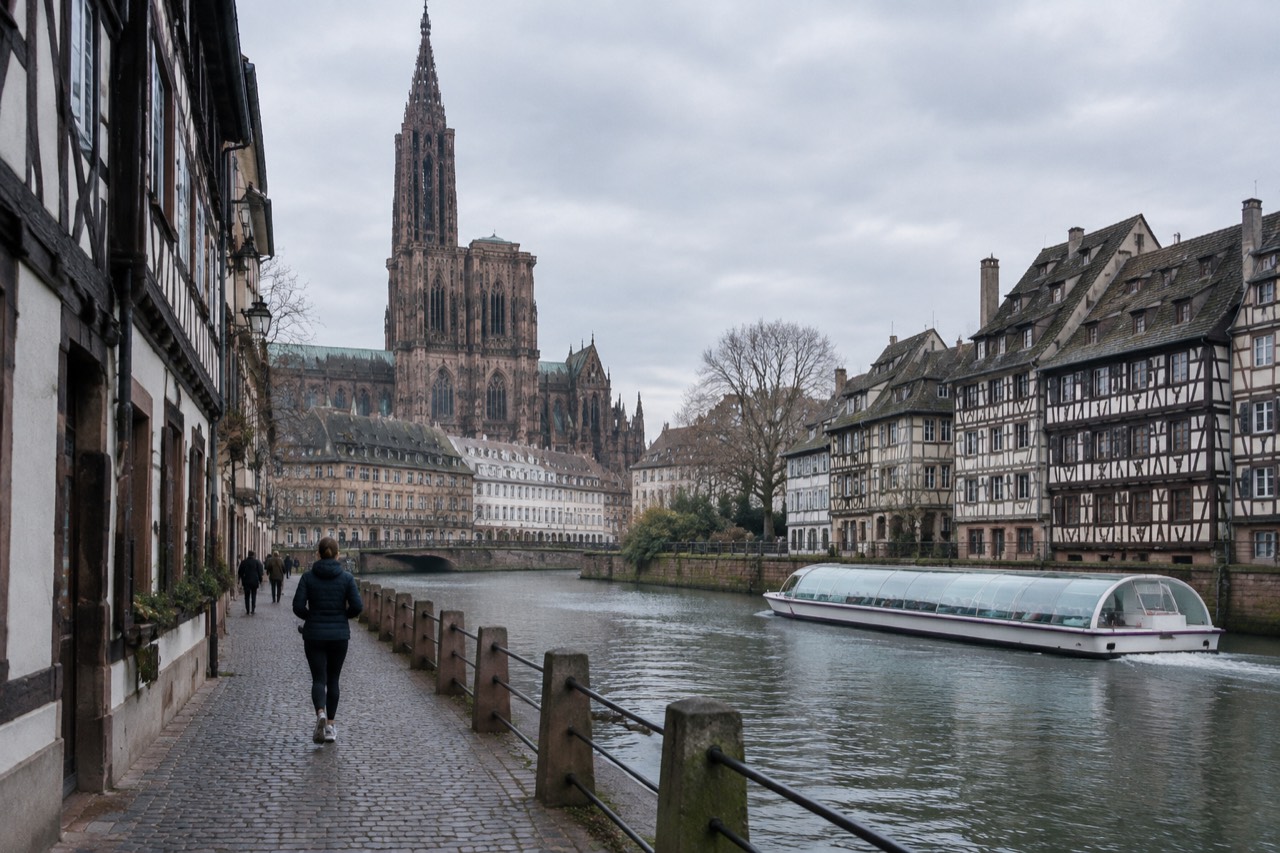
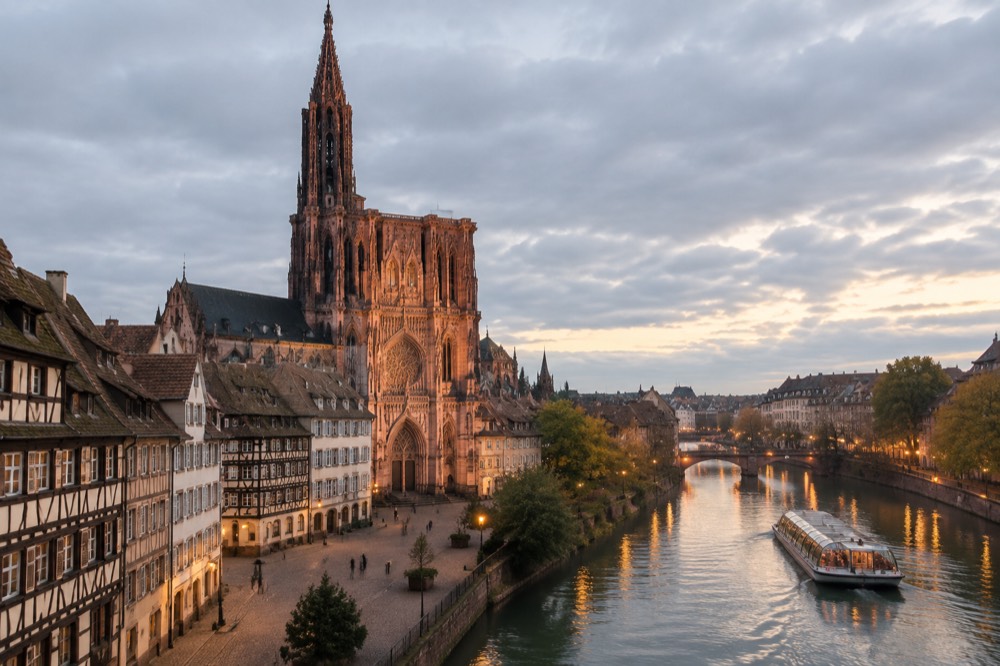
The standard circuits pass through Petite France, under the covered bridges, past the Barrage Vauban terrace, along the Ill to the European Parliament, the Council of Europe and the European Court of Human Rights, and back past the Musée d'Art Moderne. The cathedral's single spire stays visible above the rooftops for the entire old-town stretch, a fixed point that makes the geography easy to follow from the water.
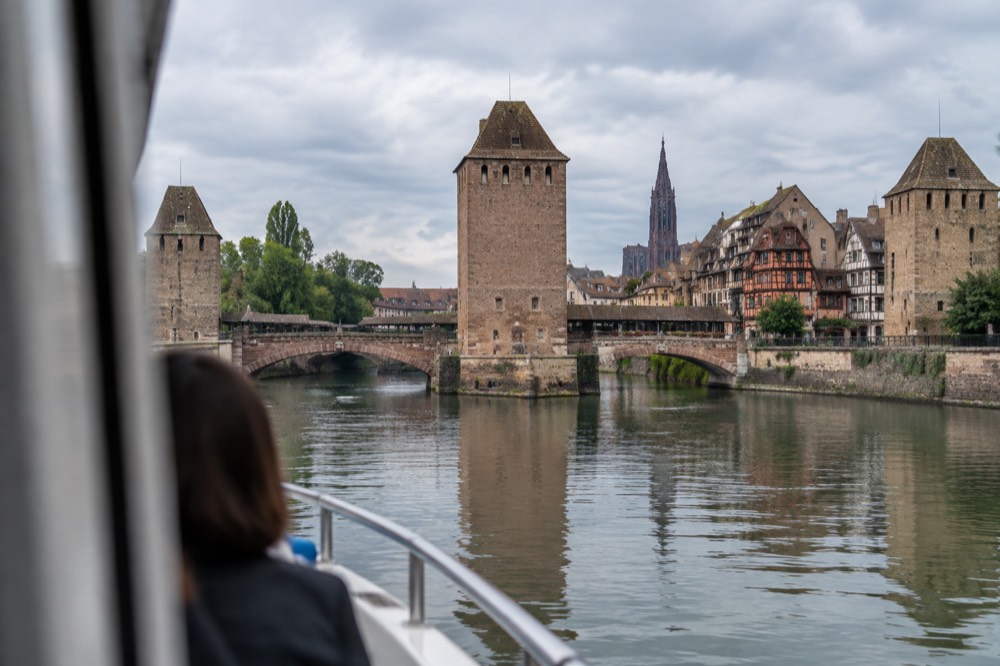
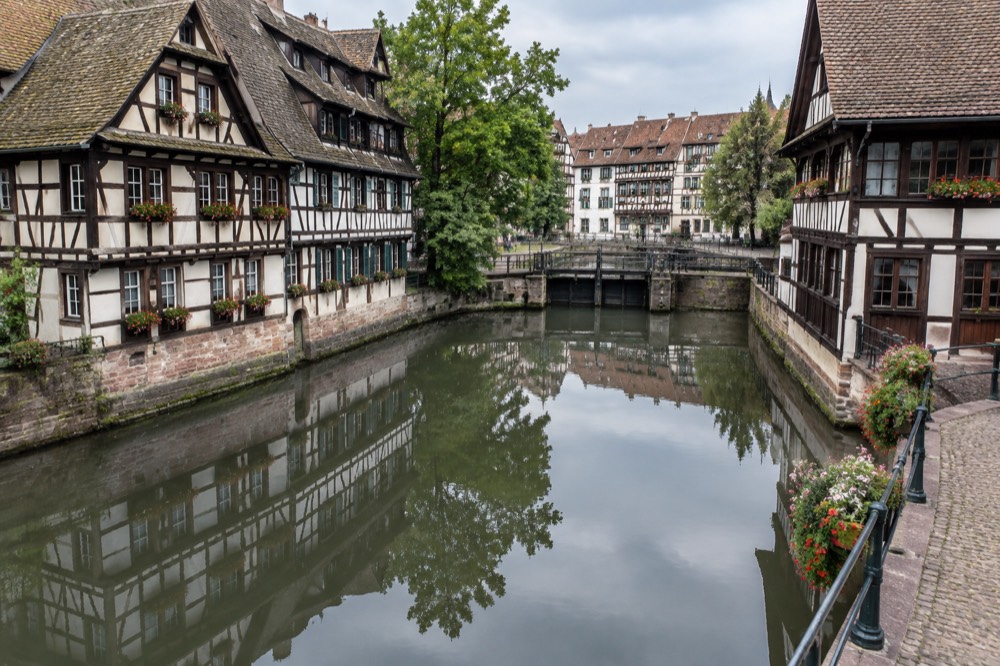
Petite France is the visual heart of the circuit. The old tanners' and millers' quarter, where the Ill splits into channels around weirs and stone ramparts, is the stretch that every photograph of Strasbourg comes from, and from the water the half-timbered facades lean over the boat at close range. The covered bridges, three stone arches with wooden roofing that once formed part of the city's medieval defences, sit beside the Barrage Vauban, a fortified weir whose panoramic terrace is one of the best elevated views in the city.
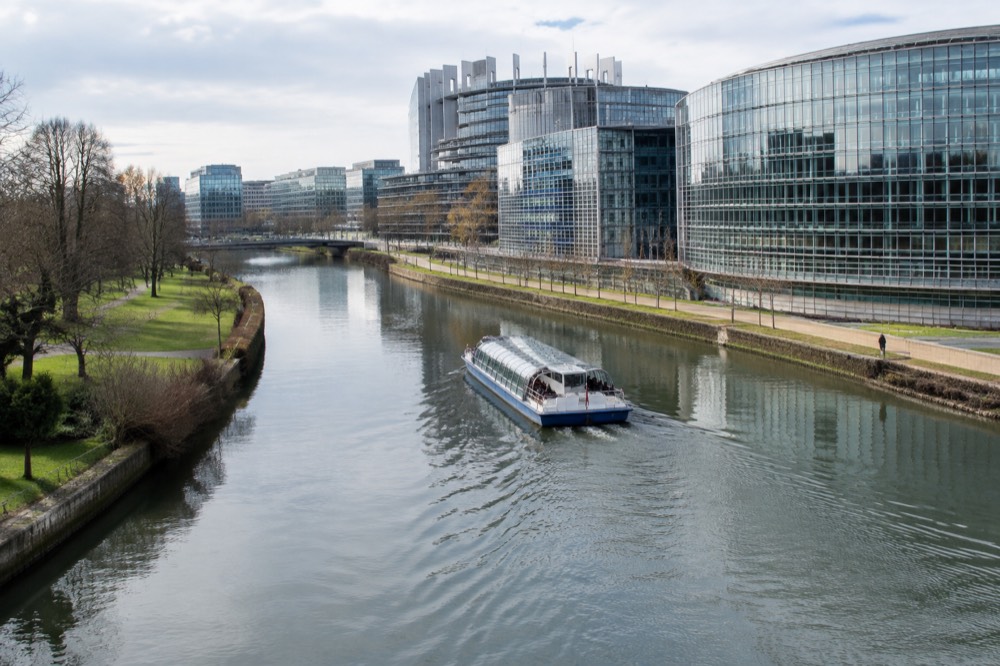
Downstream, the character changes abruptly. The European Quarter is a district of glass, steel and flags: the European Parliament with its curved facade, the Council of Europe, and the European Court of Human Rights all sit along the Ill or close to it, and the Red Tour's slow pass gives a sense of the scale that a street-level visit misses. The European Quarter guide covers the buildings in detail if you want to go inside any of them afterwards.
| Stretch of the river | What you pass | Which circuit covers it |
|---|---|---|
| Quai des Bateliers to Petite France | Half-timbered facades, riverside gardens | Red and Blue |
| Covered bridges and Barrage Vauban | Three stone arches, fortified weir, terrace viewpoint | Red and Blue |
| Grande Île loop | Cathedral spire above rooftops, Palais Rohan, Musée de l'Œuvre Notre-Dame | Red and Blue |
| Downstream to the European Quarter | European Parliament, Council of Europe, European Court of Human Rights, Musée d'Art Moderne | Red only |
The cathedral is the one landmark that follows you. Its single spire, visible from almost every stretch of the old-town circuit, is the orientation point for the whole boat tour: when the spire is behind you, you are heading downstream; when it is ahead, you are coming back. The platform at 66 m is open to visitors who want the view from the top rather than the bottom, and the 10 EUR full fare is a natural pairing with the boat tour on the same day.
For the weirs themselves, the Barrage Vauban's terrace has seasonal opening hours, and the Barrage Vauban guide lists the current schedule. The covered bridges are visible from the water at all times, and the Petite France guide covers the quarter's lanes and squares for anyone who wants to walk the same ground after the boat.
When Is The Best Time For A Strasbourg Boat Tour?
Summer gives the longest daylight and the warmest decks, with July and August averaging mean maximum temperatures of 26.4 C and 26.1 C. Winter brings the Christmas market, when the city fills with chalets and the boats run a special illuminated circuit. Spring and autumn sit between the two extremes: mild air, thinner crowds and the river at its calmest. The season changes what the water gives back more than any other variable.
The Meteo-France 1991-2020 normals for Strasbourg-Entzheim give a picture of a semi-continental climate: cold winters, warm summers, and rain distributed fairly evenly across the year. The glass-roofed boats make the rain a non-issue for the indoor seating, but an open deck in December at a mean maximum of 5.9 C is a different experience from the same deck in July.
| Season | Month | Mean max | Mean min | Rain days >= 1 mm | What the water gives |
|---|---|---|---|---|---|
| Spring | April | 17.0 C | 5.7 C | 8.6 | Mild air, green banks |
| Summer | July | 26.4 C | 14.9 C | 10.4 | Warm decks, long light |
| Autumn | October | 15.8 C | 7.2 C | 9.6 | Colour, thinner crowds |
| Winter | December | 5.9 C | 0.8 C | 10.2 | Christmas market, illuminated circuit |
Winter deserves its own paragraph. The Strasbourg Christmas market runs from late November to 24 December each year, and the 2025 edition, which ran 26 November to 24 December, drew 3.05 million visitors according to the city's own press release. During the market weeks, Batorama runs a special illuminated circuit that passes the decorated squares after dark. The 2026 dates are not yet published on the city's Christmas site, so check there before planning a December visit. The best time to visit Strasbourg guide covers the full seasonal picture beyond the boat.
The practical difference between seasons, beyond temperature, is crowd density. The Christmas market weeks bring the year's heaviest footfall to the old town, and the boats fill accordingly. A summer morning departure is quieter than a December afternoon one, though both are manageable if you arrive at the landing stage early. The Strasbourg in winter guide has the full cold-weather picture for anyone planning a market-season trip.
Can You Take A Private Boat Tour In Strasbourg?
Yes, several operators run private charters on the Ill, from small skippered boats carrying up to four people to larger vessels with a captain aboard. These are priced per group rather than per person, and the route can usually be tailored to the group's interests, whether that is a slow circuit of Petite France, a longer run to the European Quarter, or an evening cruise with the city lights on the water.
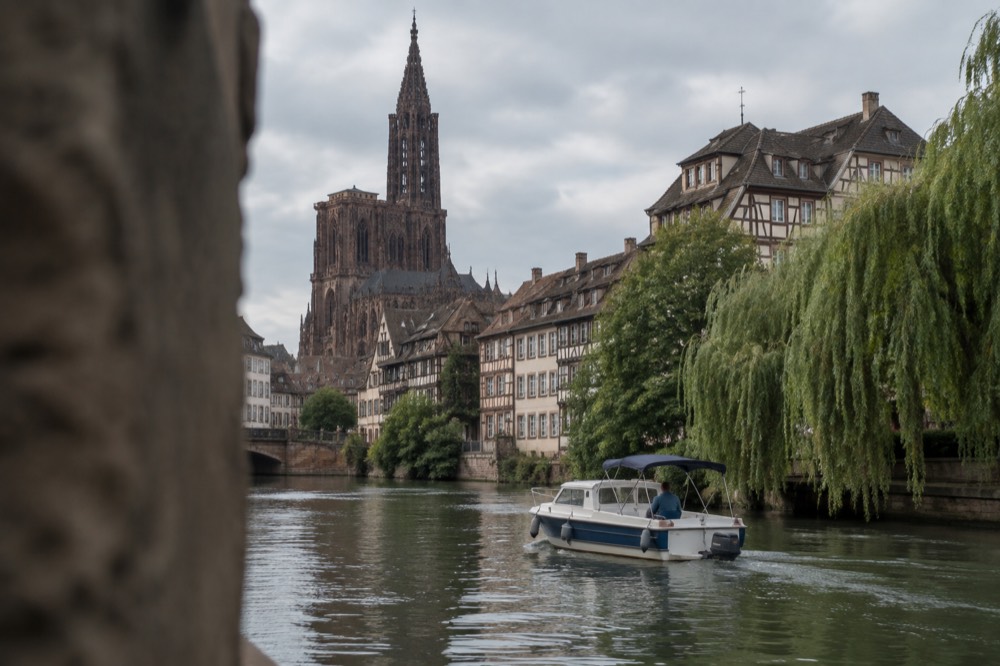
A private charter is a different product from the Batorama circuits. The skippered boats are small, open and manoeuvrable, which means they can hold position for a photograph, take a side channel the glass-roofed cruisers cannot enter, and run at whatever pace the group prefers. A private boat with a captain aboard is larger and can carry more people, and the captain's commentary is live rather than recorded.
The price difference is significant. A private cruise for four is a premium product, and a larger private charter costs more again, but the per-group pricing means the gap narrows as the group grows. For a couple, a private boat is a luxury; for a family of six or a group of eight friends, the arithmetic can work out closer to the Batorama circuits per head.
The skippered option suits a small group that wants intimacy and a tailor-made route. The skipper knows the river, can adjust for light and weather on the day, and can run a circuit that stops where the group wants to stop rather than where the fixed timetable dictates. Check the operator's live listing for the current fare, which is quoted per group of up to four.
Prefer the river to yourself with a skipper who knows it? Book a private boat tour here.
For a larger group or a more formal occasion, a private boat with a captain aboard runs a similar service at a bigger scale. The captain handles the vessel while the group has the deck to themselves, and the route can be agreed in advance.
Both private options depart from central Strasbourg, though the exact landing stage varies by operator. Confirm the departure point, the route and the duration on the operator's listing before booking, because these details are set by the operator rather than by a fixed schedule.
How Does A Boat Tour Fit Into A Strasbourg Visit?
A boat tour works best as the first activity of a visit, not the last. The circuit maps the city from the water, and everything afterwards falls into place. Pair a morning cruise with an afternoon walking tour of the Grande Île, or combine it with a segway or bike tour that covers the same ground at street level. A one-day visit fits the 45 minute Blue Tour; two days allow the 1 hour 10 minute Red Tour plus a walking tour.
The logic is simple. Strasbourg's geography is confusing at street level: the Ill splits, the channels braid around the Grande Île, and the old town's lanes double back on themselves. From the water, the same city resolves into a clear loop, and a visitor who has seen it from a boat spends the rest of the trip knowing which direction the cathedral is. The one day in Strasbourg itinerary puts a morning boat tour in exactly this position.
| Length of stay | Morning | Afternoon |
|---|---|---|
| One day | Blue Tour, 45 minutes | Walking tour of the Grande Île and cathedral |
| Two days | Red Tour, 1 h 10 | Segway or bike tour, then municipal museums |
| Three days | Red Tour, 1 h 10 | Alsace wine route or medieval villages day trip |
For the second day or beyond, the pairing options multiply. A guided segway tour covers the riverside and the European Quarter at street level, which is the natural complement to a boat circuit that showed you the same buildings from the water. The Strasbourg Travel Guide homepage has the full range of tours and itineraries if you want to build a complete plan.
For a third day, the Alsace wine route and the medieval villages to the south and west of the city are the standard excursion, and several guided day trips run from Strasbourg with hotel pickup. A boat tour on day one, a segway or walking tour on day two, and a wine route day trip on day three is a sequence that covers the city, the river and the region.
The medieval villages day trip takes in the wine route's stone-and-timber towns with a tasting stop, and it pairs naturally with a Strasbourg boat tour because the two experiences show opposite halves of the Alsace picture: the urban river city and the rural hillside villages. Check the operator's live listing for the current fare and departure schedule.
Common Questions About Strasbourg Boat Tours
Do I Need To Book A Strasbourg Boat Tour In Advance?
Batorama sells open tickets that can be used on any departure, and buying at the landing stage on the day is normal outside the Christmas market weeks. During the market season, when the city's footfall is at its heaviest, booking ahead or arriving early for the first departure of the day is the safer approach. Private charters should always be booked in advance because the boats are small and the operators need notice to prepare a route.
Is Commentary Available In English On The Boats?
Yes, the Batorama boats use prerecorded commentary in several languages, including English, delivered through headphones or onboard speakers depending on the vessel. Private charters with a skipper or captain provide live commentary, and the language should be confirmed with the operator before booking.
Are The Strasbourg Boats Enclosed Or Open?
The Batorama sightseeing boats are glass-roofed and enclosed, with open-deck seating available on some departures in warm weather. This matters in a city with 112.3 rain days a year on the 1991-2020 Meteo-France normals: the enclosed cabin means a departure runs in any weather. Private boats are generally open, which is worth considering when choosing a season.
Can You Take A Boat Tour In Strasbourg In Winter?
Yes, the boats run year-round, and the winter circuit is one of the city's signature experiences because it passes the Christmas market's decorated squares after dark. The 2025 edition of the market ran 26 November to 24 December and drew 3.05 million visitors, and the boats fill accordingly. The 2026 dates are not yet published, so check the city's Christmas site before planning a December trip.
Where Do The Strasbourg Boats Depart From?
The Batorama landing stage sits on the River Ill beside the Palais Rohan, within a short walk of the cathedral and the Petite France quarter. Private charter departure points vary by operator, and the exact location should be confirmed on the operator's listing before booking.
Is A Strasbourg Boat Tour Worth It?
For a first visit, yes: the boat is the fastest way to see Petite France, the covered bridges, the Grande Île and the European Quarter in one seated sweep, and the view from the water is one that a walking tour cannot replicate. For a repeat visitor who has already done the circuit, the value depends on the season: the Christmas illuminated cruise and a private charter at golden hour are the two experiences that justify a second trip on the water.
A Strasbourg boat tour is the one activity that shows the whole city in a single loop, from the medieval weirs of Petite France to the glass facades of the European Parliament, and it costs less than a museum ticket and a coffee combined. Whether you take the 45 minute Blue Tour on a flying visit or charter a private boat for an evening on the Ill, the river is the city's best classroom.