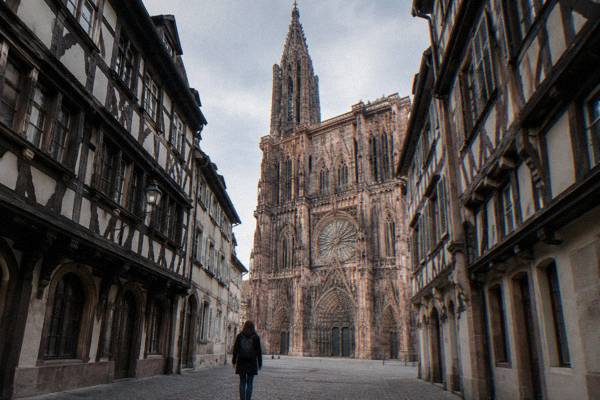
Why Is Strasbourg Cathedral Famous?
Why Strasbourg Cathedral is famous: its single Gothic spire, the 66 m platform, the astronomical clock show at 12:30, and the hours and ticket prices to plan a visit.
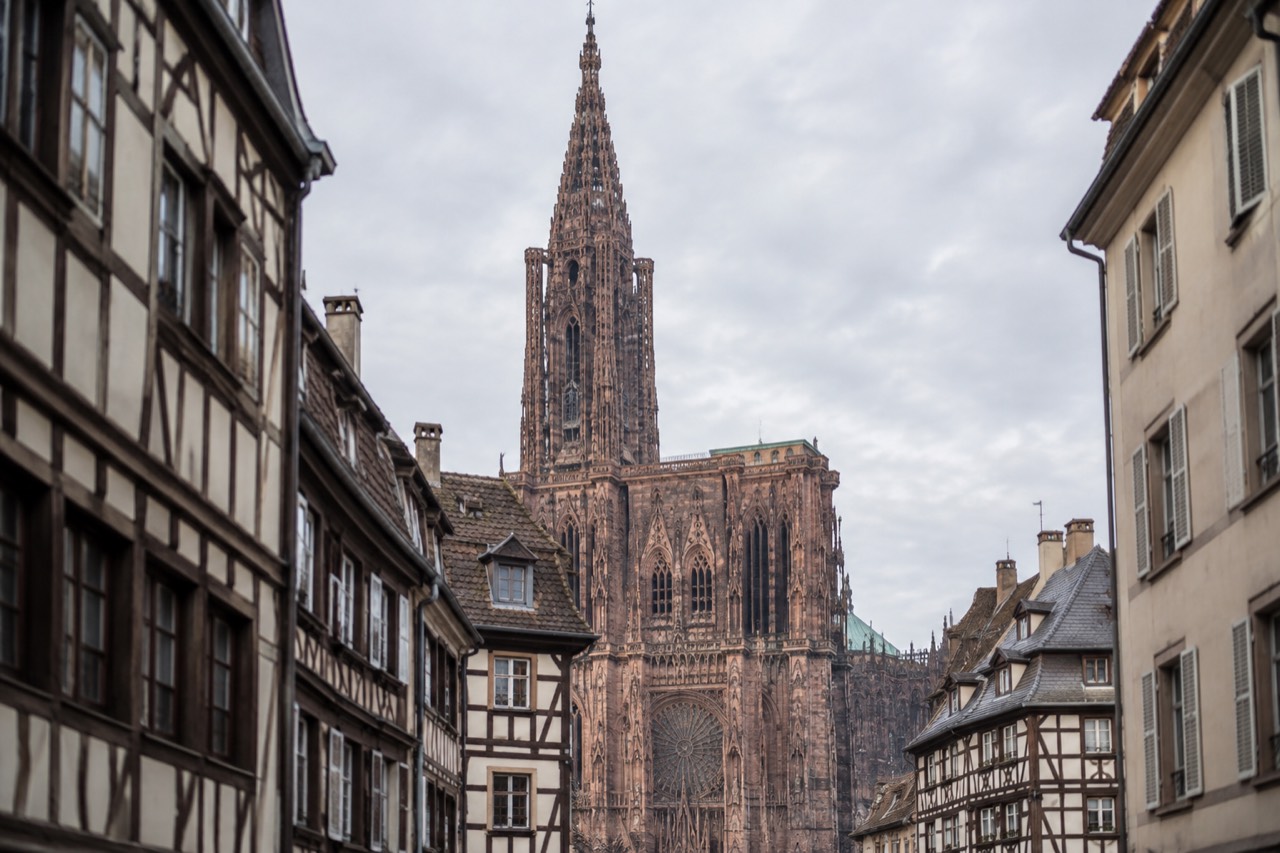
Strasbourg Cathedral stands in the middle of Strasbourg, the prefecture of the Bas-Rhin in Alsace, in the Grand Est region of north-eastern France, a short distance from the German border across the Rhine. It is the single most recognisable structure in a city whose whole historic core, the Grande Île and the Neustadt together, is listed by UNESCO as a World Heritage property. The building's fame rests on a handful of concrete things: one tall Gothic spire rather than the two towers many visitors expect, an astronomical clock whose automaton show still runs daily, a viewing platform at 66 m, and a setting in the heart of a half-timbered medieval city. This page sets out exactly what is behind that reputation, with the cathedral's own published hours and ticket prices, and it answers the question in full below.
Why Is Strasbourg Cathedral Famous?
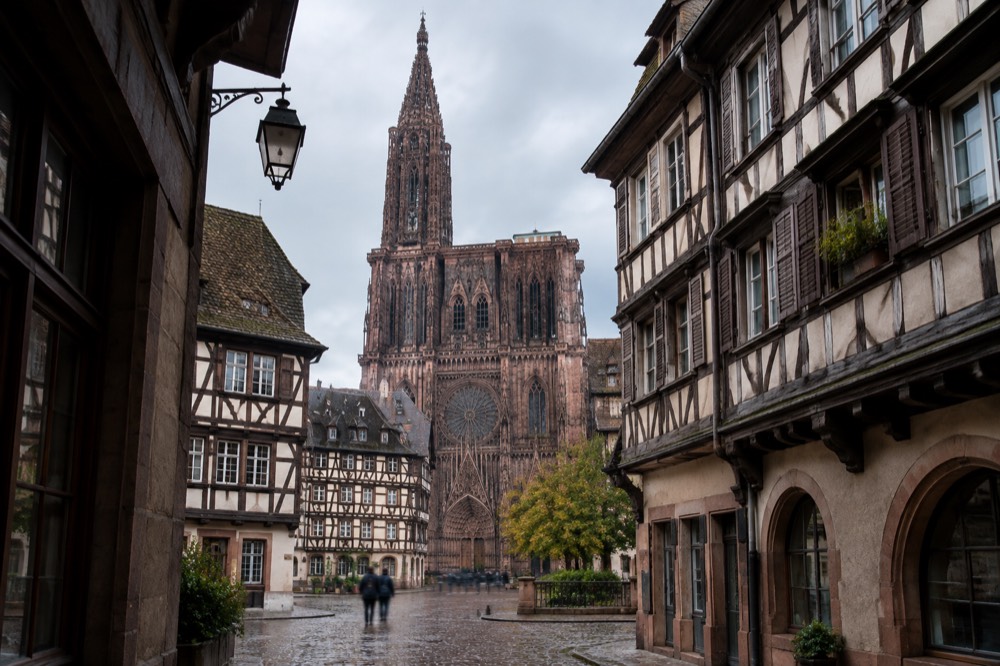
Strasbourg Cathedral is famous for its single Gothic spire, one of the most striking silhouettes in France, for its astronomical clock that performs a full automaton show daily at 12:30, and for its stone platform at 66 m overlooking the terracotta roofs of the Grande Île. The cathedral anchors a UNESCO-listed World Heritage city centre in Alsace, north-eastern France, and it defines Strasbourg's skyline in a way few single buildings define any European city.
That answer deserves unpacking. The first thing that surprises many first-time visitors is the tower arrangement. Where the classic French Gothic cathedral presents two matching towers over its west front, Strasbourg's cathedral carries a single spire, and the effect is asymmetrical and immediately recognisable. The platform inside that spire sits at 66 m, and from it the whole island city is visible: the roofscape of the Grande Île, the Ill river winding through Petite France, and on clear days the Black Forest line on the German horizon.
The second pillar of the fame is the astronomical clock. This is not a decorative antique behind a rope. It is a working mechanism with moving figures, and the full automaton show runs daily at 12:30 sharp, with a ticketed audience seated in front of it. A clock that performs, on a fixed schedule, inside a cathedral, is genuinely rare, and it is the detail visitors retell. The cathedral's own site publishes the show time and the day-of ticket rules, which we cover in full further down this page.
The third pillar is the setting. The cathedral sits on its own square, the Place du Château, ringed by the Musée de l'Œuvre Notre-Dame and half-timbered houses, at the centre of a city whose entire historic core is a UNESCO World Heritage property, "Strasbourg, Grande-Île and Neustadt". For context on how the city earned that listing and its wider reputation, see the companion page why Strasbourg is so famous, and for the deeper story of the building itself, the Strasbourg Cathedral attraction guide covers the interior in detail.
How The Astronomical Clock Show Works
The astronomical clock performs its full automaton show once a day, at 12:30 sharp, and watching it requires a ticket bought on the day only: 4 EUR for an adult, 3 EUR for groups of 12 or more and students up to 25, and 2 EUR for children aged 6 to 17. There are no reservations and no advance sales, so the audience assembles for a single scheduled performance rather than dropping in at will.
The ticket rules matter more here than at most sights. The cathedral's own clock page states that tickets are sold on the day only, at the cathedral stalls between 10:00 and 11:00 or at the Saint-Michel entrance from 11:30. That means a visitor who arrives at noon hoping to buy a place may be too late, and the practical advice is to buy the ticket in the morning, visit something else nearby, and return shortly before 12:30. The show itself is short, and the seating fills in the minutes before it begins.
The clock's fame also comes from what it is rather than only what it does. It is an astronomical instrument: it tracks the positions of celestial bodies, not just the hour, and the automaton figures that mark the daily performance are part of a mechanism centuries in the making. Describing it as a clock undersells it in the way describing the cathedral as a church undersells it. Both are working machines as much as buildings, and that duality is a large part of why the cathedral holds its reputation among travellers who have seen dozens of Gothic churches.
| Clock show detail | Figure |
|---|---|
| Daily show time | 12:30 sharp |
| Adult ticket | 4 EUR |
| Groups of 12+, students to 25 | 3 EUR |
| Children 6 to 17 | 2 EUR |
| Sales window, cathedral stalls | 10:00 to 11:00 |
| Sales window, Saint-Michel entrance | from 11:30 |
| Advance reservations | Not available, day-of purchase only |
For visitors weighing the whole city against its neighbours, the clock and the spire together are the reason many people give for choosing Strasbourg over a shorter stop elsewhere, a comparison explored in how many days in Strasbourg is enough.
A guided visit is one way to make sure the clock, the platform and the interior are all timed correctly against the fixed 12:30 show, and a dedicated cathedral guided tour exists on the roster for exactly that purpose.
To have the timings handled for you, book a guided walking tour here.
What To See Inside The Cathedral And From The Platform
Inside, the cathedral's nave keeps fixed visiting hours, Monday to Saturday 08:30 to 11:15 and 12:45 to 17:45, and on Sundays and feast days 14:00 to 17:15. The platform above opens 09:30 to 13:00 and 13:30 to 20:00 from 1 April to 30 September, and 10:00 to 13:00 and 13:30 to 18:00 from 1 October to 31 March, with the last ascent 19:15 in summer and 17:15 in winter.
The pattern to notice is the lunchtime split. The nave closes mid-morning and reopens in the early afternoon on weekdays, which lines up with the clock show at 12:30: the building's schedule is built around that performance. The platform has its own split opening with a closed window in the middle of the day, and the last ascent times are earlier than the closing times, so a visitor arriving at 19:50 in July would find the door shut even though the posted close is 20:00. The cathedral's own pages publish these hours, and they are the figures to check before setting out, because feast days and services can change the nave's access. More of these guides are collected on Strasbourg Travel Guide.
The platform ticket is 10 EUR at the normal rate and 6 EUR reduced, with children under 6 free, per the official 2026 ticket document. The same document notes a small bonus: the platform ticket gives a reduced rate at the Musée de l'Œuvre Notre-Dame, the museum across the square that holds the cathedral's own sculpture and art. There are no luggage lockers at the cathedral, so anyone travelling with bags needs a plan for them before arriving; the site's luggage storage guide covers the options.
| Visit | Hours or price | Notes |
|---|---|---|
| Nave, Monday to Saturday | 08:30 to 11:15 and 12:45 to 17:45 | Feast days can differ |
| Nave, Sundays and feast days | 14:00 to 17:15 | Afternoon only |
| Platform, 1 April to 30 September | 09:30 to 13:00 and 13:30 to 20:00 | Last ascent 19:15 |
| Platform, 1 October to 31 March | 10:00 to 13:00 and 13:30 to 18:00 | Last ascent 17:15 |
| Platform ticket | 10 EUR normal, 6 EUR reduced | Children under 6 free |
| Platform closed dates | 1 January, 1 May, 25 December | Per the official document |
Whether the nave itself costs anything to enter is a question with its own answer page, is Strasbourg Cathedral free to enter, which should be read before budgeting a visit.
The cathedral also works as the anchor for a bigger day out, and the roster's guided options below cover three different scales of trip: a city loop by bike, a medieval-villages day with wine tasting, and a full-day highlights tour of the Alsace region. Each listing carries its own price, duration and departure details on the operator's live listing.
For travellers who would rather keep the day inside the city, the bike option is the one that pairs most naturally with a cathedral morning, because it loops the Grande Île, Petite France and the river quarter in a single guided ride with the bicycles included in the booking.
Planning a visit around the cathedral also pairs naturally with a wider loop of the city, and a guided bike tour with bikes included is one of the more efficient ways to fit the cathedral, Petite France and the river quarter into a single afternoon, with the operator's live listing carrying the current price and departure times.
Whichever way the day is built, the fixed points to write down are the 12:30 clock show, the morning ticket window at the stalls, and the platform's last ascent time for the season, because those three figures decide the shape of any cathedral visit.
Is Strasbourg Cathedral The Tallest In The World?
Strasbourg Cathedral has a single spire and a stone platform at 66 m, and its historical claim to height is a subject with its own dedicated answer page. The facts on this page: one spire, not two, a platform at 66 m, and a silhouette that dominates the city's low roofscape. Claims about world records should be checked rather than repeated from guidebook folklore.
The height question deserves a careful answer rather than a confident one. The figures in the cathedral's own materials concern the platform at 66 m and the ticketed ascent to it; the historical claim that the tower was for a period the tallest structure in the world belongs to the dedicated page, is the Strasbourg Cathedral the tallest in the world. What can be said plainly is that the spire's effect on the city is out of proportion to Strasbourg's size: the commune counted 293,771 residents at the last INSEE census figure, and the tower reads as the centre of gravity for the whole urban area.
The comparison shoppers should also know that the cathedral's fame is not only about verticality. The astronomical clock, the rose of stained glass, the sculpture now housed in the Musée de l'Œuvre Notre-Dame, and the building's role as the heart of a World Heritage city all contribute. Visitors who enjoy ranking cathedrals may also want the companion piece on the nicest cathedral in France, and those curious about the building's confessional history, which is unusual for a French cathedral, can read whether the cathedral of Notre-Dame in Strasbourg is Catholic or Protestant.
When Is The Best Time To Visit The Cathedral?
The cathedral keeps its full schedule year round, but two windows change the experience: during the Christmas market the nave stays open continuously Monday to Saturday, 08:30 to 17:45, on the Place du Château side, and in winter the platform's last ascent moves to 17:15, so late afternoon visits lose the view. A morning visit in any season lines up best with the clock ticket sales at 10:00.
The Christmas period is the special case. Strasbourg's Christmas market, the subject of its own answer on the most famous Christmas market in France, fills the squares around the cathedral in late November and December, and during those weeks the cathedral's own hours page publishes a continuous opening on the Place du Château side. The 2026 market dates have not been published by the city yet; the usual pattern is an opening in the last week of November and a run to 24 December, and last year's edition ran 26 November to 24 December 2025. Anyone planning a December visit should confirm the current dates on the city's Christmas site before booking anything.
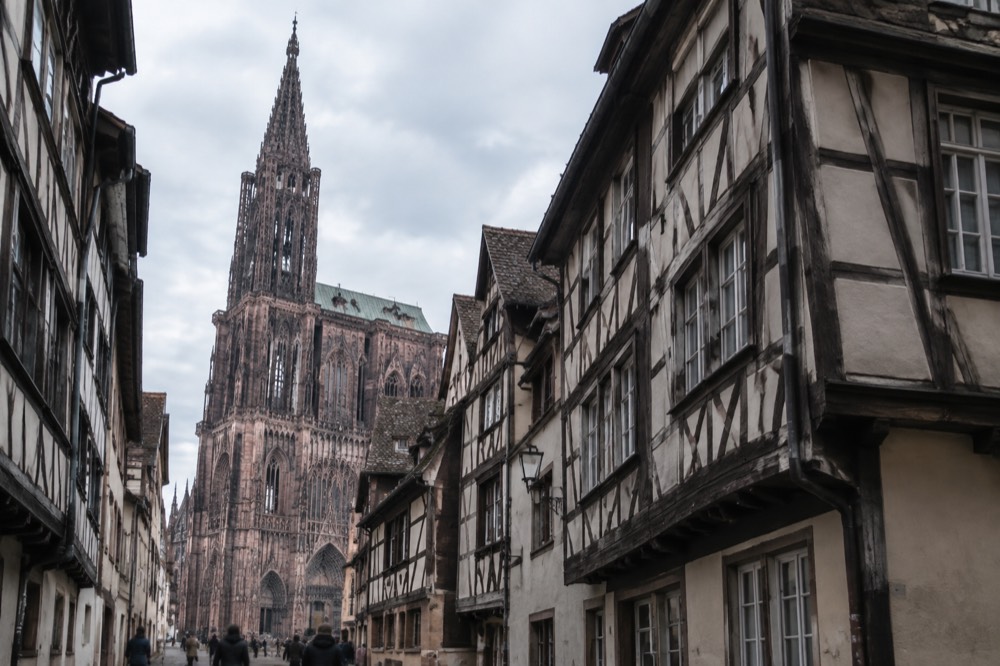
Outside the market weeks, the ordinary schedule applies, and the quietest practical window is the early morning nave opening at 08:30 on a weekday, before the square fills. The climate is worth one line of planning: Strasbourg sits in a semi-continental zone, with mean daily maxima from 5.2 C in January to 26.4 C in July and 635.7 mm of rain across the year, so the platform ascent is a different experience in a summer evening light than in a January drizzle, and the roof view rewards a clear day. The site's weather guide covers the month-by-month figures in full.
How To Fit The Cathedral Into A Day In Strasbourg
A workable order is the nave at its 08:30 opening, the clock ticket bought at the stalls between 10:00 and 11:00, the platform ascent either side of midday, and the clock show at 12:30, leaving the afternoon for Petite France, the river and the museums. The cathedral is walkable from anywhere on the Grande Île, and the city's tram network runs a single ticket at 1.90 EUR.
The reason the cathedral rewards a plan is that its three experiences, nave, platform and clock, run on three different schedules that only align in the morning. Arrive after 11:15 and the nave is closed until 12:45; arrive after 11:00 and the clock ticket stalls may have finished their morning window; arrive in the late afternoon in winter and the platform's last ascent has passed. The morning is the only window in which everything is open at once, which is why the fixed 12:30 show works so well as a natural lunchtime anchor for a first day in the city.
For visitors extending the day beyond the city, the cathedral also works as the fixed point around which an Alsace itinerary is built. The wine country south of the city, covered in the site's Alsace region guide, and the question of what Alsace is famous for both start from this square, and the guided day trips below are the roster's options for turning a cathedral morning into a full regional day, with all prices and durations rendered from the operators' live listings.
Any of those three turns the cathedral into the centrepiece of a full day, and the choice between them comes down to how far from the city the day should reach.
Common Questions About Strasbourg Cathedral
Why is Strasbourg Cathedral famous?
Strasbourg Cathedral is famous for its single Gothic spire, its astronomical clock that performs a full automaton show daily at 12:30, and its stone platform at 66 m above the UNESCO-listed Grande Île. The building anchors the historic centre of Strasbourg in Alsace, north-eastern France, and its silhouette defines the city's skyline.
Is Strasbourg Cathedral free to enter?
The nave's visiting hours are published by the cathedral itself, Monday to Saturday 08:30 to 11:15 and 12:45 to 17:45, and Sundays and feast days 14:00 to 17:15. The platform costs 10 EUR normal and 6 EUR reduced, and the clock show has its own admission fee. The site's dedicated answer page covers the nave admission question in detail.
How much does the astronomical clock show cost?
The clock show ticket is 4 EUR for an adult, 3 EUR for groups of 12 or more and students up to 25, and 2 EUR for children aged 6 to 17. Tickets are sold on the day only, at the cathedral stalls between 10:00 and 11:00 or at the Saint-Michel entrance from 11:30, and the show runs at 12:30 sharp.
How high is the cathedral platform?
The platform sits at 66 m, reached by a ticketed ascent inside the single spire. The adult ticket is 10 EUR, the reduced rate is 6 EUR, and children under 6 go free. The platform ticket also gives a reduced rate at the Musée de l'Œuvre Notre-Dame across the square.
When is the cathedral open during the Christmas market?
During the Christmas market the cathedral stays open continuously Monday to Saturday, 08:30 to 17:45, on the Place du Château side. The market itself usually opens in the last week of November and runs to 24 December, and the current edition's dates should be confirmed on the city's Christmas site before a December trip.
Can you visit the cathedral on a guided tour?
Yes, a dedicated cathedral guided tour is on the roster, and the city's walking and bike tours all pass the Place du Château. The operators' live listings carry the current prices, durations and departure points for each option.
The cathedral's fame, in the end, is the sum of one unmistakable spire, a clock that still performs every day at 12:30, a 66 m platform over a World Heritage roofscape, and a square that has been the centre of the city's life for centuries, and any one of those four would justify the trip on its own.