How Do I Get To Strasbourg From The US?
How to reach Strasbourg, in Alsace, north-eastern France, from the United States: hub choices, Strasbourg Airport (SXB), the airport train shuttle, local fares and seasonal timing.

Strasbourg, the prefecture of the Bas-Rhin in Alsace, north-eastern France, sits on the River Ill beside the Rhine, which forms the border with Germany, and no airline offers a nonstop flight there from North America. Every journey from the United States runs in two stages: a transatlantic flight into a European hub, then an onward hop by plane, train or road into the Alsatian capital. The good news is that the final leg is unusually easy. Strasbourg Airport (SXB) at Entzheim has a train station attached, a shuttle runs up to five times an hour, and the city centre is eight minutes away by rail. This page walks through the realistic route options, what the airport itself offers, the local fares once you land, and how to time the trip around Strasbourg's semi-continental seasons.
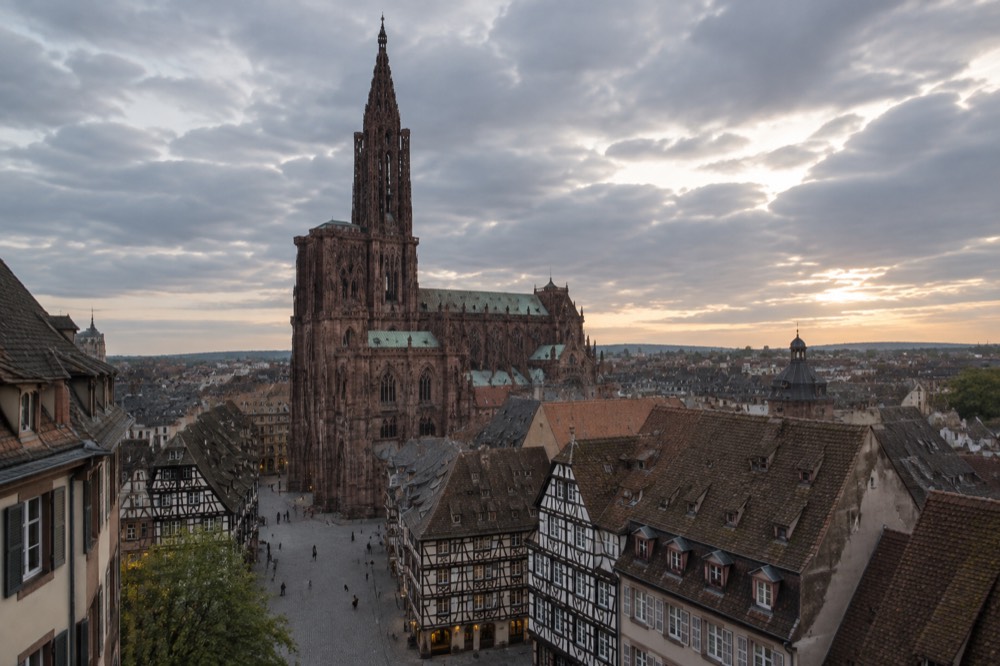
How Do I Get To Strasbourg From The US?
You fly from the US to a European hub and connect onward to Strasbourg, in north-eastern France. There is no nonstop transatlantic flight into Strasbourg Airport (SXB), so the standard plan is a transatlantic hop into a major hub such as Paris, Frankfurt, Amsterdam or Zurich, then a short onward flight, a train or a rental car. From Paris, the fastest TGV connections reach Strasbourg in under two hours. Book the whole journey on one ticket where possible so the airline owns the connection.
That last sentence matters more than the choice of hub. When a transatlantic ticket and the onward leg are booked separately, a missed connection becomes your problem: a new ticket, a hotel night and a day of the trip gone. When both legs sit on one reservation, the airline rebooks you if the first flight lands late. Strasbourg is a small- to medium-sized destination on the far side of a big ocean, so building slack into the itinerary is cheap insurance. An overnight at the hub, or a connection of several hours, costs less than a missed regional flight on the day of arrival.
The choice of hub also shapes the first days of the trip. Arriving through Paris pairs well with a TGV ride from Paris Est, which turns the transfer into part of the holiday rather than a chore. Arriving through Frankfurt, Zurich or Amsterdam suits travellers who prefer one more short flight into Strasbourg itself, or who plan to combine Alsace with Germany or Switzerland. There is no single right answer, only the answer that matches your home airport's nonstop destinations and your appetite for trains.
| Route | What It Involves | Who It Suits | What To Check Before Booking |
|---|---|---|---|
| Via Paris, then TGV from Paris Est | Transatlantic flight to Paris, transfer to Paris Est, direct TGV to Strasbourg | Travellers who enjoy rail travel and want the transfer inside France | TGV times and fares on SNCF Connect; connection time between the arrival airport and Paris Est |
| Via a German hub, then onward by rail or road | Transatlantic flight to Frankfurt or another German airport, onward train or rental car across the Rhine | Travellers combining Strasbourg with Germany or the Black Forest | Rail connections on the German side; car hire opening hours if landing late |
| Via Zurich or Amsterdam, then a connecting flight to SXB | Transatlantic flight, then a short European flight into Strasbourg Airport | Travellers who want the simplest final leg | Whether the connecting flight and the transatlantic leg are on one ticket |
| Via Paris, then a connecting flight to SXB | Transatlantic flight to Paris, then a domestic French flight to Strasbourg | Travellers avoiding a station transfer in Paris | Total journey time against the TGV alternative; baggage rules on the regional leg |
Which Route From The US Works Best For You?
The route that suits you depends on where your home airport flies nonstop and how much of the journey you want on rails. Flying into Paris and taking the TGV keeps the transatlantic leg on one airline ticket and gives a fast, direct train onward from Paris Est. Flying into a German hub such as Frankfurt and crossing the Rhine by road or rail suits travellers combining Strasbourg with Germany. Connecting into Strasbourg Airport itself keeps the final leg short and lands you eight minutes from the main station.
Think about the trip in three pieces: the ocean crossing, the hub transfer and the final leg. The ocean crossing is the part you cannot change much; it is long, and the goal is simply a good fare and a convenient arrival time. The hub transfer is where itineraries succeed or fail. Paris requires a change of station for the TGV, so allow generous time, while an air connection through Zurich, Amsterdam or a German airport keeps you inside one terminal system.
The final leg is where Strasbourg rewards planning. The city's own airport is small, close and rail-linked, which makes it a genuinely pleasant arrival point once you are in Europe. The alternative, arriving by TGV at Strasbourg station, puts you inside the city with a short tram ride to the old centre. Both work. The deciding factor is usually which hub your transatlantic carrier serves nonstop from your home airport, and that is a question of searching fares with the onward leg included rather than booking the cheapest ocean crossing alone.
For travellers who dislike tight connections, a night at the hub is a reasonable strategy. Frankfurt, Paris, Zurich and Amsterdam all have airport hotels, and a morning onward flight or train turns the arrival day into a relaxed half day in Strasbourg rather than a race through a terminal. The cost of one hotel night buys a full extra day of usable holiday at the far end, and it removes the single largest point of failure in a two-stage journey.
What To Know About Strasbourg Airport (SXB)
Strasbourg Airport (SXB) at Entzheim is a compact regional airport with a train station attached. No nonstop service arrives from North America, so its long-haul passengers reach it through European connections. A shuttle train runs up to five times an hour and takes eight minutes to Strasbourg station, and a combined ticket covering the train plus a day of tram and bus travel costs 4.60 EUR. Jet2 has announced winter routes to Edinburgh, Manchester and London Stansted, twice weekly.
The airport's size is its virtue. Entzheim handles a modest number of destinations, which means short walks, quick baggage reclaim and a station platform a few steps from the terminal. The shuttle into town is the airport's backbone: up to five trains an hour in each direction, eight minutes door to platform, and a combined ticket that folds the train ride together with 24 hours of travel on the city's tram and bus network. For a traveller arriving jet-lagged from a two-stage journey, that simplicity is worth a slightly longer routing through Europe.
The Jet2 announcement adds a British angle for the final leg: Edinburgh from 27 November to 21 December, Manchester from 26 November to 20 December and London Stansted, each twice weekly through the winter window. For American travellers these routes matter indirectly. They widen the airport's winter schedule, which improves the odds of a workable connection from any hub that serves the UK, and they signal that Entzheim stays busy through the Christmas market season, when Strasbourg's accommodation fills early.
How Do You Get From The Airport To The City Centre?
Take the shuttle train. It links Entzheim with Strasbourg station up to five times an hour, covers the distance in eight minutes, and the combined ticket, which folds in the rail leg plus 24 hours of tram and bus travel, costs 4.60 EUR. On the CTS city network a single ticket costs 1.90 EUR bought in the app, with Badgéo or by contactless payment, or 2.50 EUR if bought on board a bus. A 24-hour Solo pass costs 4.60 EUR.
The combined airport ticket deserves a moment of attention, because it quietly solves the first-day transport problem. It covers the train from the airport and then a day of unlimited tram and bus rides, so the same ticket that carries you into town also carries you to your hotel, out to dinner and down to the riverside for an evening stroll. Buy it at the airport, keep it for the day, and the question of how to reach the old centre answers itself.
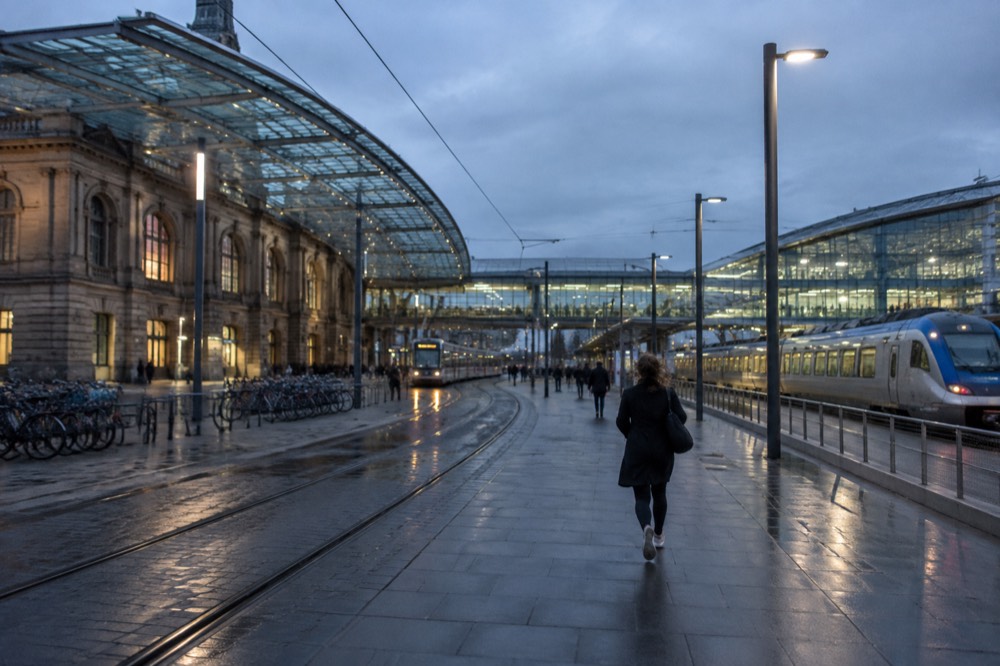
Strasbourg station sits on the western edge of the city centre, and trams fan out from the forecourt into every quarter. The Grande Île, the UNESCO-listed old island where the cathedral and Petite France stand, is a short tram ride or an easy walk away. Once you have dropped your bags, the city becomes a walking place: the question is Strasbourg a walkable city gets a firm yes for the historic core, and the tram network covers the longer hops to Neustadt and the European Quarter.
| Ticket | Price | Where It Works |
|---|---|---|
| Single ticket | 1.90 EUR | CTS app, Badgéo or contactless payment, any tram or bus |
| Single ticket bought on board | 2.50 EUR | On buses only |
| 24H Solo pass | 4.60 EUR | One traveller, all trams and buses for 24 hours |
| 24H Trio pass | 10.20 EUR | Two or three travellers together for 24 hours |
| Airport combined ticket | 4.60 EUR | Shuttle train from Entzheim plus a day on the CTS network |
If you land late and the shuttle timetable has thinned out, a taxi or a pre-booked transfer covers the same short distance, but for the overwhelming run of arrivals the train is the answer: frequent, quick and cheap. There is no need to arrange anything in advance. The station is attached to the terminal, tickets are sold on the spot, and Strasbourg station's own facilities, from left luggage to the tram platforms outside, are built for travellers arriving at any hour.
Prefer a ride waiting when you land? Book an airport transfer here.
Once the bags are down and the jet lag is manageable, the first evening is the moment to let someone else do the orienting. A guided walk with a local guide turns the old island into a map you can read for the rest of the stay, and the food-led versions do it with dinner included.
Where Should You Stay On Arrival?
Stay inside or on the edge of the Grande Île for a first visit, because the cathedral, Petite France, Place Kléber and the riverside lanes all sit within an easy walk of one another. Petite France, the former tanners' quarter on the western tip of the island, puts half-timbered houses and canal views outside the door. Krutenau, the student quarter south of the island, offers a lived-in neighbourhood with winstubs and lower-key streets, usually at gentler rates.
The old island is where the postcard version of Strasbourg lives, and it is also the most practical base, because every arrival route ends within a short tram ride of it. The trade-off is price and availability: rooms inside the historic core are limited, and in December they fill early. The neighbourhood guides on this site break the options down street by street, starting with where to stay in Petite France, the quarter travellers picture when they imagine the city.
For a first visit, the length of stay shapes the base as much as the budget does. The question of how many days in Strasbourg is enough has a practical answer: the old core rewards two full days at a comfortable pace, and a third day opens the door to the European Quarter, Neustadt and a river cruise on the Ill. Travellers flying in from the US have crossed an ocean to be here, so building in at least one recovery day before the first early start is a habit worth keeping.
When Should You Fly To Strasbourg?
Strasbourg has a semi-continental climate, with cold winters and warm summers and rain in every month of the year. Meteo-France 1991-2020 normals for Strasbourg-Entzheim give a mean daily maximum of 5.9 C in December against 26.4 C in July, and 112.3 days of rain of 1 mm or more across the year. Spring and autumn are mild shoulder seasons. December, the Christmas market month, needs the earliest booking of all.
The seasonal pattern matters for an American traveller in a way it does not for a weekend visitor from Belgium, because the cost of bad timing is measured in a transatlantic fare. Summer brings the warmest weather, with mean daily maxima above 24 C from June to August, and the fullest terraces along the Ill. Winter is genuinely cold: December's mean daily minimum sits at 0.8 C, and the city's atmosphere depends on the Christmas market rather than the weather.
| Month | Mean daily maximum | Mean daily minimum | Days with 1 mm of rain or more |
|---|---|---|---|
| March | 12.1 C | 2.6 C | 8.5 |
| July | 26.4 C | 14.9 C | 10.4 |
| October | 15.8 C | 7.2 C | 9.6 |
| December | 5.9 C | 0.8 C | 10.2 |
December deserves special mention because it is the month that defines Strasbourg for many travellers. The market's usual pattern runs from late November to 24 December, and last year's edition drew 3.05 million visitors, which is why rooms in and around the old centre sell out far ahead of the summer peak. The question is December a good time to visit Strasbourg has a weather answer and a crowd answer, and they point in different directions. If the market is the reason for the trip, book flights and rooms together, early, and confirm the coming edition's dates on the city's own Christmas site before locking the itinerary.
Shoulder seasons are the quiet compromise. May's mean daily maximum of 20.9 C and September's 21.6 C sit either side of summer without the same pressure on hotel rooms, and the rain-day counts, 10.8 and 8.0 respectively, are close to the year-round norm. Whatever the month, pack for rain as well as the forecast: the city's covered lanes and winstubs make a wet afternoon a pleasure rather than a loss.
How Should You Spend The First Evening?
Arrive hungry and let a guided food walk handle the first evening. A traditional food walking tour with tastings introduces the winstub table, tarte flambée, choucroute and Alsatian wine in a single outing, with a local guide explaining what each dish is and where to eat it again later in the trip. It works as orientation as much as dinner: the route threads the lanes of the old island between stops, so the walk doubles as a first-night map.
The logic is simple. After a transatlantic flight and a connection, the last thing a traveller wants is to research restaurant lists in a foreign city at eight in the evening. A food-led walk removes the decision, feeds you the regional classics in one go and leaves you with names of dishes, wines and neighbourhoods to return to. The Alsatian table is distinctive enough to reward the introduction: it is a German-inflected French kitchen, and the question is Strasbourg more German or French is answered most vividly on a plate.
The same evening logic scales up. Once the legs have recovered, a day trip into the Alsace wine country or the Vosges castles turns the trip from a city break into a regional one, and the guided versions handle the driving and the cellar doors. The Strasbourg Travel Guide site's day-trip pages cover the wine route villages and castle itineraries in detail, and the tours below pair naturally with an arrival from the US: one for the first evening's table, one for the region beyond the city, one for the river that runs through it.
The food walk pairs with a first-night stay in the old centre, since the meeting points sit inside the historic core and the route ends within a stroll of the main hotels. Book it for the first full evening rather than the arrival day itself, so jet lag has a night to loosen its grip before the first glass of riesling. The operator's live listing carries the current times and availability, and Check availability before the flight is booked, because popular evening slots fill first in high season.
Common Questions About Getting To Strasbourg From The US
How do I get to Strasbourg from the US?
There is no nonstop flight, so you fly from the US to a European hub such as Paris, Frankfurt, Amsterdam or Zurich, then connect onward by a short flight, train or road. From Paris, direct TGV trains run from Paris Est and the fastest connections reach Strasbourg in under two hours. Alternatively, connect into Strasbourg Airport (SXB) and take the eight-minute shuttle train into the city.
Is there a direct flight from the US to Strasbourg?
No. Strasbourg Airport (SXB) at Entzheim is a regional airport without nonstop transatlantic service, and every journey from North America connects through a European hub. The airport's own schedule is built around European destinations, including new Jet2 winter routes to Edinburgh, Manchester and London Stansted, twice weekly.
How do I get from Strasbourg Airport to the city centre?
Take the shuttle train. It runs up to five times an hour between Entzheim and Strasbourg station, takes eight minutes, and a combined ticket covering the train plus a day of tram and bus travel costs 4.60 EUR. From the station forecourt, trams reach the Grande Île and every central quarter within minutes.
Can I reach Strasbourg by train from Paris?
Yes. Direct TGV services run from Paris Est to Strasbourg, and the fastest connections take under two hours. Check times and fares on SNCF Connect before booking, and allow generous time to cross Paris between your arrival airport or station and Paris Est, especially with checked baggage.
What is the weather like in Strasbourg in December?
Cold and damp. Meteo-France 1991-2020 normals give December a mean daily maximum of 5.9 C, a mean daily minimum of 0.8 C and 10.2 days of rain of 1 mm or more. Pack warm layers, a proper coat and waterproof shoes, and plan the days around the indoor winstubs and the Christmas market as much as the outdoor squares.
Do I need a car in Strasbourg once I arrive?
No. The historic core is compact and pedestrian-friendly, the tram and bus network covers the wider city, and a single CTS ticket costs 1.90 EUR bought in the app or by contactless payment. A car only earns its keep if the trip continues into the wine route villages, the Vosges or the Black Forest, and even then a guided day trip from Strasbourg covers the same ground without the driving.