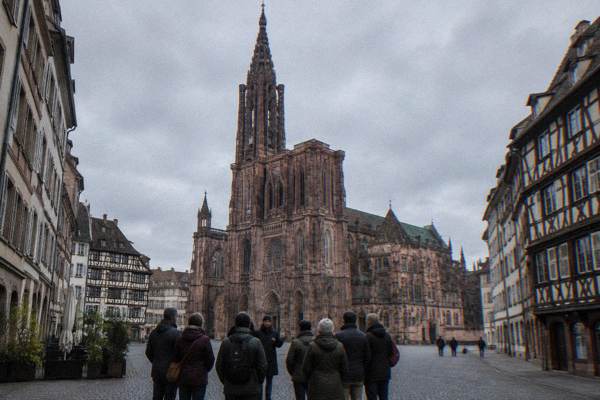
What Is The Most Christmassy Town In France?
Strasbourg, in Alsace, is the most Christmassy town in France: 3.05 million visitors at the 2025 Christmas market, a single-spired cathedral and a World Heritage old town full of chalets.
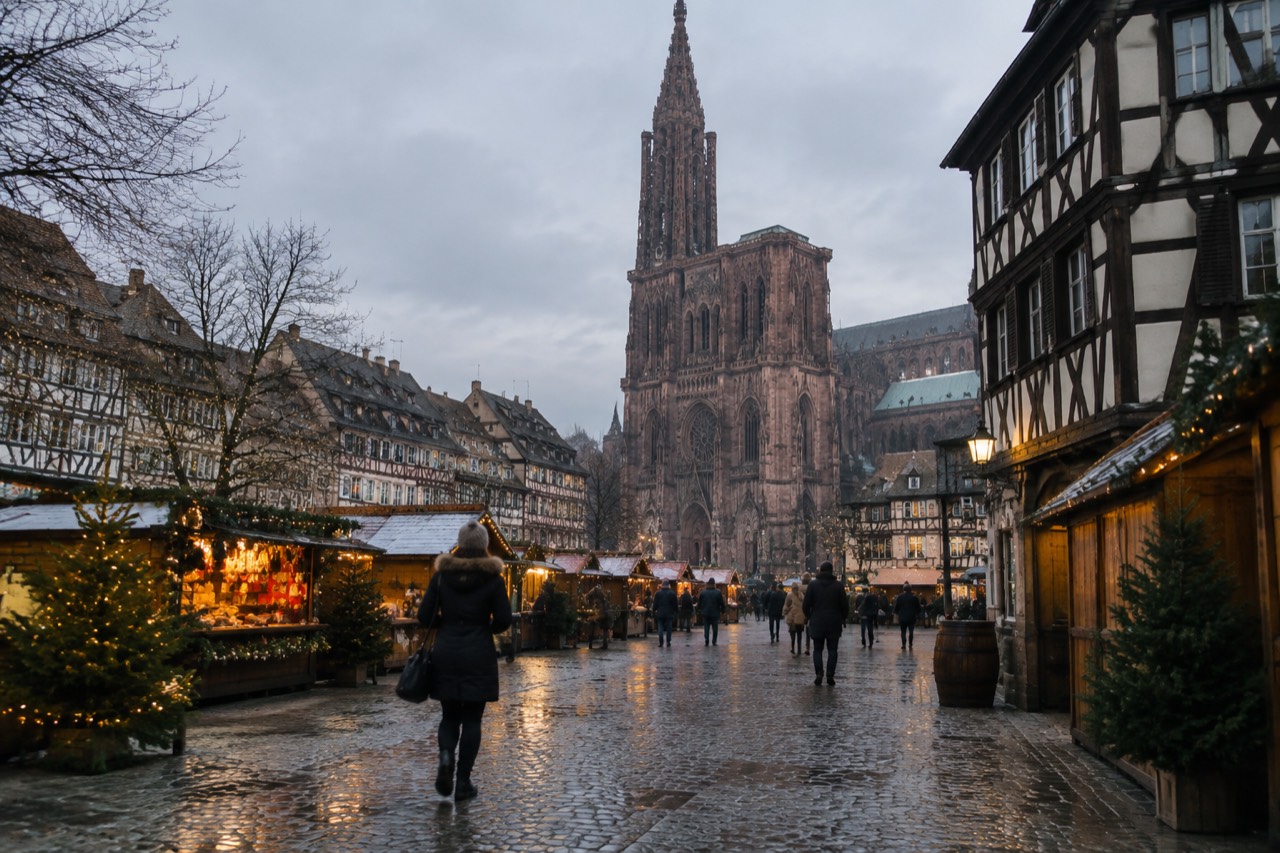
Strasbourg, the prefecture of the Bas-Rhin in Alsace, north-eastern France, sits on the River Ill beside the Rhine, across the water from the German town of Kehl. Each December it becomes the most Christmassy town in France. The city brands itself the Capital of Christmas, the 2025 edition of its market drew 3.05 million visitors, and the half-timbered lanes of the Grande Île fill with wooden chalets from late November to 24 December. This page sets out why Strasbourg holds the title, which Alsace towns contest it, and how to plan a December visit around the verified hours, ticket prices and weather numbers.
What Is The Most Christmassy Town In France?
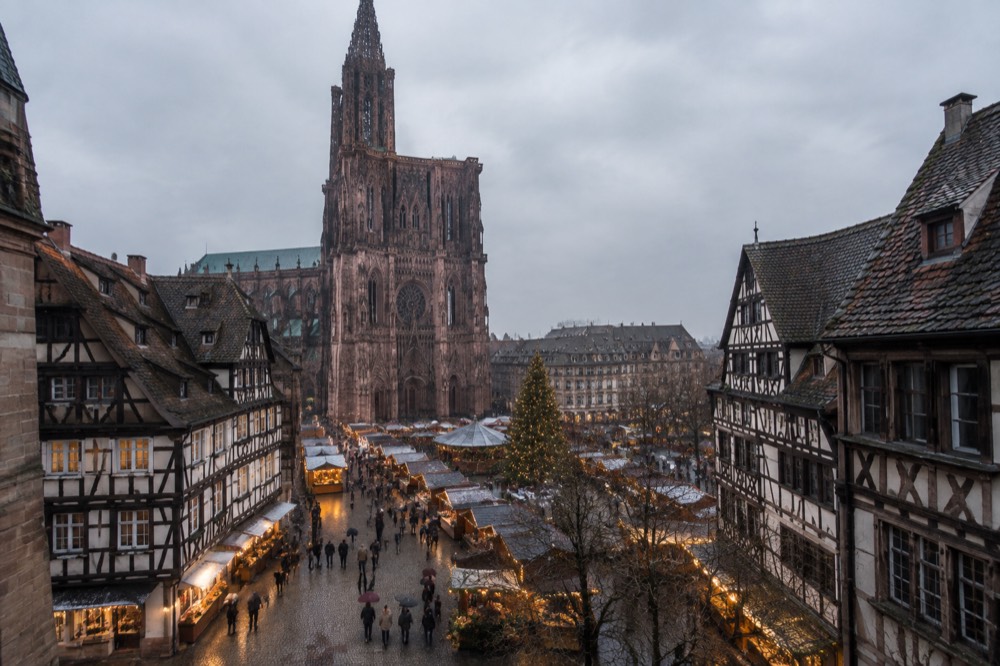
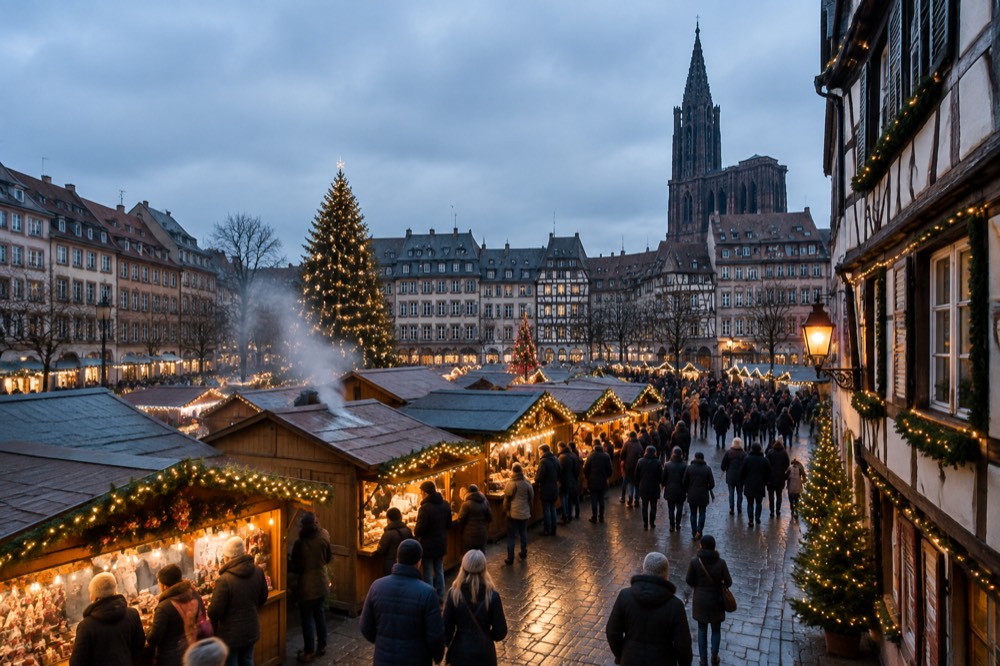
Strasbourg, in Alsace in north-eastern France, is the most Christmassy town in France, and the gap to the field is wide. The city styles itself the Capital of Christmas, and the 2025 edition of its market drew 3.05 million visitors against a commune population of 293,771. Chalets spread across the squares of the Grande Île, beneath a single-spired cathedral, from late November to 24 December, inside a World Heritage old town that needs no decoration to look seasonal.
The claim rests on scale and setting together. Strasbourg's Christmas market is not one square of stalls but a programme spread across the historic centre, with the cathedral, Place Kléber, Place Gutenberg and the riverside lanes of Petite France all drawn into it. The city's press release for the 2025 edition records 3.05 million visitors, down from 3.4 million in 2024, which is a drop but still a figure no other French town's market approaches on paper. The old town itself does half the work: the Grande Île and the Neustadt together form a UNESCO World Heritage property, and the half-timbered, riverside, gingerbread architecture reads as Christmas even in July.
To find your way between the market squares and the old lanes, book a free walking tour here.
The other half is tradition. Strasbourg's Christmas market is one of the oldest of its kind in France, and the city leans on that heritage hard, with a dedicated city Christmas site, a guest-country programme and a giant tree on Place Kléber. The Strasbourg Travel Guide covers the market in depth elsewhere on this site; this page stays on the single question of which French town deserves the "most Christmassy" label, and the honest answer does not change.
| What | Figure | Source of the number |
|---|---|---|
| 2025 market dates | 26 November to 24 December 2025 | City press release |
| 2025 attendance | 3.05 million visitors | City press release |
| 2024 attendance | 3.4 million visitors | City press release |
| Commune population | 293,771 (INSEE, 2023) | INSEE |
| Cathedral platform ticket | 10 EUR full, 6 EUR reduced | Cathedral ticket PDF |
| Astronomical clock show | 4 EUR, daily at 12:30 | Cathedral hours page |
| Batorama long boat tour | 16.20 EUR full, 8.90 EUR reduced | Batorama official site |
| Municipal museum ticket | 9 EUR full, 5 EUR reduced | Musées de Strasbourg |
| December mean maximum | 5.9 C | Meteo-France 1991-2020 normals |
Why Does Strasbourg Own Christmas In France?
Strasbourg owns Christmas in France because it combines the country's biggest market attendance with a setting that no rival can match. The 2025 edition drew 3.05 million visitors. The market spreads across the squares of a World Heritage old town, the Grande Île, under a cathedral with a single spire and a platform at 66 m, and the city runs the whole thing under an official Capital of Christmas banner with its own dedicated website.
The programme is city-wide rather than square-bound. Chalets stand across several squares in the historic centre, the cathedral's astronomical clock runs its automaton show daily at 12:30, and the riverside quarters of Petite France and the Krutenau sit inside the same walkable loop. During the market the cathedral keeps continuous Monday-to-Saturday hours on the Place du Château side, 08:30 to 17:45, which matters because the building is the visual anchor of the whole event. The dates follow a stable pattern: the market opens in the last week of November and runs to 24 December, closing early in the evening on the final day. The 2026 dates are not yet published, and the city's Christmas site states that the programme is still being finalised, so check there before locking in travel.
For a first visit in December, a guided walk is an efficient way to see the market squares and the old town lanes before the evening crowds build. The small-group curiosities walk on this site's roster pairs the cathedral quarter with the lesser-known corners of the old town, and a shorter city centre walk covers the core loop for visitors with a river-cruise stop or a tight schedule.
The format in question deserves a word of its own. Cruise passengers docking on the Ill and travellers on a Paris day trip both face the same problem: a market that rewards wandering but punishes bad routing, because the squares sit on opposite sides of the cathedral and the riverside lanes are easy to miss. A short guided loop of the city centre solves the routing and leaves the afternoon free for the clock show at 12:30 or a Batorama boat tour, whose long circuit runs 1h10 and costs 16.20 EUR full fare.
Which Other Alsace Towns Contend For The Title?
The serious contenders are all in Alsace: Colmar, Eguisheim, Riquewihr and Kaysersberg, each a half-timbered wine-town with its own December market. None matches Strasbourg's scale or its cathedral-and-river setting, and none runs a city-wide programme under an official Capital of Christmas banner. Colmar comes closest on atmosphere, while the wine villages win on intimacy and on pairing a market visit with a tasting.
Colmar is the standard answer from travellers who prefer small and pretty to large and grand. Its old town is canal-side and half-timbered, its market clusters in the historic centre, and it sits close enough to Strasbourg to work as a day trip or a second base. Eguisheim and Riquewihr are smaller again: concentual lanes, wine-cellars, stork nests, and markets you can walk around in an afternoon. Kaysersberg adds a ruined castle above the rooftops. The honest framing is that these towns offer a different experience rather than a lesser one, and the choice comes down to whether the December trip is about one big city event or a string of village markets. This site's guide to the most beautiful villages in Alsace covers them all outside the Christmas season.
| Town | What Christmas looks like | Who it suits | What to check before going |
|---|---|---|---|
| Strasbourg | Chalets across several squares of a World Heritage old town, cathedral anchor, 3.05 million visitors in 2025 | First-time visitors, weekend trips, river-cruise stops | 2026 dates on the city's Christmas site; cathedral platform hours |
| Colmar | Half-timbered old town with canals and clustered market squares | Couples and second visits to Alsace | Market dates and train or tour options from Strasbourg |
| Eguisheim | Small concentual-lane village market with wine-cellars | Slow travellers, wine-first itineraries | Opening days, which are shorter than the city season |
| Riquewihr | Walled wine village with festive lanes and tasting rooms | Wine-route trips combining several villages | Parking and shuttle arrangements in December |
| Kaysersberg | Market beneath a ruined castle above the rooftops | Photographers, village-hopping routes | Winter road conditions on the wine route |
Combining them is the strongest December itinerary in France: two or three nights in Strasbourg for the big market, then a day through the wine villages. The full-day Colmar, Riquewihr and Haut-Koenigsbourg castle tour on the roster handles that loop with the driving included, which matters in December when the wine route's minor roads can be frosty. For readers weighing the two cities against each other, this site also answers the question of which market leads in France in a dedicated page.
What To Do In Strasbourg In December
A December visit divides into four blocks: the market squares, the cathedral, the river, and the museums. The astronomical clock show runs daily at 12:30 for 4 EUR, the platform ticket is 10 EUR full and 6 EUR reduced, the Batorama long boat tour costs 16.20 EUR full and 8.90 EUR reduced, and municipal museums charge 9 EUR full and 5 EUR reduced, with free entry on the first Sunday of the month.
Start with the cathedral, because it anchors the market geographically and thematically. The nave's visiting hours on Monday to Saturday are 08:30 to 11:15 and 12:45 to 17:45, and on Sundays 14:00 to 17:15; during the market the cathedral is open continuously Monday to Saturday on the Place du Château side. The platform at 66 m runs on seasonal hours, 10:00 to 13:00 and 13:30 to 18:00 with the last ascent at 17:15 in the winter window, and it closes on 1 January, 1 May and 25 December. Clock tickets are sold on the day only, at the cathedral stalls in the morning or at the Saint-Michel entrance from 11:30, so plan the 12:30 show around a morning market stroll rather than a lunch booking.
The river is the second half of a December day. Batorama's official site lists the long tour at 16.20 EUR full and 8.90 EUR reduced, the short tour at 12.50 EUR full and 7.20 EUR reduced, with the Red Tour running 1h10 and the Blue Tour 0h45; the boat gives a warm, seated view of Petite France, the Covered Bridges and the Neustadt façades when the evening air bites. For museums, the municipal ticket is 9 EUR full and 5 EUR reduced, a 1-day Pass Musées is 20 EUR, and every municipal museum is free on the first Sunday of the month, which in December is a genuine planning lever. One closure to route around: the Musée Alsacien is shut for works until 2028, so the folk-arts fix is the Musée de l'Œuvre Notre-Dame beside the cathedral instead.
A guided walk slots neatly into the first afternoon, before the routing mistakes happen. The small-group curiosities walk that this site features moves from the cathedral quarter through the old town's stranger corners, and it is a good fit for December because a guide who knows the lanes also knows which market squares are worth the detour and which can be skipped at peak crowd. It can be booked through the operator's live listing, with free cancellation available on the listing's terms.
Getting around costs very little. CTS's fare page gives a single ticket at 1.90 EUR bought through the app or contactless, or 2.50 EUR on board a bus, with a 24h Solo pass at 4.60 EUR and a 24h Trio at 10.20 EUR for two to three people. The historic centre is walkable end to end, so the tram is mainly for the airport run and the European Quarter; this site's page on whether December is a good time to visit weighs the trade-offs in full.
What Is December Weather Like In The Most Christmassy Town?
December in Strasbourg is cold and grey rather than snowy: Meteo-France 1991-2020 normals give a mean daily maximum of 5.9 C, a mean minimum of 0.8 C, 45.2 mm of rain and 10.2 days with 1 mm of rain or more. The climate is semi-continental, so the city gets real winter cold without a reliable white Christmas, and the market experience is built for it, with mulled wine and covered chalets.
The numbers matter for packing more than for planning, because the market runs regardless. November, the shoulder of the season, averages a 9.4 C maximum and a 3.3 C minimum with 9.2 rain days, so an opening-weekend visit is milder but wetter than a mid-December one. Layers, a real coat and waterproof shoes are the honest kit list: the squares are cobbled, the riverside lanes in Petite France hold puddles after rain, and the platform ascent is outdoor staircase all the way to 66 m. The 24 December close comes early in the evening, so the final day rewards a morning arrival.
Common Questions About Christmas In France
What is the most Christmassy town in France?
Strasbourg, in Alsace in north-eastern France. The city styles itself the Capital of Christmas, its 2025 market drew 3.05 million visitors, and the event fills the World Heritage old town from late November to 24 December.
Is Strasbourg or Colmar better for Christmas?
Strasbourg for scale, programme and the cathedral setting; Colmar for a smaller, prettier, more intimate market. Many travellers do both, using Strasbourg as the base and Colmar as a day trip.
When does the Strasbourg Christmas market run?
The usual pattern is late November to 24 December, closing early in the evening on the final day. The 2025 edition ran 26 November to 24 December 2025. The 2026 dates are not yet published, so confirm them on the city's Christmas site.
Is the Strasbourg Christmas market worth the crowds?
For a first Christmas trip to France, yes: the setting, the cathedral and the river together justify the visit. Weekday mornings are calmer than weekends, and the boat tour and platform offer breaks from the squares.
What should be booked ahead for December in Strasbourg?
Accommodation first, then a guided walk and any day trip to the wine villages. Cathedral clock tickets are sold on the day only, so those cannot be pre-booked, but everything else benefits from early booking in the December window.
Does it snow in Strasbourg at Christmas?
Not reliably. December normals give a mean minimum of 0.8 C and a mean maximum of 5.9 C, with 10.2 rain days, so cold rain is at least as likely as snow. The market is designed for cold, not for white ground.
Strasbourg's case for the title is the one that survives contact with the numbers: a 3.05-million-visitor market, a World Heritage old town and a cathedral that anchors the whole programme, all inside a walkable island city a short hop from the German border. Book the bed early, confirm the 2026 dates on the city's Christmas site, and let the wine villages fill the spare day.