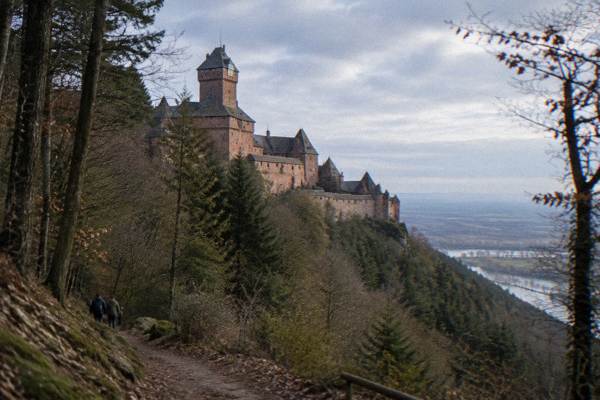
Haut Koenigsbourg
Haut Koenigsbourg is the medieval castle that dominates the Alsatian Vosges south of Strasbourg, and it pairs naturally with the wine villages that sit beneath it. Here is how to plan the day.
Short answer
Haut Koenigsbourg is a medieval hilltop castle in Alsace, north-eastern France, roughly an hour's drive south of Strasbourg in practice, though no verified door-to-door time exists. It is best visited as part of a day trip that also takes in Riquewihr or Kaysersberg, and several guided tours from Strasbourg include it.
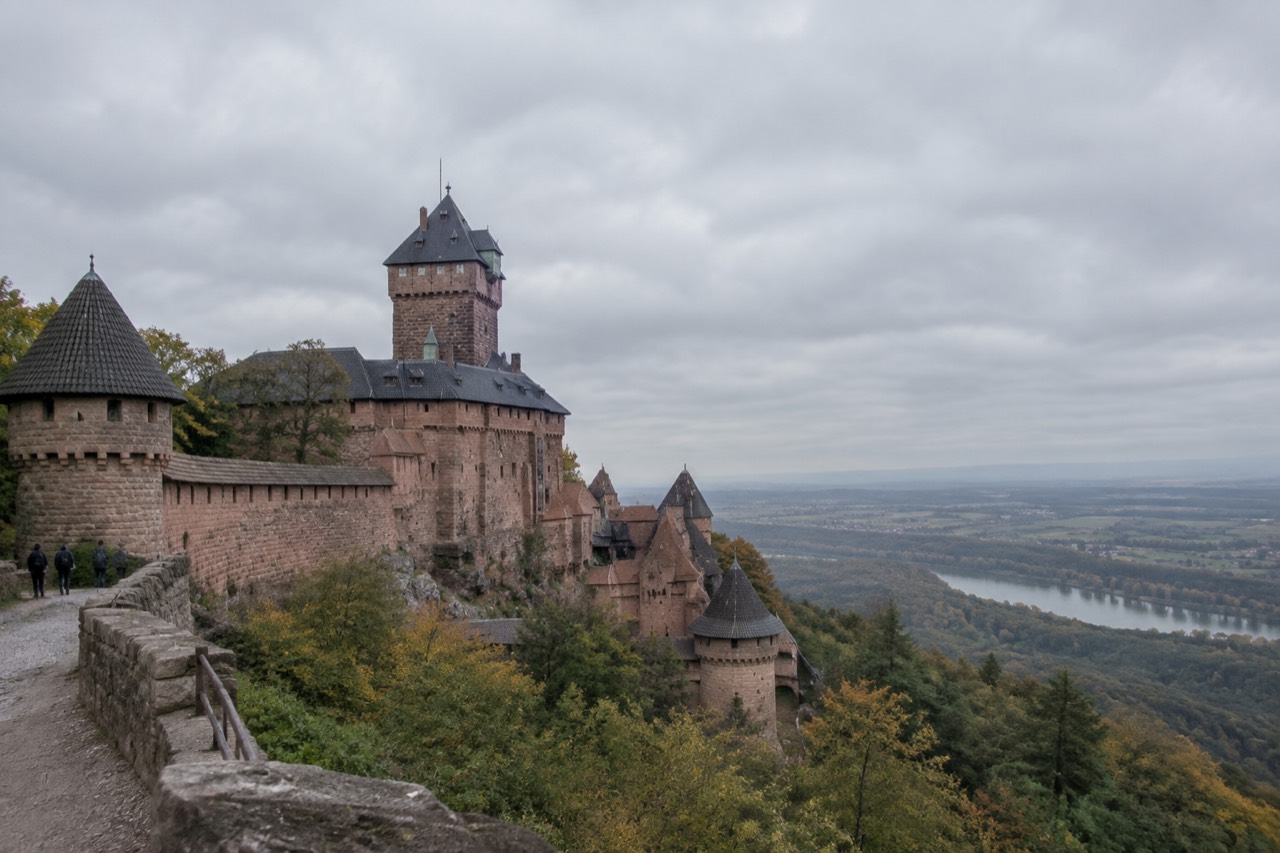
Haut Koenigsbourg stands on a wooded ridge in Alsace, in the Bas-Rhin department of the Grand Est region of north-eastern France, south of Strasbourg and close to the border with Germany. It is the castle you see on half the postcards of the region: pink sandstone walls, round towers, a long approach ramp, and a terrace that looks out over the plain of Alsace to the Vosges on one side and the Black Forest across the Rhine on the other. The castle gives its name to a whole day-trip pattern from Strasbourg, because it sits at the top of the wine route and within easy reach of the villages that line it, among them Riquewihr, Kaysersberg and Eguisheim. This guide covers what the castle actually is, how to get there from Strasbourg without a car, what you see once you are inside, and how to fold it into a day that also takes in the vineyards below.
What Is Haut Koenigsbourg?
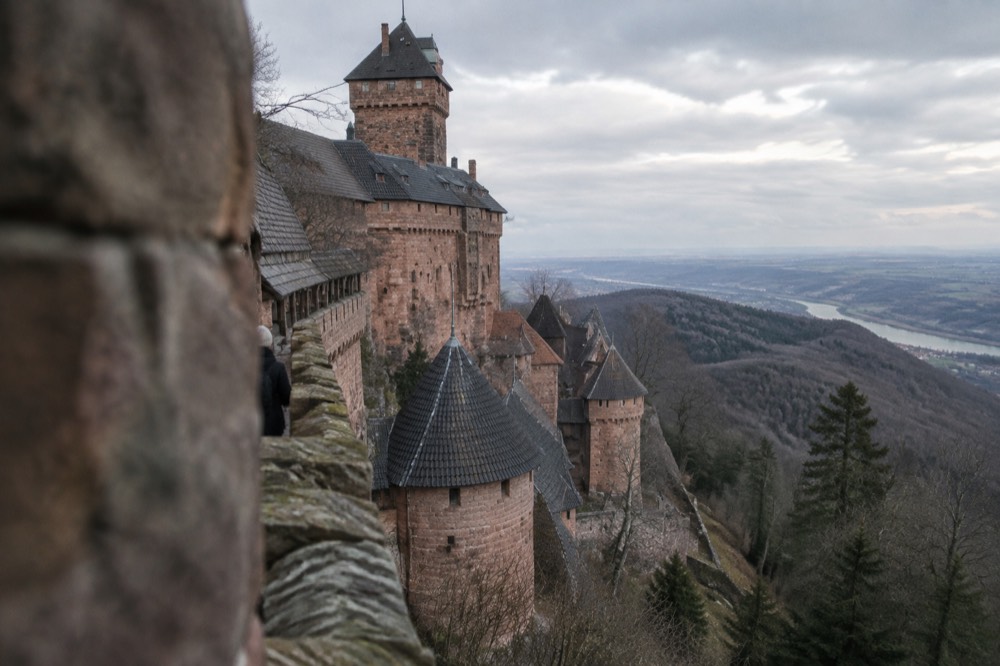
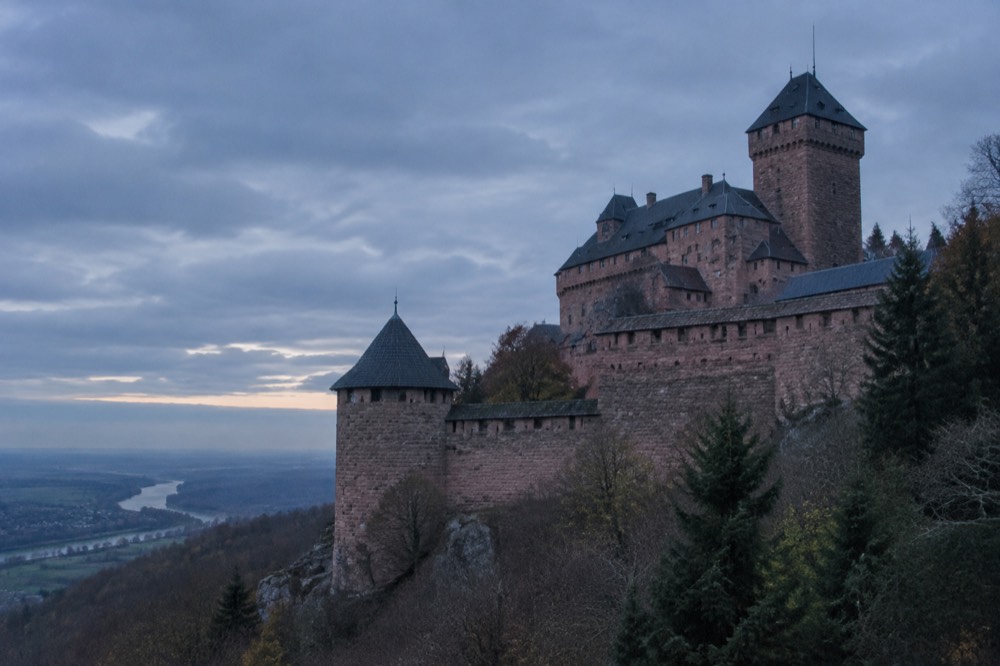
Haut Koenigsbourg is a medieval hilltop castle in the Bas-Rhin department of Alsace, north-eastern France, on a forested ridge above the village of Orschwiller, south of Strasbourg and west of the Rhine border with Germany. It is one of the recognisable landmarks of the Alsace wine route region, and it is usually visited as a half-day stop within a longer day trip from Strasbourg that also takes in one or more of the wine villages below it. The castle's character is what makes it stand out among Alsatian sights. Where the region's villages are low, timbered and floral, the castle is vertical, martial and bare: ramparts, a dry moat, a keep, and interior rooms furnished in the style of a medieval fortress household. The walls are built from the local pink sandstone, the same stone that gives Strasbourg Cathedral its colour, and on a clear day the terrace panorama runs from the Vosges summits to the German side of the Rhine valley.
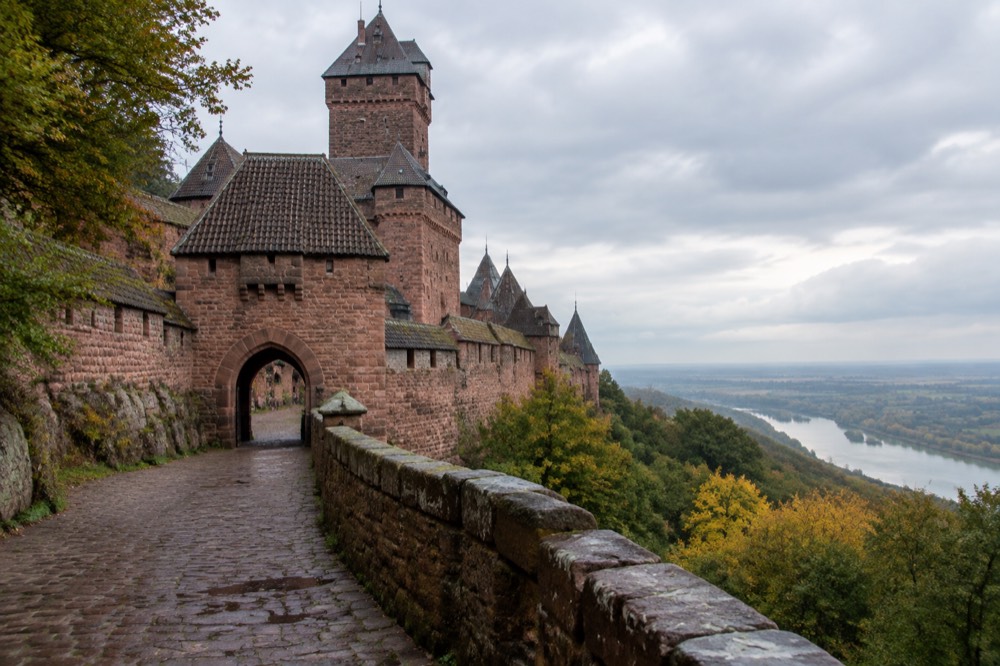
The castle's hill has been a fortified position for centuries, and the site changed hands repeatedly across the French and German history of Alsace, a history this site covers in detail elsewhere. What stands today reflects a restoration carried out when the region was under German administration, and that restoration is why the castle reads as a complete fortress rather than a ruin. The approach is deliberately theatrical: you walk up a rising ramp through outer defences, pass beneath a gateway, and only then reach the courtyard and the keep. Guides on the paid tours from Strasbourg tend to spend their castle stop on exactly this sequence, because it is the part that explains how the building was meant to work as a defensive machine.
Inside, the visit divides into three kinds of space, and it is worth knowing which of them you care about before you arrive.
| Part of the castle | What it is | Who it suits |
|---|---|---|
| Outer rampart and gateway | The rising approach, walls and defensive passage you cross to enter | Photographers and anyone interested in how the defences were laid out |
| Courtyard and keep | The central fortress core with towers and stairways | Visitors who want the classic postcard views and the structure itself |
| Interior rooms | Furnished halls, kitchens and living quarters in medieval style | Families and visitors who prefer something to look at inside rather than only walls |
| Terrace and viewpoints | Open platforms looking over the plain of Alsace and the Vosges | Everyone, and the reason many people make the trip |
One practical note for planning: the castle sits on a hill, and reaching it from the parking area or the drop-off point involves uphill walking on stone ramps and stairs. Visitors with limited mobility should check the castle's official access information before committing to the trip, because the terrain is part of the experience and cannot be bypassed. The same applies to visiting in December, when ice on the ramp can close sections of the visit.
How To Get There From Strasbourg Without A Car?
The honest answer is that Haut Koenigsbourg is awkward to reach by public transport, and the two realistic options from Strasbourg are a self-drive day, which gives full flexibility over timing and route, or a guided day trip that includes the castle in a loop with the wine villages. There is no direct train to the castle. The rail network of the region runs along the plain, through towns such as Sélestat, while the castle sits on its ridge above the village of Orschwiller, and the last stretch from any station to the castle gate is a matter of local buses or a taxi, with connections that are sparse outside peak periods. For that reason, the standard advice for a visitor based in Strasbourg without a car is to treat the castle as part of a guided loop rather than as a standalone destination.
If a self-drive day sounds like your kind of freedom, book a rental car here.
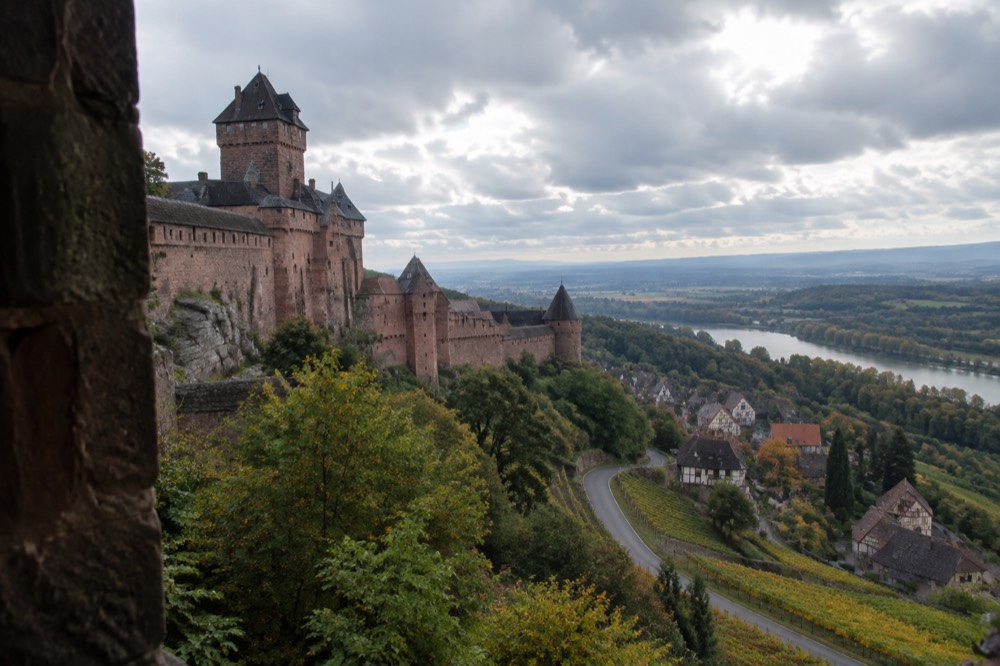
For drivers, the pattern is simple: leave Strasbourg, follow the plain south, and climb into the Vosges foothills where the wine route begins. The road between the castle and the villages is the famous part, a ribbon of vineyards and half-timbered villages running along the lower slopes. Parking at the castle exists but fills in high season and on holiday weekends, so an early start matters more in July and August than in spring or autumn. Check the castle's official site for current opening days and any seasonal closures before you set out, because hilltop sites in the Vosges do close for weather.
| Option | What it involves | Who it suits |
|---|---|---|
| Self-drive from Strasbourg | A loop south through the plain, up to the castle, then along the wine route back | Couples and families who want to set their own pace and stop freely |
| Guided day trip with castle entry | A coach loop from Strasbourg taking in the castle plus villages such as Riquewihr or Kaysersberg | Visitors without a car, or anyone who prefers not to drive after a wine tasting |
| Train plus local connection | Rail to a station on the plain, then a local bus or taxi for the final climb | Only determined independent travellers; connections are limited and need checking in advance |
The guided option is the one that removes every planning decision at once, and it is the format that covers the castle on this site's roster.
What You Actually See On A Castle Visit?
A visit to Haut Koenigsbourg is a walk through a complete fortified complex: the outer defences and gateway, the courtyard, the keep with its towers, a set of furnished interior rooms, and open terraces with a panorama over the plain of Alsace, the Vosges and the Rhine valley towards Germany. The order matters. You arrive at the lower end of the site, climb through the outer works, and the castle reveals itself in stages, which is exactly how the builders intended a defended approach to feel. The furnished rooms are the part that separates this castle from a bare ruin: halls with period furniture, a kitchen setup, and displays that give the interior a lived-in character that children in particular respond to.
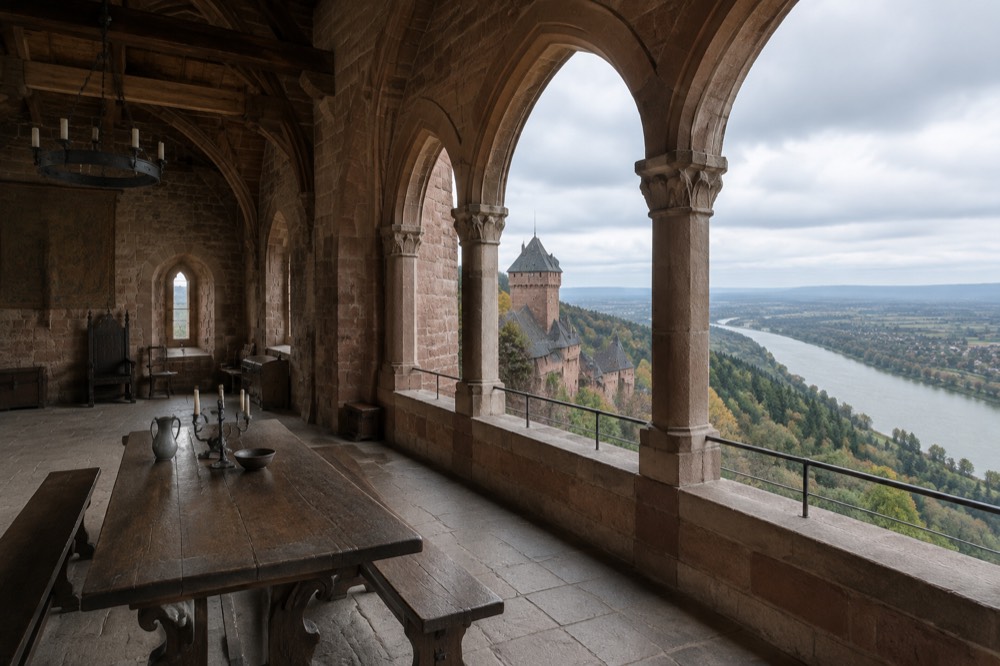
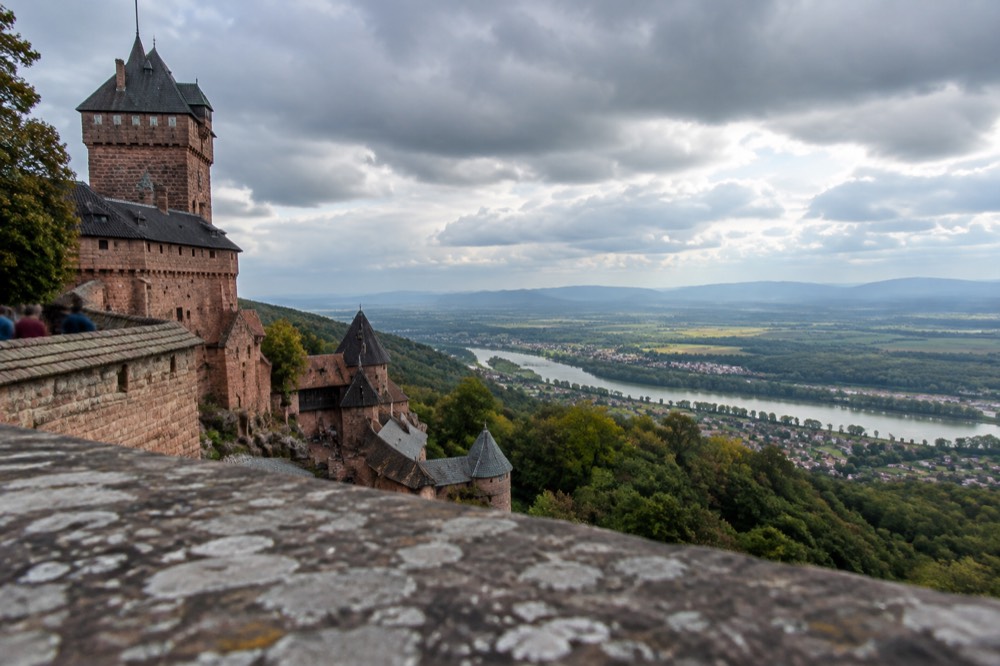
The terrace is the payoff. From the top of the works you look south and west across forested slopes towards the high Vosges, and east across the plain towards the Rhine and the German side of the border. On a clear day the view explains the castle's whole purpose: this ridge was the watching point for the corridor between the Vosges and the river, and everything that moved on the plain below was visible from here. Guides on the Strasbourg day tours usually give the group free time at the castle rather than a full guided interior circuit, so it is worth walking the ramp and the terrace on your own rather than staying near the entrance.
Give the interior a slower pass if you have the time. The rooms are dim, stone-vaulted and cool even in summer, and the contrast between the bare defensive exteriors and the furnished interiors is the castle's most interesting idea. In winter the atmosphere changes completely: the site is emptier, the stone is cold, and the view, when the Vosges are clear of cloud, can carry snow on the higher summits. Whatever the season, wear shoes with grip, because the ramps and stairs are worn stone and they stay slick after rain.
Which Tours From Strasbourg Include The Castle?
The castle appears on several guided day trips from Strasbourg, and the choice between them comes down to what else you want in the day: the classic format pairs the castle with Colmar and the wine villages of Riquewihr and Kaysersberg, while longer formats trade village time for a broader sweep of the wine route. The flagship format on this site's roster is the loop that takes in Colmar, the castle, Riquewihr and Kaysersberg, which is the most complete single-day version of the region for a first-time visitor. It is the tour to pick if you want the castle, one proper town and two wine villages in one departure from Strasbourg, and you can Check availability on the operator's live listing alongside the fuller details in our Colmar and castle day trip coverage.
The alternatives change the balance of the day. A medieval-villages-and-wine-tasting format spends less time on towns and more on the tasting rooms of the route, which suits visitors whose real interest is Alsatian wine and who see the castle as the scenic anchor between tastings. A castle-plus-Riquewihr format drops Colmar entirely and keeps the day shorter and tighter. The table below lays out the formats that include the castle or compete with it for the same day.
| Tour format | What the day covers | Who it suits |
|---|---|---|
| Colmar, castle, Riquewihr and Kaysersberg | A full loop: town, castle and two wine villages | First-time visitors who want the complete region in one day |
| Medieval villages with wine tasting | Wine-route villages with tastings built into the day | Wine-first travellers who want the cellar more than the town |
| Castle and Riquewihr only | A tighter loop without Colmar | Visitors short on time or energy, or those returning to Alsace |
One honest comparison point: the castle is the fixed element in all of these, and what you are really choosing is the ratio of town to vineyard to tasting room around it. If you have two days in the region, a better plan is a castle-and-villages day followed by a separate day in Colmar itself, which deserves more than a mid-afternoon stop. Our Strasbourg and Colmar itinerary page works through that split in detail.
How Does The Castle Pair With The Alsace Wine Route?
The castle sits at the top of the logical route through the wine country: the standard pairing is the castle in the morning, followed by Riquewihr or Kaysersberg in the afternoon, with Eguisheim or Riquewihr as the tasting stop, and the whole loop run from Strasbourg in a single day. The geography does the work here. The villages of the route, Riquewihr, Kaysersberg, Eguisheim, Ribeauvillé and Hunawihr among them, sit in a band along the lower slopes of the Vosges, and the castle rises above the middle of that band, so a loop that climbs to the castle first and then descends into the villages wastes no road. That is exactly the shape the guided tours use, and it is the shape to copy if you drive.
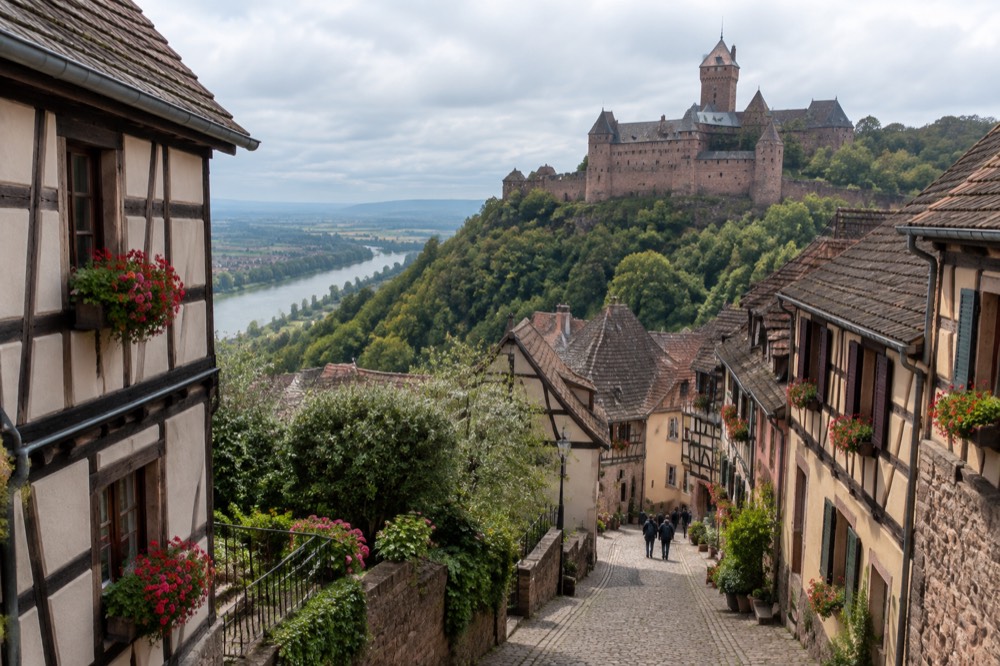
The pairing also solves the wine-tasting-and-driving problem. If you drive the route yourself, the sensible order is castle first, tasting last, and a designated driver or a very light hand at the cellar door. If you take a guided tour, the driving is handled and the tasting stops are scheduled, which is why the wine-tasting formats are popular with visitors who would otherwise have to skip the cellars. Our Alsace wine route guide covers the villages and the practicalities of the route in full, and it is the companion read to this page.
| Village | Character | How it fits a castle day |
|---|---|---|
| Riquewihr | Walled, intensely picturesque, the classic wine village | The standard afternoon stop on castle loops |
| Kaysersberg | A river village with a ruined castle of its own | The usual second stop, quieter in the evening |
| Eguisheim | Circular village, concentric streets, very compact | A good alternative if you have seen Riquewihr already |
| Ribeauvillé | Larger, livelier, with a fountain square | A stop on the longer wine-route formats |
For visitors whose interest in the day is genuinely the wine rather than the views, a half-day wine tour from Strasbourg is a real alternative to the full castle loop, trading the fortress for cellar time. The format below is the one to weigh against a castle day if your priority is tasting. The full index of guides sits on Strasbourg Travel Guide.
What Should You Check Before You Go?
Before a Haut Koenigsbourg day trip, check four things on official pages: the castle's current opening days and any weather closures, the entry arrangements and whether your tour includes castle admission or leaves it to you, the parking situation if you are driving, and the opening days of the specific wine villages or cellars you plan to stop in. The castle's own site is the source, not a travel blog. Hilltop sites in the Vosges close for weather and low season, and a castle closed on the day of your self-drive loop turns the whole trip into a villages-only day, which is a different and lesser experience.
| What to check | Why it matters | Where to check |
|---|---|---|
| Castle opening days and hours | Hilltop sites have seasonal and weather closures | The castle's official site |
| Whether your tour includes castle entry | Some formats include admission, others leave it to you | The operator's live listing |
| Parking at the castle | The lot fills in summer and on holiday weekends | The castle's official site |
| Village and cellar opening days | Small cellars close midweek and out of season | The village or producer's own page |
Timing within the day matters as much as the date. The castle is at its busiest from late morning through mid-afternoon in July and August, which is precisely when the wine villages are also at their fullest. A morning castle visit followed by an early-afternoon village walk, with the tasting stop after the crowds thin, is the pattern the guided tours converge on, and it is the pattern to aim for if you drive. In the Christmas period the calculus changes again: the villages run their Christmas markets, the days are short, and the castle competes for time with everything from Strasbourg's own Christmas market to the smaller market squares of the wine route, so a castle day in December needs an earlier start than the same day in June.
When Is The Best Season For A Castle Day Trip?
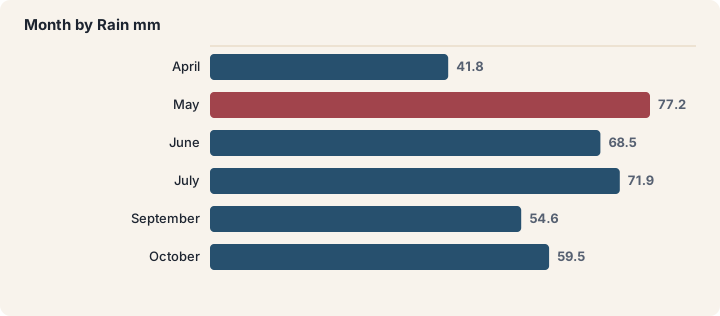
The best seasons for a Haut Koenigsbourg day trip from Strasbourg are late spring, from May into June, and early autumn, in September and October, when the weather is settled enough for the terrace panorama, the vineyards are at their most photogenic, and the summer crowds at both the castle and the wine villages have not yet arrived or have already gone. The climate here is semi-continental, which means warm summers, cold winters and rain spread through the year: Meteo-France 1991-2020 normals for Strasbourg-Entzheim give a mean maximum of 20.9 C in May against 5.9 C in December, and 635.7 mm of rain across the year. Autumn is the favourite of photographers because the vine leaves turn colour across the whole lower slope of the Vosges, and the view from the castle terrace takes in that band of hills directly.
| Month | Mean maximum C | Mean minimum C | Rain mm | Rain days of 1 mm or more |
|---|---|---|---|---|
| April | 17.0 | 5.7 | 41.8 | 8.6 |
| May | 20.9 | 10.1 | 77.2 | 10.8 |
| June | 24.4 | 13.4 | 68.5 | 10.2 |
| July | 26.4 | 14.9 | 71.9 | 10.4 |
| September | 21.6 | 10.7 | 54.6 | 8.0 |
| October | 15.8 | 7.2 | 59.5 | 9.6 |
December deserves a separate word, because it is the month that brings people to Strasbourg in the largest numbers, drawn by the Christmas market, which ran from 26 November to 24 December in its last edition and drew 3.05 million visitors. A castle day in December is entirely possible and the villages are at their festive best, but the days are short, the light goes early, and the mean minimum sits at 0.8 C, so the terrace time you get is brief. The trade is worth it for the combination of a fortress morning and a lantern-lit village afternoon, and it is the one season where the guided format clearly beats self-drive, because the coach handles the early darkness on the road back to Strasbourg. Our Strasbourg in winter coverage develops the December planning in full.
Is Haut Koenigsbourg Worth The Trip From Strasbourg?
For a first visit to Alsace of two days or more, yes: the castle is the region's single most dramatic sight, it pairs with the wine villages better than any other stop, and a guided loop from Strasbourg makes it a low-effort day. For a one-day stay in Strasbourg itself, it is the wrong call, because the city's own core, the Grande Île, the cathedral and Petite France, fills a day on its own and the castle would cost you most of it. The honest framing is that the castle is the anchor of the second day, not the first. Visitors who try to fold it into a single day in Strasbourg end up seeing the city at a sprint and the castle at a sprint, and enjoy neither.
The case for the castle is strongest for three kinds of traveller. Families do well, because the fortress is a place children can physically explore, ramp to terrace, rather than look at through a rope. Photographers do well, because the combination of pink stone, forest ridge and vineyard plain gives the region its most complete set of frames in one site. And wine-route travellers do well, because the castle is the natural high point, in both senses, of a day that otherwise runs along the valley floor. If you fall into none of those groups and your interest is mainly urban, the European institutions and the museum quarter of Strasbourg will serve you better, and this site's coverage of the European quarter lays out that alternative.
The medieval-villages format below is the strongest rival to the classic castle loop, and it is the pick if your second day leans towards cellars rather than ramparts. Whichever you choose, book the departure from Strasbourg early in your stay rather than late, so a weather closure at the castle can be rescheduled into another day of the trip.
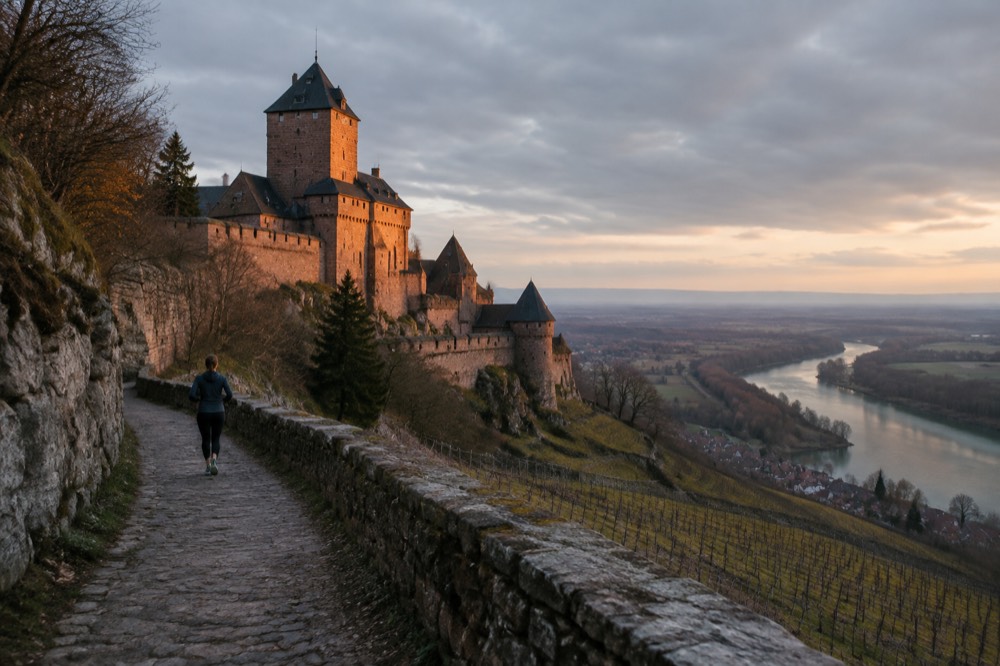
A last word on the shape of the day. The castle rewards the early start: the ramp and the terrace are quiet in the first hour, the light across the plain is at its clearest, and the whole site feels like the fortress it is rather than the attraction it becomes by noon. The villages reward the opposite, coming alive from late afternoon, so the loop that runs castle-then-villages is not just the shortest route but the right tempo. That is the pattern every good day trip from Strasbourg into this corner of Alsace follows, and it is the one to build yours on.
Common Questions About Haut Koenigsbourg
Where is Haut Koenigsbourg?
Haut Koenigsbourg is a hilltop castle in the Bas-Rhin department of Alsace, in the Grand Est region of north-eastern France, south of Strasbourg and west of the Rhine, which forms the border with Germany. It stands on a forested ridge above the village of Orschwiller, at the top of the Alsace wine route.
Can you visit Haut Koenigsbourg from Strasbourg in one day?
Yes, it is a standard day trip from Strasbourg, usually run as a loop that also takes in the wine villages below the castle, such as Riquewihr and Kaysersberg, and often Colmar as well. Guided coach tours from Strasbourg cover this loop, and self-drive visitors can follow the same route.
Is Haut Koenigsbourg worth visiting?
For a first visit to Alsace of two days or more, the castle is the region's most dramatic sight and pairs naturally with the wine villages. For a one-day stay in Strasbourg, the city's own core fills the day and the castle is better saved for a second trip or a longer stay.
How do you get to Haut Koenigsbourg without a car?
Public transport is awkward: there is no direct train, and the final climb from the nearest stations depends on sparse local connections. The practical car-free option is a guided day trip from Strasbourg that includes the castle in a loop with the wine villages.
What do you see at Haut Koenigsbourg?
A complete fortified complex: the outer rampart and gateway, the courtyard and keep, furnished interior rooms in medieval style, and open terraces with a panorama over the plain of Alsace, the Vosges and the Rhine valley towards Germany.
When is the best time of year to visit?
Late spring from May into June and early autumn in September and October, when the weather is settled, the terrace view is clear and the summer crowds at the castle and the wine villages have eased. December also works for a fortress morning followed by a Christmas-market village afternoon, though the days are short and cold.
The castle, the ridge and the vineyards below it together make the fullest single day the region offers from Strasbourg, and with the practical checks above done in advance, the day runs itself.