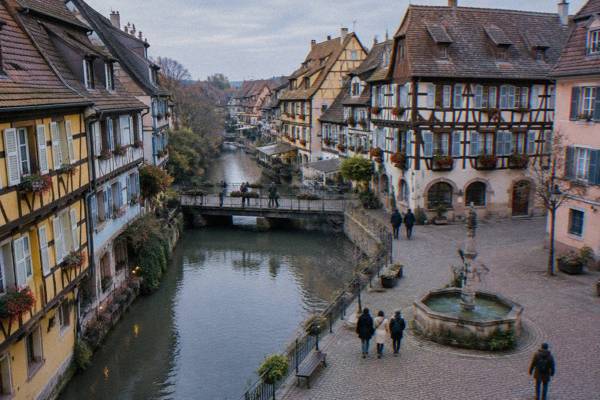
Kaysersberg
Kaysersberg is one of the wine villages of the Alsace Wine Route, a short trip from Strasbourg in north-eastern France, and this guide covers what to expect, how to plan the day and which tours pair well with a visit.
Short answer
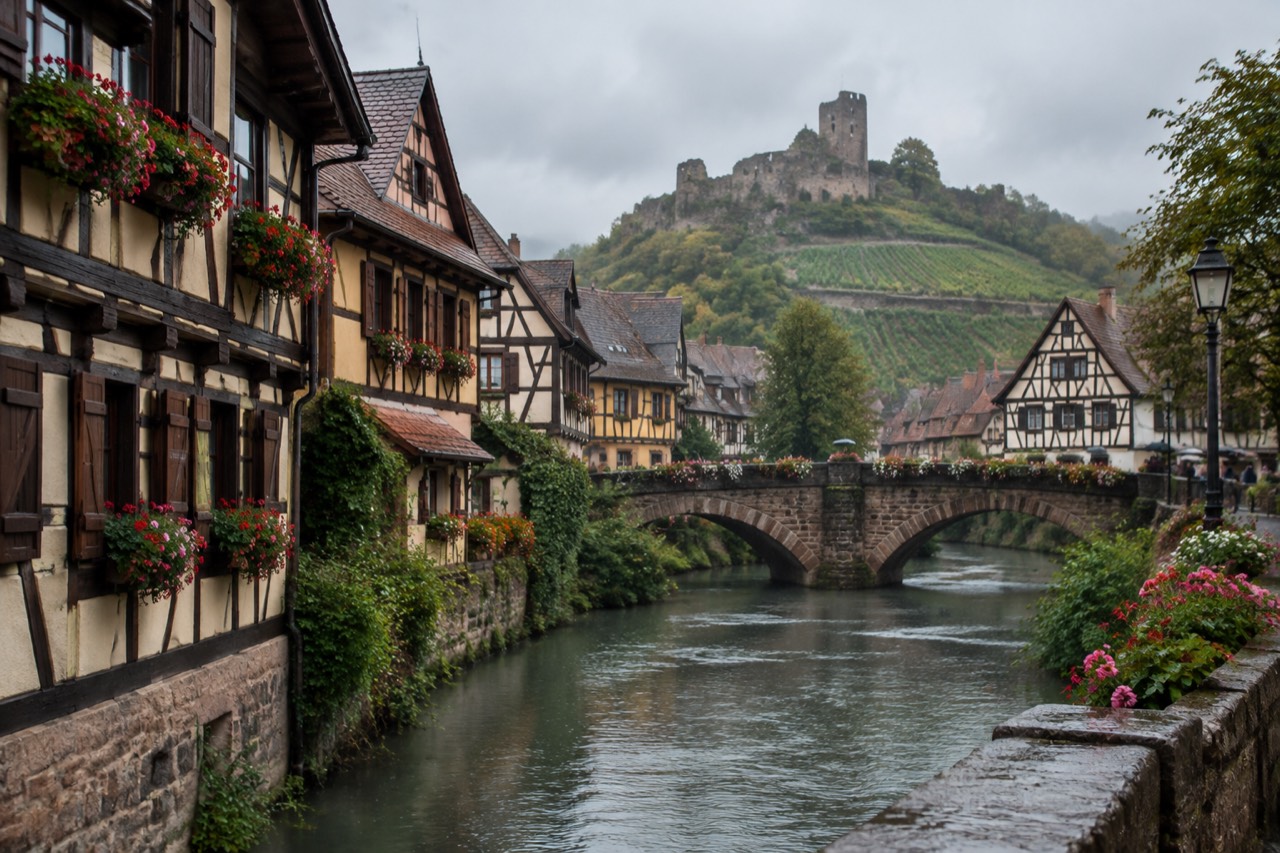
Kaysersberg is a medieval wine village on the Alsace Wine Route in the Haut-Rhin, reached from Strasbourg on a day trip through the vineyards. Expect half-timbered houses, a ruined hilltop castle, winstub cooking and tasting rooms, on official transport pages or with a guided tour.
Kaysersberg sits on the Alsace Wine Route in the Haut-Rhin, south of Strasbourg in north-eastern France, and it is the kind of village that people plan an entire Alsace trip around. The town wraps around a stream lined with half-timbered houses, rises to a ruined castle on a hill, and opens onto vineyard slopes that produce some of the region's most respected white wines. For travellers based in Strasbourg, it is a natural counterpart to the city: Strasbourg gives you the cathedral, the Grande Île and the European institutions, while Kaysersberg gives you the small-scale Alsace of wine cellars, painted façades and quiet lanes. This guide covers what the village is actually like, how it fits alongside other wine villages, what to see once you are there, and which guided tours pair well with the visit.
What Kind Of Village Is Kaysersberg?
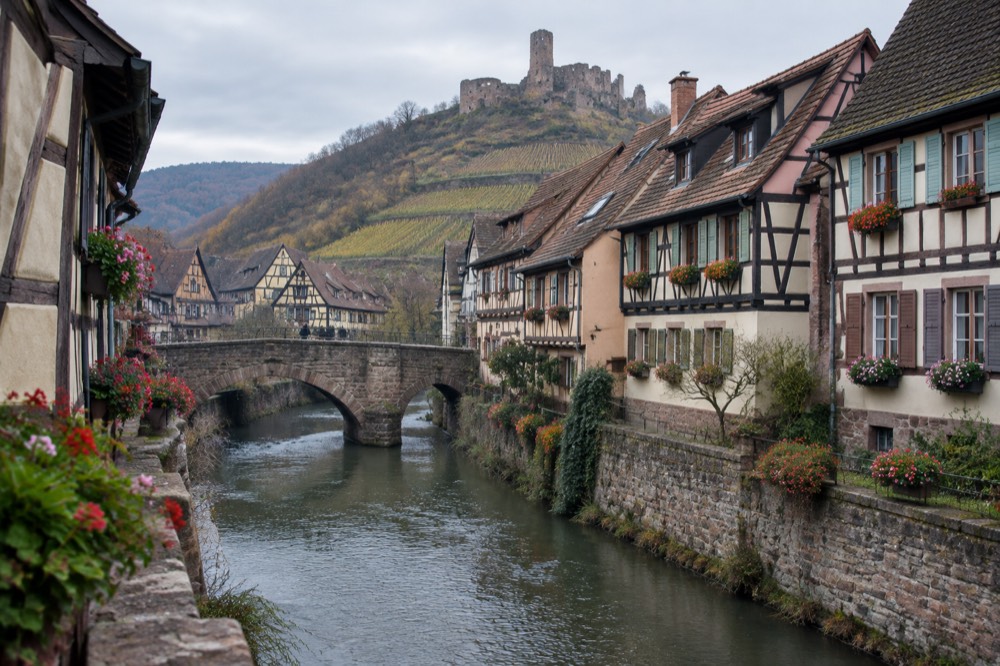
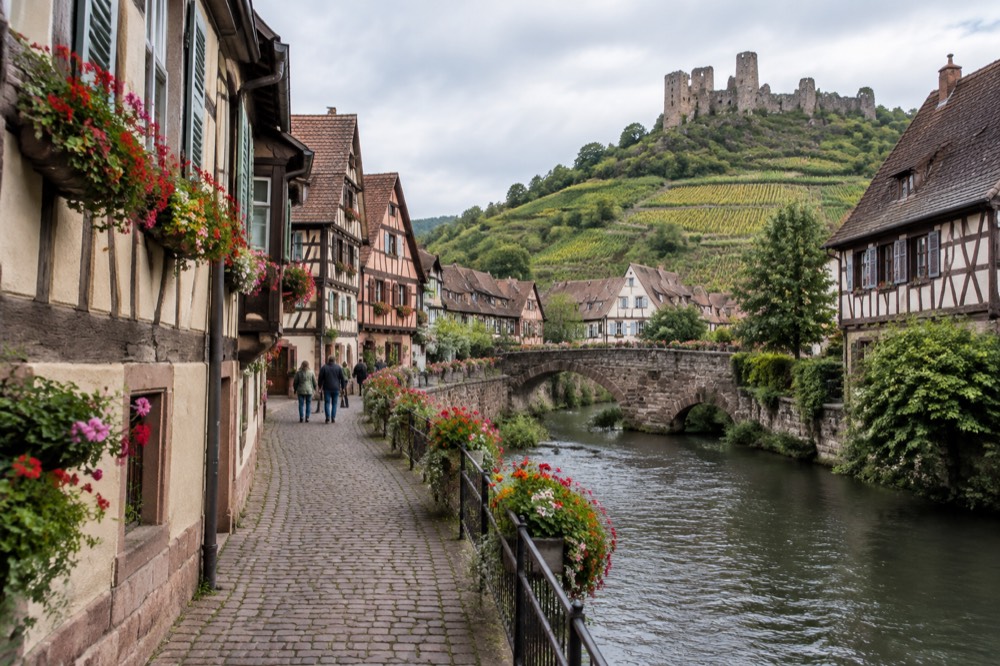
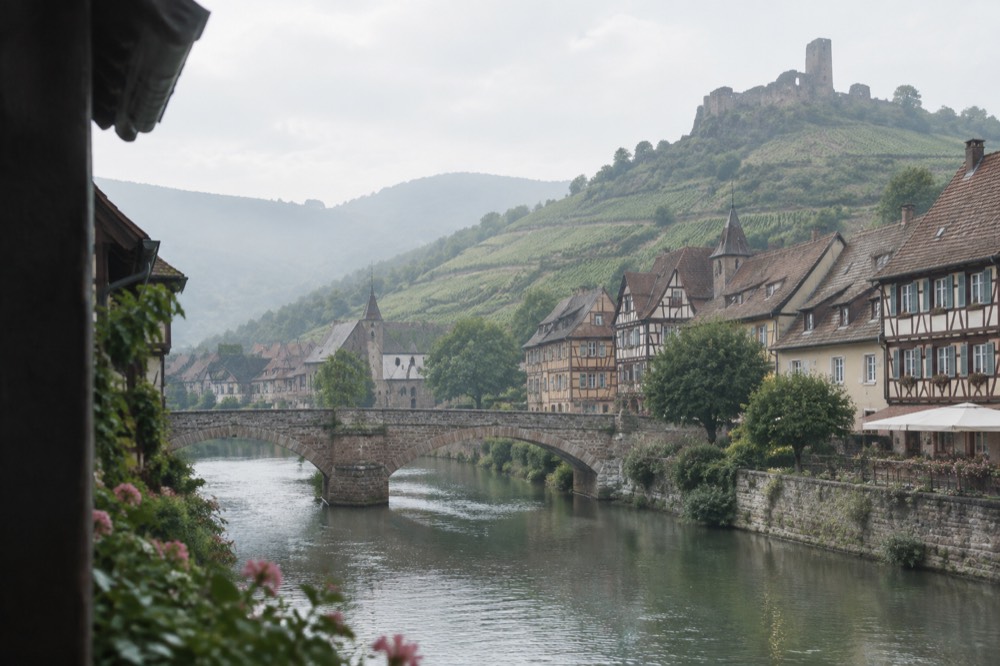
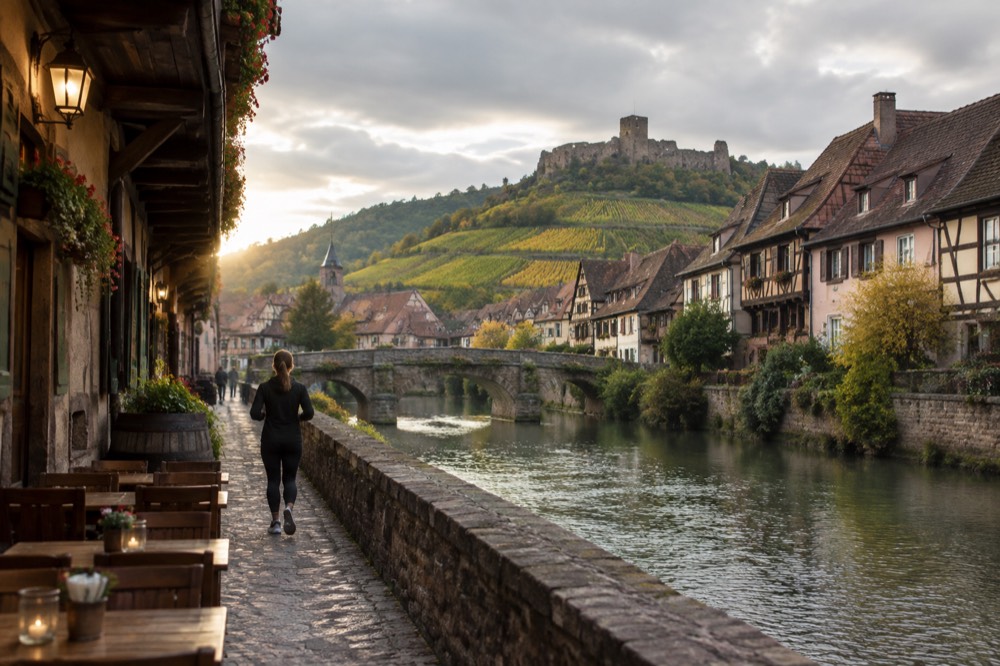
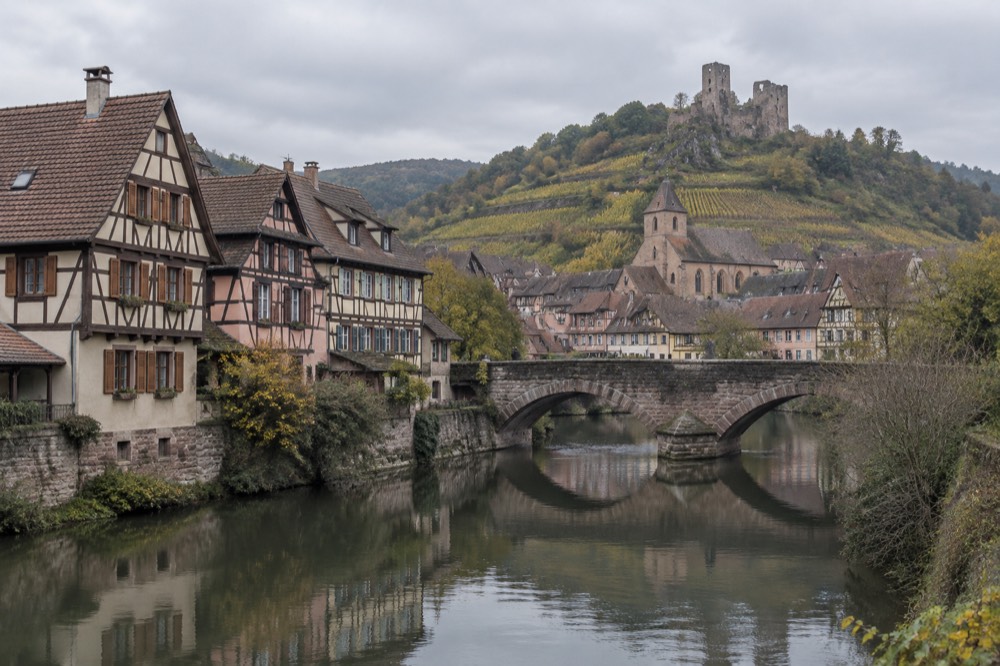
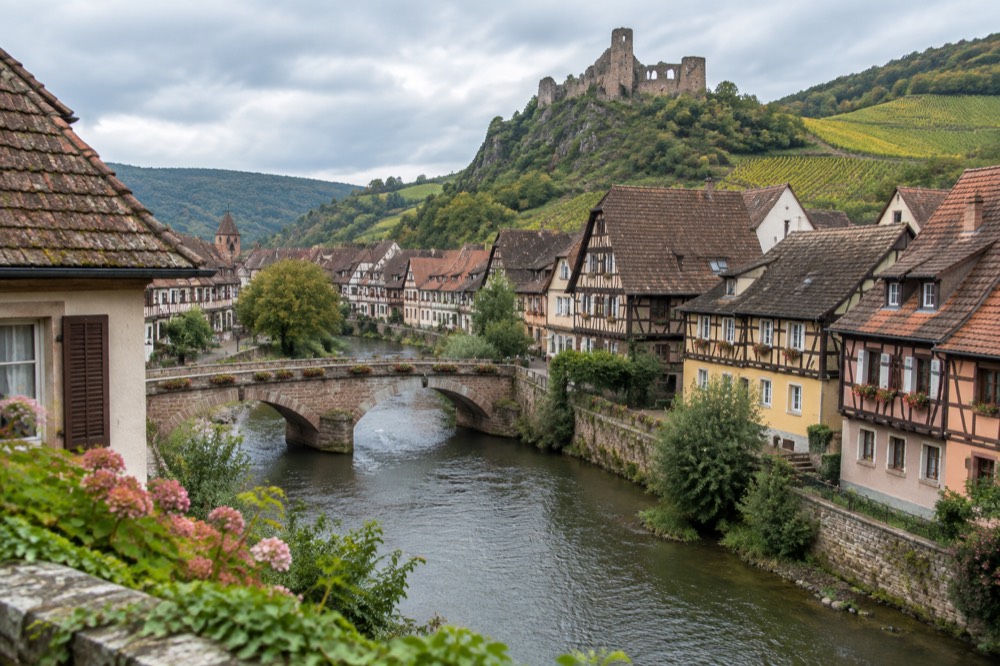
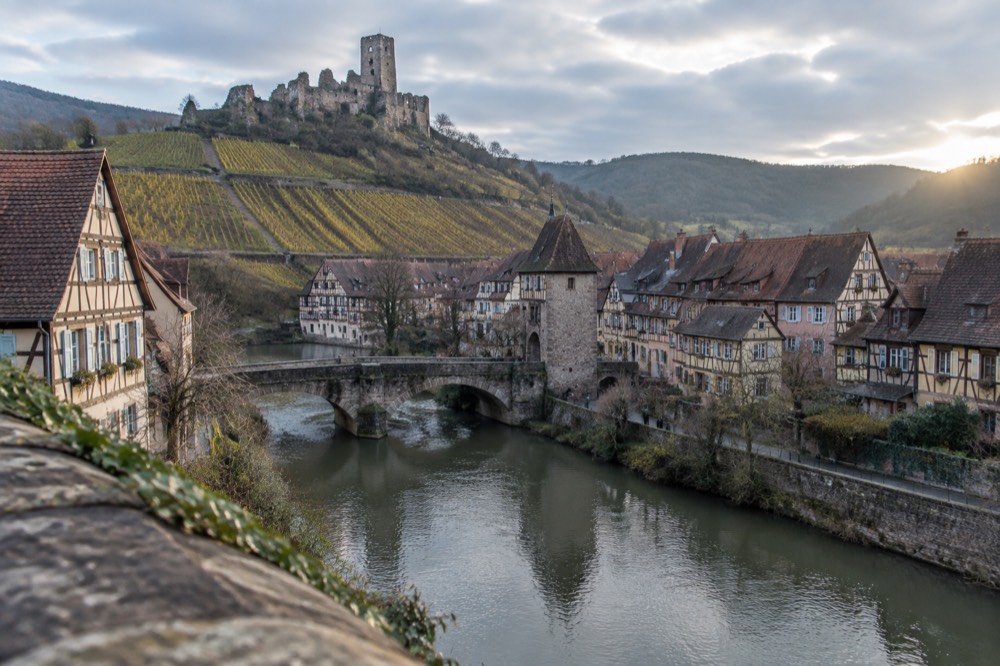
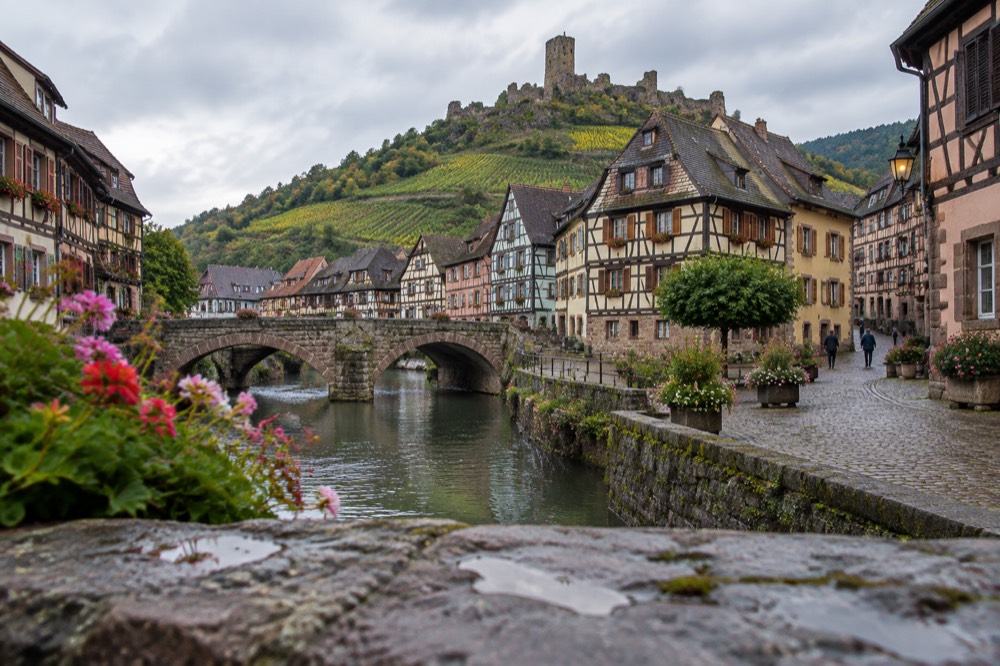
Kaysersberg is a small, medieval wine town on the Alsace Wine Route, built around a stream, a fortified bridge and a hilltop castle ruin, with half-timbered and stone houses painted in the deep colours typical of the Haut-Rhin vineyards. It is a working wine village rather than an open-air museum: tasting rooms, a winstub tradition and vineyard parcels on the slopes above the houses keep the town tied to its agricultural base. The streets are narrow and cobbled, the main lane follows the water, and the castle ruin above gives a clear view over the rooftops and out to the vineyards. Everything of interest sits within comfortable walking distance of the central bridge, so the village rewards slow wandering rather than a checklist.
The atmosphere changes with the seasons. In summer the lanes fill with visitors following the wine route, and the flower boxes that hang from the timber façades are at their fullest. In late November and December the town runs its own Christmas market, smaller and quieter than Strasbourg's, and the half-timbered architecture does a great deal of the decorative work on its own. Between those peaks, in spring and autumn, the village is calmer, and the surrounding vineyards are arguably the better half of the visit: the rows change colour through the year and the walking paths between them are public.
For context on the region, the Alsace Wine Route day trip guide explains how the villages string together and how to sequence them. Kaysersberg is one of the better-known stops on that route, and it pairs naturally with Riquewihr, Eguisheim and Ribeauvillé, each of them a short drive along the same corridor of vineyards.
How Does Kaysersberg Compare With The Other Wine Villages?
Kaysersberg is larger and more substantial than Eguisheim, more compact and less commercial than Riquewihr, and it is the one with a genuine castle ruin you can climb, which makes it the best single choice for a first wine-route visit from Strasbourg. Riquewihr is the most photographed and the most crowded, a near-perfect preserved street that can feel like a set in high summer. Eguisheim is rounder, smaller and cosier, arranged in concentric circles around a central square. Kaysersberg has more of a real town about it: a proper main street, a river running through it, a church with a notable interior, and a hill that you actually walk up for the view.
| Village | Character | Best For | What To Check Before You Go |
|---|---|---|---|
| Kaysersberg | Wine town on a stream, castle ruin above | A first wine-route stop, walkers, photographers | Castle path conditions and tasting-room hours |
| Riquewihr | Preserved medieval street, heavy visitor flow | Photography, classic Alsace imagery | Parking arrangements in the high season |
| Eguisheim | Small, circular, village-square intimacy | A short stop, families, a slower pace | Whether markets or festivals are running |
| Ribeauvillé | Lively town with wine festival tradition | Wine focus, a less crowded alternative | Festival calendar on the town's pages |
| Obernai | Larger town north of the vineyard belt | Combining town amenities with wine-route charm | Opening hours of sights and cellars |
The honest planning advice is that these villages overlap. If you are driving the route yourself, two or three stops in a day is realistic and satisfying; trying to cover more turns the day into a transport exercise. If you would rather not drive at all, a guided outing is the alternative, and a tour through the vineyard villages of the wine route exists precisely for this corridor. One option from the roster covers several of these villages with tastings built in:
A guided format also answers the question of who drives home after the tastings, which is not a trivial point on a route whose whole purpose is wine.
What Should You Actually See And Do In Kaysersberg?
The core of a Kaysersberg visit is the fortified bridge and stream-side street, the hilltop castle ruin with its view over the vineyards, the parish church, and the tasting rooms along the main lane, and all of it can be covered on foot in a relaxed half-day. The bridge is the postcard view: houses reflected in the water, geraniums in season, the castle above. The climb to the ruin is short but steep, and the reward is the panorama over the roofline and the vineyard slopes beyond. The church, with its carved interior, is worth stepping into even on a short visit. Beyond those, the pleasure of the place is the side lanes, the painted timber, and the small details that a slower pace reveals.
| Sight Or Activity | What It Is | Who It Suits | Practical Note |
|---|---|---|---|
| Fortified bridge | Stream-side setting with half-timbered houses | Everyone, photographers | Best light and fewest people early in the day |
| Castle ruin | Hilltop remains above the village | Walkers, view-seekers | Steep short path; wear shoes with grip |
| Parish church | Gothic interior with notable carving | Architecture and history interest | Check visiting hours locally |
| Tasting rooms | Cellars pouring Alsace whites | Wine travellers | Ask about tasting fees before you sit down |
| Vineyard paths | Walking routes between the rows | Anyone wanting quiet | Public paths; carry water in summer |
| Christmas market | Small seasonal market in the old town | December visitors | Confirm dates on official pages |
Food matters here as much as sightseeing. The winstub tradition, the Alsatian version of a tavern serving regional dishes, runs through the whole wine route, and Kaysersberg has its share. Expect the classics of the region: tarte flambée, choucroute, baeckeoffe and kougelhopf, all dishes you will meet again wherever the wine route villages serve food. Tasting fees in wine cellars vary from cellar to cellar, so ask at the counter before you commit; some waive the fee with a purchase, others charge per pour, and the honest answer is on the room's own price card.
For travellers who want the food side of Alsace handled by a guide, a gourmet walking format in Strasbourg itself is a good pairing, either before or after the village day:
When Is The Best Time Of Year To Visit?
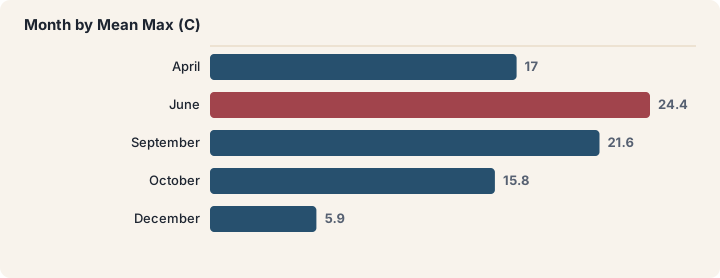
The best time to visit Kaysersberg is late spring through early autumn for the vineyards and walking, and December for the village Christmas market, with the trade-off that summer weekends bring the heaviest visitor flow and December brings short days and cold, occasionally wet weather. The Alsace climate is semi-continental, which means warm summers, cold winters and rain distributed across the year rather than concentrated in one wet season. Meteo-France 1991-2020 normals for Strasbourg-Entzheim, the nearest long-run reference series, give a mean maximum of 26.4 C in July against 5.2 C in January, with 635.7 mm of rain across the year. The vineyards are at their most striking around the harvest period, when the rows turn gold and red.
| Month | Mean Max (C) | Mean Min (C) | Rain Days (1 mm Or More) | What It Means For A Visit |
|---|---|---|---|---|
| April | 17.0 | 5.7 | 8.6 | Spring greenery, cool evenings |
| June | 24.4 | 13.4 | 10.2 | Full summer feel, busiest lanes |
| September | 21.6 | 10.7 | 8.0 | Harvest colours, warm days |
| October | 15.8 | 7.2 | 9.6 | Autumn gold in the vine rows |
| December | 5.9 | 0.8 | 10.2 | Christmas market season, wrap up |
The December option deserves a note of caution and a note of promise. The promise: a small-town Alsatian Christmas market, with half-timbered architecture doing half the work, is a genuinely atmospheric thing, and Kaysersberg's is quieter than Strasbourg's. The caution: Strasbourg's own market, the region's anchor event, ran from 26 November to 24 December in its 2025 edition and drew 3.05 million visitors according to the city's own bilan, and the city posts each edition's dates on its Christmas site, so confirm everything there and on the village's own pages before locking in a December itinerary. The usual pattern, in words rather than dates, is an opening in the last week of November and a run through to 24 December, with an early-evening close on the final day.
How Do You Get There From Strasbourg Without A Car?
Kaysersberg is reachable from Strasbourg by regional train to a nearby station on the Colmar line followed by a local bus or taxi for the final leg, and by organised day tours that handle the whole route, but no verified door-to-door time or fare for this specific journey is published on this site, so plan the connection on the official SNCF and regional transport pages.
| Way Of Getting There | How It Works | Who It Suits | What To Check |
|---|---|---|---|
| Regional train plus local bus | Rail to the Colmar corridor, then a connecting service | Independent travellers on a budget | Timetables and connection times on official pages |
| Rental car | Self-drive along the wine route | Anyone wanting several villages in a day | Parking arrangements in each village |
| Guided day tour | Coach or minivan with a set itinerary | Visitors who do not drive or prefer structure | What the itinerary includes and what is extra |
| Private transfer | Door-to-door hire | Groups, families | Availability and cost with the operator |
For travellers without a car, the guided tour is the stress-free answer, and the roster has several that pass through this corridor. A full-day option that pairs Colmar with the castle and the villages is one route:
For travellers without a car, the guided tour is the stress-free answer, book an Alsace day trip here.
The trade-off with any set itinerary is time in each place. A tour that covers Colmar, Riquewihr and the Haut-Koenigsbourg castle, as that one does, gives you a slice of everything and a long look at nothing. Self-driving gives you the opposite: one village, properly, at your own pace. Decide before you book which of those two days you actually want. The Colmar day trip guide and the Haut-Koenigsbourg guide cover the neighbouring stops in detail if you are weighing a multi-stop itinerary.
Can You Pair Kaysersberg With A Trip Across The Rhine?
Yes, and the pairing works better than it first sounds: the Alsace wine villages sit close to the German border, and a two-day plan can devote one day to the French vineyard belt and one to Baden-Baden or the Black Forest across the Rhine, with the related tour on this page covering the German side as a single guided outing. France and Germany are both in the Schengen area and both use the euro, so there is no border formalities to plan for and no currency to change, which makes the cross-Rhine combination unusually frictionless for a European region. The contrast is the point: Alsatian half-timber and riesling on one day, Black Forest scenery and a German spa town the next.
The related tour for this page is exactly that German-side outing, a full-day trip that takes in the Black Forest and Baden-Baden from Strasbourg. It suits travellers who have already seen the Alsatian villages, or who want to split a week between the two cultures that shaped this border region. Check availability on the operator's live listing for the current itinerary and departure details. The Black Forest guide and the Baden-Baden guide on this site cover both destinations in depth for anyone weighing the self-drive alternative.
What Does A Wine Tasting In Kaysersberg Involve?
A tasting in Kaysersberg means sitting in a cellar or tasting room, usually attached to the family winery that made the bottles, and working through a flight of Alsace whites, typically riesling, pinot gris, gewurztraminer and sylvaner, poured by someone who can tell you which slope each came from. The village's vineyard parcels sit on the hills immediately above the houses, so the distance between the grape and the glass is short, and the people pouring often farm those slopes themselves. Fees vary from cellar to cellar and are posted at the counter or on the room's price card; ask before you sit down, and expect some cellars to waive the fee with a purchase.
The wines themselves are the region's signature, and the grape varieties and styles are covered in detail in the Alsace Wine Route guide. The short version for a village visit: Alsace is white-wine country, the aromatic varieties are the regional speciality, and the same villages that produce them also pour crémant, the region's traditional-method sparkling wine. If a tasting room offers a vertical tasting, the same wine across several vintages, take it: it teaches more in twenty minutes than any label-reading does.
| Wine | Style In Short | What To Ask In The Tasting Room |
|---|---|---|
| Riesling | Dry, mineral, precise | Which slope the parcel is on |
| Pinot gris | Fuller, rounder, spiced | Whether it is dry or off-dry |
| Gewurztraminer | Aromatic, rose and spice | How it pairs with local cheese |
| Sylvaner | Light, fresh, everyday | Which dishes the cellar serves it with |
| Crémant d'Alsace | Traditional-method sparkling | Whether it is blanc de blancs |
For a structured introduction to Alsace wine without leaving Strasbourg, a short tasting experience in the city is a good warm-up for the village day, and one sits on the roster:
The pairing logic is simple: learn the grapes in town, then meet them again in the cellar of the family that grows them. It turns a village stop into something you can actually read, rather than a series of pleasant but anonymous glasses. The full index of guides sits on Strasbourg Travel Guide.
Where Should You Eat On A Kaysersberg Day?
The eating options in Kaysersberg centre on winstubs and regional restaurants serving the Alsatian classics, tarte flambée, choucroute, baeckeoffe and kougelhopf, with the better tables booked up in the high season and at Christmas market time, so reserve ahead if a specific restaurant matters to your day. The winstub format, a tavern serving generous regional plates, is the village's default, and the dishes are the same ones served all along the vineyard corridor of the wine route. Portions are large by design; the cuisine was built for farm labour, not for grazing.
| Dish | What It Is | When It Suits |
|---|---|---|
| Tarte flambée | Thin flatbread with cream, bacon and onion | A light lunch or a shared evening plate |
| Choucroute | Sauerkraut with sausages and pork | The full winstub experience, a cold day |
| Baeckeoffe | Slow-baked meat and potato casserole | A long unhurried lunch |
| Kougelhopf | Alsatian brioche-style cake | Breakfast or with afternoon coffee |
| Munster cheese | Local washed-rind cheese | With a late riesling tasting |
Two practical notes. First, kitchens in small villages often close between the lunch and dinner services, so a late-afternoon arrival can land between mealtimes with everything shut; plan to eat either properly at midday or after the evening service opens. Second, December brings the market's own food stalls, and the street food there, warm spiced wine and grilled sausages above all, covers a casual meal well enough that a restaurant reservation matters less. Whatever the season, confirm the day's opening pattern for any restaurant you specifically want, since village hours shift with the tourist calendar.
Is Kaysersberg Worth It If You Have Already Seen Strasbourg?
Kaysersberg is worth the trip precisely because it is nothing like Strasbourg: the city gives you Gothic architecture, European institutions and river crossings, while the village gives you vineyards, cellar doors and a scale you can walk end to end, so the two complement rather than duplicate each other. Travellers who base themselves in Strasbourg for several days typically reach a point where the city is seen and the appetite turns to the countryside, and the wine route day trip guide covers that pacing in detail. That is the moment for the vineyards, and Kaysersberg is a strong first stop for it.
The reverse question also gets asked: is the village worth it if you only have one day in the region and have not yet seen Strasbourg itself? The honest answer is no, take the city first. The cathedral's single spire, the astronomical clock with its daily 12:30 show, the Petite France quarter and the boat tours on the Ill, all covered in this site's core guides, are the region's anchors, and a day spent only in a village skips them. The village is the second layer of an Alsace visit, not the first.
What Should You Know Before You Go?
Before you go, know that Kaysersberg is small, that its visitor flow peaks in summer and at Christmas, that tasting and restaurant hours vary with the season, and that the practical figures for getting there, times, fares and distances, need to be confirmed on official transport pages. The village rewards early arrival: the bridge and the main lane are at their best before the late-morning crowds, and the light on the timber façades is softer then too. Comfortable shoes matter more than in a city, since the castle path is steep and the lanes are cobbled.
A short checklist for the day:
| Item | Why It Matters | Note |
|---|---|---|
| Comfortable walking shoes | Cobbles and the castle climb | Grip matters if the path is damp |
| A tasting plan | Cellars vary in hours and fees | Ask the fee before you sit |
| A restaurant reservation | Small village, seasonal demand | Especially summer weekends and December |
| A weather check | Semi-continental climate, rain year-round | Layers and a light rain layer |
| A confirmed return connection | Local services thin in the evening | Check the last departure before you commit |
For the weather half of that checklist, the semi-continental pattern means rain can arrive in any month; the Strasbourg-Entzheim normals show between 8.0 and 10.8 rain days of one millimetre or more every month of the year, so a packable rain layer is never wasted space in this region, even in summer. In winter, the mean minimum sits below freezing in January, so December visitors should plan for genuinely cold evenings, which the Christmas market's warm spiced wine exists to solve.
How Does Kaysersberg Fit Into A Wider Alsace Itinerary?
Kaysersberg slots most naturally into a wine-route day alongside Riquewihr and Ribeauvillé, into a two-day plan that adds Colmar and the Haut-Koenigsbourg castle, or into a week that stretches down the wine route towards Eguisheim and Obernai and across the Rhine to the Black Forest, and the right shape depends on whether you are driving, touring or riding the train spine. The village is a stop, not a destination in itself, and the strongest itineraries treat it as one bead on the string. The Alsace road trip planning guide lays out the full sequence for drivers, and it ranks the stops for travellers who must choose between them.
In practical terms, the region's attractions fall into a few families that combine cleanly. The wine villages, Riquewihr, Eguisheim and Ribeauvillé among them, share one road and one day. The larger towns, Colmar above all, work either as the base for a vineyard day or as the bookend at either end of it. The castles, led by the Haut-Koenigsbourg, combine with the villages into a single tour day, and several roster tours do exactly that. The Vosges side, Mont Sainte-Odile and the Route des Crêtes, makes a separate day of hills and viewpoints rather than villages. And across the Rhine, the Black Forest, Baden-Baden and Europa-Park offer a German contrast day after the French vineyards, which is where the related tour on this page comes in.
The guided options follow the same logic. A half-day wine tour from Strasbourg keeps the outing shorter and lighter, and one sits on the roster for travellers who want a taste of the route without committing a full day:
Whatever the shape of the itinerary, the underlying advice holds: fewer stops, longer in each, beats a checklist day through the vineyards. The villages are small enough that an extra hour in one, spent in a cellar or on the castle path, is worth more than a photograph taken from a parking bay in a fourth town.
Common Questions About A Kaysersberg Day Trip
Where is Kaysersberg?
Kaysersberg is a wine village in the Haut-Rhin, in Alsace in north-eastern France, on the Alsace Wine Route south of Strasbourg and near Colmar, in a vineyard belt that runs along the foothills of the Vosges facing the German border across the Rhine.
Can you visit Kaysersberg from Strasbourg in a day?
Yes, the village is a standard day trip from Strasbourg by car, by regional train with a local connection, or on a guided wine-route tour. No verified door-to-door time or fare for the specific journey is published on this site, so plan the connection on official transport pages or let a tour handle the route.
What is Kaysersberg known for?
Kaysersberg is known for its half-timbered houses on a stream, its hilltop castle ruin, its parish church, and its vineyards on the slopes above the village, which produce the Alsace white wines poured in its cellars. It is one of the better-known stops on the Alsace Wine Route.
Is Kaysersberg worth visiting compared with Riquewihr?
Both are worth visiting, but they differ in character: Riquewihr is the more preserved and more crowded, while Kaysersberg is a more substantial town with a castle ruin you can climb and a calmer atmosphere outside peak periods. For a single first stop, Kaysersberg offers more variety in one place.
When is the best time to visit Kaysersberg?
Late spring through early autumn suits the vineyards and the walking paths, with the harvest period bringing the strongest colours to the rows. December brings the village's small Christmas market, cold weather and short days. Summer weekends carry the heaviest visitor flow.
Do you need a car to visit Kaysersberg?
No, but a car gives the most freedom on the wine route, where the villages sit off the main rail line. Alternatives are a regional train with a local bus or taxi connection, or a guided day tour that covers several villages and tastings without any driving on your side.
The short version of all of the above: Kaysersberg is the wine village to pick if you want one place that combines architecture, a view, a walk and a cellar door, and it earns its place on any Strasbourg-based itinerary that reaches the vineyard belt. Plan the transport on official pages, book the table that matters to you, arrive early, and give the village the one thing it rewards most, which is time.