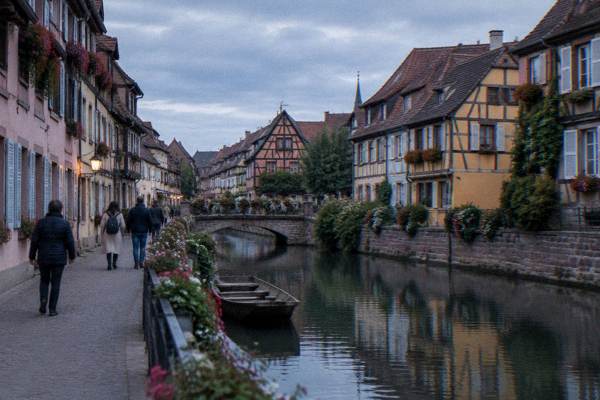
Eguisheim
Eguisheim is a wine village in Alsace, north-eastern France, close to Colmar on the Alsace wine route, and it makes an easy counterpart to a Strasbourg city break. Here is how to plan the day.
Short answer
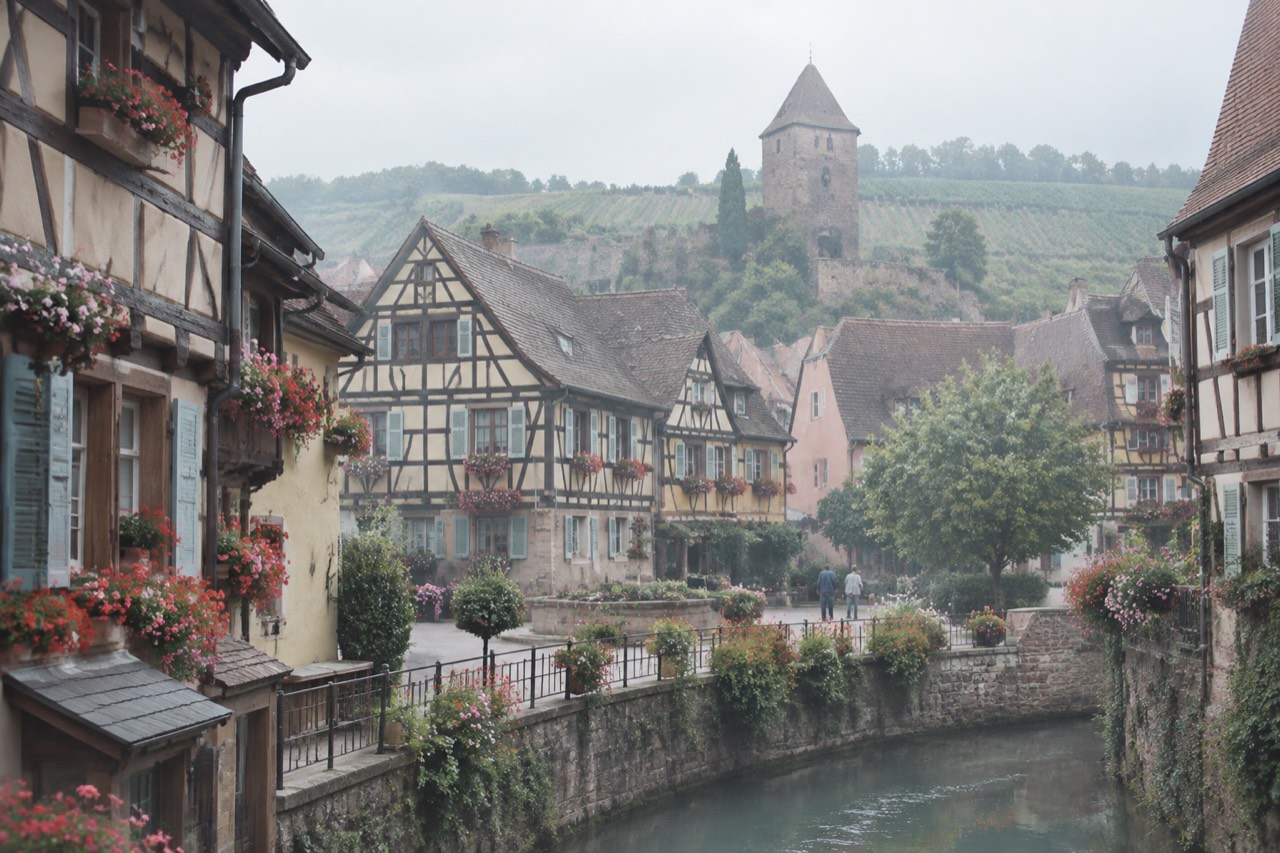
Eguisheim is a small half-timbered wine village on the Alsace wine route, close to Colmar and reachable from Strasbourg as a day trip by road or rail via Colmar. Plan a half day of lanes, cellars and tasting rooms, pair it with another wine village or a castle, and go in late spring through early autumn for the warmest weather.
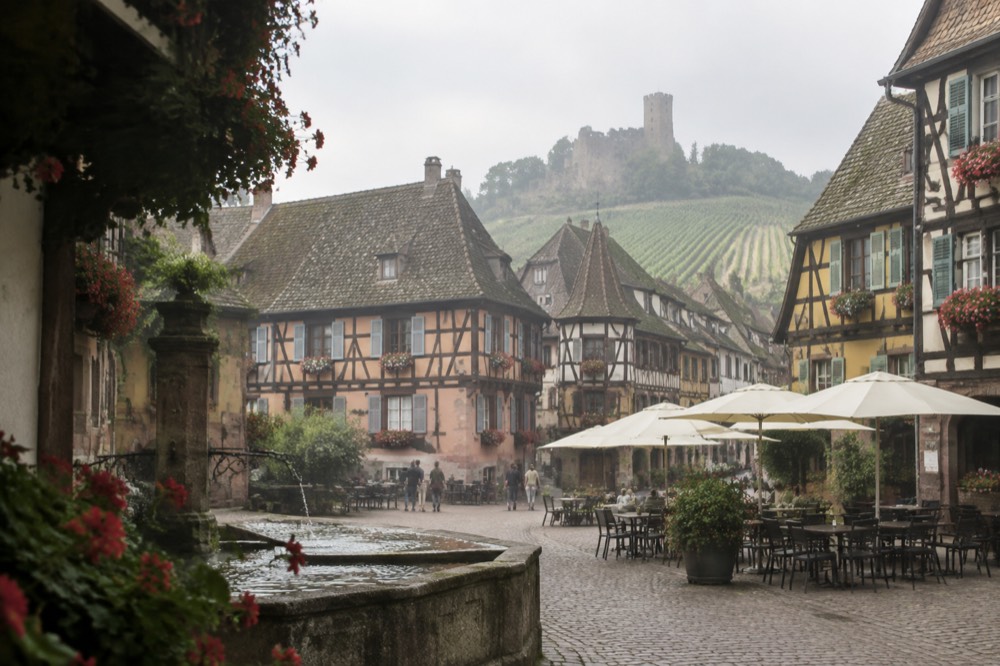
Eguisheim is a half-timbered wine village in Alsace, north-eastern France, on the plain south of Strasbourg, beside Colmar on the Alsace wine route. The village is famous for its shape: the streets curl in concentric rings around a small central square, so a walk keeps bending back on itself past painted facades, cobbled lanes and wine cellars. Vineyards run almost to the doorsteps, which tells you what the local economy has been for centuries, and tasting rooms sit inside houses that look older than the vines outside them. For travellers basing themselves in Strasbourg, Eguisheim is the kind of stop that turns a city break into an Alsatian one, and this Strasbourg Travel Guide page sets out how to build that day without guessing at the details.
What Is Eguisheim And Why Do Visitors Go There?
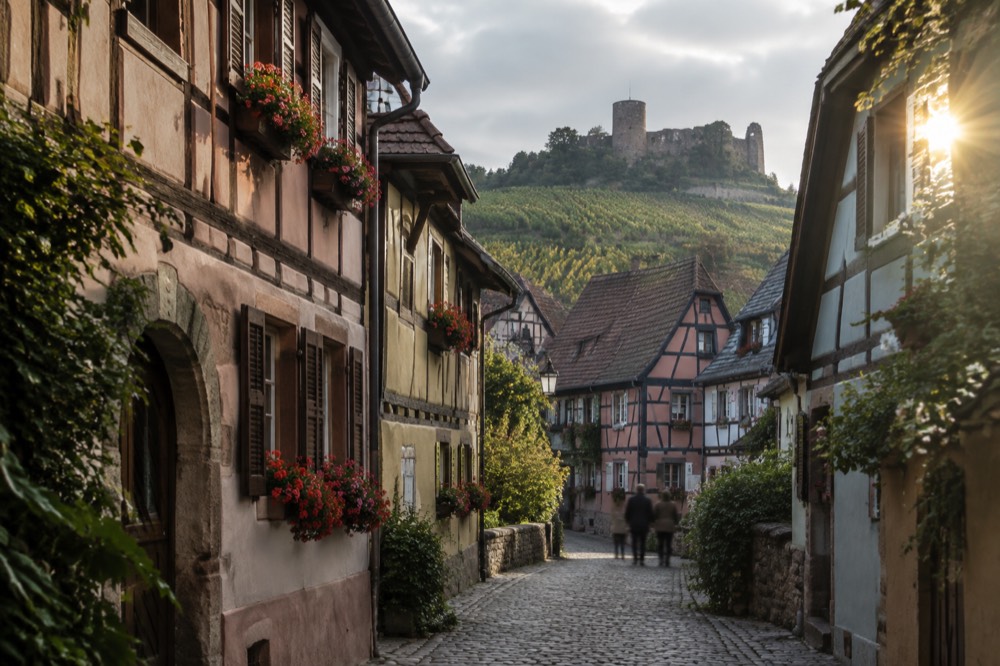
Eguisheim is a wine-growing village on the Alsace wine route, just beside Colmar in north-eastern France, and visitors go there for its ring of concentric streets, half-timbered houses and cellar-door tastings. It is a place to walk slowly rather than a place of monuments, pairing naturally with Strasbourg as a half-day or full-day excursion for anyone who wants the Alsatian postcard village in a compact, walkable form.
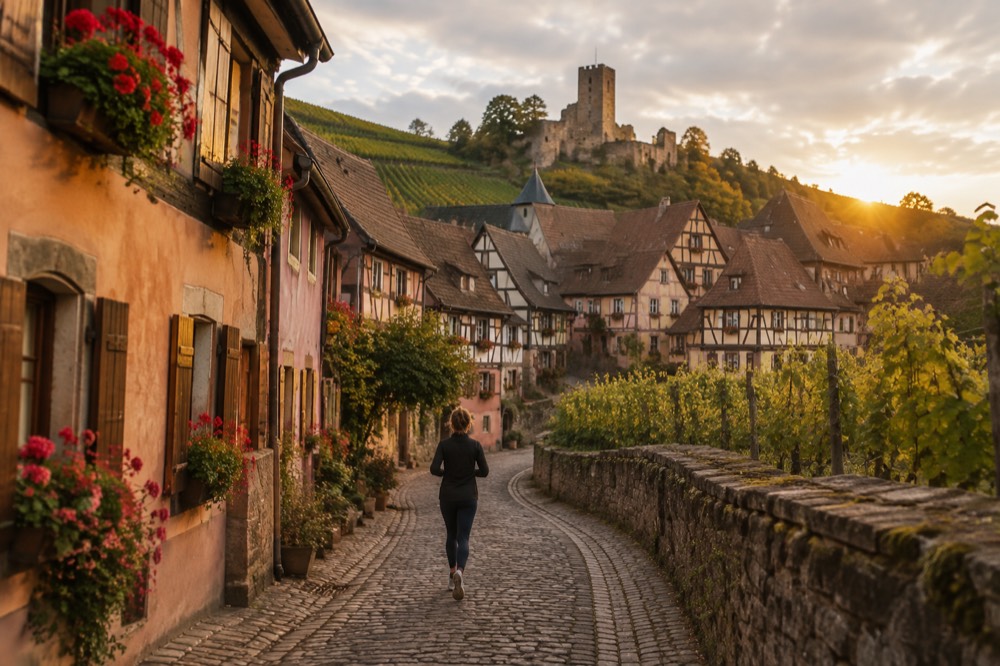
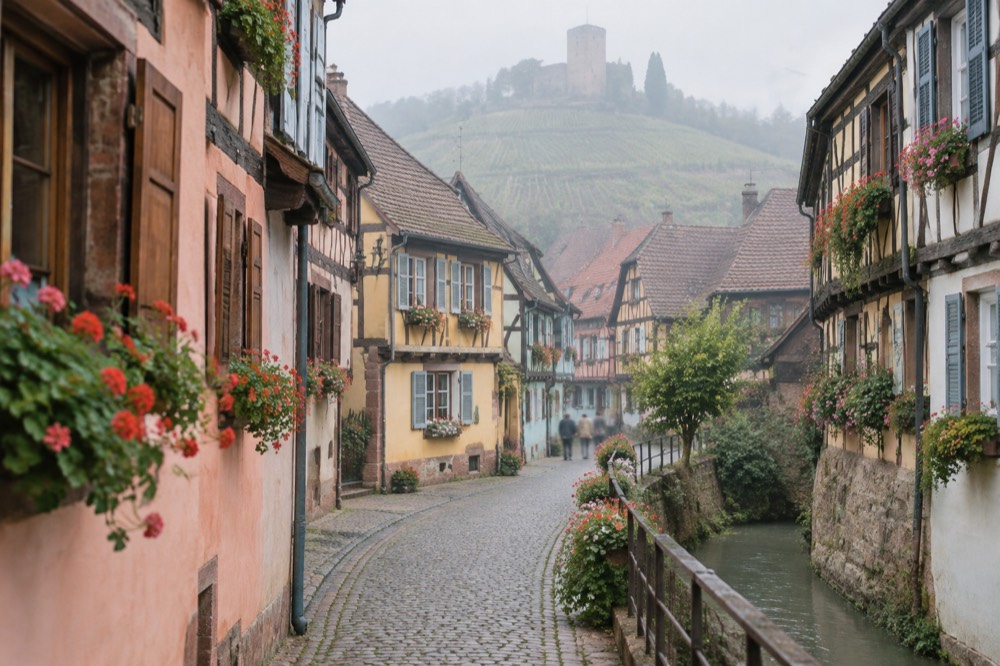
The village's layout is its signature. Instead of a main street with side lanes, Eguisheim grew in rings around its central square, and the streets that follow those rings are lined with restored houses in the colours Alsatian villages are known for: deep ochres, blues, greens and reds on timber frames. Walking the outer ring and then cutting inward takes an unhurried loop, and because the rings reconnect constantly, it is close to impossible to get properly lost. That makes it a forgiving village for first-time visitors, for families, and for anyone who simply wants to wander with a camera.
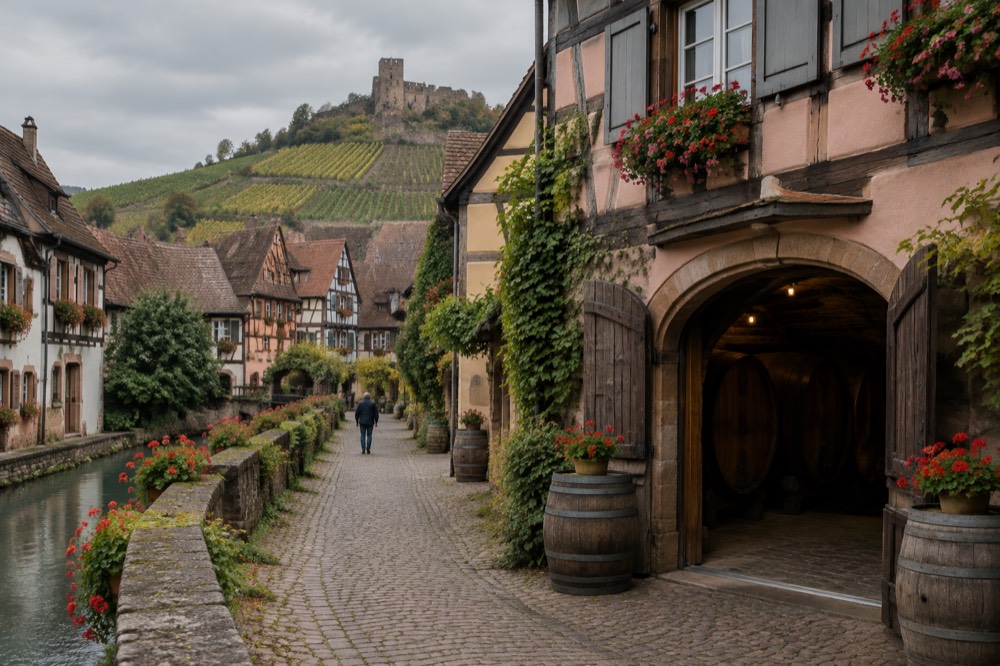
Wine is the reason the village exists in its present form. Eguisheim sits in the heart of the Alsatian vineyard belt, and the grape varieties of the region, Riesling, Gewurztraminer, Pinot Gris and Sylvaner among them, are poured in cellars a few steps from the vines they came from. Tasting is a normal part of a visit rather than a special event: cellars open their doors through the day, and the etiquette is simple. Ask what is open, taste what is poured, and buy a bottle if something suits you. Some cellars charge a small fee for a structured tasting, others pour freely for visitors who buy, and the honest answer at any door is to ask before you sit down.
| Feature | What You Find | Why It Matters For Planning |
|---|---|---|
| Village shape | Concentric rings of streets around a central square | Easy, looped wandering with no route to plan |
| Architecture | Restored half-timbered houses in traditional colours | The main sight is the village itself |
| Wine | Cellar-door tastings of Alsatian varieties | Tasting is the core activity, allow time for it |
| Setting | Vineyards around the village edge | Vineyard walks without leaving on foot |
| Scale | A small village you cover on foot | Half a day is a realistic visit length |
How Do You Get From Strasbourg To Eguisheim?
You reach Eguisheim from Strasbourg by road, or by rail toward Colmar followed by a short local connection, and no single door-to-door travel time is quoted here. Check times on SNCF Connect for the train leg and on local transport pages for the final hop, and treat the village as part of a Colmar-and-wine-country day rather than a destination needing its own timetable.
Driving gives the freedom the wine route really rewards. The appeal of the region is hopping between villages, Eguisheim, Riquewihr, Kaysersberg, and a car lets you set your own order and linger where a cellar catches you. The trade-offs are the usual ones for wine country: a designated driver who does not taste, parking that fills in the village edges on busy days, and the discipline of getting back across the plain to Strasbourg at the end. If tasting is the point of your day, that trade-off matters more than any schedule.
Driving gives the freedom the wine route really rewards. Book a rental car here.
Rail-and-connect is the alternative. Trains run south from Strasbourg through the Alsatian plain towards Colmar, and from Colmar the wine villages are served by local buses and shuttles whose timetables change with the seasons, so confirm the current connections before you commit. The rail option suits a two-stop day, Colmar plus one village, better than a three-village sweep. It also removes the driving question entirely, which for a tasting day is not a small thing.
If you would rather not plan any of it, guided day tours from Strasbourg handle the routing, the village stops and, on several of them, the tasting:
Eguisheim itself sits in that same wine country, and travellers who want the village specifically should read each itinerary on the operator's live listing to see which stops it includes. Check availability once you have settled your dates, because seats on the popular loops go first in the high season.
What Should You See And Do In Eguisheim?
The short answer is the village itself: walk the concentric lanes of the old ring, pause at the central square with its fountain and chapel, follow a path out through the surrounding vineyards, and stop at two or three wine cellars along the way. There is no ticketed circuit and no single must-see monument, so one slow loop, a walk among the vines, a few cellar visits, and a long lunch in the square make a complete day.
Start at the central square and walk outward, or the reverse, it hardly matters, because the rings reconnect. The lanes are narrow enough that photography works best in the quieter morning hours, and the facades change character as you circle, some plain and weathered, some painted and hung with geraniums in the warm months. The fountain and the small chapel at the centre are the natural turnaround points. Give the loop time: the village is small, but the point of it is not to finish it.
The vineyard edge is the underrated half of a visit. Paths leave the last ring and run straight into the vines, and a short walk out gives you the view back across the roofs, which is the composition the village is photographed for. In the growing season the rows are green walls; in winter the bare vines show the geometry of the slopes. Either way, it is the quietest part of a visit and the part day-tour schedules squeeze out first.
Cellars are the third act. Eguisheim's producers pour from their own vineyards, and a tasting is a conversation about the slope, the grape and the year rather than a bar transaction. Ask about the house's specialty, taste the dry Riesling against the aromatic Gewurztraminer, and note that sparkling Cremant d'Alsace, the region's traditional-method fizz, is on nearly every list. If you want the fuller picture of what is in the glass, the site's guide to Alsace wine and its varieties is the companion read.
| Stop | What It Is | How To Take It |
|---|---|---|
| The ring lanes | Concentric streets of restored houses | One unhurried loop, camera first in the morning |
| Central square | The village heart with fountain and chapel | A pause, a coffee, orientation point |
| Vineyard paths | Walking tracks into the surrounding rows | A short out-and-back for the rooftop view |
| Wine cellars | Producer tasting rooms in the village | Two or three stops, ask the tasting terms at the door |
| Stork sights | Nesting storks, an Alsatian emblem, in season | Look up on roofs and chimneys as you walk |
Where Does Eguisheim Sit On The Alsace Wine Route?
Eguisheim sits at the southern end of the Alsace wine route, right beside Colmar, making it either the first or the last village on a north-to-south drive and a natural anchor for exploring southern Alsace. Because the route strings its wine villages along the Vosges foothills, Eguisheim's position puts Riquewihr, Kaysersberg, Ribeauville and the castle road toward Haut-Koenigsbourg all within easy reach, so plan your day around that whole cluster rather than a single village.
The route as a whole is covered in the site's Alsace wine route day trip guide, which sets out the driving logic, the village order and the tasting etiquette in one place. The short version for Eguisheim: because the village is small, it works best as one stop of two or three on a southern loop, with Colmar as either the start or the finish. A morning in Eguisheim, lunch in a village square, an afternoon in Riquewihr or Kaysersberg, and the drive back north to Strasbourg is the shape that repeats itself across the region's itineraries, and it repeats because it works.
For visitors who want the villages and the wine without self-driving, a guided tour is the standard answer. The full-day Colmar, Riquewihr and Haut-Koenigsbourg tour this page features is the classic expression of that loop:
A different flavour of the same idea is a medieval villages and wine tasting day trip, which trades the castle for more time in the villages and a structured tasting stop. Where the castle tour balances architecture and wine, the villages-first tours lean into the lanes and the cellars, which suits travellers whose priority is the postcard-and-glass half of Alsace rather than its ramparts. Read the itinerary on the live listing to see which villages each departure actually touches, because no two loops are identical.
Whichever way you assemble the day, the pairing logic stays the same: one anchor village, one second stop, and no third stop that forces you to rush the second. The wine route punishes over-scheduling more than almost anywhere in France, because the pleasure of it is standing in a cellar at a quarter to five with nowhere else to be.
What Should You Eat And Drink In Eguisheim?
Eguisheim eats like the rest of Alsace: tarte flambee, choucroute, baeckeoffe and kougelhopf in winstubs and village restaurants, with the local wines poured alongside, and lunch is the meal to build the day around. The village has eateries from simple winstub counters to sit-down rooms, and the dishes are the hearty ones the region is known for, food that belongs to a working wine village rather than to a city dining scene.
The plates to know are covered in depth on this site. Tarte flambee, the thin cream, onion and lardon tart baked in a wood oven, is covered in the tarte flambee guide; choucroute, the sauerkraut and sausage platter that pairs with Riesling, in the choucroute guide; and the slow-cooked three-meat baeckeoffe in the baeckeoffe guide. Kougelhopf, the dome-shaped Alsatian cake, is the standard sweet ending and travels well, which makes it the thing to buy at a bakery on the way out of the village. The winstub tradition itself, the Alsatian wine room where these dishes are served, has its own guide in winstubs in Strasbourg.
Drinking follows the same logic as tasting. The village's cellars pour the local still wines and Cremant, and restaurants pour them by the glass with the regional dishes they were built for. Riesling with choucroute, Gewurztraminer with the spicy and aromatic plates, Pinot Gris when you want weight: the pairings are traditional rather than fussy, and any server will steer you if you ask. For the depth behind those names, the site's Alsace wine guide explains the varieties, the labels and what the sweetness terms on Alsatian bottles actually mean, which is worth five minutes before your first cellar stop because Alsatian labels carry grape names where other regions carry place names.
When Is The Best Time Of Year To Visit Eguisheim?
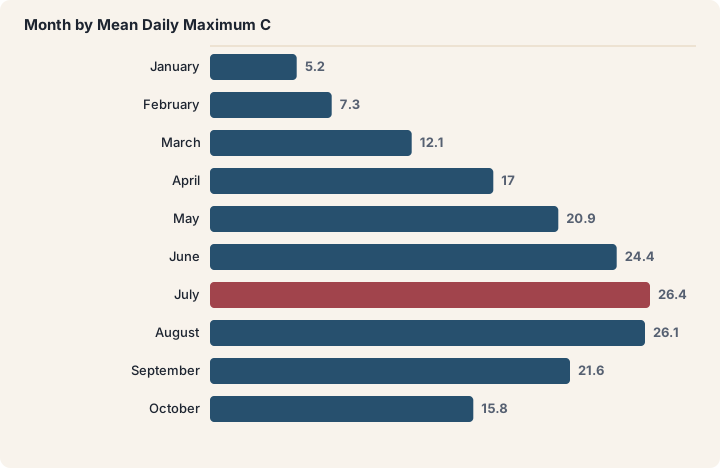
The warm months from late spring to early autumn give Eguisheim its flowering facades, green vineyards and full cellar doors, while December wraps the village in the Alsatian Christmas season, and each season changes what the day feels like. The region's climate is semi-continental, with cold winters and warm summers, so the choice is really between the green season, the quiet shoulder months and the festive close of the year, and the normals below show what each of those actually looks like on the ground.
The numbers behind that come from the Meteo-France 1991-2020 normals for Strasbourg-Entzheim, the long-run station on the same Alsatian plain, and they describe the year you will actually meet in the vineyards: mean daily maxima from 5.2 C in January to 26.4 C in July, 635.7 mm of rain across the year, and rain days peaking in the summer half of the calendar. Summer is the warmest and also the busiest face of the wine route; spring and autumn are cooler and quieter; winter is cold enough that the village is a short, brisk walk rather than a long linger.
| Month | Mean Daily Maximum C | Mean Daily Minimum C | Rain Days Of 1 mm Or More |
|---|---|---|---|
| January | 5.2 | -0.2 | 9.1 |
| February | 7.3 | 0.0 | 8.3 |
| March | 12.1 | 2.6 | 8.5 |
| April | 17.0 | 5.7 | 8.6 |
| May | 20.9 | 10.1 | 10.8 |
| June | 24.4 | 13.4 | 10.2 |
| July | 26.4 | 14.9 | 10.4 |
| August | 26.1 | 14.5 | 9.5 |
| September | 21.6 | 10.7 | 8.0 |
| October | 15.8 | 7.2 | 9.6 |
| November | 9.4 | 3.3 | 9.2 |
| December | 5.9 | 0.8 | 10.2 |
Two seasonal notes are worth their own sentences. Autumn is harvest season in a wine village, which changes the feel of the cellars and the pace of the lanes, and it is the time when the vines turn the colours that photographers come for. December belongs to the Christmas season across Alsace: Strasbourg's own market, the reference point for the region, opens in the last week of November and runs to 24 December, with last year's edition running 26 November to 24 December 2025 and drawing 3.05 million visitors, and the villages take on their own lights and stalls, though you should confirm locally what is running in Eguisheim in any given year. The dates for the Strasbourg edition are published on the city's Christmas site, and that is where to check before you plan a December day.
Should You Go Independently Or On A Guided Day Tour?
Independent travel suits confident drivers who want to control the stops and the cellar time; a guided tour suits visitors who want the wine route without a car, a designated driver or a timetable, and both work well from Strasbourg. The honest deciding factors are tasting, transport and pace: how much you intend to drink, whether you have a car, and how many villages you want to compress into one day.
| Aspect | Going Independently | Taking A Guided Tour |
|---|---|---|
| Route | Your own order, changed at will | Fixed loop chosen by the operator |
| Tasting | A driver in the group stays sober | Everyone in the group can taste |
| Pace | Linger or leave as you like | Stops run to the tour's clock |
| Coverage | Two or three stops is realistic | Itineraries can pack several stops in |
| Planning load | You book cellars and parking | The operator handles the day |
| Cost control | Pay as you go, per cellar and per lunch | One price on the listing, extras vary |
The independent case is strongest for slow travellers. Two villages and a long lunch is a full and generous day, and the freedom to stay for one more pour in a cellar you like is exactly what a self-driven day buys you. The guided case is strongest for the wine itself: on a tour, nobody in your party draws the short straw of driving, and the operator has already solved the routing, the parking and the question of which cellars welcome groups. For visitors on a short Strasbourg break, one guided wine-country day plus one independent city day is a common and sensible split.
A third option is to anchor the wine village day to the city either side of it. A guided secrets walk in Strasbourg, an evening-format stroll through the old town's hidden corners and stories, pairs neatly with a day in the villages: the city walk in the evening, the wine route the following day, or the reverse. It is a way of covering both halves of the destination without doubling your planning.
How Does Eguisheim Compare With The Other Wine Villages?
Eguisheim is the ring-shaped, cellar-first village closest to Colmar; Riquewihr is the fortified wine street further north; Kaysersberg is the river village with the ruined castle above it; and Obernai is the larger working town on the Strasbourg side of the route. They are not substitutes so much as different moods, and the practical question is which two you can pair in a day without rushing both, because each village rewards the same slow pace that the wine route runs on.
| Village | Setting | What It Does Best | Watch For |
|---|---|---|---|
| Eguisheim | Rings of lanes beside Colmar | The loop walk and cellar-door tasting | Busy at midday in high season |
| Riquewihr | Fortified street on the vineyard slope | The classic wine-route facade shot | Small centre, fills quickly |
| Kaysersberg | River village below a ruined castle | Castle view and riverside lanes | The climb if you want the view |
| Obernai | Larger town nearer Strasbourg | Bell tower, rampart walk, easier logistics | More town than village in feel |
| Ribeauville | Long main street below the Vosges | Quiet lanes and wine heritage | Fewer headline sights |
Each of these has a full page on this site: the Riquewihr day trip guide, the Kaysersberg village guide, the Obernai day trip guide and the Ribeauville guide set out what each village is for in detail. The short comparison for planning: Eguisheim and Riquewihr are the two names travellers arrive knowing, and they are different enough to pair, one a ring, one a street. Kaysersberg adds height and a castle silhouette. Obernai is the one to pick if your day starts late from Strasbourg or ends early, because it sits on the northern half of the route where the drive back is shorter.
What Else Can You Pair With Eguisheim On The Same Day?
The natural pairings are Colmar, the other southern wine villages, the Haut-Koenigsbourg castle above the plain, and, for a different country altogether, the Black Forest across the Rhine in Germany. Southern Alsace compresses a lot into a small area, and the pairing you choose should follow what kind of day you want: wine, architecture, views or a border crossing. Because France and Germany sit side by side here in Schengen, both in the euro, a two-country day is a real option rather than a complication.
The French pairings are the obvious ones. Colmar, covered in the site's Colmar day trip guide, is the regional hub and the place to eat if the village kitchens are full; its old quarters give you the canals and the colour in a bigger, busier package. The Haut-Koenigsbourg castle, covered in the Haut-Koenigsbourg guide, stands above the vineyards and gives the day a rampart-and-view counterweight to the lanes and cellars, which is exactly why the featured castle-and-villages tour combines them. Mont Sainte-Odile, the convent mountain covered in the Mont Sainte-Odile guide, is the pick for a day that wants forest and pilgrimage atmosphere instead of wine.
The German pairing is the wildcard. The Black Forest begins across the Rhine, and a Freiburg, Titisee and Triberg day trip from Strasbourg swaps the Alsatian villages for deep valleys, waterfalls and cuckoo-clock country, a genuinely different day rather than more of the same. It is the option for a second excursion after the wine route has had its day, or for a group whose interests split between wine and walking.
| Pairing | Country | What It Adds To The Day | Who It Suits |
|---|---|---|---|
| Colmar | France | Canals, bigger old quarters, main hub | Everyone, as start or finish |
| Riquewihr and Kaysersberg | France | The classic wine-route streets | First-time wine-route visitors |
| Haut-Koenigsbourg castle | France | Ramparts and a view over the plain | Visitors who want more than wine |
| Mont Sainte-Odile | France | Forest, heights, convent heritage | Walkers and quiet seekers |
| Black Forest loop | Germany | Valleys, lakes and waterfalls | A second excursion, or non-wine days |
What Should You Check Before You Set Off?
Before you leave, confirm four things: the current rail and local bus times if you are not driving, the opening days of the cellars you most want to visit, the parking arrangements at the village edge, and the weather picture for the plain. None of these is dramatic, and all of them are the difference between a day that flows and one that eats its own margins.
Transport times change with the season, and the local connections around Colmar are the piece to verify on the day, on SNCF Connect for the trains and the regional transport pages for the buses. Cellar opening days vary by producer and by season, and a cellar that pours all week in summer can keep shorter days out of it, so a quick check of the producers you care about, or a flexible list, saves a locked door. Parking in a village this size sits at the edges rather than in the lanes, and arriving before the midday wave makes the whole arrival calmer. The weather needs no more than the forecast, but the normals table above tells you what the seasons actually do here: rain days run at eight to eleven a month all year, so a light layer and something for a shower is standard kit in any season, and the winter months are cold enough that the village is a brisk walk rather than a long one.
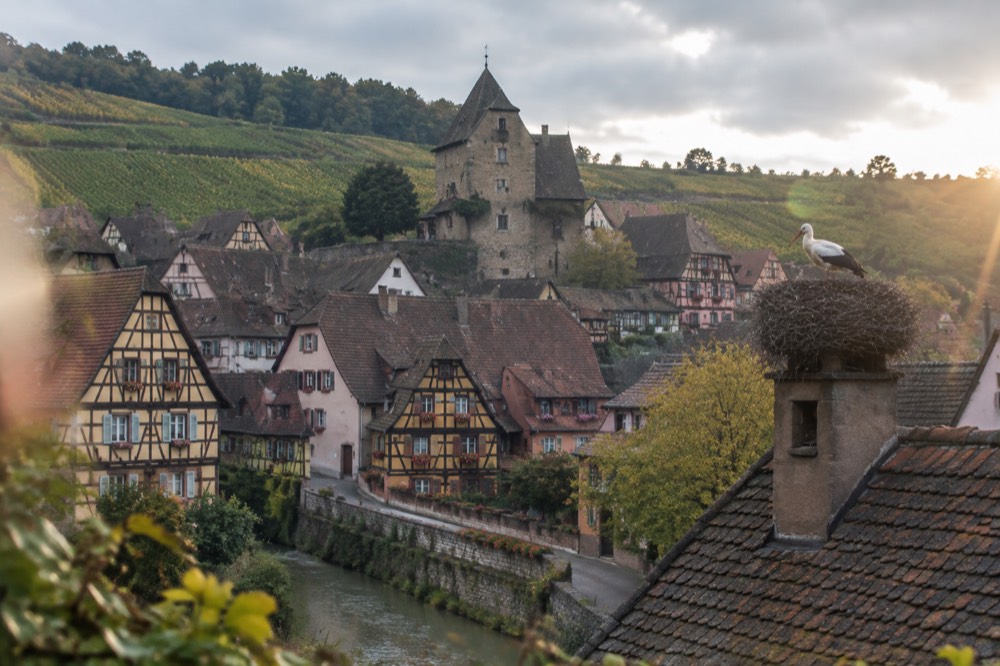
The last check is the softest one and the most useful: decide what the day is for before you build it. A tasting day wants two villages and no clock; a photography day wants the early light and the quiet lanes; a family day wants the castle or the storks and a square to eat in. Eguisheim serves all three, but not in the same itinerary, and the visits that disappoint are the ones that tried to do the whole wine route between lunch and the drive home.
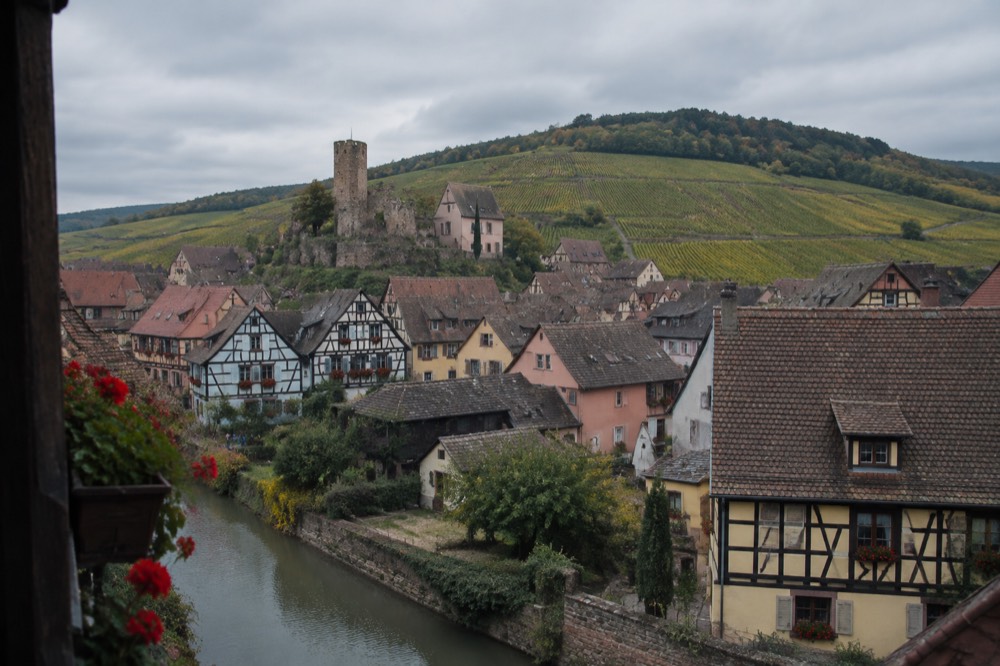
If the driving, the timetables or the designated-driver question make a self-built day look like work, the guided loops below cover the villages, the tastings and the castle road from Strasbourg in one booking, and the operator's live listing carries the current itinerary and availability for each departure.
Common Questions About Eguisheim
What Is Eguisheim And Why Do Visitors Go There?
Eguisheim is a wine-growing village on the Alsace wine route, beside Colmar in north-eastern France, known for its concentric ring of streets, half-timbered houses and cellar-door tastings. Visitors come for a slow loop of the lanes, a walk out to the vines and glasses poured a few steps from the vineyard, in a village small enough to cover comfortably on foot in half a day.
How Do You Get From Strasbourg To Eguisheim?
By road, or by rail towards Colmar with a local connection onward. Check the trains on SNCF Connect and the local connections around Colmar before you commit, or take a guided day tour that covers the southern wine villages from Strasbourg and removes the driving question entirely.
What Should You See And Do In Eguisheim?
Walk the concentric ring lanes, pause at the central square with its fountain and chapel, take a short path out into the vineyards for the view back over the roofs, and stop in two or three cellars to taste the local Riesling, Gewurztraminer and Cremant. There is no ticketed circuit; the village itself is the sight, and a long lunch completes the day.
When Is The Best Time Of Year To Visit Eguisheim?
Late spring through early autumn gives the flowering facades, green vineyards and full cellar doors, with July and August the warmest months at mean daily maxima of 26.4 C and 26.1 C. Autumn is harvest season in the vines, and December brings the Alsatian Christmas season, though you should confirm locally what is running in the village in any given year.
How Does Eguisheim Compare With Riquewihr And Kaysersberg?
Eguisheim is the ring-shaped, cellar-first village closest to Colmar; Riquewihr is the fortified wine street on the vineyard slope; Kaysersberg is the river village below a ruined castle. They are different moods rather than substitutes, and pairing two of them, one ring and one street, is the standard shape of a wine-route day.
Should You Visit Eguisheim Independently Or On A Guided Tour?
Independently if you have a car, a sober driver and a preference for controlling your own cellar time; on a guided tour if you want the wine route without driving, parking or timetables. Both work well from Strasbourg, and a common split is one guided wine-country day plus one independent day in the city itself.
Eguisheim rewards the traveller who arrives with modest ambitions and leaves with a full afternoon: one loop of the rings, one walk in the vines, two cellars and a square to eat in. Fit it beside Colmar or the other wine villages, keep the schedule loose, and the village does the rest.