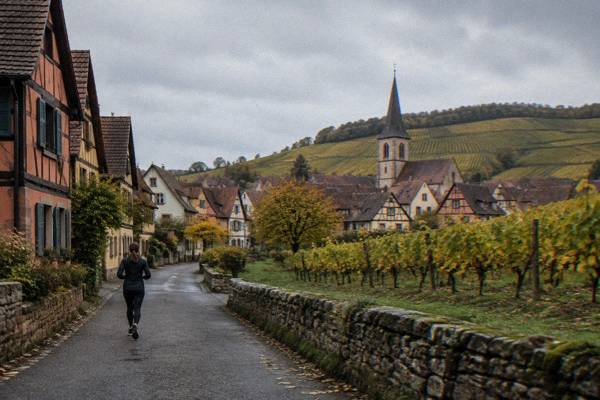
Obernai
Obernai is a walled wine town on the Alsace Wine Route in Alsace, north-eastern France, south of Strasbourg, the prefecture of the Bas-Rhin beside the German border. This guide covers what the town is for, what to see in a day, how to get there from Strasbourg without guessing at timetables, and how to pair it with the wine villages and hills around it.
Short answer
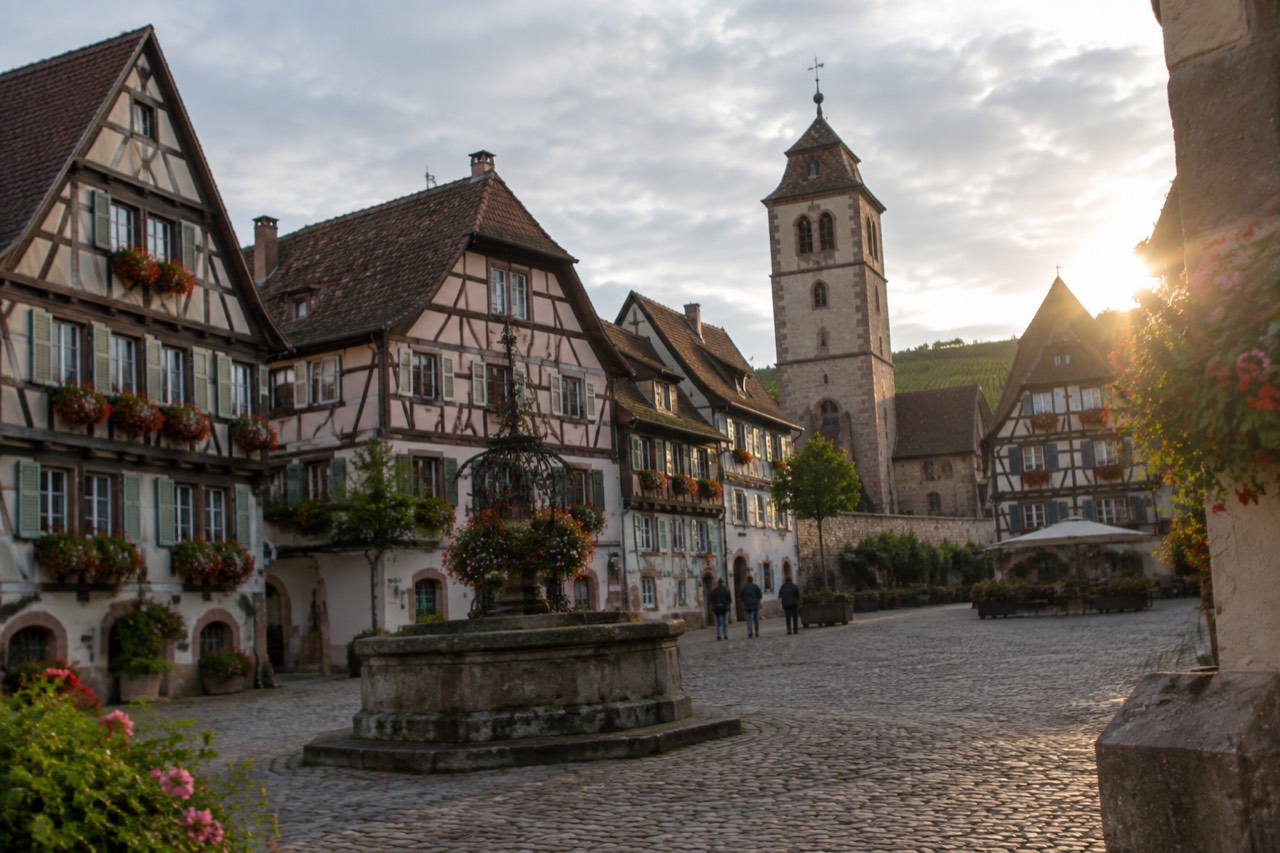
Obernai is a walled, half-timbered wine town on the Alsace Wine Route in the Bas-Rhin, south of Strasbourg in north-eastern France. It works as a relaxed half-day or full-day trip built around ramparts, a market square, vineyard slopes and winstub cooking. No door-to-door times or fares are quoted here: check the official pages for the current schedule.
Obernai is a walled wine town on the Alsace Wine Route, in Alsace in north-eastern France, south of Strasbourg, the prefecture of the Bas-Rhin, which sits on the River Ill beside the Rhine and the German border. The town is the kind of place travellers picture when they picture Alsace: ramparts you can walk, half-timbered burgher houses painted in deep colours, a belfry over a market square, and vineyard slopes at the edge of the streets. It is smaller and calmer than Strasbourg, which is exactly why it earns a day of a Strasbourg stay. This guide, published by Strasbourg Travel Guide, covers what Obernai is for, what to see, how to approach the journey, and how to fold the town into a wider Alsace wine-route itinerary.
Where Is Obernai And What Kind Of Town Is It?
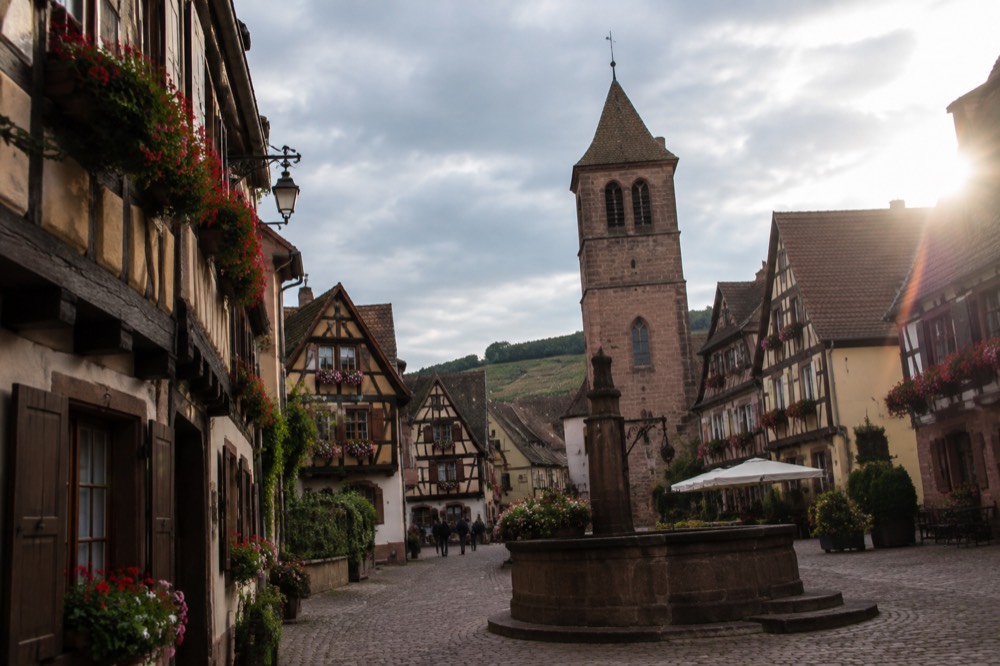
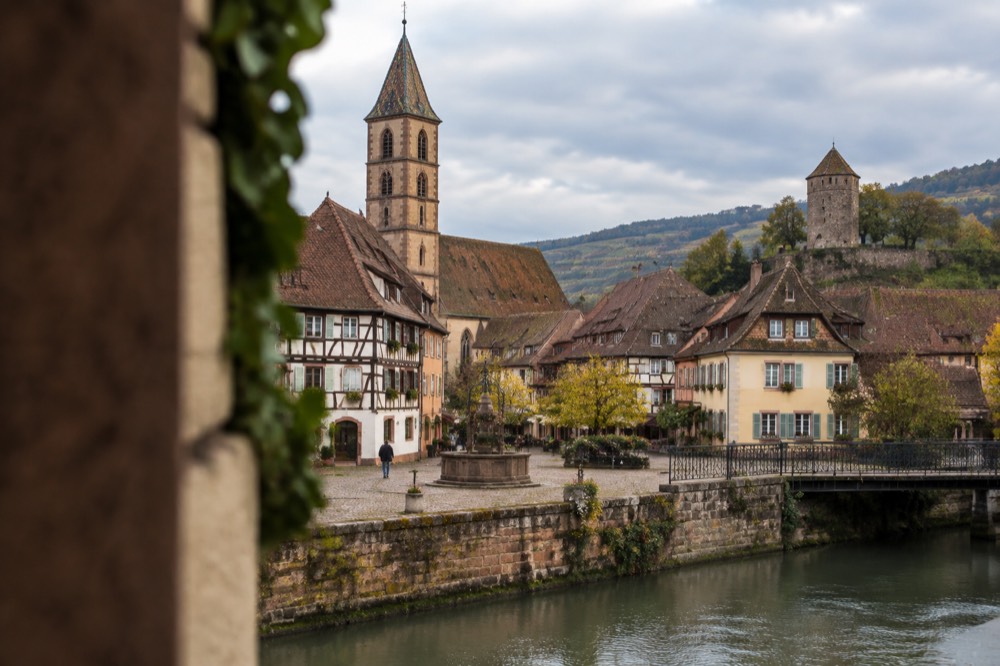
Obernai is a commune in the Bas-Rhin department, in Alsace in the Grand Est region of north-eastern France, sitting in wine country at the foot of the Vosges foothills south of Strasbourg. It is a genuinely walled town: the medieval ramparts still ring the old centre, and inside them the streets are half-timbered, slow and built around wine. It is a working wine town rather than an open-air museum, with cooperatives, tasting rooms and winstubs serving the surrounding slopes.
The simplest way to place Obernai is by what surrounds it. To the north sits Strasbourg, the regional capital and the seat of European institutions. To the west, the Vosges rise toward Mont Sainte-Odile, the ridge-top monastery and viewpoint that has its own Mont Sainte-Odile day-trip page on this site. To the south and east spreads the Alsace Wine Route, the string of wine villages between which Obernai sits comfortably. The town is French, uses the euro, and is inside the Schengen area like its German neighbours across the Rhine.
What distinguishes Obernai from the smaller wine villages further south, such as Riquewihr or Eguisheim, is scale and self-sufficiency. It is large enough to hold a proper market square, a belfry, several churches, a swimming lake on the outskirts and a full choice of places to eat, yet small enough that the old centre is entirely walkable. That balance makes it a good base for a relaxed day: you are never far from a tasting room, and you never need a car inside the walls.
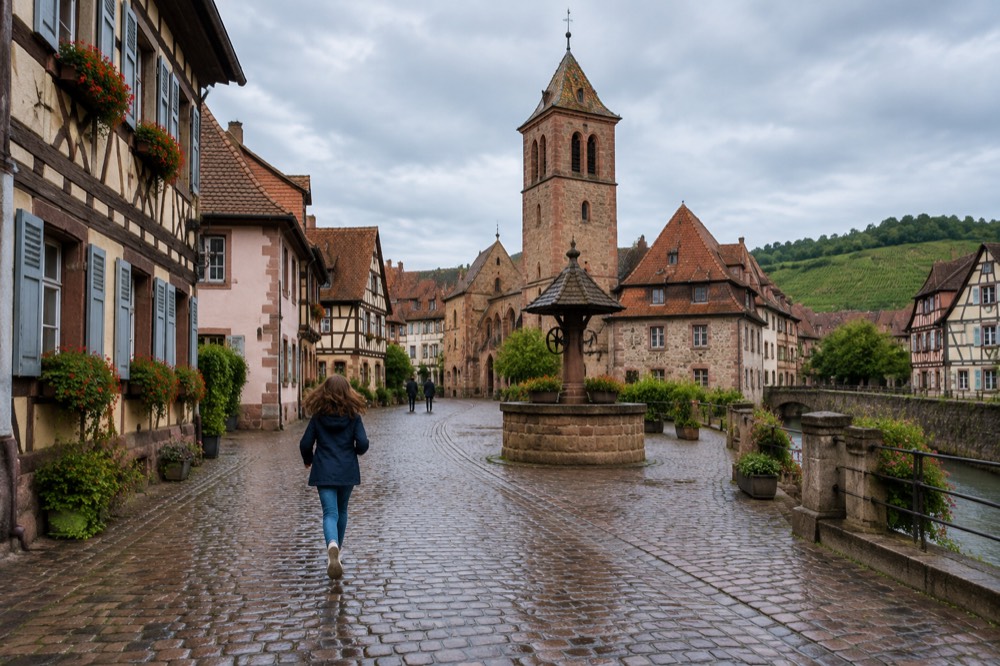
Do not arrive expecting a museum piece with roped-off streets. Obernai is a living town with schools, a hospital and a real weekday rhythm, and its charm is partly that it keeps working. The market square fills and empties on its own schedule, the ramparts are public space, and the winstubs serve locals as well as visitors. Check the tourist office's own site for opening times of anything specific before you build an itinerary around it.
| Aspect | What you find |
|---|---|
| Setting | Wine country at the foot of the Vosges, south of Strasbourg in the Bas-Rhin |
| Old centre | Walled medieval core with half-timbered houses and a belfry |
| Character | A working wine town, not a staged visitor attraction |
| Best for | A relaxed half-day of ramparts, square and tasting rooms |
| Pairs with | Mont Sainte-Odile to the west, the wine villages to the south |
| What to check | Tourist office page for opening times and market days |
What To See In Obernai On A Day Trip?
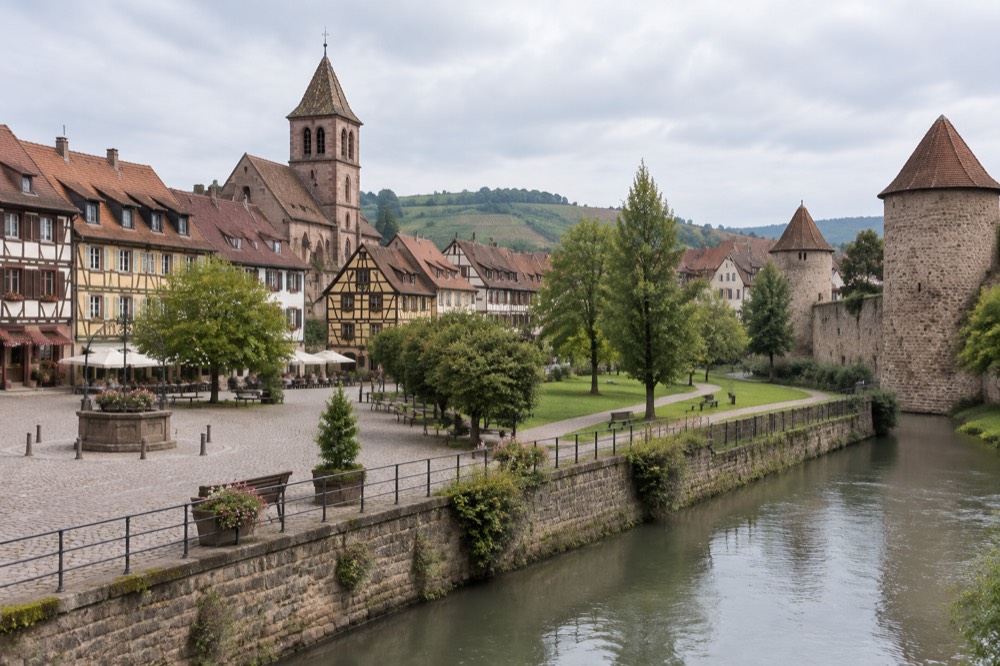
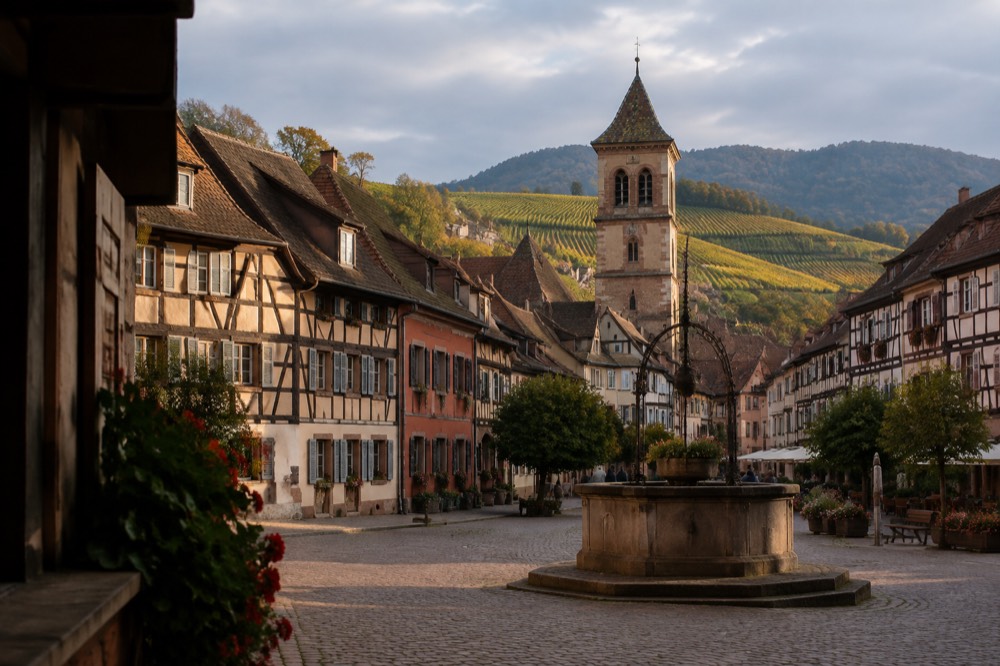
The core of an Obernai visit is the old centre: walk the ramparts, linger on the market square under the belfry, step into the parish church, and then let yourself drift out toward the vineyard slopes at the edge of town. The whole circuit is compact, and none of it needs a ticket or a timetable unless you want a tasting, so the day can be built entirely around strolling, eating and drinking. Give the square the slow hour it deserves.
Start on the market square, the place du Marché, where the belfry stands with its covered stair turret and the façades lean over the cobbles in ochres, greens and blues. This is the town's stage: cafés under arcades, a fountain, and the daily life of a Bas-Rhin commune. From there, the ramparts are the second essential. The walls survive as a green walk, with towers at intervals, and they give the clearest sense of the town as it was built to be: a defended market settlement in contested border country between France and the Holy Roman Empire's German lands, which is the historical thread that runs through all of Alsace.
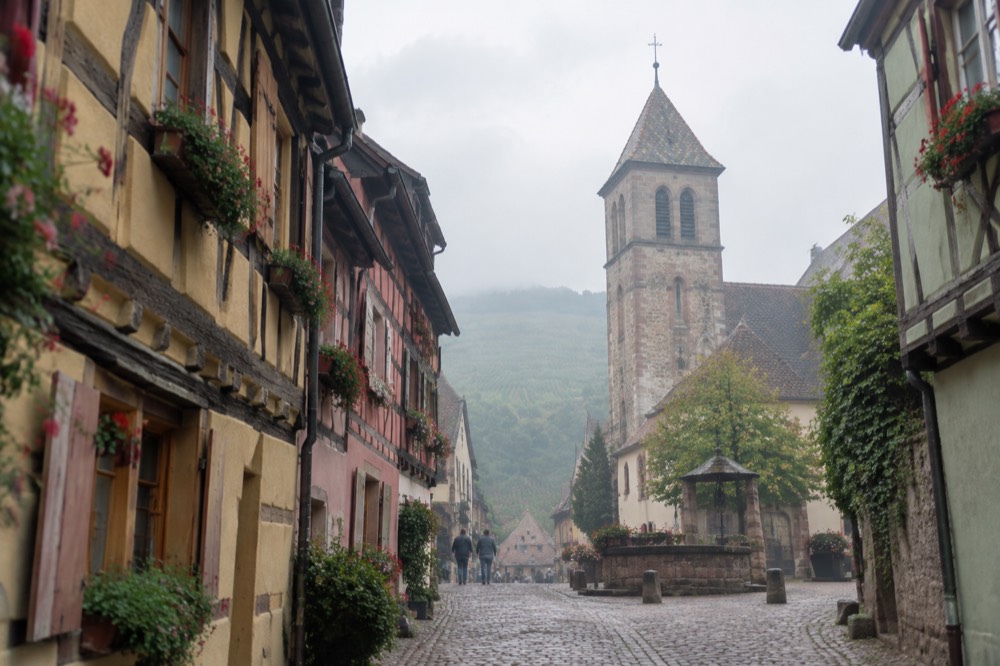
The parish church and the old corn hall sit within a few streets of the square, and the lanes between them are the real attraction: painted beams, carved lintels, courtyards with storks' nests in season. Alsace's stork population is a story in itself, and this site has a fuller guide to storks in Alsace coverage among its day-trip pages. Beyond the walls, vineyards climb the slopes within easy walking of the centre, and several producers and the local cooperative welcome visitors for tastings. Confirm tasting hours on each producer's own page, since they vary with the season and the harvest.
If you are staying several days in Strasbourg and Obernai is one stop among many, it pays to orient yourself in the capital first. A guided walk such as the Strasbourg guided walking tour pages describe can set up the region's history before you head into the wine country, and the roster below includes three well-reviewed options for exactly that.
| Sight | What it is | Why it earns its time | What to check |
|---|---|---|---|
| Place du Marché and belfry | The market square with its landmark tower | The visual heart of the town, ringed with cafés | Market days on the tourist office page |
| Ramparts | Walkable medieval walls with towers | The best free circuit of the old centre | Opening access to towers, if any |
| Parish church | The town's main place of worship | Quiet interior, carving and stained glass | Service times before visiting |
| Vineyard slopes | Working vines at the edge of town | The landscape the town exists to serve | Producer pages for tasting hours |
| Winstubs | Traditional Alsatian eating houses | The food and wine of the slopes in one room | Whether booking is needed in season |
How Do You Get From Strasbourg To Obernai?
Obernai is reached from Strasbourg by regional train, by bus, or by car, and the trip is short enough that no single mode dominates the decision. This guide deliberately prints no journey time, frequency or fare for the run, since schedules change. What matters is that the town is on the Alsace Wine Route corridor south of Strasbourg, so the same regional network that serves the wine country serves Obernai too.
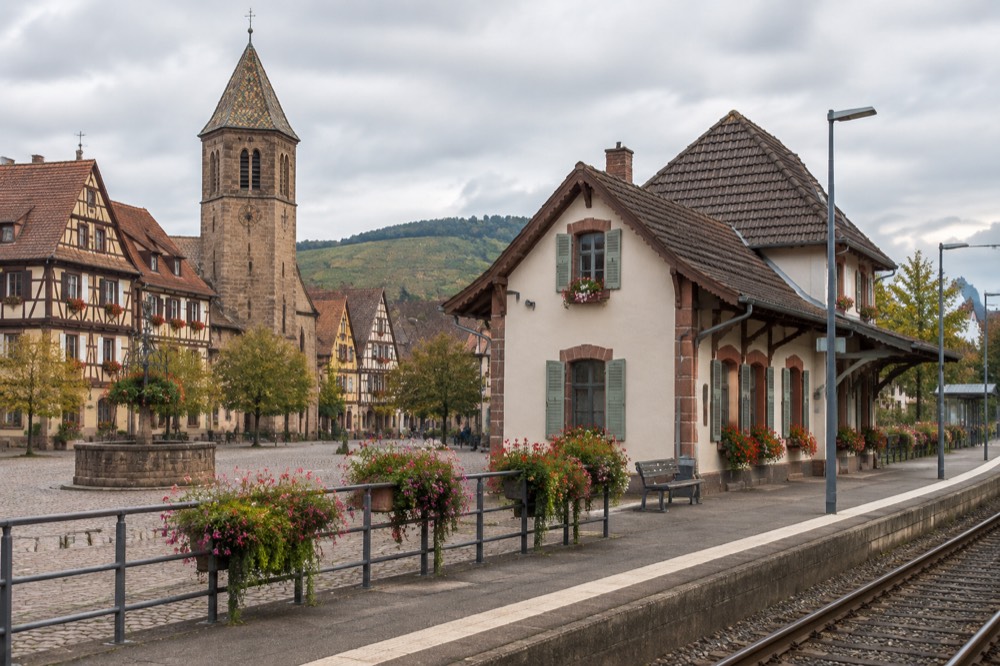
The train is the option that requires the least planning. Regional services run from Strasbourg's central station toward the wine-country towns of the Bas-Rhin, and Obernai is a station town, with the walk from the platform into the old centre a simple one. Check the current timetable and fares on the SNCF regional site or the official journey planner rather than any third-party summary, because frequencies shift between weekdays, weekends and holidays. Buy before you board where the network requires it, and keep your ticket until you leave the station at the far end.
Driving gives you the wine-route freedom: the ability to stop at a vineyard, detour to Mont Sainte-Odile, or thread the villages at your own pace. The trade-off is parking and the small roads through wine country in high season, when the villages fill with visitors doing exactly the same thing. If you drive, plan to arrive in the morning and park outside the walls, since the old centre is for pedestrians and the walk from the outer car parks is part of the visit.
Buses and organised shuttles also serve the corridor, and a guided day trip from Strasbourg is the fourth option: it removes the timetable, the parking and the driving altogether, and several of the roster's Alsace tours include stops in the wine country around Obernai. For travellers on a short stay, that simplicity is often worth more than the flexibility of a car. Whatever you choose, confirm the day's schedule on the official operator or transport page the evening before, since works and seasonal changes are real.
Obernai Or The Wine Villages: Which Should You Choose?
Choose Obernai if you want a walled town with real scale, a market square, and enough restaurants and tasting rooms to fill a whole day without a car. Choose one of the smaller wine villages, such as Riquewihr, Eguisheim or Kaysersberg, if your priority is picture-book lanes and you are happy with a shorter, sharper stop. The honest answer is that a Strasbourg stay of three days or more can hold both.
The comparison matters because the wine villages are often sold as interchangeable, and they are not. Riquewihr is the classic walled lane town, compact and intensely photographed. Eguisheim is the concentric one, its streets ringing the old village core in loops. Kaysersberg adds a ruined castle ridge above the town and a river running through it. Ribeauvillé is quieter, with its own fountain square and wine festival tradition. Each rewards a different mood, and none of them offers the full-service town day that Obernai does.
Obernai's advantage is substance. It has the ramparts, yes, but also the belfry, the square, the church, the vineyards at walking distance and a spread of winstubs and hotels that means a late lunch never becomes a scramble. If your trip is one day out of Strasbourg and you want to feel you have visited a town rather than a set piece, Obernai is the stronger pick. If you are touring the whole wine route by car, treat Obernai as either the first or last stop, with the smaller villages strung between it and Colmar, the region's second city and the natural southern anchor of the route.
One way to split the difference is to let a guide do the choosing. A small-group walk of Strasbourg on your first morning, such as the welcome walk in the roster, sets up the region's Franco-German story, and the orientation makes every village stop afterwards mean more.
| Town | Character | What it suits | Trade-off |
|---|---|---|---|
| Obernai | Walled town with belfry, square and full services | A whole relaxed day, no car needed inside | Less intensely picturesque than the smallest villages |
| Riquewihr | Classic walled lane town | Photographers, short sharp stops | Crowded at peak, thin on services |
| Eguisheim | Concentric streets ringing the old core | A slow loop walk with wine stops | Small enough to see in half a day |
| Kaysersberg | Castle ridge above a river town | Walkers who want a climb and a view | The climb is not for everyone |
| Ribeauvillé | Quieter fountain-square town | Escaping the peak crowds | Fewer headline sights |
What To Eat And Drink In Obernai?
Eat the Alsatian classics in Obernai's winstubs: tarte flambée, the thin crème fraîche, onion and bacon flatbread; choucroute, the sauerkraut platter with sausages and pork; and baeckeoffe, the slow-baked meat and potato casserole. Drink the local riesling and the sparkling crémant d'Alsace, and finish with kougelhopf, the ring-shaped brioche that is the region's signature cake. The town's winstubs serve all of it.
The winstub is the institution that makes an Obernai day complete. Part tavern, part dining room, it serves the cooking of the surrounding farms and vines at communal tables, and it is where the town's own rhythm is most visible. Tarte flambée arrives on a wooden board in minutes, which makes it the natural first stop; choucroute and baeckeoffe are the slow dishes, the ones to order when the afternoon has nowhere else to be. Kougelhopf, baked in the fluted mould that appears on every Alsatian souvenir stall, is the correct end to the meal, and it also travels: a wrapped kougelhopf from a bakery is a legitimate souvenir of the trip.
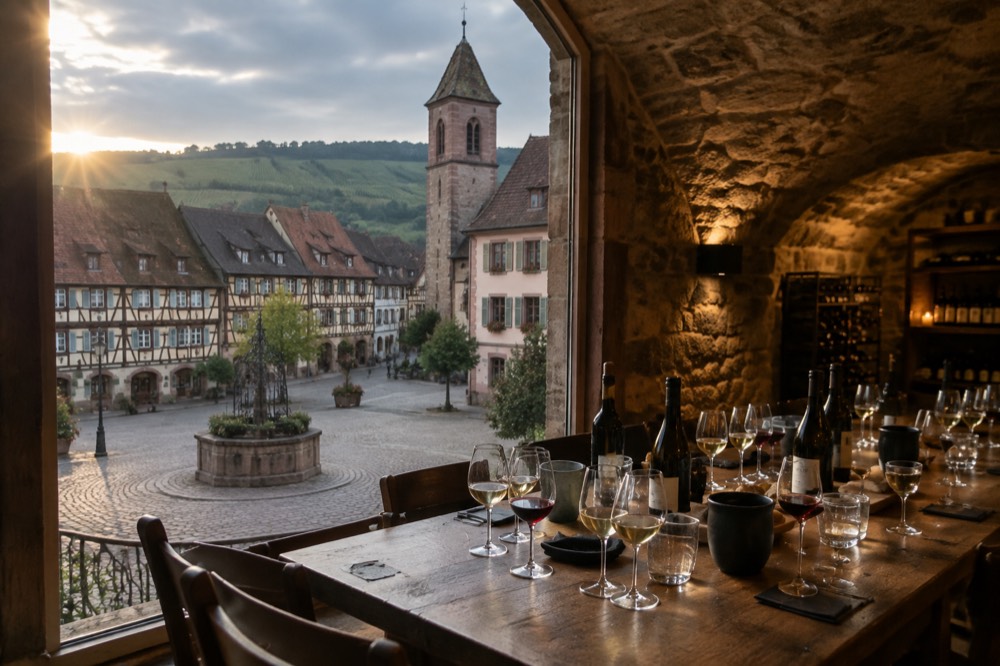
The drink order is simpler than the food order. Alsace is white-wine country, riesling above all, with pinot gris, gewurztraminer and sylvaner alongside, and the crémant, the region's traditional-method sparkling wine, as the festive default. The vineyards around Obernai feed the town's tasting rooms, and a tasting before lunch or after the ramparts walk is the most efficient way to meet the local producers. Tasting fees and pour sizes vary from producer to producer, so ask what the tasting includes when you sit down, and check whether a fee is waived against a bottle purchase, which is a common arrangement in the region.
If food is the reason you travel, plan the day around it. Arrive in time for the morning market if one is running, walk the ramparts to earn an appetite, taste at a cooperative or cellar, then take a long winstub lunch. That is a full Obernai day, and it needs nothing else added. This site carries deeper guides to tarte flambée and the region's other dishes among its food pages, but in Obernai the winstub does the explaining for you.
| Dish or drink | What it is | How it fits the day |
|---|---|---|
| Tarte flambée | Thin flatbread with crème fraîche, onion, bacon | Fast winstub lunch or shared board |
| Choucroute | Sauerkraut with sausages and pork | The slow, hearty main |
| Baeckeoffe | Slow-baked casserole of meat and potato | A dish to order when time is open |
| Kougelhopf | Fluted ring-shaped brioche | Dessert, or a wrapped gift to carry home |
| Riesling | The region's flagship white wine | The default glass with lunch |
| Crémant d'Alsace | Traditional-method sparkling wine | The celebration pour |
Which Season Suits An Obernai Day Trip?
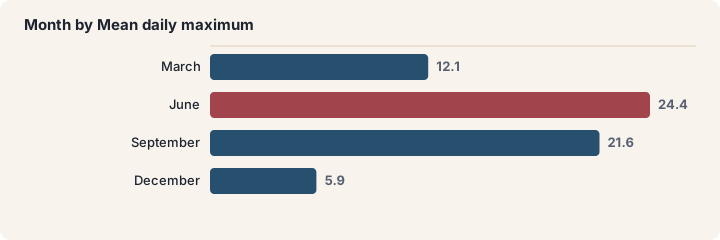
Late spring through early autumn suits an Obernai day trip best, because the ramparts walk, the vineyards and the square-side tables all want dry weather. The climate here is semi-continental, with cold winters and warm summers: the long-run Strasbourg-Entzheim record shows mean daily maxima of 20.9 C in May and 26.4 C in July, against 5.2 C in January. December trades warmth for the Christmas-market atmosphere of the whole region.
The vineyards give the seasons their meaning in wine country. In spring the slopes wake up and the villages are quiet; in summer the long evenings put tables outside on the square; in autumn the harvest turns the hills gold and the new wine arrives in the winstubs. Any of those three windows rewards the trip, and the differences between them are about crowds and colour rather than feasibility. The table below shows the Strasbourg-Entzheim climate normals, the nearest long-run record to the wine route, for the months travellers weigh most.
December deserves its own paragraph, because it changes the calculation. The whole region turns into a Christmas destination, with Strasbourg's own market running from late November to 24 December and the wine towns running smaller versions of their own. An Obernai day in December is a cold-weather visit built on hot wine, warm rooms and the smell of spiced bread, and it is a completely different trip from the summer one. Confirm the current season's dates and opening pattern on the official Christmas site rather than on third-party pages, since each year's programme is announced in its own time.
| Month | Mean daily maximum | Mean daily minimum | Rain days of 1 mm or more |
|---|---|---|---|
| March | 12.1 C | 2.6 C | 8.5 |
| June | 24.4 C | 13.4 C | 10.2 |
| September | 21.6 C | 10.7 C | 8.0 |
| December | 5.9 C | 0.8 C | 10.2 |
Guided Tour Or Independent Trip From Strasbourg?
Go independent if you want to control the pace, linger over lunch and stop wherever a cellar sign catches you, since Obernai is easy to reach and easy to walk. Take a guided day trip if you would rather not drive the wine route, or if you want several villages in one day without timetable arithmetic. Both work; the choice is about how much of the day you want to own versus how much you want handled.
The independent version is straightforward: a regional train or bus from Strasbourg, a walk from the station into the old centre, and a day built on the ramparts, the square and a winstub. The risk is not the town, it is the rest of the wine route. Without a car, the villages beyond Obernai are linked by thin rural connections, and a plan that assumes you can hop from village to village on a whim can unravel in an afternoon of missed buses. Check the regional transport pages for the specific day you travel, and build slack into the return.
The guided version solves exactly that. The roster includes a full-day Best of Alsace tour that covers the region's historical highlights in one booked seat, with the driving, parking and route planning handled. For travellers whose Strasbourg stay is short, that single booking can be the difference between seeing the wine country and reading about it.
There is a middle path too: a half-day wine tour out of Strasbourg, which pairs a morning or afternoon of guided tasting with an independent Obernai stop on either side of it. That suits a first visit, when you want the region's wines explained before you order them by the glass in a winstub.
For a guided introduction to the region's wines, book a half-day wine tour here.
| Approach | Who it suits | What to check |
|---|---|---|
| Independent by train or bus | Slow travellers, food-led days, one-town itineraries | Regional timetable and return connections |
| Independent by car | Wine-route tourers wanting multiple stops | Parking outside the walls, harvest-season roads |
| Full-day guided tour | Short stays, no-drive travellers | The operator's live listing for the itinerary |
| Half-day wine tour | First-time visitors wanting context | Tasting inclusions on the listing |
How Do You Pair Obernai With A Longer Alsace Itinerary?
Pair Obernai with Mont Sainte-Odile for a hills-and-walls day, with the wine villages for a two-day route south toward Colmar, or with Haut-Koenigsbourg castle for a history-heavy circuit. On a three-day Strasbourg stay, the strongest pattern is one day in the city, one day in Obernai and the ridge, and one day along the wine route to Colmar. The pairings below are about mood, not mileage.
Mont Sainte-Odile is the natural western pairing: the monastery ridge looks out over the plain that Obernai sits in, and a day that takes in both gives you the view from above and the streets below. Check the site's own Mont Sainte-Odile guide for access and opening details, since the summit site runs its own schedule. To the south, the wine-route pairing writes itself: Obernai, then Eguisheim, then Riquewihr or Kaysersberg, ending in Colmar or turning back to Strasbourg. For a castle day, Haut-Koenigsbourg anchors the southern route and gives the itinerary a grand medieval set piece.
The medieval-villages tour in the roster is built for exactly this pairing: a full day of wine-country villages with tastings included, which covers the southern string in one stroke and leaves Obernai free for a separate, slower day of your own.
If Obernai is one tile in a bigger Alsace plan, resist the urge to compress everything into a single day. The region rewards depth over coverage: one town walked properly, one ridge climbed, one cellar understood, beats five villages photographed from a car park. Obernai, precisely because it is a full town rather than a single street, is a good place to practise that slower rhythm.
| Pairing | What the day looks like | Who it suits |
|---|---|---|
| Obernai plus Mont Sainte-Odile | Walls in the morning, ridge and view after | First visit, history and scenery together |
| Obernai plus the wine villages | A route south through the vineyards toward Colmar | Car travellers, photographers |
| Obernai plus Haut-Koenigsbourg | Town morning, castle afternoon | Families, castle enthusiasts |
| Obernai alone | Ramparts, square, tasting, long winstub lunch | Slow travellers, food-led days |
Common Questions About Obernai
Is Obernai worth a day trip from Strasbourg?
Yes, if you want a walled wine town with ramparts, a belfry, vineyards at the edge of the streets and a full choice of winstubs. Obernai offers a complete small-town day rather than a single photo street, and it can be reached from Strasbourg by regional train, bus or car. Confirm schedules on the official transport pages before you travel.
How do I get from Strasbourg to Obernai without a car?
Regional train and bus services link Strasbourg with the wine-country towns of the Bas-Rhin, and Obernai is a station town with a short walk into the old centre. This guide prints no times or fares for the route: check the regional operator's own site for the current timetable, and plan your return connection before you settle into a long winstub lunch.
What is Obernai known for?
Obernai is known for its walkable medieval ramparts, its belfry on the market square, its half-timbered old centre, and its position on the Alsace Wine Route at the foot of the Vosges. It is also associated with Sainte Odile, the region's patron saint, whose ridge-top monastery at Mont Sainte-Odile stands in the hills to the west and pairs naturally with a day in the town.
Is one day enough for Obernai?
One day is enough to walk the ramparts, see the square and belfry, visit the church, taste at a cellar and take a long winstub lunch. Travellers who want to add vineyard walks, the surrounding hills or several tastings often spread the visit across a night, but the core of the town fits comfortably in a day trip from Strasbourg.
Should I choose Obernai or Riquewihr?
Choose Obernai for a full-service town day with ramparts, restaurants and a market square; choose Riquewihr for the most concentrated stretch of picture-book lanes on the wine route. With three or more days in the region, see both: Obernai as a relaxed base or first stop, Riquewihr as one of the southern villages strung toward Colmar.
Obernai rewards the traveller who slows down: one square, one wall walk, one cellar, one long lunch. Build the day that way, check the official pages for anything time-sensitive, and the town will do the rest.