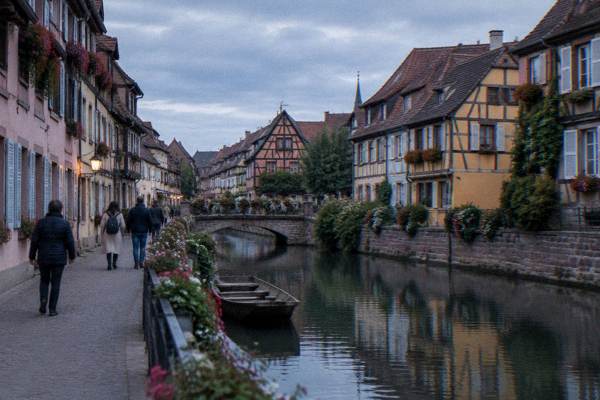
Ribeauville
Ribeauville is one of the half-timbered wine villages of the Alsace wine route, a straightforward day trip from Strasbourg for anyone pairing the city with vineyard country.
Short answer
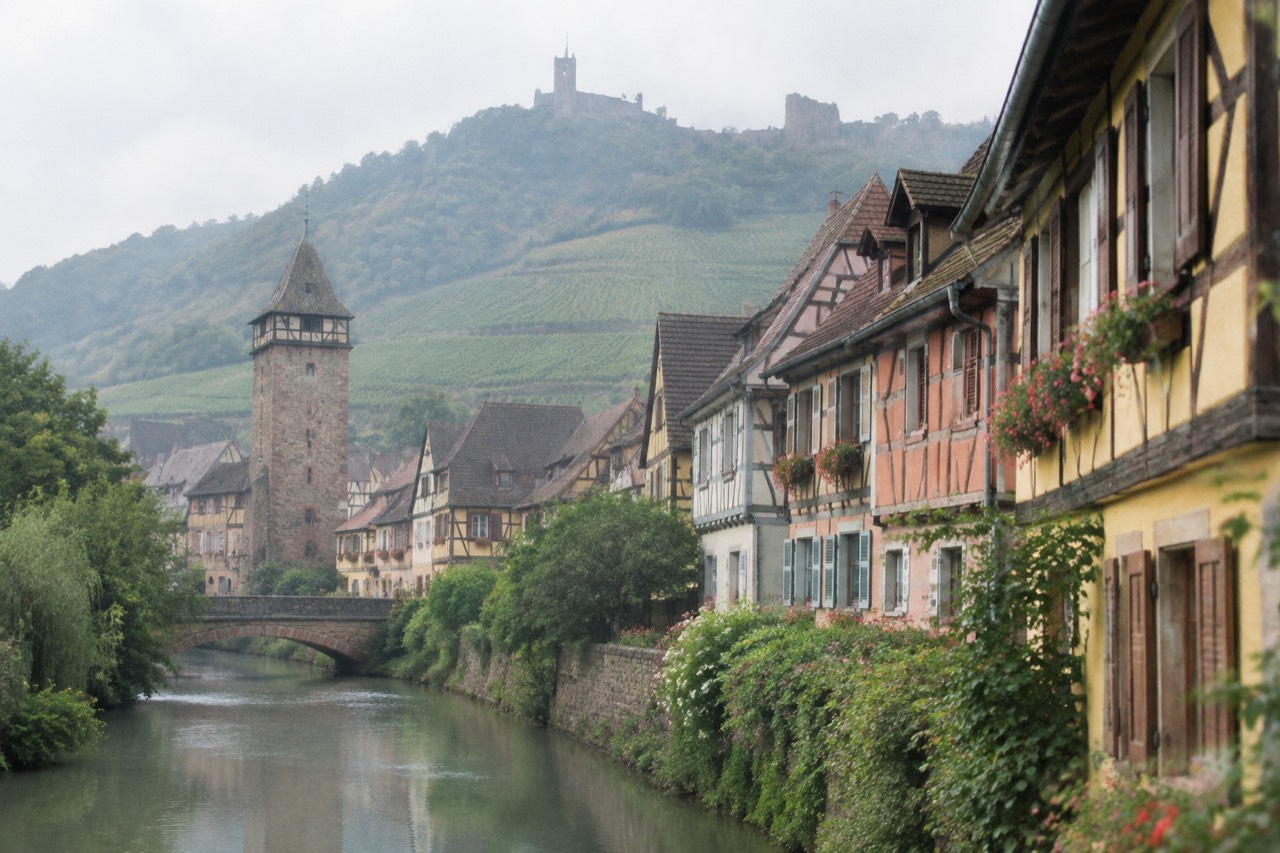
Ribeauville is a small wine village on the Alsace wine route, visited on a day trip from Strasbourg by car, by train with a connection for the final stretch, or on an organised small-group tour. Plan around the old lanes, the vineyard paths and the tasting rooms, and pair it with neighbouring villages such as Riquewihr or Kaysersberg.
Ribeauville sits on the Alsace wine route, a day trip out of Strasbourg, the prefecture of the Bas-Rhin in Alsace, north-eastern France, on the River Ill beside the German border. The village belongs to the string of half-timbered wine settlements that run south from the plain towards Colmar, and it shares their look: narrow lanes, deep-roofed houses painted in flat colours, vineyards climbing the hillsides behind the last gardens. It is a place for walking slowly, tasting what grows on the slopes above it, and moving on to the next village before the light goes.
What Is Ribeauville And What Kind Of Day Trip Is It?
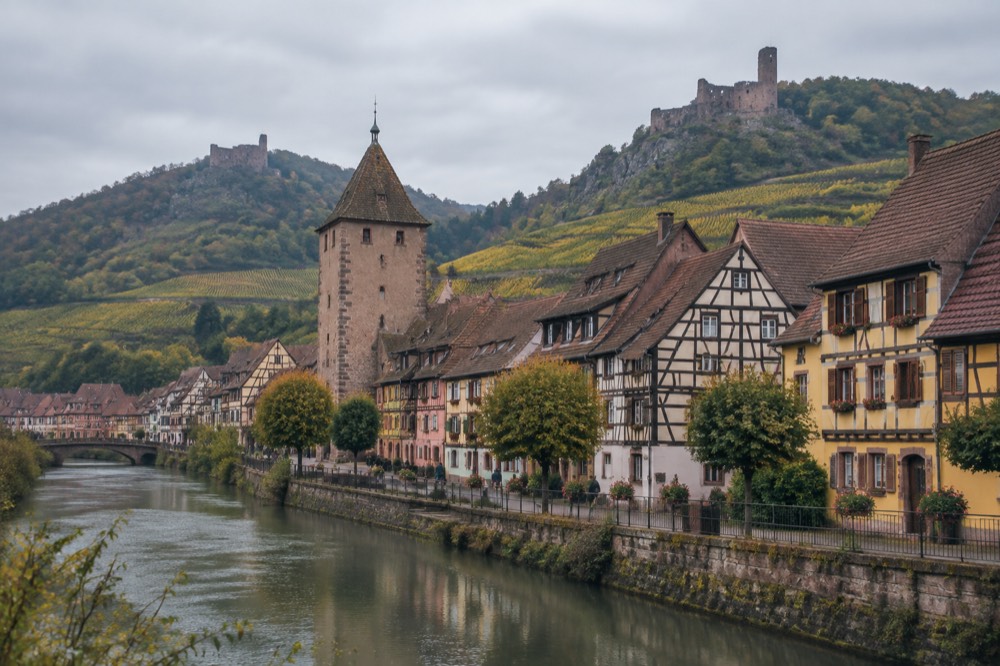
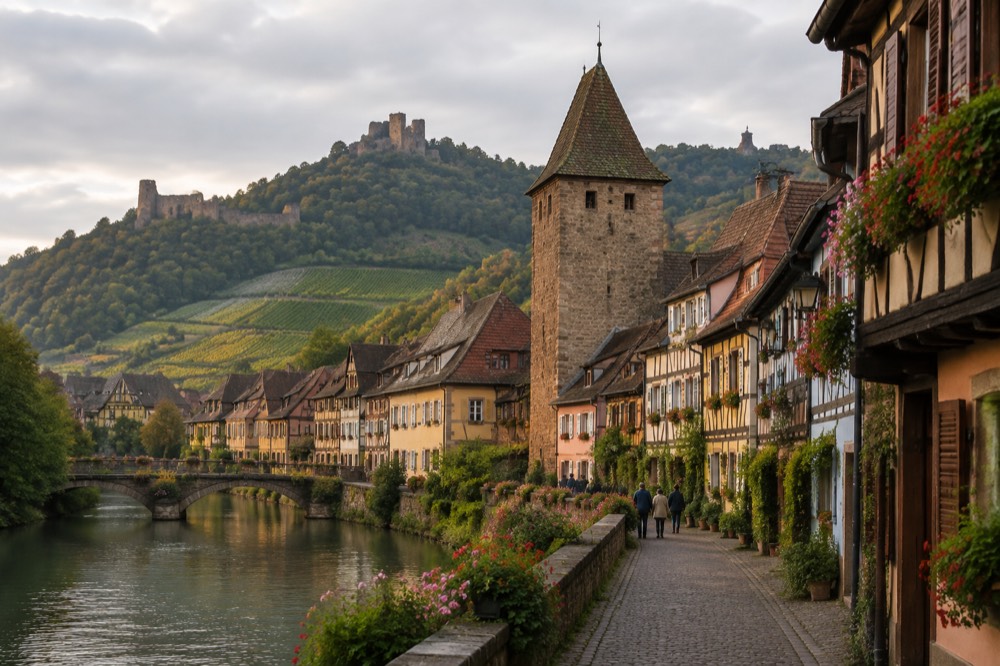
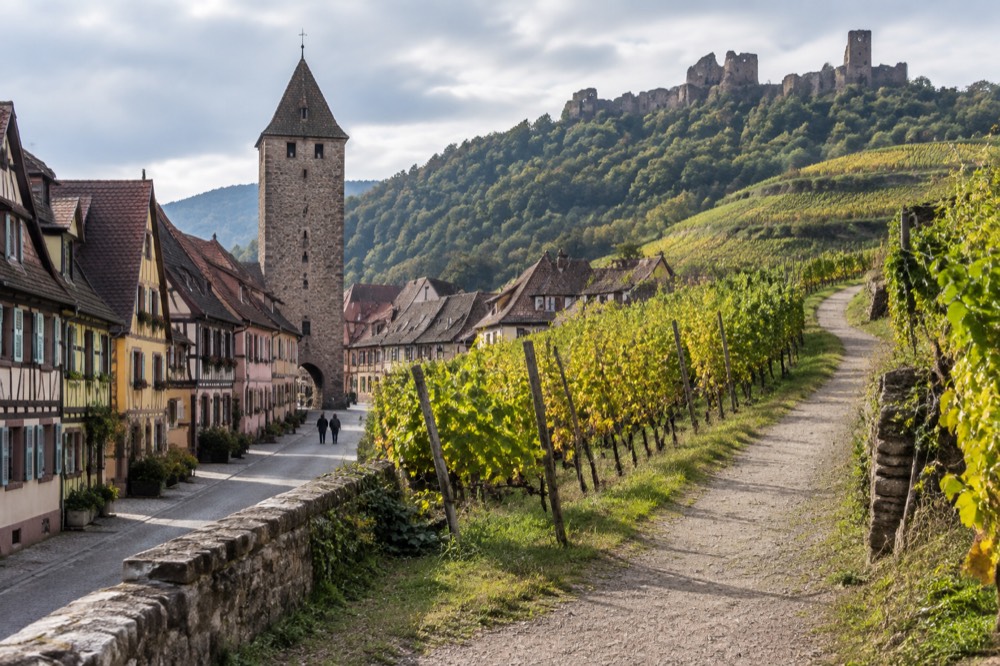
Ribeauville is a small wine village on the Alsace wine route, the better-known tourist stops of Riquewihr and Kaysersberg. It is quieter and less crowded than its neighbours, with a relaxed main street, wine tasting cellars, and three ruined castles above the town. It works best as a half-day stop or add-on to a nearby base rather than as a full-day destination in its own right. Visitors come for the old lanes and half-timbered houses, for the tasting rooms that pour the village's own Alsace wines, and for the paths that leave the last street and climb straight into the vineyards. A sensible plan pairs it with one or two other villages on the same road, or with a hillside sight such as Haut-Koenigsbourg, in a single loop out of Strasbourg.
The village belongs to the same family as the other wine-route settlements covered in this Strasbourg Travel Guide: a compact historic core, a working wine economy around it, and enough to fill a relaxed morning or afternoon without a schedule. What marks it out from its neighbours is pace. The coach groups thicken around Riquewihr and thin out again by the time the road reaches Ribeauville, so the lanes stay walkable even in the busy weeks.
That makes it a good counterweight in a two-village day. Spend the crowded hours somewhere bigger, then arrive here when the day-trip traffic has started to drain away, and the village gives back what the famous stops take: room to stand in a square, a table without a wait, a tasting that runs at the pace of the conversation. The Alsace wine route overview covers the whole road and where each village sits on it, which is the first thing to check before committing to a route.
How Do You Get From Strasbourg To Ribeauville?
There is no single door-to-door figure worth printing, because the honest answer depends on how you travel: by car along the wine route, by regional train with a connection for the final stretch, or on an organised day trip that handles the road for you. Each option changes the shape of the day, not just the cost. A car lets you chain several villages together; a train anchors you to one or two stops; a tour trades flexibility for a driver who knows where the parking actually is.
| Way of getting there | What it involves | Who it suits | What to check first |
|---|---|---|---|
| Own car or hire car | The wine route is a signed road through the villages; you set the order and the stops | Travellers chaining three or four villages in a day | Parking arrangements in each village, and opening days of cellars |
| Regional train plus a final connection | Rail serves the wine-route corridor, with a taxi or local link for the last stretch to the village itself | Visitors who would rather not drive in wine country | Timetables and connection options on the official rail pages for the day you travel |
| Organised small-group day trip | A driver-guide runs the road and the schedule from Strasbourg | First-time visitors and anyone who wants to taste without counting glasses | The live listing for the route, the stops and the days it runs |
| Bicycle or e-bike | The corridor between villages is rideable for confident cyclists | Slow travellers with a full day and fair weather | Route planning on official cycling pages, and cellar opening hours |
The car is the format the wine route was built around. Villages sit close together along the same road, so a driver can leave Strasbourg in the morning, work down the route, and still be back for dinner, with Ribeauville as one stop among several rather than the whole objective. The trade-off is parking: the popular villages fill their spaces early in high season, and the official village pages carry the current arrangements.
The train suits a different kind of day. Rail reaches the corridor, but the last stretch into a village like this needs a connection, and that anchors the plan to a timetable. It works well for a single-village day with a long lunch and no ambition beyond it. For anyone weighing the choice, the Strasbourg day trips overview compares the destinations that work without a car against the ones that reward driving.
Before leaving the city, it helps to have Strasbourg itself sorted. A short orientation walk with a local guide maps the ground quickly, and the walk with a local is a compact way to do it; Check availability on the operator's live listing for days and departure times.
What Should You Actually Do In Ribeauville?
The core of a Ribeauville visit is the old lanes, the village square, the tasting rooms, and the vineyard paths that climb from the edge of the village into the hills: all of it walkable, none of it ticketed, and best spread across a slow half-day rather than rushed in an hour. There is no single monument that demands a queue. The village is the sight, and the pleasure of it comes from pace rather than a checklist.
| What to do | Type of stop | Who it suits | When it works best |
|---|---|---|---|
| Wander the old lanes and half-timbered streets | Free, self-guided | Everyone; it needs no plan | Early morning or late afternoon, when the lanes are quiet |
| Sit in the village square with a drink | Café stop | Travellers pacing a multi-village day | Midday, between walks |
| Taste in a village cellar or tasting room | Wine experience, fees vary by cellar | Adults curious about Alsace wines | Check each cellar's days and hours before you set out |
| Walk the vineyard paths above the village | Walking route, signposted from the village edge | Anyone with sturdy shoes and an hour or two to spare | Dry weather, daylight hours |
| Browse the small shops and food counters | Shopping | Visitors taking produce home | Standard shop opening days |
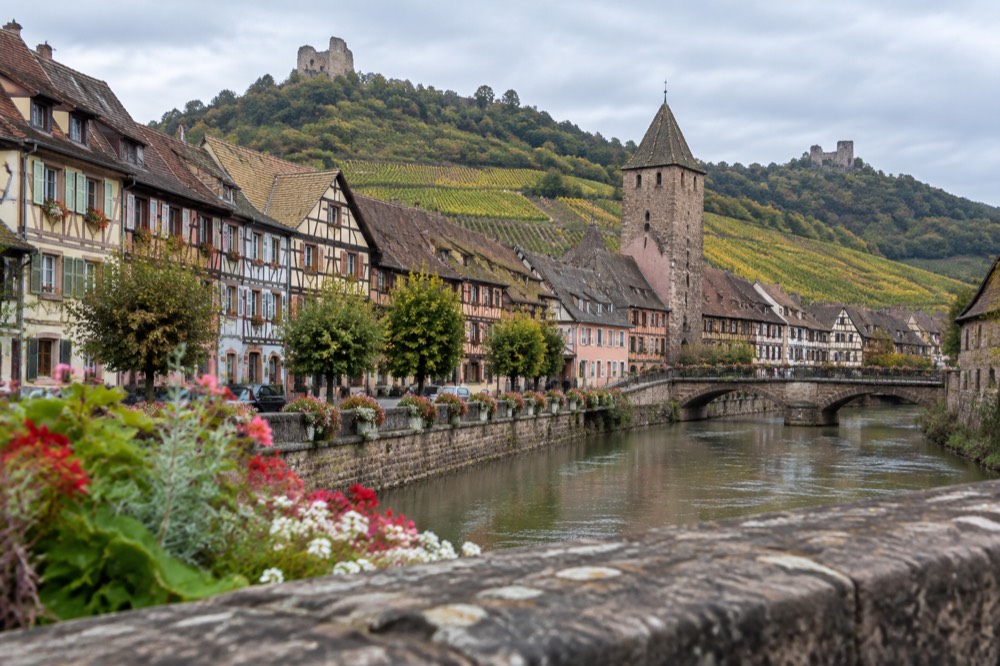
The lanes reward aimlessness. Half-timbered houses line the streets, painted in the flat, confident colours the region uses, with carved details around the doorways and dates worked into beams that are best enjoyed as craft rather than quizzed for history. The square is the natural centre of gravity: a table there, a glass of something local, and an hour disappears without effort.
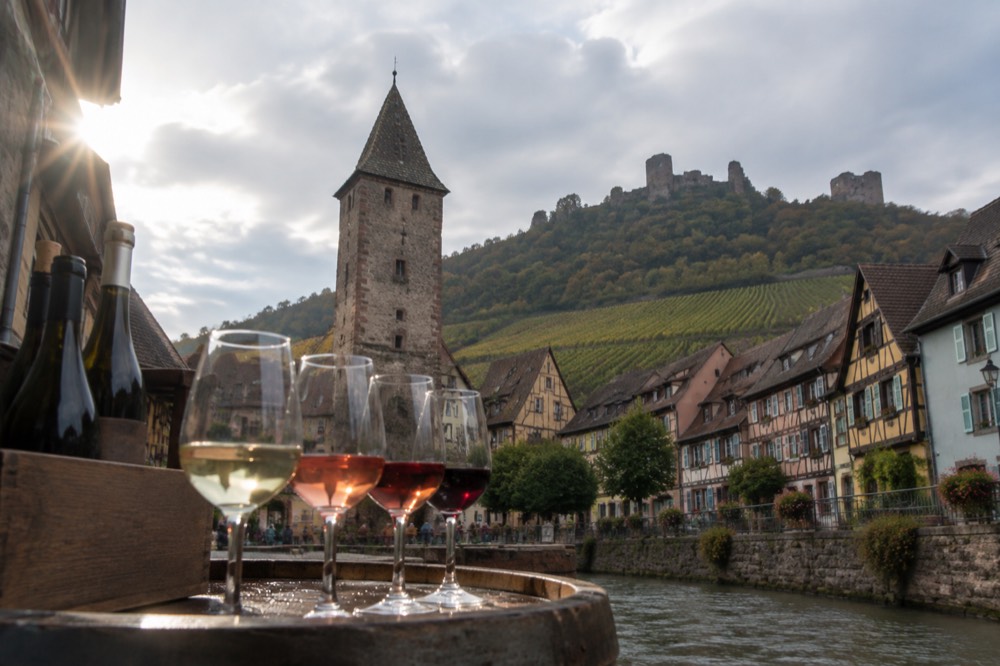
The tasting rooms are the reason wine-route villages exist as destinations. Ribeauville grows and pours the classic Alsace varieties, and the cellars in and around the village are working businesses rather than museums. Tasting fees and conditions differ from cellar to cellar, so the practical move is to check opening days before you commit the day, and to ask about the fee when you arrive rather than assuming.
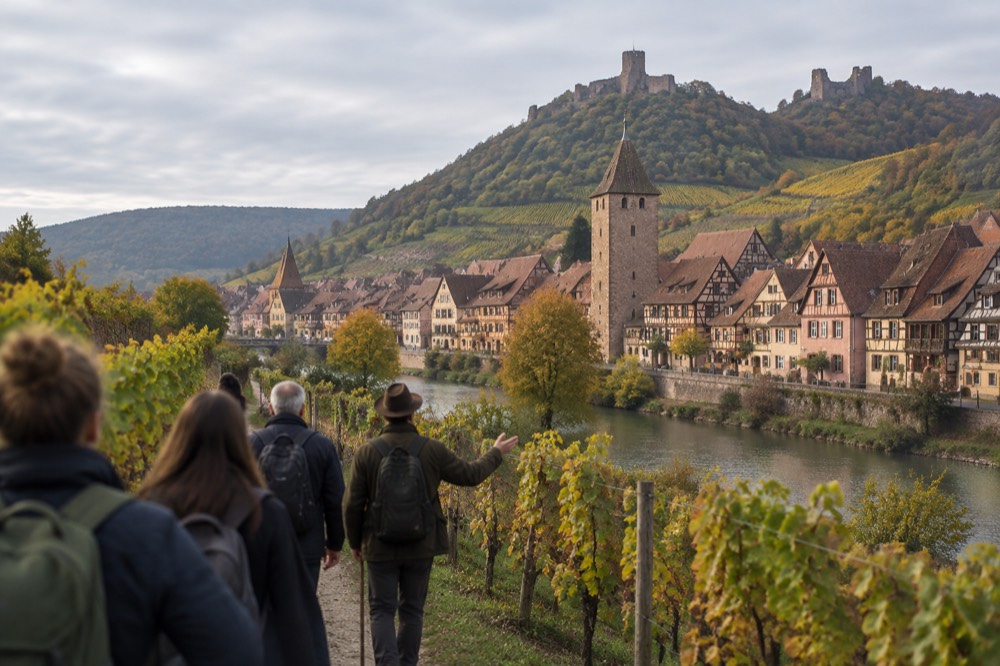
Above the last street, the vineyards start, and the paths through them are the village's best free feature. They climb into the hills on signposted routes, with the vines on one side and the valley opening below, and they can be as short or as long as the daylight allows. Sturdy shoes matter more than fitness: the paths are real walking country, not a landscaped promenade.
Which Nearby Villages Pair Well With Ribeauville In One Day?
Riquewihr and Kaysersberg are the two natural pairings, both on the same wine-route corridor and both close enough that a car can cover all three in a relaxed day; Eguisheim and Colmar make a southern alternative, and Haut-Koenigsbourg adds a castle to the loop. The choice is really about how much driving you want between walks. Two villages and a long lunch is a gentle day; three plus a castle is a full one.
| Pairing | Character | What it adds to a Ribeauville day | How it fits the route |
|---|---|---|---|
| Riquewihr | The famous walled wine village, busy and beautiful | The postcard streets and the biggest choice of cellars | Same corridor; pairs naturally in one loop |
| Kaysersberg | River village with a bridge, a ruined castle above and a strong food scene | A second, different village face and a hillside walk | Same corridor; works before or after Ribeauville |
| Eguisheim | Circular village wrapped in vineyards, a favourite for slow wandering | A concentric lane pattern unlike either neighbour | Sits further south; suits a Colmar-direction day |
| Colmar | The small city of the southern wine route, with canals and museums | Museums, galleries and a proper town evening | Best as the anchor of a two-day plan |
| Haut-Koenigsbourg | Restored hilltop castle above the plain | The one big-ticket sight of the region, with valley views | Pairs with any northern wine-route day by car |
| Kintzheim eagle park and monkey mountain | Animal parks in the forested hills near the castle | A family option that children rate above cellars | Same hillside area as the castle |
The classic loop is Ribeauville, Riquewihr and Kaysersberg, in whichever order the parking and the crowds dictate. All three are wine villages, but they do not repeat each other: one is the postcard, one runs along a river with a castle above it, and one, this one, keeps the quietest lanes of the three. A driver who starts early can walk all three cores and still taste properly in two of them.
Travellers with a second day, or with less appetite for driving, should read the Colmar guide and build a southern day instead: Colmar in the morning, Eguisheim after lunch, and the road back through the vines. Families get more out of swapping a third cellar for the hillside around Haut-Koenigsbourg, where the castle and the animal parks give children something the wine route cannot.
What Should You Eat And Drink In Ribeauville?
In Ribeauville, eat the classic dishes of the Alsace wine route: tarte flambée, choucroute, baeckeoffe and kougelhopf, all paired with the village's own riesling and other local Alsace wines. For the best experience, book a table for lunch rather than trying to find one at dusk, when options are harder to come by and the pace of service slows down. The village's kitchens cook the regional repertoire, and the wines poured beside it are the reason the village exists. This is a place where lunch is the main event of the day, not a pause between sights.
| Dish or drink | What it is | Where you meet it in the village |
|---|---|---|
| Tarte flambée | Thin bread base with cream, onions and bacon, baked fast and eaten hot | Village restaurants and cafés at lunch |
| Choucroute | Sauerkraut cooked with pork and sausages, the heavyweight Alsatian plate | Restaurant menus, usually as the main course |
| Baeckeoffe | A slow-baked casserole of meats and potatoes, a dish made for a walking day | Traditional restaurants; worth ordering ahead where kitchens make a set quantity |
| Kougelhopf | The brioche-like Alsatian cake with its moulded shape, served plain | Bakeries and breakfast tables |
| Riesling and other Alsace wines | The dry whites the region is built on, poured from the surrounding slopes | Tasting rooms, cellars and by the glass at lunch |
The practical advice is about timing rather than dishes. Wine-route villages are small, kitchens are finite, and the lunch window closes earlier than city visitors expect. Arriving with a plan, or a booking, matters more in August and in the Christmas weeks than at any other time of year. The region's food pages on this site cover each dish in depth if you want the background before you order.
The site's food coverage goes deep on the Alsatian repertoire: what choucroute should taste like, what makes a kougelhopf good, and how the wines of the route differ from each other. Reading even one of those pages before the trip changes the lunch, because you order the dish the kitchen is actually proud of instead of the first thing translated on the menu.
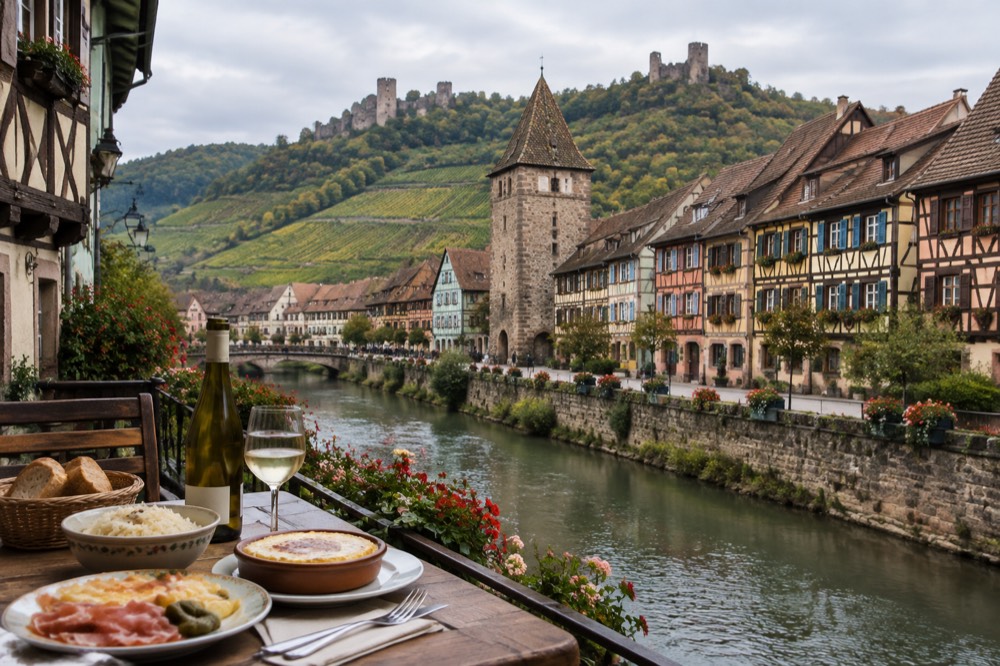
For travellers who want the food explained rather than just served, a guided gourmet walk in Strasbourg makes a strong pairing with a village day: one day tasting in the city with a guide, the next tasting in the cellars on your own judgement.
When Is The Best Time Of Year To Visit Ribeauville?
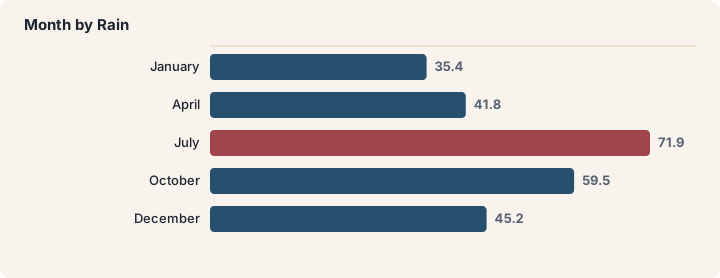
Late spring through early autumn gives the vineyards their green and the walking paths their best footing, December turns the whole wine route into a Christmas destination, and the deep winter weeks trade atmosphere for empty lanes and short days. The climate here is semi-continental: warm summers, cold winters, and rain spread across the year rather than packed into one season. The nearest long-run figures, from the Strasbourg-Entzheim station's 1991-2020 normals, give a mean July maximum of 26.4 C against a January maximum of 5.2 C, with 635.7 mm of rain across the year.
| Month | Mean daily maximum | Mean daily minimum | Rain | Days with 1 mm or more |
|---|---|---|---|---|
| January | 5.2 C | -0.2 C | 35.4 mm | 9.1 |
| April | 17.0 C | 5.7 C | 41.8 mm | 8.6 |
| July | 26.4 C | 14.9 C | 71.9 mm | 10.4 |
| October | 15.8 C | 7.2 C | 59.5 mm | 9.6 |
| December | 5.9 C | 0.8 C | 45.2 mm | 10.2 |
Those numbers are station normals for the Strasbourg plain, and they describe the region's shape rather than any single village afternoon. What they tell a planner is that no month is dry: rain days run between eight and eleven across the year, so a wine-route day needs a covered fallback, a café, a cellar, or a museum, whatever the season.
The Christmas period is the region's other face. Strasbourg's own market, the anchor of the season, opens in the last week of November and runs to 24 December; last year's edition ran 26 November to 24 December 2025 and drew 3.05 million visitors. The wine villages share the season in their own smaller register, with stalls and lights rather than city-scale crowds, and the 2026 dates for the city market were still being finalised on the official Christmas site at the time of planning, so confirm them there before booking anything around them.
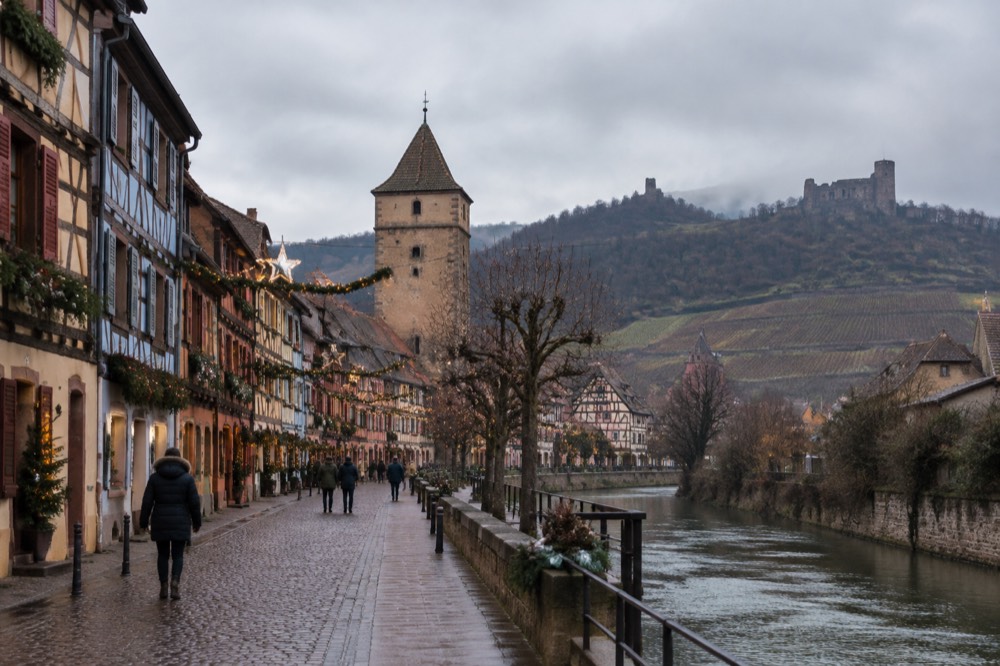
For visitors building a December plan around the markets, an organised Christmas-markets day tour from Strasbourg covers the driving while the villages do the atmosphere.
Can You Reach Ribeauville On An Organised Tour From Strasbourg?
Yes: small-group day tours from Strasbourg run the wine route and the medieval villages, with a driver-guide handling the road, the parking and the order of stops, which is the simplest format for travellers who would rather not drive in wine country. The trade is control. A tour decides which villages you see and for how long, and it cannot be steered towards a particular cellar, but it removes every logistical decision between Strasbourg and the vines.
| Format | What it covers | Who it suits | What to weigh |
|---|---|---|---|
| Medieval villages and wine-tasting day trip | A guided loop through wine-route villages with tastings built in | First-time visitors who want the region explained | Fixed stops; no detour to a cellar of your own choosing |
| Best-of-Alsace historical day trip | A longer circuit mixing villages with regional sights | Travellers using one day to see the region whole | A long day on the road by design |
| Half-day Alsace wine tour | A shorter loop focused on the cellars | Visitors with an afternoon to spare | Fewer stops in exchange for a lighter schedule |
| Self-drive with this guide | Your own route, your own timing | Confident drivers and repeat visitors | You own the parking and the cellar opening hours |
The guided format earns its keep in three places. It handles the road, which matters after a morning of tasting. It knows the parking, which matters in August. And it narrates the region, which matters for travellers who want to understand what they are drinking rather than just drink it. Against that, the independent driver keeps the freedom to linger where a tour gives a village an hour.
The medieval-villages and wine-tasting day trip is the natural fit for this page's village, since it is built exactly around stops of this kind.
Keen on a guided wine-route day? Book an Alsace half-day wine tour here.
What Does A Ribeauville Day Trip Cost?
The village itself costs nothing to enter and walk, so the budget is really three lines: the road out of Strasbourg, the tasting fees and lunches in the village, and whatever you pair with the day back in the city. Cellar fees vary from producer to producer and are best asked about on arrival; the Strasbourg side, by contrast, has printed prices you can plan around before you leave.
| Cost line | What to expect | What to check |
|---|---|---|
| Walking the village lanes and vineyard paths | No ticket; the streets and paths are public | Footwear and daylight, nothing else |
| Wine tasting in a cellar | Fees vary by cellar and by flight poured | Ask at the counter, or when you book, rather than assuming |
| Lunch in the village | Regional dishes at wine-route prices | Book a table in high season and at Christmas |
| Cathedral platform, Strasbourg | 10 EUR full, 6 EUR reduced, under 6 free | Seasonal ascent hours on the cathedral's own page |
| Astronomical clock show, Strasbourg | 4 EUR, show at 12:30, tickets sold on the day only | Ticket sales points and times before you plan the morning |
| Municipal museums, Strasbourg | 9 EUR full, 5 EUR reduced, free the first Sunday of every month | Which museums are open; the Musée Alsacien is closed for works until 2028 |
One planning note on the Strasbourg side: the City Card is a discount card rather than an all-inclusive pass, at 5 EUR adult and 3.50 EUR child for 7 days, taking set amounts off museums, the boat, the platform and the clock. It earns its price only across several paid sights, so it suits a full city day, not a village day with one stop back in town.
Is Ribeauville Worth The Trip From Strasbourg?
Yes, with one condition: it is worth it as part of a wine-route day, not as a destination in itself, because the village rewards a slow half-day and a plan that moves on to somewhere else before the afternoon ends. Travellers who come for one famous sight will not find it here. Travellers who want the wine route at its quietest, with lanes you can actually walk in August and cellars that have time to talk, will find exactly that.
Set against its neighbours, the case is straightforward. Riquewihr has the reputation and the crowds that come with it. Kaysersberg has the drama of the river and the castle above. Ribeauville has neither, and that is the point of it: the same timbered architecture, the same wines, the same vineyard paths, at a pace the bigger villages lose by mid-morning in summer.
The strongest plan treats all three as one day. Walk one village early, taste in the second over a long lunch, and end in the third when the coaches have gone, then roll back to Strasbourg for the evening. The Riquewihr guide and the Kaysersberg guide carry the details for each end of that loop, and the wine route guide holds the road that joins them.
Common Questions About Ribeauville
Can You Visit Ribeauville From Strasbourg Without A Car?
You can, but the day changes shape. Rail serves the wine-route corridor, and the final stretch into the village needs a connection such as a taxi, which anchors the plan to a timetable. An organised small-group day tour is the other car-free option, and it covers several villages in one road loop. Check the official rail and tour pages for the day you travel before committing either way.
What Is Ribeauville Known For?
Ribeauville is known as a half-timbered wine village on the Alsace wine route, with old lanes, tasting rooms pouring the local Alsace wines, and signposted paths that climb from the village edge into the surrounding vineyards. It is quieter than its neighbours Riquewihr and Kaysersberg, which is exactly why many travellers include it.
How Many Hours Should You Spend In Ribeauville?
A slow half-day is the honest answer: an hour or two for the lanes and a square, an hour for a tasting, and more only if you take the vineyard paths up into the hills. The village pairs well with one or two neighbours on the same road, so treat it as one stop in a wine-route loop rather than a full-day destination.
Is Ribeauville Good In December?
December puts the whole wine route into its Christmas register: stalls and lights in the villages, and the big city market in Strasbourg, which opens in the last week of November and runs to 24 December. Last year's edition drew 3.05 million visitors, so village tables and cellars need booking in that period. Confirm the current dates on the city's official Christmas site before you plan around them.
Which Village Is Better, Ribeauville Or Riquewihr?
They answer different questions. Riquewihr is the famous walled postcard, with the biggest choice of cellars and the crowds to match in high season. Ribeauville keeps quieter lanes and a slower pace at the same times of year. A car can do both in one day, and that is the plan this guide recommends.
Do You Need To Book Wine Tastings In Ribeauville Ahead?
It depends on the season and the cellar. Outside the busy weeks, walking in and asking at the counter usually works, and tasting fees are best asked about on arrival since they vary by producer. In summer and around Christmas, booking a table for lunch and, where possible, a tasting saves the day from unravelling at noon. Check each cellar's opening days before you set out.