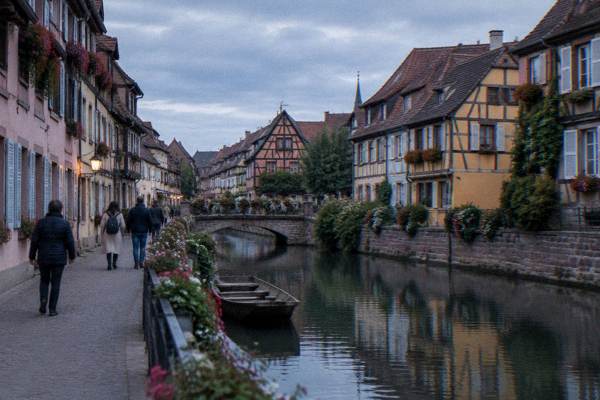
Mont Sainte Odile
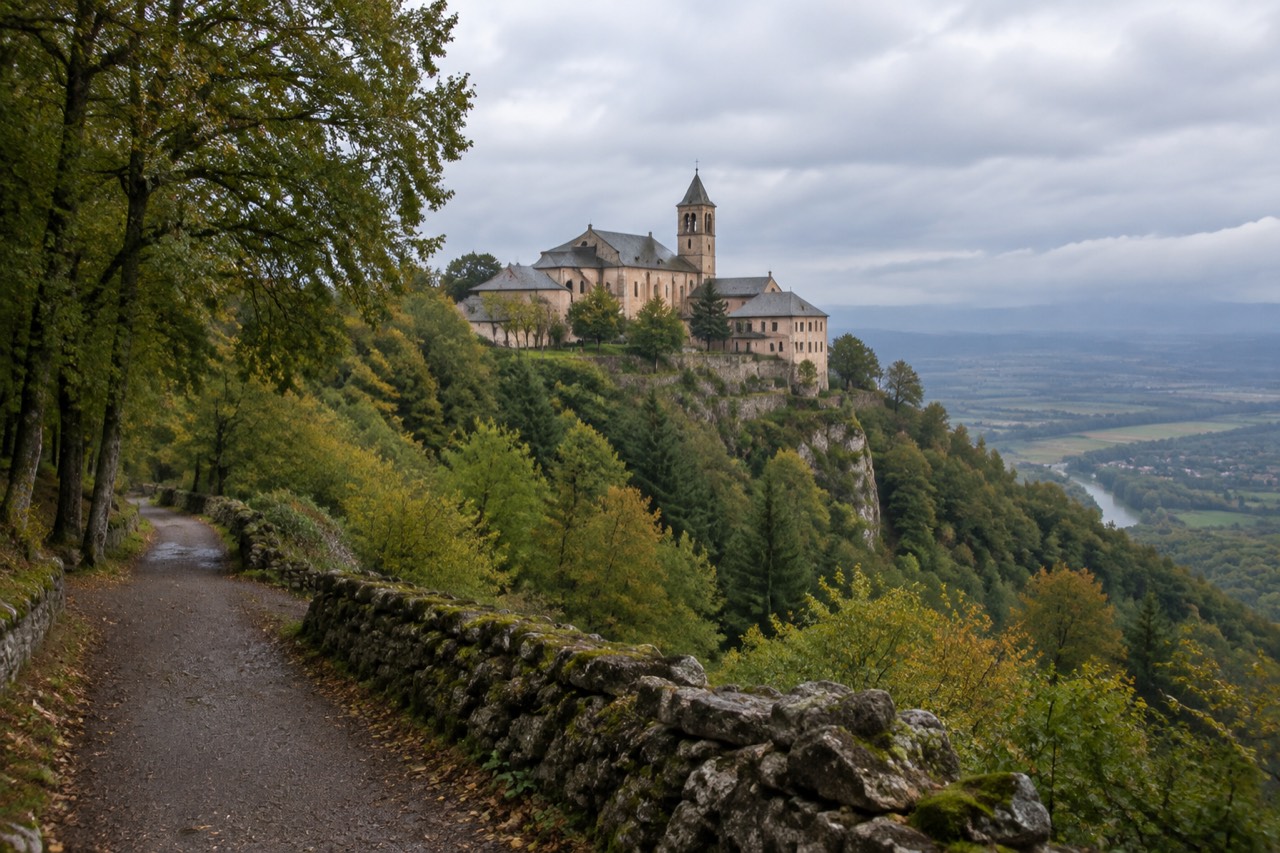
Mont Sainte Odile is the mountaintop abbey that watches over Alsace from the Vosges ridge above the plain of Strasbourg, a day trip that mixes a panoramic terrace, forest walks and the wine villages on the road below.
Short answer
Mont Sainte Odile is a mountaintop abbey in the Vosges, reached on a day trip from Strasbourg by road through the wine-route foothills around Obernai. Give it a full day, go when the weather is clear for the view across the plain toward the Black Forest, and pair the summit with a wine village or a second guided day trip from the city.
Mont Sainte Odile is a mountaintop abbey in the Vosges, the forested ridge that rises west of Strasbourg, the prefecture of the Bas-Rhin in Alsace, in the Grand Est region of north-eastern France, a city that sits on the River Ill beside the Rhine, which forms the border with Germany. The mountain is the kind of place that changes the shape of a trip to Strasbourg: instead of another half-timbered street, you get a summit terrace with the whole Alsatian plain laid out below, a working religious house that draws pilgrims and walkers, and a ring of ancient stone blocks, the Pagan Wall, that loops through the trees around the plateau. This guide covers what the mountain is, what you actually see up there, when to go, and which other day trips and guided tours pair well with it.
What Is Mont Sainte Odile?
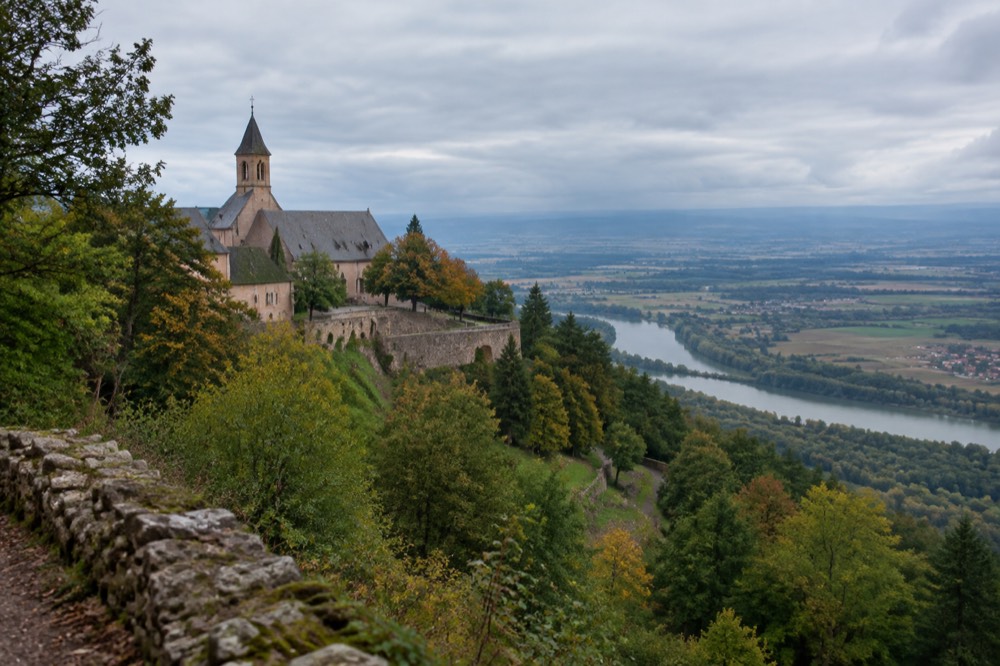
Mont Sainte Odile is a historic abbey perched on a forested summit in the Vosges mountains of Alsace, France. Dedicated to Saint Odile, the patron saint of Alsace, it stands as one of the region's most recognisable landmarks outside Strasbourg itself. Pilgrims and visitors have long traveled to this elevated site, drawn by its religious significance and the sweeping views it offers over the surrounding Alsatian countryside. The site works as a pilgrimage destination, a viewpoint and a walking base all at once, which is a rare combination for a single day-trip stop. From the terrace the plain of Alsace opens toward the Rhine and, on clear days, the hills of the Black Forest on the German side of the river. The abbey church and the surrounding buildings sit on a plateau enclosed by the Pagan Wall, a circuit of large stone blocks whose origin archaeologists still debate, which gives the summit a layered, unusual atmosphere for a day trip built around a view.
The mountain carries a weight in Alsatian culture that a first-time visitor can easily miss. Saint Odile is the region's patron, and the summit has been a destination for pilgrims for centuries, which is why the abbey remains a living religious house rather than a museum piece. Visitors arrive for very different reasons: some come for the panorama, some for the chapel and the springs associated with the saint, some to walk sections of the Pagan Wall through beech forest, and some simply because the mountain is the most prominent point on the horizon when you look west from Strasbourg. The site handles all of these without feeling like a single-attraction stop, and the plateau is small enough that a slow half day on the summit covers the terrace, the church and a stretch of the wall.
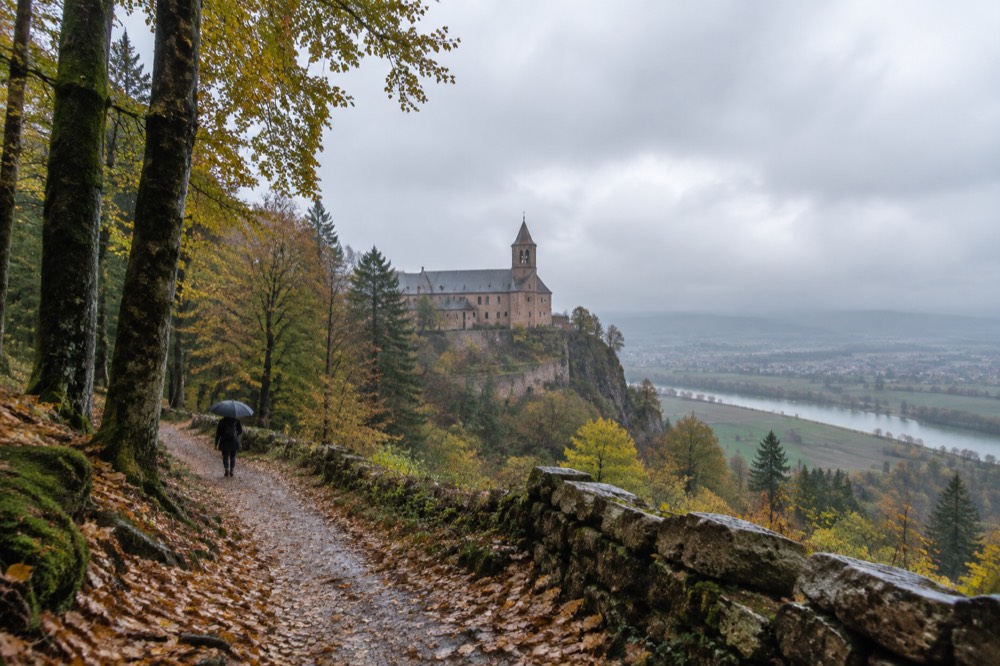
What surprises many first-time travellers is how much of the experience is outdoors. The buildings themselves are modest in scale, and the reason people remember the mountain is the setting: the ridge, the forest, and the long view over the patchwork of vineyards and villages that runs from the foothills down to the Rhine. Plan for time outside, with shoes that can handle forest paths, and treat the abbey as the anchor of a walk rather than the whole of the visit.
How Do You Get To Mont Sainte Odile From Strasbourg?
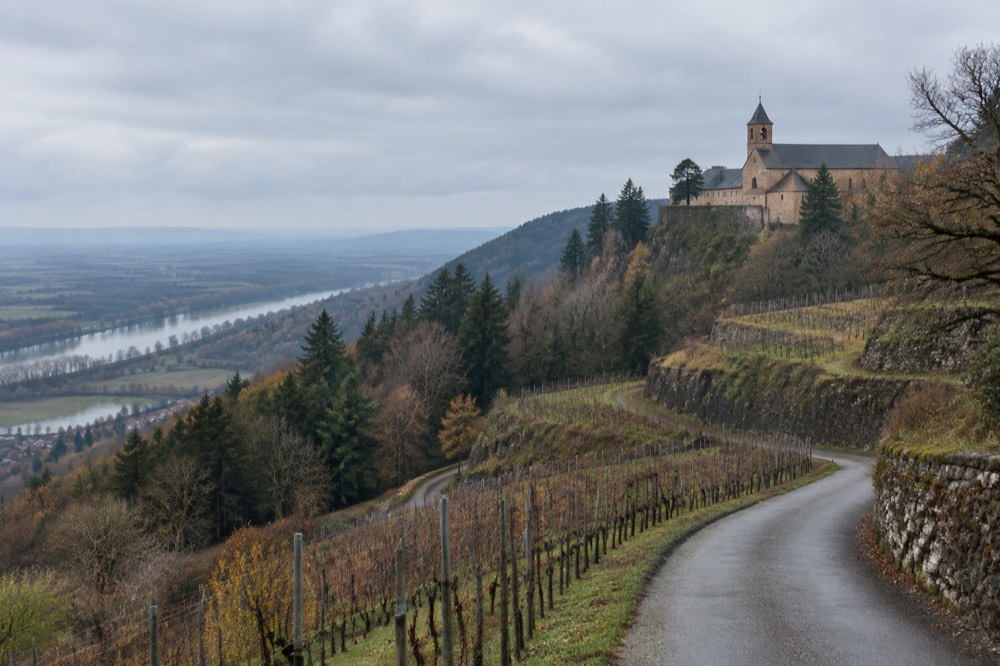
There is no train to the summit, so you reach Mont Sainte Odile from Strasbourg by road, either with your own car, with a guided day trip, or with the seasonal public transport options that serve the mountain, and you should check the current timetables on the official pages before committing to any of them. The road out of Strasbourg crosses the plain and climbs through the wine-route foothills, and Obernai is the natural gateway town on the way up. The final approach is a mountain road with bends and forest on both sides, so allow generous time, drive it in daylight on a first visit, and expect the weather on the ridge to be colder and changeable compared with the city.
For independent travellers, the practical pattern is simple: leave Strasbourg in the morning, break the climb in the foothills, and reach the abbey around midday when the terrace light is at its best. Parking on the summit is limited relative to the number of visitors the site draws in high season, and the access arrangements can change from season to season, so the abbey's own information pages and the Alsace transport pages are the places to confirm the current situation before you set out. In winter, ice and snow can close or restrict the upper road, and the mountain is genuinely exposed when the weather turns, so a flexible plan matters more here than on a city itinerary.
Planning to drive yourself up to the summit? Book a rental car here.
If you would rather not drive, a guided day trip from Strasbourg solves the mountain road, the parking and the timing in one booking, and the coach itineraries that cover the wider Alsace hinterland pair the region's villages with a driver who knows the roads.
Whichever way you travel, build the day around the mountain rather than squeezing it in. The summit rewards a long lunch-hour pause, a slow circuit of part of the wall, and the drive back down through the wine villages in the late afternoon, and none of that survives a tight schedule. Check the opening arrangements for the abbey buildings on the official page as well, since religious houses keep their own calendars and services can affect access to parts of the site.
What Can You See On The Summit?
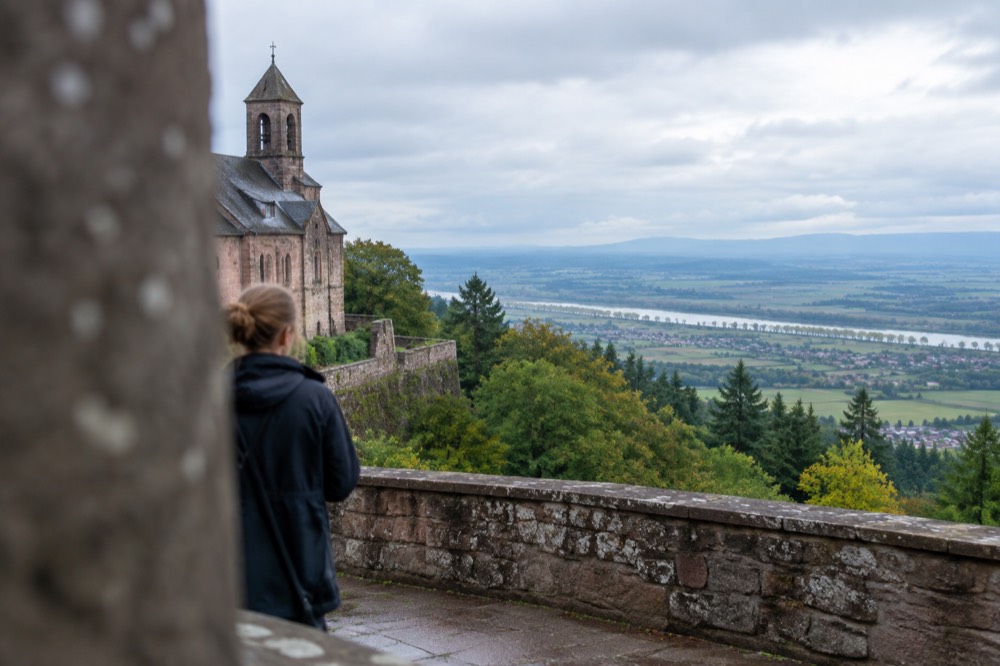
The summit offers four things in a compact space: the panoramic terrace with its view over the plain of Alsace, the abbey church, the chapel and springs associated with Saint Odile, and the Pagan Wall, the ancient stone circuit you can walk in sections through the surrounding forest. Together they fill a half day comfortably without any of them feeling like padding. The terrace is the headline, the church and the chapel give the place its meaning, and the wall turns the visit into a walk rather than a viewpoint stop.
The terrace is where every visitor ends up, and rightly so. On a clear day the view runs across the whole width of Alsace: the plain with its villages and vineyards, the line of the Rhine, and the darker hills of the Black Forest on the German side. Looking back along the ridge you see the Vosges themselves, forested and folded, running south toward the higher summits. The light changes through the day, and late afternoon often softens the plain in a way that photographers plan around, though in summer the terrace can be busy by mid-morning, so an early arrival buys both quiet and parking.
The abbey church and the chapel are quieter, working parts of a religious house rather than staged attractions, and visitors are asked to behave accordingly. The springs associated with the saint draw pilgrims who come for reasons that long predate tourism, and it is worth knowing that the site's religious calendar can shape what is open on any given day. The Pagan Wall is the element that feels least like anywhere else in Alsace: a dry-stone circuit of large blocks running for a considerable distance through the trees around the plateau, of debated origin and age, and walkable in sections that range from a short loop to a longer forest hike. Signposting on the paths varies, so take the map from the information point and keep to marked routes.
| Part of the summit | What it is | Who it suits | What to allow |
|---|---|---|---|
| Panoramic terrace | Open viewing platform over the plain of Alsace toward the Rhine and the Black Forest | Every visitor, photographers, first-timers wanting the signature view | A unhurried pause, longer in clear weather |
| Abbey church | The working church of the abbey, at the heart of the plateau | Visitors interested in the religious life of the site | A short respectful visit around services |
| Chapel and springs | The devotional sites associated with Saint Odile | Pilgrims and visitors interested in the saint's story | Time to find them, as they sit apart from the main terrace |
| Pagan Wall | An ancient dry-stone circuit through the forest around the plateau | Walkers, anyone who wants more than a viewpoint | A short loop or a longer forest section, with a map |
When Is The Best Time To Visit Mont Sainte Odile?
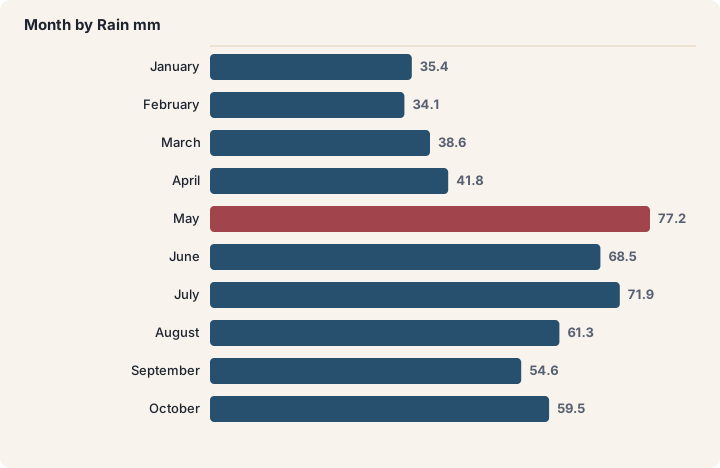
The best time to visit Mont Sainte Odile is a clear day between late spring and early autumn, when the terrace view is unobstructed and the forest paths of the Pagan Wall are dry, though the mountain is open year round and each season changes what the summit feels like. The plain below has a semi-continental climate, with Meteo-France 1991-2020 normals for Strasbourg-Entzheim showing a mean maximum that runs from 5.2 C in January to 26.4 C in July, and 635.7 mm of rain across the year. The summit sits higher than the plain, so conditions up top run colder and windier than these city figures, and mist can sit on the ridge while Strasbourg stays in sunshine.
The vineyards on the road up are at their most photogenic, and the harvest season gives the foothill villages a reason to stop on the way home. Winter strips the view down to its bones and can be beautiful in hard frost, but the mountain road and the forest paths demand respect in ice and snow, and the terrace is a cold place to stand for long. Spring brings the forest back to life and thinner crowds, with the caveat that April and May carry their share of rain in the normals. Summer gives the longest days and the fullest terrace, and the earlier you arrive, the more of the quiet you keep.
| Month | Mean maximum C | Mean minimum C | Rain mm | Days with 1 mm or more |
|---|---|---|---|---|
| January | 5.2 | -0.2 | 35.4 | 9.1 |
| February | 7.3 | 0.0 | 34.1 | 8.3 |
| March | 12.1 | 2.6 | 38.6 | 8.5 |
| April | 17.0 | 5.7 | 41.8 | 8.6 |
| May | 20.9 | 10.1 | 77.2 | 10.8 |
| June | 24.4 | 13.4 | 68.5 | 10.2 |
| July | 26.4 | 14.9 | 71.9 | 10.4 |
| August | 26.1 | 14.5 | 61.3 | 9.5 |
| September | 21.6 | 10.7 | 54.6 | 8.0 |
| October | 15.8 | 7.2 | 59.5 | 9.6 |
| November | 9.4 | 3.3 | 47.6 | 9.2 |
| December | 5.9 | 0.8 | 45.2 | 10.2 |
Whatever the season, check the forecast for the Vosges rather than the forecast for Strasbourg, and treat any prediction of low cloud on the ridge with suspicion: the terrace is a different proposition in mist, and the wall walk is the better use of a grey hour. A flexible day, with the summit early and a village or a museum in reserve for the afternoon, is the pattern that copes with an Alsatian weather change.
Which Alsace Day Trips Pair Well With The Mountain?
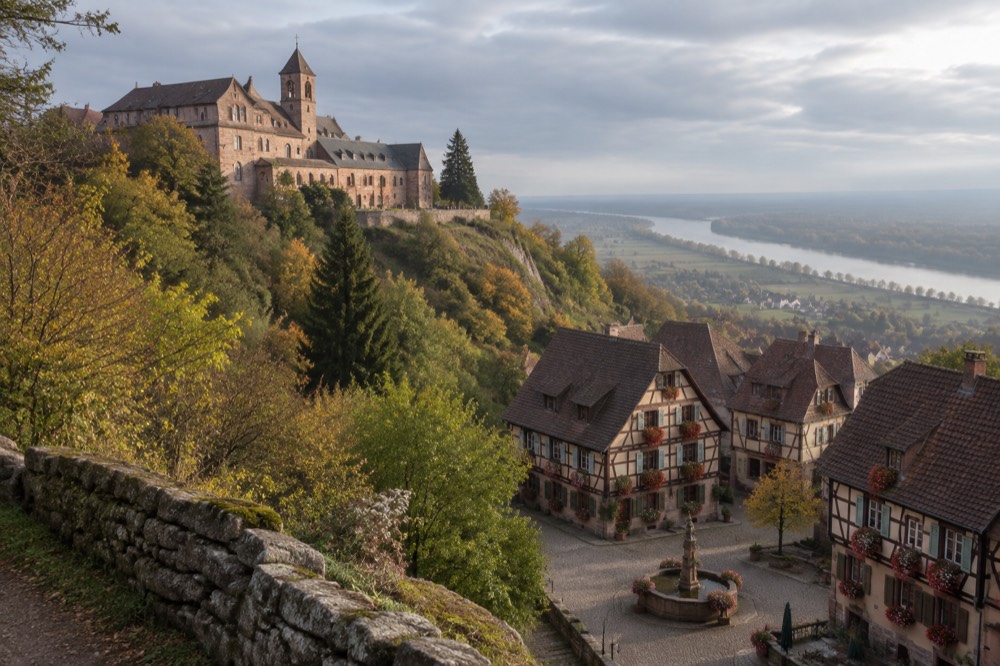
Mont Sainte Odile pairs naturally with the wine-route villages on its lower slopes, above all Obernai, and with Haut-Koenigsbourg and the other ridge and foothill sights of central Alsace, so the strongest plan is one mountain day and one village day rather than two summit days. Obernai is the gateway on the climb and works as a lunch stop or a half day in its own right. The wine route villages south of the mountain, Eguisheim, Riquewihr, Kaysersberg and Ribeauville, string together into a second day. Haut-Koenigsbourg, the castle that dominates the ridge further south, is the closest thing to a companion viewpoint, and the Natzweiler-Struthof memorial sits in the same Vosges highland for visitors who want the region's harder history on the itinerary.
The pairing logic is simple: the mountain is about the long view and the forest, while the villages are about half-timbered streets, wine and food, and mixing the two in a single day leaves both short-changed. A two-day pattern, one summit day and one village day, also spreads the driving more sensibly, since the roads between the sights are rural and slow. Travellers relying on guided trips should note that the coach itineraries bundle several villages into one day, which is an efficient way to see the wine route without a car, and the trade-off is less time in each stop than an independent driver would take.
| Day trip pairing | What it adds | Who it suits | How it pairs with the mountain |
|---|---|---|---|
| Obernai | A walled wine town with rampart walks and a lively square, on the road up from Strasbourg | First-timers, families, anyone without a full second day | The natural stop on the climb, or the base for the night before |
| Alsace wine route villages | Half-timbered streets, tasting rooms and vineyard views across the foothills | Wine drinkers, photographers, slow travellers | The village day to follow the summit day |
| Haut-Koenigsbourg | A restored ridge castle with its own commanding view over the plain | Castle visitors, anyone wanting a second panorama | A same-region alternative when the summit is in cloud |
| Natzweiler-Struthof | The memorial site of the former camp in the Vosges highland | Visitors engaging with the region's history | A sobering counterpart to the pilgrimage mountain, best as its own morning |
For visitors building the whole region around Strasbourg, the Alsace wine route guide covers the villages in depth, the Obernai guide does the same for the gateway town, and the Haut-Koenigsbourg guide handles the castle. This Strasbourg Travel Guide also carries full pages on Kaysersberg, Riquewihr, Eguisheim and Ribeauville for anyone planning the village day stop by stop, plus a Colmar day trip guide if the itinerary stretches south.
The guided alternative deserves a paragraph of its own. A coach day trip through the Alsace hinterland removes the mountain-road question entirely for the summit-adjacent villages, and the Black Forest trip that features on this page crosses the Rhine into Germany, a different landscape that pairs well with a second Alsace day for travellers staying a week. Check availability on the operator's live listing if the cross-border option appeals, since the departure details and the seasonal calendar live there.
Can You Visit Mont Sainte Odile On A Guided Tour?
No dedicated Mont Sainte Odile tour appears on this site's roster, so the guided route to the mountain region runs through the general Alsace day trips from Strasbourg, which cover the wine villages, the castle country and the Vosges foothills by coach with a guide. That is a genuine constraint worth knowing before you plan: if you want to stand on the terrace itself with a guide, the options are private arrangements and the seasonal local offers, and the coach products bundle the region rather than the summit. For plenty of travellers the bundle is the better buy anyway, because the villages are where a guide's commentary earns its keep and the mountain explains itself.
The two coach patterns that fit a mountain-centred stay are the historical circuit of Alsace and the medieval-villages itinerary with wine tasting. The first sweeps the region's headline sights in a single day, a good fit for a short trip that wants the whole of Alsace in one booking. The second leans into the villages and the vineyards with tastings built in, which suits travellers whose real interest is the wine route and who will take the mountain as a self-guided day either side of it. Both run from Strasbourg, both return to the city, and both leave the evening free for the old town.
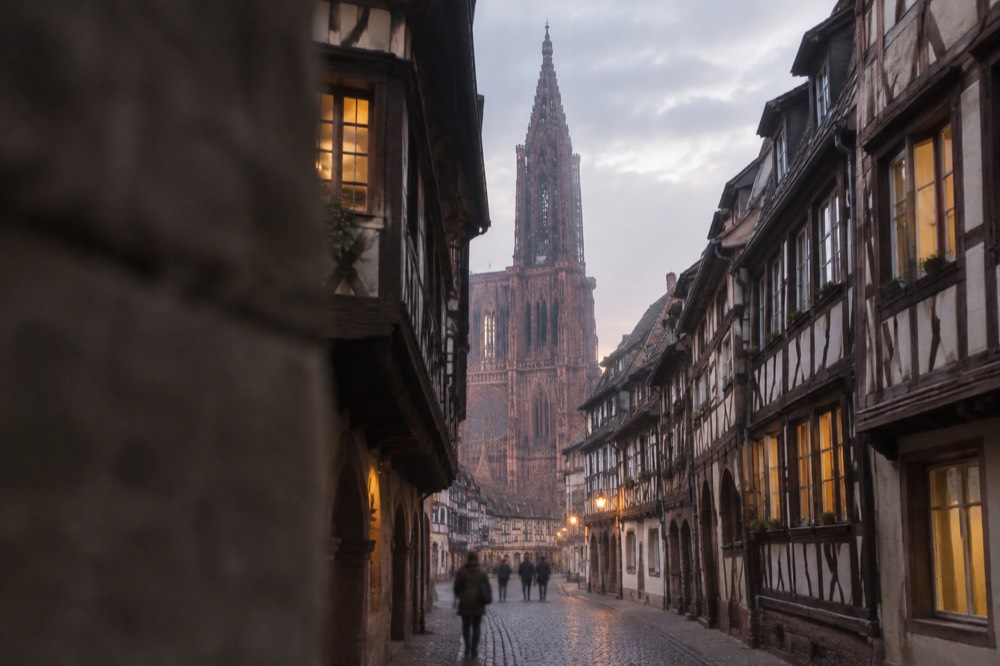
Between the coach days, the city itself carries the evenings well. Strasbourg's old quarter, the Grande Île, is compact enough for a walk after dinner, and the river loops around Petite France give the night a setting that needs no itinerary. A private evening walk is one way to anchor that part of the trip, and the roster carries one that fits the bill, but equally a map and an hour will do the job. The point is that a mountain-and-villages week in Strasbourg does not need every evening planned, and the best evenings in the old town are the unplanned ones.
What Should You Check And Budget Before You Go?
Before you go, check three things on the official pages: the abbey's current opening arrangements and any admission charge, the access and parking situation on the summit road for your season, and the weather on the ridge, and budget mainly for the road, food and the village stops. A wrong figure on a religious site's admission is worse than no figure. The costs you can plan for are the city transport legs and the optional guided days.
In Strasbourg itself, the CTS network handles the city legs cheaply: a single ticket costs 1.90 EUR bought through the app or contactless, or 2.50 EUR bought on board the bus, and the day passes below cover a full day of trams and buses. These figures come from the CTS fare pages and apply to the city network, not the mountain, so treat them as the before-and-after of your summit day rather than part of it. Food on the road is the other budget line: the foothill villages carry winstubs and bakeries at Alsatian prices, and the mountain itself has limited options, so plan lunch before you climb or after you come down.
| CTS ticket | Price | What it covers |
|---|---|---|
| Single ticket | 1.90 EUR via the app or contactless, 2.50 EUR on board the bus | One journey on the Strasbourg city network |
| 24h Solo | 4.60 EUR | One person, unlimited city travel for a day |
| 24h Trio | 10.20 EUR | Two to three people travelling together, a day of city travel |
| What to check | Where to check it | Why it matters |
|---|---|---|
| Abbey opening arrangements and admission | The abbey's own information pages | Religious houses keep their own calendars and service schedules |
| Summit road access and parking | The abbey and local authority pages | Arrangements are seasonal and can change with weather |
| Ridge weather forecast | A mountain-aware forecast for the Vosges | The summit runs colder and mistier than the Strasbourg plain |
| Village stop details on the way up | The Obernai and wine-route pages | Lunch and parking are easier planned than improvised |
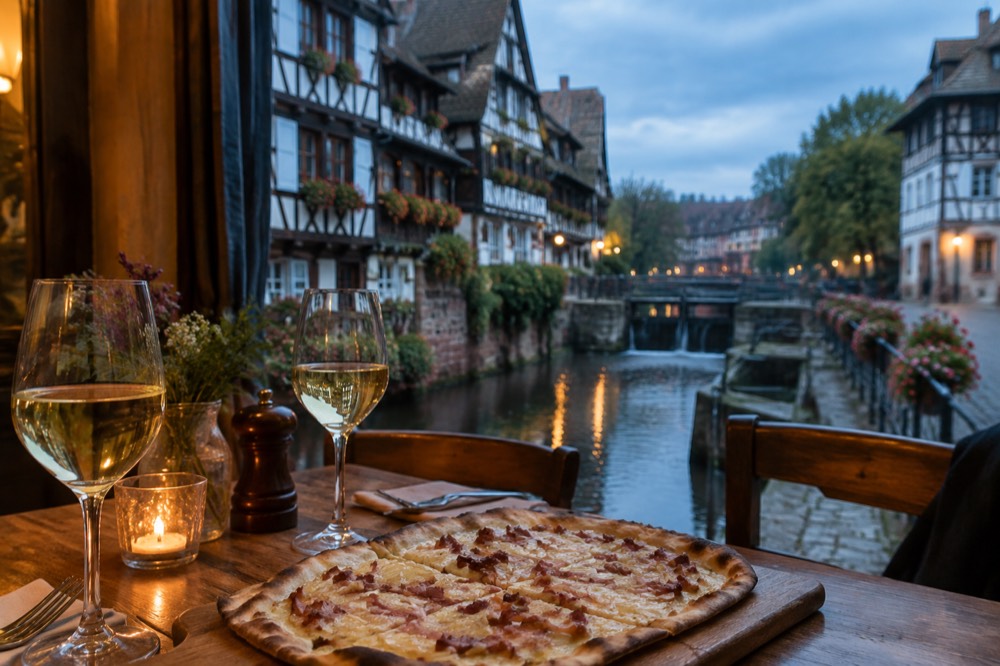
For travellers who prefer the wine side of the region, the tasting-led village day is the other guided pattern worth booking from Strasbourg, and it sits naturally as the day after the summit. The medieval-villages itinerary below is the one this site features for that pattern, and its live listing carries the current departure details and the tasting inclusions.
One last planning note for winter visitors: the mountain does not close for the season, but the road, the paths and the terrace all change character in snow and ice, and the region's December draw is the Christmas market in Strasbourg itself, which last year's edition ran from 26 November to 24 December and drew 3.05 million visitors. A December trip built around the market can still take a clear-day run up to the summit, but confirm the road status first and keep the market as the anchor of the day.
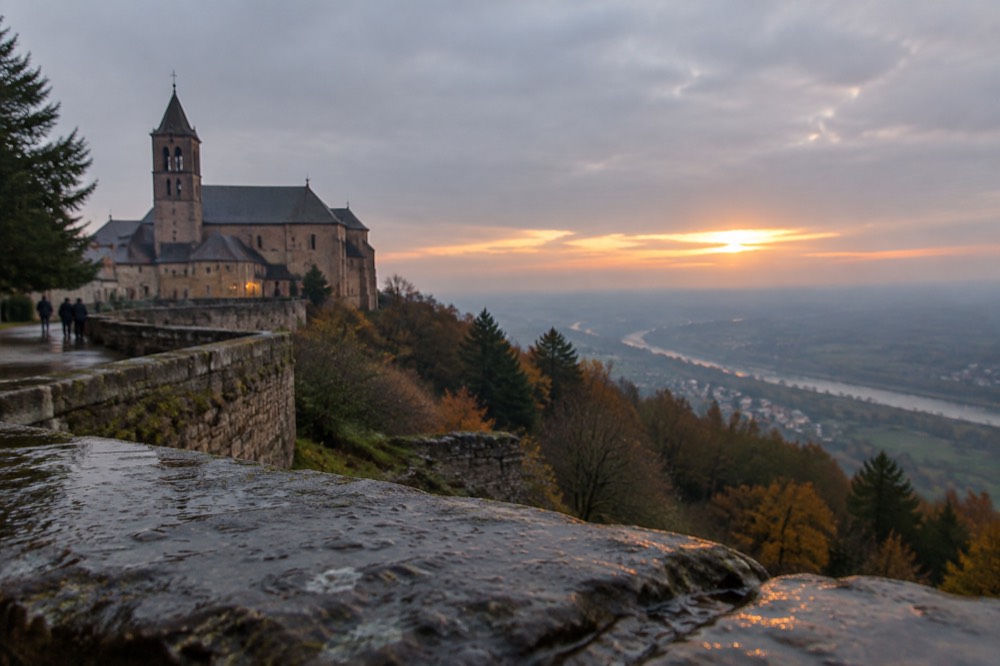
Mont Sainte Odile rewards exactly the kind of traveller who runs out of city: it is the day from Strasbourg that ends with wind, forest and a view that takes in two countries. Pair it with a wine village, give the summit a clear morning, and keep the official pages close for the details that change with the seasons.
Common Questions About Mont Sainte Odile
How do I get to Mont Sainte Odile from Strasbourg?
By road: your own car, a guided day trip covering the Alsace hinterland, or the seasonal public transport options that serve the mountain. There is no train to the summit. The route climbs from the plain through the wine-route foothills around Obernai, and the final stretch is a winding mountain road best driven in daylight. Check the current timetables and access arrangements on the official pages before you travel.
What can you see from the top of Mont Sainte Odile?
From the panoramic terrace you see the plain of Alsace spread below, the line of the Rhine, and, on clear days, the hills of the Black Forest on the German side of the river. Looking back along the ridge, the forested Vosges run south toward the higher summits. The view depends on the weather, so check a mountain forecast rather than the Strasbourg one before committing to the day.
What is the Pagan Wall?
The Pagan Wall is a circuit of large dry-stone blocks that runs through the forest around the summit plateau of Mont Sainte Odile. Its origin and age are still debated by archaeologists, which is part of its fascination. Sections of the wall can be walked on marked forest paths, and the information point on the plateau carries maps of the routes.
When is the best time of year to visit?
Late spring through early autumn on a clear day gives the best combination of an unobstructed terrace view and dry forest paths, and autumn is the season the region speaks well of for colour in the beech woods and the vineyards. Winter visits are possible but the mountain road and paths demand care in ice and snow. The summit is colder and windier than Strasbourg in every season.
Can you visit Mont Sainte Odile on a guided tour from Strasbourg?
This site's roster carries no dedicated summit tour, so the guided route runs through the general Alsace day trips from Strasbourg, which cover the wine villages, the castle country and the foothills by coach. If standing on the terrace with a guide matters to you, look at private arrangements and the seasonal local offers, and check the details on the operator's live listing before booking.
How long should I spend on the mountain?
A slow half day on the summit covers the terrace, the abbey church, the chapel and springs, and a section of the Pagan Wall, and a full day lets you add a proper forest walk and a lunch stop in the foothills on the way up or down. Anything less than half a day turns the visit into a viewpoint stop, which wastes the walking the plateau is built for.