Why Is Strasbourg So Expensive In December?
Why December prices in Strasbourg climb: Christmas market demand, 3.05 million visitors, and which costs stay flat all season.
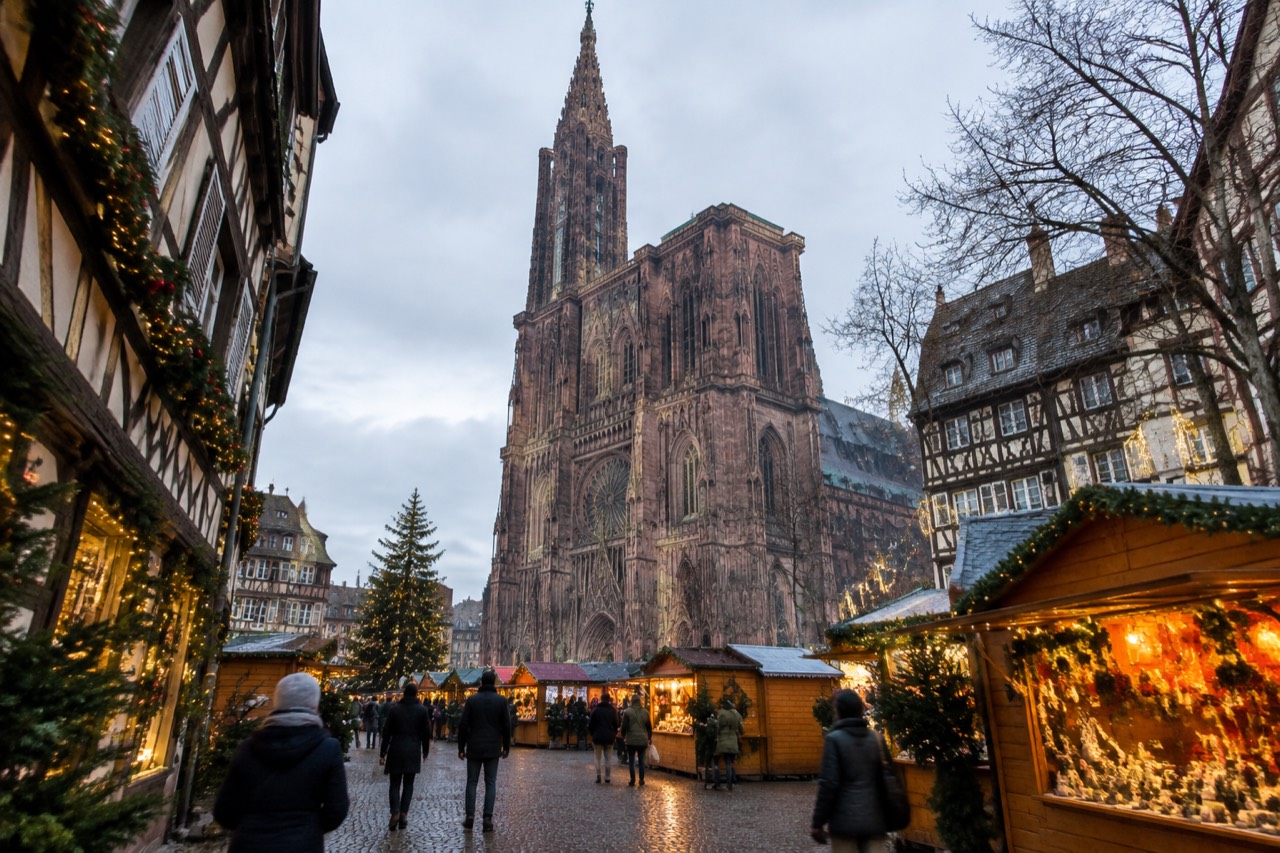
Strasbourg, prefecture of the Bas-Rhin in Alsace, north-eastern France, sits on the River Ill beside the Rhine border with Germany, and for four weeks each winter it becomes one of the most demanded city destinations in Europe. The Christmas market, which the city brands as Strasbourg Capitale de Noël, pulled 3.05 million visitors in the 2025 edition, down from 3.4 million the year before, and that concentration of demand is the short answer to why a December trip costs more than the same trip in March. The longer answer splits into three parts: accommodation pricing that tracks the market calendar, food and drink sold at seasonal stalls, and the fixed, city-run costs that stay identical all year.
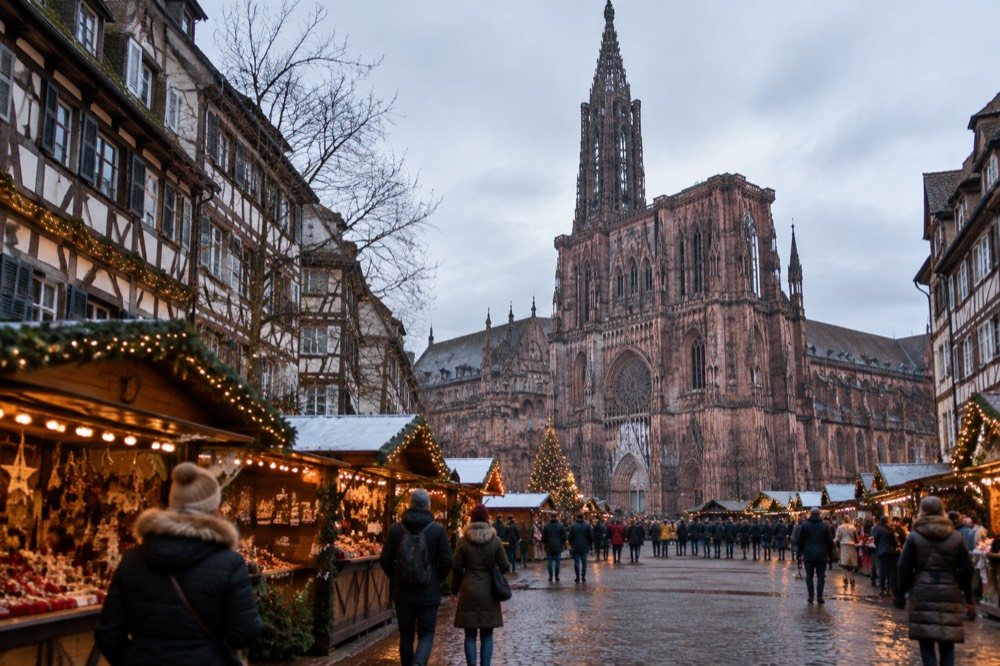
Why Is Strasbourg So Expensive In December?
Strasbourg is expensive in December because the Christmas market compresses a whole year of visitor demand into roughly four weeks, from late November to 24 December, and accommodation, restaurant and stall prices respond to that surge while the city's own sightseeing costs do not. The 2025 edition drew 3.05 million visitors against a resident population of 293,771, so beds, tables and mulled wine sell at seasonal peak rates. Cathedral, museum, boat and tram prices stay flat all month.
The demand math is stark. A city of fewer than three hundred thousand permanent residents, per the INSEE 2023 commune figure, hosts a market season that the city's own press release measured at 3.05 million visitors for the 2025 edition. Every one of those visitors needs a bed for at least one night, and the historic centre, the Grande Île, is a bounded UNESCO-listed island of lanes where new hotel supply cannot simply appear. When a fixed stock of rooms meets a four-week spike, nightly rates climb, so the honest advice is to expect higher rates in market weeks and to compare on the booking platform rather than trust a printed figure.
The second driver is the market itself. The chalets, which typically open late morning and run into the evening, sell food and drink at festival prices: the same tarte flambée costs more at a heated stall on Place Kléber than it does in a winstub two streets away. That is not a Strasbourg peculiarity, it is how seasonal markets work everywhere, but visitors feel it more here because the market is the reason they came and the stalls are where they eat.
To taste your way through the chalets with a guide, book a Christmas market walking tour here.
The third driver is less obvious: December in Strasbourg is genuinely winter. The Meteo-France 1991-2020 normals for Strasbourg-Entzheim give a mean December maximum of 5.9 C and a mean minimum of 0.8 C, with 45.2 mm of rain over 10.2 rain days. Cold, damp weather pushes spending indoors, into restaurants, cafés and covered attractions, and indoor capacity in a medieval quarter is finite. Demand meets a hard ceiling, and the ceiling sets the price.
How The Visitor Surge Sets The Price Of Everything
The Christmas market is the single largest demand event in Strasbourg's year, and it is compressed into about four weeks, which is why December behaves like peak season even though it is midwinter. The 2025 edition drew 3.05 million visitors, and the 2024 edition drew 3.4 million. Hotels, restaurants and market stalls all price against that footfall, while the cathedral, the museums, the boat operator and the tram network keep their standard fares.
It helps to think of Strasbourg in December as two economies running on the same streets. The seasonal economy is the market: chalet food and drink, glühwein cups, ornaments, and the hotel rooms that shelter the people buying them. That economy prices to the calendar, and the calendar peaks from late November to 24 December. The civic economy is everything the city itself runs: the cathedral platform at 10 EUR full and 6 EUR reduced, the astronomical clock show ticket at 4 EUR, the municipal museums at 9 EUR full and 5 EUR reduced, Batorama's boat tours at 16.20 EUR full and 8.90 EUR reduced on the long circuit, and the CTS tram single at 1.90 EUR bought in the app or by contactless and 2.50 EUR bought on board the bus. None of those figures carries a December supplement. A family can spend a full day on civic prices that barely differ from a February Tuesday.
The pressure point between the two economies is capacity. The Grande Île holds a finite number of restaurant tables, and the winstubs, the Alsatian taverns serving choucroute and baeckeoffe, fill early in market weeks. When tables are scarce, the value of a reservation rises, and one practical answer is a guided food walk, which builds the restaurant stops into a booked itinerary. The Traditional Food Walking Tour with Tastings does exactly that across about three and a half hours, and you can Check availability alongside reading the site's fuller take on where locals eat in Strasbourg.
Why Hotel Rates Spike In Christmas Market Weeks
Hotel rates spike because the market calendar concentrates demand into the weeks from late November to 24 December, and Strasbourg's room stock in and around the Grande Île cannot expand to meet it. Expect the highest rates of the year in market weeks, a drop in early December weekdays, and a reset after 24 December. The city's own attendance figures show what the beds are competing to absorb.
The verified numbers explain the shape of the curve. The 2025 edition ran 26 November to 24 December 2025 and drew 3.05 million visitors; 2024 drew 3.4 million. Those are season totals, not nightly occupancy, but they describe a city absorbing a visitor flow roughly ten times its resident population across a single month. The official 2026 dates are not yet published, and the city's Christmas site states that the dates and programme are still being finalised, so any booking should follow the pattern rather than a printed date: late November opening, 24 December close, and confirmation on the city's own Christmas pages.
Within the season, the pressure is uneven. Weekends in December carry the heaviest load, because the market is a short-break destination for travellers from across France, Germany and Switzerland, and the opening week and the final week before Christmas both draw crowds that midweek dates in early December do not. A traveller with date flexibility can cut accommodation cost sharply by arriving on a Monday or Tuesday in the first half of December, and the market experience is the same market. The trade-off is weather: December averages a mean maximum of 5.9 C and 10.2 rain days of 1 mm or more, so the cheaper dates are also the damper ones.
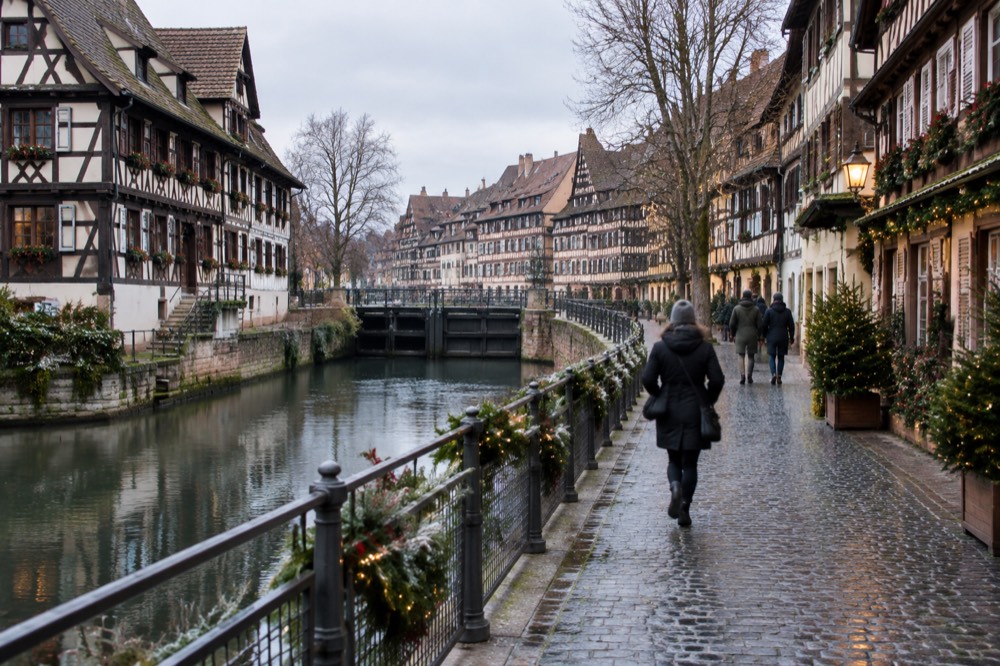
Where you sleep also matters more than in a spread-out city. Petite France, the former tanners' quarter at the western tip of the Grande Île, puts you inside the postcard, and the site's guide to where to stay in Petite France covers the trade-offs; rooms there carry the December premium at its fullest because the quarter is small, walkable and photographed endlessly. Staying a tram ride out, near the station district or across the river in Neustadt, trades atmosphere for a lower rate and a 1.90 EUR single ticket into the centre.
What December Actually Costs On The Ground
The fixed, city-run costs of a Strasbourg day do not rise in December at all: the cathedral platform is 10 EUR full and 6 EUR reduced, the astronomical clock show is 4 EUR, municipal museums are 9 EUR full and 5 EUR reduced, and the tram network charges the same fares it charges in July. What rises is everything sold at the market and everything booked by the room. A visitor who splits spending between the two can hold a December budget close to an off-season one.
The table below sets out the verified civic prices, the ones that do not move in December, against the transport fares that get you between them. These are the numbers worth memorising, because they are the floor under any December day in the city. Everything else covered here is indexed on Strasbourg Travel Guide.
| Cost | Full price | Reduced price | December change |
|---|---|---|---|
| Cathedral platform (66 m) | 10 EUR | 6 EUR (children 6-18, students) | None |
| Astronomical clock show, 12:30 daily | 4 EUR | 3 EUR (groups of 12+, students to 25), 2 EUR (children 6-17) | None, day-of tickets only |
| Municipal museums (each) | 9 EUR | 5 EUR | None; free first Sunday of the month |
| Pass Musées, 1 day | 20 EUR | 20 EUR | None |
| Strasbourg City Card, 7 days | 5 EUR | 3.50 EUR (child 3-17) | None; a discount card, not a pass |
| Batorama long tour (1h10) | 16.20 EUR | 8.90 EUR | None |
| Batorama short tour (0h45) | 12.50 EUR | 7.20 EUR | None |
| CTS single tram/bus ticket | 1.90 EUR (app, contactless) | 2.50 EUR on board the bus | None |
| CTS 24h Solo pass | 4.60 EUR | 4.60 EUR | None |
| CTS 24h Trio pass (2-3 people) | 10.20 EUR | 10.20 EUR | None |
Two of those rows deserve a second look. The Strasbourg City Card is a 5 EUR discount card valid for 7 days, not an all-inclusive pass: it takes money off museums, the boat tour, the cathedral platform and the clock, so it pays for itself within a day of sightseeing but it does not prepay anything. And the free first Sunday of every month at all municipal museums falls inside the market season if your dates align, which turns a 9 EUR ticket into a free one at the Musée des Beaux-Arts or the Musée de l'Œuvre Notre-Dame. One museum is off the table either way: the Musée Alsacien is closed for works until 2028, and no December itinerary should route through it.
The clock deserves its own note because it is the one fixed cost with a genuine December constraint. Tickets are sold on the day only, at the cathedral stalls or the Saint-Michel entrance, and the show is at 12:30 sharp. In market weeks the queue logic tightens, so the fixed price is best treated as a morning errand rather than an afternoon impulse.
Why Food And Drink Prices Climb At The Market
Prices climb at the market because the chalets are temporary businesses with unusually high costs: they operate for only about a month, in heated and decorated wooden structures, with staff and stock brought in just for the season, all to serve visitors who have travelled specifically to spend. That is why a tarte flambée costs more at a chalet than in a winstub, and why mulled wine comes with a deposit on the mug.
The winstub is the escape valve. These taverns serve the Alsatian canon, choucroute, baeckeoffe, kougelhopf, year-round at menu prices that do not carry a Christmas supplement, and the site's pages on the signature dish of Strasbourg and the winstubs themselves cover what to order. The catch in December is capacity again: the good winstubs fill, they fill early, and a party of four walking in at 20:00 on a Saturday in market weeks may not be seated at all. A booked table or a booked food walk converts scarcity into certainty.
The food-tour option is worth spelling out because it solves two December problems at once. A guided tastings walk secures the restaurant stops and prices the evening before arrival, which matters when the alternative is queueing in 5.9 C mean-maximum weather. For travellers weighing the whole season, the site's answer to whether December is a good time to visit Strasbourg runs the full trade-off.
How To Visit Without Paying December Peak Rates
The reliable ways to cut a December budget are timing and geography: arrive midweek in early December rather than a weekend, sleep outside the Grande Île and ride the tram in at 1.90 EUR, eat in winstubs rather than at chalets, and anchor the sightseeing day on the fixed civic prices, the 10 EUR platform, the 4 EUR clock and the 9 EUR museums. None of those tactics depends on luck, and all of them survive the market crowds.
The timing tactic has a hard edge to it. The market pattern runs late November to 24 December, and the 2025 edition's 3.05 million visitors were not spread evenly: weekends and the closing week carry the weight. Early-December weekdays are the soft spot, and the weather is the price of it, with December normals of 5.9 C mean maximum, 0.8 C mean minimum and 10.2 rain days of 1 mm or more. Rain in Strasbourg in December is a planning assumption, not a surprise, and the site's rainy-day guide exists for exactly this.
The geography tactic is the tram. A 24h Solo pass at 4.60 EUR covers a full day of riding, and the 24h Trio at 10.20 EUR covers two to three people, so a family staying a ten-minute ride from the centre spends less on two days of transport than on one chalet dinner. The city's tram network runs through the market season on its normal fares, and the airport link is equally flat: the combined train-plus-tram ticket from Strasbourg Airport is 4.60 EUR, with the shuttle train covering the station run in 8 minutes.
For travellers who want the market experience beyond Strasbourg itself, a booked day trip reframes the cost question. The Alsace Christmas Markets Day Tour from Strasbourg pairs the city with the region's other market towns in one booked, priced itinerary, which converts a day of variable spending into a known figure.
The comparison worth making before booking anything is Strasbourg against Colmar, the other Alsatian market city, because the two split the December crowds and the prices behave differently. The site's answer on which Christmas market is better, Strasbourg or Colmar lays out the choice, and the honest cost summary is that Strasbourg is the bigger draw with the bigger peak, while Colmar is smaller and easier to walk end to end.
Where The Money Goes If You Still Go
A December trip to Strasbourg spends in three layers: the seasonal layer, hotel nights and market stalls, which prices to 3.05 million visitors; the civic layer, platform, clock, museums, boat, tram, which holds its fares all month; and the booking layer, tours and food walks, which you can price and lock before arrival. The expensive city and the affordable one are the same city on the same night, and the difference is which layer you are standing in.
The ones who report it was reasonable usually did the same things at the same stalls. The difference is that the second group booked the fixed layers early, slept a tram ride out, and treated the chalets as the splurge rather than the default. The market is the splurge; it is a good one.
Common Questions About December Costs In Strasbourg
Why is Strasbourg so expensive in December?
Because the Christmas market concentrates roughly a year's worth of visitor demand into about four weeks, from late November to 24 December, and the 2025 edition drew 3.05 million visitors to a city of 293,771 residents. Hotel rooms and market stalls price to that surge, while the cathedral, museums, boat tours and trams hold their standard fares.
When do December prices in Strasbourg peak?
Weekends across the market season and the closing run before 24 December carry the heaviest demand. Early-December weekdays are the softest dates, with the trade-off of colder, wetter weather: December normals give a mean maximum of 5.9 C and 10.2 rain days of 1 mm or more.
Do the cathedral and museums cost more during the Christmas market?
No. The cathedral platform is 10 EUR full and 6 EUR reduced, the astronomical clock show is 4 EUR, and municipal museums are 9 EUR full and 5 EUR reduced, all year round. Municipal museums are free on the first Sunday of every month, and the Musée Alsacien is closed for works until 2028.
Is it cheaper to stay outside the Grande Île in December?
Directionally yes, because the room stock inside the historic island is small and the December premium lands on it hardest. A room near the station or in Neustadt trades atmosphere for a lower rate and a 1.90 EUR tram single, or a 4.60 EUR 24h Solo pass, into the centre.
Are the official 2026 Christmas market dates out yet?
The city's Christmas site states that the official 2026 dates and programme are still being finalised. The pattern is late November to 24 December, with an early evening close on 24 December, and the 2025 edition ran 26 November to 24 December. Confirm the dates on the city's Christmas pages before booking.
Does eating at the market chalets cost more than eating in restaurants?
Chalet food and drink carry festival pricing, since the stalls operate for one month in heated temporary structures. Winstubs keep their normal menus year-round, but they fill early in market weeks, so a booked table or a booked food walk is the reliable way to eat at restaurant prices in December.
The short version of all of it: Strasbourg in December is expensive exactly where you would expect a three-million-visitor market to be expensive, and cheap exactly where a well-run city should be cheap. Book the seasonal layer early, hold the civic layer to its published fares, and the month becomes a great deal more manageable than its reputation suggests.