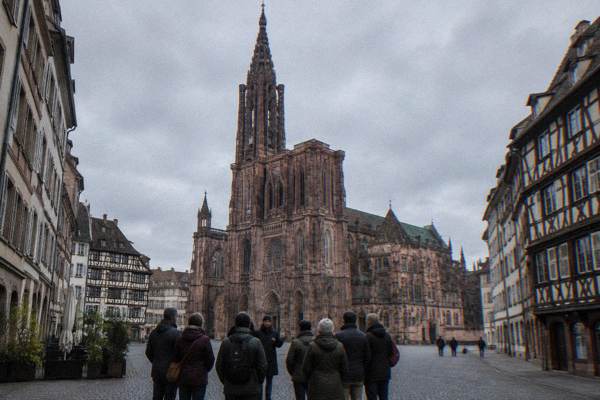
What Is The Real Story Behind The Christmas Tree?
The decorated Christmas tree began as an Alsatian custom, and Strasbourg in north-eastern France turned it into a city tradition; the real story, the ornaments' meanings and how to see the tree today.
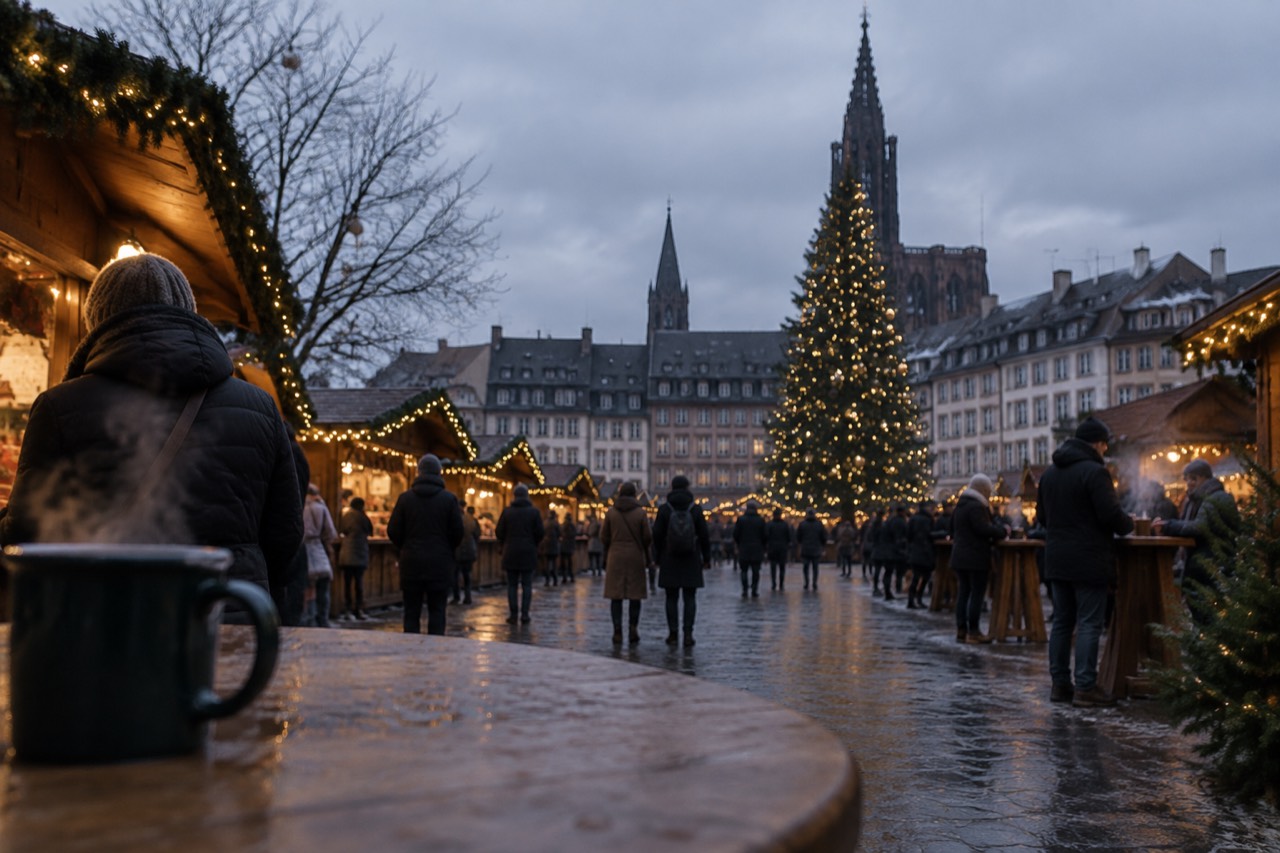
Strasbourg, in Alsace in north-eastern France, is the city that put the decorated fir tree on the map. The custom of bringing a tree indoors and dressing it for Christmas is traced to this region, and Strasbourg's own Christmas market, which runs from late November to 24 December, still raises a great tree on Place Kléber as its centrepiece. The real story behind the tree is older, stranger and more local than the version that travels with it, and it runs through guild halls, forest fir, wax candles and paper roses rather than glass baubles and tinsel.
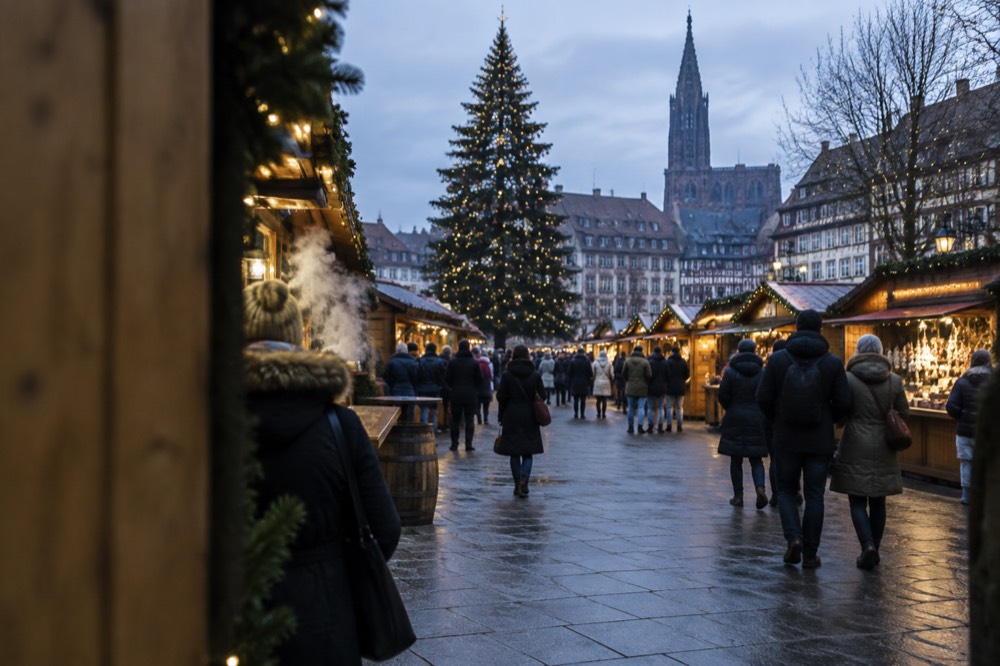
What Is The Real Story Behind The Christmas Tree?
The decorated Christmas tree is an Alsatian tradition. The earliest written records of fir trees dressed for Christmas come from towns in Alsace, the region around Strasbourg, where guilds and prosperous families set up trees in their halls in the medieval period. Strasbourg carried the custom into the modern era, and its Christmas market, running from late November to 24 December each year, still builds the whole season around a great tree on Place Kléber.
The story is a regional one before it is a universal one. Alsace sits on the border between the French and German worlds, and its winter customs drew on both. The fir tree, evergreen through a semi-continental winter that Meteo-France's 1991-2020 normals put at a mean December maximum of 5.9 C, was an obvious symbol of life holding on through the cold months. Dressing it, hanging it with edible and symbolic decorations, and standing it in a guild hall or a family parlour was the Alsatian contribution to the European Christmas.
What travels in the popular version of the story is often a compressed tale: a tree, a prince, a German court, and a sudden fashion that spread across the world. The documented record is humbler and older. Towns across Alsace, including Sélestat south of Strasbourg, whose humanist library preserves the earliest written mentions of decorated trees, were describing the custom while much of the rest of Europe had never seen a tree indoors at Christmas. Strasbourg, as the region's great city, gave the tree an audience, a market and eventually a stage the size of a main square.
The Strasbourg Travel Guide editors keep this page focused on the tree itself. For the wider season, the Strasbourg Christmas market guide covers the squares, the food and the timings, and the Christmas markets in Alsace guide spreads the same story across the region's smaller towns.
Where Did The Decorated Fir Tree Begin?
The decorated fir tree began in the towns and guild halls of Alsace. Written records from the region describe fir trees set up and decorated for Christmas in the medieval period, a custom that began in corporate and family settings before it reached public squares. Strasbourg's market, which drew 3.05 million visitors in its 2025 edition, is the direct descendant of that indoor Alsatian tree.
The custom grew out of the guilds. In the medieval Alsatian towns, trade associations marked the Christmas season with feasts in their halls, and a decorated fir stood at the centre of the celebration. The decorations were not toys but symbols: apples from the harvest, wafers stamped for the occasion, and later candles whose light stood in for the season's scarcity of sun. A tree that could only be cut in the forest and carried indoors was an expense, and that expense is part of the record too: early accounts note rules limiting how large a tree could be cut, a sign the custom was popular enough to need restraining.
From the guild halls the tree moved into wealthy homes, and from homes into the streets. Strasbourg's Christmas market, one of the oldest city markets in Europe, gave the tree a public role it had never had indoors. The market's 2025 edition ran from 26 November to 24 December and the city's press release put attendance at 3.05 million, down from 3.4 million in 2024. Those numbers describe a market, but the tree is what the market is arranged around.
The Alsatian claim is not just a matter of pride; it is a matter of documents. The region's libraries hold the earliest written descriptions of the custom, and the tradition spread outward from the Upper Rhine valley along trade routes, first through German-speaking lands and later, by way of royal marriages and fashionable courts, across Europe and beyond. Every plastic fir in a shopping mall descends from a forest tree cut in a valley like this one.
| Alsatian tree custom | What it involved | Where it lived |
|---|---|---|
| The guild tree | A fir erected in a guild hall for the Christmas feast, hung with apples and wafers | The towns of Alsace, including Strasbourg and Sélestat |
| The family tree | A smaller dressed fir in the parlours of prosperous households | Alsatian towns, spreading outward over the centuries |
| The market tree | A large public tree as the centrepiece of the city Christmas market | Place Kléber in Strasbourg |
| The forest rule | Limits on cutting fir for Christmas, an early sign of the custom's reach | The forests of the Vosges foothills |
Seeing the tree tradition on the ground rather than in a library is easier with a guide, and the roster carries several ways to do it.
To see where the tree's story still plays out each December, book a free walking tour here.
How Strasbourg Made The Tree Its Own
Strasbourg turned the Alsatian tree into a civic monument. The city's Christmas market, one of the oldest in Europe, adopted the decorated fir as its public centrepiece, and today a great tree stands on Place Kléber through the season. The city brands itself around Christmas, and the tree on the main square is the single object that carries that brand.
The move from private tree to public tree is the part of the story Strasbourg owns. Once the custom had spread through homes, the city market gave it a stage. A tree on the main square belongs to everyone at once: it needs no guild membership and no parlour, and it turns a whole neighbourhood into the room where the tree stands. Place Kléber, the largest of the city's central squares and the site of the Strasbourg Christmas market's principal tree, is where that idea plays out each December, with the market's chalets arranged around the tree rather than the tree added to the chalets.
The city has kept the tradition through every political change the region has absorbed. Alsace has changed hands between France and Germany across the centuries, and the Christmas tree travelled with the region's culture rather than with its flag. When Strasbourg rebuilt its identity after the Second World War, the tree and the market were part of what the city put at the centre of itself. The city's modern self-presentation as a Christmas capital is built on that continuity, and the annual tree on Place Kléber is its proof.
The season is not a small affair. The 2025 edition drew 3.05 million visitors across a market that ran from 26 November to 24 December, and the city's own bilan counts the tourist office's welcome desk at 66,001 visitors in December 2025 alone. The 2026 dates are not yet published; the city's Christmas site states that the dates and programme are still being finalised, and the usual pattern runs from late November to 24 December. Anyone planning around the tree should confirm the dates on the city's Christmas site before booking anything.
For visitors who want the tree and the lights in one sweep, a guided loop of the city is the efficient option.
What The Ornaments Originally Meant
The first tree ornaments were edible and symbolic, not decorative in the modern sense. Alsatian trees carried apples, wafers, candles and paper roses, each tied to the season's meaning: harvest, communion, light in darkness and paradise regained. The glass bauble arrived later as an imitation of the apple, and the modern tree is a descendant of that substitution.
The apple is the oldest ornament and the one with the clearest meaning. It recalls the paradise plays that medieval towns performed at Christmas, in which the tree of the garden stood on stage hung with fruit. The decorated fir is in part a domestic version of that stage tree: a paradise tree in the parlour. The wafer, stamped and hung alongside the apple, brought the communion table onto the same branch. Together they made the tree a small theology lesson that a household could assemble in an afternoon.
Candles came next, and they changed the tree's character. A tree lit by flame is a different object from a tree hung with fruit, and the candle-lit tree is the image that spread across Europe in prints and engravings. Wax and light were expensive, which kept the custom tied to prosperity for a long time. Paper roses and sugared sweets widened it, and the glass bauble, first made in the region as a substitute for the apple in years when the harvest failed or the price of fruit ran high, completed the transformation. The shiny spheres on a modern tree are apples in glass, and the story of the tree is in that substitution.
| Original ornament | What it stood for | What replaced it |
|---|---|---|
| Apple | The tree of paradise from the medieval Christmas plays | The glass bauble |
| Wafer | The communion bread of the season | Sugar biscuits and gingerbread |
| Candle | Light returning in the darkest month | Electric lights |
| Paper rose | The flower of paradise in midwinter | Artificial flowers and ribbon |
| Nuts and sweets | The wealth of the harvest stored for winter | Wrapped chocolates |
The tree's meanings survive in Strasbourg's market food as much as in its decorations. The Strasbourg Christmas market food guide follows the edible side of the tradition, from the treats hung on branches to the dishes sold around them, and the tarte flambée and kougelhopf pages trace the baking that shares the season with the tree.
The best way to feel how compact the tree's city is, from the Place Kléber tree to the half-timbered streets around the cathedral, is on wheels. The guided bike tour with a local guide loops the Grande Île and the river banks, and the guide's commentary covers the squares where the custom took its public form.
How To See The Strasbourg Tree Today
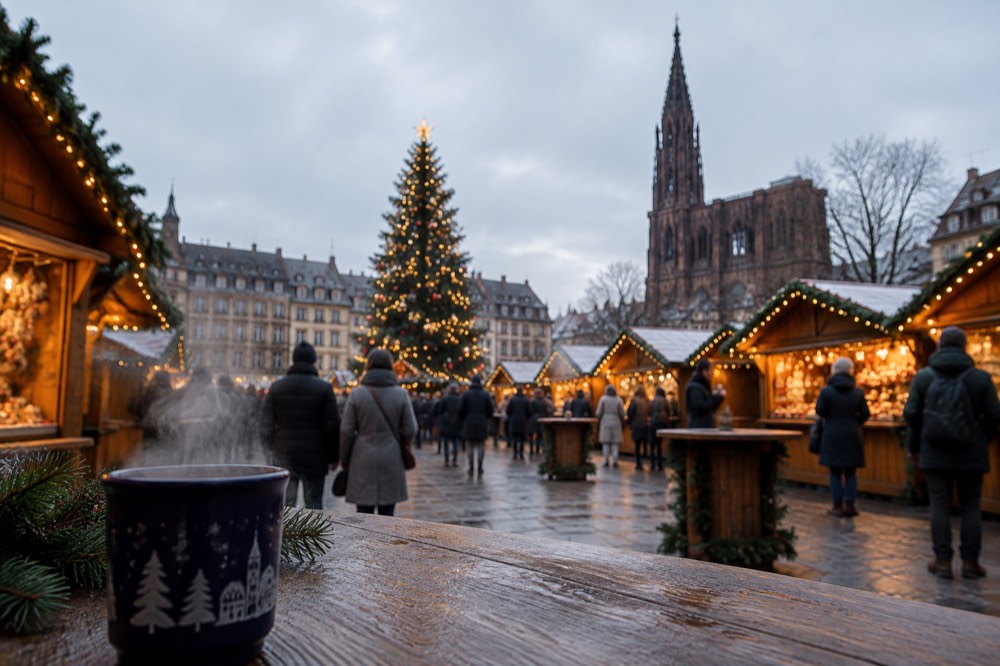
The modern Strasbourg tree stands on Place Kléber through the Christmas season, which runs from late November to 24 December. The cathedral, the astronomical clock and the market squares all sit within a short walk of it, and a single CTS day pass at 4.60 EUR covers the trams and buses between them. Plan around the 24 December early close.
The practical shape of a tree visit is simple. The tree and the market chalets cluster on and around Place Kléber, with the cathedral a few streets away. The cathedral's nave is open Mon-Sat 08:30-11:15 and 12:45-17:45, and on Sundays from 14:00 to 17:15; during the market the cathedral is open continuously Mon-Sat on the Place du Château side, 08:30-17:45. The astronomical clock show runs daily at 12:30, with tickets at 4 EUR bought on the day only. The tower platform, at 66 m, costs 10 EUR full and 6 EUR reduced, with hours split by season: 09:30-13:00 and 13:30-20:00 from April to September, 10:00-13:00 and 13:30-18:00 from October to March.
Getting between the squares is cheap. A CTS single ticket is 1.90 EUR through the Badgéo card, the CTS app or contactless payment, or 2.50 EUR bought on board a bus. The 24h Solo pass is 4.60 EUR and the 24h Trio, covering two or three people together, is 10.20 EUR. For anyone arriving from the airport, the combined train, tram and bus ticket is 4.60 EUR and the shuttle train covers the line to the central station in 8 minutes.
| What | Figure | Note |
|---|---|---|
| Cathedral nave, Mon-Sat | 08:30-11:15 and 12:45-17:45 | Continuous 08:30-17:45 on the Place du Château side during the market |
| Astronomical clock show | 12:30 daily, 4 EUR | Tickets on the day only, no reservations |
| Tower platform | 10 EUR full, 6 EUR reduced | Platform at 66 m, under 6 free |
| CTS 24h Solo pass | 4.60 EUR | Single ticket 1.90 EUR, or 2.50 EUR on board |
| Market season | Late November to 24 December | 2025 edition ran 26 November to 24 December; confirm 2026 dates on the city's Christmas site |
For a different angle on the tree, the river gives one. Batorama's boat tours pass the Grande Île from the water, with the long tour at 16.20 EUR full and 8.90 EUR reduced, the short tour at 12.50 EUR and 7.20 EUR, and durations of 1h10 for the Red Tour and 0h45 for the Blue Tour. The Strasbourg boat tour guide compares the circuits in detail.
The segway option pairs well with the lights. The guided segway tour covers the same riverside and old-town ground on a shorter loop, and it runs in the evening hours when the tree and the chalet streets are lit.
Anyone weighing the season itself should also read whether the Christmas market in Strasbourg is worth it, how many days to give it in the Christmas markets planning answer, and how the city compares with its rival in the Strasbourg or Colmar Christmas market answer.
The three tours above cover the tree's city in three different rhythms, from a segway sweep to a guided bike loop.
Common Questions About The Christmas Tree Story
What is the real story behind the Christmas tree?
The real story is that the decorated fir tree began as an Alsatian custom, recorded first in the towns around Strasbourg, where guilds and families dressed fir trees with apples, wafers and candles for the Christmas season. Strasbourg carried the tree from private halls to the public square, and its market still centres the season on a great tree on Place Kléber.
Did the Christmas tree start in Strasbourg?
The custom started in the region, not in one city. The earliest written records come from Alsace, including towns south of Strasbourg such as Sélestat, while Strasbourg gave the tree its public stage through its Christmas market. The honest answer is that the tree is Alsatian and Strasbourg made it famous.
Why do we put apples and lights on Christmas trees?
Apples recall the paradise tree of the medieval Christmas plays, and wafers hung beside them brought the communion table onto the branch. Candles stood for light returning in the darkest month of a semi-continental winter. Glass baubles later replaced the apple, and electric lights replaced the candles, but the meanings carried over.
Where is the big tree in Strasbourg?
The principal tree stands on Place Kléber, the largest of the city's central squares and the heart of the Strasbourg Christmas market. The market's chalets are arranged around it, and the cathedral, the astronomical clock and Petite France all sit within a short walk.
When can I see the Strasbourg Christmas tree?
The season runs from late November to 24 December. The 2025 edition ran 26 November to 24 December, and the 2026 dates are not yet published; the city's Christmas site states the dates and programme are still being finalised, so confirm them there before booking travel.
Is the Christmas tree tradition German or French?
It is Alsatian, which is both and neither. Alsace has moved between French and German rule across the centuries, and the tree custom belongs to the region's own culture rather than to either state. Strasbourg, French today and German-speaking for long stretches of its past, is the clearest illustration of that dual inheritance.
The tree on Place Kléber each December is the end of a story that started with a fir cut in an Alsatian forest and hung with apples, and the city that stages it is the same one that wrote the custom down.