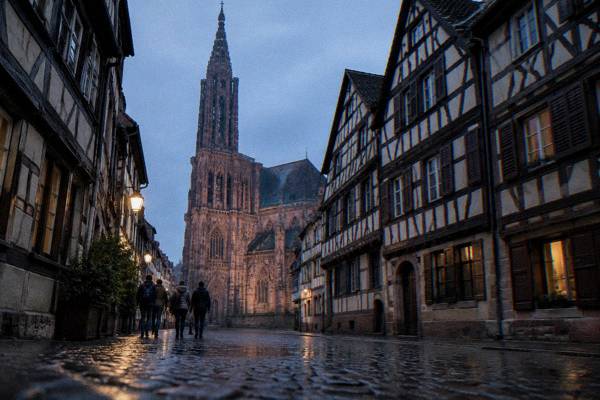
Eglise Saint Thomas Strasbourg
The Eglise Saint Thomas sits a short walk from Strasbourg Cathedral in the heart of Alsace, north-eastern France, and it is the city's great Protestant church: austere outside, startling inside, and easy to fold into a morning in the Grande Île.
Short answer
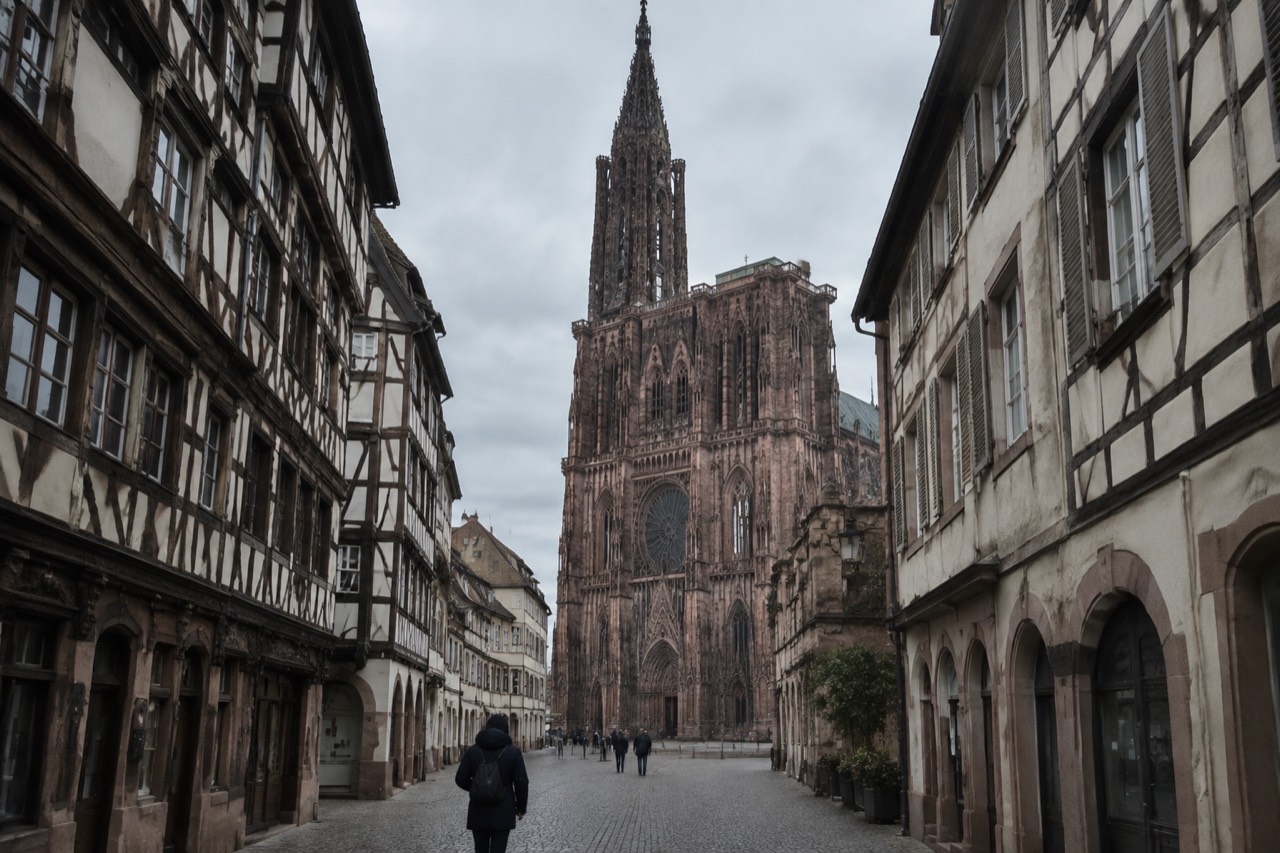
The Eglise Saint Thomas is a historic Protestant parish church of pink sandstone in central Strasbourg, France, standing a few minutes from the cathedral on the Grande Île. It is known for its cavernous five-aisle interior, its historic pipe organ and a celebrated reclining tomb monument. Check the parish's own page for opening times and any admission arrangements before you go.
Strasbourg, in Alsace, north-eastern France, keeps its fame in two colours: the pink sandstone of its cathedral and the half-timbered warmth of its riverside quarters. The Eglise Saint Thomas belongs firmly to the first family. This is a huge Protestant parish church standing on its own quiet square between the cathedral and the Ill, and for travellers who have already stood under the cathedral's nave it offers something the cathedral cannot: an interior you can read at your own pace, with an organ gallery, a famous reclining tomb monument and a vast hall of columns that feels closer to an Alsatian barn than to a French Gothic sanctuary. This guide sets out what the church is, what you actually look at inside, how to reach it by tram, how it compares with Strasbourg's other historic churches, and how to fold it into a day built around the Grande Île and the cathedral.
What Is The Eglise Saint Thomas In Strasbourg?
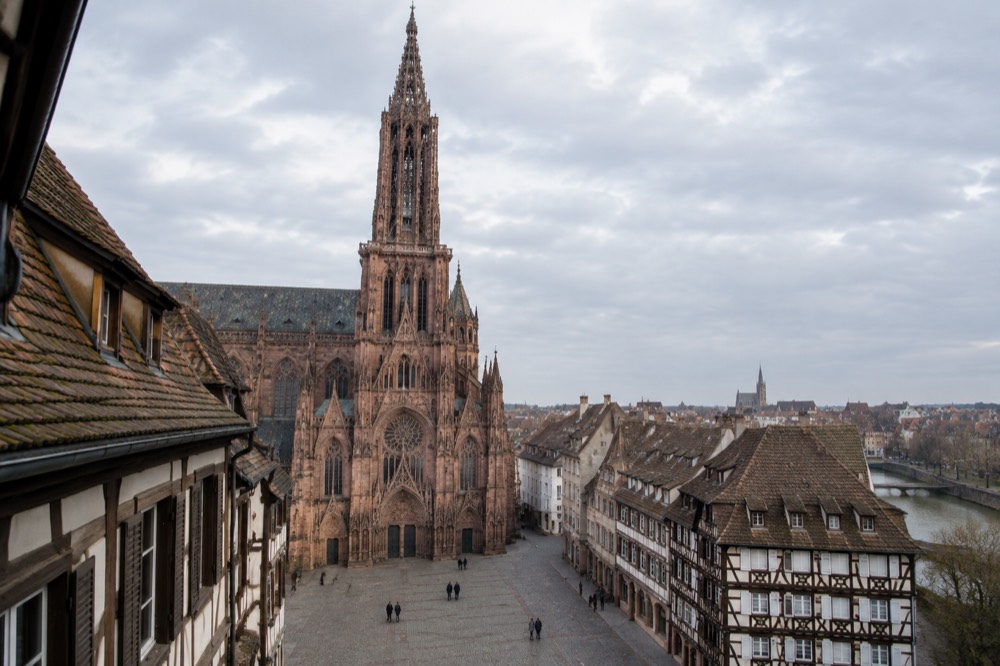
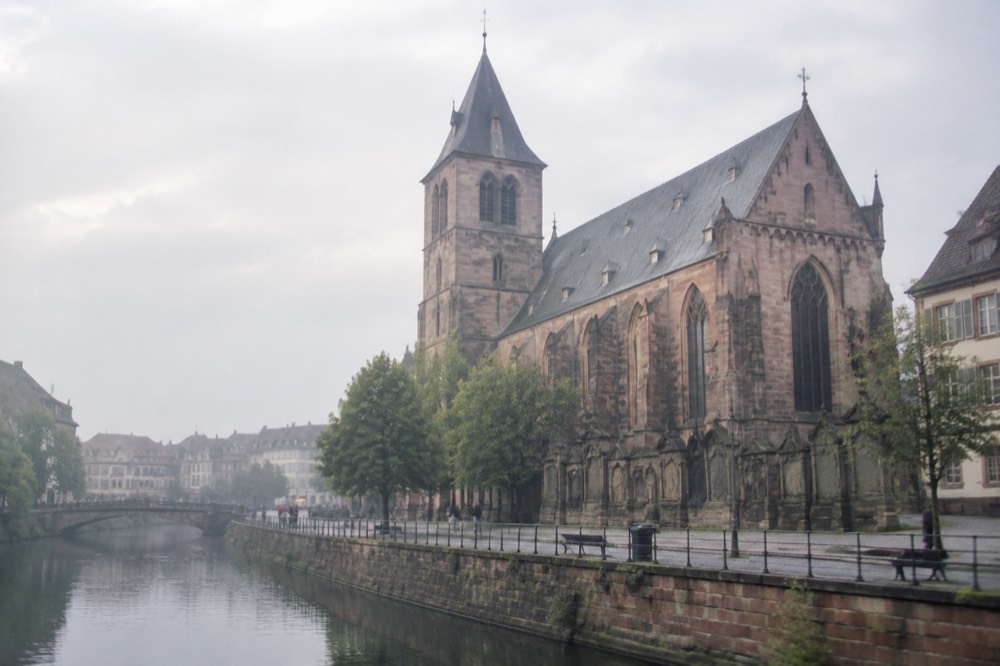
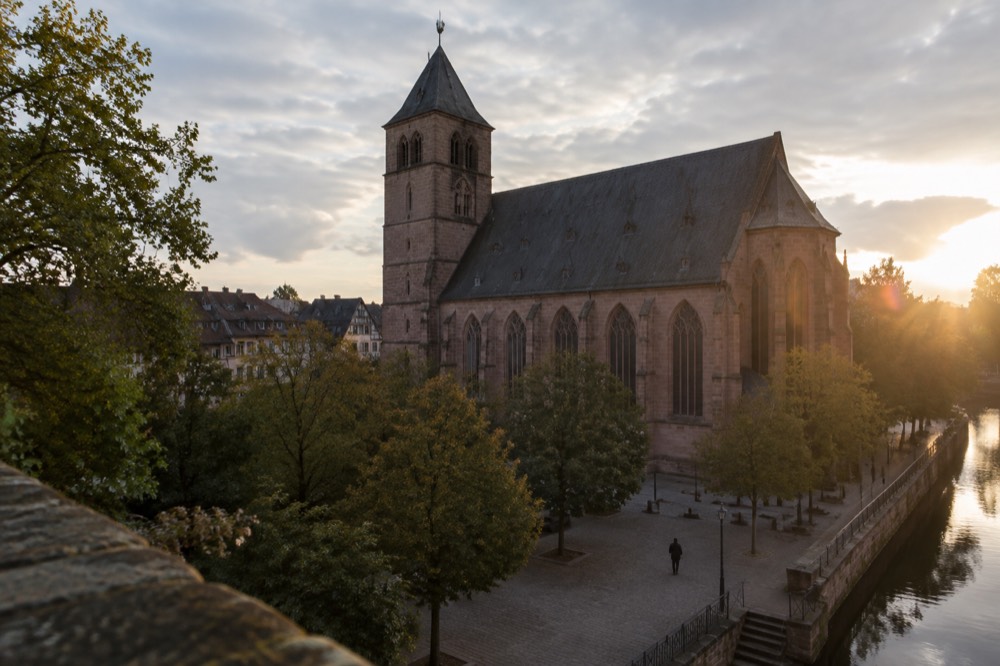
The Eglise Saint Thomas is the principal Protestant parish church of central Strasbourg, France, a medieval hall church of pink sandstone that locals have long called the city's Protestant cathedral. It stands on Place Saint-Thomas, a low-walled square between the cathedral and the River Ill, and its five-aisle interior, historic pipe organ and monumental reclining tomb make it one of the most rewarding church interiors in Alsace. It is a working parish church rather than a ticketed museum, which shapes the whole visit: you come during opening hours, you move quietly, and you check the parish's own page for service times that close the building to sightseers. The church's denomination matters to its look. Where Strasbourg's Catholic cathedral fills its nave with side chapels and gilded detail, Saint Thomas is a Lutheran preaching hall, built around the word rather than the altar, and the effect is a single enormous room where the eye travels straight down the aisle to the pulpit and the organ above it.
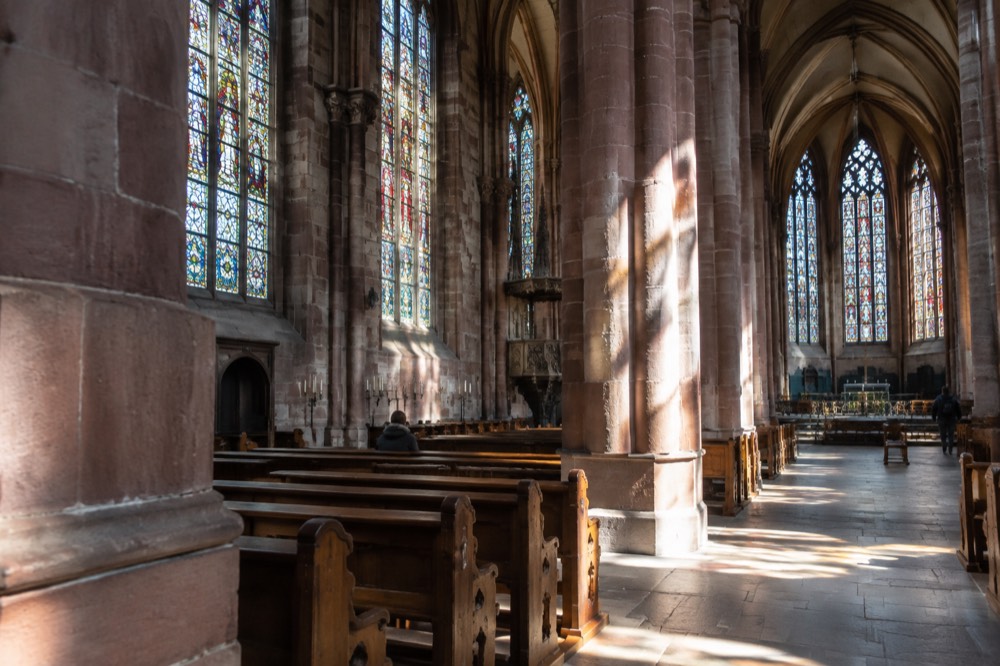
The building's character comes from that Protestant logic. The interior is a "hall church" arrangement, meaning the side aisles rise almost as high as the central nave, so the space reads as one wide, bright hall rather than a soaring central vessel with dim flanks. Light falls through clear and stained glass onto pale stone columns, and the walls carry epitaphs and memorial tablets, a Lutheran tradition of commemoration that gives the church something of the feel of a family album in stone. The organ is the other headline. The church's historic pipe organ is celebrated across Alsace, and it still serves services and recitals; the parish's own pages list the concert programme, and a recital is one of the better ways to hear the building rather than merely see it.
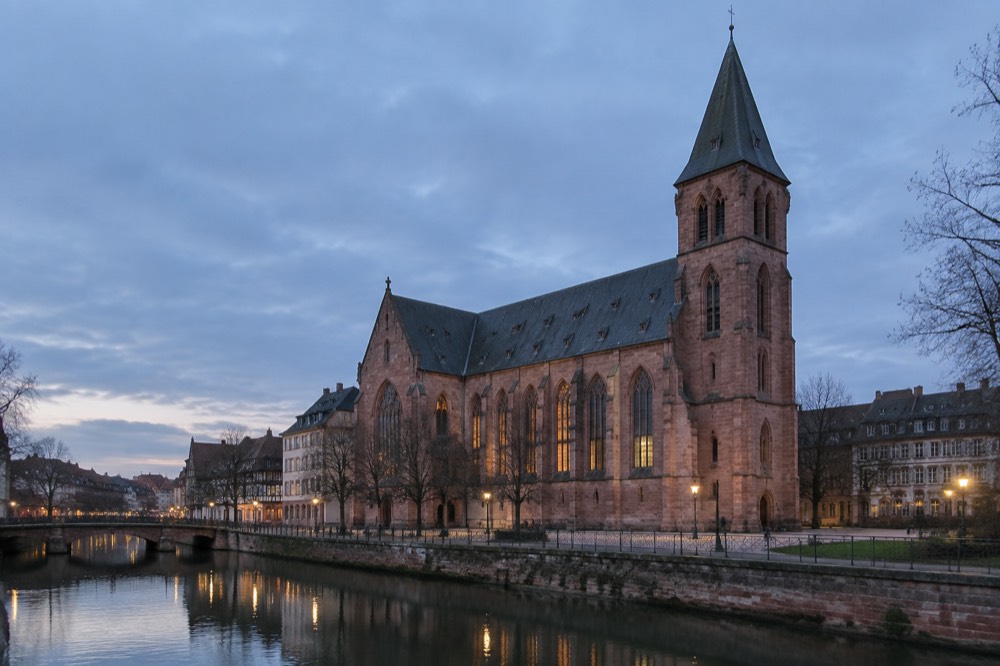
For planning purposes, treat the church as a stop of half an hour to an hour. There is no queue culture here, no timed entry, nothing to book ahead. You walk in, you let your eyes adjust, and you work through the interior at the pace of a parish visitor. What follows in this guide is built around that simplicity: what to look at, when to come, and how to pair Saint Thomas with the paid sights of the same quarter.
| Aspect | What to expect | What to check before you go |
|---|---|---|
| Type of site | Working Protestant parish church, not a ticketed museum | Parish page for opening hours |
| Setting | Place Saint-Thomas, between the cathedral and the Ill | Any service times that close sightseeing |
| Interior | Five-aisle hall church, pale columns, memorial tablets | Whether a recital is scheduled |
| Headline sights | Historic pipe organ, monumental reclining tomb | Photography rules during services |
| Visit length | Roughly half an hour to an hour | Nothing to book in advance |
| Admission | Arrangements are set by the parish | Parish's own page |
Why Visit Saint Thomas When The Cathedral Is Nearby?
Because the two buildings answer different questions. Strasbourg Cathedral, a short walk away, is the overwhelming Gothic statement of the city, with its single spire, its platform at 66 m and its astronomical clock; the Eglise Saint Thomas is where you slow down. It has no platform to climb and no automaton show, so the visit costs nothing in logistics, and its hall interior, organ and tomb monument give you something the cathedral's vast nave does not: a space built to human scale that still takes your breath away. The pairing works especially well for travellers who find big-ticket sights exhausting. You do the cathedral in the morning, with the platform ticket at 10 EUR full price or 6 EUR reduced and the 12:30 astronomical clock show at 4 EUR, then walk over to Saint Thomas and let the contrast do the work. One building is vertical theatre; the other is a room you sit in.
The cathedral's own numbers frame the day. The nave is open Monday to Saturday from 08:30 to 11:15 and 12:45 to 17:45, and on Sundays and feast days from 14:00 to 17:15, hours published on the cathedral's own hours page. The tower platform keeps seasonal hours: from 1 April to 30 September it runs 09:30 to 13:00 and 13:30 to 20:00 with the last ascent at 19:15, and from 1 October to 31 March it runs 10:00 to 13:00 and 13:30 to 18:00 with the last ascent at 17:15. Children under 6 climb free, and the platform ticket also gives a reduced rate at the Musée de l'Œuvre Notre-Dame, which sits right on the cathedral square. That museum, at 9 EUR full price and 5 EUR reduced as one of the municipal museums, holds the cathedral sculpture that the weather has retired indoors, and it makes a natural third stop on the same walk.
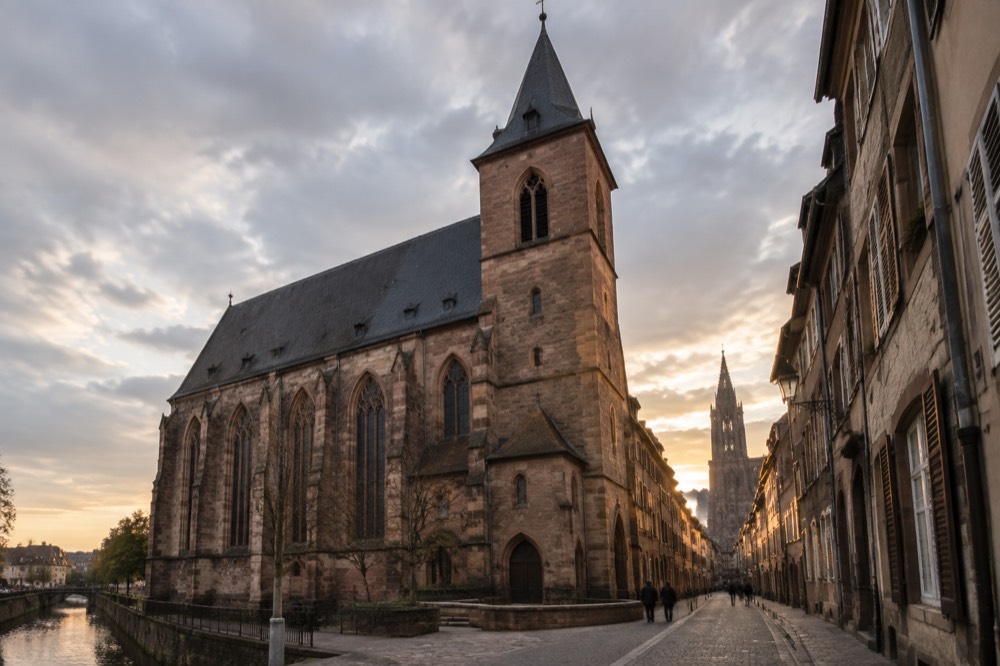
Saint Thomas also earns its place for a quieter reason: the square around it is one of the calm patches of the Grande Île. The streets between the cathedral and the Ill carry far less footfall than the riverside lanes of Petite France, and the church's walled square, with its trees and its low surrounding buildings, is a place where a long trip finally stops moving. Travellers who string together the cathedral, the clock show, the platform and the museum often need exactly such a pause, and the church provides it without a ticket or a queue. If you are travelling with a guide anyway, the guided formats below cover the historic centre's church architecture in one sweep, with the pricing, ratings and durations rendered on the operator's live listing.
What Can You See Inside The Church?
The interior rewards three things above all: the hall of columns, the historic pipe organ on its gallery, and the monumental reclining tomb that anchors one side aisle. The hall is the architecture; the organ is the sound; the tomb is the sculpture. Around them the walls carry rows of stone epitaphs and memorial tablets from Alsatian parish families, and the clear glass of the windows floods the whole space, so the visit is less about hunting highlights than about standing in one large, luminous room and reading it slowly. Give the organ gallery time. Even silent, it is the visual centre of the church, a great wooden case above the west end, and if the parish calendar lists a recital during your stay, an hour of organ music in this hall is one of the distinctive experiences of a Strasbourg trip. The tomb monument is the sculptural draw. It is a large figure surrounded by attendant forms, a work of funerary sculpture that travellers often compare, in scale and ambition, with pieces in far larger museums, and it sits within easy view of the aisle rather than behind barriers.
The memorial tablets deserve their own sentence or two. Lutheran churches of this kind commemorate their parish in stone, and at Saint Thomas the tablets line the walls in ranks, each with its inscription, its coats of arms and its weathered lettering. They turn the church into a record of the Alsatian families who worshipped here across the centuries, and they are the reason the interior feels inhabited rather than curated. Bring the detail into your visit deliberately: walk one side aisle slowly, tablet by tablet, and you will have seen a side of Strasbourg that the cathedral square never shows.
Practical notes are few but real. Photography is generally welcomed in visiting hours, but a service or a recital changes the rules, and quiet is the default either way. There are no lockers or facilities to speak of, and nothing that needs booking. If you want the building explained rather than simply seen, the guided walks and tours later in this guide include the historic centre's churches, and the operator's live listing carries the current details.
How Does Saint Thomas Compare With Strasbourg's Other Historic Churches?
Strasbourg's historic churches split cleanly by role. The cathedral is the Gothic showpiece with the paid platform and the clock; the Eglise Saint Thomas is the great Protestant hall with the organ and the tomb; the Eglise Saint-Pierre-le-Jeune carries remarkable medieval frescoes in a smaller frame; and the Eglise Saint-Paul, south of the centre, is the one you photograph from the water. Each keeps its own hours, and each rewards a different kind of visitor. The comparison matters because a first trip tempts you to see everything, and the churches of the Grande Île are close enough that overdoing them is a real risk. Two churches in a morning is a sensible pace, three is the ceiling, and the pairing that works best for a first visit is the cathedral plus Saint Thomas, because they are a few minutes apart and opposite in character.
| Church | Character | Headline sight | Best for |
|---|---|---|---|
| Strasbourg Cathedral | Gothic, single spire, platform at 66 m | Astronomical clock, 12:30 show | The overwhelming first visit |
| Eglise Saint Thomas | Protestant hall church | Historic organ, reclining tomb | Slowing down after the cathedral |
| Eglise Saint-Pierre-le-Jeune | Older parish church, frescoed interior | Medieval wall paintings | Fresco and detail lovers |
| Eglise Saint-Paul | Neo-Gothic, river island setting | Its spires seen from the Ill | Photographers and riverside walkers |
The Eglise Saint-Pierre-le-Jeune deserves its place on any church-focused itinerary. Its painted interior gives you colour where Saint Thomas gives you stone, and its scale means a visit of twenty minutes rather than an hour, so it slots into an afternoon walk towards the river. The Eglise Saint-Paul, by contrast, is less about the interior and more about the silhouette: standing on its island in the Ill, it reads as one of the city's riverine landmarks, and travellers on the Batorama boat tours pass it with cameras up. If you are building a churches-of-Strasbourg day, the honest sequence is cathedral in the morning, Saint Thomas at midday, then the riverside pair in the afternoon light, when the stone photographs warmest.
How Do You Get To Eglise Saint Thomas?
You get to Eglise Saint Thomas on foot, because the church sits in the heart of the Grande Île where cars are largely pointless: it is a few minutes' walk from Strasbourg Cathedral through the old streets, and a short stroll east from Petite France. If you start further out, the CTS tram network drops you within an easy walk, and a single ticket costs 1.90 EUR via the Badgéo card, the CTS app, or contactless payment. The walk itself is part of the visit. The streets between the cathedral and the church are among the oldest in the city, tall stone houses with carriage arches, and the square opens suddenly at the end of them, which is exactly how a medieval parish church should arrive. Travellers staying anywhere in the centre will likely reach the church on foot without ever thinking about transport, and that is the right way to do it.
For those using the network, the fare structure from the CTS fare pages is simple. A 24-hour Solo pass costs 4.60 EUR and covers one person for a day of trams and buses; a 24-hour Trio pass costs 10.20 EUR and covers two to three people travelling together, which suits families. Contactless payment works at 1.90 EUR a journey, and buying on board the bus costs more at 2.50 EUR, so the app or a contactless card is the better habit. If you are landing at Strasbourg Airport and heading straight in, the airport's own access page details the train shuttle, which runs up to five trains an hour and takes 8 minutes to the central station, with a combined train-and-network ticket at 4.60 EUR; from the station the tram network carries you towards the centre in minutes. The rest of the planning pages sit on Strasbourg Travel Guide.
| Ticket | Price | Notes |
|---|---|---|
| CTS single (app, Badgéo, contactless) | 1.90 EUR | Cheapest way to ride |
| CTS single bought on the bus | 2.50 EUR | Avoid if you can |
| 24-hour Solo pass | 4.60 EUR | One person, all day |
| 24-hour Trio pass | 10.20 EUR | Two to three people together |
| Airport combined ticket | 4.60 EUR | Train shuttle plus network |
Cyclists have an even easier case. Strasbourg is a flat, bike-minded city, and the church's square sits on natural riding lines between the centre and the riverside quarters; bike racks are the norm around the old streets, and a bike tour of the city's landmarks covers this quarter without parking worries. For anyone who prefers to arrive with a guide rather than navigate alone, a classic guided walk of the historic centre is the low-friction option, with the local guide handling the route between the cathedral, Saint Thomas and the river.
When Is The Best Time To Visit The Church And The Quarter?
Strasbourg's climate is semi-continental, which means real winters and warm summers, and the church itself is an all-season sight because it is an interior. Meteo-France 1991-2020 normals for Strasbourg-Entzheim put the mean daily maximum at 5.2 C in January against 26.4 C in July, with 635.7 mm of rain a year, so the practical choice is not whether the church is open but how pleasant the streets around it are. Midweek mornings are the calm window. The seasonal logic is straightforward. In winter the church is a warm, luminous refuge, and the cold makes the walk between it and the cathedral brisk and short. In summer the interior stays cool while the square outside bakes, and the long evening light makes the riverside walk afterwards the better half of the visit. The shoulder months of April, May, September and October give the best balance of mild air and thinner crowds.
| Month | Mean daily maximum | Mean daily minimum | Rain days of 1 mm or more |
|---|---|---|---|
| January | 5.2 C | -0.2 C | 9.1 |
| April | 17.0 C | 5.7 C | 8.6 |
| July | 26.4 C | 14.9 C | 10.4 |
| October | 15.8 C | 7.2 C | 9.6 |
| December | 5.9 C | 0.8 C | 10.2 |
December deserves its own paragraph, with care. Strasbourg's Christmas market is the city's busiest season, and last year's edition ran from 26 November to 24 December 2025, drawing 3.05 million visitors according to the city's own press release. The 2026 dates are not yet published; the city's Christmas site states that the official dates and programme are still being finalised, and the usual pattern is an opening in the last week of November running to 24 December, with chalets typically open from late morning into the evening. During those weeks the Grande Île is at its fullest, and the streets around Saint Thomas carry a steady stream of market walkers. The church becomes a pause in the middle of the market rather than a quiet stop, so if calm matters to you, come before the market opens or after it closes for the season, and confirm the 2026 dates on the city's Christmas site before planning around them.
What Can You Do Around Saint Thomas Afterwards?
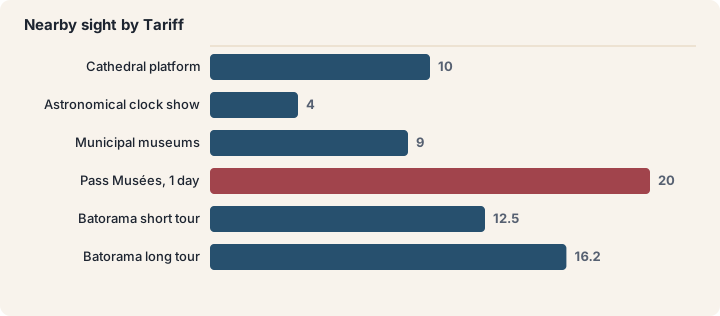
Saint Thomas sits in the densest cluster of sights in Strasbourg, so the honest answer is almost everything, all on foot. Riverside Petite France, the Ponts Couverts and the Barrage Vauban terrace lie west and south; the cathedral, Place du Château and the Palais Rohan museums stand east and north; and the full loop takes only an afternoon. Paid anchors nearby include the cathedral platform at 10 EUR, the clock show at 4 EUR, the municipal museums at 9 EUR and Batorama river tours from 12.50 EUR. Start with the river if the light is good. The walk from the church towards the Ill brings you to the Ponts Couverts and the Barrage Vauban, whose panoramic terrace keeps seasonal hours, 08:00 to 19:00 in September and October, with the price not stated on the official page, so check before you plan the climb. From up there the rooftops of Petite France and the cathedral spire compose themselves into the classic Strasbourg view, and the Ponts Couverts stand directly below you.
The museum cluster is the other natural pairing. The Palais Rohan houses the Beaux-Arts and decorative arts collections, and the municipal tariff structure makes a multi-museum afternoon cheap and simple: 9 EUR full price or 5 EUR reduced per museum, a 1-day Pass Musées at 20 EUR, and free entry to every municipal museum on the first Sunday of the month. The Strasbourg City Card, at 5 EUR for adults and 3.50 EUR for children and valid for seven days, is a discount card rather than an all-inclusive pass, taking money off museums, the boat tours, the cathedral platform and the clock show. One caution for planners: the Musée Alsacien is closed for works until 2028, so route your folk-art ambitions elsewhere on this trip.
| Nearby sight | Tariff | Notes |
|---|---|---|
| Cathedral platform | 10 EUR full, 6 EUR reduced | Under 6 free; seasonal hours |
| Astronomical clock show | 4 EUR | 12:30 daily; tickets on the day only |
| Municipal museums | 9 EUR full, 5 EUR reduced | Free first Sunday of the month |
| Pass Musées, 1 day | 20 EUR | Covers the municipal set |
| Batorama short tour | 12.50 EUR full, 7.20 EUR reduced | Blue Tour, 0h45 |
| Batorama long tour | 16.20 EUR full, 8.90 EUR reduced | Red Tour, 1h10 |
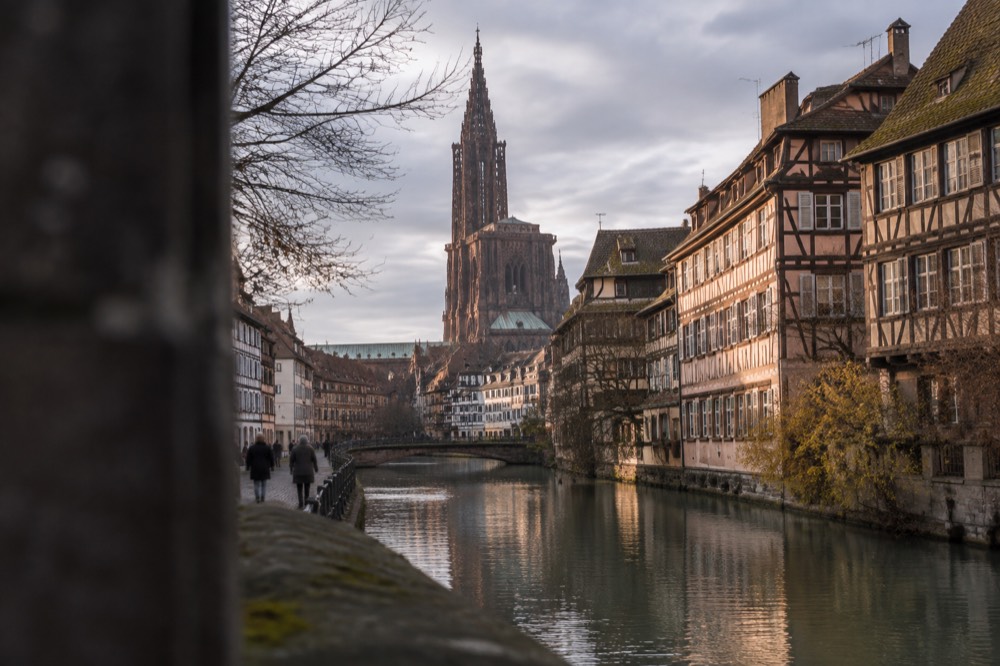
The river itself is the third option, and for many travellers the best one. Batorama's official prices are listed above, with the long Red Tour running 1h10 and the short Blue Tour 0h45, and the boats depart from the quays a short walk from the church, gliding past the European Parliament buildings and back through the old quarter. A private alternative runs on the same water: a skippered private cruise on the Ill for up to four people, with pricing on the operator's live listing, which turns the same stretch of river into something you have entirely to yourselves.
Which Guided Tours Pass Through This Quarter?
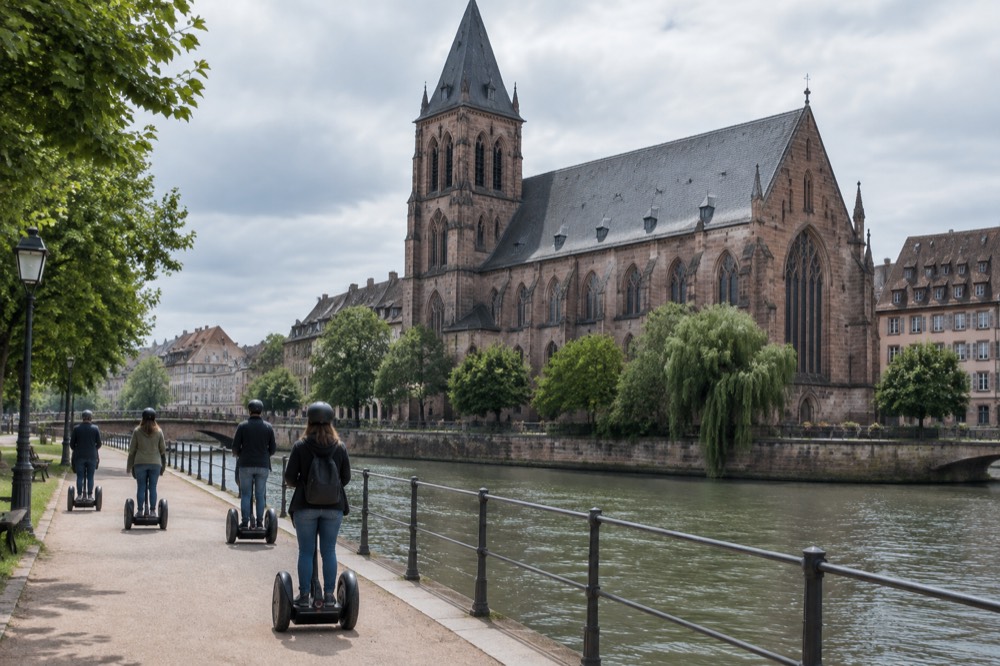
Most guided tours of Strasbourg pass through the Saint Thomas quarter, since routes across the Grande Île go by the cathedral and the river. Walking tours range from a one-hour city-centre orientation to a two-and-a-half-hour hidden-stories walk, while bike and segway tours cover the same ground plus the riverside and the European Quarter in around two hours. Free pay-what-you-want walks through GuruWalk use English-speaking guides you tip at the end. The choice comes down to pace and depth. A short walk suits a stopover or a first afternoon; a longer hidden-stories walk suits travellers who want the narratives behind the facades; a bike or segway tour suits anyone who wants the European institutions and the riverside folded into the same outing. The segway format deserves a special mention for this specific church, because the Euro route sweeps the wide spaces between the historic centre and the institutions, and a two-hour small-group segway tour with a guide covers that sweep efficiently; its price, rating and review count render on the operator's live listing, and you can check availability there before committing.
For church-focused travellers, the guided cathedral tour is the natural companion piece. It covers the great building whose shadow Saint Thomas stands in, with the guide explaining the sculpture, the spire and the clock, and it pairs neatly with an independent hour at Saint Thomas afterwards, when you can sit in the Protestant hall and let the contrast sink in. Whatever format you choose, book the time slot that leaves you a free hour around midday: the astronomical clock show at 12:30 sharp is the fixed point of any cathedral-quarter day, tickets are sold on the day only, and a guided morning that ends near the Place du Château puts you within a few minutes of both the show and the church.
A final word on how to use guides here. Strasbourg rewards the first guided circuit and then a second, unguided day, because the city is small enough that a single tour teaches you the geography you need to explore alone. Take the tour on day one, note where the guide pointed and you did not stop, and return on day two: the church is exactly the kind of place that second visit, unhurried and unprogrammed, is made for.
Common Questions About The Eglise Saint Thomas
What is the Eglise Saint Thomas in Strasbourg, France?
It is the principal Protestant parish church of central Strasbourg, a medieval hall church of pink sandstone on Place Saint-Thomas, between the cathedral and the River Ill. Locals have long called it the city's Protestant cathedral. It is known for its five-aisle hall interior, its historic pipe organ and a monumental reclining tomb, and it remains a working parish church rather than a ticketed museum.
Is the Eglise Saint Thomas free to enter?
Admission arrangements are set by the parish, and this guide does not print a price because the parish's own page is the authority. The church is a place of worship with visiting hours around services, so check the parish's page for opening times, service schedules and any admission arrangements before you go.
How far is Saint Thomas from Strasbourg Cathedral?
The two buildings sit a few minutes apart on foot in the Grande Île, linked by old streets of tall stone houses, so no tram or taxi is needed. The walk is short enough that the standard pattern is to visit the cathedral in the morning, catch the 12:30 astronomical clock show if you have a ticket, and then stroll over to Saint Thomas while the contrast between the two interiors is fresh.
What is the church famous for inside?
Three things: the vast hall of columns, where the side aisles rise nearly as high as the nave and the space reads as one luminous room; the historic pipe organ on its gallery, still used for services and recitals; and the monumental reclining tomb monument that anchors one aisle. The walls also carry ranks of stone epitaphs and memorial tablets from Alsatian parish families.
When is the best time to visit the Eglise Saint Thomas?
Midweek mornings outside the Christmas market season are the calm window. The church itself is an all-season interior, and Strasbourg's semi-continental climate, with mean daily maxima from 5.2 C in January to 26.4 C in July, matters more for the streets around it than for the building. In late November and December the Christmas market fills the same quarter; last year's edition ran 26 November to 24 December 2025, and the next edition's dates are not yet published, so confirm them on the city's Christmas site.
Can you visit Saint Thomas and Petite France in the same walk?
Yes, easily. The church stands between the cathedral and the Ill, and the riverside lanes of Petite France, the Ponts Couverts and the Barrage Vauban terrace lie a short stroll to the south and west, so a loop taking in the church, the river quarter and the cathedral square is a comfortable half-day on foot, with the Batorama quays on the same route if you want to add a boat tour.
The Eglise Saint Thomas is the quiet half of Strasbourg's religious architecture, and it earns an hour of any trip that already includes the cathedral. Walk over after the clock show, sit under the organ gallery, read a wall of Alsatian memory, and then let the river quarter take you the rest of the way through the day.