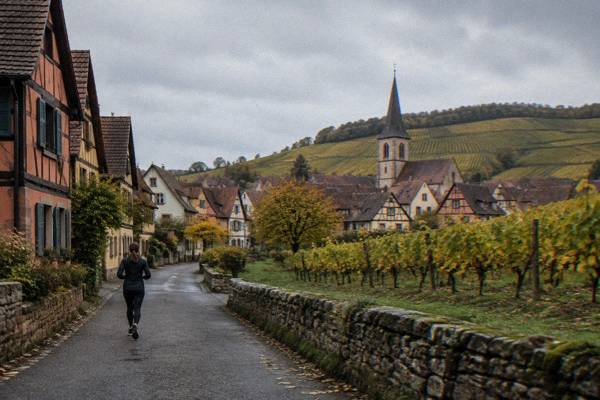
Hunawihr
Hunawihr and Bergheim sit side by side on the Alsace Wine Route between Riquewihr and Ribeauvillé, a short drive from Strasbourg in Alsace, north-eastern France. This guide covers what each village offers, how to reach them, where to eat, and how to build the day.
Short answer
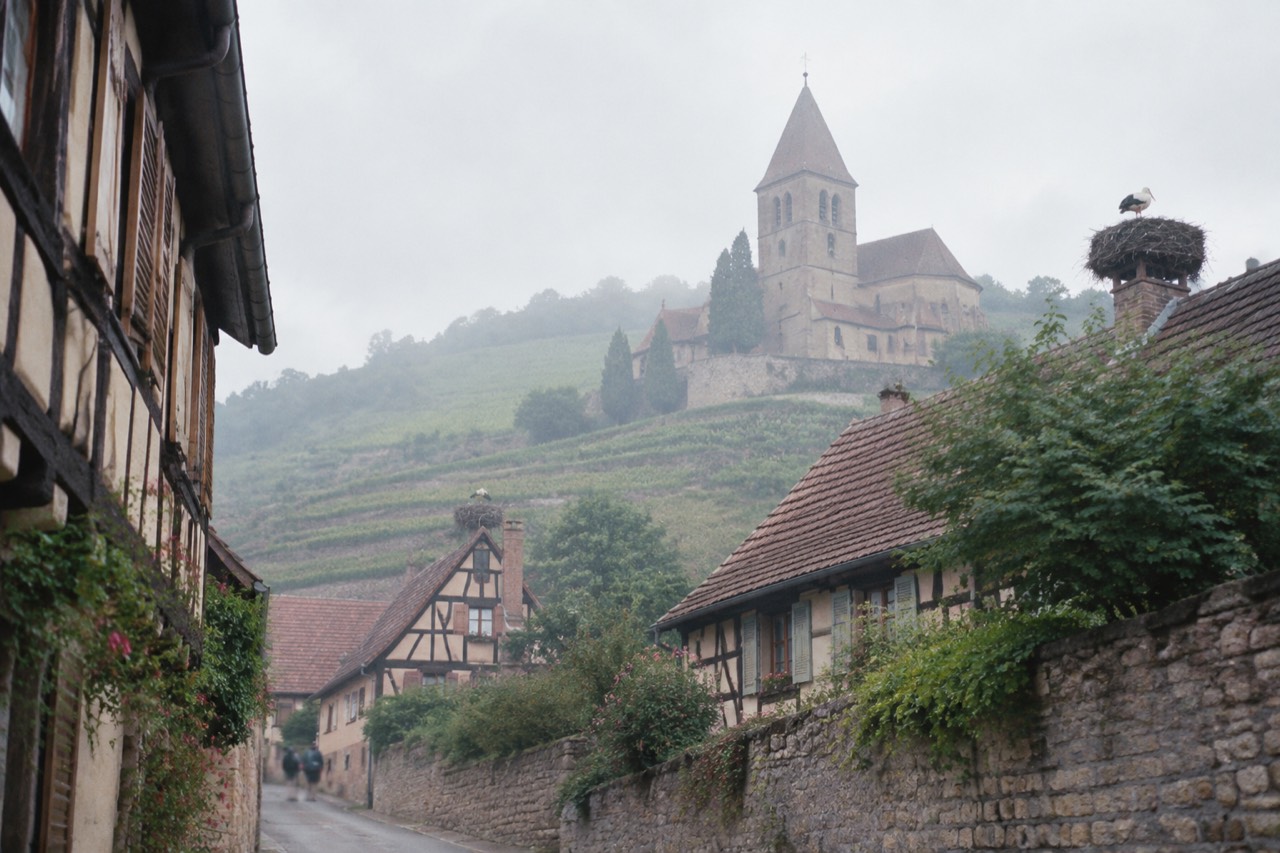
Hunawihr and Bergheim are two neighbouring wine villages on the Alsace Wine Route in Alsace, north-eastern France, reached from Strasbourg by car or on an organised wine-route tour. Hunawihr is known for its fortified church among vineyards; Bergheim for its ramparts and winstub tables. Allow a full day to combine both with Riquewihr or Ribeauvillé.
Hunawihr and Bergheim are two of the quieter stops on the Alsace Wine Route, the vineyard-lined stretch of country that runs south from Strasbourg, the prefecture of Bas-Rhin in Alsace, north-eastern France. Where Riquewihr draws the crowds and Colmar fills its lanes by mid-morning, these two neighbouring villages keep a slower rhythm: a fortified church standing in its vineyards in Hunawihr, and a ring of ramparts around Bergheim's flower-decked streets. They sit close enough together that a single day covers both comfortably, with time left for a tasting, a winstub lunch, or a detour to the villages between them and Strasbourg. This guide lays out what each village offers, how to reach them, and how to plan the day.
What Are Hunawihr And Bergheim?
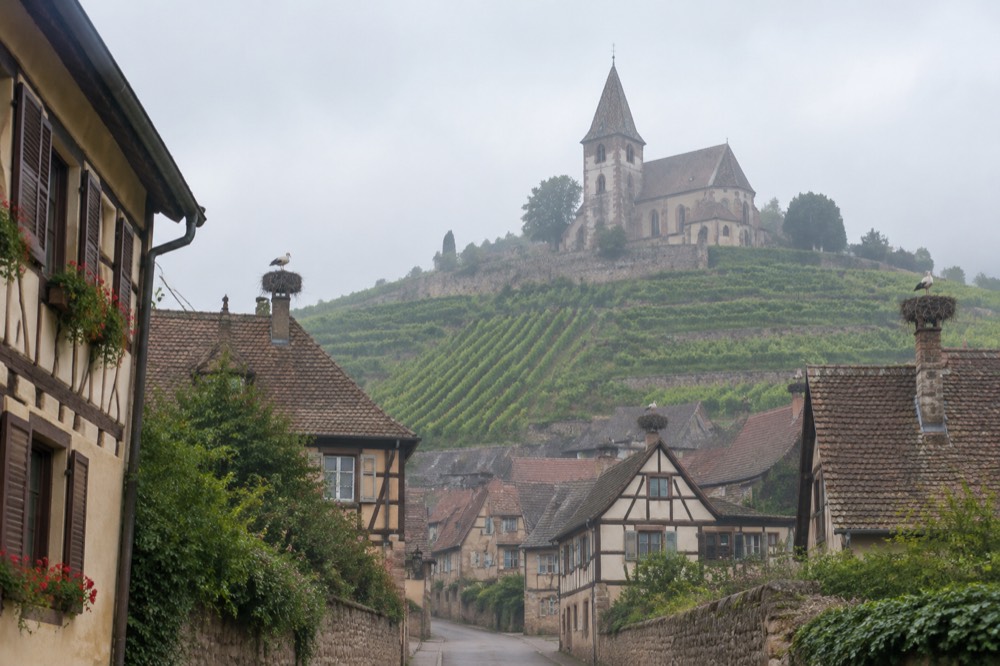
Hunawihr and Bergheim are two small wine villages in the heart of the Alsace Wine Route, north-eastern France, roughly between Riquewihr and Ribeauvillé and within easy reach of Strasbourg for a day trip. Hunawihr is famous for its fortified church rising directly out of the vineyards, while Bergheim is a walled village with ramparts, gates and quiet lanes lined with half-timbered houses. Neither charges an entry fee to walk around.
That combination is the whole appeal. The Alsace Wine Route strings together dozens of villages, and the ones closest to Strasbourg, such as Obernai in the south, get their share of coach traffic. Hunawihr and Bergheim sit where the vineyards climb the hills below the Vosges, and the walk between church, ramparts and tasting room takes an unhurried hour or two rather than a full afternoon.
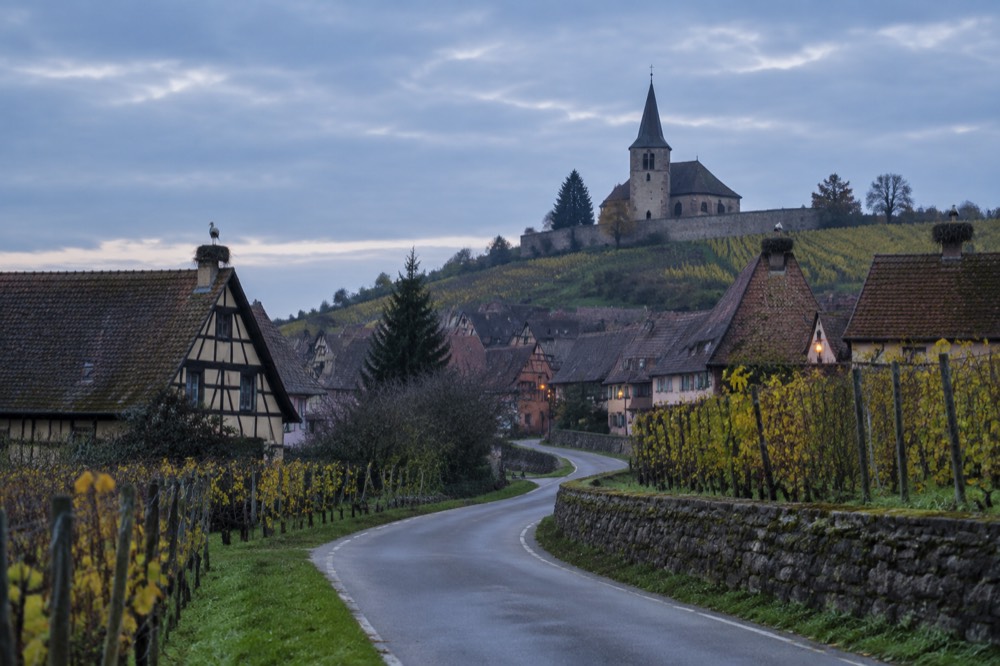
Hunawihr's church is the village's signature image: a medieval building ringed by its own defensive wall, set in the middle of the slopes rather than tucked behind houses. Photographers time their visit for late afternoon, when the light comes across the vines. Bergheim's draw is different: it is one of the wine-route villages that kept its complete ring of fortifications, so you enter through a gate and walk streets that still follow the old plan. Both villages belong to the same winemaking tradition, and both are within the area covered by our broader Alsace Wine Route guide.
How Do You Get To Hunawihr And Bergheim From Strasbourg?
The practical way to reach Hunawihr and Bergheim from Strasbourg is by car, following the Route des Vins through the wine-route villages, or by joining an organised day tour from Strasbourg that covers several villages in one loop. There is no direct high-frequency public transport link.
Driving yourself gives the freedom to stop in Riquewihr, Ribeauvillé or Kaysersberg on the way, and the wine route is signed. The trade-off is parking: village centres are small, and in the summer months and around the Christmas period the popular stops fill early. An organised tour removes the parking question entirely and adds a driver who knows the back roads, at the cost of a fixed itinerary and less time in any single village.
| Option | What it involves | Who it suits | What to check |
|---|---|---|---|
| Own car or rental | Self-drive along the wine route, stops at will | Couples and small groups who want flexibility | Parking availability in each village centre |
| Organised wine-route day tour | Coach or minivan loop from Strasbourg with several village stops | First-time visitors and non-drivers | Itinerary and village list on the live listing |
| Regional bus and TER train | Public transport with connections via the nearest rail stations | Budget travellers with time | Current timetables on the regional operator's site |
| Private driver or taxi | Door-to-door from Strasbourg, fully custom route | Families and groups | Availability and fare quoted in advance |
For travellers who prefer a guided day, the tour listings cover this stretch of the wine route well. A medieval villages and wine tasting day trip from Strasbourg runs to the vineyard villages with tastings built in, which suits anyone whose main goal is the wine rather than the walking.
Prefer to leave the planning to a guide? Book a half-day Alsace wine tour here.
Whichever route you choose, book the wine-route day early in a Strasbourg stay, because the popular departure days fill first and the villages are the reason many people come to Alsace at all.
One point worth repeating: the region's vineyards sit on hillsides, and the walking between car park, church and tasting room is on cobbled or gravel surfaces. Comfortable shoes matter more than they do in Strasbourg's flat city centre. Pack for the weather too, because the semi-continental climate means summer days can be warm while spring and autumn mornings stay cool.
What Is There To See In Hunawihr?
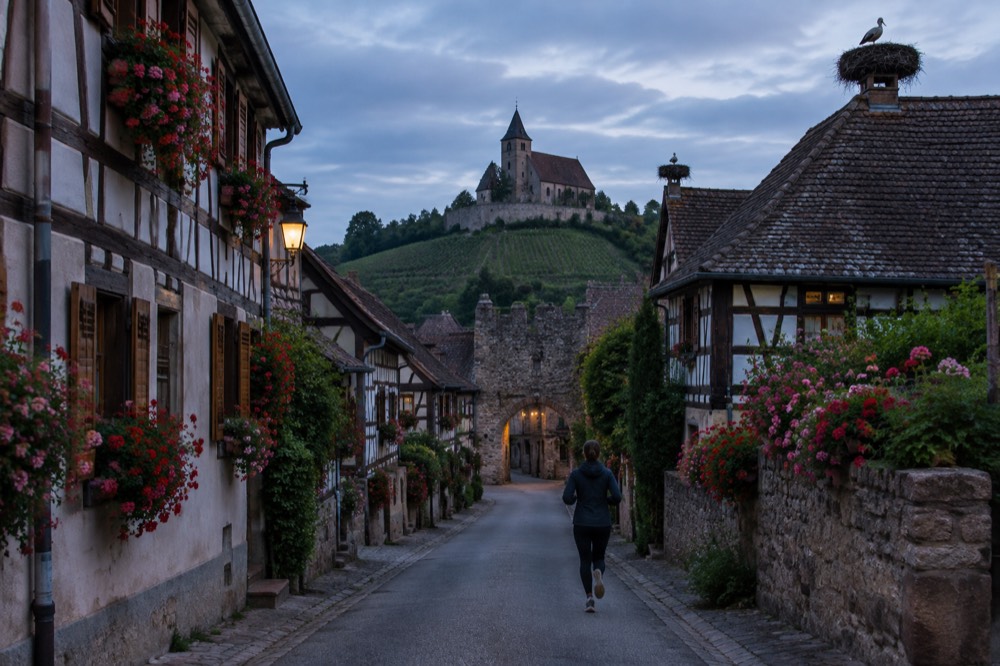
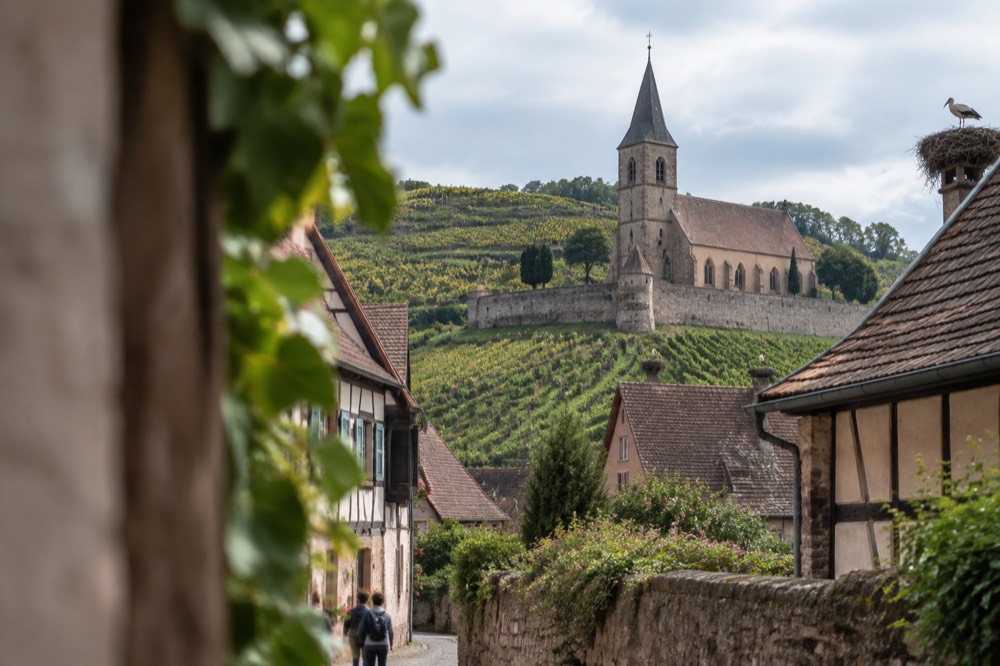
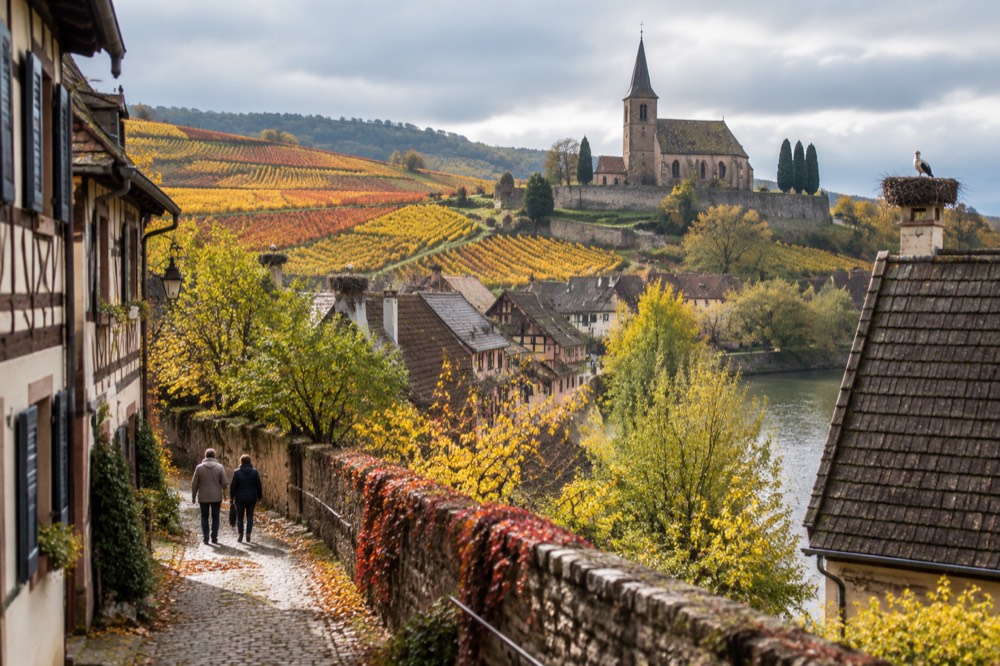
Hunawihr's headline sight is its fortified church, a medieval building enclosed by its own defensive wall and surrounded on all sides by vineyard slopes, which makes it one of the most photographed spots on the whole Alsace Wine Route. Around it the village offers a compact centre of half-timbered houses, wine-growers' courtyards, and tasting rooms where the local growers pour their own production. The village is small enough to see on foot in a leisurely morning.
The church is the reason people come. Unlike village churches tucked into a square, this one stands apart, in the vines, so the approach on foot is part of the experience: you walk up through the rows with the building ahead of you. The setting rather than the interior is the draw, and the slopes that frame it are working vineyards, part of the same wine-growing landscape that gives the village its living. Give the walk an unhurried pace and let the light do its work.
Beyond the church, the village itself rewards a slow loop. Growers' houses line the lanes, several with open courtyards and cellar doors where tastings run during the visiting season. The stork is part of the Alsatian countryside's story, and the villages of this stretch, including nearby Kintzheim with its eagle park and monkey mountain, are where the reintroduced birds nest; our storks in Alsace guide covers where to see them properly. Hunawihr itself keeps things modest, which is exactly its charm.
| Sight or activity in Hunawihr | Type | What it offers | What to check |
|---|---|---|---|
| The fortified church in the vineyards | Heritage landmark | The village's signature view, walls and setting among the vines | Opening hours on the parish or tourist page |
| Village lanes and half-timbered houses | Streetscape | A short walking loop of growers' houses and courtyards | Nothing, open access |
| Growers' tasting rooms | Wine tasting | Alsace grape varieties poured by the producers themselves | Tasting days and fees at each cellar door |
| Vineyard paths | Walking | Short walks between the rows on the slopes | Footwear and weather |
| Photographic viewpoints | Scenery | Morning and late-afternoon light on the church | Position of the sun by season |
A morning works well for Hunawihr: the light on the vineyards is softer, the lanes are quieter, and there is time for a tasting before lunch. Visitors who want the village almost to themselves should aim for the shoulder months rather than the summer peak, when the wine route as a whole is at its liveliest.
Where To Eat And Drink On A Hunawihr And Bergheim Trip?
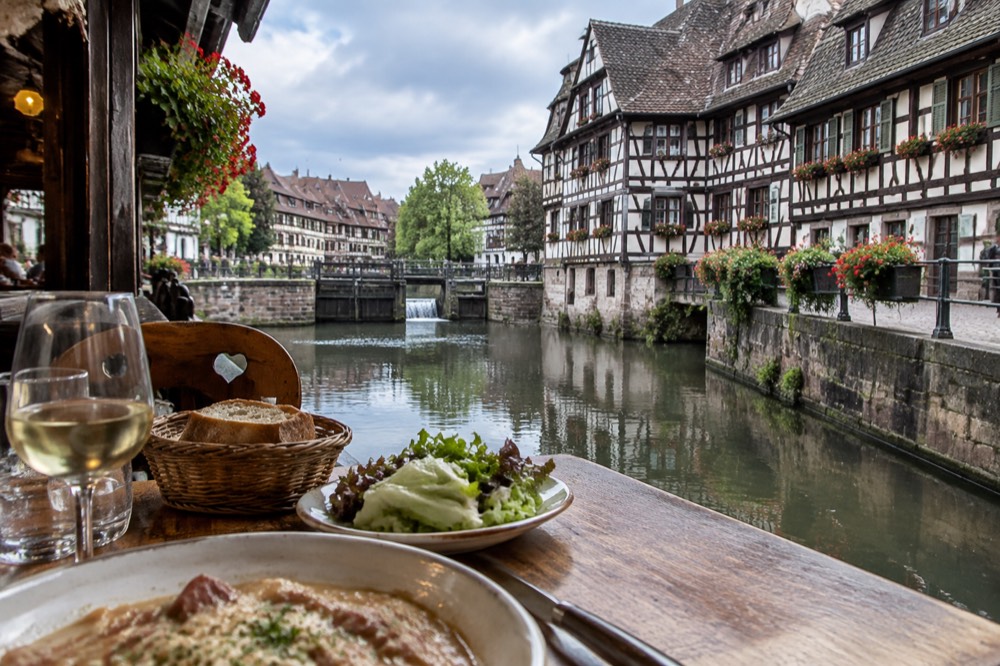
Eating on this trip means winstub food: the Alsatian tradition of hearty regional dishes served in village dining rooms, with tarte flambée, choucroute, baeckeoffe and kougelhopf all on the menus, alongside the local white wines and Riesling-led lists poured by the glass. Both villages have small restaurants and tasting rooms, and the surrounding wine route adds more choice in Riquewihr and Ribeauvillé. Book a table in advance in the busy season.
The winstub is the region's dining institution, and the villages of the wine route keep the tradition closest to its roots. Menus lean on the classics: tarte flambée, the thin crust with cream, onions and lardons; choucroute, the sauerkraut platter with sausages and pork; baeckeoffe, the slow-baked casserole of meats and potatoes. Dessert is often kougelhopf, the domed Alsatian cake that appears at breakfast as readily as after dinner. Our winstubs guide explains the tradition in depth, and the same dishes travel well out to the villages.
Wine is the other half of the meal. Alsace grows Riesling, Gewurztraminer, Pinot Gris and more, and in the villages the glass you drink usually comes from the slope you can see through the window. Tastings at growers' cellars are the most direct way to try them, and fees, where they apply, are modest and often waived with a purchase; ask at the cellar door rather than assuming. For travellers who want to understand the region's flavours before or after the drive, a guided culinary walk in Strasbourg covers the city's food traditions with tastings along the way, and the operator's live listing shows current availability: Check availability.
Lunch in the villages is the meal to plan around, because dining rooms are small and the midday trade from the wine route fills them. A late lunch, after the coaches have moved on, is often easier to get and more relaxed. In the evening the villages quieten early, which is worth knowing if your day runs long and you had imagined a leisureing dinner in Hunawihr itself: the wider choice is back in Colmar or Strasbourg.
What Is There To See In Bergheim?
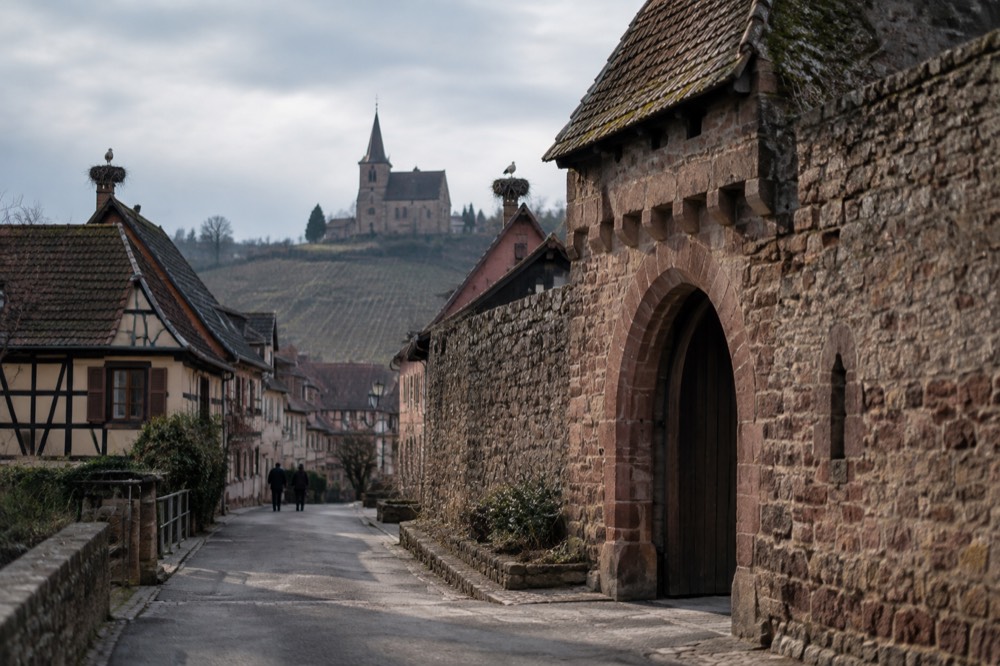
Bergheim's defining feature is its ring of medieval ramparts, one of the best preserved on the Alsace Wine Route, which still encircles the village and gives it a distinct, walled character: you enter through gates, walk flower-lined streets inside the walls, and can follow the fortifications around the village on foot. Inside there are half-timbered houses, wine-growers' courtyards, tasting cellars and quiet squares, all on a scale that takes an hour or two to see properly.
The walls are what set Bergheim apart from its neighbours. Walking the circuit gives a real sense of the village's shape and history, and the gates and towers photograph well from outside as well as within. Inside, the streets are the classic wine-route mix: deep half-timbering, painted facades, window boxes, and cellar doors. Bergheim also carries a sombre piece of regional history, having been the site of witch trials, and the village's heritage displays touch on that past; treat any dates or details as something to confirm on the local heritage pages rather than in a guidebook summary. The rest of the planning pages sit on Strasbourg Travel Guide.
Bergheim pairs naturally with Hunawihr, and the two together make a coherent day: walls and lanes in one, church and vines in the other. Both are quieter than Riquewihr, so the contrast with that village's busier lanes, covered in our Riquewihr guide, is part of the pleasure of doing the three in sequence. Ribeauvillé, the next village along, adds a bigger centre with more restaurants; see our Ribeauvillé guide for its story.
| Sight or activity in Bergheim | Type | What it offers | What to check |
|---|---|---|---|
| The ramparts and gates | Fortifications | A walkable circuit around the walled village | Footwear, some uneven surfaces |
| Old streets and half-timbered houses | Streetscape | Painted facades, courtyards, window boxes | Nothing, open access |
| Tasting cellars | Wine tasting | Growers' wines poured in vaulted cellars | Tasting days and fees |
| Village heritage displays | Local history | Bergheim's past, including its trial history | Opening hours locally |
| Squares and fountains | Rest stops | Shaded spots for a pause between walks | Nothing |
Give Bergheim the afternoon. The walls look their best in the low sun, the tasting cellars are a natural stop before the drive back, and the village's compact size means you are never more than a few minutes from the car park or the road south.
How Do Hunawihr And Bergheim Fit On The Alsace Wine Route?
They sit on the northern half of the Alsace Wine Route, in the cluster of villages around Riquewihr and Ribeauvillé, which is the stretch that also includes Kaysersberg and Eguisheim's better-known lanes a little further south. That makes them ideal middle stops on a loop from Strasbourg: you can pair them with one or two headline villages without doubling back, and the driving between stops is short. The wine route is signed throughout, and every village on it has growers who welcome visitors.
The classic mistake on a first wine-route day is trying to do too much. The villages look close together, but each rewards time on foot, tastings take longer than expected, and lunch sits in the middle of everything. Two or three villages is a comfortable full day; four is possible but rushed. Hunawihr and Bergheim, being neighbours, count almost as one stop, which is precisely why they work so well in a loop.
| Village | Known for | Pairs well with | Our guide |
|---|---|---|---|
| Hunawihr | Fortified church in the vineyards | Bergheim, same day by car | This page |
| Bergheim | Complete ramparts and gates | Hunawihr, Ribeauvillé | This page |
| Riquewihr | The busiest wine-route lanes and tasting rooms | Hunawihr, a short hop away | Riquewihr guide |
| Ribeauvillé | Larger centre, restaurants, fountains | Bergheim, next door | Ribeauvillé guide |
| Kaysersberg | River setting and hillside views | A loop with Hunawihr and Riquewihr | Kaysersberg guide |
| Eguisheim | Circular village layout, lanes | The southern stretch of the route | Eguisheim guide |
| Obernai | Busy market town nearer Strasbourg | A shorter day from the city | Obernai guide |
For anyone building the trip around wine rather than scenery, a guided wine-route day adds context that self-driving cannot: the guides explain the grape varieties, the terroir and the classification system as you go, and the itineraries usually include tastings that would need booking individually otherwise. The medieval villages and wine tasting excursion from Strasbourg is the format that fits this stretch best.
Self-drivers should still book at least one tasting ahead, especially in the summer months, because the well-known cellars fill their slots first. And if the day is more about the drive than the wine, the Route des Crêtes, high in the Vosges above the vineyards, makes a dramatic extension; our Route des Crêtes guide covers it.
When Is The Best Time To Visit Hunawihr And Bergheim?
The best time to visit is late spring through early autumn, when the vineyards are in leaf, the tasting rooms are on full summer schedules and the walking is dry; the harvest period in autumn brings colour and activity to the slopes, while December adds the region's famous Christmas markets, though the village lanes are busiest then. Strasbourg's semi-continental climate gives warm summers and cold winters, so the season changes the trip considerably.
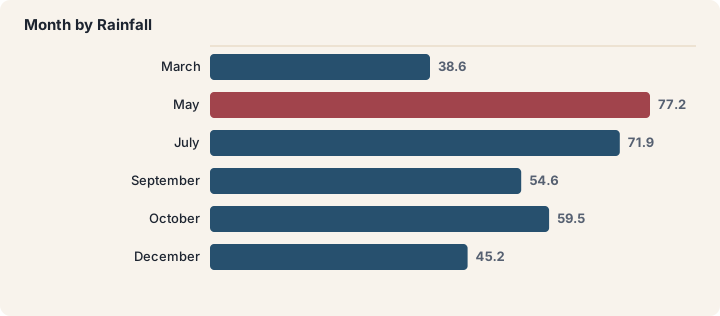
The numbers behind that come from the Meteo-France 1991-2020 normals for Strasbourg-Entzheim, the nearest long-record station to the vineyards. Summer means an average maximum of 26.4 C in July and 26.1 C in August, with nights around 14.9 C and 14.5 C; winter means 5.2 C and 5.9 C daytime highs in January and December. Rain falls somewhere in the region on roughly 8 to 10 days a month all year, totalling 635.7 mm annually, so a waterproof layer earns its place in the bag in every season.
| Month | Average daily maximum | Average nightly minimum | Rainfall | Days with 1 mm or more |
|---|---|---|---|---|
| March | 12.1 C | 2.6 C | 38.6 mm | 8.5 |
| May | 20.9 C | 10.1 C | 77.2 mm | 10.8 |
| July | 26.4 C | 14.9 C | 71.9 mm | 10.4 |
| September | 21.6 C | 10.7 C | 54.6 mm | 8.0 |
| October | 15.8 C | 7.2 C | 59.5 mm | 9.6 |
| December | 5.9 C | 0.8 C | 45.2 mm | 10.2 |
December deserves a special note, because it is the month the whole region is famous for. Strasbourg's own market, the anchor of the area's Christmas trade, ran from 26 November to 24 December in its 2025 edition and drew 3.05 million visitors; the city posts each edition's dates on its Christmas site, so confirm them there before planning a December trip. The villages of the wine route run their own smaller markets in the same period, and the pattern is consistent: late November to 24 December, with chalets typically open late morning to evening. Our Christmas markets in Alsace guide covers the alternatives, and our best time to visit Strasbourg guide weighs the seasons for the city itself.
A One-Day Hunawihr And Bergheim Itinerary From Strasbourg
A comfortable one-day plan leaves Strasbourg in the morning, reaches Hunawihr for the church and a vineyard walk before the lanes fill, continues to Bergheim for the ramparts and a winstub lunch, then uses the afternoon for a tasting and one headline village such as Riquewihr or Kaysersberg on the drive back, returning to Strasbourg by evening. The order can be reversed, but the morning light on Hunawihr's church and the quieter lanes before midday argue for this direction.
The plan below is deliberately loose. The point of the wine route is not to keep a schedule but to let the villages work on you, so treat the rows as a rhythm rather than a timetable.
| Part of the day | Where | What to do |
|---|---|---|
| Early morning | Strasbourg | Set out early, before the wine-route car parks fill |
| Morning | Hunawihr | Walk up to the fortified church through the vines, loop the village lanes |
| Late morning | Bergheim | Enter by the gate, follow the ramparts, browse the streets |
| Midday | Bergheim or Ribeauvillé | Winstub lunch, tarte flambée or choucroute, a glass of Riesling |
| Afternoon | Grower's cellar | A booked tasting in Bergheim or Hunawihr |
| Late afternoon | Riquewihr or Kaysersberg | One headline village stop on the return leg |
| Evening | Strasbourg | Dinner back in the city, or a rest before the next day |
Two practical notes finish the plan. First, if the day is your first in the region, consider following it with a guided walk in Strasbourg itself: the villages show you Alsace's countryside, and the city's guided walks show you its history, and the two together give a fuller picture than either alone. A historic walk with a local guide is the format that fits an evening or a spare morning.
Second, keep an eye on the clock in the late afternoon. The wine route's light is at its best then, but the return drive in winter darkness is a different experience from the summer equivalent, and Strasbourg's restaurants take their last seatings earlier than a big city's. Leaving the final village with daylight to spare is the difference between a relaxed end and a rushed one.
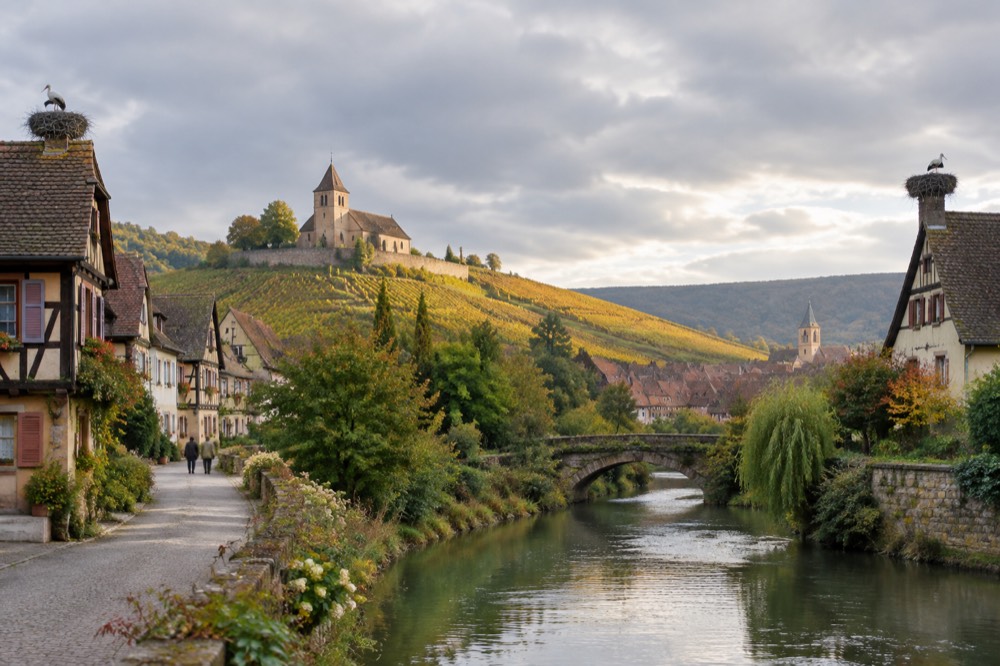
If the day trip has whetted your appetite for more of the region, the choices branch from here: the vineyard villages south towards Eguisheim and Colmar, the castle at Haut-Koenigsbourg above the plain, or the Vosges ridges on the Route des Crêtes.
Common Questions About Hunawihr And Bergheim
How far is Hunawihr from Strasbourg?
Hunawihr sits on the Alsace Wine Route in Alsace, north-eastern France, within day-trip range of Strasbourg by car or organised tour. We do not publish a driving time or distance for this route; check a journey planner or your tour's listing for current timings.
Can you visit Hunawihr and Bergheim without a car?
Yes, but it takes planning. The practical car-free options are an organised wine-route day tour from Strasbourg, which stops in several villages, or regional public transport with connections; timetables change, so check the regional transport authority's journey planner before committing to a date.
Which is better, Hunawihr or Bergheim?
They do different jobs. Hunawihr's fortified church among the vineyards is the single most striking sight of the pair, while Bergheim's complete ramparts and quieter lanes make it the better village for a slow walk and a winstub lunch. On a day trip from Strasbourg there is no need to choose, because they sit next to each other on the wine route.
What is Hunawihr famous for?
Hunawihr is famous for its fortified church, a medieval building enclosed by its own defensive wall and surrounded by working vineyard slopes, which makes it one of the most photographed settings on the Alsace Wine Route. The village around it is a compact cluster of half-timbered wine-growers' houses and tasting rooms.
Are Hunawihr and Bergheim worth visiting in winter?
Yes, with the right clothing. The Meteo-France 1991-2020 normals for Strasbourg-Entzheim give a December mean maximum of 5.9 C and a mean minimum of 0.8 C, so wrap up. In the late-November to 24 December period the region's Christmas markets add a seasonal draw, though the next edition's dates should be confirmed on the city's official Christmas site.
Where do you eat in Hunawihr and Bergheim?
Both villages have small restaurants and winstub-style dining rooms serving Alsatian classics such as tarte flambée, choucroute and baeckeoffe, with kougelhopf for dessert and the local white wines by the glass. Tables are limited, so book ahead in the busy season, or drive on to Ribeauvillé or Riquewihr for a wider choice.