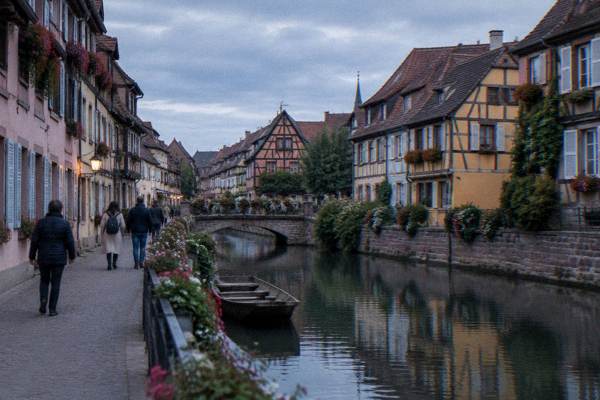
Alsace Storks
The white stork is the unofficial emblem of Alsace, and Strasbourg, the prefecture of the Bas-Rhin in north-eastern France, is the practical base for going to see them.
Short answer
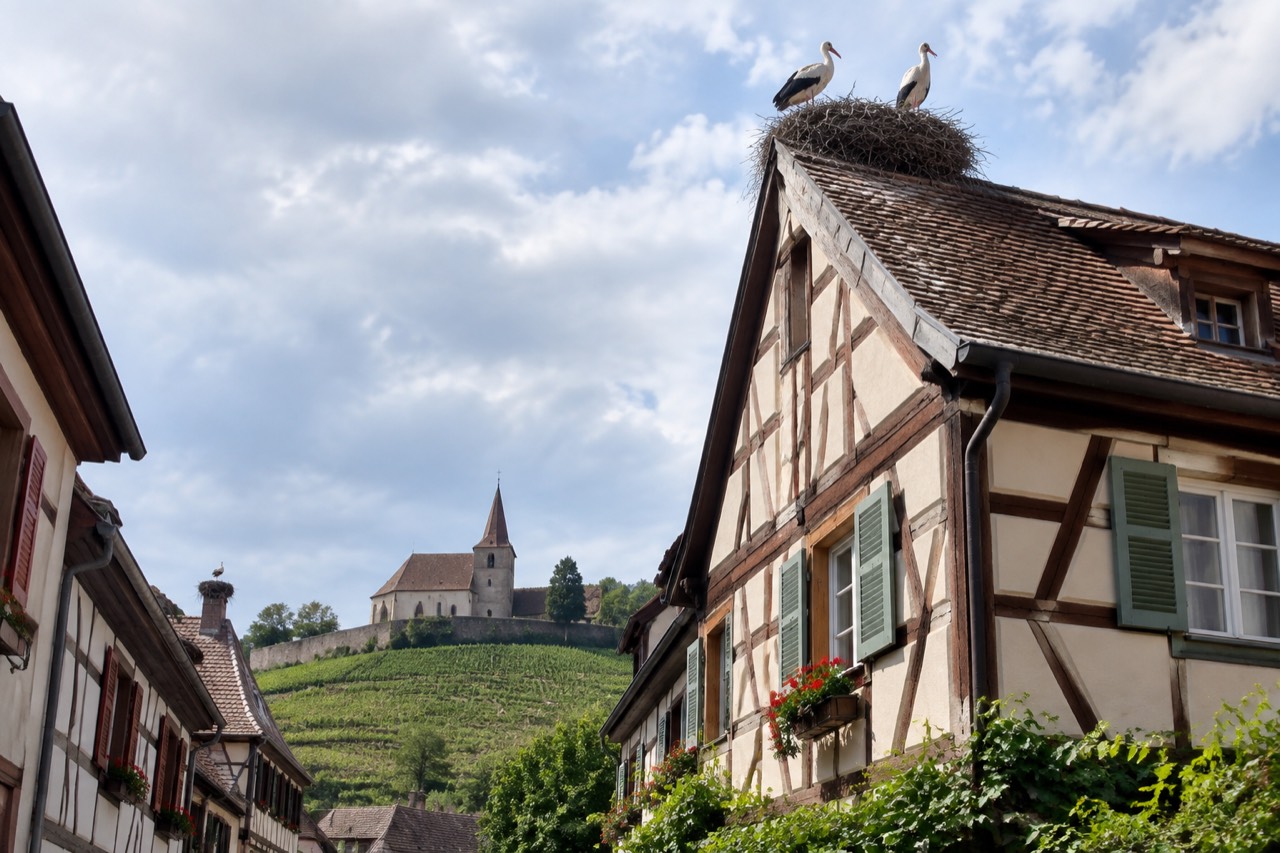
Alsace storks are white storks that nest on chimneys, rooftops and purpose-built platforms across the region around Strasbourg, in north-eastern France. They return in early spring, raise chicks through summer and gather for migration in late summer. The region's climate is semi-continental, with mean maxima from 5.2 C in January to 26.4 C in July.
The white stork is the bird that Alsatian farmhouses, postcards and shop signs all agree on, and Strasbourg, the prefecture of the Bas-Rhin in Alsace, north-eastern France, is the natural base for going to look for one. The stork stands on rooftops and chimney stacks across the region, on the Alsace plain between the Vosges and the Rhine, which forms the border with Germany. This guide covers what the stork means here, where the nesting sites sit, when to time a visit, and how to fold a stork outing into a wider trip around Strasbourg and the Alsatian villages.
Why Is The Stork The Symbol Of Alsace?
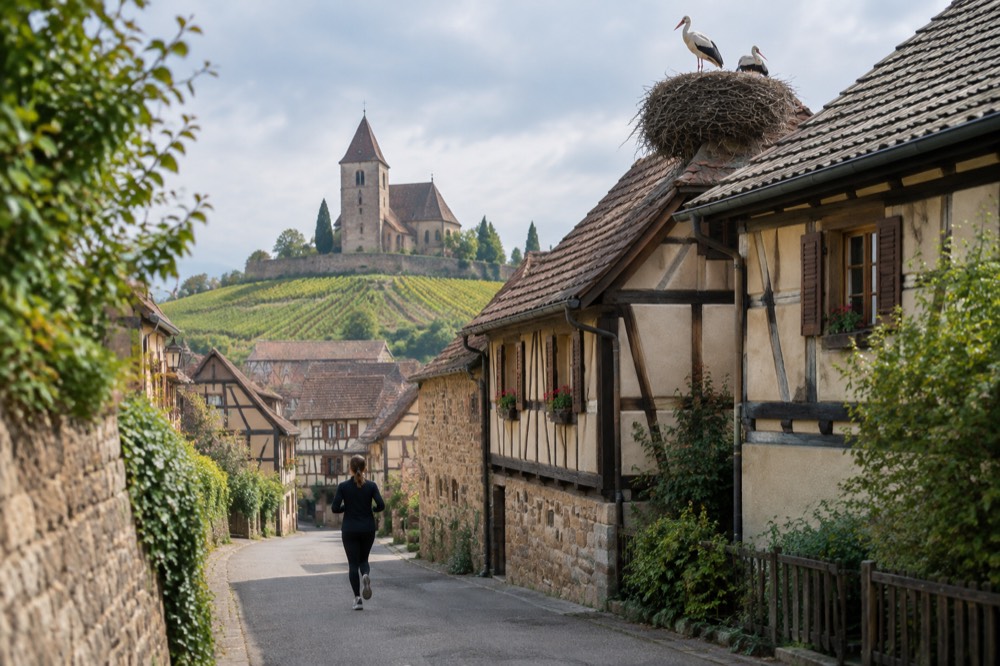
The stork became the symbol of Alsace through centuries of rural cohabitation: the birds nested on farm chimneys across the plain, farmers treated them as good luck, and the image spread onto tiles, weathervanes, embroidery and inn signs until it stood for the region itself. The bird's near disappearance and later return turned it from a folk motif into a conservation story, which is why the stork now appears on tourist material from Strasbourg to the wine villages.
The nesting habit is the root of it all. A white stork pairs for the season, returns to the same nest year after year, and builds a structure heavy enough that it needs a broad, stable base: a chimney stack, a barn ridge, a telegraph pole or one of the man-made platforms that villages now erect. Alsatian farmhouses, with their deep roofs and fat chimneys, offered exactly that, so the bird and the village grew up together. Local tradition treated a nesting pair as a blessing on the house, and children were told the familiar story that storks deliver babies, a tale Alsatian families shared with much of Europe.
The symbolic side runs deeper than souvenirs. The stork appears on the roofline of restored half-timbered houses, on the signage of winstubs, and in the decorative painting that covers beams and shutters in the wine villages south of Strasbourg. When the Alsatian tourist authorities promote the region, the bird is rarely far from the frame. Visitors who arrive in Strasbourg by train and walk into the Grande Île usually meet the motif before they meet the bird itself.
| Where the motif appears | What it looks like | What it signals |
|---|---|---|
| Roof ridges and chimney stacks | Twig nests, sometimes on raised platforms | An active or recent nesting site |
| Weathervanes and roof finials | Cut-metal or carved wooden storks | Traditional farmhouse decoration |
| Winstub and inn signage | Painted storks above the door | Regional identity on eating houses |
| Tiles, textiles and ceramics | Stork motifs on decorative arts | The folk-art tradition of the region |
The conservation chapter matters because it explains why the bird is celebrated so loudly today. Stork numbers in Alsace fell steeply in the decades after the Second World War, as wetlands were drained and pesticides and power lines took their toll, and the bird became scarce on the chimneys it had made famous. Reintroduction and protection programmes, including purpose-built nesting towers and the stork parks that visitors can walk through today, brought the bird back to the point where nests are again a normal sight in the villages between Strasbourg and the Vosges foothills. The direction of the story is well documented in the region's own visitor material.
Where To See Storks In And Around Strasbourg?
The reliable places to see storks from Strasbourg are the dedicated stork parks and reintroduction centres of the Alsace plain, the wetland reserves along the Rhine, and the villages of the wine route and the foothills, where nests sit on chimneys and platforms from early spring through summer. Strasbourg itself has nests on some taller buildings and church towers, but a sighting in the city is a bonus rather than a plan. For a guaranteed look at birds close up, a stork park is the answer.
The stork parks are the surest option. Centres in the region keep resident and recovering birds, breed storks for release, and maintain feeding areas where wild birds gather, so visitors see the species at close range in a managed setting. These parks sit in the countryside within a day trip of Strasbourg, and each explains the reintroduction programme that brought the bird back. Check each centre's own site before setting out, as opening hours, ticket prices and journey times vary.
Wild viewing is less certain but more memorable. Storks forage in wet meadows, along riverbanks and in freshly cut or freshly ploughed fields, following the mower to pick up insects and small prey. Around Strasbourg, the river corridors of the Ill and the Rhine, the fields of the Ried wetlands, and the meadows between the wine villages are the habitats to watch. A slow drive or a rural cycle path in early summer, with regular stops to scan rooftops and field margins, is the standard method.
In the city itself, look up around the taller churches and the rooflines of the larger public buildings, and keep an eye on the Ill as it threads through the European Quarter. Storks pass over Strasbourg regularly in the migration seasons and a few pairs nest within the built-up area, but the city is a place to spot the bird incidentally, not a destination for it. The villages are where the density of nests is real.
| Type of site | What you get | Reliability | Best season |
|---|---|---|---|
| Stork park or reintroduction centre | Close-up birds, breeding programme, feeding areas | High, birds are resident | Spring through autumn |
| Wetland and river meadows | Wild foraging birds in habitat | Moderate, weather dependent | Spring and summer |
| Wine route villages | Nests on chimneys and platforms | Good in nesting season | Spring and summer |
| Strasbourg rooftops | Occasional nesting or passing birds | Low, a bonus not a plan | Any season |
How Do You Plan A Stork Day Trip From Strasbourg?
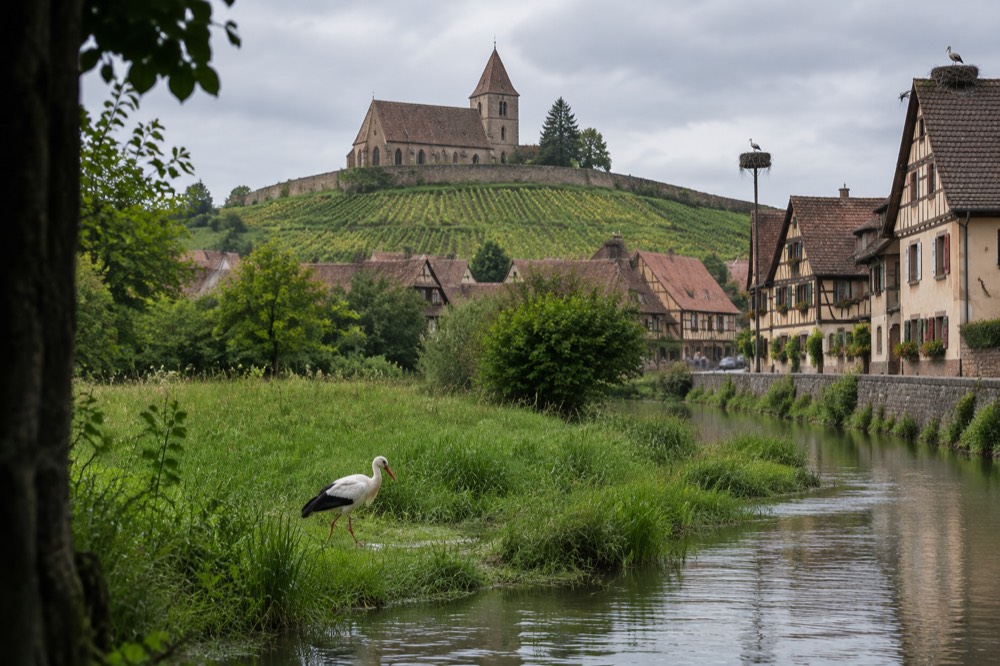
Plan the day around one anchor site, a stork park or a wetland reserve, reached by car or by a regional train toward the wine villages, and loop in one or two villages on the way back so the day has both close-up birds and rooftop nests. Go in the morning when storks feed, carry binoculars, and leave the afternoon for a village walk. Cross-border options into Germany exist, but the stork parks and the densest nesting villages are on the Alsatian side.
The shape of a good day is simple. Storks feed in the early part of the day, so the meadows and the parks are livelier before the middle of the afternoon, and a nest with chicks is active whenever the adults are bringing food. A single anchor site gives certainty, and the villages give atmosphere: half-timbered streets, a winstub lunch, and chimneys that may carry a nest at any turn. Trying to cover every stork site in Alsace in one day turns the trip into a drive, so pick a corridor and stay in it.
The corridors that work all run south or south-west from Strasbourg, along the wine route toward the villages that sit below the Vosges, or east toward the Rhine wetlands. The wine route option is the one that pairs a stork outing with the classic Alsatian day out, since the villages on that corridor are the same ones that draw visitors for their streetscapes, and the most beautiful villages of Alsace itineraries cover the same ground. Trains and buses serve some of these villages, but a car gives the freedom to stop at a field where storks are feeding, which is where the best views happen.
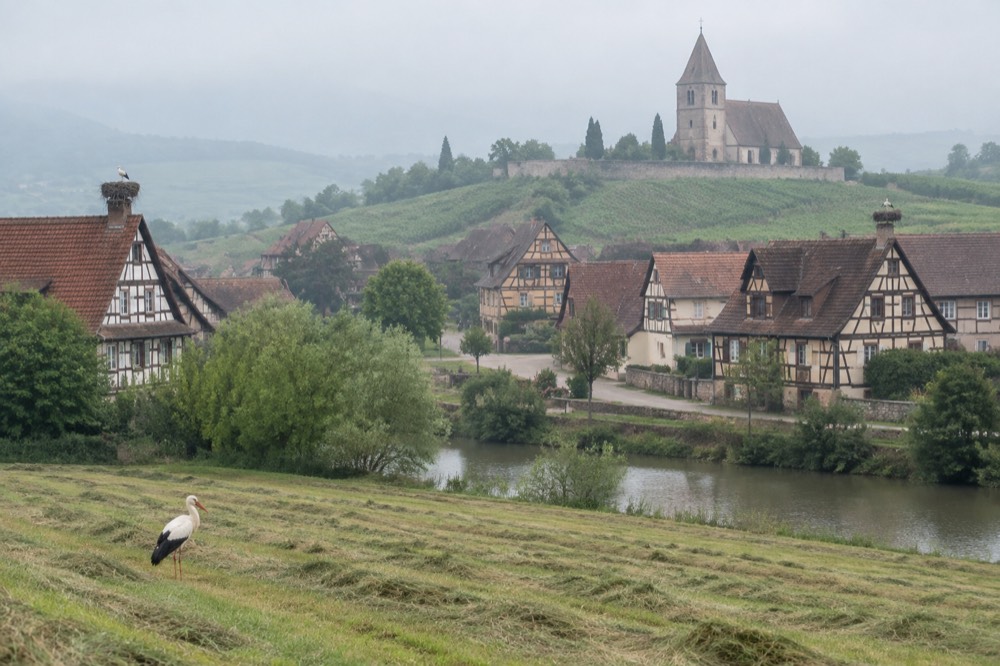
For visitors without a car, the realistic version is a guided day trip that crosses the region, several of which stop in stork country as part of a wider Alsace circuit, or a regional train to a single town with a walkable centre and a station. What matters is to treat the stork as one thread of the day rather than the whole of it: the bird is abundant enough in the right season that a well-chosen route will produce sightings without forcing the schedule.
| Day trip shape | Anchor | What it adds | Who it suits |
|---|---|---|---|
| Wine route corridor | A stork park plus two villages | Nesting chimneys, village streets, lunch | First-time visitors |
| Rhine wetlands corridor | A wetland reserve | Wild foraging birds, quiet paths | Birders and walkers |
| Cross-border loop | Black Forest scenery across the Rhine | Forest contrast to the plain | Repeat visitors |
When Is The Best Time Of Year To See Alsace Storks?
Early spring through late summer is the window: storks return to Alsace from their African wintering grounds in early spring, courtship and nest repair follow at once, chicks hatch in late spring, and by late summer the young gather in flocks before migration. A visit between late spring and midsummer offers the full picture, incubating adults, growing chicks and busy feeding flights. The migration gatherings in late summer are dramatic but brief.
The nesting calendar drives everything. A pair that has nested before arrives first and reclaims the platform, and the male's bill-clattering, a sound Alsatians know from every farmyard, carries through the village. Once the chicks hatch, the adults fly constant feeding circuits to the meadows, which is when the birds are easiest to watch: one adult on the nest, one in the field, both visible from a respectful distance. By late summer, the young of the year join feeding flocks that assemble before departure, and the chimney stacks go quiet until the following spring.
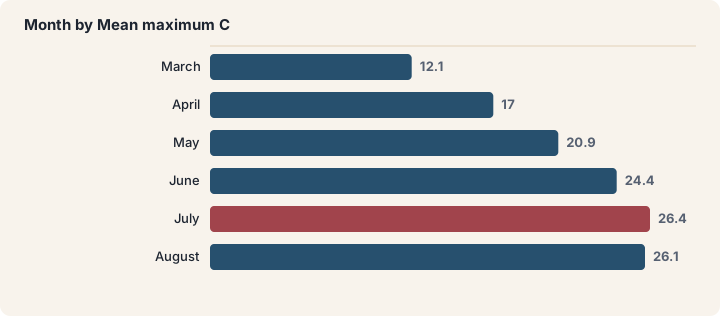
The climate sets the background. Meteo-France 1991-2020 normals for Strasbourg-Entzheim show a semi-continental year, with a mean maximum of 12.1 C in March rising to 26.4 C in July, and rainfall spread across every month, from 38.6 mm in March to 71.9 mm in July. The stork season sits inside the warm, long half of the year, and a wet afternoon does not stop the birds feeding, so the season is more important than the forecast.
| Month | Mean maximum C | Mean minimum C | Rain days of 1 mm or more |
|---|---|---|---|
| March | 12.1 | 2.6 | 8.5 |
| April | 17.0 | 5.7 | 8.6 |
| May | 20.9 | 10.1 | 10.8 |
| June | 24.4 | 13.4 | 10.2 |
| July | 26.4 | 14.9 | 10.4 |
| August | 26.1 | 14.5 | 9.5 |
Spring in Strasbourg is the season that rewards the stork watcher twice over, because the city's own outdoor season opens at the same time as the nesting one, and the spring guide to Strasbourg covers the terraces, gardens and riverside walks that fill the weeks around it. Summer keeps the birds present and adds the long evenings of a semi-continental climate, with mean maxima above 26 C in July and August. Autumn belongs to the departure and to the birds that linger, and winter belongs to the motif rather than the bird: the storks on the weathervanes stay put while the real ones are away.
What Does A Stork Nest Look Like And Where Are They In Strasbourg?
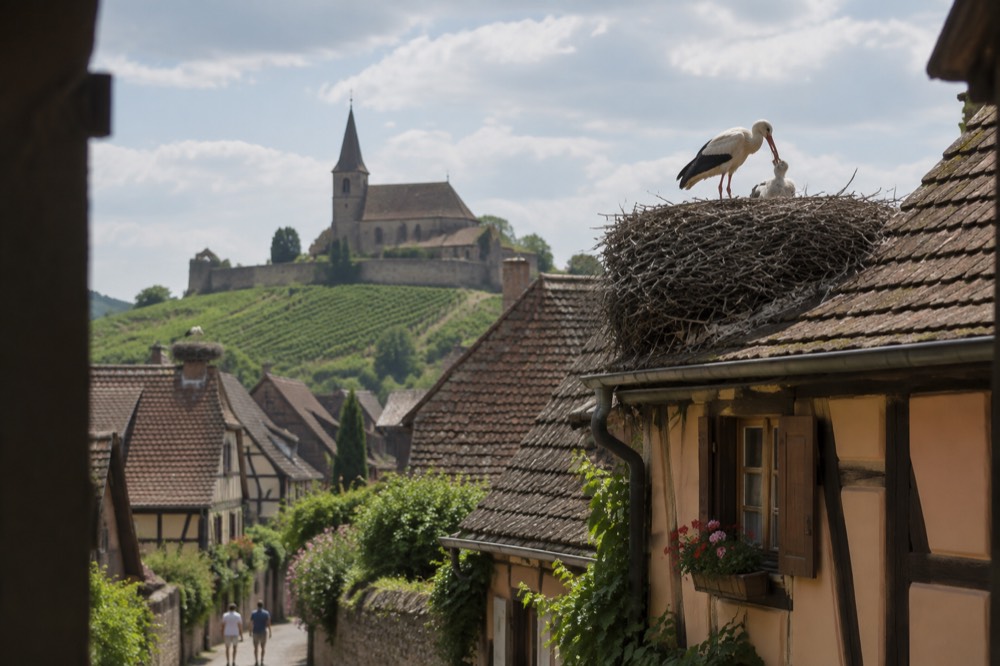
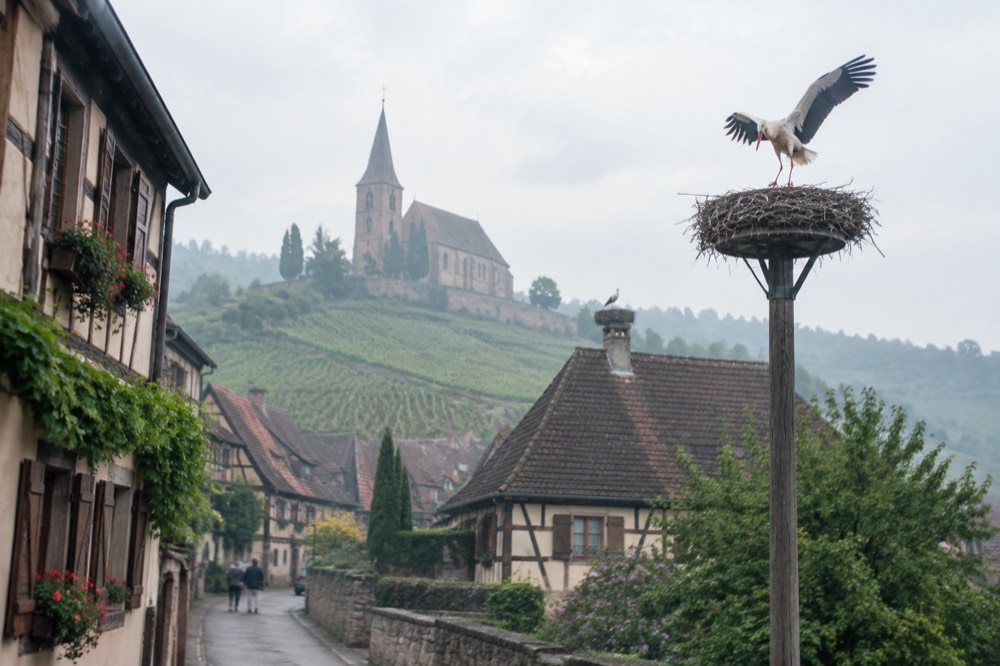
A stork nest is a large, rough platform of sticks, wide enough to fill a chimney top and deep enough to hide standing chicks, often reused and added to each spring until it looks like a basket of kindle on the roofline. In Strasbourg, look on the taller churches, the ridges of larger old buildings and the platforms on poles near the river, and scan the Ill's banks and meadows for feeding birds.
The structure is unmistakable once seen. It is not the neat cup of a songbird but a coarse heap of twigs, white-splashed below from the droppings of the chicks, and it grows over seasons of reuse. The birds will accept a man-made base as readily as a chimney, and villages across Alsace erect metal basket platforms on poles precisely to keep the pairs coming back, sometimes moving a nest, stick by stick, onto the new base when a roof is repaired. That accommodation between bird and building is the practical face of the region's attachment to the species. The wider set of guides lives on Strasbourg Travel Guide.
Within Strasbourg, the search is a matter of looking up in the right quarters. The historic centre's tall roofs carry the odd pair, the churches of Saint-Thomas and Saint-Pierre-le-Jeune among the buildings whose towers and ridgelines suit a nest, and the greensward along the Ill from the Parc de l'Orangerie toward Robertsau offers the foraging habitat that keeps a pair in the area. The Orangerie itself, the park beside the European Quarter, is the city's classic spot for a slow afternoon with a pair of binoculars, and its stork presence is part of why families end up there.
| Place in Strasbourg | What to look for | When to look |
|---|---|---|
| Church towers and tall ridgelines | Stick platforms on high masonry | Spring and summer |
| Parc de l'Orangerie and the Ill banks | Feeding birds on the lawns and shallows | Spring through autumn |
| Robertsau and the riverside meadows | Foraging flights over the fields | Early morning in summer |
| Grande Île rooftops | Occasional nests, seen from the streets below | Any season, a bonus |
The city's free sights are the frame for this kind of wandering, and the free things to do in Strasbourg guide collects the squares, bridges and riverside walks that cost nothing, which is the right budget for an afternoon whose object is a bird on a roof. The Ponts Couverts and the Barrage Vauban terrace, with its seasonal hours, give the wide views over the river quarters where the storks pass through, and the cathedral's single spire, with its platform at 66 m, gives the tallest vantage in the city, though the storks are better watched from below.
How Do You Watch And Photograph Storks Without Disturbing Them?
Keep a long lens and a longer distance, stay on paths and roads, never approach a nest to make a bird fly, and let the feeding meadows come to you: storks are tolerant of vehicles and distant walkers but abandon nests when people press in close. The rule of thumb is that if the bird stops feeding or stands alert, you are close enough. Photograph from the car, from marked paths and from village streets, where the birds are habituated to people below them.
Nest photography is the easy half, because a rooftop nest is watched from a public street and the birds are used to the street's noise. The chick-feeding sequence, the wing-stretching of the young and the bill-clattering salute between arriving adults all happen above the traffic and can be shot from below with a modest telephoto. The temptation to climb, to use a drone or to shout for a reaction is exactly what the region's protectors ask visitors to avoid, and the result is usually a bird that flushes and a nest that is left unguarded for the minutes that matter.
Feeding-field photography is the harder and better half. Storks follow the mowers, so a field being cut in early summer can hold a dozen birds, and a car stopped at the verge is a hide that the birds ignore. Walkers who leave the road to close the distance change that arithmetic at once. In the wetlands, the hides and observation points that the reserves provide are the whole point of the infrastructure: use them, and give the meadows between them a wide berth in the breeding weeks.
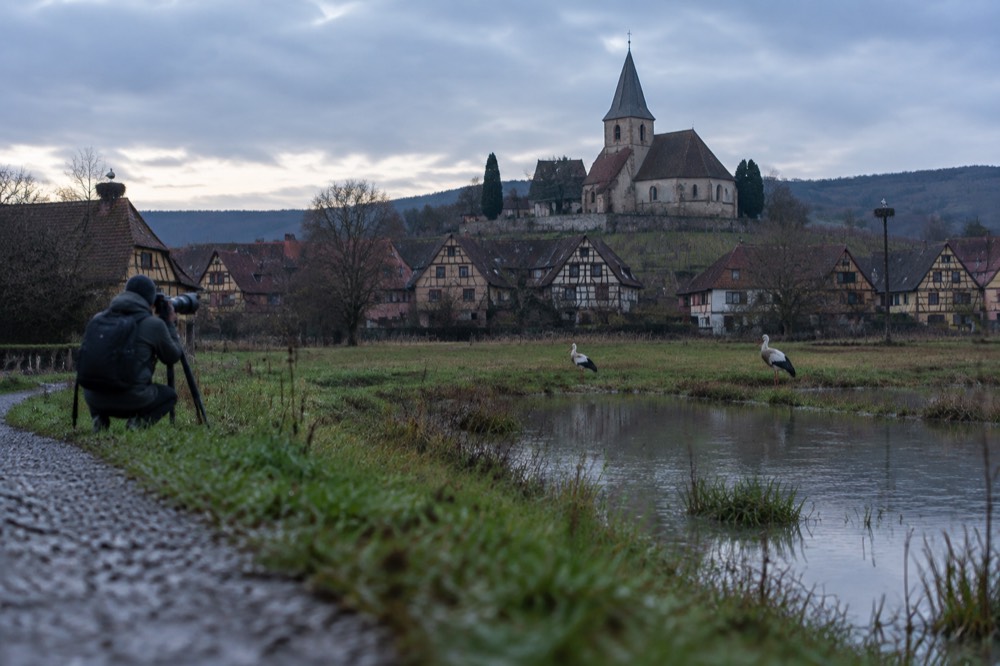
The etiquette is not complicated, and it is the same etiquette that applies to the region's other wildlife, from the eagles and vultures of the Haut-Koenigsbourg country to the quiet birds of the Rhine islands. Keep to the marked route, take nothing, leave the dog on the lead in the reserves, and check the rules of each site on its own page before visiting, because the reserves vary in what they permit at different times of the nesting season. A stork that is habituated to a village street is not a stork that is habituated to a person in its meadow, and the distinction is worth keeping in mind all day.
What Pairs Well With A Stork Day In Alsace?
A stork outing pairs naturally with the wine route villages, a tasting stop, a walk in the Vosges foothills or a castle visit, because the bird's territory and the classic Alsatian day trip are the same territory. The villages south and south-west of Strasbourg put nests on chimneys, wine in the cellars and viewpoints in the hills within a single loop. In winter, when the birds are away, the Christmas markets take over the region's calendar.
The wine route is the pairing that answers itself. The storks nest in the same villages that grow the grapes, so a day that begins at a stork park can end in Riquewihr or Eguisheim or Kaysersberg with a glass of the local riesling or a crémant, and the Alsace wine route planning pages cover the stops. The vineyard rows climb the hillsides while the storks keep to the plain below, so the day gains altitude and variety without ever leaving the bird's home range.
The hills add the second dimension. The Vosges foothills and the crest road above them give the long views back over the plain the storks cross, and the castles of that ridge, Haut-Koenigsbourg among them, sit above the same landscape. In the other direction, the Rhine and the German bank offer a different pairing: the Black Forest begins across the river, and a cross-border loop contrasts the open Alsatian plain with the dark German hills.
| Pairing | What it adds to the stork day | Season |
|---|---|---|
| Wine route villages | Streetscapes, tastings, chimney nests | Spring through autumn |
| Vosges foothills and castles | Views over the plain, hill walking | Spring through autumn |
| Rhine wetlands and hides | Wild birds, quiet paths | Spring and summer |
| Cross-border Black Forest loop | Forest contrast, German towns | Year round |
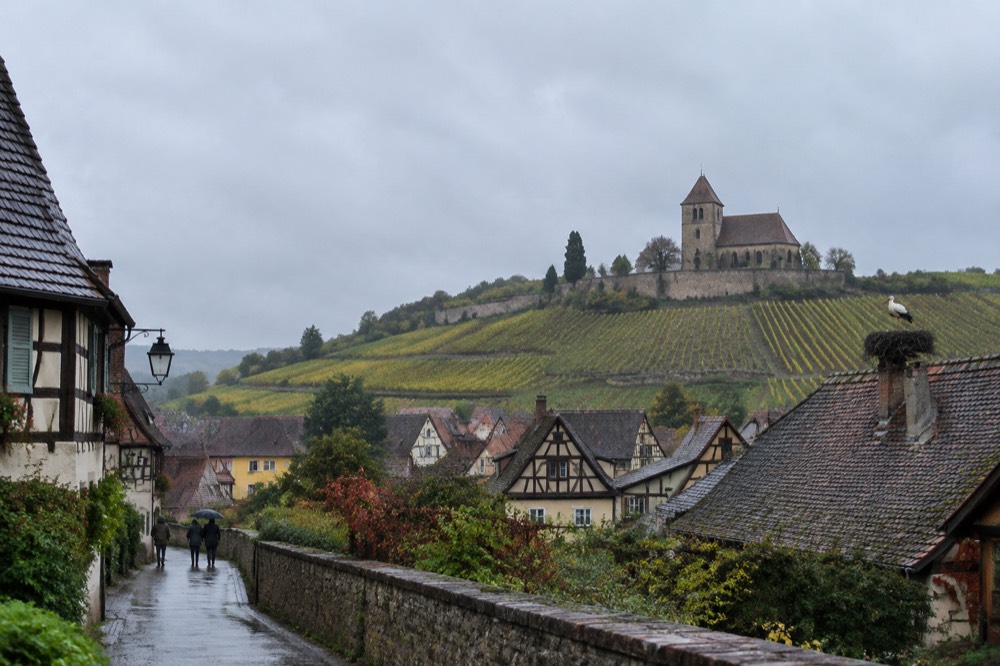
In the cold half of the year the region pivots to its other great tradition. The storks are in Africa, the villages go quiet, and the Christmas market takes over Strasbourg's squares, opening in the last week of November and running to 24 December, with the next edition's dates still to be confirmed on the city's own Christmas site; last year's edition ran 26 November to 24 December 2025. The Strasbourg Christmas market guide and the wider Christmas markets in Alsace pages cover that season, and the stork motif on the chalets and the decorations keeps the bird present in the region's imagery even while the real birds are away.
Do You Need A Guide Or A Tour To See Storks In Alsace?
No, a guide is not needed to see storks, because the parks, the villages and the roadside meadows are self-service, but a guided walk or a regional day trip adds context that the birds themselves do not supply: the reintroduction story, the nesting calendar and the villages' history. A city walking tour on the first day, followed by an independent stork day, is the pattern that works for visitors who want both.
The independent version is entirely workable. The stork parks sell their own entry, the villages are public streets, and the feeding fields are visible from rural roads, so a visitor with a car, a map and a free morning can assemble the day alone. What the independent version misses is the narrative: why the bird disappeared, what the reintroduction involved, which nest on which chimney has been occupied for how many seasons. That is the layer a local guide carries, and in the villages it is sometimes the only layer that separates a rooftop with sticks from a rooftop with a story.
In Strasbourg itself, the guided options are walking tours of the historic centre, and the Secrets from Strasbourg walk, a guided walk of the city's hidden corners, is the one this site features: it covers the quarters where the riverside and rooftop life of the city shows itself, and it makes a sound first-day orientation before a stork excursion into the countryside. The city's hidden gems guide collects the same territory for visitors who prefer to wander alone.
For the countryside, the guided day trips that cross the wine route and the Vosges foothills pass through stork country as a matter of course, and a guide who stops the vehicle for a field of feeding storks is doing exactly what an independent traveller would do with more freedom and less company. The trade is simple: independence for the bird, a guide for the region. Visitors with a full itinerary, a short stay or no car will get more from the guided version, and the Strasbourg tours overview pages lay out the formats.
What Should You Pack For A Stork-Watching Day?
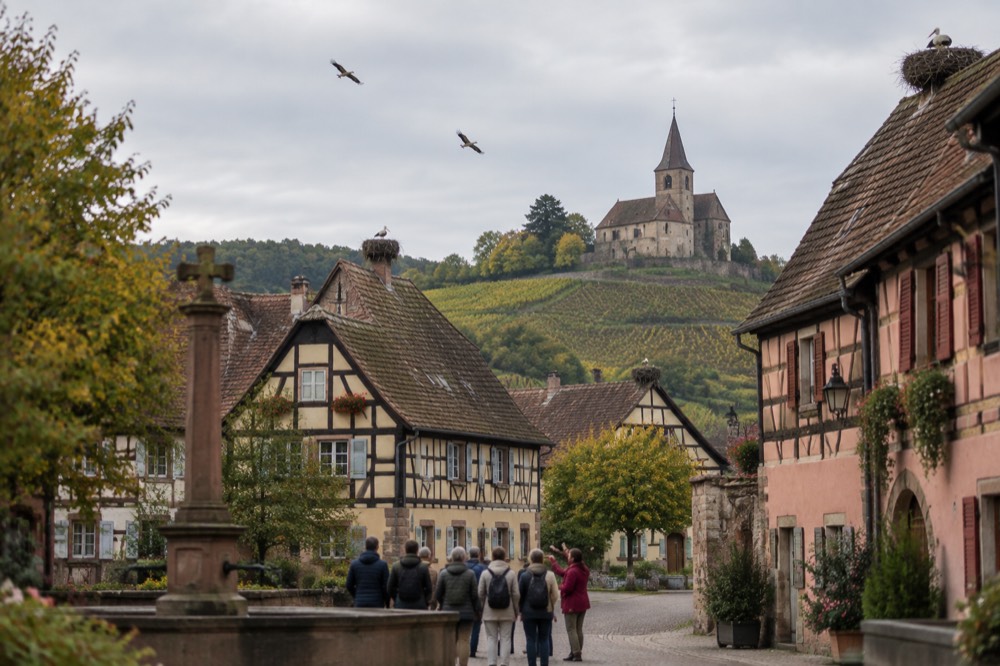
Pack binoculars, a telephoto lens if photography is the point, layered clothing for a semi-continental day, stout shoes for village streets and reserve paths, water and a picnic for the meadows, and the region's own resources: each stork park's site for hours and entry, a paper map for the rural roads where signal fades, and a plan that treats rain as a delay rather than a cancellation. The bird does not mind the weather.
The optics matter more than the camera. A stork on a nest at street distance is visible to the naked eye, but a feeding field is watched from a hundred metres and more, and binoculars turn a white shape in the grass into a bird with a ring on its leg. A telescope is for the serious hides of the Rhine reserves; binoculars are for everyone else. If the camera is the point, a lens that reaches the birds without stepping into the meadow is the whole of the ethics discussion from the watching section, compressed into a specification.
The clothing follows the climate rather than the season's reputation. A spring day can run from a mean minimum of 2.6 C in March at dawn to a mean maximum of 20.9 C in May by afternoon, so layers, not a single outfit, are the answer, and the rain days of the 1991-2020 normals, 8.5 in March and 10.8 in May, say the same thing about the outer layer. Summer asks for a hat and water for the open plain, where shade is a village, not a feature.
| Item | Why it earns its place | Season it matters most |
|---|---|---|
| Binoculars | Feeding fields are watched at distance | All seasons |
| Telephoto lens | Keeps the photographer out of the meadow | Nesting season |
| Layered clothing | Semi-continental days swing wide | Spring and autumn |
| Rain shell | Rain days are common in every month | All seasons |
| Sturdy shoes | Reserve paths and village cobbles | All seasons |
| Water and picnic | The meadows have no services | Summer |
The last item is patience, which costs nothing. A stork day is a slow day by design: the mowers' schedule decides where the birds are, the nest decides when the feeding flights happen, and the afternoon in a village square with a glass of wine is not a failure of the plan but the plan itself. The visitors who enjoy the bird the most are the ones who let the region set the pace, which is the spirit the whole of Alsace rewards.
Common Questions About Alsace Storks
Are storks common in Alsace?
Storks nest across the Alsace plain and are a normal sight in the villages between Strasbourg and the Vosges from early spring through summer, after a steep decline in the decades after the Second World War and a reintroduction effort that brought the bird back to the region's chimneys. The current population figure is not published on this page, but nests on village rooftops are again an ordinary feature of the landscape.
Where is the best place to see storks in Alsace?
The dedicated stork parks and reintroduction centres of the Alsace plain give the closest and surest views, including resident birds and feeding areas. Wild storks are watched in the wet meadows along the Ill and the Rhine and from the villages of the wine route, where nests sit on chimneys and purpose-built platforms. Strasbourg itself has occasional nests on taller buildings, but the city is a bonus rather than a destination for the species.
When do storks arrive in Alsace?
White storks return to Alsace from their African wintering grounds in early spring, with pairs reclaiming old nests and beginning courtship and repairs at once. Chicks hatch in late spring, feeding flights run through midsummer, and the young gather in flocks before the late-summer departure. The exact arrival varies with the weather along the migration route, so early spring should be read as a window rather than a date.
Can you see storks in Strasbourg itself?
Yes, occasionally. A few pairs nest within the built-up area on tall buildings and church towers, and storks pass over the city in the migration seasons and feed along the Ill and its meadows, especially toward the Parc de l'Orangerie and Robertsau. But the densest nesting is in the villages, so a sighting in Strasbourg is best treated as a pleasant surprise on a walk rather than the object of one.
What do Alsace storks eat?
White storks are opportunistic feeders: insects, earthworms, amphibians, small fish, small mammals and reptiles, taken from wet meadows, riverbanks and the fields the mowers have just cut. In the stork parks the diet is managed as part of the breeding and reintroduction programme, which is one reason the parks offer reliable close-up viewing at any hour of the day.
Is a stork park visit suitable for children?
Yes, stork parks are built for exactly that: close-up birds, walkable enclosures and an educational story about the reintroduction programme that children can follow. Pair it with a village stop for a tarte flambée lunch and the day holds a child's attention from morning to afternoon. Check each park's own site for opening hours, entry prices
The stork is the thread that runs through the whole of Alsace, from the weathervane above a winstub in Strasbourg to the platform on a pole at the edge of a wine route village, and a day spent following it is a day spent in the region's ordinary, working landscape rather than its monuments. Pick the season, pick a corridor, look up, and the bird that made Alsace's roofs famous will do the rest.