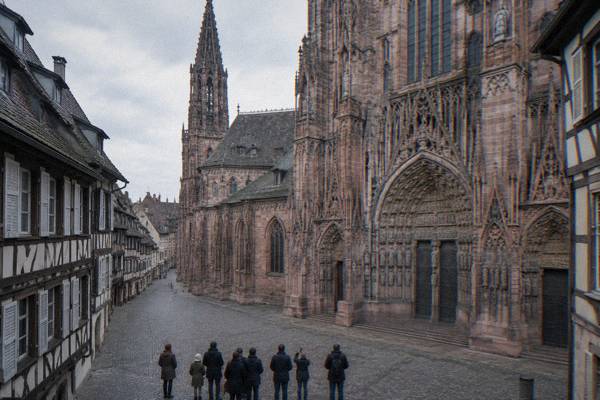
Saint Pierre Le Jeune Strasbourg
The Église Saint-Pierre-Le-Jeune is one of the old-town churches of Strasbourg in Alsace, north-eastern France, known for its painted interior and its quiet cloister a few streets from the cathedral.
Short answer
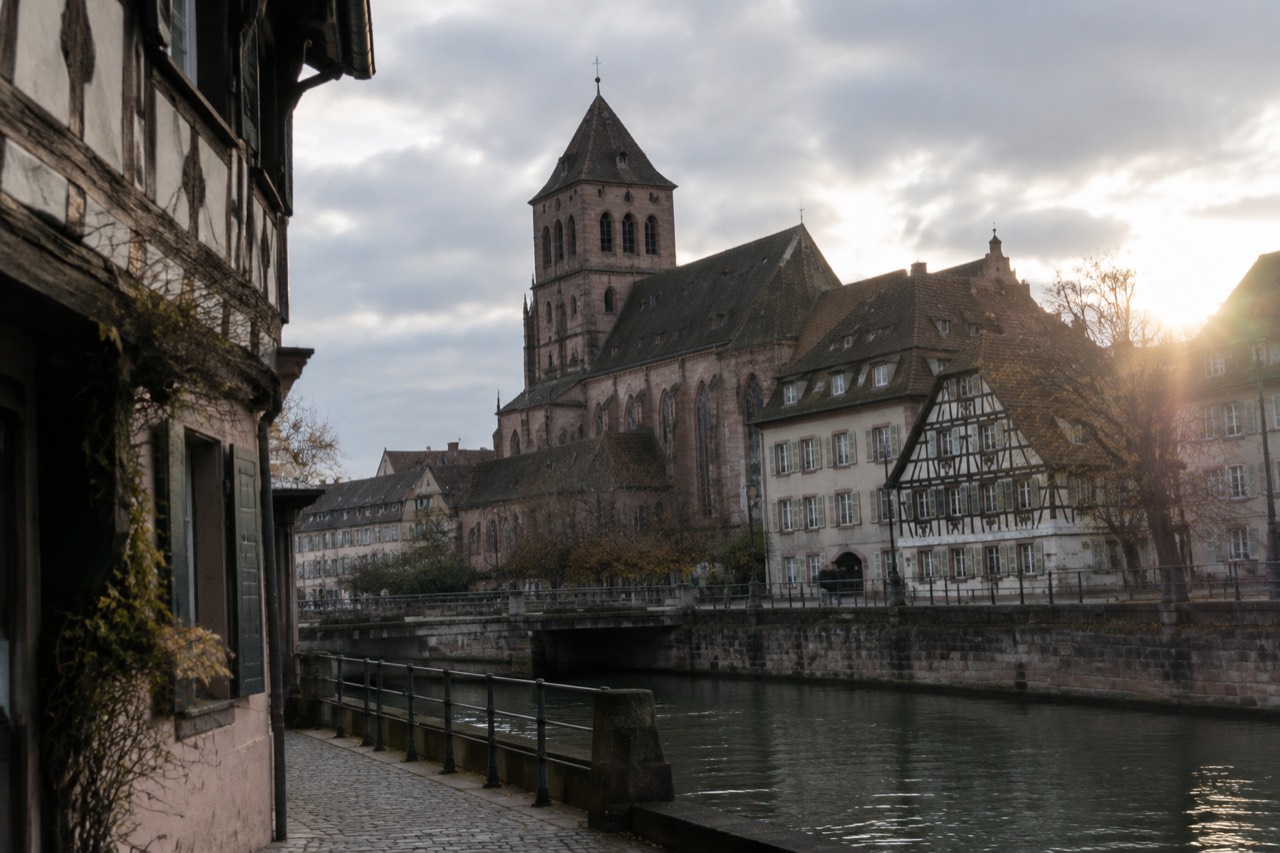
The Église Saint-Pierre-Le-Jeune is a historic parish church on the Grande Île in Strasbourg, France, a few streets from the cathedral. It is known for its interior wall paintings, its cloister. Admission details and opening hours are published on the parish and city pages, so check those before visiting.
The Église Saint-Pierre-Le-Jeune stands in the heart of Strasbourg, the prefecture of the Bas-Rhin, in Alsace in the Grand Est region of north-eastern France, a few streets from the cathedral on the Grande Île, the river-girded medieval core that gives this border city its character. Where the cathedral draws the crowds and the cameras, this smaller church asks for less and rewards patience: an interior covered in painted decoration, a cloister that keeps the noise of the city outside, and a congregational story that reflects the mixed Protestant and Catholic inheritance of Alsace itself. This page lays out what the church is, what you actually look at once you are inside, how it compares with the city's bigger ecclesiastical sights, and how to fold it into a day built around the cathedral, Petite France and the river quarter.
What Is The Église Saint-Pierre-Le Jeune In Strasbourg?
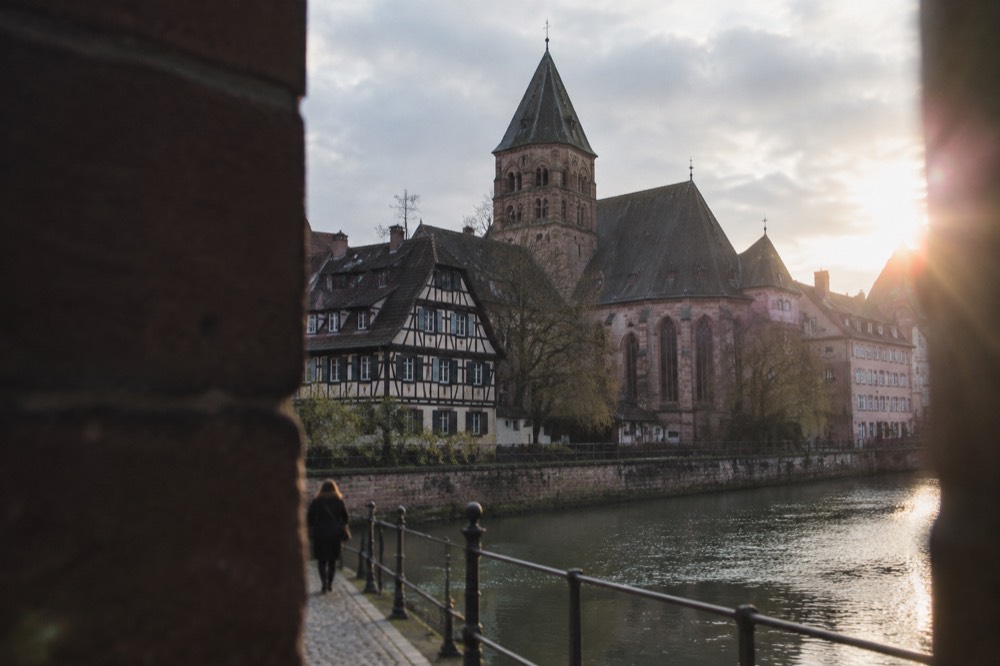
The Église Saint-Pierre-Le-Jeune is a medieval parish church on the Grande Île in Strasbourg, France, a few streets from the cathedral. Its interior carries extensive wall paintings, and it keeps a cloister beside the nave. It is a working parish church rather than a ticketed monument, so hours and access are set by the parish, not by a museum schedule.
The name distinguishes it from a second, older Saint-Pierre church elsewhere in the city: "le Jeune" means "the Younger," and both parishes sit within the old town's ecclesiastical history. The church you want as a visitor is the one on the Grande Île, inside the UNESCO-listed river loop. Strasbourg's World Heritage property is listed as "Strasbourg, Grande-Île and Neustadt," with the Neustadt, the German-built quarter east of the Ill, added as a later extension, and this church belongs to the older, western half of that inscribed area.
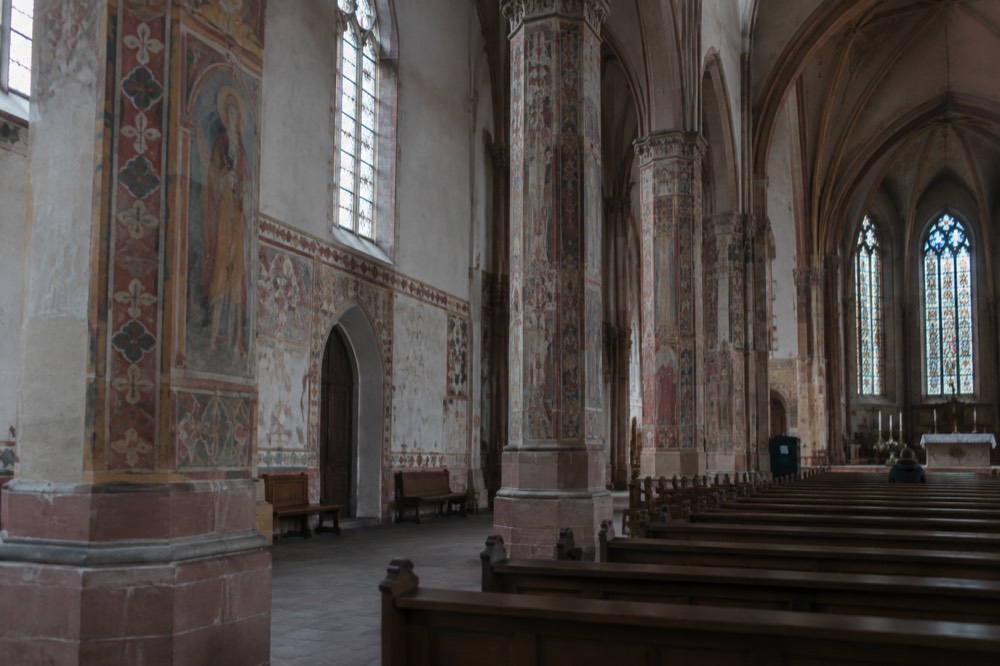
What makes it worth the detour is the interior. Where the cathedral soars in bare stone and glass, Saint-Pierre-Le-Jeune is painted: figurative decoration across walls and columns, restored in stretches, reading like a picture book for congregations who could not read. The church also holds a cloister, a covered walkway of a kind the cathedral never had, which is a rarity in the city centre and one of the quietest corners of the Grande Île on a weekday morning. The division of the building between a Protestant and a Catholic congregation is the other headline fact: one church, two worshipping communities, a living expression of the region's religious history rather than a museum piece of it.
Because it is a parish church, the practical details are lighter than for a monument. There is no permanent ticket desk of the kind the cathedral platform has, and no timed automaton show of the kind the astronomical clock offers at 12:30. Services take precedence over sightseeing, especially around the church calendar, and the parish and city pages carry the current opening pattern. Treat any third-party listing of hours with care and confirm on the parish's own page before you build a tight itinerary around a visit.
Where Is The Church And How Do You Reach It?
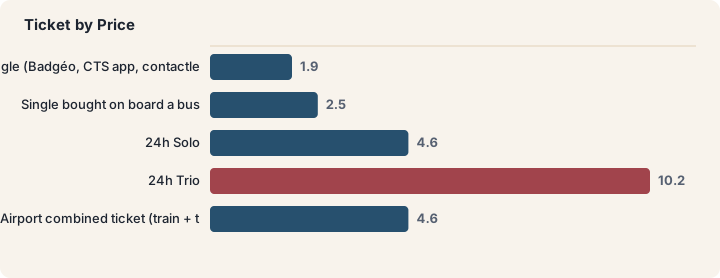
The church sits on the Grande Île, the island core of Strasbourg, France, within easy reach of the cathedral, Place Kléber and the river quarter, and every tram line that serves the city centre stops within a short level walk of it. A single CTS ticket costs 1.90 EUR bought via the app or contactless, or 2.50 EUR on board a bus, and a 24-hour Solo pass costs 4.60 EUR if you plan several rides in a day.
The Grande Île is compact, and this is the practical point for a visitor: the church, the cathedral, Place Kléber, Place Gutenberg and the Ponts Couverts are all stops on one long walk rather than separate journeys. If you arrive by train at the Gare Centrale, the tram network runs from the station forecourt into the centre, and the CTS fare page gives the single, day-pass and group prices. The verified fares are the single at 1.90 EUR through the Badgéo card, the CTS app or contactless payment, 2.50 EUR if bought on board a bus, the 24h Solo at 4.60 EUR and the 24h Trio, covering two to three people, at 10.20 EUR.
| Ticket | Price | Where it applies |
|---|---|---|
| Single (Badgéo, CTS app, contactless) | 1.90 EUR | One journey on the CTS network |
| Single bought on board a bus | 2.50 EUR | One journey on the CTS network |
| 24h Solo | 4.60 EUR | One person, unlimited CTS rides for 24 hours |
| 24h Trio | 10.20 EUR | Two to three people travelling together |
| Airport combined ticket (train + tram/bus + 24h EMS) | 4.60 EUR | Entzheim airport shuttle into Strasbourg |
If you are flying in, Strasbourg Airport at Entzheim connects to the Gare Centrale by a regional train shuttle that runs up to five trains an hour and takes 8 minutes, and the combined airport ticket at 4.60 EUR covers the train plus a day of urban transport, a detail the airport's own access page sets out. From the station, the tram ride into the centre is short, and from any central stop the church is a level stroll away. Cyclists will find the city flat and the church reachable on the same network of lanes that serves the Jardin des Deux Rives and the riverside paths, and the city's bike-hire and guided-ride options are covered on our page about cycling in Strasbourg.
For anyone who prefers to arrive with a guide rather than a map, a walking tour is the natural way to reach the church, since the old town's lanes explain themselves better with narration. The cathedral-focused guided walk is the closest match, because it treats the ecclesiastical core of the city as its subject.
If you prefer to arrive with a guide rather than a map, book a free walking tour here.
What Do You Actually See Inside The Church?
The interior of the Église Saint-Pierre-Le-Jeune in Strasbourg, France, is defined by two things: the wall paintings that cover columns and walls with figurative and decorative scenes, and the cloister adjoining the church. Visitors with an hour see both at an unhurried pace, and the church rewards slow looking more than a quick circuit.
Start with the paintings. They are the reason people who have already seen the cathedral come here, and they read differently from the stained glass of the bigger church: narrative, dense, close to the eye. Restoration work has returned stretches of the decoration to something near their original colour, and the parish keeps the interior as a space for worship first, which means the lighting is atmospheric rather than gallery-bright. Give your eyes a minute to adjust after the street, then work the walls methodically rather than hunting for a single highlight.
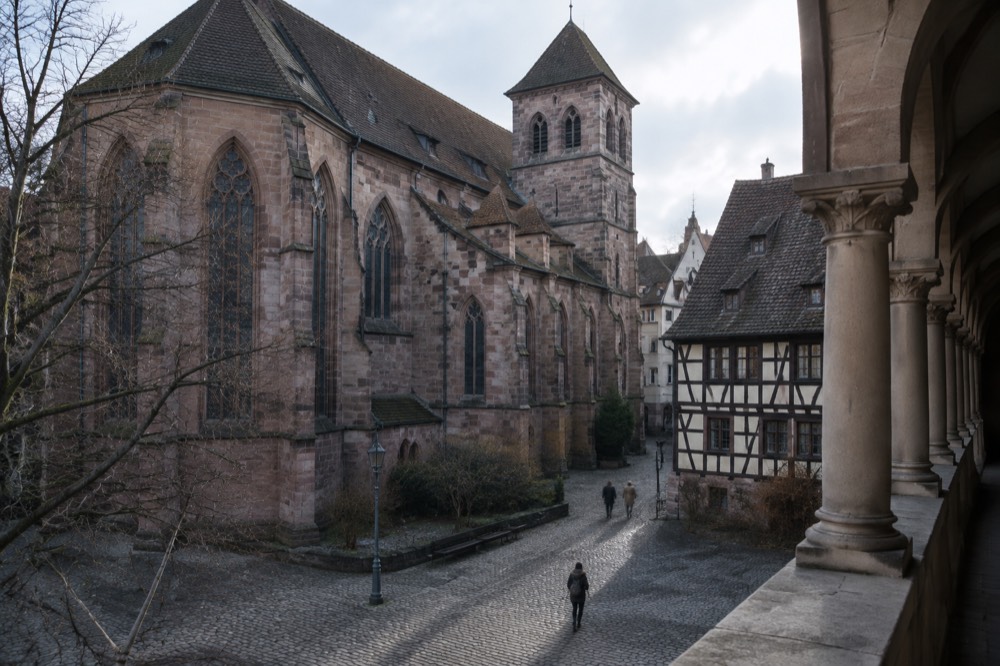
The cloister is the second act. Covered walkways of this kind are uncommon in the city, and this one functions as an architectural hinge between the street and the nave. On a weekday it is one of the quietest enclosed spaces on the Grande Île, and photographers will find the contrast between the painted interior and the plain stone of the walk worth the pause. It is a working example of the region's confessional history, visible in furniture, orientation and signage rather than on a label.
Practicalities are simple but checkable rather than assumed. The parish and the city's own pages carry the current opening pattern, and neither an admission price nor set visiting hours can be quoted here as a fixed figure, because the church is a place of worship whose schedule follows the parish calendar. Services, rehearsals and parish events close the doors to sightseeing without warning, which is normal for a working church and worth planning around: build the visit into a loose morning rather than a timed slot. Photography is generally tolerated for personal use, but flash and tripods are unwelcome in a painted interior, and any group visit should be arranged with the parish in advance.
A short visit pairs naturally with the two ecclesiastical heavyweights nearby. The Musée de l'Œuvre Notre-Dame holds the cathedral's medieval sculpture and art, and the astronomical clock performs its automaton show at 12:30 daily, with tickets at 4 EUR for adults, sold on the day only. If your morning is built around the church, the cathedral nave and the clock, you have the religious core of the Grande Île in one walk.
How Does It Compare With Strasbourg Cathedral?
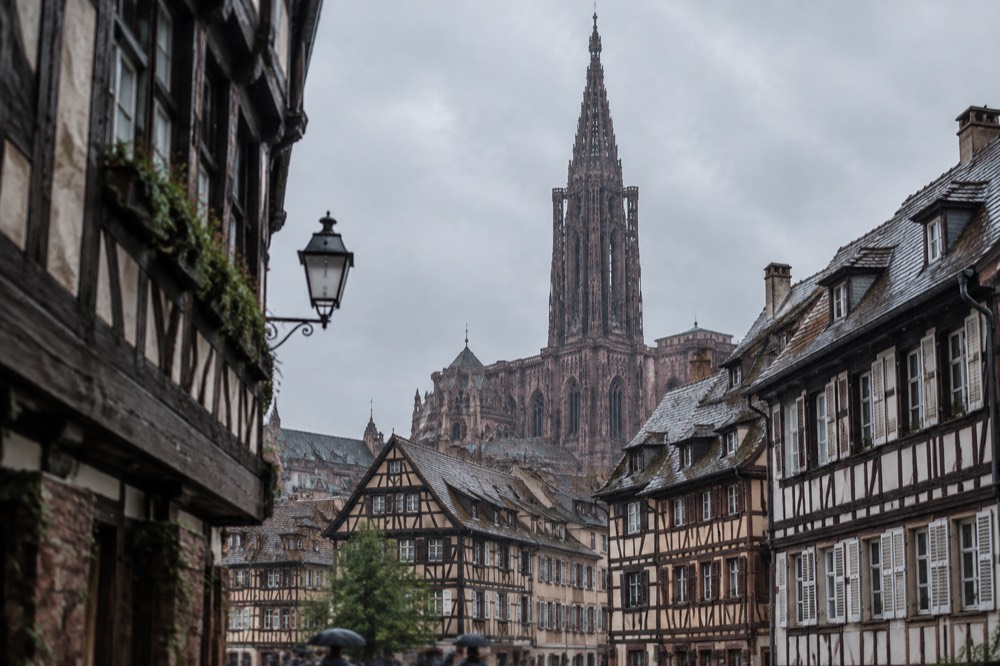
Strasbourg Cathedral is the city's monument: a single-spired giant with a platform at 66 m, an astronomical clock and a paid schedule of visits, while the Église Saint-Pierre-Le-Jeune is a smaller painted parish church with no comparable ticketed attractions. The cathedral demands half a day; Saint-Pierre-Le-Jeune asks for an hour. Seeing both on the same morning is the standard move and works well.
The cathedral's nave hours run Mon-Sat 08:30-11:15 and 12:45-17:45, with Sunday afternoons 14:00-17:15, and during the Christmas market the cathedral stays open continuously Mon-Sat on the Place du Château side. The platform above has its own seasonal hours, 09:30-13:00 and 13:30-20:00 from April to September, 10:00-13:00 and 13:30-18:00 from October to March, and its own ticket at 10 EUR full, 6 EUR reduced, under-6s free. The clock show at 12:30 costs 4 EUR for adults, 3 EUR for groups of twelve or more and students up to 25, and 2 EUR for children aged 6 to 17, with day-of purchase only.
| Visit | What you get | Ticket |
|---|---|---|
| Cathedral nave | The Gothic interior, free-flowing visits within nave hours | Check the cathedral's own page |
| Cathedral platform | Viewpoint at 66 m, reached by stairs | 10 EUR full, 6 EUR reduced, under-6s free |
| Astronomical clock | The 12:30 automaton show, ticket sold on the day | 4 EUR adult, 3 EUR groups and students, 2 EUR ages 6-17 |
| Saint-Pierre-Le-Jeune | Painted parish interior and cloister | Check the parish page |
| Municipal museums | Art and history collections, 9 EUR full, 5 EUR reduced | Free the first Sunday of each month |
The honest framing is that the two buildings answer different questions. The cathedral is about scale, engineering and light; Saint-Pierre-Le-Jeune is about colour, narrative and intimacy. A traveller who sees only the cathedral leaves with the postcard; a traveller who adds the painted church leaves with the fuller picture of what religious art in this region looked like at street level, in the parishes rather than in the great minster. The Église Saint-Thomas, another of the city's Protestant churches, extends the same story again, and the Église Saint-Paul on the edge of the Neustadt makes a fourth stop for anyone building an ecclesiastical day.
If you want the cathedral half of the pairing handled for you, a guided walk of the cathedral and its surroundings is the efficient option, and the operator's live listing carries the current price and availability.
What Nearby Sights Pair Well With A Visit?
The best pairings for the Église Saint-Pierre-Le-Jeune are, in order of convenience: Strasbourg Cathedral and its platform, the Place Kléber and Place Gutenberg squares, the Musée de l'Œuvre Notre-Dame for medieval art, and the Petite France river quarter with the Ponts Couverts and Barrage Vauban. All sit on the Grande Île or its edge, and all can be reached on foot from the church without transport.
A sensible order is to take the church early, while the light comes low through the painted nave, then walk to the cathedral for the clock show at 12:30 if you have timed your morning that way. After the cathedral, the Place Kléber and Place Gutenberg give you the civic squares of the old town, with the Christmas tree and the market chalets taking over Kléber in late November and December. The Palais Rohan holds three museums in one building, including the fine-arts collection, at the municipal rate of 9 EUR full and 5 EUR reduced, and the Musée Alsacien is closed for works until 2028, so do not route a visit there.
| Pairing | What it is | Why it fits | What to check |
|---|---|---|---|
| Cathedral platform | Viewpoint at 66 m | Same walk, one ticket | Seasonal hours, 10 EUR full |
| Astronomical clock | Automaton show at 12:30 | Times a cathedral morning | Day-of tickets only, 4 EUR adult |
| Musée de l'Œuvre Notre-Dame | Medieval sculpture and art | Explains what you just saw | 9 EUR full, 5 EUR reduced |
| Petite France and Ponts Couverts | River quarter and towers | Ends the day by the water | Free-flowing public space |
| Barrage Vauban terrace | Panoramic platform over the Ill | Best late-afternoon light | Seasonal hours on the city page |
| Batorama river tour | Boat circuit of the Ill | Sits the feet after walking | 16.20 EUR full long tour, 12.50 EUR short |
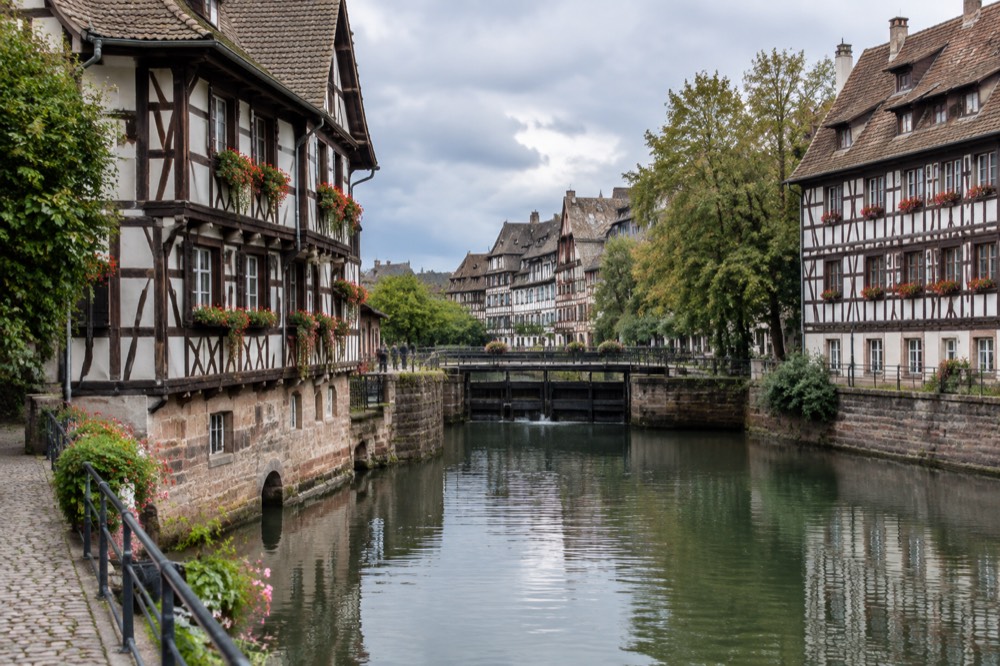
The river quarter makes the best end to the day. Petite France is the half-timbered former tanners' and millers' quarter at the tip of the Grande Île, and the Ponts Couverts and the Barrage Vauban terrace give you the two classic viewpoints over it. The Barrage Vauban terrace keeps seasonal hours, 08:00-19:00 through September and October, 08:30-16:00 from November to February, and the admission situation is not stated on the city page, so check it there. Batorama's boat tours, the long circuit at 16.20 EUR full and 8.90 EUR reduced, the short circuit at 12.50 EUR full and 7.20 EUR reduced, run from the quai des bateliers side and give the same quarter from the water.
Food belongs in the plan too, because the streets between the church and Petite France hold the winstub tradition of the city, the tavern rooms serving Alsatian dishes. A food walk is the structured way to do it, and the culinary tour on the roster covers exactly this ground. Other pages covering the same trip are gathered on Strasbourg Travel Guide.
When Is The Best Time Of Year To Visit?
The church is an indoor sight, so it works in every season, but the experience around it changes sharply: late spring to early autumn gives long evenings for the river quarter, December turns the surrounding Grande Île into the Christkindelsmärik Christmas market, and midwinter is cold, with a mean December maximum of 5.9 C and 10.2 rain days in the month. The painted interior is at its best in the low, warm light of a winter morning.
The climate here is semi-continental, which means warm summers and genuinely cold winters rather than the mild pattern of Atlantic France. The Meteo-France 1991-2020 normals for Strasbourg-Entzheim put the mean daily maximum at 26.4 C in July and 5.2 C in January, with 635.7 mm of rain spread over 112.3 rain days across the year. Rain falls in every month, between 8.0 and 10.8 days of at least 1 mm, so an umbrella is a year-round tool and an indoor church is a useful thing to have in the itinerary.
| Month | Mean max C | Mean min C | Rain mm | Rain days >= 1 mm |
|---|---|---|---|---|
| March | 12.1 | 2.6 | 38.6 | 8.5 |
| June | 24.4 | 13.4 | 68.5 | 10.2 |
| September | 21.6 | 10.7 | 54.6 | 8.0 |
| December | 5.9 | 0.8 | 45.2 | 10.2 |
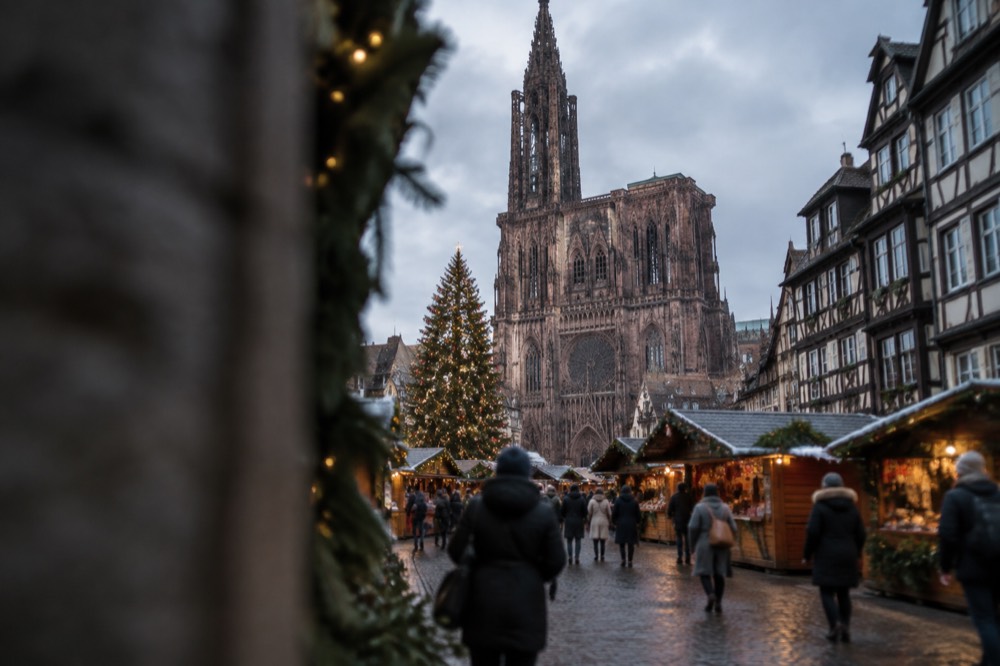
December deserves its own paragraph because it changes the whole setting. Strasbourg's Christmas market, the Christkindelsmärik, traditionally opens in the last week of November and runs to 24 December, with the closing evening early on the 24th; the 2025 edition ran 26 November to 24 December and drew 3.05 million visitors, the city's own bilan confirms. The 2026 dates are not yet published, and the city's Christmas site states that the programme is still being finalised, so confirm there before you book anything. During the market, the cathedral is open continuously Mon-Sat on the Place du Château side, the squares around the church fill with chalets, and hotel prices in the old town rise accordingly. The painted interior of Saint-Pierre-Le-Jeune is a calm counterweight to the market crowds, and an hour inside it is the cheapest form of relief a December visitor can find.
How Do You Visit The Church With A Guided Tour?
The church is not a stop on a dedicated paid tour of its own, but it sits squarely inside the old-town walking routes of Strasbourg, France, so the practical answer is a guided walk of the historic centre or the cathedral quarter, with the church visited independently before or after. The cathedral guided walk is the closest thematic match, and the free pay-what-you-want walking tours of the city cover the same streets.
Guided walks come in several shapes. The cathedral tour treats the ecclesiastical core as its subject, which suits a visitor whose interest in Saint-Pierre-Le-Jeune is primarily religious and architectural. The historic-centre walks, including a Petite France route, cover the lanes between the church and the river, and there are free, pay-what-you-want English-language walking tours that run through GuruWalk, where you tip the guide at the end, with the duration shown on each listing. The European Quarter walk heads the other way, east across the Ill into the Neustadt and the district of the European Parliament, the Council of Europe and the European Court of Human Rights, and makes a strong second half of a full day.
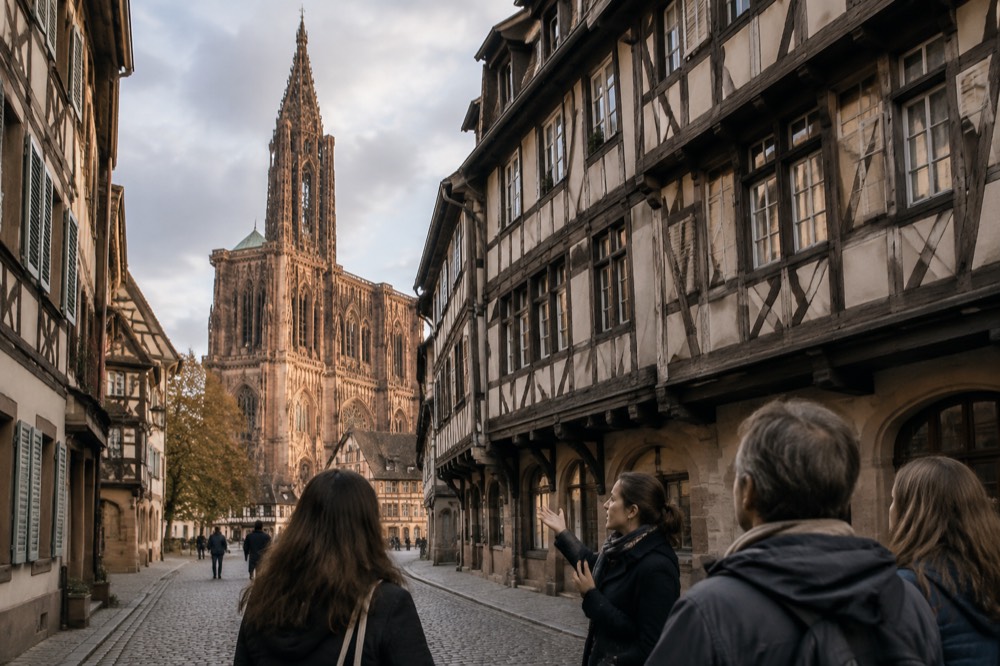
The cathedral walk is the one to pair with this page's subject, and it can be booked through the operator's live listing, which carries the current price and the meeting point. Check availability if the ecclesiastical morning is the shape of your day.
For the river half of the day, the Petite France walk with a local guide covers the quarter that ends most Strasbourg itineraries, and it slots into the afternoon after a morning of churches.
What Should Families And Less Mobile Visitors Know?
The church and its immediate quarter are workable for families and for less mobile visitors, with the usual caveats of a medieval building: level access is not guaranteed at every door, the cloister and nave involve stone floors and a few steps, and the surrounding Grande Île is pedestrian-priority and flat. The Le Vaisseau science centre and the Parc de l'Orangerie are the family anchors nearby, both reachable by tram.
Inside the church, the practical questions are steps, seating and space. A painted parish interior is generally more forgiving than a tower climb: there is no ascent comparable to the cathedral platform, whose 66 m viewpoint is reached by stairs, and seating is usually available in the nave for anyone who needs a rest. The parish page is the place to confirm step-free access at a specific entrance, since historic churches often have one accessible door and several that are not. Buggies are easier here than in the cathedral's crowded nave, and the cloister gives children an enclosed space to look at without the reverential hush of a great minster.
For the wider day, the old town rewards slow pacing. The tram network is step-free at its stops, the single fare at 1.90 EUR or the 24h Solo at 4.60 EUR covers it, and the river boat tours board from quays level with the street. Families building a longer stay will find the Orangerie park and its lawns a better release valve than the market squares in December, and the stork, the emblematic bird of Alsace, appears in parks and on rooftops across the region, a detail children tend to remember longer than any painting.
What Mistakes Do Visitors Make Here?
The recurring mistakes are simple: treating the church as a cathedral substitute and leaving disappointed, assuming it keeps monument-style hours when it keeps parish hours, skipping the cloister, visiting in the middle of a service, and leaving the surrounding quarter unexplored when the Ponts Couverts and Barrage Vauban are a short walk away. None of these are expensive errors, but each one wastes part of a morning that the Grande Île gives away for free.
The first error is expectation. This is not the tallest or the largest of anything; it is a painted parish church, and its value is intimacy. Come from the cathedral and the contrast is the point. The second error is timing: a working church closes for worship, and the parish calendar, not a tourist schedule, governs access. The third is the missed cloister, which visitors sometimes walk past because the painted nave pulls them straight in. The fourth is the unbuilt afternoon: the church sits inside a quarter that holds the Maison Kammerzell, the cathedral, the squares and the river, and the visitor who treats the church as a box to tick loses the walk that connects them.
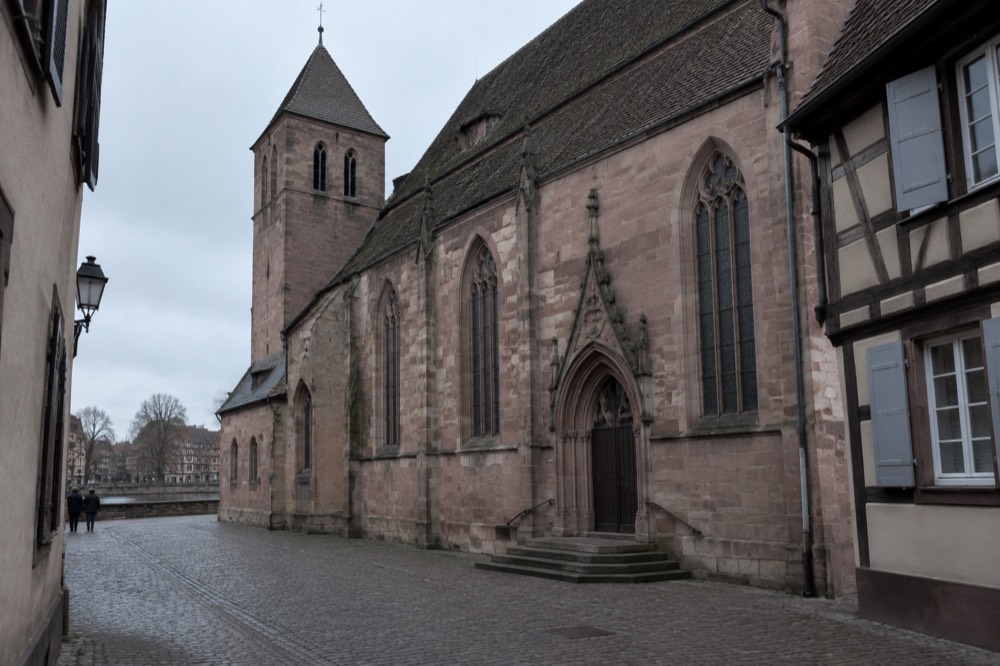
The last mistake is seasonal: assuming December is unmanageable. The market weeks crowd the squares, but they also light the whole Grande Île, extend the cathedral's continuous opening hours on the Place du Château side, and make an evening walk from the church to the river the best free spectacle in the city. Confirm the 2026 market dates on the city's Christmas site, book old-town accommodation early for the market weeks, and let the painted church be the quiet hour between the crowds.
If the day is taking shape around churches, squares and the river, these three walks cover the ground with a guide alongside you.
Common Questions About The Église Saint-Pierre-Le-Jeune
Is the Église Saint-Pierre-Le-Jeune in Strasbourg, France, free to enter?
The church is a working parish building rather than a ticketed monument, but no admission price can be quoted here as a fixed figure. Check the parish's own page for current access arrangements, and note that services take precedence over sightseeing at any hour.
How far is the church from Strasbourg Cathedral?
Both buildings sit on the Grande Île, the island core of Strasbourg, and the walk between them is short and level through the old-town lanes. No exact distance or walking time is published in the sources behind this guide, so plan it as a few streets rather than a journey, and expect the route to pass shops and cafés rather than open road.
What is the church known for?
It is known for its painted interior and its cloister. Where Strasbourg Cathedral is about scale and light, this church is about colour and narrative on walls close to the eye.
When is the best time of day to visit?
A weekday morning is the calmest window, when the old town is quiet and the light comes low through the nave. Avoid service times, which the parish calendar governs, and in December expect the surrounding squares to be busiest from late afternoon into the evening, when the Christmas market chalets are lit.
Can you visit the church and Petite France on the same day?
Yes, and that pairing is the standard shape of a Strasbourg day: the church and cathedral in the morning, the squares at midday, then the walk down through Petite France to the Ponts Couverts and the Barrage Vauban terrace in the afternoon, with a Batorama boat tour as an option if the feet need a rest.
Is the church suitable for children?
The painted walls give children something concrete to look for, and the cloister is an enclosed, low-stakes space compared with the cathedral's crowded nave. There is no tower climb of the kind the cathedral platform offers, which makes the visit shorter and easier to pace for younger travellers.
The Église Saint-Pierre-Le-Jeune will never compete with its giant neighbour for attention, and that is precisely its use: an hour of painted walls and quiet stone, inside the same river loop, a few streets from everything else you came to Strasbourg to see.