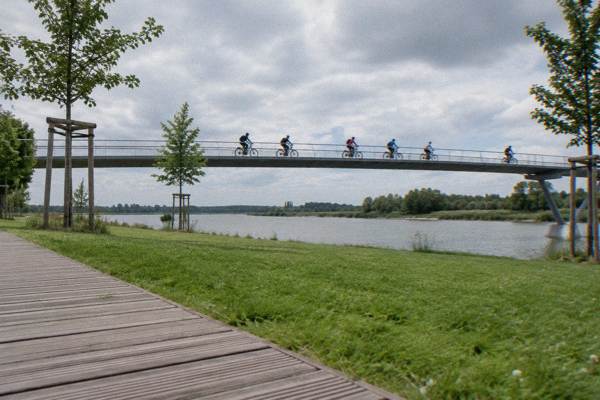
Strasbourg Bike Rental
Strasbourg, in Alsace in north-eastern France, is one of the flattest and most bike-friendly cities on the French side of the Rhine, and hiring a bicycle there is often the fastest way between the cathedral, Petite France and the European Quarter.
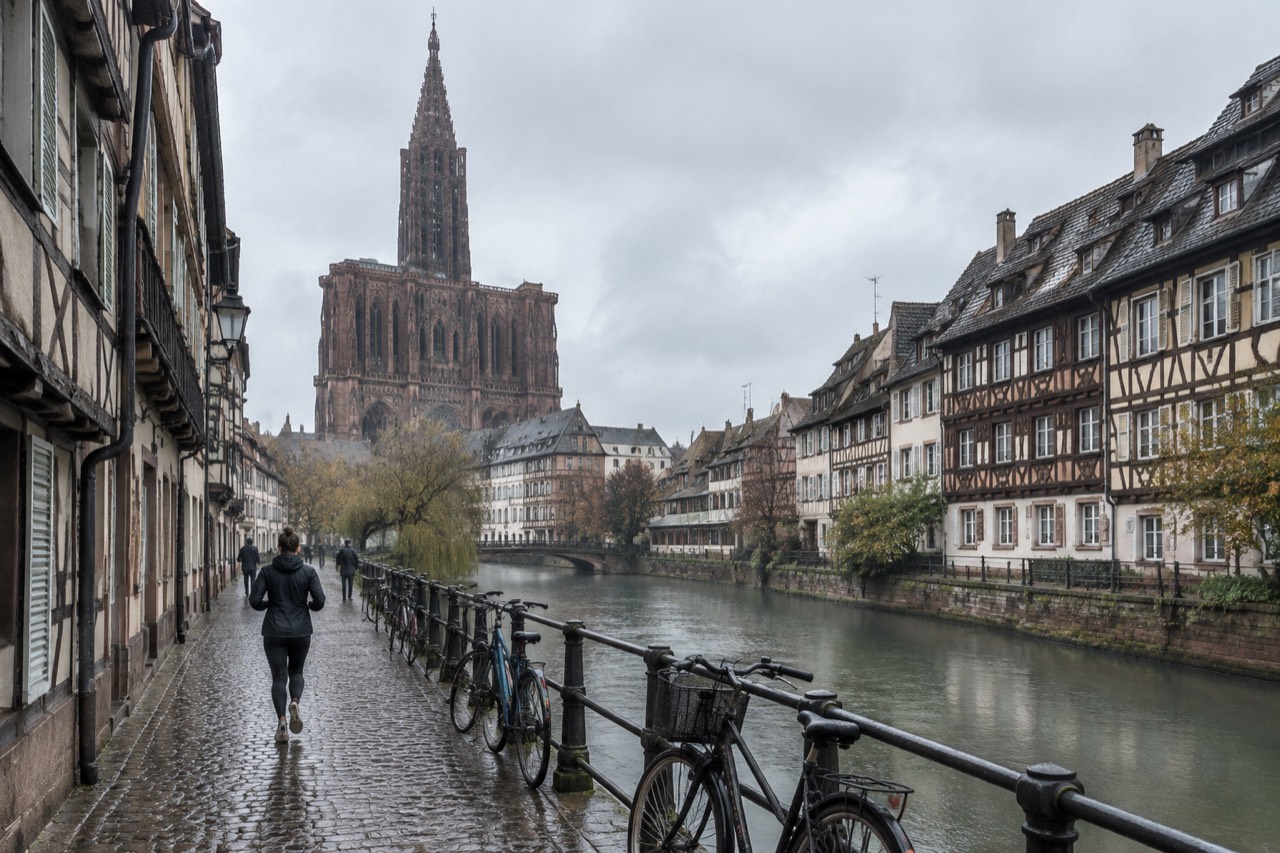
Short answer
Strasbourg, in north-eastern France, is flat, compact and crossed by riverside cycle paths, so a rented bike covers the whole city centre quickly. Hire points cluster around the station and the Grande Île; expect standard city bikes, e-bikes and child seats. A single tram ticket costs 1.90 EUR from the app or contactless, so bikes and trams pair easily for longer hops.
Strasbourg, the prefecture of the Bas-Rhin in Alsace, sits in north-eastern France on the River Ill, a short distance from the Rhine and the German border town of Kehl. The city is famously flat, its historic core sits on an island, and its network of riverside paths and tram-lined boulevards makes a bicycle a genuinely practical way to get around rather than a tourist novelty. Hiring one is usually a matter of minutes, and the distances that feel long on a map, say from the station to Petite France, or from Petite France to the European Quarter, shrink to a short and pleasant ride.
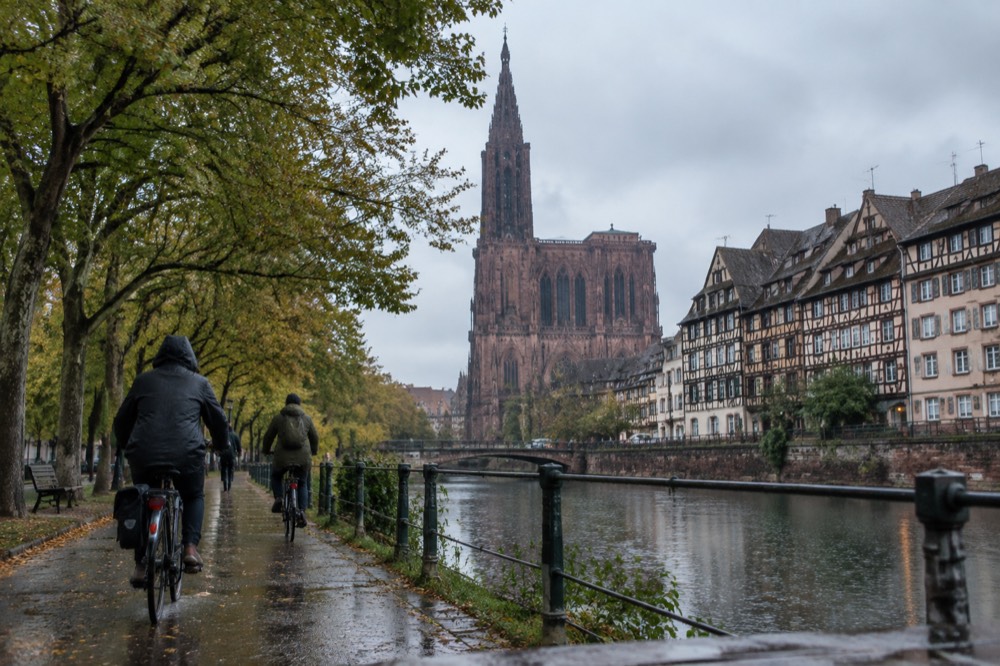
This guide walks through where to rent, what the practical decisions are, which routes reward a bike, and how two wheels combine with the trams, trains and river boats that criss-cross the city. It also covers the guided bike tours on offer for visitors who prefer a local guide to a map, and the seasonal questions that matter in a city whose climate is semi-continental, with cold winters and warm summers rather than the mild weather of the French coast.
Where To Rent A Bike In Strasbourg
Bike hire in Strasbourg is concentrated around the central station and the edges of the Grande Île, with a spread of independent shops and hotel partnerships across the city, and the practical choice is less about the shop than about the bike type, the duration and the deposit terms you accept. Treat the table below as a decision framework and confirm the details with the hire point before you go. What is safe to say is that Strasbourg's cycling infrastructure is extensive enough that a rented bike is useful from the first minute, not only once you have left the tourist streets behind.
The single most useful piece of planning advice is to rent near where you are staying or near the station, and to check the return conditions carefully. Some hire points want the bike back by a fixed closing time, others allow overnight keeps, and a day rate that looks cheap can double if you miss the return window. Ask specifically about locks, lights and whether the shop includes a repair kit, because a flat tyre on a riverside path is the most common small mishap of a cycling day.
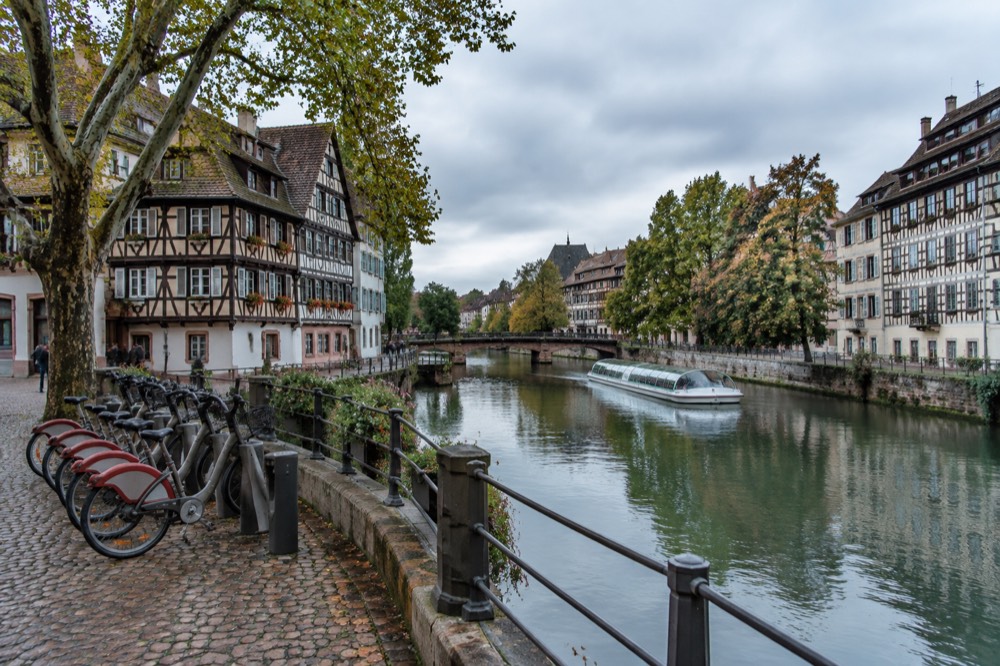
A second decision is the frame type. The lanes along the Ill are smooth and flat, so a basic city bike handles nearly everything inside the city. An e-bike earns its keep if you plan to ride out towards the Neustadt, the Parc de l'Orangerie or the European institutions, or if you want to cross the border bridge towards Kehl on the German side, all of which stretch the day beyond what legs alone comfortably manage in one outing.
How Much Does Bike Hire In Strasbourg Cost?
Rental prices in Strasbourg are set by each shop, so no single figure can be printed here, but the cost structure is predictable: an hourly rate for short rides, a cheaper day rate for a full day, a premium for e-bikes, and small add-ons for child seats, trailers and delivery to your hotel, with a deposit or ID held against the bike. The honest way to plan is to compare two or three hire points on total cost for your exact duration, including the deposit and the return window, rather than on the headline hourly rate. What follows is a checklist of what to ask, not a price list, because a figure that is not attached to a named shop would be a guess.
| Hire option | What it typically covers | Who it suits | What to confirm before paying |
|---|---|---|---|
| City bike, short hire | Basic single-speed or 7-gear bike, lock, sometimes a basket | Sightseeing inside the Grande Île | Hourly rate, return deadline, deposit |
| City bike, full day | Same bike with a day rate, usually cheaper per hour | Riding to the Neustadt and the Parc de l'Orangerie | Whether the day ends at closing time |
| E-bike | Battery-assisted frame, charger not needed for a day | Longer rides, hills avoided but distance wanted | Battery range, surcharge, weight |
| Child seat or trailer | Add-on for a child, fitted by the shop | Families with small children | Age and weight limits, fitting time |
| Hotel or delivery rental | Bike brought to your accommodation | Visitors staying outside the centre | Delivery fee, delivery window |
Two cost traps are worth naming. The first is the deposit: some shops hold a cash deposit, others block an amount on a card, and a few accept only an identity document, which you should think hard about handing over for a day. The second is the puncture clause. Ask who pays if the bike comes back with a flat, because the answer varies and it is the kind of small print that only matters when it is too late.
For visitors who would rather fold the bike into a guided experience than negotiate a rental contract, the city also has bookable options.
None of those replaces a bike, but each one slots neatly into the gaps of a cycling day: a tasting in the late afternoon, a beer session before the evening, a boat when the weather turns. The rest of this guide assumes you have two wheels sorted and moves on to the riding itself.
The Best Cycling Routes Around The Grande Île
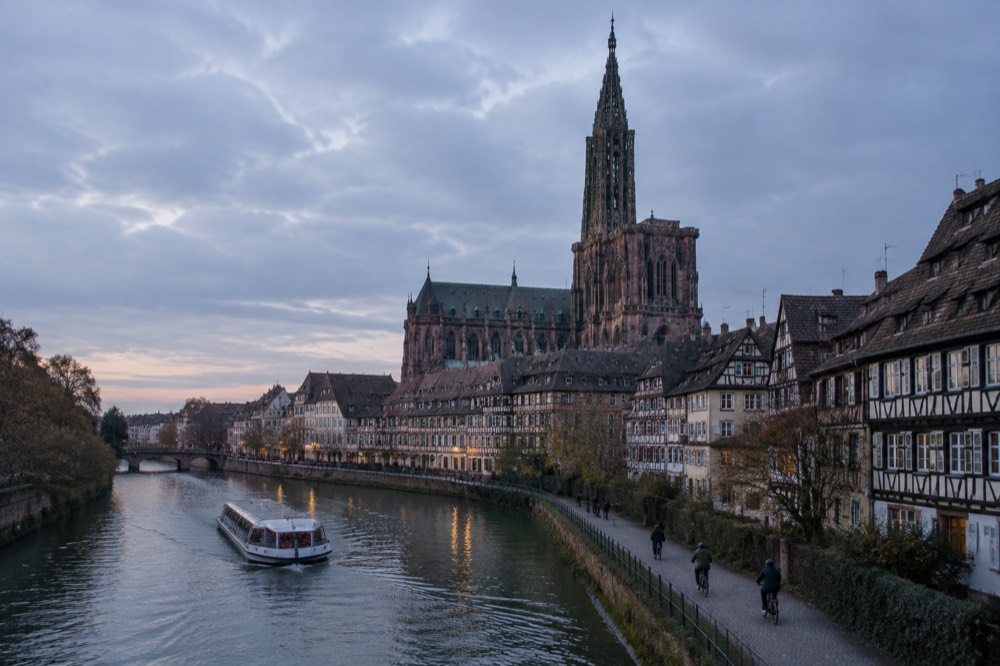
The classic Strasbourg bike loop runs from the station across the Grande Île, past the cathedral and down through Petite France to the Ponts Couverts and the Barrage Vauban, then back along the Ill through the Krutenau, and the whole circuit is rideable at a sightseeing pace inside a couple of hours because the terrain is flat and the paths are continuous. The pleasure of the route is not distance but variety: medieval streets, riverbank greenery and modern institutional architecture arrive in quick succession. Start early if you want the cobbles of Place Kléber and the cathedral square to yourselves, because the middle of the day brings both crowds and delivery traffic into the old lanes.
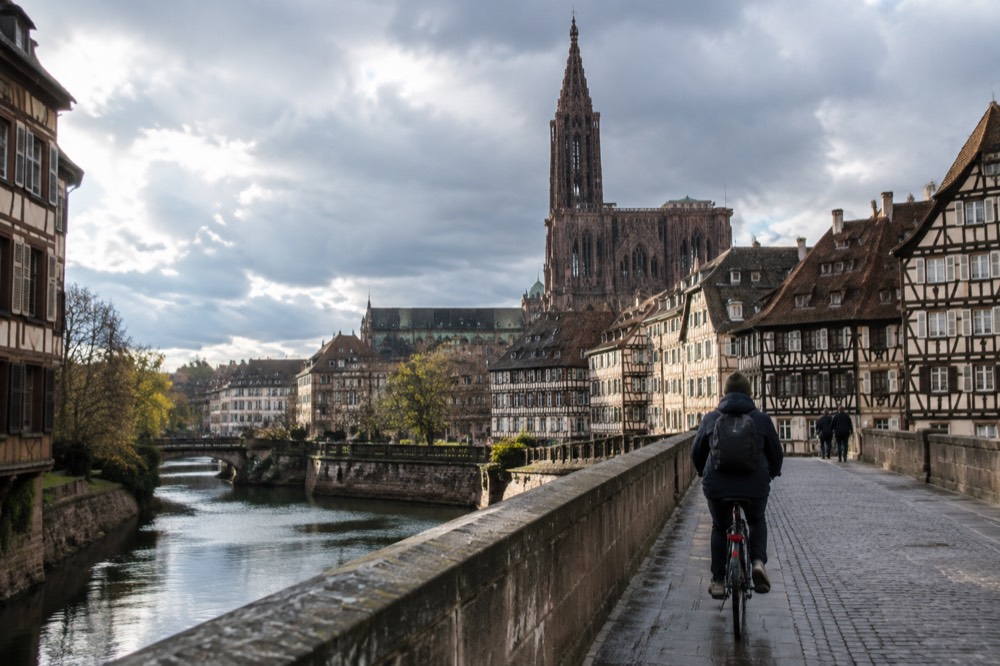
The riverside stretch is the heart of the ride. The path along the Ill past the Barrage Vauban, whose panoramic terrace keeps seasonal hours, 08:00 to 19:00 in September and October and shorter winter hours from November to February, gives you the postcard view of the Ponts Couverts and the four towers. From there the loop can continue south into the Krutenau, a former workers' quarter of small streets and student cafés, or north across the river towards the Neustadt, the German-built district of wide avenues and grand facades that extends the World Heritage property beyond the old island.
| Route | What you see | Character | Notes for cyclists |
|---|---|---|---|
| Grande Île loop | Cathedral, Place Kléber, Petite France, Ponts Couverts, Barrage Vauban | Medieval core, cobbles and crowds | Walk the bike through the busiest lanes at midday |
| Ill riverside path | Riverbanks, weeping willows, boat moorings | Flat, green, continuous | Easiest riding with children |
| Neustadt extension | Place de la République, broad avenues, institutional architecture | Grand imperial-era planning, wide boulevards | Wide lanes, comfortable in traffic |
| European Quarter ride | European Parliament, Council of Europe buildings, Parc de l'Orangerie | Modern institutions and parkland | Pairs with a Parlamentarium visit, which opens Mon-Fri 09:00-18:00 and Sat mornings and afternoons outside plenary weeks |
| Two Rhine banks ride | Crossing towards Kehl on the German side | Cross-border, open river landscape | Bring ID anyway; both countries are in Schengen |
Riders who want the institutional half of the city should budget a half day for the European Quarter and the Orangerie park together, since the distances between buildings are exactly the kind that a bike turns from a walk into a glide. The Parlamentarium visitor centre has an airport-style security check at the door, so allow time if you plan to go inside, and check its page for the different hours that apply during plenary weeks.
If all this planning sounds like more work than a holiday should involve, a guided ride takes the route decisions off your plate. The question below is the one a mid-article break exists to answer.
A tasting hour is a good anchor for the end of a ride, but it is the bike that gets you to it. The next section compares renting with riding behind a local guide.
Guided Bike Tours Or Riding On Your Own
A guided bike tour in Strasbourg suits first-time visitors who want the stories attached to the streets and do not want to plan a route, while independent rental suits anyone who already knows what they want to see, and the honest trade-off is flexibility against context: a guide adds history, shortcuts and local judgement, while your own bike adds the freedom to stop for an hour wherever you like. The city's guided bike tours run roughly two to two and a half hours with a local guide and bicycles included, which removes the rental negotiation entirely. Independent riders keep the option of a long riverside lunch or an unplanned detour into the Krutenau, which no schedule can offer.
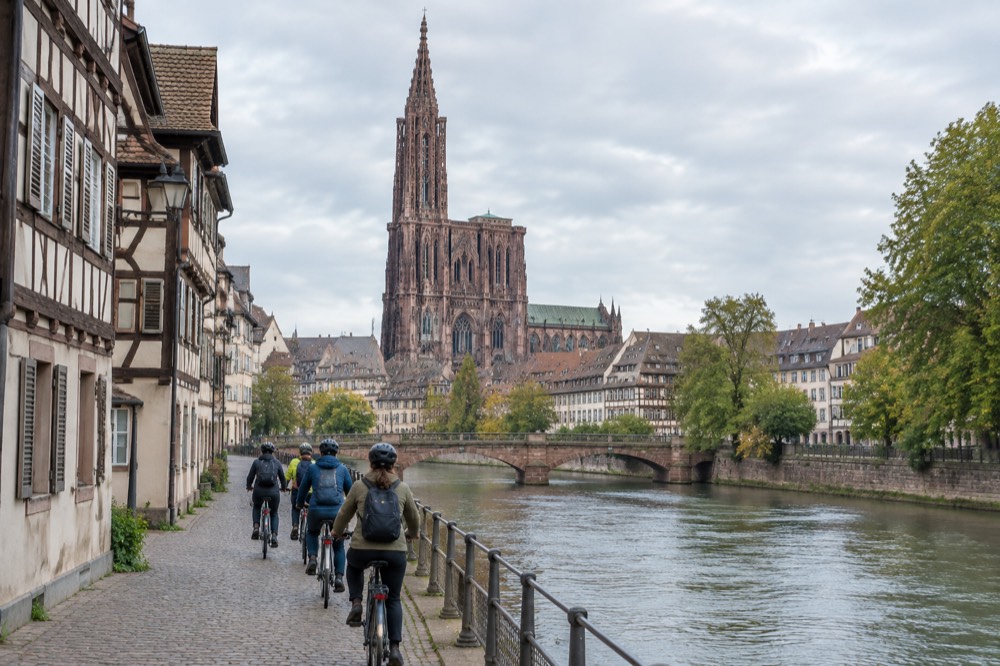
The flagship format is a two-and-a-half-hour guided bike tour with a local guide, which covers the Grande Île, the Neustadt and the European institutions in a single loop and is built for visitors whose time in the city is short. The guide carries the route, the commentary and the pacing, and the group size is small enough that questions are welcome. For travellers who land in the city with no plan at all, it is the most efficient first morning imaginable.
Happy to let a local guide take the route decisions. Book a guided bike tour here.
A shorter alternative is a bike tour with bicycles included, which trims the circuit to the core sights and leaves the afternoon free. That format suits families with school-age children, who prefer a shorter outing to a longer ride, and visitors combining the tour with a museum visit afterwards, since the municipal museums charge 9 EUR full price, 5 EUR reduced, and the 1-day Pass Musées at 20 EUR covers them all if several are on your list.
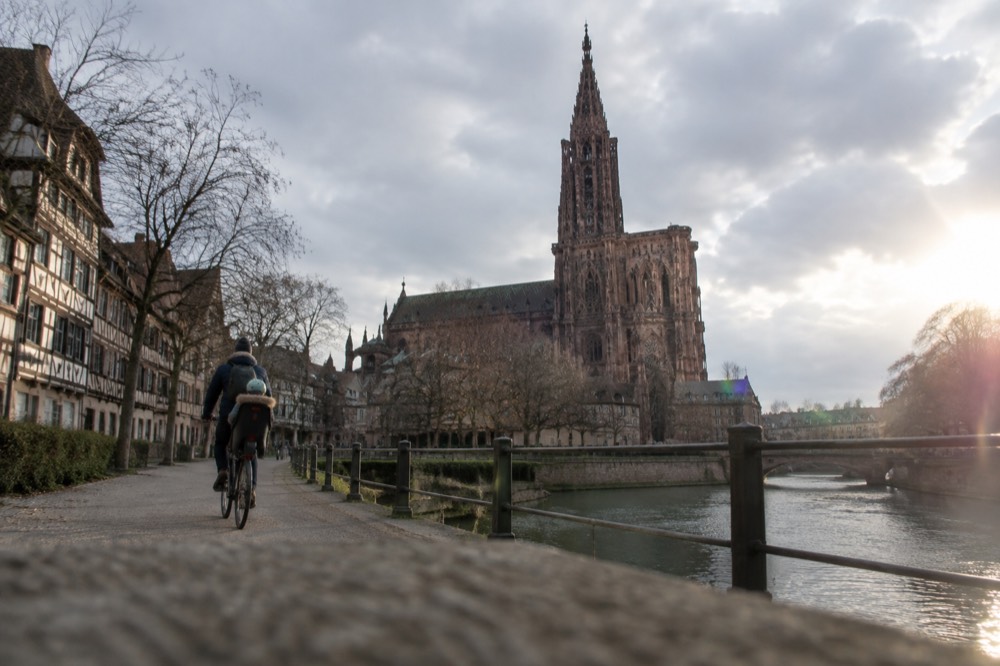
Riders who choose independence should still steal the guided routes, because they are proven. Ride the Grande Île loop clockwise, cross to the Neustadt, swing past the Parc de l'Orangerie, and finish along the Ill as the afternoon light hits the water. Stop at the covered bridges, lock the bike, and walk the last stretch into Petite France, whose lanes are better on foot than on wheels at any hour. For more ideas that cost nothing, the free sights in Strasbourg guide lists the squares and riverbanks that need no ticket at all, and the hidden corners of Strasbourg guide adds the quieter streets a bike makes easy to reach.
Combining Bikes With Trams, Trains And Boats
A bike in Strasbourg does not have to carry you everywhere, because the CTS network sells a single ticket at 1.90 EUR through the Badgeo card, the CTS app or contactless payment, 2.50 EUR if bought on board a bus, and day passes at 4.60 EUR for one traveller or 10.20 EUR for two to three, so the practical pattern is to cycle the centre and use the tram for long hops, tired legs and the airport run. The combined train-and-tram ticket from Strasbourg airport, which includes the 8-minute TER shuttle from Entzheim to the station plus a day of city transport, also costs 4.60 EUR, which makes a bike-plus-transit day remarkably cheap to assemble.
| CTS ticket | Price | Where it is sold | Best use for cyclists |
|---|---|---|---|
| Single ticket | 1.90 EUR | Badgeo, CTS app, contactless | One-off hop when rain starts |
| Single bought on board | 2.50 EUR | On the bus only | Avoid; buy before boarding |
| 24h Solo pass | 4.60 EUR | CTS app and outlets | A day of tram hops between rides |
| 24h Trio pass | 10.20 EUR | CTS app and outlets | Two or three people sharing |
| Airport combined ticket | 4.60 EUR | Airport and station | Entzheim shuttle plus city transport for a day |
The river adds a third layer. Batorama's boat tours, the long circuit at 16.20 EUR full fare and 8.90 EUR reduced, the short circuit at 12.50 EUR and 7.20 EUR, run from the quay near the Palais Rohan, with a long Red Tour and a short Blue Tour. A sensible plan is to ride the riverside path out to the Parc de l'Orangerie in the morning, then trade the saddle for a boat seat in the afternoon and let the Ill carry you back past everything you pedalled past. Cyclists who would rather not pedal at all can also consider a two-wheeled alternative of a different kind.
A segway covers the same flat riverside terrain with even less effort, and it is a popular option for visitors whose knees prefer not to climb back onto a bicycle saddle after a long morning. The tram network, meanwhile, is the answer to the one problem bikes cannot solve: distance at the end of the day. Check the CTS fare page for anything beyond the tickets listed here.
When To Cycle: Seasons And Weather In Strasbourg
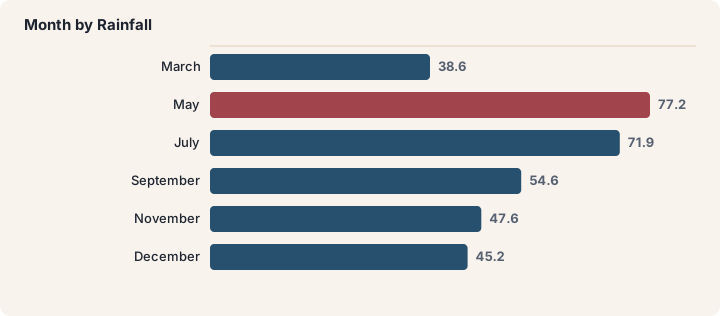
The most comfortable cycling months in Strasbourg are May to September, when Meteo-France's 1991-2020 normals for Strasbourg-Entzheim show mean daily maxima from 20.9 C in May to 26.4 C in July, while winter riding is possible but cold, with a January mean maximum of 5.2 C and a mean minimum just below freezing, so the season decides less whether you can ride than how much you will enjoy it. Rain is spread across the year, 635.7 mm annually, with the wettest months by rainfall being May at 77.2 mm and July at 71.9 mm, though summer showers tend to be short compared with the steady drizzle of November and December.
| Month | Mean maximum | Mean minimum | Rainfall | Rain days of 1 mm or more |
|---|---|---|---|---|
| March | 12.1 C | 2.6 C | 38.6 mm | 8.5 |
| May | 20.9 C | 10.1 C | 77.2 mm | 10.8 |
| July | 26.4 C | 14.9 C | 71.9 mm | 10.4 |
| September | 21.6 C | 10.7 C | 54.6 mm | 8.0 |
| November | 9.4 C | 3.3 C | 47.6 mm | 9.2 |
| December | 5.9 C | 0.8 C | 45.2 mm | 10.2 |
Spring deserves a special mention. April and May bring the city's trees into leaf along the Ill, and the riverside path is at its prettiest before the summer crowds arrive. The Strasbourg weather guide unpacks the full monthly table, and the best time to visit Strasbourg guide weighs the seasons against crowds and prices if your dates are still flexible.
Winter cycling has one great compensations: the Christmas market. The market's 2026 dates are not yet published, and the city's Christmas site states that the dates and programme are still being finalised, but the usual pattern opens the chalets in the last week of November and runs to 24 December, with the final day closing early in the evening. Last year's edition ran from 26 November to 24 December 2025 and drew 3.05 million visits, so anyone riding in December should expect busy lanes around the cathedral and plan to walk, not ride, through the market streets themselves. The Strasbourg in winter guide and the Christmas market guide cover that season in detail, and the summer in Strasbourg guide does the same for the warm half of the year.
Cycling Etiquette, Safety And Locking Up
Strasbourg is a genuinely bike-aware city, and the rules that matter are ordinary French urban cycling rules: ride on the marked lanes where they exist, respect pedestrians on shared paths, use lights after dark, and lock the frame and a wheel to a fixed rack every single time you stop, because the one mistake visitors make is a soft lock through a wheel only. The old quarter's cobbled lanes are shared with heavy foot traffic in the middle of the day, and the courteous move, which locals also make, is to dismount and walk the bike through the busiest stretches around the cathedral and Petite France. Nobody hurries a cyclist who is walking politely.
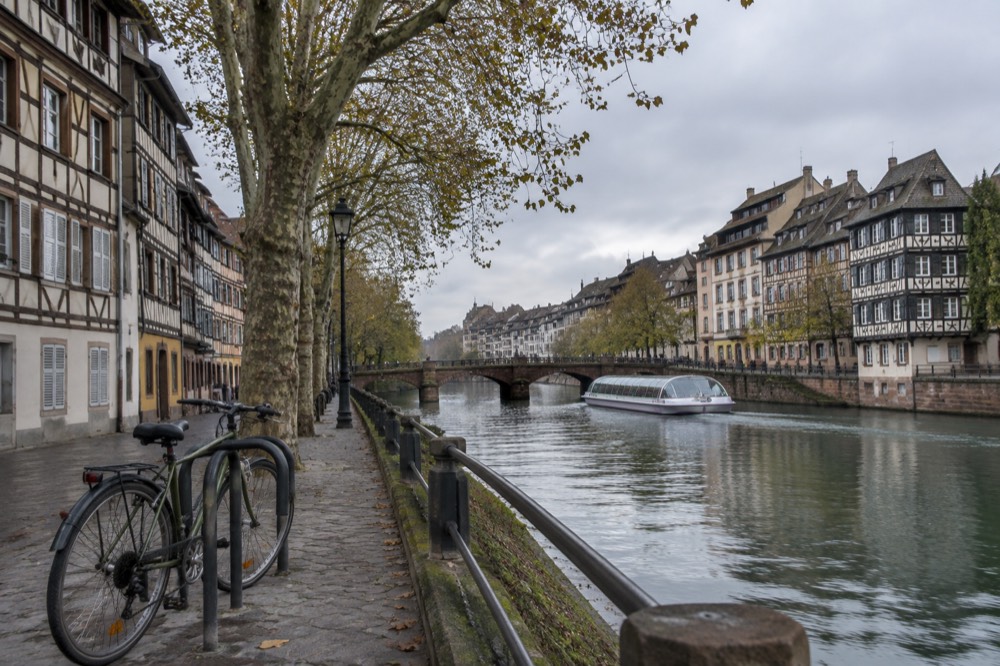
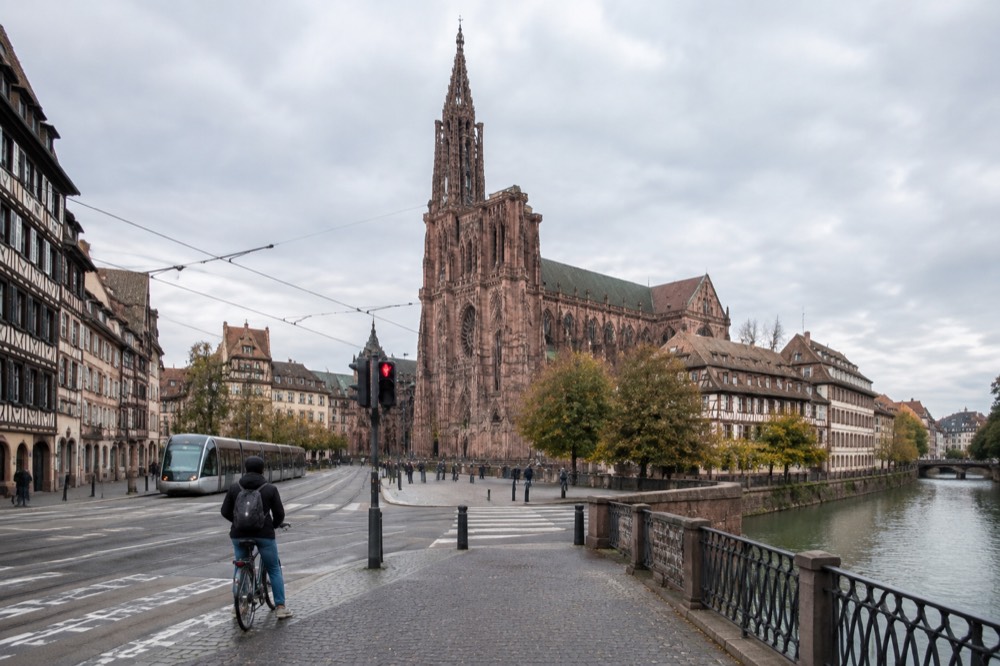
On safety, the honest summary is that Strasbourg's flat terrain and extensive lanes make it one of the easier French cities for cautious cyclists, and the main risks are the ordinary ones: tram rails when crossing tracks at a shallow angle, delivery vans in the old lanes, and pedestrians stepping into marked paths without looking. Take the first tram-rail crossing slowly and at a right angle, and the rest of the day tends to look after itself. The city's general safety picture, evening included, is covered in the Strasbourg at night guide.
Locking up deserves a paragraph of its own because it is where rental deposits are lost. Use the shop's lock if one is included, ask how it is meant to be used, and prefer a fixed rack over a signpost or a railing on the riverside, where the towpath is public and busy. Inside the paid museums and the cathedral there is no place to keep a bike, and the cathedral has no lockers of any kind, so plan sightseeing stops around racks near the entrance rather than assuming a bike can come inside.
One last planning note on where to base yourself. Staying inside or just beside the Grande Île puts every route in this guide within a short ride, while a hotel out towards the station district or the Neustadt adds only a few minutes on the flat. The where to stay in Strasbourg guide compares the neighbourhoods for visitors travelling light, and the Strasbourg Travel Guide homepage pulls the whole city together if this is your first page of planning.
However you assemble the day, the pattern that works is simple: rent near your base, ride the riverside loop in the morning, trade the bike for a boat or a tram when the legs tire, and finish with something that has nothing to do with wheels.
Common Questions About Bike Rental In Strasbourg
Is Strasbourg good for cycling?
Yes. The city is flat, its core sits on an island surrounded by riverside paths, and the network of marked lanes extends from the Grande Île through the Neustadt to the European Quarter and the Parc de l'Orangerie. A loop taking in the cathedral, Petite France, the Ponts Couverts and the Barrage Vauban is rideable at a sightseeing pace inside a couple of hours.
Do I need to book a bike in advance in Strasbourg?
It is wise in the busy seasons and around the Christmas market period, when the city draws millions of visits and hire fleets can run low. In quieter weeks a same-day rental is usually straightforward, but families needing child seats or trailers, and anyone wanting an e-bike, should reserve ahead and confirm the fitting time.
Can I take a rented bike on the tram in Strasbourg?
Check the current CTS rules before you rely on it. The practical alternative is to park the bike and buy a single tram ticket at 1.90 EUR from the app or contactless payment, or a 24h Solo pass at 4.60 EUR, and hop on without the bike.
Can I cycle from Strasbourg to Germany?
Yes. Kehl sits on the far bank of the Rhine, and both France and Germany are in the Schengen area and use the euro, so a cross-border ride needs no currency change. Bring identification anyway, and check the bridge crossings on the official pages before you set out.
What should I check before paying for a bike rental?
Ask for the total cost of your exact duration including any deposit, the return deadline and what happens if you miss it, the puncture and damage terms, and whether a lock, lights and a child seat are included. Confirm the deposit form too, since shops differ between cash, a card block and a held identity document.
Is winter a bad time to cycle in Strasbourg?
It is cold rather than impossible. The 1991-2020 normals give a January mean maximum of 5.2 C and a mean minimum slightly below freezing, with December averaging 10.2 rain days of 1 mm or more. Layered clothing and lights make short winter rides practical, and the Christmas market season rewards them, though the market lanes themselves are best walked.