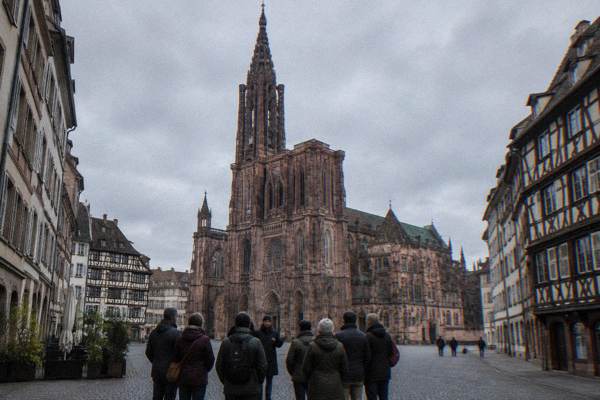
Strasbourg Photography Spots
Strasbourg, in Alsace, north-eastern France, beside the German border, is one of the most photogenic cities in Europe: a single-spired cathedral, a medieval river quarter and half-timbered streets that change character with every season.
Short answer
The core photography spots in Strasbourg are the cathedral and its 66 m platform (10 EUR), Petite France's canals, the Barrage Vauban terrace, Place Kléber and the Grande Île streets. The platform opens 09:30-20:00 in summer, the clock show runs at 12:30 for 4 EUR, and the Christmas market fills the old town over the festive season.
Strasbourg, the prefecture of the Bas-Rhin in Alsace, part of the Grand Est region of north-eastern France, sits on the River Ill beside the Rhine, which forms the border with Germany. The commune counted 293,771 residents in the INSEE figures for 2023, and its historic core, the Grande Île, is a UNESCO World Heritage property together with the later Neustadt extension. For a photographer, that combination delivers something rare: a medieval island city of half-timbered houses, a single-spired cathedral of pink sandstone, working canals, and a Germanic imperial quarter, all within walking distance of each other. This guide walks through the spots worth planning a shoot around, the hours and tickets that shape access, and the seasonal light that changes what the city gives you.
Why Strasbourg Rewards A Camera
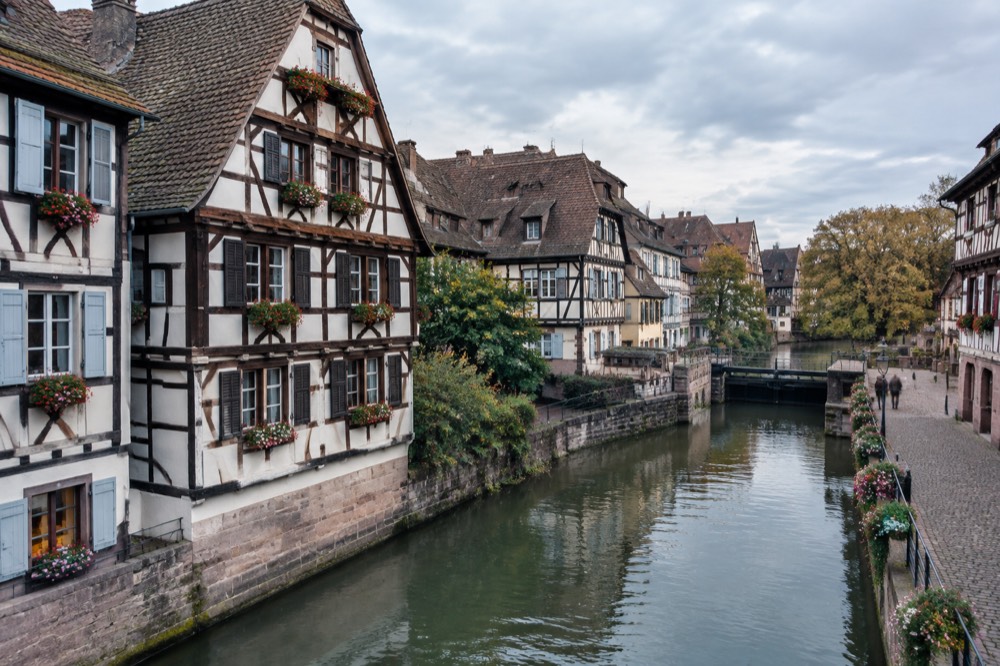
Strasbourg photographs well for three reasons that have nothing to do with equipment: a dense medieval street plan that funnels light into narrow lanes, a river quarter where water doubles every facade, and a semi-continental climate that produces hard summer light, golden autumn afternoons and genuinely cold, atmospheric winters. The Meteo-France 1991-2020 normals for Strasbourg-Entzheim give a mean daily maximum of 5.2 C in January against 26.4 C in July, with 635.7 mm of rain spread over 112.3 days of 1 mm or more. In practice that means overcast softness is common, blue-sky glare arrives in summer, and winter brings the low, slanting light that makes sandstone glow.
The city's two World Heritage halves also give two distinct palettes. The Grande Île is medieval and warm: timber frames, whitewash, the cathedral's red Vosges sandstone. The Neustadt, the later German-built quarter, is broad and imperial, with heavy facades and long avenues that suit wide compositions. A single day of shooting can cover both on foot, and the distances involved are short enough that the weather's mood, not the walking, is the real constraint.
The seasons each add their own material. Spring brings blossom to the riverbanks, summer fills the terraces and the Ill with boats, autumn colours the plane trees along the quays, and from late November to 24 December the Christmas market turns the old town into an evening subject with almost no equal in France. The 2025 edition drew 3.05 million visits, which tells you what the December crowds will feel like.
The Best Photography Spots In The Historic Centre
The essential shots inside the Grande Île are the cathedral's west front from Rue Mercière, the astronomical clock's courtyard at Place du Château, the timbered houses of Petite France, the Ponts Couverts with the Barrage Vauban behind them, and the open geometry of Place Kléber, and all five sit within a short walk of one another. The cathedral's own hours page sets the rhythm: the nave opens 08:30-11:15 and 12:45-17:45 Monday to Saturday, and 14:00-17:15 on Sundays and feast days. During the Christmas market it stays open continuously on the Place du Château side, 08:30-17:45, which is worth knowing if your shoot overlaps the market weeks.
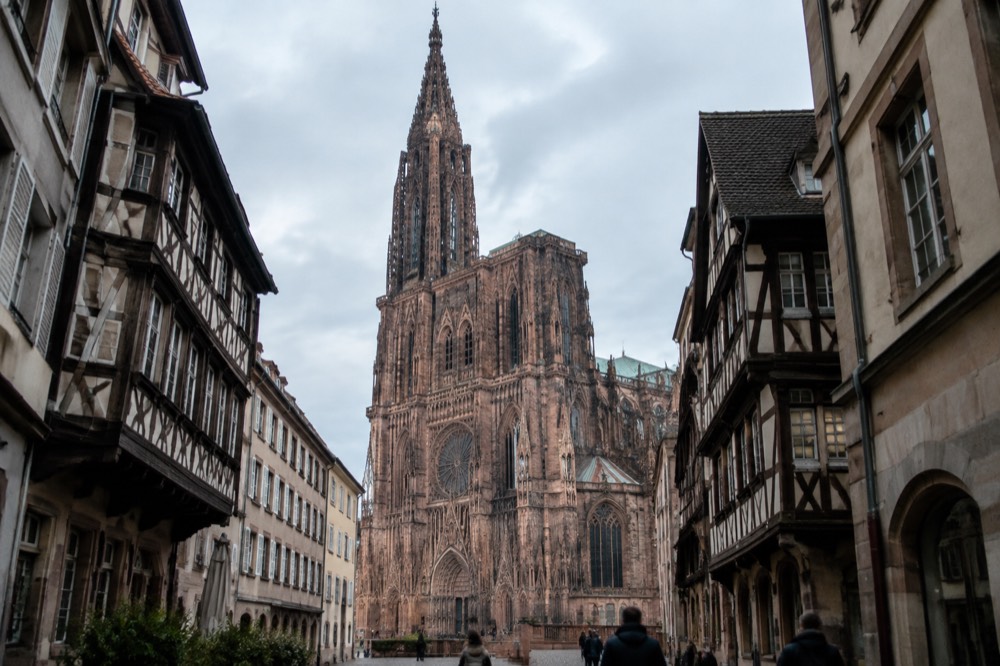
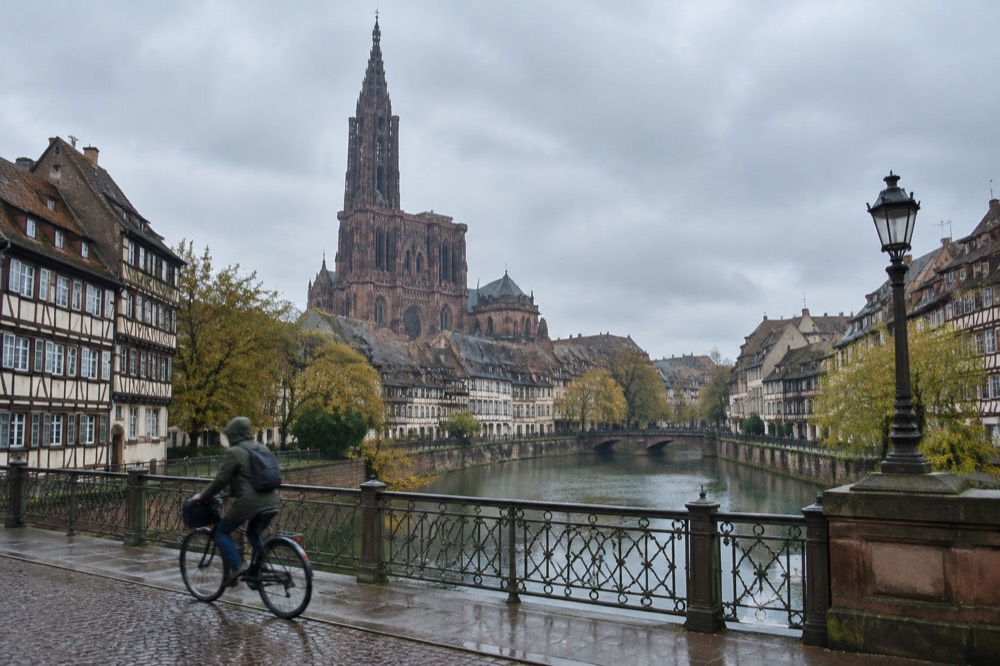
Rue Mercière is the classic approach: a narrow restaurant street that frames the cathedral's single spire between timbered facades, best in early morning before the terraces fill. Place du Château, the square behind the cathedral, gives you the Musee de l'Œuvre Notre-Dame's Gothic facade as a foreground and hosts the 12:30 clock show crowd. Place Kléber, the city's largest square, works for wide urban frames and for the giant Christmas tree in December. Place Gutenberg, between the two, is quieter and often better for people-free compositions in the early evening.
The table below is the planning skeleton for the historic core: what each spot delivers, when the light cooperates, and what practical detail shapes access.
| Spot | What to shoot | Best light | Access detail |
|---|---|---|---|
| Cathedral west front, Rue Mercière | Spire framed by timbered houses | Early morning, before 09:00 | Nave open 08:30-11:15 and 12:45-17:45 Mon-Sat |
| Place du Château | Gothic courtyard, clock entrance | Mid-morning to noon | Clock show at 12:30, 4 EUR, day-of tickets only |
| Cathedral platform | Rooftops of the Grande Île | Late afternoon | 10 EUR full, 6 EUR reduced, 66 m up |
| Place Kléber | Wide square, tree at Christmas | Blue hour in winter | Open public square at all hours |
| Place Gutenberg | Calmer facades, café life | Early evening | Open public square at all hours |
A guided walk is a genuinely efficient way to find these angles on a first visit, because the good vantage points are not always on the obvious streets. The historic walking tour with a local guide covers the old town's core, and the operator's live listing carries the current departure details.
Want a local to show you these angles on foot? Book a historic center walking tour here.
For photographers who would rather move at their own pace, the same ground works as a self-directed loop: start at Rue Mercière for the spire, cut through Place du Château, drop south to the river, and finish at Place Kléber as the evening lights come on. Allow a half day if you want the cathedral interior, the platform and the river quarter in one pass, because the platform's midday closure breaks the day up.
Petite France And The River Ill From The Water
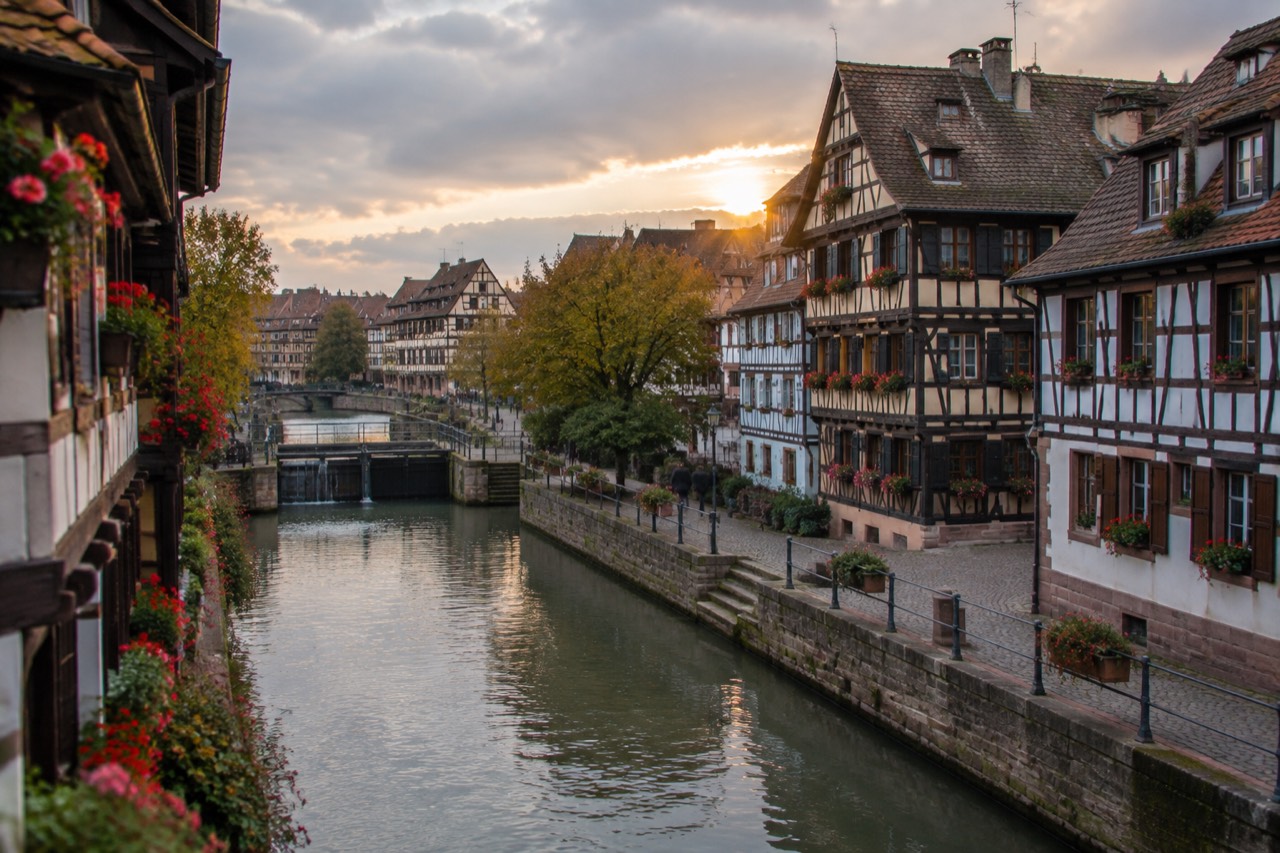
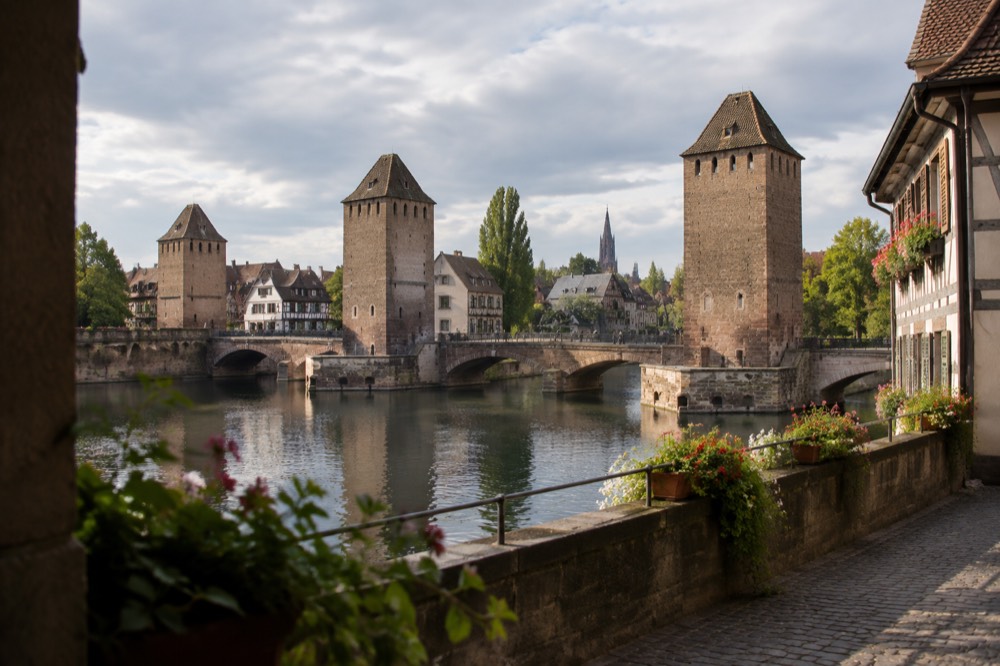
Petite France, the former tanners' and millers' quarter at the south-western tip of the Grande Île, is Strasbourg's single most photographed area, and its best frames come from three positions: the Pont Saint-Thomas side in early morning, the Ponts Couverts looking back at the timbered facades, and the Barrage Vauban's panoramic terrace, which stacks the whole quarter, the Ponts Couverts and the cathedral spire into one elevated frame. The terrace's seasonal hours matter: the city's page lists 08:00-19:00 from September to October, 08:30-16:00 from November to February, and 08:00-19:00 in March and April. Check the current admission terms on the city's own page before you go.
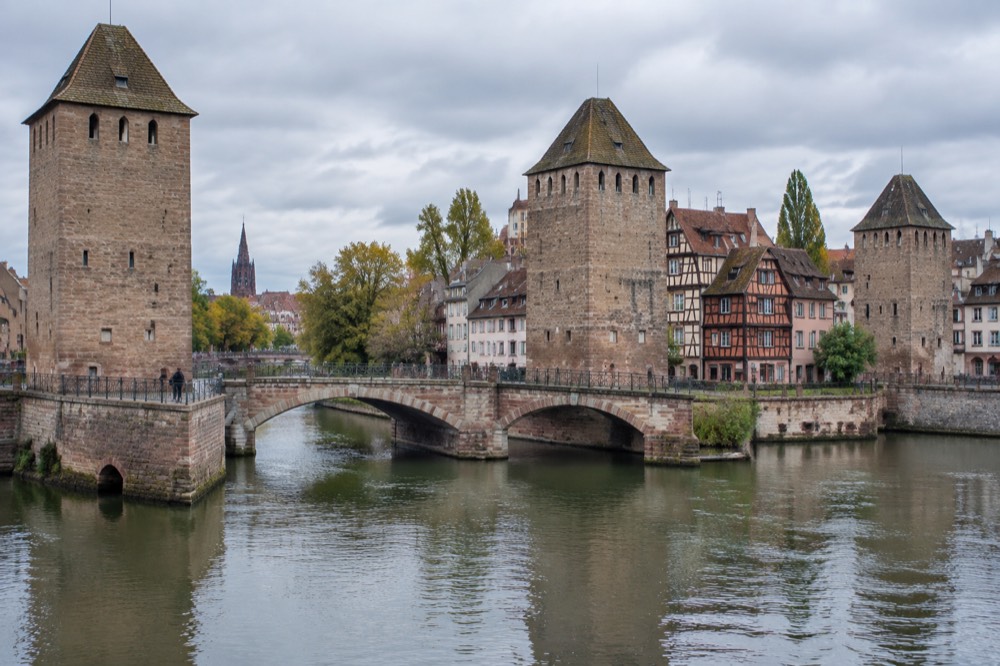
The quarter itself is small and walkable in under an hour, but the light moves across it all day. The canals that split around the island mean reflections work in both directions, and the weirs below the Ponts Couverts give long-exposure material at any hour. The Barrage Vauban terrace is the one elevated position in this part of town, and it faces north-east toward the spire, which puts the cathedral in clean silhouette at dusk in the colder months.
Shooting the city from the water changes the geometry entirely. Batorama's river tours, the official sightseeing boats on the Ill, run a long tour at 16.20 EUR full fare and 8.90 EUR reduced, lasting 1h10 on the Red Tour, and a short tour at 12.50 EUR full and 7.20 EUR reduced, lasting 0h45 on the Blue Tour. The boats pass through the lock at the Barrage Vauban and under the Ponts Couverts, giving water-level frames of the quarter that are hard to get any other way. The trade-off is simple: you shoot from a moving deck, so shutter speed matters more than composition.
| Batorama tour | Duration | Full fare | Reduced fare | Photographic value |
|---|---|---|---|---|
| Red Tour (long) | 1h10 | 16.20 EUR | 8.90 EUR | Full Grande Île loop, European quarter reach |
| Blue Tour (short) | 0h45 | 12.50 EUR | 7.20 EUR | River quarter and Ponts Couverts in less time |
If you are planning a longer stay around the river and the evening light, the guide to night photography conditions, night walks in Strasbourg, covers the districts that hold up after dark, and where to stay in Strasbourg explains which neighbourhoods put you within walking distance of Petite France.
Cathedral Angles, Hours And Tickets
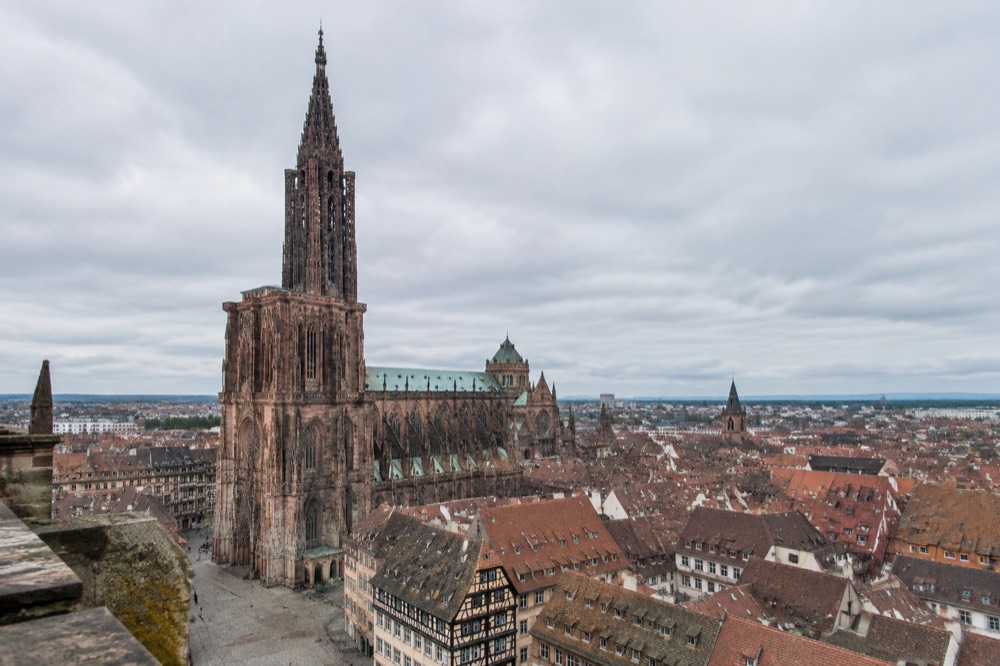
The cathedral rewards three separate visits rather than one: the exterior at first light, the interior during the mid-morning opening window, and the 66 m platform in late afternoon, and each has its own hours and ticket, with the platform at 10 EUR full and 6 EUR reduced, children under 6 free, and the astronomical clock show at 12:30 for 4 EUR with day-of tickets only. The platform runs 09:30-13:00 and 13:30-20:00 from 1 April to 30 September, with the last ascent at 19:15, and 10:00-13:00 and 13:30-18:00 from 1 October to 31 March, last ascent 17:15. It closes on 1 January, 1 May and 25 December.
The interior is where the rose window and the pillar forest do their work, and the morning window, 08:30-11:15, is the calmer of the two daily openings. The clock show at 12:30 sharp is a ticketed event with a specific drill: tickets are sold on the day only, at the cathedral stalls between 10:00 and 11:00 or at the Saint-Michel entrance from 11:30, and there are no reservations. A tripod inside the nave is not part of the visiting arrangement, so plan for handheld work at higher sensitivity settings. The platform ticket also carries a reduced rate at the Musee de l'Œuvre Notre-Dame next door, which pairs the view with the cathedral sculpture museum in one afternoon.
| Cathedral element | Hours | Price | Photographer's note |
|---|---|---|---|
| Nave, Mon-Sat | 08:30-11:15, 12:45-17:45 | Entry terms on the cathedral's page | Morning window is quieter |
| Nave, Sun and feast days | 14:00-17:15 | Entry terms on the cathedral's page | Afternoon light through the rose window |
| Platform, 1 Apr-30 Sep | 09:30-13:00, 13:30-20:00 | 10 EUR full, 6 EUR reduced | Last ascent 19:15, sunset frames possible |
| Platform, 1 Oct-31 Mar | 10:00-13:00, 13:30-18:00 | 10 EUR full, 6 EUR reduced | Last ascent 17:15, dusk in December |
| Astronomical clock show | 12:30 daily | 4 EUR | Day-of tickets only, no reservations |
The platform is the one viewpoint in the city where the weather decides everything. A grey afternoon flattens the rooftop panorama, while the low winter sun turns the sea of red tiles warm and picks out the Black Forest ridge line on the horizon beyond the Rhine plain. If the forecast is poor, flip the plan: do the interior in the morning window and save the platform for a clearer day.
Golden Hour And Night Photography In Strasbourg
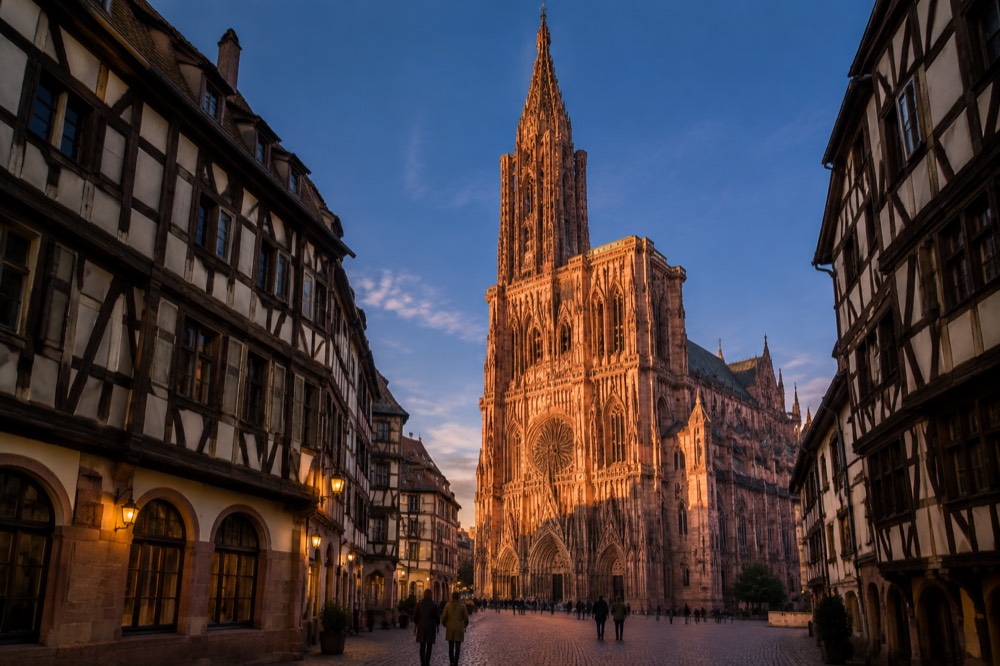
Strasbourg's night photography works because the old town is small, walkable and lit by warm streetlight rather than floodlighting, and the strongest after-dark frames are the cathedral's lit west front, the Ponts Couverts and the Ill reflections, and the Christmas market squares in December, all reachable on a loop of under an hour on foot. The city's tram network runs late enough to move between districts without a car, and a CTS 24h Solo pass at 4.60 EUR covers a full day and evening of rides, with singles at 1.90 EUR through the app or contactless, or 2.50 EUR bought on board a bus.
Blue hour, the window after sunset when the sky holds colour while the streetlights take over, is the single most productive time in this city. The sandstone of the cathedral holds the last daylight longer than the streets around it, so the west front stays photogenic for ten to fifteen minutes after the lanes have gone dark. Along the Ill, the calm water doubles the lit bridges, and long exposures smooth the weirs below the Ponts Couverts. In December the market squares extend the evening: chalets typically open from late morning into the evening, and the 24 December close comes early, in the early evening.
Practical night work in Strasbourg needs less gear than most cities: a camera that handles high sensitivity cleanly, one fast prime, and a small tripod for the riverbank frames where traffic is light. The historic lanes are narrow, so wide lenses earn their keep, and the lighting colour varies street by street, which makes a raw workflow worthwhile. The seasonal guides matter here too: Strasbourg in winter covers the cold-month conditions, and the best time to visit Strasbourg weighs the seasons against crowd levels.
Seasonal Light: Christmas Markets To Summer Blue
The Christmas market season, late November to 24 December, transforms Strasbourg into one of Europe's great evening photography destinations, with the 2025 edition running 26 November to 24 December and drawing 3.05 million visits, while spring and summer trade that atmosphere for blossom, long evenings and terrace life, and autumn delivers the year's most cooperative light. The next edition's dates are still being finalised, so confirm them on the city's Christmas site before planning a December shoot. The pattern is stable in shape: the market opens in the last week of November and runs to 24 December, closing early in the evening on the final day.
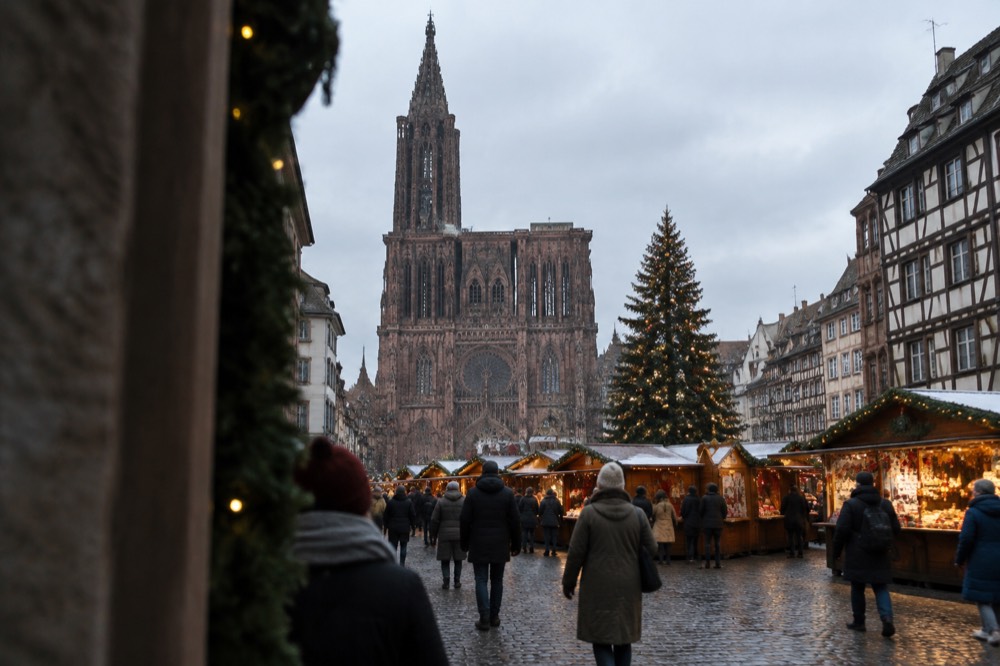
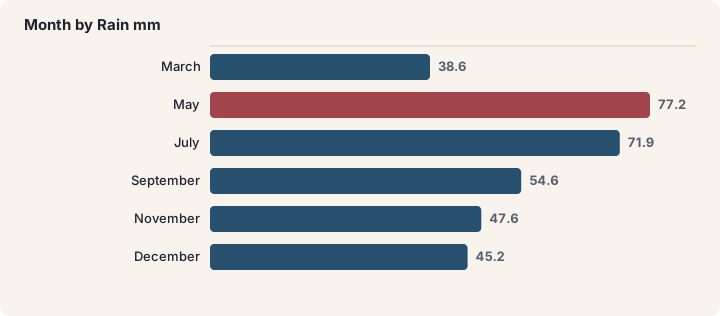
December light is a planning problem in itself. The Meteo-France normals give December a mean maximum of 5.9 C and a mean minimum of 0.8 C, with 45.2 mm of rain over 10.2 days of 1 mm or more, so cold-weather battery care and weather sealing matter more than they do in summer. The compensation is that dusk arrives early enough to shoot blue hour and the market lights before dinner, and the cold air often clears the haze over the rooftops. The seasonal spread is laid out below.
| Month | Mean max C | Mean min C | Rain mm | Rain days | What it gives a photographer |
|---|---|---|---|---|---|
| March | 12.1 | 2.6 | 38.6 | 8.5 | Bare trees, clean sight lines |
| May | 20.9 | 10.1 | 77.2 | 10.8 | Blossom, wettest month, soft light |
| July | 26.4 | 14.9 | 71.9 | 10.4 | Long evenings, hard midday light |
| September | 21.6 | 10.7 | 54.6 | 8.0 | Warm golden hours, fewer crowds |
| November | 9.4 | 3.3 | 47.6 | 9.2 | Fog on the Ill, market build-up |
| December | 5.9 | 0.8 | 45.2 | 10.2 | Market lights, early blue hour |
For the market weeks specifically, the Strasbourg Christmas market guide maps the squares and the flow of the crowds, Christmas markets in Alsace extends the shoot to the wider region, and Christmas market food in Strasbourg covers the stall-level detail that makes the best market frames. Outside the season, spring in Strasbourg and autumn in Strasbourg each have their own light and their own quiet weeks, and Strasbourg weather month by month gives the full normals table behind the planning.
Day Trips For The Camera: Alsace Villages And Beyond
The photography that starts in Strasbourg continues in the Alsace countryside, where the wine-route villages of Riquewihr, Eguisheim, Kaysersberg and Obernai give flower-lined lanes, vineyard slopes and castle silhouettes that the city cannot supply, and a guided day trip is the practical way to reach several of them in one light-controlled day. The distances and drive times between these villages are not the point to plan around, the light is: the villages face different directions, and a route that puts you in Eguisheim's lanes in the morning and a vineyard slope in the late afternoon uses the day well.
The medieval villages and wine-tasting day trip from Strasbourg is the natural fit here, pairing village photography with cellar visits along the route. Check availability on the operator's live listing for current departure times and inclusions.
Not every worthwhile day trip is photogenic in the postcard sense. The Natzweiler-Struthof site, the former concentration camp in the Vosges above the Alsace wine route, is a place visitors go to understand, not to shoot, and photography there deserves restraint and respect for the memorial's character. The half-day guided visit from Strasbourg exists for that purpose, and the operator's live listing carries the current details.
The table below is the qualitative planning grid for the main day-trip directions: what each destination gives a camera, and what to confirm before setting out. No distances or journey times are printed here because the planning should rest on what each place offers, not on figures that shift with traffic.
| Day trip | What it gives a photographer | How it pairs with the city | What to check first |
|---|---|---|---|
| Alsace wine villages | Lanes, vines, castle backdrops | Same light as Strasbourg, rural version | Village parking and cellar hours |
| Colmar | Canals, pastel facades | A second river-quarter subject in one region | Museum and boat hours on the official pages |
| Black Forest | Forest, lakes, gorge scenery | A contrast to the urban sandstone palette | Seasonal road and attraction status |
| Haut-Koenigsbourg | A mountaintop castle interior and view | The wide landscape frame the city lacks | Castle opening calendar |
| Struthof memorial | History and remembrance, not scenery | A sober counterweight to the postcard day | Visit terms on the memorial's page |
For the wider picture of the region, the Alsace road trip guide sequences the villages and the Vosges, Riquewihr and Eguisheim each get their own close-up treatment, and the most beautiful villages in Alsace is the full list to shoot through.
Practical Planning: Tickets, Transport And Shooting Etiquette
A photography day in Strasbourg is cheap to run: the CTS network's 24h Solo pass is 4.60 EUR, the 24h Trio for two to three people is 10.20 EUR, the airport shuttle combined ticket is 4.60 EUR, and the Strasbourg City Card at 5 EUR adult and 3.50 EUR child for 7 days stacks discounts on the museums, the boat tours, the cathedral platform and the clock, so the only fixed costs that add up are the platform and the boat. Museums are 9 EUR full and 5 EUR reduced, a 1-day Pass Musees is 20 EUR, and every municipal museum is free on the first Sunday of the month, which is the budget answer for an interior-heavy day.
One closure matters for planning: the Musee Alsacien is shut for works until 2028, so it is not on any itinerary, photographic or otherwise. The other municipal museums, from the Beaux-Arts in the Palais Rohan to the Musee de l'Œuvre Notre-Dame beside the cathedral, remain the interior options, and the Palais Rohan courtyard alone justifies a stop on a walking route. Etiquette in the old town is straightforward: the winstubs and shops of the Grande Île are working businesses, the lanes are residential, and December crowds deserve extra patience around the chalets. A telephoto for candid market frames does the polite work that a wide lens in someone's face does not.
| Ticket or pass | Price | What it covers | When it pays off |
|---|---|---|---|
| CTS single | 1.90 EUR app or contactless, 2.50 EUR on board | One tram or bus ride | One-off hops between districts |
| CTS 24h Solo | 4.60 EUR | A full day of tram and bus | A multi-district shooting day |
| CTS 24h Trio | 10.20 EUR | A day for two to three people | Shooting with companions |
| Airport combined ticket | 4.60 EUR | Train, tram or bus and 24h EMS | Arriving straight into a shoot |
| Strasbourg City Card | 5 EUR adult, 3.50 EUR child, 7 days | Discounts on museums, boat, platform, clock | A packed two-to-three-day visit |
| Pass Musees 1 day | 20 EUR | The municipal museums in one day | A museum-heavy rainy day |
For photographers who want a subject beyond the heritage core, the street-art walk is a different Strasbourg again: the operator's live listing carries the current route and times, and the Krutenau and Neustadt walls it covers sit outside the postcard zone entirely.
If the whole trip is being built around the camera, is Strasbourg worth visiting makes the honest case, free things to do in Strasbourg lists the no-cost frames, squares and riverbanks, and hidden gems across Strasbourg covers the quieter corners that a first visit misses. The Strasbourg Travel Guide homepage pulls the whole city together, and the city pass guide explains exactly what the discount card does and does not include.
Common Questions About Photography In Strasbourg
Where Is The Best View Of Strasbourg Cathedral?
The Barrage Vauban terrace is the classic elevated view, stacking the Ponts Couverts, the river quarter and the spire in one frame. The cathedral's own platform at 66 m, 10 EUR full and 6 EUR reduced, gives the rooftop panorama instead, with hours split by season: 09:30-20:00 in summer and 10:00-18:00 in winter, with a midday break.
Can You Photograph Inside Strasbourg Cathedral?
Yes, within the visiting hours: the nave opens 08:30-11:15 and 12:45-17:45 Monday to Saturday, and 14:00-17:15 on Sundays and feast days. During the Christmas market it stays open continuously on the Place du Château side, 08:30-17:45. The astronomical clock show at 12:30 is ticketed at 4 EUR, with day-of sales only at the cathedral stalls or the Saint-Michel entrance.
Is Petite France The Most Photogenic Part Of Strasbourg?
It is the most photographed quarter, a former tanners' island of half-timbered houses and canals at the south-western tip of the Grande Île. Whether it is the best depends on the season: in December the market squares compete with it, and in summer the riverbanks and the Neustadt's broad avenues give cleaner, emptier frames.
When Is The Best Time Of Year For Photography In Strasbourg?
December for the Christmas market lights, late September and October for warm golden hours with thin crowds, and May for blossom on the riverbanks, though May is also the wettest month at 77.2 mm of rain. The Meteo-France 1991-2020 normals give the year a mean maximum of 16.0 C and 635.7 mm of rain over 112.3 rain days.
Do You Need A Ticket For The Barrage Vauban Terrace?
The terrace has seasonal opening hours, 08:00-19:00 from September to October and from March to April, and 08:30-16:00 from November to February. Admission terms are on the city's own page for the site, so check there before planning a sunrise or dusk shoot.
Can You Take Photos On The Strasbourg Boat Tours?
Yes, the Batorama river tours are built for it, passing the Ponts Couverts and the river quarter at water level. The long Red Tour runs 1h10 at 16.20 EUR full fare, and the short Blue Tour runs 0h45 at 12.50 EUR, with reduced fares of 8.90 EUR and 7.20 EUR. Shoot from a moving deck, so keep shutter speeds up.
Strasbourg gives a photographer an unusually complete range for a city of its size: a World Heritage medieval core, an imperial quarter, a working river landscape and a Christmas season that draws over three million visits. Plan around the hours and the light rather than the distances, carry one less lens than you think you need, and the city does the rest.