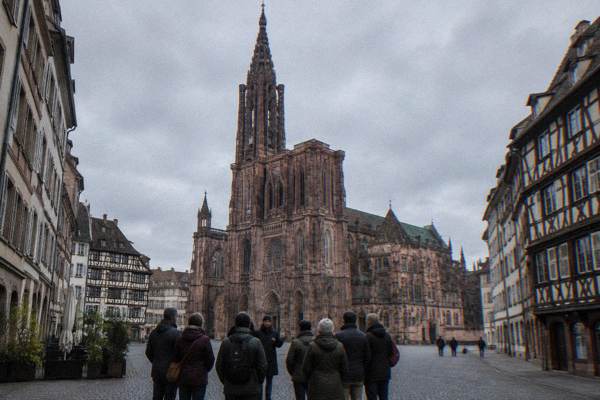
3 Days In Strasbourg
Three days is enough to see the cathedral, the old quarter, the European institutions and still take one day trip into Alsace or the Black Forest. Here is how to split the days, what each ticket costs and where the time actually goes.
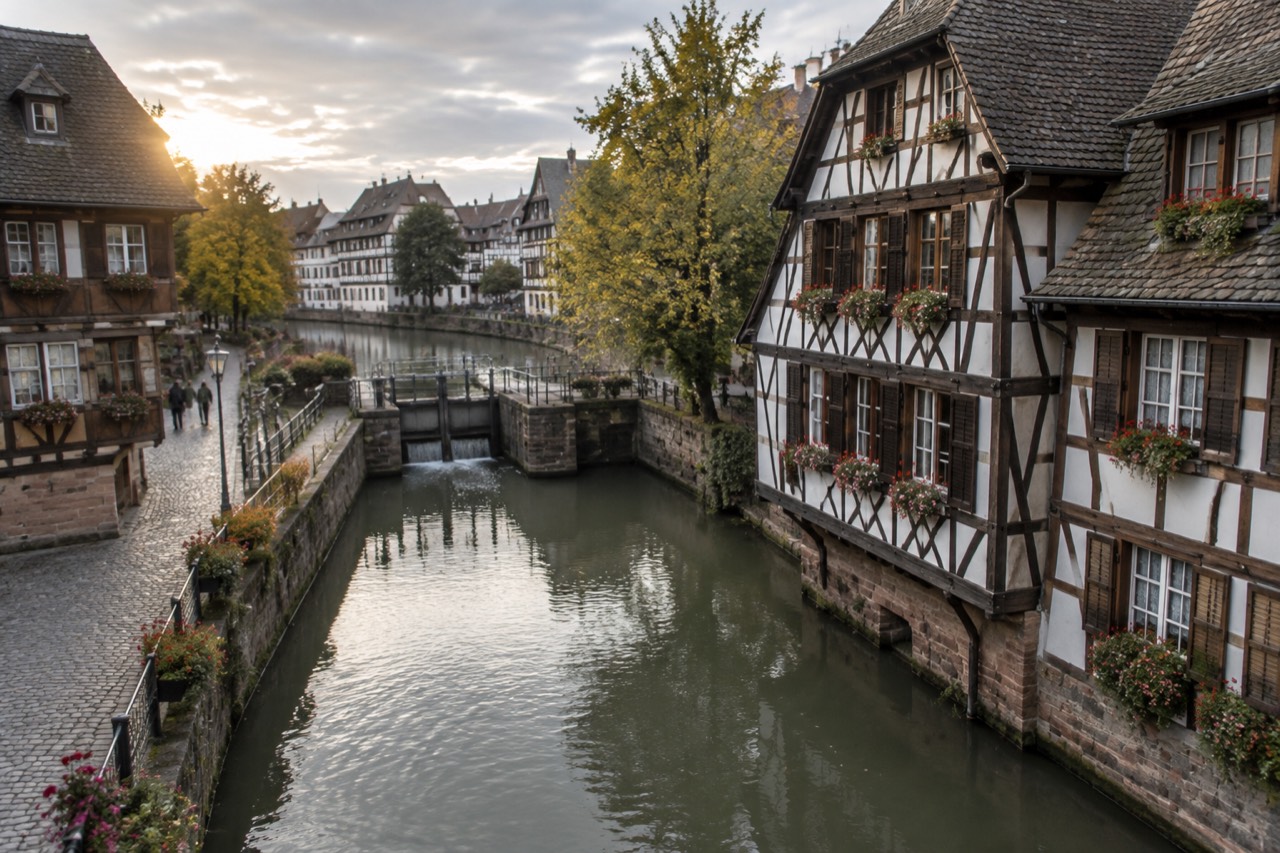
Short answer
Three days in Strasbourg, in Alsace, north-eastern France, is the sweet spot: day one for the Grande Île and the cathedral, day two for the European Quarter and museums, day three for an Alsace or Black Forest day trip. Entry tickets and transport stay modest beyond your hotel and meals.
Strasbourg, the prefecture of the Bas-Rhin in Alsace, in the Grand Est region of north-eastern France, sits on the River Ill a short way upstream of the Rhine, which forms the border with Germany, with Kehl on the far bank. Three days here is the length that lets you do the city properly and still leave town once. The historic centre, the Grande Île, is compact enough to cover on foot in a day; the European institutions and the Neustadt need a second; the wine villages, the Vosges foothills or the Black Forest fill a third. This itinerary splits the visit that way, with verified ticket prices, transport fares and timing notes so the plan survives contact with the ground.
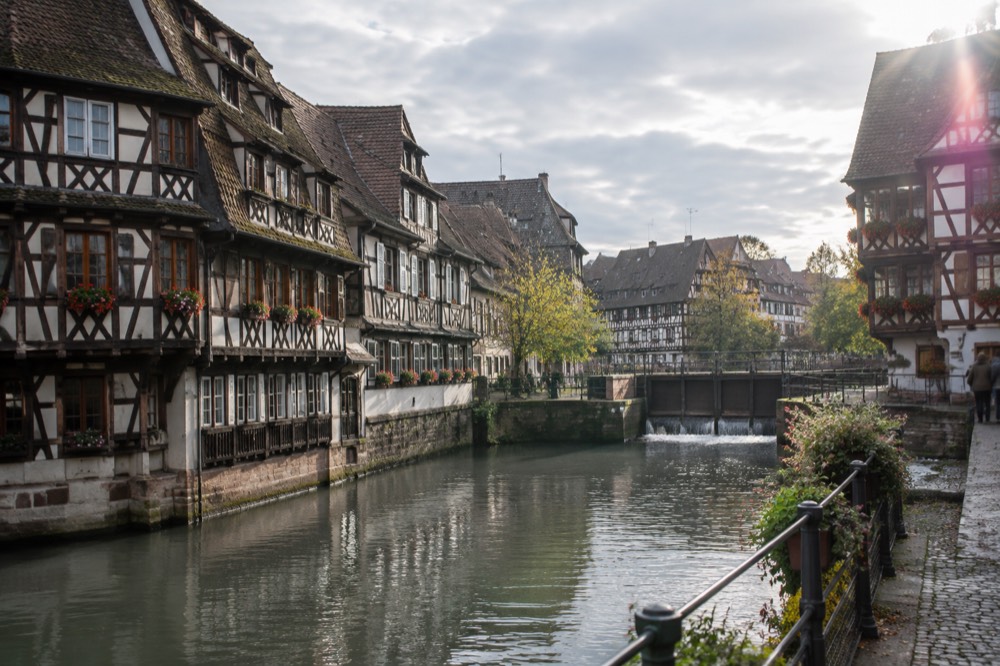
Is Three Days In Strasbourg The Right Length?
Three days is the comfortable answer for Strasbourg itself plus one excursion: day one walks the Grande Île from the cathedral to Petite France, day two takes in the European Quarter and a museum or two, and day three goes out to the Alsace wine route, the Black Forest or a castle. Two days work if you skip the excursion, and four only make sense if you plan several day trips. Anything longer and you are really touring Alsace, not the city.
The city itself is small. The commune counted 293,771 residents at the last INSEE figure, and the parts a visitor cares about, the Grande Île and the Neustadt, sit inside a loop of the Ill that you can cross on foot in half an hour. What stretches a visit is the surrounding region: Colmar, the wine villages, Haut-Koenigsbourg, the Black Forest and Baden-Baden all sit within a day trip's reach, and Strasbourg is the natural base for all of them. The question of how many days you need is really a question of how many of those excursions you want.
If you are still weighing the length, the one-day Strasbourg itinerary covers the essentials in a single loop, and the two-day Strasbourg itinerary adds the European Quarter. The how many days in Strasbourg is enough answer goes deeper on the trade-offs. Three days is where the city and one excursion both fit without rushing.
What To Do On Day One In The Grande Île?
Spend day one entirely inside the Grande Île: start at the cathedral when the nave opens at 08:30, climb to the platform at 66 m, watch the 12:30 astronomical clock show, then walk downhill through Place Kléber and the rue des Hallebardes to Petite France and the Ponts Couverts, finishing on the Barrage Vauban terrace as the light drops. Book nothing except the clock ticket, which is sold on the day only.
The cathedral rewards the early start. The nave is open Monday to Saturday 08:30-11:15 and 12:45-17:45, and on Sunday afternoons 14:00-17:15; the visiting gaps exist because this is a working church, and the midday closure brackets the clock show. The platform, reached by stairs, runs on seasonal hours: 09:30-13:00 and 13:30-20:00 from April to September, 10:00-13:00 and 13:30-18:00 from October to March, with the last ascent earlier than the closing time. The ticket is 10 EUR full price, 6 EUR reduced, free for children under 6. There are no lockers, so travel light.
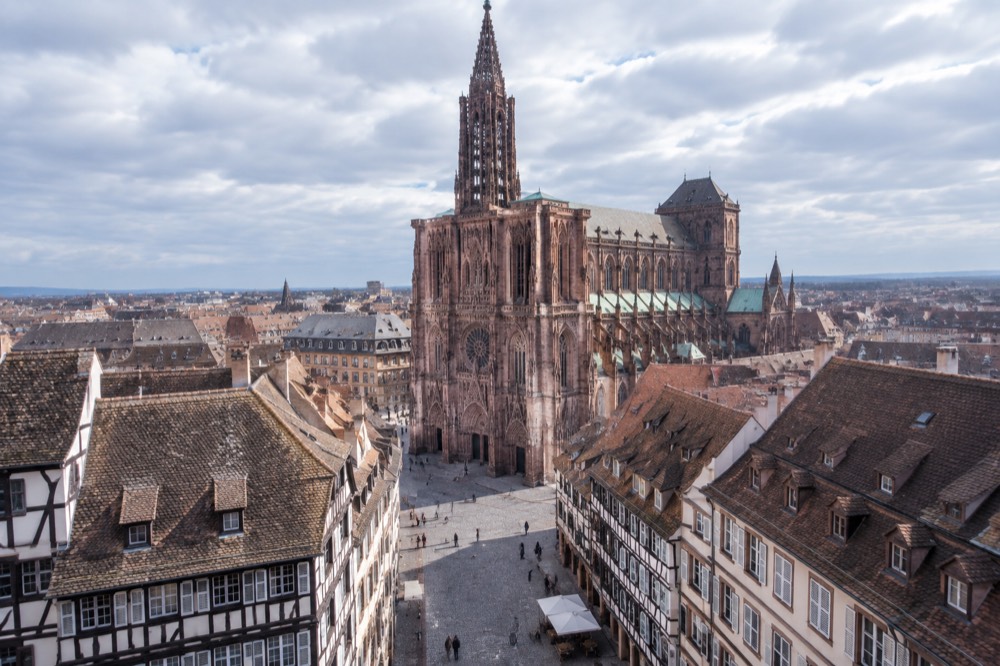
The astronomical clock show is the fixed point of the day. It runs at 12:30 sharp, daily except on Sundays with an 11:00 mass, and the ticket is 4 EUR, sold on the day only, with no reservations: sales happen at the cathedral stalls between 10:00 and 11:00 or at the Saint-Michel entrance from 11:30. Get the ticket early, because day-of sales are the only route in. The astronomical clock guide explains what the automaton sequence actually shows, which makes the wait easier to bear.
| Sight | Hours | Ticket | Note |
|---|---|---|---|
| Cathedral nave | Mon-Sat 08:30-11:15, 12:45-17:45; Sun 14:00-17:15 | Entry on the cathedral's own terms | Closed midday around the clock show |
| Platform at 66 m | Apr-Sep 09:30-13:00, 13:30-20:00; Oct-Mar 10:00-13:00, 13:30-18:00 | 10 EUR full, 6 EUR reduced, under 6 free | Last ascent before close |
| Astronomical clock show | 12:30 daily | 4 EUR adult, day-of purchase only | Sales 10:00-11:00 or from 11:30 at Saint-Michel |
| Barrage Vauban terrace | Sep-Oct 08:00-19:00; Nov-Feb 08:30-16:00; Mar-Apr 08:00-19:00 | Check the official page | Seasonal hours vary |
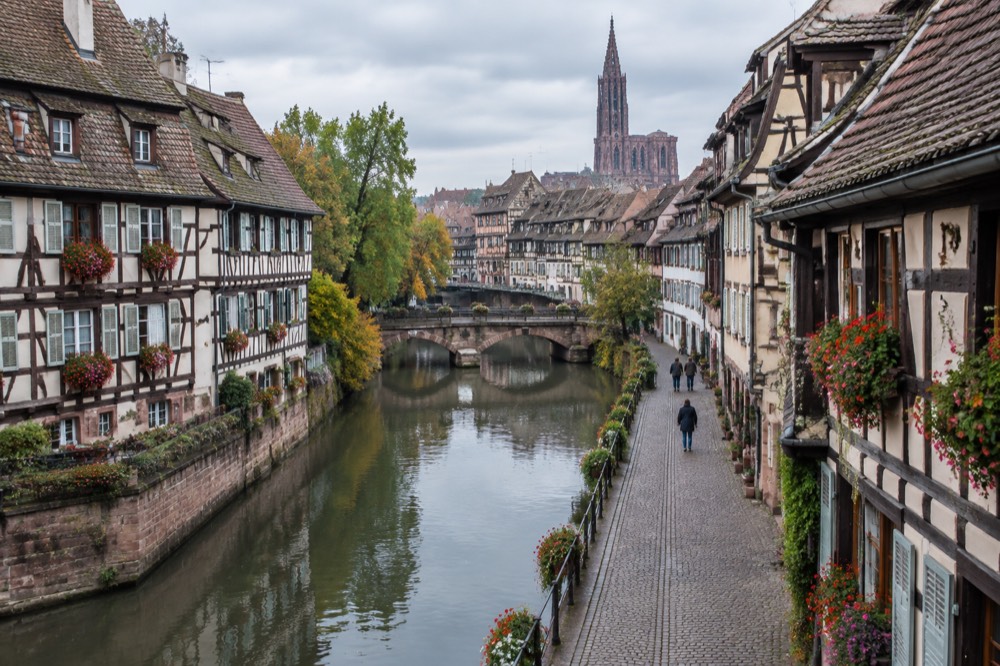
Afternoon belongs to the water. Walk from the cathedral through the commercial streets to Place Kléber, the city's main square, then on to Petite France, the old tanners' and millers' quarter where the Ill splits into channels. The Ponts Couverts and the Barrage Vauban sit at the downstream end; the barrage's panoramic terrace, with its seasonal hours listed above, looks back over the whole ensemble and is the classic end-of-day viewpoint. A Batorama boat trip makes a good late addition: the short Blue Tour runs 45 minutes and the long Red Tour 1h10, at 12.50 EUR and 16.20 EUR full price respectively.
A guided walk is the efficient way to absorb the old town if three days is your whole allowance for the city. The cathedral tour is the one that earns its fee most clearly, because the building's history is dense and the guides carry it well; it runs about an hour and a half and pairs naturally with the clock show.
The Strasbourg Cathedral guide has the full detail on the building, and the Maison Kammerzell next door deserves ten minutes even from outside. If the evening is free, the riverside quai des Bateliers stretch fills with restaurants and is an easy walk from Petite France. For dinner, look for a winstub, the Alsatian tavern form, where tarte flambée and choucroute come with local Riesling by the carafe.
If you would rather have a guide walk you through the cathedral's architecture and the clock's mechanics, Check availability on the operator's live listing for departure times and the cancellation terms.
What To Do On Day Two In The European Quarter And Museums?
Give day two to the east: the Neustadt's grand avenues, the European Parliament and its Parlamentarium, the Council of Europe and the European Court of Human Rights, then a museum afternoon back on the Grande Île at the Palais Rohan or the Musée de l'Œuvre Notre-Dame. The Parlamentarium keeps short Saturday hours and different hours in plenary weeks, so check its page before you set out.
The European Quarter is the part of Strasbourg that surprises visitors who came for half-timbering. The Parlamentarium Simone Veil, the European Parliament's visitor centre, opens Monday to Friday 09:00-18:00 and Saturday 09:30-12:00 and 13:00-18:00 outside plenary weeks, with an airport-style security check at the door; plenary weeks change the schedule, and the visiting page carries the detail. The European Parliament guide, the Council of Europe guide and the European Court of Human Rights guide each explain what you can actually see from outside and what needs booking.
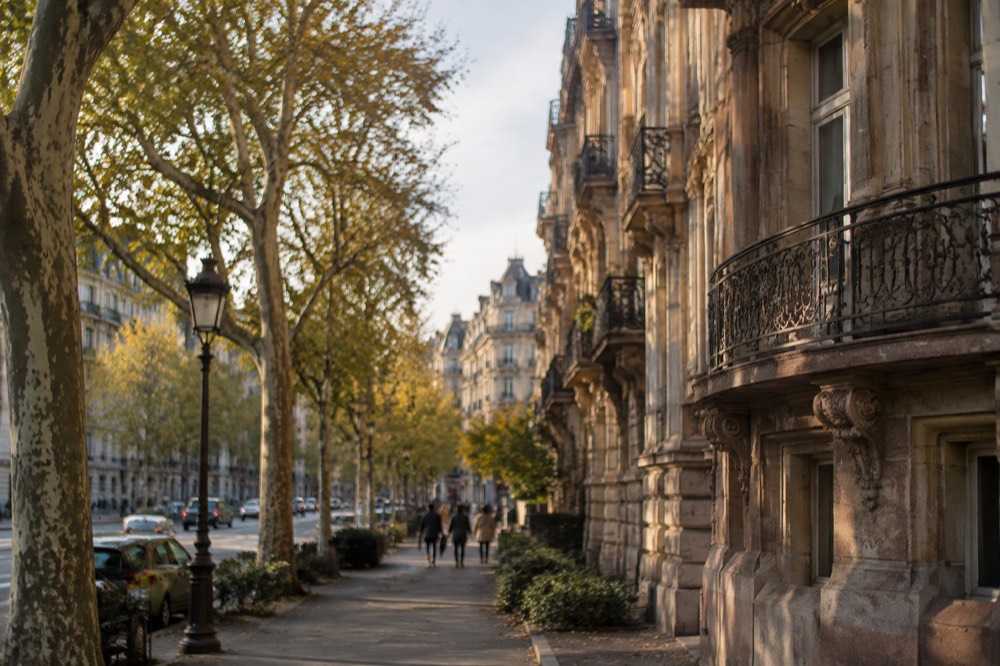
The Neustadt itself, the wide-planned extension of the city across the Ill, is a World Heritage property together with the Grande Île under the name "Strasbourg, Grande-Île and Neustadt". Walk it on the way: the avenues around Place de la République are wide, planted and largely free of the crowds that fill the old island. The Neustadt area guide maps a sensible loop, and the European Quarter area guide covers the institutional cluster.
The museum afternoon is where the municipal ticket structure matters. All municipal museums charge 9 EUR full and 5 EUR reduced, a one-day Pass Musées costs 20 EUR, and every municipal museum is free on the first Sunday of the month. The Musée Alsacien is closed for works until 2028, so plan around it. The Palais Rohan on the Grande Île holds the Archaeological Museum, the Musée des Beaux-Arts and the Musée des Arts Décoratifs in one building; the Musée de l'Œuvre Notre-Dame, near the cathedral, holds the medieval sculpture, and a cathedral platform ticket gives a reduced rate there.
| Museum | Location | Full price | Reduced | Note |
|---|---|---|---|---|
| Musée des Beaux-Arts | Palais Rohan | 9 EUR | 5 EUR | Fine arts, top floor |
| Musée Archéologique | Palais Rohan basement | 9 EUR | 5 EUR | Regional archaeology |
| Musée des Arts Décoratifs | Palais Rohan | 9 EUR | 5 EUR | Period interiors |
| Musée de l'Œuvre Notre-Dame | Near the cathedral | 9 EUR | 5 EUR | Platform ticket gives a reduced rate |
| MAMCS | Near the Petite France end | 9 EUR | 5 EUR | Modern and contemporary art |
| Musée Alsacien | Formerly Petite France area | Closed | Closed | Closed for works until 2028 |
A bike is the best tool for the day. The European Quarter, the Neustadt and the Orangerie park chain together along flat riverside paths, and a guided ride covers all three in a couple of hours with the stories attached. The cycling guide page has the broader picture, since Strasbourg is one of France's most bicycle-friendly cities and the network extends far beyond the centre. For families, the Strasbourg with kids itinerary routes the same ground with playground stops and the zoo-minded in mind.
If rain moves in, the plan inverts cleanly: the museums, the MAMCS and the covered market halls do a full wet afternoon, and the rainy day in Strasbourg itinerary lists the options in order of drying value. Whatever the weather, keep the evening free for the Krutenau, the student quarter south of the Grande Île, where the eating is cheaper and louder than in the old town.
What To Do On Day Three: Alsace, The Black Forest Or A Slow City Day?
Use day three for one excursion: the Alsace wine route villages such as Riquewihr, Eguisheim, Kaysersberg and Obernai, a castle-and-villages loop taking in Haut-Koenigsbourg, or the German side with Freiburg and the Black Forest. If you would rather not leave the city, spend it on the Orangerie park, the Jardin des Deux Rives and the markets, and leave the excursions for a second visit.
The wine route is the classic choice. Villages like Riquewihr, Eguisheim, Kaysersberg and Obernai line a route that runs south from Strasbourg towards Colmar, and a guided day trip strings several together with a tasting stop, which saves you the driving and the parking. The Alsace wine route guide covers the geography; the most beautiful villages in Alsace page ranks the candidates. The Alsace road trip itinerary is the right read if day three is really the first day of a longer drive.
The wine route is the classic day-three excursion. Book an Alsace day trip here.
The German option is just as close. Kehl sits across the Rhine, and the Black Forest day trips run to Freiburg, Titisee and Triberg, or to Baden-Baden, all of them across a border that, inside Schengen and the euro zone on both the French and German sides, you will likely cross without noticing. The Black Forest guide and the Baden-Baden guide set out what each town is for. If Switzerland tempts instead, read the Basel guide first: Basel is Schengen but not in the euro, so euros are not the working currency there.
| Day-three option | What it is for | Who it suits | What to check first |
|---|---|---|---|
| Alsace wine villages | Half-timbered streets, tastings, easy walking | First-time visitors, photographers | Tasting room hours in each village |
| Haut-Koenigsbourg and villages | Castle plus Riquewihr-style stops | Families, history-minded visitors | Castle opening dates in low season |
| Colmar on your own | A second old town, canals, museums | Train travellers, slow walkers | The Colmar guide's museum hours |
| Black Forest, Freiburg, Titisee | German scenery, forest towns, lake | Drivers and tour takers | Tour pickup points and times |
| Slow city day | Orangerie, Jardin des Deux Rives, markets | Anyone tired, anyone with kids | Market days on the official pages |
Food is the other half of day three if you stay in town. A guided tastings walk through the Grande Île and the Krutenau covers tarte flambée, charcuterie, cheese and wine in one moving lunch, and it is the most efficient introduction to Alsatian eating for a short stay. The Strasbourg food guide and the winstubs guide name the specific dishes and the tavern form behind them.
If your three days fall in late November or December, day three belongs to the Christmas market instead. The market typically opens in the last week of November and runs to 24 December, with an early-evening close on the final day; the 2025 edition ran 26 November to 24 December and drew 3.05 million visitors, and the city posts each edition's dates on its Christmas site, so confirm them there. The Strasbourg Christmas market itinerary and the how many days do you need in Strasbourg for Christmas markets answer cover that version of the trip in full.
How Much Does Three Days In Strasbourg Cost?
Beyond accommodation and meals, the cathedral platform at 10 EUR, the clock show at 4 EUR, a museum at 9 EUR, a Batorama boat trip at 12.50-16.20 EUR and a 24-hour transport pass at 4.60 EUR are the main movable parts. The Strasbourg City Card at 5 EUR is a discount card, not a pass, and the one-day Pass Musées at 20 EUR only pays off from three museums upward.
The arithmetic is straightforward because the entry prices are modest and the walking is free. A day-one stack of platform plus clock plus a short boat trip adds up at full price. A museum-heavy day two with the 20 EUR pass and a transport pass adds a little more. Day three depends on the excursion: a guided day trip is priced on the operator's listing, and an independent village day costs little beyond lunch and a tasting fee, which varies by cellar, so check the room before you sit down.
| Item | Full price | Reduced | When it pays |
|---|---|---|---|
| Cathedral platform | 10 EUR | 6 EUR (6-18, students) | Clear mornings |
| Astronomical clock show | 4 EUR | 3 EUR groups and students to 25, 2 EUR 6-17 | Once per trip |
| Municipal museum | 9 EUR | 5 EUR | Rain days |
| Pass Musées, 1 day | 20 EUR | none | Three or more museums |
| Batorama short tour, 45 min | 12.50 EUR | 7.20 EUR | Tight schedules |
| Batorama long tour, 1h10 | 16.20 EUR | 8.90 EUR | First visit |
| CTS 24h Solo pass | 4.60 EUR | none | Any day with 3+ rides |
| Strasbourg City Card | 5 EUR adult, 3.50 EUR child | 7 days validity | Several paid sights planned |
Two structural savings are worth planning around. Every municipal museum is free on the first Sunday of the month, so a visit whose day two lands on a first Sunday can swap its 20 EUR pass for zero. And the City Card, at 5 EUR for seven days, discounts the museums, the boat, the platform and the clock by small amounts; with three or four paid sights it covers itself, but it never includes entry, so read it as a coupon book rather than a pass. The Strasbourg City Card guide runs the numbers in detail, and the Strasbourg on a budget guide collects the free layer: the squares, the bridges, the riverside walks and the churches that cost nothing to enter.
Accommodation is the variable that dwarfs everything else, and it swings hard in December. The where to stay in Strasbourg guide compares the neighbourhoods, and the December-specific where to stay for the Christmas market page explains why the same room changes price with the season. Book early for late November and December; the market draws over three million visitors across its run, and the centre fills first.
How To Get Around Strasbourg In Three Days?
Walk for day one, use the tram and bus for day two, and take the airport train shuttle if you are flying: a CTS single is 1.90 EUR bought in the app or by contactless and 2.50 EUR on board a bus, a 24-hour Solo pass is 4.60 EUR, and a 24-hour Trio pass for two or three people is 10.20 EUR. The airport shuttle combined ticket, covering the train plus a day of city transport, is 4.60 EUR.
The CTS network of trams and buses covers everything a three-day visitor needs, and the fares reward planning. Buy singles through the Badgéo card, the CTS app or contactless payment at 1.90 EUR rather than on the bus at 2.50 EUR; the 24-hour Solo pass at 4.60 EUR breaks even on the third ride; and the Trio at 10.20 EUR covers two or three people together, which suits families. The 72-hour pass price is not published on the fare page, so check CTS's own site before assuming it exists at a given price.
| Ticket | Price | Validity | Best for |
|---|---|---|---|
| Single, app or contactless | 1.90 EUR | One journey | Occasional rides |
| Single, bought on the bus | 2.50 EUR | One journey | Emergencies only |
| 24h Solo | 4.60 EUR | One person, 24 hours | Day two in the city |
| 24h Trio | 10.20 EUR | 2-3 people, 24 hours | Families and pairs |
| Airport combined ticket | 4.60 EUR | Train shuttle plus 24h city transport | Arrival and departure days |
The airport link is unusually good. The TER shuttle between Strasbourg station and Entzheim airport runs up to five trains an hour and takes 8 minutes, and the combined ticket folds the shuttle and a day of city transport into one 4.60 EUR purchase. The airport to city centre guide and the getting around Strasbourg guide carry the detail, including the tram lines that matter for the European Quarter. If you are arriving from Paris, the Paris to Strasbourg guide covers the rail options; the fastest trains complete the run in under two hours, and SNCF Connect has the current timetables.
Cycling deserves a mention as transport, not just as a tour. The flat terrain and the riverside paths make a borrowed or hired bike the fastest way to cross between the Grande Île, the Neustadt and the Orangerie, and day two's geography is built for it. For the day-three excursions, the choice is between a guided trip with transport included, the regional train, or a hire car; the Strasbourg car rental guide covers the third option, including where it makes sense and where the tram is simpler.
When Is The Best Time Of Year For A Three-Day Visit?
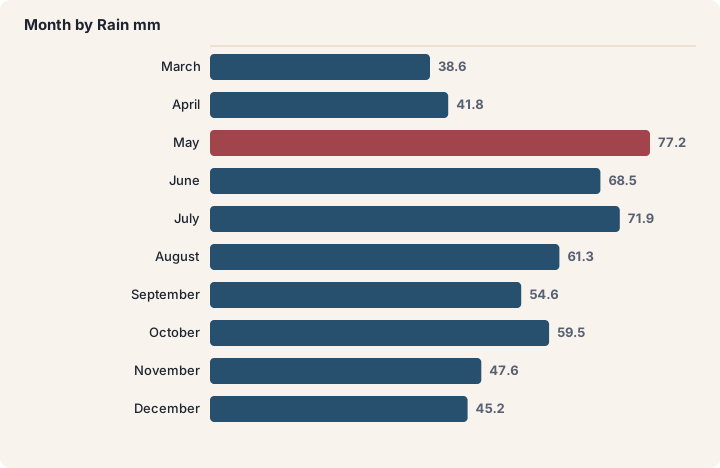
Late spring through early autumn is the comfortable window: Meteo-France's 1991-2020 normals for Strasbourg-Entzheim give mean daily maxima of 20.9 C in May, 24.4 C in June and 26.4 C in July, against 5.2 C in January and 5.9 C in December, with 635.7 mm of rain spread over 112.3 rain days a year. December trades cold and wet for the Christmas market, which is a different trip with its own logic.
The climate here is semi-continental, which means real summers and real winters rather than the mild oceanic pattern of western France. The rain is the constant: every month averages between 8.0 and 10.8 days with at least 1 mm of rain, so no season buys you a dry guarantee. May is the wettest month at 77.2 mm, February among the driest at 34.1 mm, and the shoulder months of April, September and October combine tolerable temperatures with thinner crowds than July and August.
| Month | Mean max C | Mean min C | Rain mm | Rain days >=1 mm |
|---|---|---|---|---|
| March | 12.1 | 2.6 | 38.6 | 8.5 |
| April | 17.0 | 5.7 | 41.8 | 8.6 |
| May | 20.9 | 10.1 | 77.2 | 10.8 |
| June | 24.4 | 13.4 | 68.5 | 10.2 |
| July | 26.4 | 14.9 | 71.9 | 10.4 |
| August | 26.1 | 14.5 | 61.3 | 9.5 |
| September | 21.6 | 10.7 | 54.6 | 8.0 |
| October | 15.8 | 7.2 | 59.5 | 9.6 |
| November | 9.4 | 3.3 | 47.6 | 9.2 |
| December | 5.9 | 0.8 | 45.2 | 10.2 |
December deserves its own paragraph because it is both the coldest sensible month and the city's peak. The Christmas market transforms the centre, fills the hotels and doubles the price of the same rooms, and the is December a good time to visit Strasbourg answer weighs the trade honestly. If the market is the reason for the trip, the Strasbourg in winter guide and the Strasbourg Christmas market guide cover the logistics, and the seasonal pages for spring, summer and autumn do the same for the rest of the year.
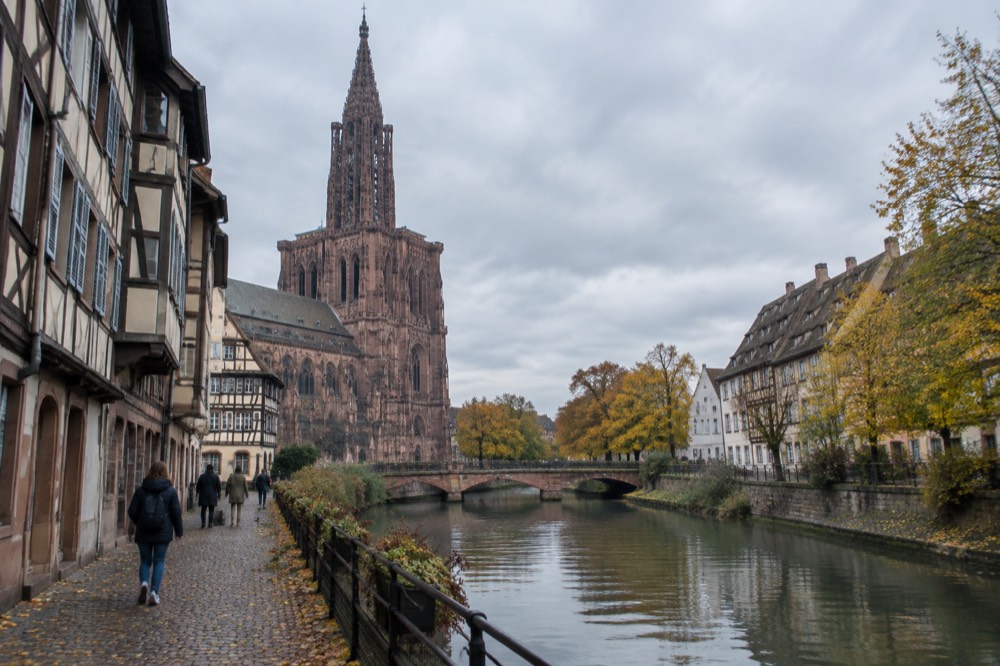
For a three-day plan specifically, the season mainly changes day three. In summer the excursion options all run and the villages are at their fullest; in winter the Black Forest and the wine villages quieten down and the market absorbs the time instead; in the shoulder months you get the villages to yourself with some cellar closures to check ahead. Whatever the month, the best time to visit Strasbourg guide is the fuller read.
What Could Go Wrong With A Three-Day Plan?
Three things break three-day itineraries in Strasbourg: the clock show's day-of-only ticket rule, which fails anyone who arrives at the cathedral after 11:30 without a ticket; the Musée Alsacien closure, which catches plans built on older guidebooks; and the Sunday museum squeeze, when free first-Sunday crowds meet reduced cathedral hours. Build slack into day one's afternoon and the plan survives all three.
The clock rule is the one that bites. Tickets are sold on the day only, at the cathedral stalls between 10:00 and 11:00 or at the Saint-Michel entrance from 11:30, and there is no reservation route. If day one is your only cathedral day and you sleep through the morning, the show is gone. The fix is simple: treat the 12:30 show as the anchor of day one and plan breakfast around it, not the other way round.
The Sunday pattern cuts both ways. The municipal museums are free on the first Sunday of the month, which saves the 20 EUR pass, but the cathedral nave opens only at 14:00 on Sundays, and the clock show does not run on Sundays with an 11:00 mass. A Sunday that lands mid-itinerary is best given to the European Quarter, the parks and Petite France, with the museums held for Monday. The Strasbourg museums guide has the full opening picture, including which museums sit where.
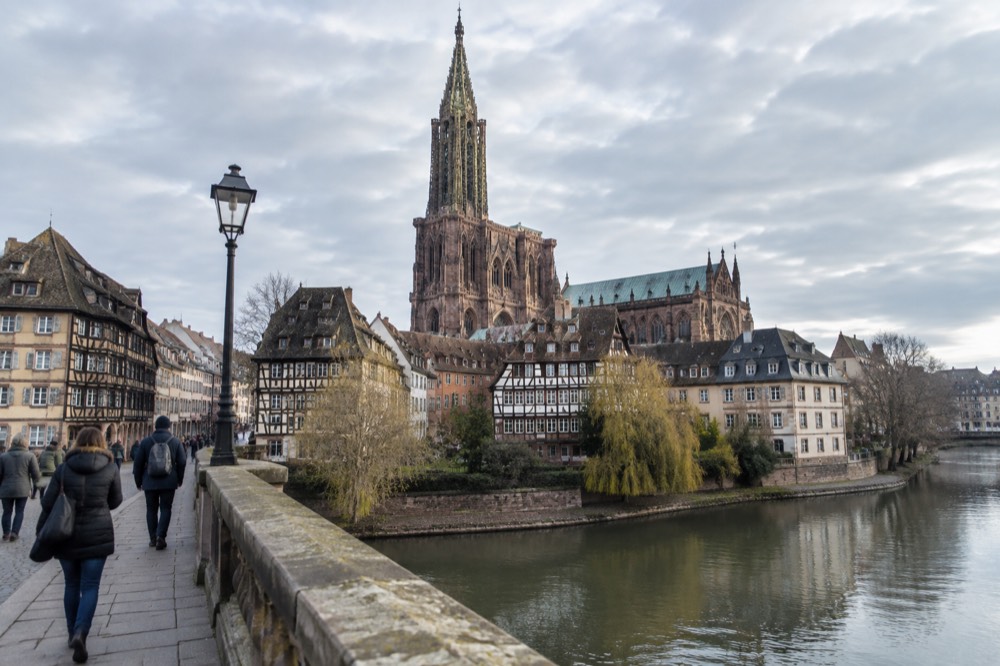
Rain is the third variable, and with 112.3 rain days in an average year it will touch some part of a three-day visit. The semi-continental climate delivers summer downpours as readily as winter drizzle, so keep the museum afternoon and the covered market halls as movable pieces rather than fixing them to a clock hour. The rainy day itinerary exists for exactly this, and the Strasbourg weather guide carries the monthly normals in full.
Finally, the day-three excursion needs a booking decision made by day one evening, not on the morning itself. Guided day trips to the wine villages, the castle or the Black Forest have fixed departure points and times, and the popular ones fill in high season and around the Christmas market. If the excursion is the centrepiece of the trip, book it before you leave home and let the city days flex around it; if the city is the centrepiece, leave day three open and decide on the ground.
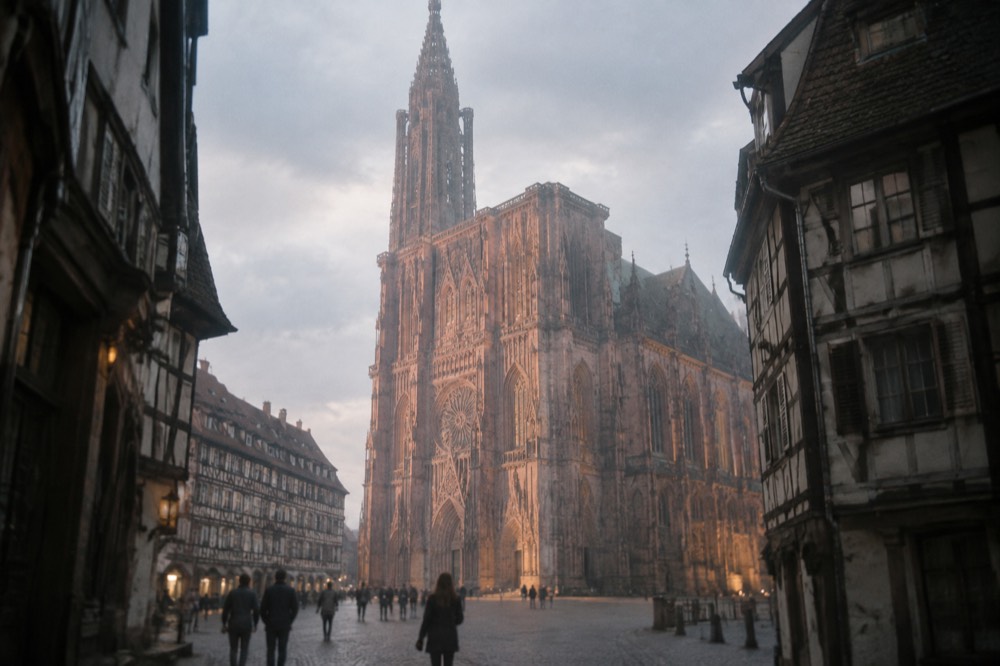
Three days in Strasbourg, planned this way, leaves almost nothing of the city unseen and adds one proper excursion besides. The cathedral and the Grande Île fill the first day, the European Quarter and the museums the second, and the third belongs to Alsace or the Black Forest, with the Christmas market taking over that slot in December. For the fuller version of any single piece, start with the Strasbourg Travel Guide homepage and work outward; for the next trip, the Strasbourg and Colmar itinerary and the how many days in Colmar is enough answer extend the same logic down the wine route.
Common Questions About Three Days In Strasbourg
Is Three Days In Strasbourg Enough?
Yes, for the city itself plus one excursion. Day one covers the Grande Île, the cathedral, the clock and Petite France; day two covers the European Quarter and the museums; day three takes a wine village, castle or Black Forest trip. Four days only pay off if you want several excursions.
What Should I Not Miss In Three Days?
The cathedral nave and platform, the 12:30 astronomical clock show, Petite France and the Ponts Couverts, the Barrage Vauban terrace view, and one excursion into the Alsace villages or the Black Forest. A Batorama boat trip on the Ill is the best single add-on if time allows.
How Much Money Do I Need For Three Days?
Beyond accommodation and meals, the main costs are the platform at 10 EUR, the clock at 4 EUR, a museum at 9 EUR, a boat trip at 12.50-16.20 EUR and a 24-hour transport pass at 4.60 EUR. Excursions are priced on the operator's listing.
Do I Need A Car For Three Days In Strasbourg?
No, not for the city. The tram and bus network with a 24-hour pass at 4.60 EUR covers the Grande Île, the Neustadt and the European Quarter, and the airport shuttle is a train. A car or a guided trip only matters on day three if you choose the wine villages or the Black Forest.
Can I Visit The Christmas Market In Three Days?
Yes, comfortably. The market typically runs from the last week of November to 24 December, and the city days of this itinerary double as market days since the chalets sit in the same squares. The 2026 dates were still being finalised on the city's Christmas site, so confirm them there before booking.
What Is The Best Day Three Excursion From Strasbourg?
The Alsace wine route villages are the classic choice for first-time visitors, with a castle-and-villages loop as the alternative. The Black Forest and Baden-Baden suit travellers who want Germany, and Colmar suits anyone who prefers a second old town by train. All are covered in the day-trip guides linked above.