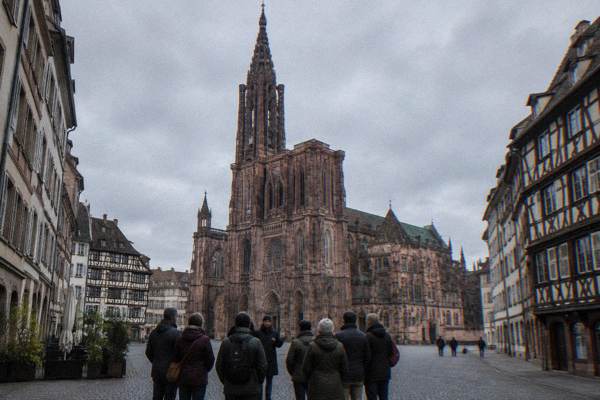
2 Days In Strasbourg
Two days in Strasbourg, in Alsace in north-eastern France, cover the cathedral, Petite France, the Grande Île and the European Quarter, with time left for the food the city is known for.
Short answer
Two days in Strasbourg are enough for the Grande Île, the cathedral and its astronomical clock, Petite France, the Ponts Couverts and the Barrage Vauban terrace, plus the European Quarter. Add a Batorama river tour and a food walk and the two days feel full without rushing. A third day is only needed for Alsace day trips.
Strasbourg, the prefecture of the Bas-Rhin in Alsace, in the Grand Est region of north-eastern France, sits on the River Ill beside the Rhine, with the German town of Kehl across the water. Two days here cover the whole of the historic core on foot: the Grande Île, the island centre that is a UNESCO World Heritage property together with the Neustadt, the single-spired cathedral, the canals of Petite France, and the modern institutions of the European Quarter on the far side of the river. This itinerary lays out a realistic two-day plan, hour by hour, with the verified opening hours, ticket prices and transport fares that actually shape a visit.
Is Two Days In Strasbourg Enough?
Two days are enough to see the cathedral inside and out, watch the astronomical clock at 12:30, walk Petite France and the Ponts Couverts, climb to the cathedral platform at 66 m, take a river tour and reach the European Quarter, with evenings free for a winstub dinner. What two days do not cover is Alsace beyond the city: the wine route villages, Colmar, Haut-Koenigsbourg and the Black Forest all need a third day or a separate trip.
The honest answer depends on what a visitor counts as seeing a city. Strasbourg's historic core is compact: the Grande Île is a genuine island, and the distances between the cathedral, Place Kléber, Place Gutenberg and Petite France are short enough that the whole loop is a comfortable morning. The Neustadt, the German-era extension beyond the new canal, adds an hour or two of wide boulevards and grand facades. The European Quarter, the Parc de l'Orangerie and the riverside walk back to the centre fill an afternoon.
What stretches a Strasbourg visit is queueing and timing rather than distance. The astronomical clock show runs once a day, at 12:30 sharp, and tickets are sold on the day only, at the cathedral stalls between 10:00 and 11:00 or from 11:30 at the Saint-Michel entrance on Place du Château. The cathedral nave closes to visitors between 11:15 and 12:45 from Monday to Saturday, so a late arrival can find the doors shut. The platform has its own seasonal hours. A two-day plan that respects these fixed points wastes very little time.
Readers deciding between one, two and three days can compare the trade-offs in the one-day Strasbourg itinerary and the three-day Strasbourg itinerary, and the question how many days in Strasbourg is enough has its own answer page. Two days is the sweet spot for the city itself.
| Fixed point | When | Ticket |
|---|---|---|
| Cathedral nave, Mon-Sat | 08:30-11:15 and 12:45-17:45 | Admission on the door, check the cathedral page |
| Cathedral nave, Sun and feast days | 14:00-17:15 | Admission on the door, check the cathedral page |
| Astronomical clock show | 12:30 daily, except some Sundays | 4 EUR adult, 2 EUR children 6-17 |
| Cathedral platform, 1 Apr-30 Sep | 09:30-13:00 and 13:30-20:00, last ascent 19:15 | 10 EUR full, 6 EUR reduced |
| Cathedral platform, 1 Oct-31 Mar | 10:00-13:00 and 13:30-18:00, last ascent 17:15 | 10 EUR full, 6 EUR reduced |
| Barrage Vauban terrace, Sep-Oct | 08:00-19:00 | Check the official page for admission |
Day One: The Grande Île, The Cathedral And Place Kléber
Day one belongs to the Grande Île. Start at the cathedral at 08:30 when the nave opens, buy the clock ticket for the 12:30 show, climb the platform after the nave closes at 11:15, then walk Place Gutenberg, Place Kléber, Maison Kammerzell and the Rue des Orfèvres before dinner in a winstub. The whole day is on foot inside one island.
The cathedral is the anchor of the day and of the city. Its single spire dominates the skyline, and the platform at 66 m gives the best view over the red roofs of the Grande Île. The nave is open to visitors Monday to Saturday from 08:30 to 11:15 and again from 12:45 to 17:45, and on Sundays and feast days from 14:00 to 17:15. During the Christmas market season the cathedral stays open continuously on the Place du Château side, Monday to Saturday from 08:30 to 17:45. Full detail on hours, tickets and how the visit is organised is on the Strasbourg Cathedral guide.
The astronomical clock needs planning because of the ticket rules. Tickets are sold on the day only, with no reservations: at the cathedral stalls between 10:00 and 11:00, or from 11:30 at the Saint-Michel entrance on Place du Château. The show itself is at 12:30 sharp. The adult ticket is 4 EUR, with 2 EUR for children aged 6 to 17 and a 3 EUR group and student rate. The astronomical clock guide explains what the automaton actually does, which helps the wait make sense.
Between the morning nave visit and the 12:30 show, the platform is the natural filler, though the order can be reversed in the afternoon when the platform reopens at 13:30. The platform ticket is 10 EUR full price and 6 EUR reduced, free for children under 6, and it also gives a reduced rate at the Musée de l'Œuvre Notre-Dame. There are no luggage lockers at the cathedral, so bags left at a hotel or a storage point stay there for this visit.
The afternoon is a walking loop with no tickets at all. Place Gutenberg, with its statue of the printer who spent years in Strasbourg, sits two streets from the cathedral west front. Place Kléber, the largest square in the city centre, holds the Christmas tree in December and the Aubette building on its north side. Maison Kammerzell, a half-timbered merchant house directly facing the cathedral, is the most decorated facade in the city; the Maison Kammerzell guide covers whether it is worth going inside. The Place Kléber guide does the same for the square.
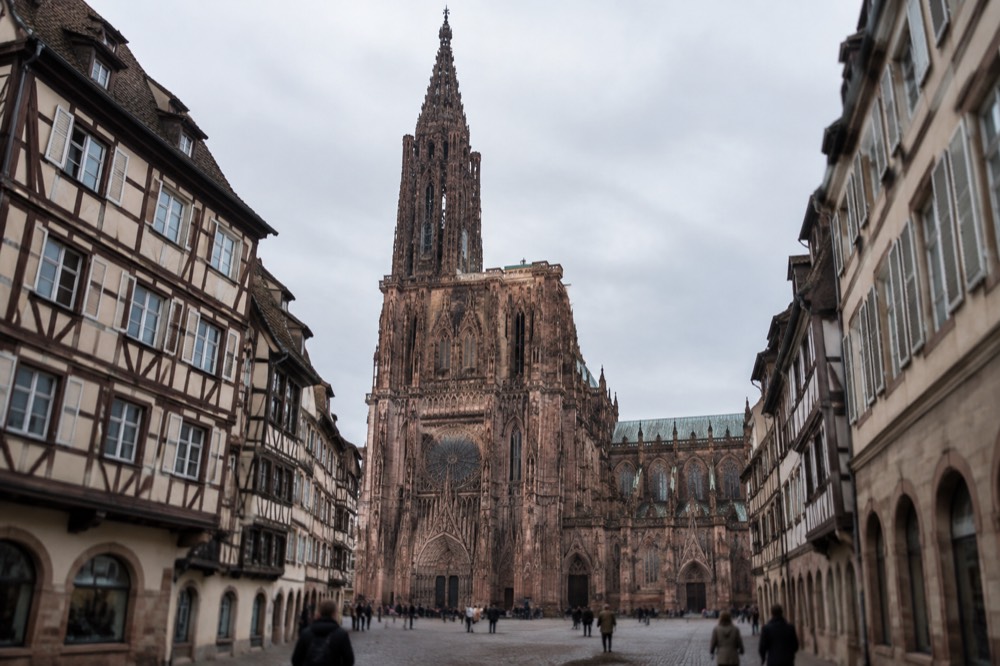
A guided walk on day one saves research time for visitors who like a narrative with their streets. A local-guide walk of roughly two hours covers the cathedral district and the main squares, and a shorter sixty-minute version with a local suits anyone whose first day is already half over. Both render their current price, rating and duration on the operator's live listing, so nothing needs to be guessed at, and the sixty-minute walk is a good fit if the clock show has eaten the morning.
Want a narrative with your streets on day one? Book a free walking tour here.
| Time | Day one plan | Cost per adult |
|---|---|---|
| 08:30-10:00 | Cathedral nave, west front, Place du Château | Check the cathedral page |
| 10:00-11:15 | Clock ticket, then platform ascent | 4 EUR clock, 10 EUR platform |
| 11:15-12:30 | Rue des Orfèvres, Place Kléber, coffee | Varies |
| 12:30-13:00 | Astronomical clock show | Included in clock ticket |
| 13:30-15:30 | Palais Rohan museums or Musée de l'Œuvre Notre-Dame | 9 EUR municipal museums |
| 15:30-17:30 | Place Gutenberg, Maison Kammerzell, shopping streets | Free |
| Evening | Winstub dinner, tarte flambée | Varies |
Evening on day one is a winstub evening. These Alsatian tavern rooms serve tarte flambée, the thin crust topped with cream, onions and lardons, and choucroute garnie, the sauerkraut platter that is the region's signature dish. The city's food culture has its own pages: the winstubs in Strasbourg guide and the tarte flambée guide explain what to order and how the dishes differ from the German versions across the border.
Day Two: Petite France, The River And The European Quarter
Day two crosses water twice. Morning goes to Petite France, the Ponts Couverts and the Barrage Vauban terrace, then a Batorama river tour from the quay. Afternoon goes to the European Quarter, the Parliament district and the Parc de l'Orangerie, with the walk back along the Ill. The day ends back on the Grande Île for dinner.
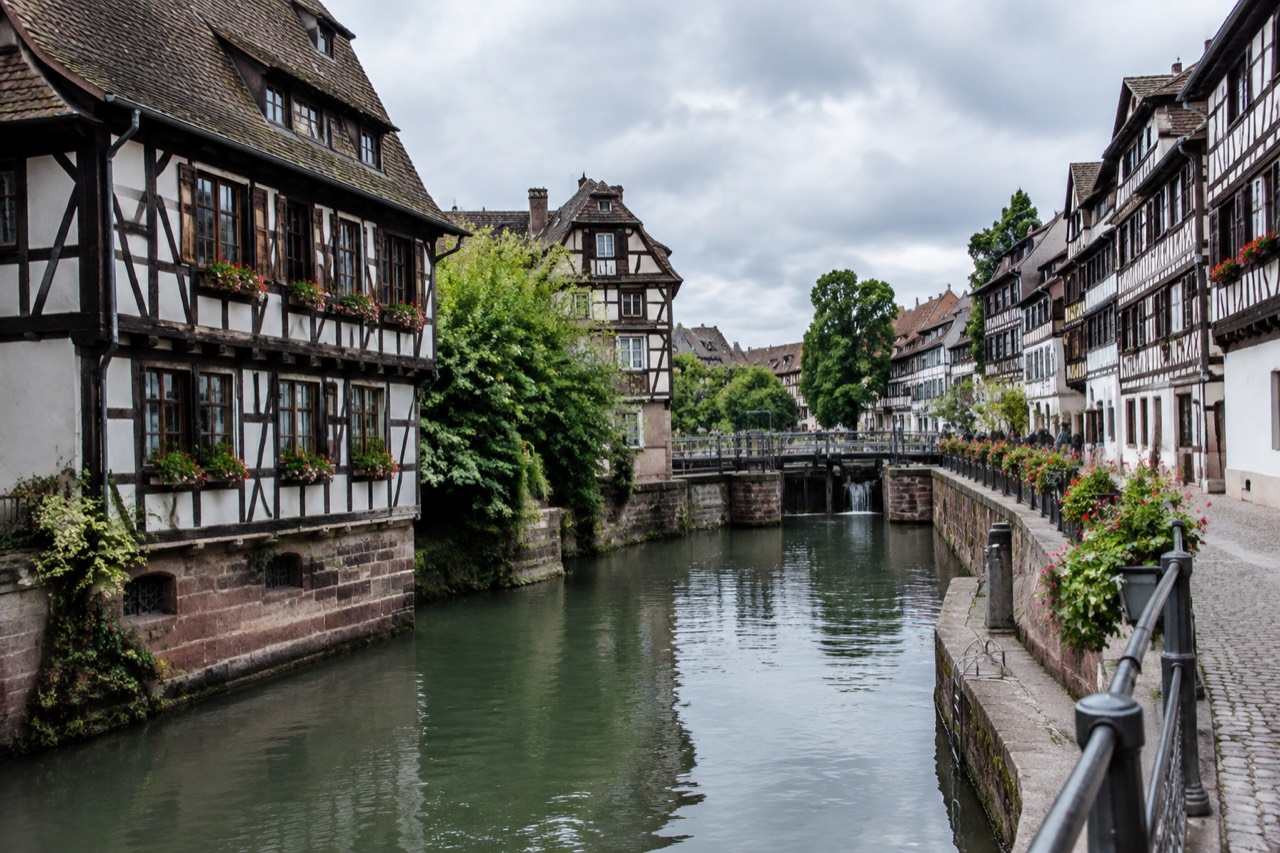
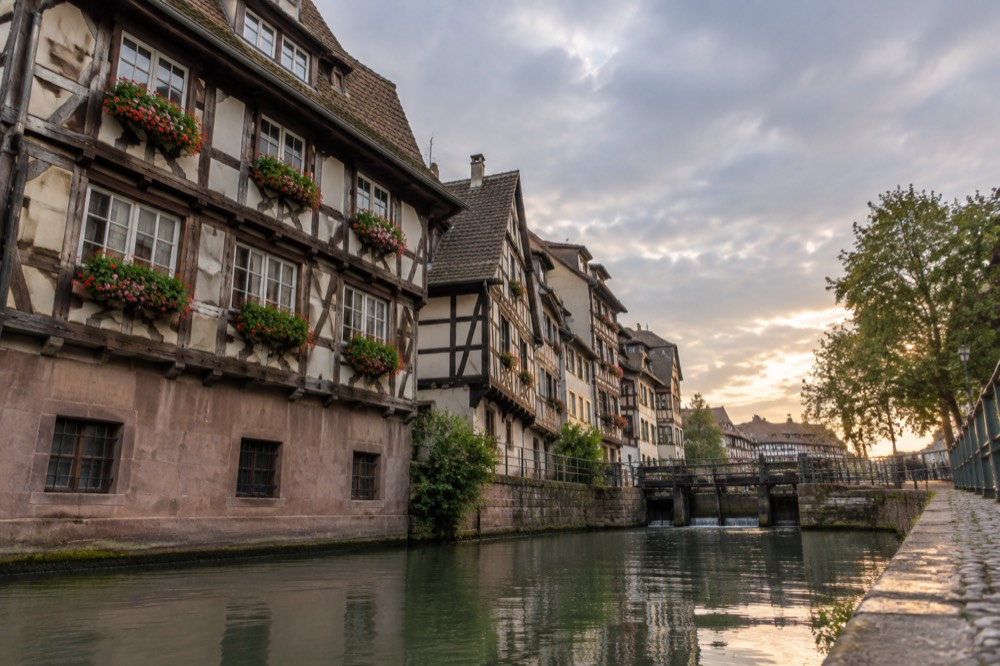
Petite France is the former tannery quarter at the western tip of the Grande Île, where the River Ill splits into channels. Half-timbered houses stand directly on the water, and the quarter's lanes need no ticket and no guide, only an hour or two of wandering. The Petite France guide maps the quarter and picks the viewpoints. The Ponts Couverts, the bridged towers at the quarter's edge, connect to the Barrage Vauban, the massive defensive dam whose panoramic terrace looks back over the whole skyline: the terrace's seasonal hours are 08:00-19:00 from September to October, 08:30-16:00 from November to February and 08:00-19:00 in March and April, with admission details on the official page. The Ponts Couverts guide and the Barrage Vauban guide cover both.
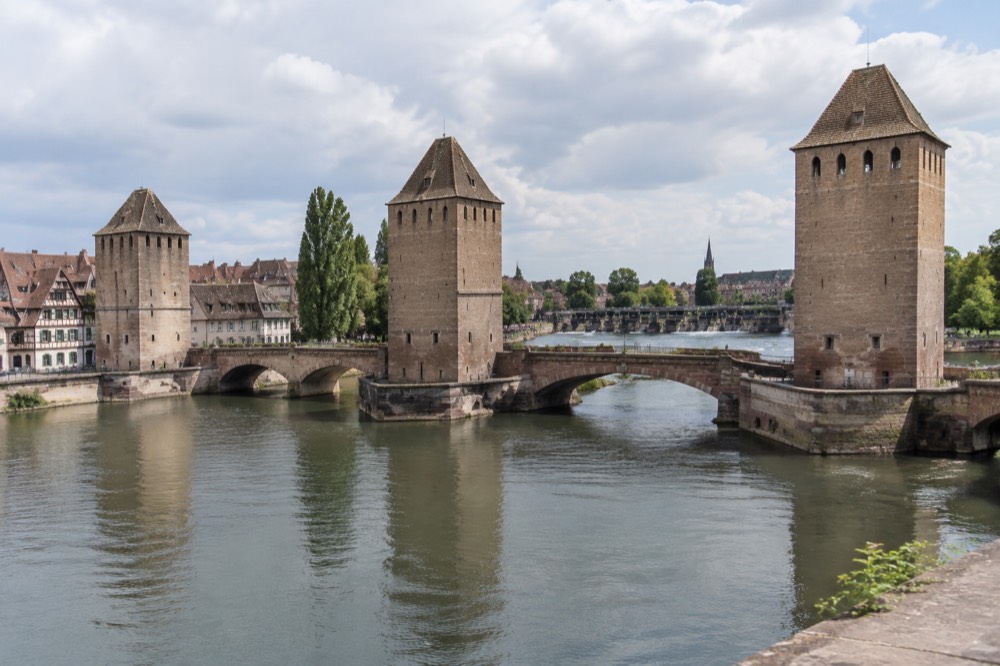
The river tour fits naturally at midday. Batorama, the official operator, runs from the quay near the Palais Rohan: the long tour, the Red Tour, lasts 1h10 and costs 16.20 EUR full fare or 8.90 EUR reduced; the short Blue Tour lasts 0h45 and costs 12.50 EUR or 7.20 EUR reduced. The boat passes Petite France from the water, the Neustadt facades and, on the longer circuits, the European institutions. It is the one moment in two days when the city is seen sitting down, and it is the best value per minute of any paid sight in the centre.
The European Quarter is the part of Strasbourg that surprises visitors who came for the half-timbering. The city shares the seat of the European Parliament and hosts the Council of Europe and the European Court of Human Rights, all in a district of glass, flags and parkland a short tram ride or a riverside walk from the centre. The Parlamentarium Simone Veil, the Parliament's visitor centre, opens Monday to Friday 09:00-18:00 and Saturday 09:30-12:00 and 13:00-18:00 outside plenary weeks, with an airport-style security check at the door and different hours during plenary weeks, so the official page is the place to confirm before going. Admission terms are on that same page.
A guided walk of the European District turns a district of institutional buildings into a story: what each institution does, why Strasbourg hosts them, and how the quarter was built. The site's own featured tour for this itinerary is the European District walking tour, which the Strasbourg Travel Guide pairs with this two-day plan; its live listing carries the current price, rating and departure details. Check availability for the tour before fixing the afternoon, since guided slots in the quarter are limited compared with the city-centre walks.
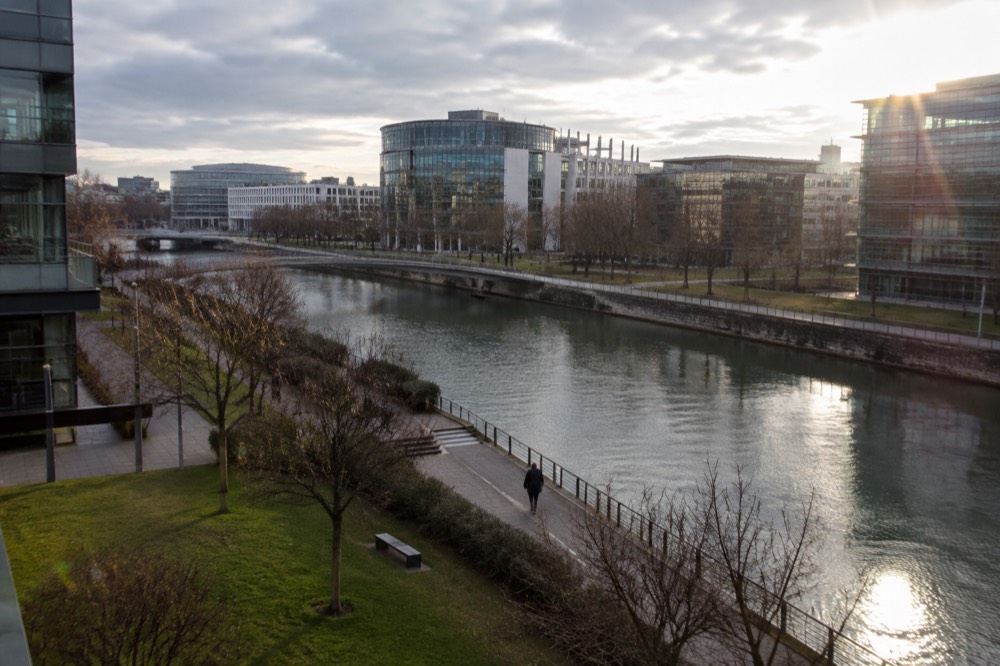
The Parc de l'Orangerie, the largest park in the city, sits beside the European Quarter and holds storks, the bird that is the symbol of Alsace. The stork reintroduction programme is described on the storks in Alsace guide. From the park, the walk back along the Ill to the Grande Île is one of the pleasantest stretches in the city, with the Neustadt on the far bank. The Neustadt guide and the Grande Île guide explain what each half of the World Heritage property is.
| Time | Day two plan | Cost per adult |
|---|---|---|
| 09:00-11:00 | Petite France lanes, Ponts Couverts | Free |
| 11:00-12:00 | Barrage Vauban terrace viewpoint | Check the official page |
| 12:00-13:15 | Batorama Red Tour river cruise | 16.20 EUR full, 8.90 EUR reduced |
| 13:30-15:30 | European Quarter walk or guided tour | Tour price on the live listing |
| 15:30-17:00 | Parc de l'Orangerie, stork enclosure | Free |
| 17:00-18:30 | Riverside walk back to the Grande Île | Free |
| Evening | Krutenau dinner quarter | Varies |
Dinner on day two can go to the Krutenau, the student quarter south-east of the Grande Île, where eating is cheaper and more casual than in the centre. The best restaurants in Strasbourg guide and the where do locals eat in Strasbourg answer list the places worth the walk.
Where To Eat In Two Days, And What To Taste
Two days allow roughly six meals, and the ones that matter are the winstub dinner, the tarte flambée, the morning boulangerie stop and one Alsatian wine tasting. A guided food walk with tastings compresses the eating research into a single three-hour block and suits anyone who would rather taste with a guide than read menus. The city's signature dishes and drinks each have a dedicated guide.
Alsatian food is the reason some visitors come at all. Beyond tarte flambée and choucroute, the region's table includes baeckeoffe, the three-meat casserole marinated in wine, and kougelhopf, the brioche moulded cake that appears at breakfast and dessert. The baeckeoffe guide and the kougelhopf guide describe both, and the Strasbourg food guide ties the whole table together. Wine is the other half: Alsace grows riesling, gewurztraminer and pinot gris, and the Alsace wine guide explains the labels. A tasting room visit in the centre, or a guided tasting, fits day two's late afternoon.
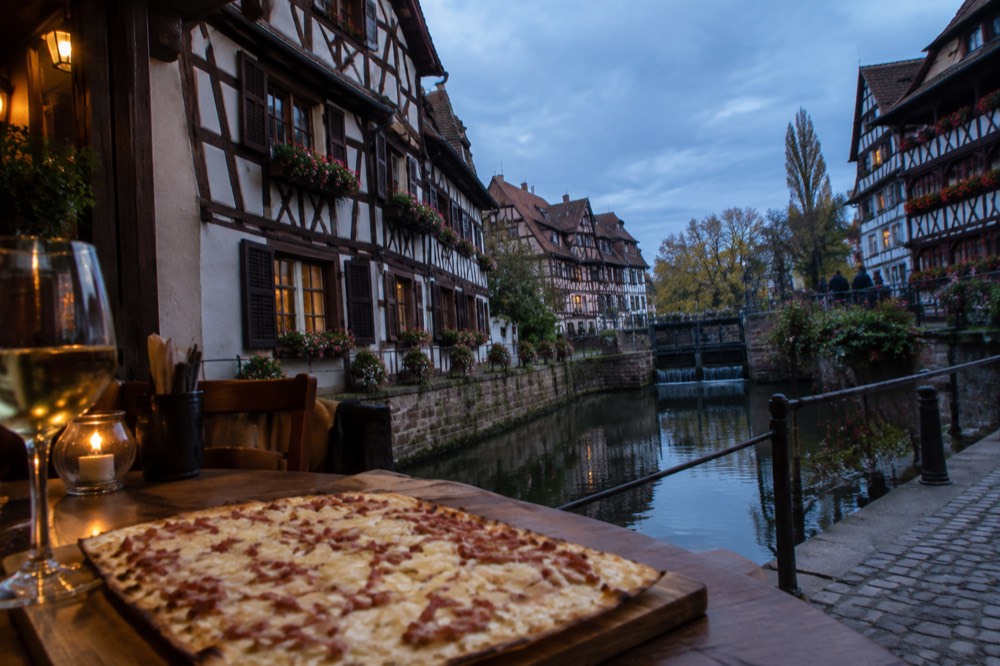
The gourmet tastings walk above is the structured option: it moves through the city with a guide and stops at food producers and sellers along the way, and its price, rating and duration render from the listing rather than from this page. The alternative is self-guided, and the winstub guide above is the map for it. Either way, book the winstub dinner ahead in December, when the Christmas market fills the centre: the market's usual pattern runs from the last week of November to 24 December, and the city's Christmas site is where the next edition's dates will be confirmed, since they are still being finalised.
| Meal | What to order | Where to read more |
|---|---|---|
| Day one breakfast | Kougelhopf or a boulangerie viennoiserie | Kougelhopf guide |
| Day one lunch | Tarte flambée, shared | Tarte flambée guide |
| Day one dinner | Choucroute garnie in a winstub | Winstubs guide |
| Day two breakfast | Boulangerie stop near Petite France | Strasbourg food guide |
| Day two lunch | Market or riverside casual | Strasbourg markets guide |
| Day two dinner | Baeckeoffe or Krutenau casual | Baeckeoffe guide |
Getting Around Strasbourg In Two Days
Two days in Strasbourg need almost no transport inside the city: the Grande Île, Petite France and the Neustadt are walkable end to end. A single CTS ticket costs 1.90 EUR from the app or by contactless, or 2.50 EUR bought on board a bus, and a 24-hour Solo pass costs 4.60 EUR. The tram matters mainly for the European Quarter, the station and the airport shuttle.
CTS runs the trams and buses. The single ticket at 1.90 EUR applies to the Badgéo card, the CTS app and contactless payment, while buying on board a bus costs 2.50 EUR. The 24-hour Solo pass is 4.60 EUR, and the 24-hour Trio pass, covering two or three people together, is 10.20 EUR. For a two-day stay based in the centre, one or two singles on the day of the European Quarter visit, or one 24-hour pass, is the realistic spend; the full fare logic is on the getting around Strasbourg guide.
The airport link is a train, not a bus: the TER shuttle runs from Entzheim to Strasbourg station in 8 minutes, up to five trains an hour, and a combined ticket covering the train plus a 24-hour CTS pass costs 4.60 EUR. That combined ticket is the best first purchase of a two-day trip for anyone flying in. The Strasbourg airport to city centre guide walks through it step by step, and the Strasbourg train station guide does the same for rail arrivals, including the fast TGV link from Paris, which takes under two hours; times and fares are on SNCF Connect.
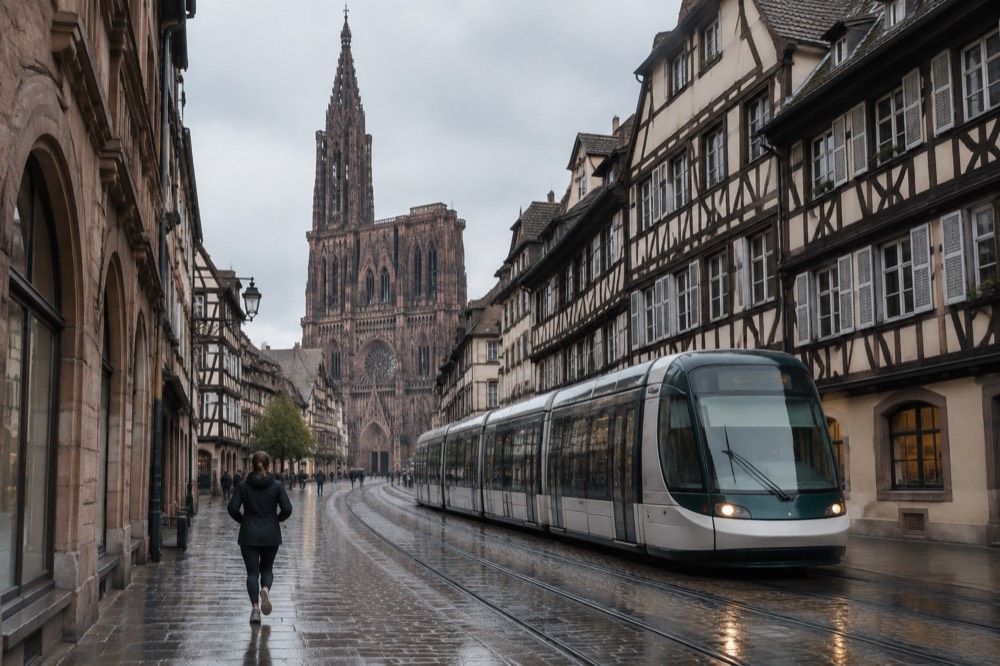
Cycling is the other realistic option. Strasbourg is flat, and the Ill-side paths make a bike a pleasant way to reach the Orangerie or the Neustadt. A guided bike tour with a local guide and bicycles included suits visitors who want the route chosen for them; the Strasbourg by bike guide covers self-guided options and hire.
What Two Days In Strasbourg Costs
A two-day Strasbourg budget, excluding travel to the city and accommodation, depends on how many paid sights you add: the platform and clock, one Batorama tour, two municipal museums and a food stop. Transport inside the city adds 1.90 EUR per single tram ticket or 4.60 EUR for a 24-hour pass. Guided tours are priced in USD on their own listings and are not counted here.
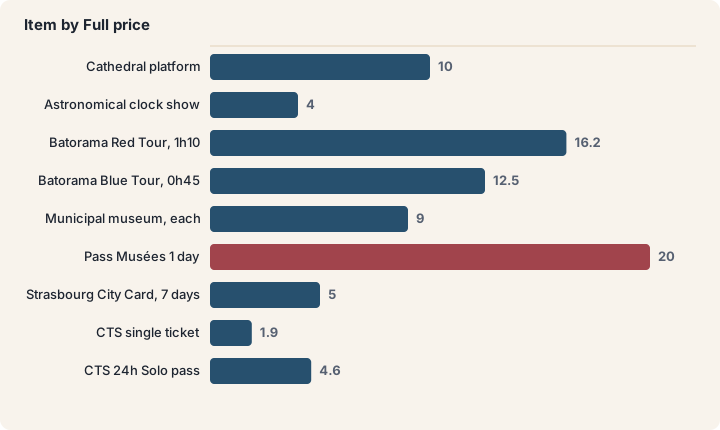
The table below uses only the verified door prices. Museum strategy matters: every municipal museum costs 9 EUR full fare or 5 EUR reduced, and all of them are free on the first Sunday of every month, so a visit that lands on that Sunday saves the entire museum line. The 1-day Pass Musées at 20 EUR pays off from the third museum onward. The Strasbourg City Card, at 5 EUR adult and 3.50 EUR for children aged 3 to 17, valid seven days, is a discount card rather than a pass: it reduces museum entry, the boat tour, the cathedral platform and the clock, so it suits a two-day plan that stacks several of those. The Strasbourg city pass guide runs the arithmetic.
| Item | Full price | Reduced |
|---|---|---|
| Cathedral platform | 10 EUR | 6 EUR |
| Astronomical clock show | 4 EUR | 2 EUR children 6-17 |
| Batorama Red Tour, 1h10 | 16.20 EUR | 8.90 EUR |
| Batorama Blue Tour, 0h45 | 12.50 EUR | 7.20 EUR |
| Municipal museum, each | 9 EUR | 5 EUR |
| Pass Musées 1 day | 20 EUR | 20 EUR |
| Strasbourg City Card, 7 days | 5 EUR | 3.50 EUR child 3-17 |
| CTS single ticket | 1.90 EUR app or contactless | 2.50 EUR on board bus |
| CTS 24h Solo pass | 4.60 EUR | 4.60 EUR |
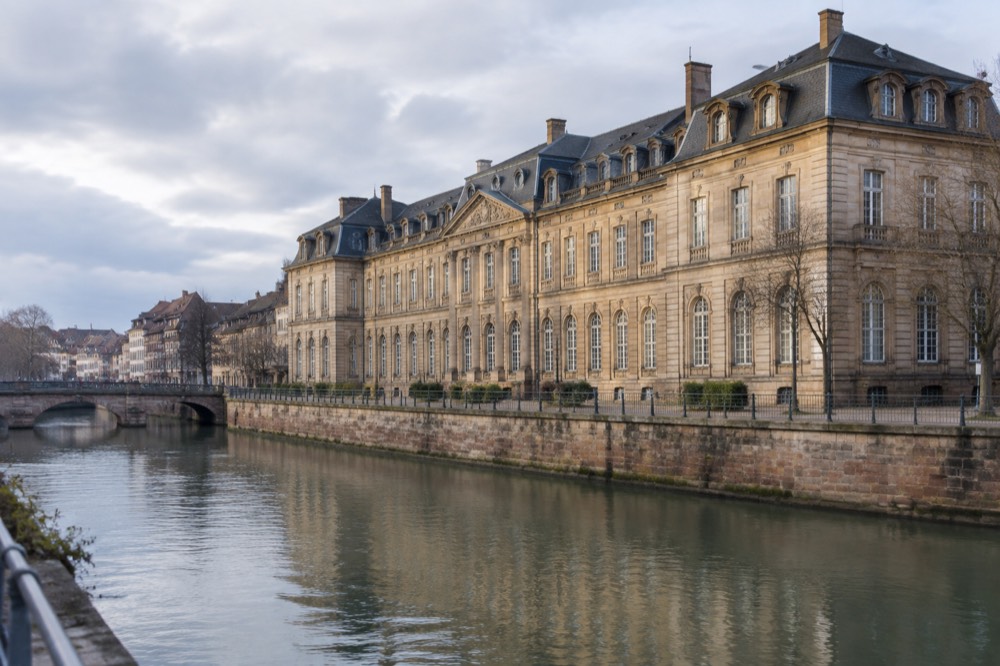
One closure to plan around: the Musée Alsacien, the folk museum, is shut for works until 2028 and cannot be part of any itinerary. The other municipal museums, including the Musée des Beaux-Arts in the Palais Rohan, the MAMCS modern art museum and the Musée de l'Œuvre Notre-Dame by the cathedral, are the alternatives, and the Strasbourg museums guide compares them. The Palais Rohan guide covers the building that holds two of them.
When Two Days Are Not Enough: Day Three Options
A third day in Strasbourg is for leaving Strasbourg: the Alsace wine route villages such as Riquewihr, Eguisheim and Kaysersberg, Colmar, Haut-Koenigsbourg castle, or across the border into the Black Forest and Baden-Baden. All of these are half-day to full-day trips that do not fit inside two city days, and several have guided day tours from Strasbourg on the roster.
The nearest and easiest extension is Colmar, the Alsatian town of canals and painted facades, which pairs with Strasbourg in the Strasbourg and Colmar itinerary. The wine route villages are the other classic pairing, covered in the Alsace road trip itinerary and the Alsace wine route guide. Germany is close enough for a same-day trip: the Black Forest guide, the Freiburg guide and the Baden-Baden guide cover the crossings, and the which cities are within 2 hours of Strasbourg answer lists the full ring. Distances and journey times vary by mode and are best checked on the official rail and operator pages before committing a third day.
Guided day tours remove the planning load entirely. A full-day Alsace tour with wine tasting, a medieval villages circuit or a Black Forest trip all run from Strasbourg with hotel pickup points in the centre, and their prices and durations render from their live listings. For visitors who have only two days and want one of these anyway, the trade is simple: drop the European Quarter on day two and take the day trip instead, since the quarter can be seen in part from the Batorama river tour.
| Day three option | What it is | Plan with |
|---|---|---|
| Colmar | Canal town, Alsatian old core | Strasbourg and Colmar itinerary |
| Wine route villages | Riquewihr, Eguisheim, Kaysersberg | Alsace wine route guide |
| Haut-Koenigsbourg | Restored mountaintop castle | Haut-Koenigsbourg guide |
| Black Forest and Freiburg | German forest towns and lakes | Black Forest guide |
| Baden-Baden | Spa town across the border | Baden-Baden guide |
| Christmas markets in December | Strasbourg plus Colmar and villages | Christmas markets in Alsace guide |
Two Days In Strasbourg In December
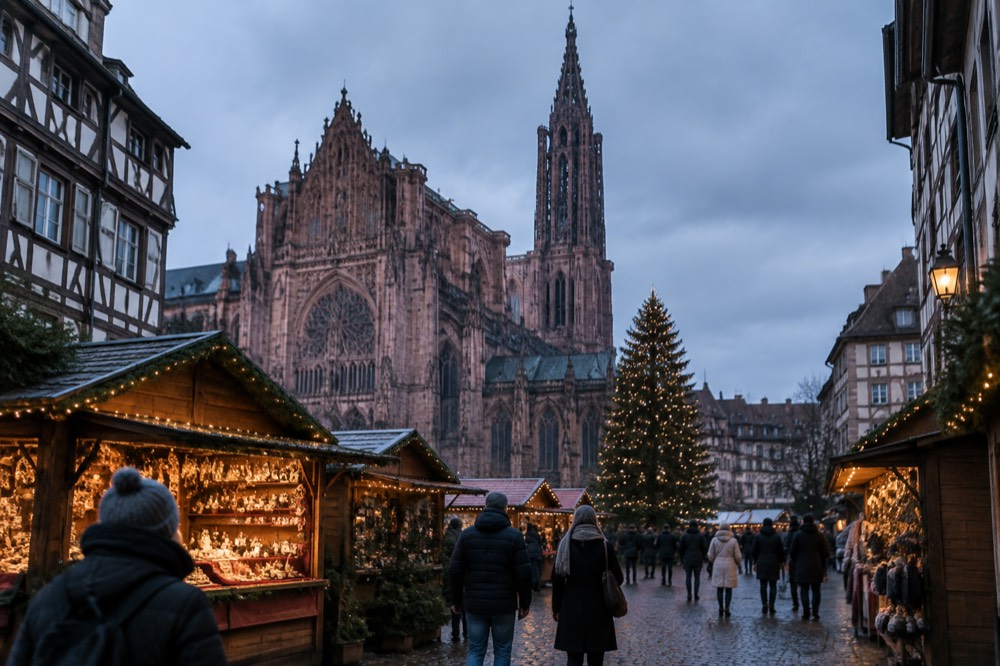
A December two-day plan swaps the European Quarter morning for the Christmas market: the market's usual pattern runs from the last week of November to 24 December, with chalets opening late morning and running into the evening, and the 2025 edition ran 26 November to 24 December with 3.05 million visitors. The 2026 dates are still being finalised, so the city's Christmas site is the place to confirm them before booking.
December changes the rhythm of the two days. The cathedral stays open continuously on the Place du Château side, Monday to Saturday from 08:30 to 17:45, which removes the midday closure that shapes day one in other seasons. The market spreads across the centre's squares, with the tree on Place Kléber, and the eating shifts towards market food: bredele biscuits, hot spiced wine and roasted chestnuts between meals. The Strasbourg Christmas market itinerary is the dedicated plan, the Christmas market food guide handles the stalls, and the question of how many days you need for the Christmas markets has its own answer. December weather is cold rather than snowy-guaranteed: Meteo-France 1991-2020 normals give a December mean maximum of 5.9 C, a mean minimum of 0.8 C and 10.2 days of rain of 1 mm or more, so layers and a waterproof matter more than a sled.
Two days still work in December, but the plan should drop one of the two museum blocks, since the market absorbs the evenings and the after-dark hours are the market's best. A rainy or grey day has its own playbook on the rainy day in Strasbourg guide, which is built around the museums, the covered passages and the boat.
Common Questions About Two Days In Strasbourg
Is Two Days In Strasbourg Enough?
Two days cover the Grande Île, the cathedral and the 12:30 astronomical clock show, Petite France, the Ponts Couverts, the Barrage Vauban terrace, a Batorama river tour and the European Quarter. A third day is only needed for Alsace day trips such as Colmar, the wine route villages or the Black Forest.
What Should I Do On The First Day In Strasbourg?
Day one belongs to the Grande Île: the cathedral nave from 08:30, the clock ticket bought on the day, the platform at 66 m, then Place Kléber, Place Gutenberg and Maison Kammerzell on foot, with a winstub dinner in the evening.
Do I Need To Book The Astronomical Clock In Advance?
No. Tickets are sold on the day only, with no reservations: at the cathedral stalls between 10:00 and 11:00, or from 11:30 at the Saint-Michel entrance on Place du Château. The show is at 12:30 sharp and the adult ticket is 4 EUR.
Can I Visit The European Quarter In Half A Day?
Yes. The Parlamentarium Simone Veil opens Monday to Friday 09:00-18:00 and Saturday mornings and afternoons outside plenary weeks, with a security check at the door, and the institutions' exteriors, the Parc de l'Orangerie and the riverside walk back fit the same half day. A guided European District walk covers the whole loop with the history attached.
How Much Does Two Days In Strasbourg Cost In Tickets?
It depends on how many paid sights you add: the platform at 10 EUR, the clock at 4 EUR, the Batorama Red Tour at 16.20 EUR and two municipal museums at 9 EUR each. All municipal museums are free on the first Sunday of every month.
Do I Need A Transport Pass For Two Days In Strasbourg?
Usually not. The historic core is walkable end to end. A single CTS ticket is 1.90 EUR from the app or by contactless, a 24-hour Solo pass is 4.60 EUR, and the airport train plus 24-hour pass combined ticket is 4.60 EUR, so one pass on the arrival day plus singles covers a typical two-day stay.
Two days in Strasbourg, planned around the fixed points of the clock show, the platform hours and the river quay, leave a visitor with the whole of the World Heritage core seen, the food of Alsace tasted, and a clear sense of exactly what a third day would add.