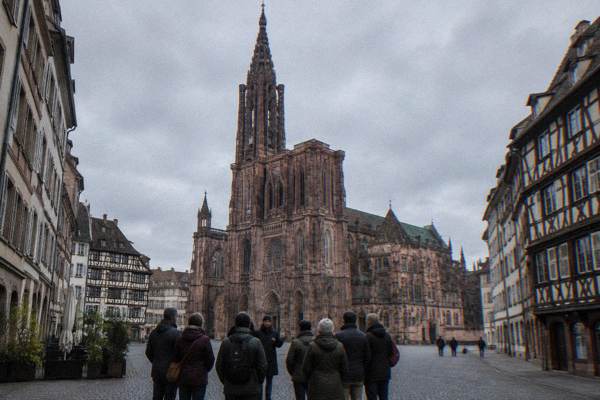
Strasbourg Rainy Day
Rain in Strasbourg, in north-eastern France on the German border, is not a write-off. The city holds one of the densest clusters of museums, covered church interiors and winstubs in Alsace, and the whole old centre folds indoors within a few minutes' walk.
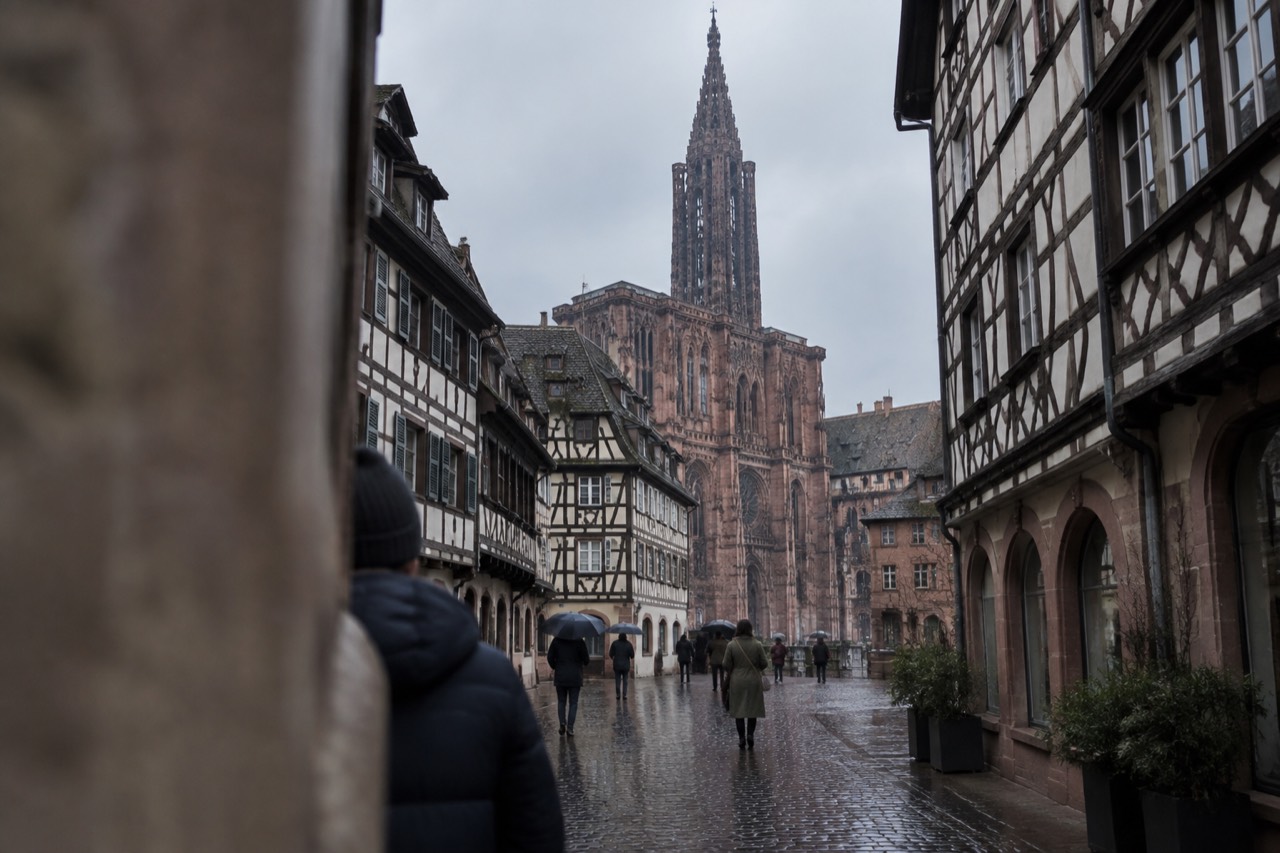
Short answer
Spend a rainy Strasbourg day indoors: municipal museum tickets are 9 EUR full and 5 EUR reduced, the Pass Musees 1 day is 20 EUR, the astronomical clock show runs at 12:30 for 4 EUR, and a 24h CTS pass at 4.60 EUR moves you between them. Add a winstub lunch, the cathedral nave and an evening food walk.
Rain falls regularly on Strasbourg, the prefecture of the Bas-Rhin in Alsace, north-eastern France, and the city is built for it. Meteo-France 1991-2020 normals for Strasbourg-Entzheim count 112.3 days with 1 mm of rain or more and 635.7 mm of rain across the year, spread evenly enough that no season is dry. The old centre, the Grande Île, packs museums, a cathedral nave, a covered astronomical clock show and winstub dining rooms into a space you can cross under umbrellas in a quarter of an hour. This page lays out a full wet-day plan: where the rain actually falls on the calendar, which museums to pick, what the cathedral offers when the spire is invisible in cloud, where to eat, and how the trams are priced when you would rather not walk.
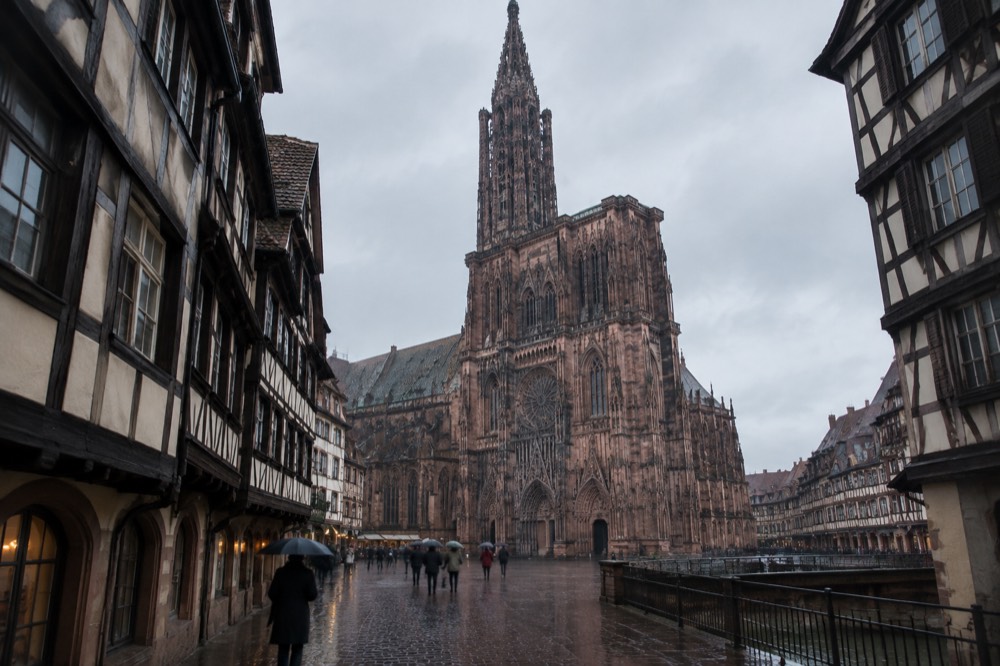
What To Do In Strasbourg When It Rains
A rainy day in Strasbourg is best built around three indoor anchors: a municipal museum at 9 EUR full or 5 EUR reduced, the cathedral nave with its 12:30 astronomical clock show at 4 EUR, and a long winstub lunch, stitched together with the tram network using a 24h Solo pass at 4.60 EUR. Add the Musée de l'Œuvre Notre-Dame or MAMCS for modern art, and the day fills itself without a single view depending on the sky.
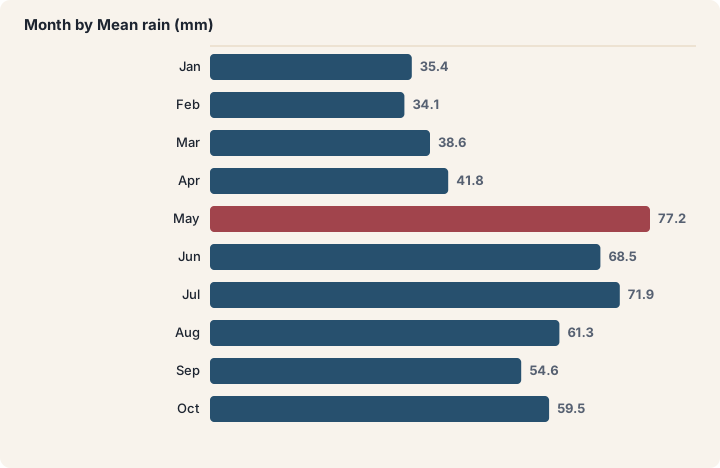
The rainfall calendar matters more here than in Mediterranean cities, because the wet months are not concentrated. May is the wettest month at 77.2 mm, February the driest at 34.1 mm, and the number of days with at least 1 mm of rain barely moves between 8.0 in September and 10.8 in May. In other words, a rainy day can find you in any month, and the plan below works in all of them. The table shows the full picture from the Meteo-France 1991-2020 normals for the Strasbourg-Entzheim station.
| Month | Mean rain (mm) | Days with 1 mm or more |
|---|---|---|
| Jan | 35.4 | 9.1 |
| Feb | 34.1 | 8.3 |
| Mar | 38.6 | 8.5 |
| Apr | 41.8 | 8.6 |
| May | 77.2 | 10.8 |
| Jun | 68.5 | 10.2 |
| Jul | 71.9 | 10.4 |
| Aug | 61.3 | 9.5 |
| Sep | 54.6 | 8.0 |
| Oct | 59.5 | 9.6 |
| Nov | 47.6 | 9.2 |
| Dec | 45.2 | 10.2 |
Read that table as a planning tool rather than a forecast. A two-day visit in May carries a real chance of one wet day, and the same is true of a December visit built around the Christmas market, when the mean daily maximum sits at 5.9 C. The difference is that December rain is cold rain, so the indoor anchors matter more, and the one day in Strasbourg itinerary should be reshuffled so the outdoor stretches, Petite France and the riverbank, land in the driest window. If the whole stay is wet, the two days in Strasbourg plan and the three days in Strasbourg plan both have slack that can absorb a museum-heavy substitute day.
One structural point that first-time visitors miss: Strasbourg's indoor attractions cluster on two islands of walkability. The museums of the Grande Île, the cathedral, the Palais Rohan museums and the covered shopping streets around it, sit within a short walk of each other, and the European Quarter institutions sit on a separate axis reached by tram. A rainy day should commit to one cluster, not zigzag between them, because every transfer is time spent under rain.
Which Museums Save A Wet Day In Strasbourg
The municipal museums are the backbone of a rainy Strasbourg day: tickets are 9 EUR full and 5 EUR reduced at each of them, the 1-day Pass Musees is 20 EUR, and every municipal museum is free on the first Sunday of the month. The Musée des Beaux-Arts and the Musée de l'Œuvre Notre-Dame are the two that pair best with a cathedral visit, and MAMCS is the pick for contemporary art.
Seven municipal museums share the same tariff sheet: the Musée Alsacien, the Archaeological Museum, MAMCS, the Museum of Decorative Arts, the Musée des Beaux-Arts, the Musée Historique and the Musée de l'Œuvre Notre-Dame. One caution is binding: the Musée Alsacien is closed for works until 2028 and should not appear in any plan. The others operate on the 9 EUR and 5 EUR tariffs, and the 1-day Pass Musees at 20 EUR pays for itself at the third museum door, which is exactly what a long rainy afternoon invites. The first-Sunday rule is the quiet bargain in the tariff sheet, and it is confirmed on the city's own culture pages.
| Museum | Full ticket | Reduced | Wet-day note |
|---|---|---|---|
| Musée des Beaux-Arts | 9 EUR | 5 EUR | Fine arts, inside the Palais Rohan |
| Musée de l'Œuvre Notre-Dame | 9 EUR | 5 EUR | Medieval sculpture, beside the cathedral |
| MAMCS | 9 EUR | 5 EUR | Modern and contemporary art, large interior |
| Museum of Decorative Arts | 9 EUR | 5 EUR | Period interiors in the Palais Rohan |
| Musée Historique | 9 EUR | 5 EUR | City history |
| Archaeological Museum | 9 EUR | 5 EUR | In the basement of the Palais Rohan |
| Musée Alsacien | Closed | Closed | Closed for works until 2028 |
The pairing that works best in rain is the Musée de l'Œuvre Notre-Dame followed by the cathedral nave, because the museum sits on the square beside the cathedral and its ticket desk is a few steps from the west front. The cathedral platform ticket also carries a reduced rate at the Musée de l'Œuvre Notre-Dame, so a visitor who does climb to the 66 m platform in a dry hour keeps a discount for later. Families have a separate option in Le Vaisseau, the science centre aimed at children, which is covered in detail in the Strasbourg with kids itinerary.
For a day with truly relentless rain, the honest advice is to buy the Pass Musees and treat the Palais Rohan as a single destination: the Musée des Beaux-Arts, the Museum of Decorative Arts and the Archaeological Museum share the building, so three of the seven museums are reached without stepping outside more than once. No other block of Strasbourg museums offers that.
A different kind of indoor stop sits across the river: the European Parliament's Parlamentarium, which opens Mon-Fri 09:00-18:00 and Sat 09:30-12:00 and 13:00-18:00 outside plenary weeks, with an airport-style security check at the door. Plenary-week hours differ, so the official page should be checked before setting out. It pairs with the Petite France and old town walks only by tram, and it is a genuinely rainy-day-proof block of two to three hours.
Should You Trade A Rainy City Day For An Alsace Day Trip
Yes, sometimes: a wet Strasbourg morning is a reasonable trigger for an Alsace day trip, because the region's headline indoor stops, wine cellars and village churches, are scattered and a guided coach day handles the driving. The Best of Alsace historical day trip runs about 10.5 hours from Strasbourg and covers the villages, and its price and current availability sit on the operator's live listing.
The logic is simple. Strasbourg's own indoor attractions can be exhausted in a day and a half of solid rain, and the Alsace villages that justify a car, Riquewihr, Eguisheim, Kaysersberg, are at their least rewarding in a downpour, when their lanes empty and the photogenic angles close. A guided day trip converts that problem into cellar time, church interiors and covered coach stretches, and it removes the question of driving on wet rural roads. The historical day trip from Strasbourg is the roster's anchor option for this, and its figures, duration, rating and price, render on its own listing rather than being quoted here.
The medieval villages and wine tasting day trip is the variant that leans hardest into the cellar half of that bargain, with tasting rooms doing the work that village lanes would do in dry weather. Its duration and price are on the live listing, and it suits a traveller whose priority is Alsace wine rather than village streets.
Before committing, weigh what the day trip gives up. Strasbourg's own museums, the clock show and the winstubs are all lost for the day, and the return lands in the evening. A traveller on a short stay, two nights or fewer, is usually better served by the Strasbourg and Colmar itinerary, which splits the region across days instead of gambling one of them on a coach. A traveller with four nights or more, or one whose Strasbourg days have already absorbed the cathedral and the museums, has little to lose.
Where To Eat On A Rainy Day In Strasbourg
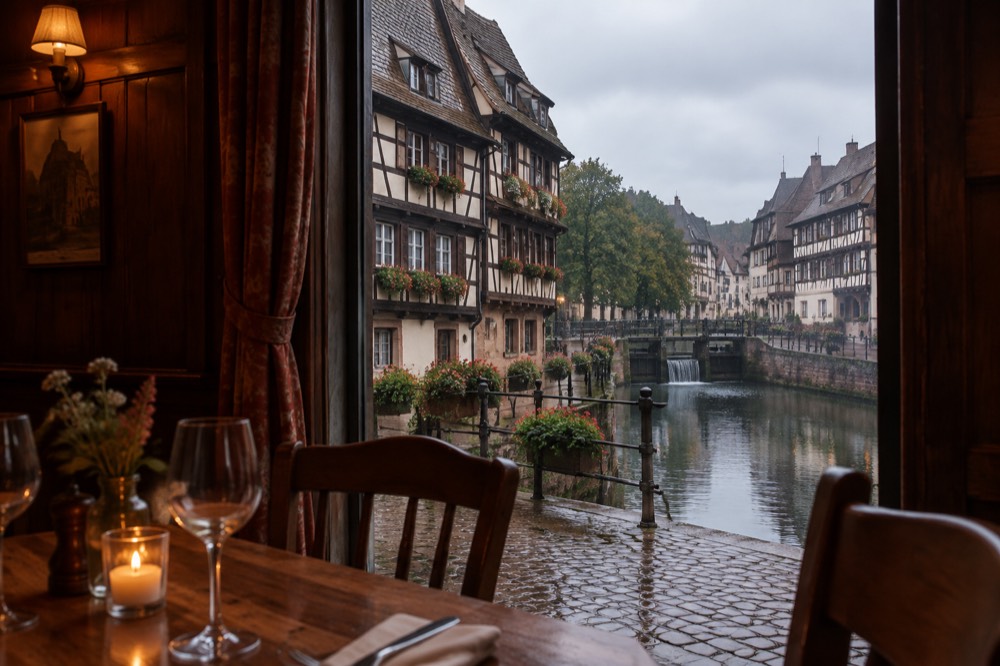
A rainy Strasbourg day is a winstub day. The traditional Alsatian dining room exists for exactly this weather: choucroute, baeckeoffe and tarte flambée are cold-weather dishes, the rooms are small and warm, and the classic ones cluster in and around the Grande Île. Book ahead for lunch, because wet days push everyone indoors at once.
The winstub is the city's native answer to rain, a small wood-panelled room where wine is served by the glass and the menu runs to the dishes Alsace built for winter. The dedicated pages on winstubs in Strasbourg and on choucroute cover the specifics; for a rainy day the planning point is timing. Seats are limited, the kitchen often closes between lunch and dinner, and a party arriving at 13:30 may find the day's choucroute finished. Aim to sit down by 12:30, or earlier on a Sunday.
| Dish | What it is | Why it suits a wet day |
|---|---|---|
| Choucroute garnie | Sauerkraut with pork cuts and sausage | Long-cooked, served hot, a full meal |
| Baeckeoffe | Meat and potato casserole baked in a pot | Baked all morning, sold through the afternoon |
| Tarte flambée | Thin flatbread with cream, onion and bacon | Quick, shared, good with a dry riesling |
| Kougelhopf | Alsatian brioche-style cake with almonds | The winstub dessert, pairs with coffee |
| Spätzle | Soft egg noodles, often with cheese | Comfort dish, widely on winstub menus |
The other rainy-day eating strategy is a guided food walk, which does the work of finding the right addresses and adds covered stops, cheese shops, bakeries, tasting rooms, between them. The traditional food walking tour with tastings is described in detail on the Strasbourg food tour guide. The Do Eat Better tradition tasting walk is the roster's other food option, roughly three and a half hours on its feet, and its price and rating are on the operator's listing.
A food walk in rain is a different proposition from a dry one, and the honest framing is that some stops will be quick and the walking stretches between them will be wet. The compensation is that December and November, the wettest-feeling months, are also when the warm rooms feel best, and the question of whether the markets themselves are better by day or by night has its own answer page for the Christmas season, at are Christmas markets better in day or night.
Can You Still Visit The Cathedral And The Clock In The Rain
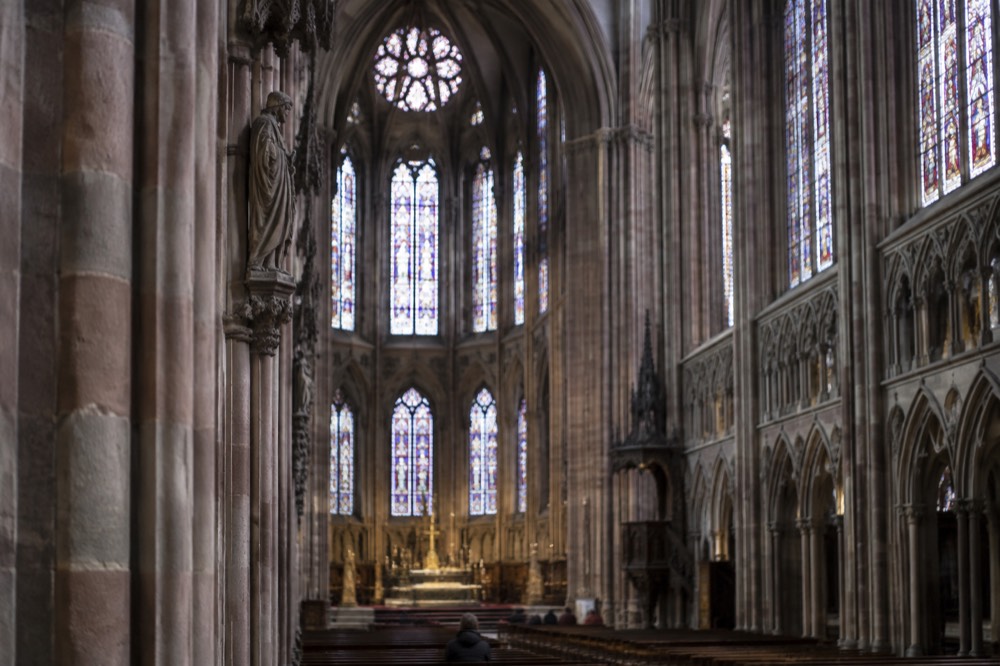
Yes, and the cathedral is arguably better in rain than in clear weather, because its two paid indoor experiences, the astronomical clock show at 12:30 for 4 EUR and the nave itself, do not depend on the view. The nave opens Mon-Sat 08:30-11:15 and 12:45-17:45 and Sun 14:00-17:15, and the clock tickets are sold on the day only, at the cathedral stalls in the morning or at the Saint-Michel entrance from 11:30.
The clock is the single best rainy-day appointment in Strasbourg, and it has a fixed time: the automaton show runs at 12:30 sharp, daily except on Sundays and feast days with an 11:00 mass. The adult ticket is 4 EUR, with reductions to 3 EUR for groups of 12 or more and students to 25, and 2 EUR for children 6 to 17. The rule that catches visitors out is the ticket sale: day-of purchase only, no reservations, sold at the cathedral stalls between 10:00 and 11:00 or at the Saint-Michel entrance on the Place du Château from 11:30. A rainy-day plan should therefore put the visitor near the cathedral by late morning, winstub or museum before, clock at 12:30, nave after. Everything else covered here is indexed on Strasbourg Travel Guide.
| Cathedral stop | Hours | Ticket | Wet-day note |
|---|---|---|---|
| Nave, Mon-Sat | 08:30-11:15 and 12:45-17:45 | Admission on the official page | Indoor, the main rainy asset |
| Nave, Sun and feast days | 14:00-17:15 | Admission on the official page | Later start on Sundays |
| Astronomical clock show | 12:30 sharp | 4 EUR adult, 2 EUR children 6-17 | Tickets day-of only, from 11:30 at Saint-Michel |
| Platform at 66 m | 1 Oct-31 Mar 10:00-13:00 and 13:30-18:00 | 10 EUR full, 6 EUR reduced | Last ascent 17:15; pointless in cloud |
| Platform, summer hours | 1 Apr-30 Sep 09:30-13:00 and 13:30-20:00 | 10 EUR full, 6 EUR reduced | Last ascent 19:15 |
The platform deserves a specific rain warning. The tower is a single spire with a viewing platform at 66 m, and climbing it in rain buys a wet staircase and, on a cloudy day, a view of grey. Save it for a clear hour, and if the forecast offers one, slot it around the clock show since both are on the same building. The full visiting picture, including the Strasbourg Cathedral page and the dedicated astronomical clock page, covers what the automaton show actually contains.
The nave has its own rainy-day virtue: during the Christmas market period it opens continuously Mon-Sat on the Place du Château side, 08:30 to 17:45, which makes it a reliable warm stop in the market weeks when everything else is a chalet in the open air. The Strasbourg Christmas market itinerary builds on that.
Which Guided Tours Work When The Weather Turns
The tours that survive rain in Strasbourg are the indoor and covered ones: the cathedral guided tour, the food walks and the wine tasting in the city, all of which spend their hours under roofs. The Segway and bike tours are honest only as shower-break options, since their whole route is open air, and the boat tours keep you on the water rather than under it.
Want someone to walk you through the covered side of the city? Book a free walking tour here.
Start with the ones built for bad weather. The cathedral guided tour stays inside the building, and the Alsace wine tasting session in Strasbourg is entirely indoors, a cellar-based hour that works whatever the sky is doing. The gourmet tastings walk moves between covered addresses. These are the tours to book when the forecast is confidently wet, and their prices and ratings render on their own listings.
The outdoor tours deserve honesty rather than a ban. Its route, the European Quarter and the riverbanks, is entirely in the open. In light drizzle it is tolerable with the right coat; in steady rain it is miserable, and no visitor should book it on a wet forecast. The same applies to the bike tours. The rule of thumb: book wheels for the dry day of a stay, roofs for the wet one.
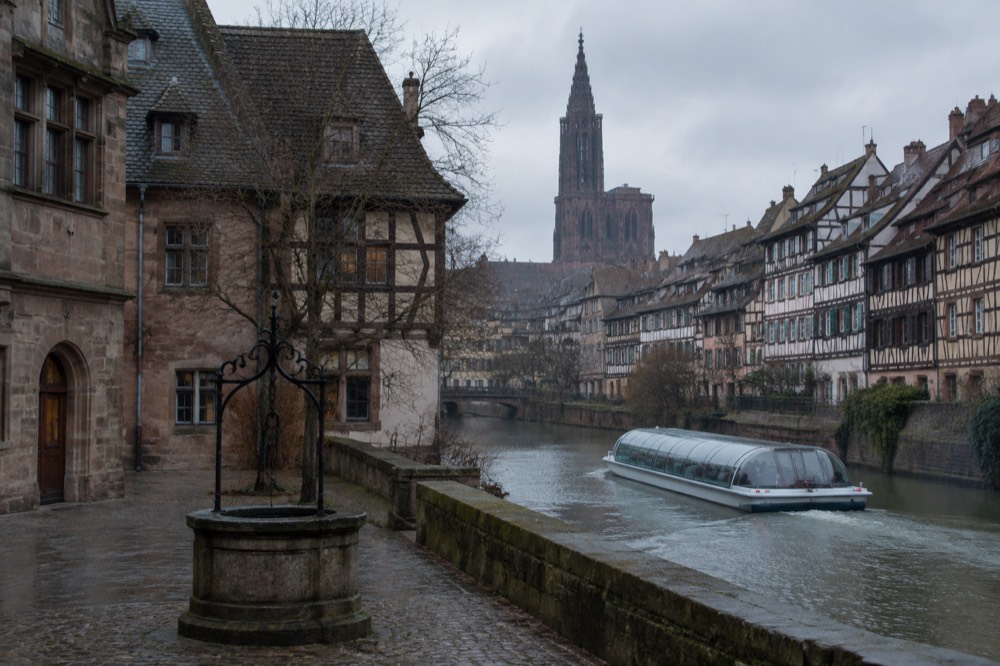
The Batorama river boats sit in between. The long tour costs 16.20 EUR full and 8.90 EUR reduced and runs 1h10 on the Red Tour circuit; the short tour is 12.50 EUR full and 7.20 EUR reduced at 0h45 on the Blue Tour. Whether the boats run in any given weather is an operational question the operator's page answers, and it should be checked on the day; the Strasbourg boat tour guide covers the circuits in full. A river view in rain is a real pleasure from under a canopy, and a poor one from an open deck, so the covered seating matters more than the departure time.
How To Get Around Strasbourg In The Wet
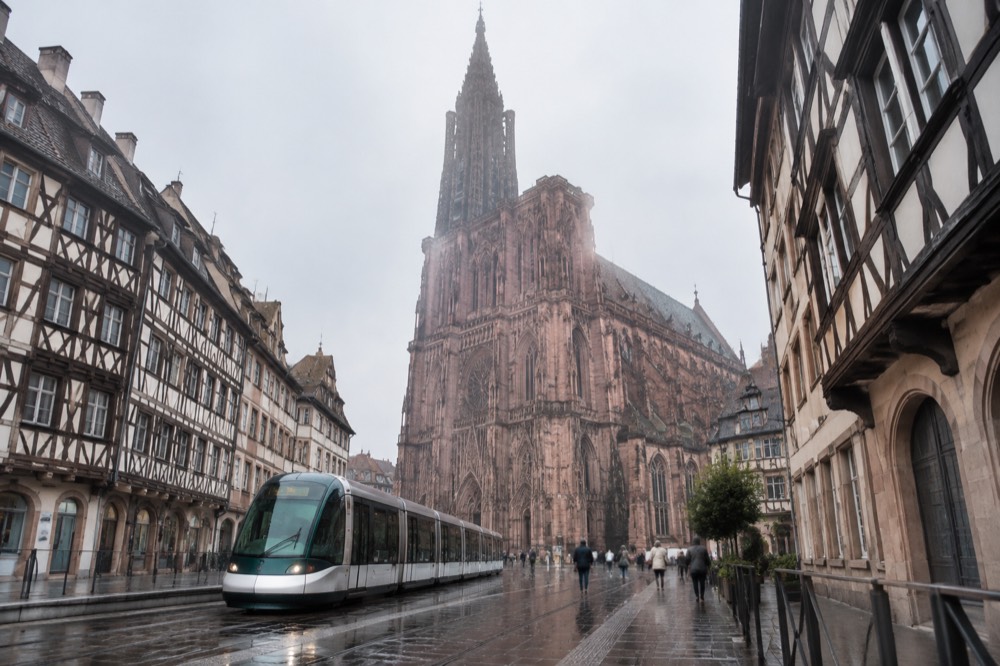
The tram is the rainy-day transport in Strasbourg, and it is cheap: a single ticket is 1.90 EUR bought through the Badgeo card, the CTS app or contactless, or 2.50 EUR bought on board the bus, and the 24h Solo pass is 4.60 EUR. For two or three people travelling together the 24h Trio at 10.20 EUR undercuts three separate day passes.
The pricing logic is straightforward. A traveller making three journeys or more in a wet day, hotel to museum, museum to cathedral, cathedral to dinner, is better on the 24h Solo at 4.60 EUR than on singles at 1.90 EUR each, and the Trio at 10.20 EUR covers two or three people for the day. Tickets bought from the driver on the bus cost more, at 2.50 EUR, than the same ticket bought in the app or tapped contactless, at 1.90 EUR, so the app is worth installing before the trip.
| CTS ticket | Price | What it covers |
|---|---|---|
| Single, app/Badgeo/contactless | 1.90 EUR | One journey on tram or bus |
| Single, bought on board bus | 2.50 EUR | Same journey, higher counter price |
| 24h Solo | 4.60 EUR | One person, unlimited day travel |
| 24h Trio | 10.20 EUR | Two or three people, one day |
| Airport combined ticket | 4.60 EUR | Train, tram or bus, and 24h travel |
The airport line deserves its own note because wet arrivals are common. The shuttle train between Strasbourg station and Entzheim airport runs up to five times an hour and takes 8 minutes, and the combined ticket covering the train plus a 24h pass on the city network is 4.60 EUR, the same figure as the 24h Solo on its own. A rainy arrival day therefore costs no more than a dry one. The details are on the Strasbourg airport to city centre page.
Walking remains the honest answer inside the Grande Île, rain or not, because the distances between the cathedral, the Palais Rohan and Petite France are short and the tram does not penetrate the old lanes. The compromise is the covered route: the streets around the cathedral and the riverside Ponts Couverts and Barrage Vauban stretch is open air, so save it for a dry window and keep the wet hours in the museum quarter. The full network picture, including bike hire, is on getting around Strasbourg.
What To Pack For A Rainy Day In Strasbourg
Pack for rain that lasts all day rather than showers: a proper raincoat or a good umbrella, shoes that survive wet cobblestones, and a thin layer for the contrast between cold streets and overheated museums. Nothing on a Strasbourg rainy day requires specialist gear, and the only genuinely useful extras are a small towel for the umbrella and a book of museum choices made in advance.
The cobblestones are the packing detail that surprises people. The Grande Île's lanes drain badly in places, and smooth-soled shoes on wet stone are a slipping hazard on the descents toward the river. Anything with grip works. The second detail is the indoor-outdoor swing: December's mean maximum is 5.9 C with a mean minimum of 0.8 C, while the museums and winstubs run warm, so a layer that comes off and goes on again beats a single heavy coat.
| Item | Why it earns its place | Wet-day alternative |
|---|---|---|
| Umbrella or raincoat | The normals count 112.3 days a year at 1 mm or more | Raincoat wins in wind on the riverbank |
| Gripped shoes | Wet cobblestones on the old lanes | Any waterproof walking shoe |
| Removable layer | Museums and winstubs run warm against 5.9 C December highs | A fleece under the coat |
| Small bag | Museums have limited cloakroom space | A daypack that folds flat |
| CTS app installed | 1.90 EUR singles against 2.50 EUR on board | Contactless bank card |
Two planning notes finish the kit. First, the cathedral has no luggage lockers, so bags that do not fit a museum cloakroom should be stored before the museum block; the Strasbourg luggage storage page covers the options. Second, a wet day is the day to pre-decide the museum order, because standing on a pavement deliberating in rain is the worst version of the decision. The table of museums above, plus the clock's 12:30 appointment, fixes the shape of the day before the first drop falls.
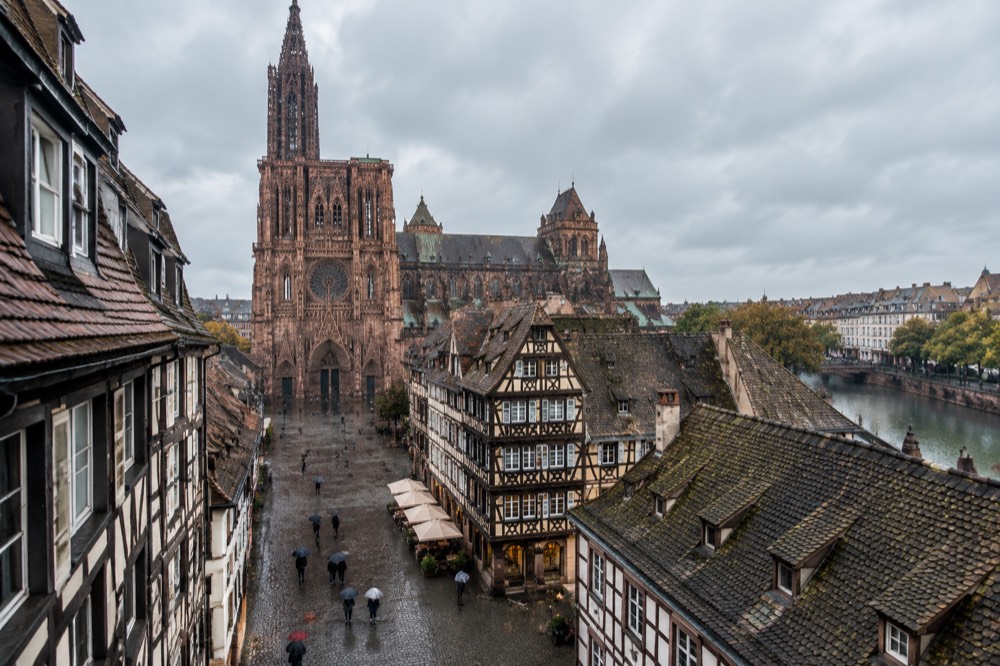
How A Rainy Day Fits Into A Longer Strasbourg Stay
A rainy day should be spent indoors in Strasbourg and the dry days saved for the outdoor list: Petite France, the riverbank, the platform at 66 m and any Alsace villages. On a two-night stay, one wet day absorbed by museums and winstubs costs nothing that cannot be rescheduled; on a longer stay, a wet day is the natural trigger for a cellar-based day trip or an evening food walk.
The reshuffle depends on the length of the stay. On a short visit, the rainy day takes the indoor half of the Strasbourg river cruise stop itinerary, the cathedral, the clock, one museum, a winstub, and the outdoor half slides to the next morning. On a week, a wet stretch of two days justifies reading the wider Alsace road trip plan and picking the cellar-heavy segments, or crossing into Germany with the Black Forest and Freiburg options, whose own indoor stops, minsters and museums, do the same work in another country. The day trips from Strasbourg page collects the full set, including Basel, where the euro is not the currency, and Heidelberg.
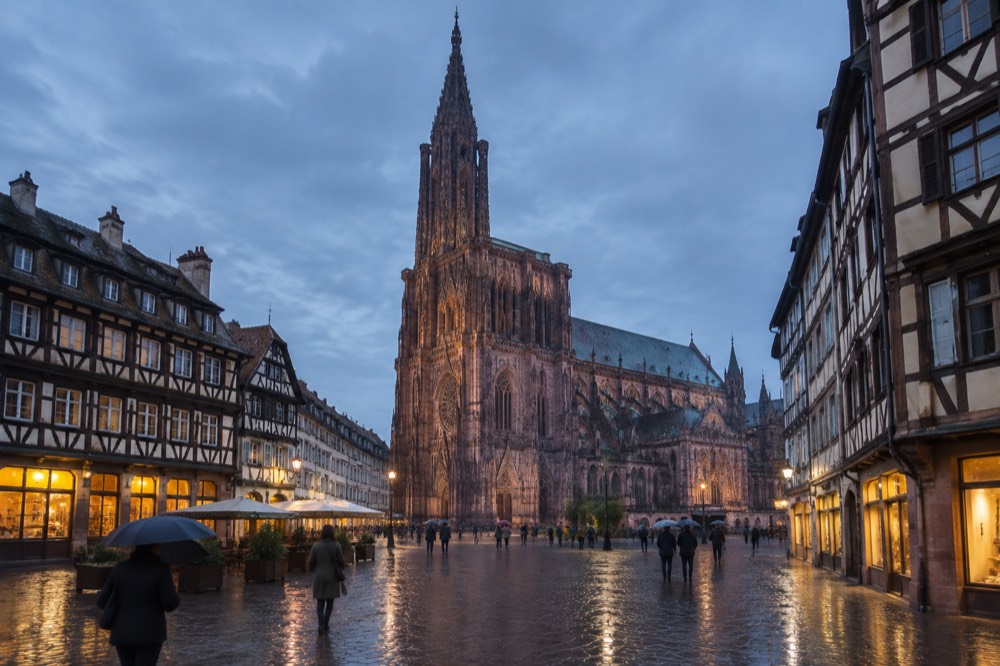
The evening deserves its own plan, because winter rain in Strasbourg falls in the dark from late afternoon, and the city's evening identity is built for it. The covered food walk, the winstub dinner and, in the market weeks, the chalets with a glass of mulled wine are all evening-shaped. The Strasbourg at night guide covers the rest. What a rainy day should not become is a lost day: the tariff sheet above shows that a full indoor day, museum pass, clock show, one platform climb if the sky clears, costs little in tickets, and the tram moves between every stop on it.
For the final word on the swap: keep the outdoor icons for dry hours, and let the rain push you toward the things Strasbourg does at least as well as any city in France, medieval sculpture, a mechanical astronomical clock, Alsatian cooking and wine by the glass.
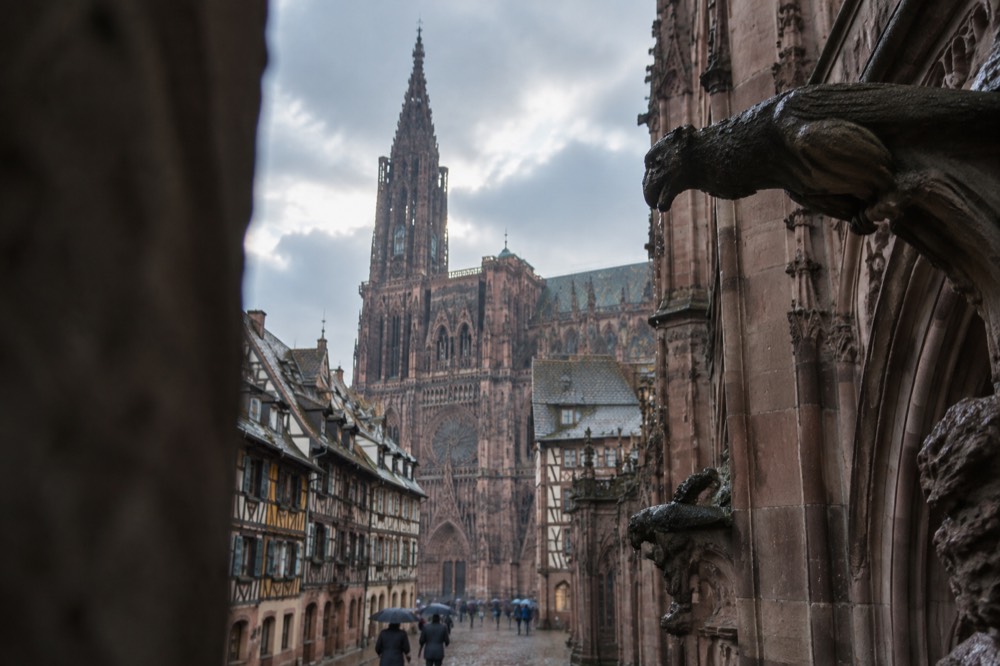
Common Questions About A Rainy Day In Strasbourg
Is Strasbourg worth visiting in the rain?
Yes. The cathedral nave, the astronomical clock show at 12:30, seven municipal museums at 9 EUR full or 5 EUR reduced, and the winstub tradition are all indoor, and the tram network at 4.60 EUR for a 24h Solo pass connects them without long exposure. The platform at 66 m and Petite France are the only headline sights that genuinely need dry weather.
How many rainy days does Strasbourg have?
The Meteo-France 1991-2020 normals for Strasbourg-Entzheim count 112.3 days per year with 1 mm of rain or more, and 635.7 mm of rain in total. May is the wettest month at 77.2 mm and February the driest at 34.1 mm, but no month falls below 8.0 rain days, so a wet day is possible in any season.
What is the best indoor attraction in Strasbourg?
The astronomical clock show is the strongest single indoor appointment: it runs at 12:30 sharp and costs 4 EUR for an adult, with tickets sold on the day only, at the cathedral stalls in the morning or at the Saint-Michel entrance from 11:30. The Musée de l'Œuvre Notre-Dame beside the cathedral is the best pairing for it.
Are Strasbourg museums free on Sundays?
Every municipal museum is free on the first Sunday of each month, which the city's culture pages confirm. On other Sundays the standard tariffs apply, 9 EUR full and 5 EUR reduced, and the 1-day Pass Musees at 20 EUR covers multiple museums on any day of the week.
Does the Strasbourg Christmas market run in the rain?
The market is made of open-air chalets, so rain affects it directly, though last year's edition ran from 26 November to 24 December 2025 and drew 3.05 million visitors regardless of weather. The 2026 dates are not yet published, so confirm them on the city's Christmas site. The covered stops in the market weeks are the cathedral nave, open continuously Mon-Sat until 17:45, and the winstubs.
Is the tram in Strasbourg covered from the rain?
Trams run on the surface, so the walk to and from the platform is open air, but the ride itself is under cover and a 24h Solo pass costs 4.60 EUR. Inside the Grande Île the distances between the cathedral, the Palais Rohan and the museums are short enough that walking with an umbrella is often quicker than waiting for a tram.
The short version of a Strasbourg rainy day: buy the museum pass, keep the 12:30 clock appointment, eat in a winstub, and let the tram handle the distances. The rain that falls on 112.3 days of the year here is the same rain that fills the cellars and keeps the dining rooms full, and a day built around it is a day built around what the city has always done best.