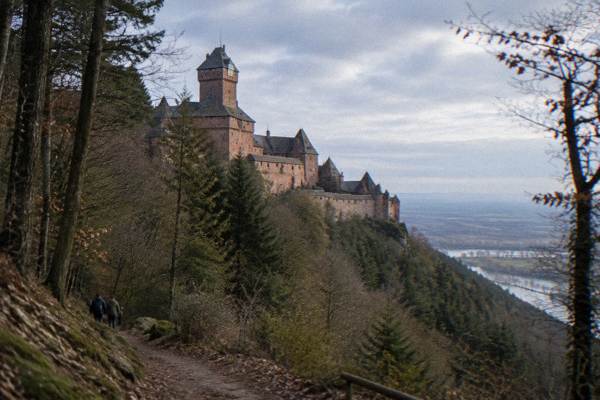
Alsace Castles
Alsace, the region around Strasbourg in north-eastern France, keeps its castles on the sandstone ridges of the Vosges foothills. This guide compares the fortresses you can reach on a day trip, from the restored Haut-Koenigsbourg to the roofless keeps above the wine villages, and explains how to plan the journey.
Short answer
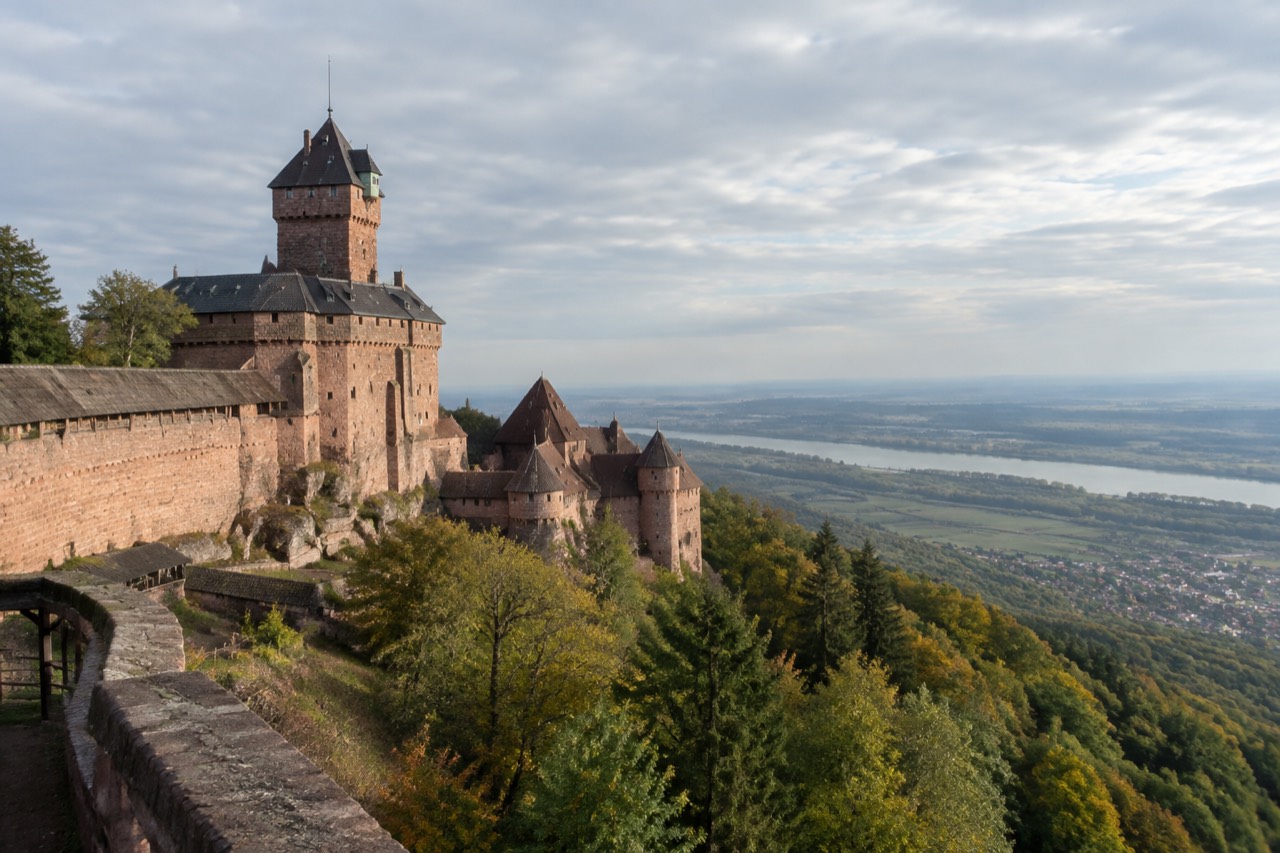
The castles of Alsace sit on sandstone ridges, in north-eastern France, and none stands inside the city itself. Haut-Koenigsbourg is the restored showpiece, while Fleckenstein, Ortenbourg and Haut-Andlau survive as ruins. Every one of them is a day trip, by car or guided tour, and this guide compares them.
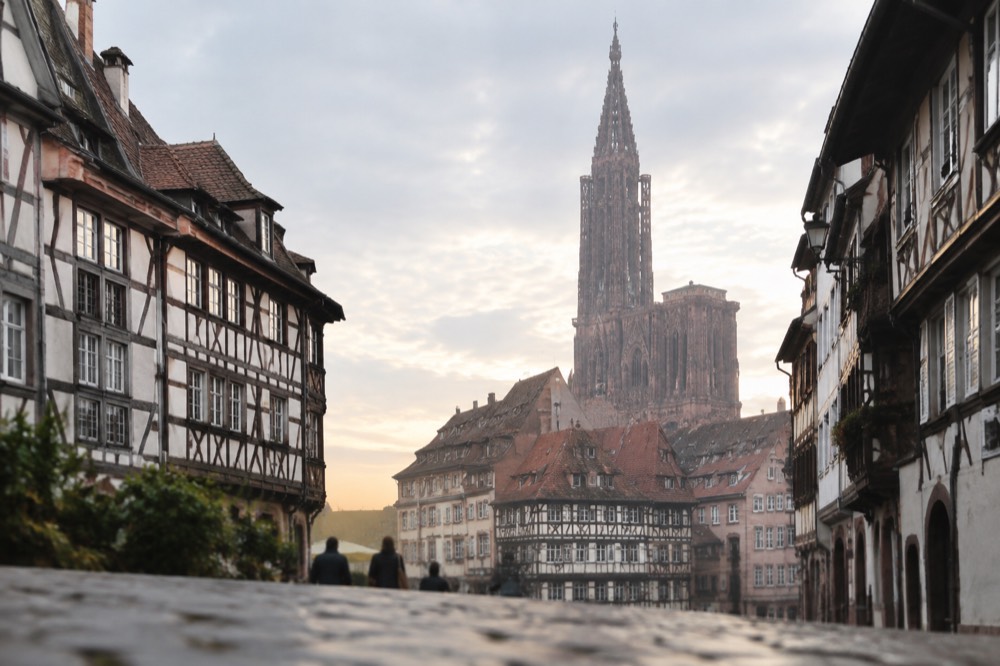
Strasbourg, prefecture of the Bas-Rhin in Alsace, part of the Grand Est region of north-eastern France, is a city of canals, half-timbered houses and one very tall cathedral spire. It is also the natural base for a region whose horizon is dentelled with castles. The Vosges foothills that rise west of the Alsatian plain carry a chain of fortified sites on their sandstone crest, some restored to their medieval appearance, others left as romantic roofless shells above vineyards and forest. None of these castles stands inside Strasbourg itself. Every one of them is a day trip into the countryside, and the choice between them is what this guide is for.
What Are The Alsace Castles?
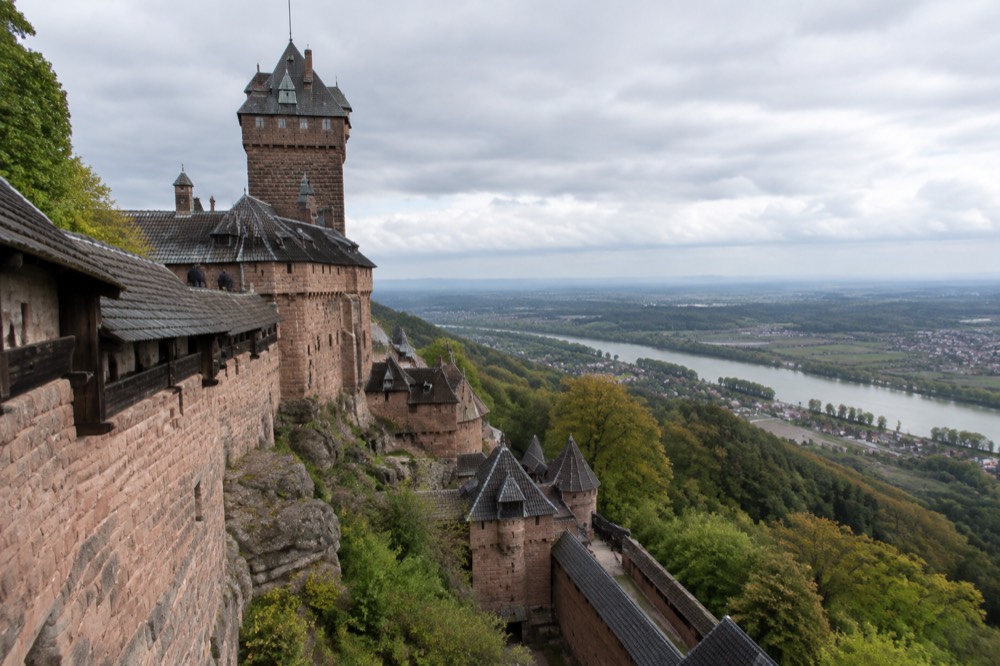
The castles of Alsace are the fortified sites, ruined and restored, that line the sandstone ridges of the Vosges foothills west and south of Strasbourg, in north-eastern France. They range from Haut-Koenigsbourg, a fortress restored and furnished as a medieval monument, to bare keeps and wall fragments such as Fleckenstein, Ortenbourg and Haut-Andlau. None sits inside Strasbourg, and each is visited as a day trip into the Alsatian countryside.
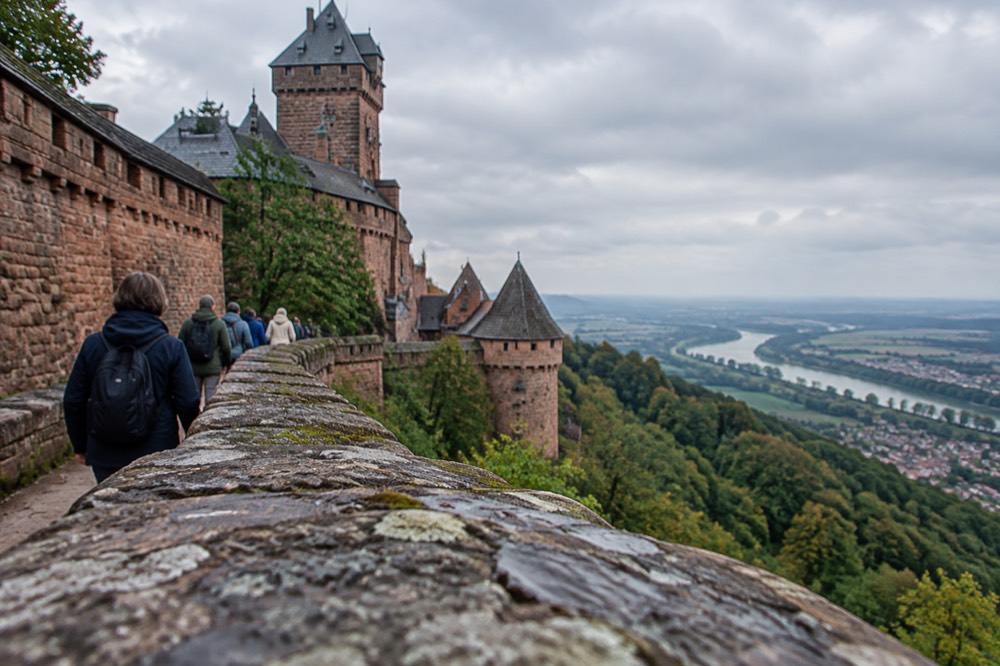
The geography explains the castles. Alsace is a long plain between the Vosges mountains and the Rhine, which forms the border with Germany, and the sandstone shoulders of the Vosges gave medieval lords natural platforms: flat-topped ridges, sheer rock on three sides, and a single approach to fortify. A string of strongholds grew along that crest, watching over the roads between the wine villages below. When their military value faded, the buildings were quarried, burned or simply abandoned, and the forest closed in around them.
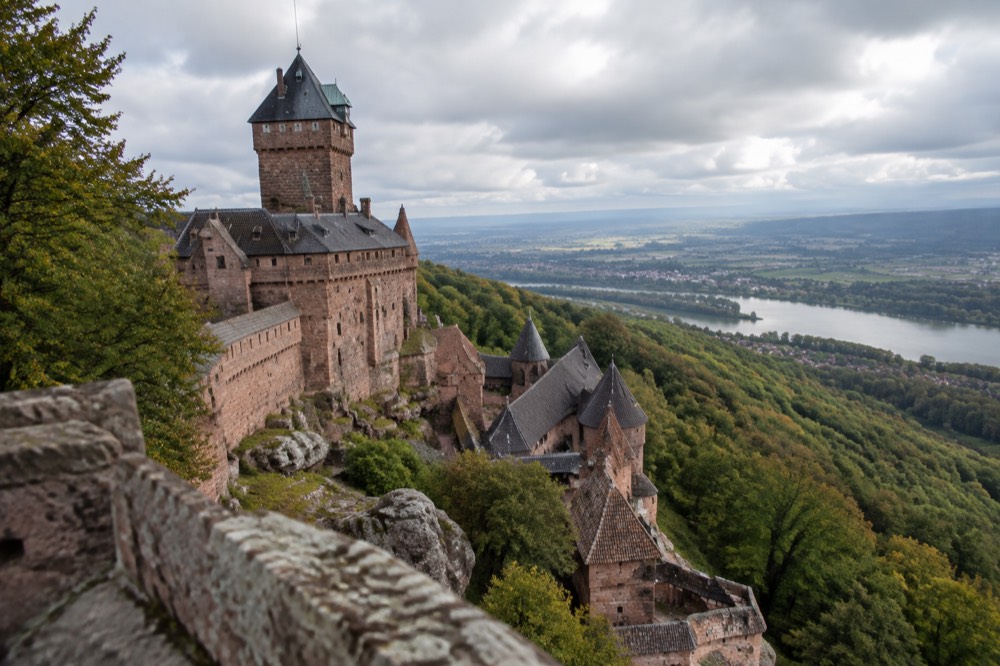
What survives today falls into two groups. Haut-Koenigsbourg is the outlier: a large fortress on a high ridge, fully restored and presented to visitors as a complete monument, with furnished rooms, a cistern, artillery platforms and wall walks. The second group is made up of ruins, and it is the larger one. Fleckenstein, Ortenbourg and Haut-Andlau are the names that come up again and again in Alsatian walking guides: rock-cut staircases, standing fragments of keep, and views across the plain that cost nothing but the climb to enjoy. Kintzheim, in the same hills near the wine village of that name, adds an eagle park and a monkey reserve to the castle landscape, and La Petite Pierre is a small walled village on the crest that makes an easy stop between sites. Mont Sainte-Odile, the convent and pilgrimage site on its own mountain, belongs to the same fortified world of walls and lookout points even though it is a religious monument rather than a military one.
For orientation before you choose, the page on where exactly Strasbourg sits in France sets out the city, the Rhine border with Germany at Kehl, and the road and rail lines that fan out from the city into the region. The rest of this Strasbourg Travel Guide article assumes that picture: a compact city base, and a countryside of ridges, vineyards and castle rocks within a day's reach.
Which Castles Can You Visit From Strasbourg?
From Strasbourg, the realistic castle list is short and clear: Haut-Koenigsbourg for the full restored fortress experience, the ruined keeps of Fleckenstein, Ortenbourg and Haut-Andlau for walkers, Kintzheim for a castle-and-wildlife combination, La Petite Pierre for a gentle walled village, and Mont Sainte-Odile for walls with a religious dimension. All lie in France, in Alsace, and all are reached by car or by a guided day tour rather than by a direct city tram.
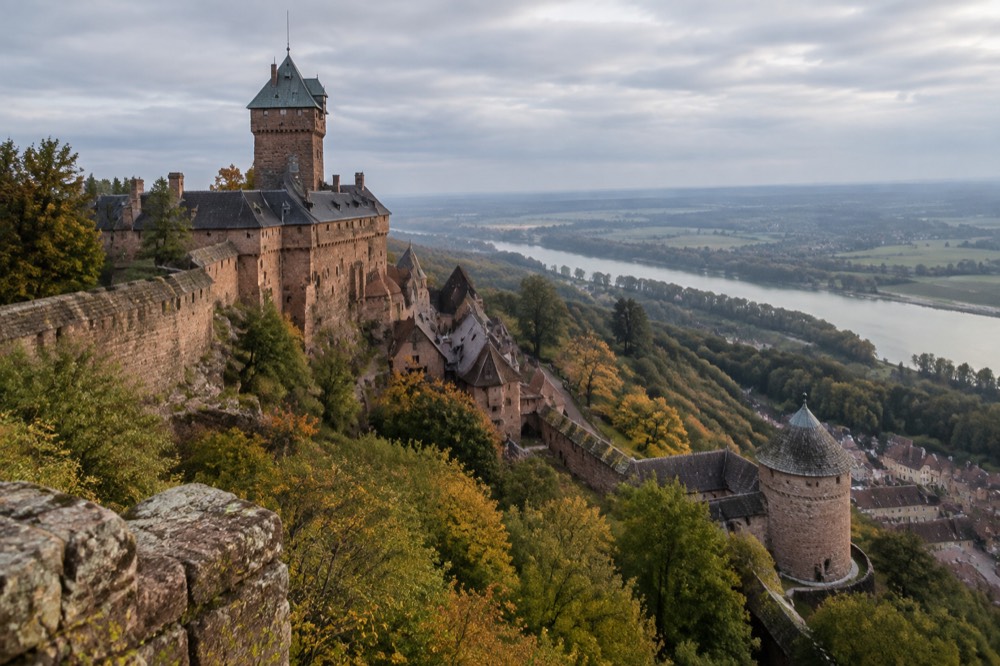
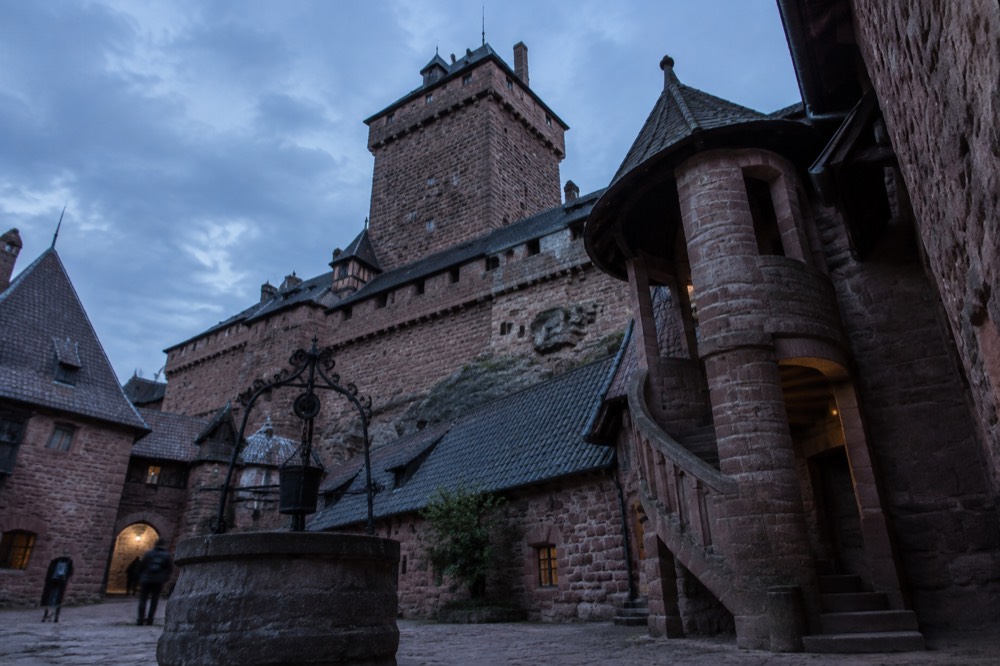
Haut-Koenigsbourg is the castle that gives the region its silhouette on postcards. It is a genuinely large fortress, with interiors arranged as they would have looked in the medieval period, a lower courtyard, a deep well and long artillery terraces facing the plain. Because it is the restored flagship, it is also the one with the fullest visitor infrastructure: a car park, a shop, a restaurant and a ticket operation, and its own official website where opening dates, closing days and admission prices are published. Check that page before you commit to a date, because a fortress of this kind closes for maintenance windows in the low season.
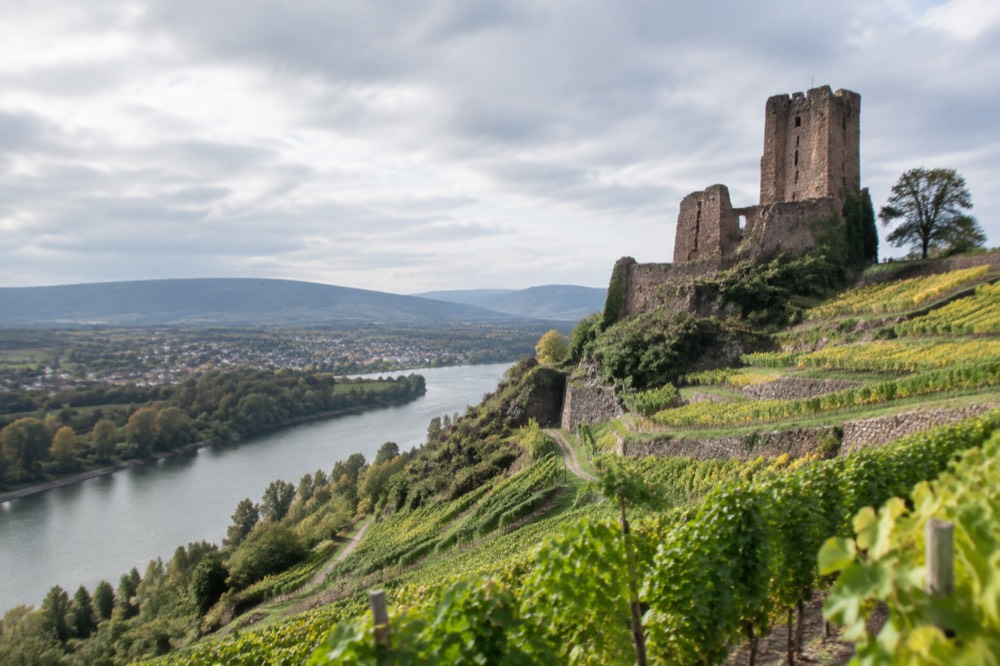
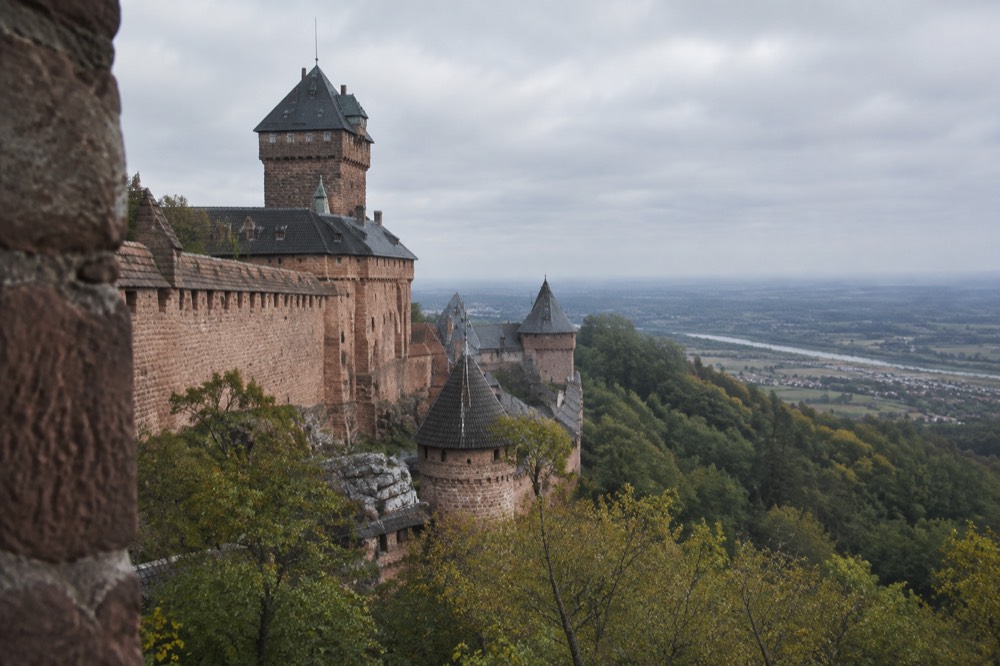
The ruins are a different kind of day out. Fleckenstein, in the north of the region near the Palatinate border, is a long, narrow rock castle with staircases cut directly into the sandstone and a visitor circuit designed around it. Ortenbourg and Haut-Andlau, both south of it on parallel ridges above the wine road, are quieter: wall fragments, a standing keep at Ortenbourg, and forest paths that serve as the access route. There are no ticket desks of any consequence at several of these sites, and no facilities to speak of, which is precisely their charm and also their planning problem. You will want walking shoes, water and a paper or offline map, because the ridge paths are not always obvious.
Kintzheim and La Petite Pierre soften the itinerary for travellers who want history without a scramble. Kintzheim's castle ruin sits above an eagle park where birds of prey are flown, and a monkey reserve nearby lets Barbary macaques roam free around visitors, a combination that works well for families. La Petite Pierre is a tiny fortified village on the crest of the ridge, with sandstone walls and a small castle at its heart, and it makes a calm lunch stop on a tour of the northern sites. Mont Sainte-Odile, finally, is a walled convent mountain with a pagan wall, an ancient stone enclosure running through the forest, and a terrace that looks across the whole plain toward Strasbourg.
| Castle Or Site | Setting | What You Actually See | Who It Suits | What To Check First |
|---|---|---|---|---|
| Haut-Koenigsbourg | High forested ridge, south of the wine road | A complete restored fortress: furnished rooms, wall walks, artillery terraces | First-time visitors, families, anyone wanting the full monument | Opening dates and admission on the castle's official page |
| Fleckenstein | Narrow sandstone crest in the northern Vosges | Rock-cut staircases, long ruined circuits, forest trails | Walkers and children who like climbing | Seasonal opening period and circuit access |
| Ortenbourg | Ridge above the wine villages | A standing keep and wall fragments with wide views | Photographers, quiet-site seekers | Path conditions and access from the parking area |
| Haut-Andlau | Twin rocks above vineyards | Ruined walls and footings on a forest saddle | Walkers pairing two ruins in one day | Trail access and weather |
| Kintzheim | Hill above a wine village | A castle ruin plus an eagle park and a monkey reserve | Families with children | Flight-show times and park opening dates |
| La Petite Pierre | Crest village in the regional park | Walled lanes, a small castle, sandstone houses | Lunch stops, slow travellers | Restaurant days, especially out of season |
| Mont Sainte-Odile | A convent mountain with forest walls | Convent buildings, the pagan wall, a panoramic terrace | Pilgrims, walkers, view seekers | Convent visiting hours and terrace access |
The honest summary of that table is that one fortress, Haut-Koenigsbourg, anchors any first castle day, and the rest are chosen by temperament: ruins for walkers, wildlife for families, a walled village for people who would rather eat well than climb.
How Do You Plan A Castle Day Trip From Strasbourg?
A castle day trip from Strasbourg is planned around three decisions: which fortress or pair of sites to target, whether to drive yourself or take a guided tour, and what the castle's own opening calendar says on the day you want. Book nothing until you have checked the official page of the castle itself for hours, seasonal closures and admission, because the restored sites close for maintenance and the ruins close with the forest paths. Then build the day around one anchor castle and one soft stop.
Start with the anchor. Haut-Koenigsbourg deserves the biggest slice of the day, because the interiors, the terraces and the walk up from the car park together take a full morning or a full afternoon. If your anchor is a ruin such as Fleckenstein or Ortenbourg, halve that time and add a second site, a wine village, or a long lunch. Trying to see three castles in one day is the classic mistake: the roads between the ridges are slow, and the Alsatian lunch hour is not a rumour.
Next, decide on transport. With a car, the ridge castles and the wine villages slot together freely, and you can stop wherever a view opens up. Without one, a guided coach tour is the practical answer, and several full-day Alsace tours from Strasbourg include Haut-Koenigsbourg alongside Colmar, Riquewihr or the wine road, which converts the castle from a logistics problem into a seat on a bus. The trade is simple: a tour costs more per person and removes the spontaneity, a hire car costs less at the margin and puts every closing time on your own shoulders.
If you decide to drive yourself, book a rental car here.
For the base itself, the neighbourhoods of Strasbourg all work, because every castle route leaves the city by the same western roads: the practical guide to where to base yourself in Strasbourg compares the centre, Petite France and the station district for exactly this kind of onward travel. Leave early, before the morning rush fills the western exits, and aim to be at your first castle for its opening rather than for lunch.
One full-day option that bundles the fortress with the wine country is the Colmar, Riquewihr and Haut-Koenigsbourg tour, which moves a whole day of driving onto a coach and leaves you free to look out of the window.
Whatever you choose, keep the evening light for the return: the ridges are at their best in low sun, and the road back into Strasbourg drops you straight into a city that eats late.
Which Castle Suits Which Traveller?
Match the castle to the traveller, not the other way round. Families with children do best at Haut-Koenigsbourg or Kintzheim, where walls, stairs and birds of prey hold attention for hours. Keen walkers should target the ruin pairs. Photographers want Ortenbourg's keep and Mont Sainte-Odile's terrace. Travellers who prefer comfort to climbing should take La Petite Pierre and the wine villages and treat the castles as scenery.
The family case deserves a sentence of honesty. Ruined castles are wonderful for children in theory and occasionally alarming in practice: unfenced drops, loose rock and no barriers are part of the deal at several ridge sites. Haut-Koenigsbourg, restored and managed as a monument, is the safe version of the medieval experience, with railings, a shop and a restaurant, and Kintzheim's eagle park adds a scheduled show to the day, which children rank above any wall. The eagle flights run to a timetable published on the park's own page, so check it the day before.
Walkers have the richest pick. The ridge paths link sites and vineyards in loops that can fill a whole day on foot, and the ruins themselves ask for modest scrambling rather than any technical skill. What they do not offer is shelter: there is no cafe at Ortenbourg and no warm room at Haut-Andlau, so the walking option is really a three-season option, and the quieter corners of Strasbourg itself are the better call on a wet day.
| If You Are Travelling As | Anchor Castle | Why It Works | Pair It With |
|---|---|---|---|
| A family with children | Haut-Koenigsbourg | Railings, facilities, furnished rooms to explore | Kintzheim eagle park and monkey reserve |
| A pair of keen walkers | Fleckenstein | Rock-cut stairs and a real circuit through the ruins | Ortenbourg or Haut-Andlau on the same ridge system |
| A photographer | Ortenbourg | A standing keep against the sky, wide plain views | Sunset from Mont Sainte-Odile's terrace |
| A food and wine traveller | La Petite Pierre | A walled village built around lunch | The wine villages below the ridges |
| A first-time visitor with one day | Haut-Koenigsbourg | The complete fortress, all in one place | A coach tour that adds Colmar or Riquewihr |
| A pilgrim or quiet seeker | Mont Sainte-Odile | A convent mountain with forest walls | The pagan wall circuit through the trees |
There is also a traveller who prefers stories to stones, and for that person the answer is not a castle at all but a guided walk through Strasbourg's own old streets, where the guides carry the history that the ruins only imply. A small-group curiosities walk of the city centre makes a good half-day complement to a castle day in the hills, and the two together give you the region's two faces: the fortress crest and the merchant city beneath it.
When Should You Visit The Alsace Castles?
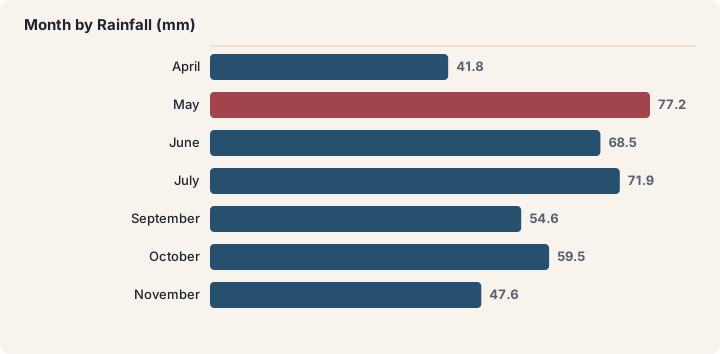
Visit the Alsace castles between late spring and early autumn if walking the ruins matters, because the ridge paths and the castle circuits are exposed and the forest approaches are at their driest then. The climate is semi-continental: Meteo-France 1991-2020 normals for Strasbourg-Entzheim put the mean daily maximum at 26.4 C in July against 5.2 C in January, with 635.7 mm of rain and 112.3 rain days across a typical year.
The numbers behind that answer are worth reading properly, because they shape the whole calendar. The monthly detail below comes from the 1991-2020 normals for the Strasbourg-Entzheim station, and the Vosges foothills a short way west run a touch cooler and wetter than the plain where the station sits. What the table shows is a genuine summer: July and August mean maxima above 26 C, which is climbing weather on exposed sandstone, not strolling weather. Layers and a rain shell belong in the bag whatever the season.
| Month | Mean Daily Maximum (C) | Mean Daily Minimum (C) | Rainfall (mm) | Rain Days Of 1 mm Or More |
|---|---|---|---|---|
| April | 17.0 | 5.7 | 41.8 | 8.6 |
| May | 20.9 | 10.1 | 77.2 | 10.8 |
| June | 24.4 | 13.4 | 68.5 | 10.2 |
| July | 26.4 | 14.9 | 71.9 | 10.4 |
| September | 21.6 | 10.7 | 54.6 | 8.0 |
| October | 15.8 | 7.2 | 59.5 | 9.6 |
| November | 9.4 | 3.3 | 47.6 | 9.2 |
Winter is a different proposition rather than a closed one. The mean December maximum of 5.9 C and a mean minimum of 0.8 C put frost on the ridge paths, and several castle sites shorten their seasons or close outright in the cold months, which is a fact to confirm on each castle's own page rather than a rule to assume. What winter does offer is the pairing that makes Alsace famous in December: castles seen from a warm coach window on the way to the Christmas markets of the wider region, and the city of Strasbourg in its winter season as the evening reward. The full month-by-month picture, including the market season, sits in the guide to the best time to visit Strasbourg, and the detailed climate data is in the Strasbourg weather guide.
What Will A Castle Trip Cost Alongside Strasbourg Sightseeing?
The castle admissions themselves are confirmed on each castle's own page and vary by site, so treat them as a per-trip check rather than a fixed budget. What can be planned in advance are the Strasbourg figures that surround the trip: the cathedral platform at 10 EUR full and 6 EUR reduced, the astronomical clock show at 4 EUR, municipal museums at 9 EUR and 5 EUR, the 1-day Pass Musées at 20 EUR, and the Strasbourg City Card at 5 EUR for seven days of discounts.
The reason for splitting the budget this way is simple. A castle day trip is mostly a transport and lunch expense plus whatever the fortress charges at its gate, and those gate prices move with the season and the site. The city figures below are fixed, published and easy to plan around, and they matter because almost every castle itinerary spends at least half a day in Strasbourg itself, at the cathedral, in a museum or on the river.
| Sight Or Ticket | Full Price | Reduced Price | What To Know |
|---|---|---|---|
| Cathedral platform, at 66 m | 10 EUR | 6 EUR, children under 6 free | Two seasonal timetables; a stair climb with no lift, and no luggage lockers |
| Astronomical clock show, daily at 12:30 | 4 EUR | 3 EUR groups and students, 2 EUR ages 6-17 | Day-of tickets only, sold at the cathedral stalls or the Saint-Michel entrance |
| Municipal museums, each | 9 EUR | 5 EUR | Free on the first Sunday of every month; the Musée Alsacien is closed until 2028 |
| Pass Musées, 1 day | 20 EUR | - | Covers the municipal museums in one day of museum-hopping |
| Strasbourg City Card | 5 EUR | 3.50 EUR ages 3-17 | A seven-day discount card, not an all-inclusive pass |
| Batorama river tour, long circuit | 16.20 EUR | 8.90 EUR | The long circuit runs 1h10 from the river bank near the cathedral |
| Batorama river tour, short circuit | 12.50 EUR | 7.20 EUR | The short circuit runs 0h45 |
Two of those lines deserve a second look. The City Card is a discount card, 5 EUR for seven days, that knocks fixed amounts off the museums, the boat tour, the cathedral platform and the clock, so it pays for itself only once you have stacked enough of those visits; the arithmetic is laid out in the guide to the Strasbourg City Card. The first-Sunday museum rule, meanwhile, is the single easiest saving in the city, and the wider list of free things to do in Strasbourg includes the public squares and riverside walks that cost nothing at all. For the full frugal itinerary, the Strasbourg on a budget guide does the sums.
For the castles themselves, the discipline is the same one this guide keeps repeating: the official page of each site, checked close to your travel date, is the only honest source for admission, hours and seasonal closures. Print or screenshot what you find, because the ridge is a place where phone signal comes and goes.
How Do You Reach The Castles Without A Car?
Without a car, the practical routes to the Alsace castles are guided coach tours from Strasbourg, which serve Haut-Koenigsbourg and the wine villages directly, or self-drive alternatives arranged from the city. Within Strasbourg itself the tram and bus network is cheap and simple: a single CTS ticket is 1.90 EUR bought through the app or contactless, or 2.50 EUR on board a bus, a 24h Solo pass is 4.60 EUR, and a 24h Trio for two to three people is 10.20 EUR.
The distinction matters because the trams end at the edge of the city. Strasbourg's network is excellent for the Grande Île, Petite France, the station and the European Quarter, and useless for a sandstone ridge in the Vosges. So the car-free castle plan has two halves: use the CTS network to live in the city cheaply, and use a tour, a hire car or a carefully checked regional connection for the day itself. The fares below are the verified city prices that cover the first half.
| CTS Ticket | Price | What It Covers |
|---|---|---|
| Single, app, Badgéo or contactless | 1.90 EUR | One journey on the tram and bus network |
| Single, bought on board a bus | 2.50 EUR | The same journey, at a premium for buying on board |
| 24h Solo | 4.60 EUR | A full day of trams and buses for one traveller |
| 24h Trio | 10.20 EUR | A full day for two to three travellers together |
| Airport combined ticket | 4.60 EUR | The shuttle train plus a 24h city ticket, valid to Entzheim airport and back |
That airport line is worth knowing even for castle planning, because it shows how the region's rail links work: the shuttle train between Strasbourg station and Entzheim airport runs up to five trains an hour and takes 8 minutes, and the combined ticket folds the city network into the fare. Regional trains fan out from the same station toward the wine towns and the Vosges valleys, and the connection from any given station to any given castle is a matter for the official journey planner on the day, not for a guidebook guess.
For the castle day itself, the tour option is the one that removes the most friction. A full-day medieval villages and wine tasting tour from Strasbourg threads the ridge country and the wine villages in one loop, with the driving handled and the stops chosen for you.
Hire cars, for travellers who want them, are collected in the city and at the airport, and the driving itself is straightforward: the plain roads are fast and the ridge roads are slow, and the whole skill is leaving enough time between sites. Whatever you choose, book the castle day for the middle of your stay rather than the first morning, so a delayed arrival does not eat it.
Can You Visit The Alsace Castles On A Guided Tour?
Yes, and for many travellers a guided tour is the better version of the castle day. Full-day Alsace tours from Strasbourg pair Haut-Koenigsbourg with Colmar, Riquewihr or the wine villages and put the driving, the timing and the parking in someone else's hands. Shorter options include half-day wine tours into the foothills and city walking tours in Strasbourg itself, which cover the region's history without leaving town.
The full-day tours are the natural fit for the castle brief. They leave from Strasbourg, run a loop through the wine country and the ridge, and typically stop at a fortress, two villages and a tasting room before returning in the evening. The advantage over self-drive is not just the driving: the guides explain what you are looking at, and a restored fortress and a bare keep both make a great deal more sense with someone narrating the walls. The disadvantage is the fixed shape of the day, and the fact that a coach cannot linger on a ridge path the way a walker can.
The shorter formats suit different itineraries. A half-day wine tour into the Alsace vineyards gives an afternoon among the slopes below the castles, with the fortresses as scenery rather than destinations, and it slots into a two-night stay where a full day in the hills would not.
And for the evening, or for a rest day between expeditions, the city walks are the third format. A small-group walking tour of Strasbourg's history and curiosities, booked through the operator's live listing, takes in the streets and stories of the old town, and it is the version of the region's past that comes with a roof and a cafe nearby.
One honest note on choosing between them: the tour that includes Haut-Koenigsbourg is the one that answers the question this page is titled with, and the tours that stay in the wine country answer a different question, about villages and tastings. Both are good days. Only one of them is a castle day.
What Should You Know Before Setting Out?
Before a castle day in Alsace, check each site's official page for hours, admission and seasonal closures, wear shoes with grip for rock and forest paths, and carry water because several ruins have no facilities at all. In Strasbourg itself, note that the Musée Alsacien is closed for works until 2028 and that the cathedral platform's two seasonal timetables change the shape of a warm-weather day. Plan one anchor castle, one soft stop and one long lunch.
The checklist below is the short version of everything this guide has argued. The one item people skip is the first one, and it is the one that ruins days: castle opening calendars in Alsace are genuinely seasonal, and a fortress that is open all summer can be shut on a random Tuesday in October. The official page of each site, read the day before, is the only reliable answer.
| Before You Go | Why It Matters | Where To Confirm It |
|---|---|---|
| Opening dates and hours of your anchor castle | Restored sites close for maintenance and low-season windows | The castle's own official page |
| Admission prices at the gate | They vary by site and are not published centrally | The castle's own official page |
| Weather for the ridge | Exposed paths, no shelter at the ruins | The forecast for the Vosges foothills, not the city |
| Footwear and water | Rock-cut stairs, forest approaches, no shops at several ruins | Your own bag |
| Lunch reservation in season | Village restaurants fill on castle traffic in summer | The restaurant or the village tourism page |
| Museum plans in Strasbourg | The Musée Alsacien is closed until 2028; others open, free on first Sundays | The Strasbourg museums' official pages |
A final word on pace. Alsace rewards slow days: one fortress walked properly, one village eaten in properly, and an evening back in Strasbourg beats a three-castle sprint every time. The region has been building its views for a very long time, and they hold still for anyone who stops to look.
Common Questions About The Alsace Castles
Can You Visit A Real Castle From Strasbourg In One Day?
Yes. Haut-Koenigsbourg, the region's restored fortress, is the standard day trip from Strasbourg, and full-day guided tours reach it alongside Colmar, Riquewihr or the wine villages. Self-drive travellers can reach the ridge castles and return the same evening. Check the castle's official page for opening dates before you book anything.
Which Is The Main Castle To See In Alsace?
Haut-Koenigsbourg is the region's flagship monument: a large, restored fortress with furnished rooms, wall walks and artillery terraces, run with a car park, shop and restaurant. The ruined keeps of Fleckenstein, Ortenbourg and Haut-Andlau are quieter alternatives for walkers. None of them stands inside Strasbourg itself.
Are The Alsace Castle Ruins Suitable For Children?
The managed sites are. Haut-Koenigsbourg has railings, facilities and rooms to explore, and Kintzheim pairs a castle ruin with an eagle park and a monkey reserve. The unmanaged ridge ruins involve unfenced drops and loose rock, so they suit older, careful children and steady shoes rather than toddlers.
Do You Need A Car To Visit The Alsace Castles?
No, but a car or a guided tour is needed for the day itself, because Strasbourg's trams serve the city and not the Vosges ridges. Full-day coach tours from Strasbourg include Haut-Koenigsbourg and the wine villages. Within the city, a CTS 24h Solo pass at 4.60 EUR covers a day of trams and buses.
When Is The Castle Season In Alsace?
The warm half of the year, late spring to early autumn, is the walking season for the ruins, with July mean maxima of 26.4 C on the Strasbourg plain. Several castle sites shorten their seasons or close in the cold months, and December, with a mean maximum of 5.9 C and 10.2 rain days, is better spent on a coach tour paired with the Christmas markets.
How Do The Castles Pair With The Strasbourg Christmas Market?
Easily, if you take a tour rather than a self-drive day. The market in Strasbourg opens in the last week of November and runs to 24 December, with the 2025 edition running 26 November to 24 December, and full-day tours return to the city in time for the evening stalls. Confirm the current dates on the city's Christmas site before you plan around them.
The castles of Alsace are the region's answer to the question of what lies beyond Strasbourg's canal-lined centre: ridges, ruins and one great restored fortress, all within a day's reach of the cathedral. Pick the anchor that matches your pace, check the official pages, and let the rest of the itinerary follow the contour lines.